Recognition: unknown
Probing Kalb-Ramond gravity with charged rotating black holes: constraints from EHT observations
Pith reviewed 2026-05-10 13:11 UTC · model grok-4.3
The pith
EHT shadow observations bound the Lorentz-violating parameter in Kalb-Ramond charged rotating black holes to ℓ ≲ 0.19 from Sgr A* data.
A machine-rendered reading of the paper's core claim, the machinery that carries it, and where it could break.
Core claim
In Kalb-Ramond gravity the spacetime of charged rotating black holes is described by a Kerr-Newman-like metric whose mass function depends on the radial coordinate and incorporates both the Lorentz-violating parameter ℓ and the charge Q. The shadow radius is thereby suppressed by the factor sqrt(1-ℓ), and the inclusion of charge produces additional distortions. When the predicted angular shadow diameter is required to lie inside the EHT intervals (35.1, 40.5) μas for M87* and (41.7, 55.7) μas for Sgr A*, the allowed values of ℓ are restricted to narrow intervals that depend on spin and on the fixed charge Q=0.2; the strongest single bound obtained is the upper limit ℓ ≲ 0.19 from the Sgr A*
What carries the argument
The radial-dependent mass function that modifies the Kerr-Newman line element by the Lorentz-violating parameter ℓ and charge Q, from which the photon-sphere radius and shadow diameter are computed.
If this is right
- The Lorentz-violating parameter suppresses the shadow radius by the factor sqrt(1-ℓ).
- For M87* at inclination 17° and Q=0.2 the EHT data restrict ℓ to roughly -0.019 to 0.075 or -0.076 to 0.029 across the allowed spin range.
- For Sgr A* at inclination 50° and Q=0.2 the data permit ℓ in the intervals -0.075 to 0.110 or -0.124 to 0.076.
- Charge Q introduces additional shape distortions beyond those caused by ℓ alone.
- The tightest single constraint obtained is the upper bound ℓ ≲ 0.19 from Sgr A* with the stellar-dynamics mass prior.
Where Pith is reading between the lines
- If these bounds remain stable under improved data, any Lorentz violation of this form must be small even in the strong-field regime.
- The same shadow-diameter method can be applied to other modified-gravity models that introduce a comparable radial mass correction.
- Higher-resolution EHT images could shrink the allowed intervals on ℓ and Q by a measurable factor.
- The analysis assumes the observed diameter is set solely by the spacetime geometry; any undetected plasma or emission effects would loosen the derived limits.
Load-bearing premise
The calculated shadow diameter for a given inclination accurately represents the EHT observable without unaccounted astrophysical or instrumental systematics.
What would settle it
A future EHT measurement of the Sgr A* shadow diameter that lies outside the interval allowed by ℓ ≲ 0.19 (using the stellar-dynamics mass prior) would falsify the reported upper bound.
Figures



read the original abstract
The Event Horizon Telescope (EHT) has guided strong-field gravitational physics by providing the first direct images of the supermassive black holes M87* and Sagittarius A*. The EHT observations offer unprecedented opportunities to test modified gravity theories against general relativity (GR). Motivated by this, we investigate charged rotating black holes in KR gravity, a framework motivated by string theory that incorporates spontaneous Lorentz symmetry breaking. The spacetime geometry is characterized by a Lorentz--violating parameter $\ell$ and electric charge $Q$, which modify the Kerr--Newman metric through a radial-dependent mass function. We compute black hole shadows and derive constraints on $\ell$ and $Q$ using EHT observations of M87* and Sgr A*. For angular shadow diameter $\theta_{\rm sh}$ of M87* at inclination $\theta_o=17^\circ$ and fixed $Q=0.2$, the EHT-allowed range $\theta_{\rm sh}\in(35.1,\,40.5)\,\mu\mathrm{as}$ constrains the Lorentz--violating parameter to approximately $-0.019\lesssim\ell\lesssim0.075$ and $-0.076\lesssim\ell\lesssim0.029$ across the admissible spin interval. For angular shadow diameter $\theta_{\rm sh}$ of Sgr A* at inclination $\theta_o=50^\circ$ and fixed $Q=0.2$, the corresponding EHT-allowed range $\theta_{\rm sh}\in(41.7,\,55.7)\,\mu\mathrm{as}$ permits approximately $-0.075\lesssim\ell\lesssim0.110$ and $-0.124\lesssim\ell\lesssim0.076$ across the admissible spin interval. Our analysis reveals that the Lorentz-violating parameter suppresses the shadow radius by a factor $\sqrt{1-\ell}$, while charge introduces additional distortions. Using the angular shadow diameter measured by EHT, we obtain an upper bound $\ell \lesssim 0.19$ from Sgr A* data with the stellar dynamics mass prior.
Editorial analysis
A structured set of objections, weighed in public.
Referee Report
Summary. The paper examines charged rotating black holes in Kalb-Ramond gravity, where the Kerr-Newman metric is modified by a radial-dependent mass function incorporating a Lorentz-violating parameter ℓ and charge Q. It computes the resulting black hole shadows and uses EHT angular shadow diameter measurements for M87* (θ_sh ∈ (35.1, 40.5) μas at θ_o=17°) and Sgr A* (θ_sh ∈ (41.7, 55.7) μas at θ_o=50°) to derive bounds on ℓ, with Q fixed at 0.2 in most cases. The analysis reports that ℓ suppresses the shadow radius by a factor √(1-ℓ) and obtains an upper bound ℓ ≲ 0.19 for Sgr A* using the stellar dynamics mass prior, along with spin-dependent ranges such as -0.019 ≲ ℓ ≲ 0.075 for M87*.
Significance. If the shadow calculations and mass mapping are robust, the work supplies concrete observational constraints on Lorentz violation in the strong-field regime around supermassive black holes, complementing other tests of modified gravity. The explicit link between the parameter ℓ and the observable shadow diameter, together with the use of two independent EHT sources, adds falsifiable content to the literature on string-inspired gravity.
major comments (2)
- [Abstract / Sgr A* analysis] Abstract and the Sgr A* constraint section: the upper bound ℓ ≲ 0.19 is stated to use the stellar dynamics mass prior directly. Because the spacetime is defined via a radial-dependent mass function M(r) that incorporates ℓ, the asymptotic mass lim r→∞ M(r) may differ from the input parameter M by a factor depending on ℓ. Without an explicit rescaling step that maps the prior mass to the correct asymptotic value before computing the shadow diameter, the reported bound on ℓ rests on an inconsistent identification of the mass scale.
- [Shadow and constraint sections] Shadow computation and constraint sections: the admissible spin intervals and error propagation for the quoted ℓ ranges (e.g., -0.019≲ℓ≲0.075 and -0.076≲ℓ≲0.029 for M87*) are not accompanied by a clear statement of how the inclination θ_o, the fixed Q=0.2 choice, and the EHT uncertainty bands are propagated through the geodesic integration. This makes it impossible to assess whether the reported intervals remain stable under modest variations of the fixed parameters.
minor comments (2)
- [Abstract / parameter choice] The abstract and main text repeatedly fix Q=0.2 without a dedicated justification or sensitivity plot showing how the ℓ bounds change for other admissible Q values.
- [Metric definition] Notation for the radial mass function M(r) and its explicit form in terms of ℓ should be introduced earlier and used consistently when discussing the asymptotic limit.
Simulated Author's Rebuttal
We thank the referee for the careful and constructive review of our manuscript. We address each major comment in detail below and have made revisions to improve clarity and rigor where appropriate.
read point-by-point responses
-
Referee: [Abstract / Sgr A* analysis] Abstract and the Sgr A* constraint section: the upper bound ℓ ≲ 0.19 is stated to use the stellar dynamics mass prior directly. Because the spacetime is defined via a radial-dependent mass function M(r) that incorporates ℓ, the asymptotic mass lim r→∞ M(r) may differ from the input parameter M by a factor depending on ℓ. Without an explicit rescaling step that maps the prior mass to the correct asymptotic value before computing the shadow diameter, the reported bound on ℓ rests on an inconsistent identification of the mass scale.
Authors: We appreciate the referee drawing attention to the mass-scale consistency. In our formulation the radial mass function is constructed so that lim r→∞ M(r) = M exactly, with ℓ modifying only the near-horizon region while leaving the ADM mass unchanged; the stellar-dynamics prior is therefore applied directly to this asymptotic M. To eliminate any ambiguity we have added an explicit paragraph in Section 2 deriving the asymptotic limit and confirming that no rescaling is required. We have also inserted a short statement in the Sgr A* analysis reiterating this identification, which leaves the quoted bound ℓ ≲ 0.19 unaltered. revision: yes
-
Referee: [Shadow and constraint sections] Shadow computation and constraint sections: the admissible spin intervals and error propagation for the quoted ℓ ranges (e.g., -0.019≲ℓ≲0.075 and -0.076≲ℓ≲0.029 for M87*) are not accompanied by a clear statement of how the inclination θ_o, the fixed Q=0.2 choice, and the EHT uncertainty bands are propagated through the geodesic integration. This makes it impossible to assess whether the reported intervals remain stable under modest variations of the fixed parameters.
Authors: We acknowledge that the numerical procedure and sensitivity analysis were not described in sufficient detail. The quoted ranges were obtained by integrating the null geodesic equations for the shadow silhouette (Section 3) over the spin interval allowed by the EHT data, with θ_o and Q held fixed at the stated values and ℓ varied until the computed angular diameter lies inside the EHT band. In the revised manuscript we have added a dedicated subsection (3.3) that (i) specifies the geodesic integrator settings and step-size convergence tests, (ii) describes the direct mapping of the EHT uncertainty intervals onto the allowed ℓ values for each spin, and (iii) reports a brief sensitivity study showing that the ℓ bounds shift by ≲ 8 % when Q is varied by ±0.05 or θ_o by ±5°. These additions make the propagation of uncertainties fully transparent. revision: yes
Circularity Check
No circularity: forward modeling of shadows matched to independent EHT data
full rationale
The derivation computes the shadow diameter from the modified metric (radial mass function incorporating ℓ and Q) via geodesic analysis, then compares the resulting θ_sh(ℓ, Q, a, M) to the external EHT-measured angular diameter ranges for M87* and Sgr A*. The stellar dynamics mass prior enters as an independent external input to fix the scale; no equation defines ℓ from the shadow data, no fitted parameter is relabeled as a prediction, and no self-citation chain supplies the central result. The mapping is a standard parameter constraint from observation, self-contained against external benchmarks.
Axiom & Free-Parameter Ledger
free parameters (2)
- ℓ
- Q
axioms (2)
- domain assumption Kalb-Ramond gravity incorporates spontaneous Lorentz symmetry breaking characterized by the parameter ℓ.
- standard math The black hole shadow boundary is determined by unstable photon orbits computed via null geodesics in the modified spacetime.
Reference graph
Works this paper leans on
-
[1]
Probing Kalb-Ramond gravity with charged rotating black holes: constraints from EHT observations
019 ≲ ℓ ≲ 0. 075 and − 0. 076 ≲ ℓ ≲ 0. 029 across the admissible spin interval. For angular shadow diameter θsh of Sgr A* at inclination θo = 50 ◦ and fixed Q = 0 . 2, the corresponding EHT-allowed range θsh ∈ (41. 7, 55. 7) µ as permits approximately − 0. 075 ≲ ℓ ≲ 0. 110 and − 0. 124 ≲ ℓ ≲ 0. 076 across the admissible spin interval. Our analysis reveals ...
work page internal anchor Pith review Pith/arXiv arXiv 2026
-
[2]
with respect to the metric gµν . This yields the field equations Rµν − 1 2 gµν R = T M µν + T KR µν , (6) where T M µν denotes the energy–momentum tensor asso- ciated with the electromagnetic field, while T KR µν ac- counts for the contributions arising from the KR field and its nonminimal couplings to gravity [ 14]. The energy– momentum tensor of the electr...
-
[3]
and takes the ex- plicit form T M µν = 2 Fµα Fν α − 1 2 gµν Fαβ F αβ +η ( 8Bαβ Bνγ Fαβ Fγµ − gµν Bαβ Bγδ Fαβ Fγδ ) . (7) The terms proportional to η encode the interaction be- tween the electromagnetic field and the KR background, effectively modifying the dynamics of the gauge field in the presence of the vacuum KR configuration [ 101]. The effective energy–m...
-
[4]
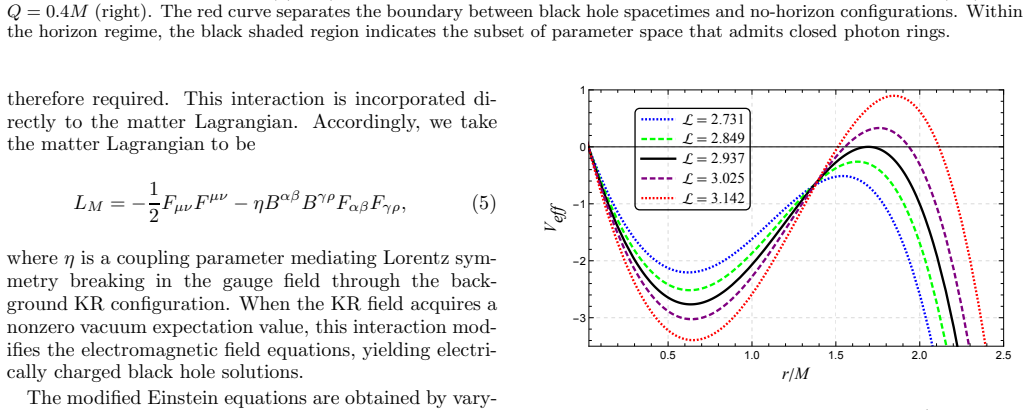
1, and Q = 0 . 2M . The curves correspond to L = 0 . 93 Lc,
-
[5]
03 Lc, and 1
97 Lc, Lc, 1 . 03 Lc, and 1 . 07 Lc, where Lc = 2 . 937 denotes the critical angular momentum. the KR field is given by T KR µν = 1 2 Hµαβ Hν αβ − 1 12 gµν Hαβγ H αβγ + 2V ′Bµα Bν α − gµν V + ξ2 [ 1 2 gµν Bαβ Bγδ Rαγ − Bα µ Bβ ν Rαβ − Bαβ Bµ γ Rαγνβ ] − ξ3 [ Bµα Bν α R + 1 2 gµν Bαβ Bαβ R −∇ α ∇ µ (Bαβ Bνβ ) − ∇ α ∇ ν (Bαβ Bµβ ) ] , (8) The prime denotes d...
-
[6]
The cross-sectional view illustrates the separation between the event horizon and the photon region. As the spin increases, frame-dragging effects shift the prograde cir- cular photon orbit inward and the retrograde orbit out- ward, producing an asymmetric thickening of the photon shell while remaining entirely outside the event horizon [ 109, 111]. A cros...
-
[7]
1001 − 0
2 M87* 0. 1001 − 0. 019 ≲ ℓ ≲ 0. 075
-
[8]
076 ≲ ℓ ≲ 0
9583 − 0. 076 ≲ ℓ ≲ 0. 029 Sgr A* 0. 1001 − 0. 075 ≲ ℓ ≲ 0. 110
-
[9]
124 ≲ ℓ ≲ 0
923 − 0. 124 ≲ ℓ ≲ 0. 076
-
[10]
1001 − 0
4 M87* 0. 1001 − 0. 031 ≲ ℓ ≲ 0. 053
-
[11]
073 ≲ ℓ ≲ 0
9013 − 0. 073 ≲ ℓ ≲ 0. 017 Sgr A* 0. 1001 − 0. 090 ≲ ℓ ≲ 0. 095
-
[12]
110 ≲ ℓ ≲ 0
861 − 0. 110 ≲ ℓ ≲ 0. 065 surements of M87* and Sagittarius A* [ 23, 24, 124]. For M87*, the observed emission ring has an angu- lar diameter of approximately 42 ± 3 µ as, correspond- ing to a shadow diameter of θsh = 37 . 8 ± 2. 7 µ as. For Sagittarius A*, the observed emission ring diameter is
-
[13]
3 µ as, with a corresponding shadow diameter of θsh = 48
8 ± 2. 3 µ as, with a corresponding shadow diameter of θsh = 48 . 7 ± 7 µ as. These bounds correspond to the 1 σ (68% confidence) intervals reported by the EHT collab- oration. From the numerically determined shadow contour in celestial coordinates ( X, Y ), the shadow area A is com- puted using Green’s theorem, and the corresponding an- gular diameter is ...
-
[14]
Figure 11 shows the angular diameter as a function of ( a/M, ℓ )
8 Mpc with inclination θ0 = 17 ◦ . Figure 11 shows the angular diameter as a function of ( a/M, ℓ ). The con- tour lines at θsh = 35 . 1 µ as and θsh = 40 . 5 µ as represent the adopted 1 σ bounds. The region between these con- tours is compatible with the EHT observations, while the white region corresponds to parameter values for which no horizon exists...
-
[15]
The angular di- ameter contours are shown in Fig
15 kpc, and inclination θ0 = 50 ◦. The angular di- ameter contours are shown in Fig
-
[16]
7 µ as and θsh = 55
The levels at θsh = 41 . 7 µ as and θsh = 55 . 7 µ as represent the obser- vational bounds. The allowed parameter region lies be- tween these contours. As in the M87* case, increasing ℓ leads to a reduction in the shadow size for fixed spin, shifting the allowed region accordingly. A fully consistent comparison with non-Kerr geome- tries would require cons...
-
[17]
1001 − 0
2 0. 1001 − 0. 0127 ≲ ℓ ≲ 0. 1125
-
[18]
043 ≲ ℓ ≲ 0
9209 − 0. 043 ≲ ℓ ≲ 0. 073
-
[19]
1001 − 0
4 0. 1001 − 0. 0234 ≲ ℓ ≲ 0. 0957
-
[20]
052 ≲ ℓ ≲ 0
8581 − 0. 052 ≲ ℓ ≲ 0. 0625 Keck
-
[21]
1001 − 0
2 0. 1001 − 0. 0373 ≲ ℓ ≲ 0. 0916
-
[22]
0711 ≲ ℓ ≲ 0
9371 − 0. 0711 ≲ ℓ ≲ 0. 0535
-
[23]
1001 − 0
4 0. 1001 − 0. 049 ≲ ℓ ≲ 0. 0755
-
[24]
0813 ≲ ℓ ≲ 0
8762 − 0. 0813 ≲ ℓ ≲ 0. 0381 TABLE VI: EHT bounds on ℓ from the Schwarzschild devia- tion parameter δ for M87* in the KR black hole model. The allowed intervals correspond to δ = − 0. 01+0. 17 − 0. 17, as shown in Fig. 14 Q/M a/M ℓ bound
-
[25]
1001 − 0
2 0. 1001 − 0. 1077 ≲ ℓ ≲ 0. 1172
-
[26]
1545 ≲ ℓ ≲ 0
9240 − 0. 1545 ≲ ℓ ≲ 0. 0806
-
[27]
1001 − 0
4 0. 1001 − 0. 1225 ≲ ℓ ≲ 0. 0991
-
[28]
1583 ≲ ℓ ≲ 0
8582 − 0. 1583 ≲ ℓ ≲ 0. 0651 age libraries for the KR solution. However, existing stud- ies indicate that current observational resolution does not significantly distinguish between Kerr and moderately deformed non-Kerr shadows. Differences in angular di- ameter are typically smaller than current measurement uncertainties, allowing the EHT bounds to be appl...
-
[29]
11 and 12
4 shown in Figs. 11 and 12. A few things stand out. First, the bounds are not extremely tight— ℓ is typically constrained to within about ± 0. 1 or so—but they are real, coming directly from the observed shadow sizes. Second, the constraints vary noticeably with both spin and charge. For M87* at the lower spin, ℓ lies between − 0. 019 and 0 . 075 when Q/M...
-
[30]
At low spin we get − 0
4: the window shrinks slightly, but not by much. At low spin we get − 0. 1225 ≲ ℓ ≲ 0. 0991, and at high spin it is − 0. 1583 ≲ ℓ ≲ 0. 0651. What stands out here is how loose these bounds are compared to the angular diame- ter constraints we saw earlier. The reason is simple: the δ measurement for M87* is not very precise yet. With error bars that big, th...
2021
-
[31]
First M87 Event Horizon Telescope Results. VI. The Shadow and Mass of the Central Black Hole
K. Akiyama et al. (Event Horizon Tele- scope), Astrophys. J. Lett. 875, L6 (2019) , arXiv:1906.11243 [astro-ph.GA]
work page Pith review arXiv 2019
-
[32]
First M87 Event Horizon Telescope Results. V. Physical Origin of the Asymmetric Ring
K. Akiyama et al. (Event Horizon Tele- scope), Astrophys. J. Lett. 875, L5 (2019) , arXiv:1906.11242 [astro-ph.GA]
work page Pith review arXiv 2019
-
[33]
K. Akiyama et al. (Event Horizon Tele- scope), Astrophys. J. Lett. 930, L12 (2022) , arXiv:2311.08680 [astro-ph.HE]
work page internal anchor Pith review arXiv 2022
-
[34]
K. Akiyama et al. (Event Horizon Tele- scope), Astrophys. J. Lett. 930, L15 (2022) , arXiv:2311.08697 [astro-ph.HE]
-
[35]
Modified Gravity and Cosmology
T. Clifton, P. G. Ferreira, A. Padilla, and C. Skordis, Phys. Rept. 513, 1 (2012) , arXiv:1106.2476 [astro-ph.CO]
work page internal anchor Pith review arXiv 2012
-
[36]
C. M. Will, Living Rev. Rel. 17, 4 (2014) , arXiv:1403.7377 [gr-qc]
work page internal anchor Pith review arXiv 2014
- [37]
-
[38]
Relativ.8 5 [arXiv:gr-qc/0502097]
D. Mattingly, Living Rev. Rel. 8, 5 (2005) , arXiv:gr-qc/0502097
-
[39]
P. Horava, Phys. Rev. D 79, 084008 (2009) , arXiv:0901.3775 [hep-th]
-
[40]
Kalb and P
M. Kalb and P. Ramond, Phys. Rev. D 9, 2273 (1974)
1974
-
[41]
Scherk and J
J. Scherk and J. H. Schwarz, Nucl. Phys. B 81, 118 (1974)
1974
- [42]
-
[43]
B. Altschul, Q. G. Bailey, and V. A. Kostelecky, Phys. Rev. D 81, 065028 (2010) , arXiv:0912.4852 [gr-qc]
-
[44]
Z.-Q. Duan, J.-Y. Zhao, and K. Yang, Eur. Phys. J. C 84, 798 (2024) , arXiv:2310.13555 [gr-qc]
-
[45]
Gravitational deflection of light and shadow cast by rotating Kalb-Ramond black holes,
R. Kumar, S. G. Ghosh, and A. Wang, Phys. Rev. D 101, 104001 (2020) , arXiv:2001.00460 [gr-qc]
- [46]
-
[47]
Jumaniyozov, J
S. Jumaniyozov, J. Rayimbaev, Y. Turaev, I. Ibragi- mov, B. Abdulazizov, M. Akhmedov, and S. Djumanov, Eur. Phys. J. C 85, 1201 (2025)
2025
- [48]
-
[49]
S. Kanzi and I. Sakallı, Nucl. Phys. B 946, 114703 (2019) , arXiv:1905.00477 [hep-th]
- [50]
- [51]
-
[52]
R. Kumar and S. G. Ghosh, Class. Quant. Grav. 38, 8 (2021) , arXiv:2004.07501 [gr-qc]
-
[53]
First M87 Event Horizon Telescope Results. I. The Shadow of the Supermassive Black Hole
K. Akiyama et al. (Event Horizon Tele- scope), Astrophys. J. Lett. 875, L1 (2019) , arXiv:1906.11238 [astro-ph.GA]
work page internal anchor Pith review arXiv 2019
-
[54]
Akiyama et al
K. Akiyama et al. (Event Horizon Telescope), Astrophys. J. Lett. 930, L12 (2022)
2022
-
[55]
R. Kumar and S. G. Ghosh, Astrophys. J. 892, 78 (2020) , arXiv:1811.01260 [gr-qc]
- [56]
-
[57]
J. M. Bardeen, in Les Houches Summer School of The- oretical Physics: Black Holes, Gordon and Breach Sci- ence Publishers, Inc., United States (1973)
1973
-
[58]
Testing General Relativity with the Event Horizon Telescope,
D. Psaltis, Gen. Rel. Grav. 51, 137 (2019) , arXiv:1806.09740 [astro-ph.HE]
- [59]
-
[60]
Akiyama et al
K. Akiyama et al. (Event Horizon Telescope), Astron. Astrophys. 681, A79 (2024) . 19
2024
-
[61]
Akiyama et al
K. Akiyama et al. (Event Horizon Telescope), Astron. Astrophys. 693, A265 (2025)
2025
-
[62]
L. Amarilla, E. F. Eiroa, and G. Giri- bet, Phys. Rev. D 81, 124045 (2010) , arXiv:1005.0607 [gr-qc]
-
[63]
L. Amarilla and E. F. Eiroa, Phys. Rev. D 85, 064019 (2012) , arXiv:1112.6349 [gr-qc]
- [64]
-
[65]
L. Amarilla and E. F. Eiroa, Phys. Rev. D 87, 044057 (2013) , arXiv:1301.0532 [gr-qc]
-
[66]
Atamurotov, A
F. Atamurotov, A. Abdujabbarov, and B. Ahmedov, Astrophys. Space Sci. 348, 179 (2013)
2013
-
[67]
Atamurotov, A
F. Atamurotov, A. Abdujabbarov, and B. Ahmedov, Phys. Rev. D 88, 064004 (2013)
2013
-
[68]
A. Abdujabbarov, F. Atamurotov, Y. Ku- cukakca, B. Ahmedov, and U. Camci, Astrophys. Space Sci. 344, 429 (2013) , arXiv:1212.4949 [physics.gen-ph]
- [69]
- [70]
-
[71]
Constraining the spin and the deformation parameters from the black hole shadow,
N. Tsukamoto, Z. Li, and C. Bambi, JCAP 06, 043 (2014) , arXiv:1403.0371 [gr-qc]
-
[72]
Black hole shadow in a general rotating space - time obtained by the Newman–Janis algorithm,
N. Tsukamoto, Phys. Rev. D 97, 064021 (2018) , arXiv:1708.07427 [gr-qc]
- [73]
-
[74]
S.-W. Wei and Y.-X. Liu, JCAP 11, 063 (2013) , arXiv:1311.4251 [gr-qc]
- [75]
- [76]
-
[77]
S.-W. Wei and Y.-X. Liu, Eur. Phys. J. Plus 136, 436 (2021) , arXiv:2003.07769 [gr-qc]
-
[78]
V. Perlick, O. Y. Tsupko, and G. S. Bisnovatyi-Kogan, Phys. Rev. D 92, 104031 (2015) , arXiv:1507.04217 [gr-qc]
-
[79]
V. Perlick, O. Y. Tsupko, and G. S. Bisnovatyi-Kogan, Phys. Rev. D 97, 104062 (2018) , arXiv:1804.04898 [gr-qc]
- [80]
discussion (0)
Sign in with ORCID, Apple, or X to comment. Anyone can read and Pith papers without signing in.