Recognition: unknown
Relaxation of magnetically-confined mountains on accreting neutron stars through cross-field mass transport
Pith reviewed 2026-05-10 12:49 UTC · model grok-4.3
The pith
Cross-field mass transport prevents instabilities from demolishing magnetic mountains on accreting neutron stars and preserves a nonzero quadrupole moment indefinitely without ohmic dissipation.
A machine-rendered reading of the paper's core claim, the machinery that carries it, and where it could break.
Core claim
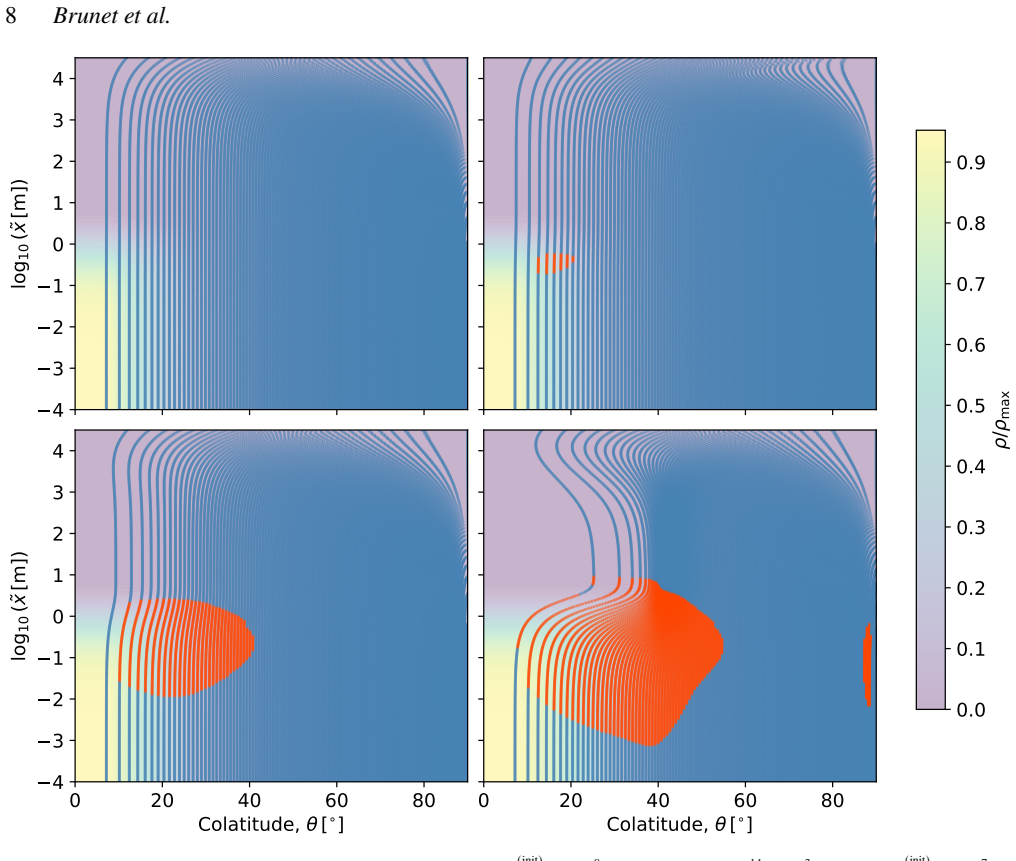
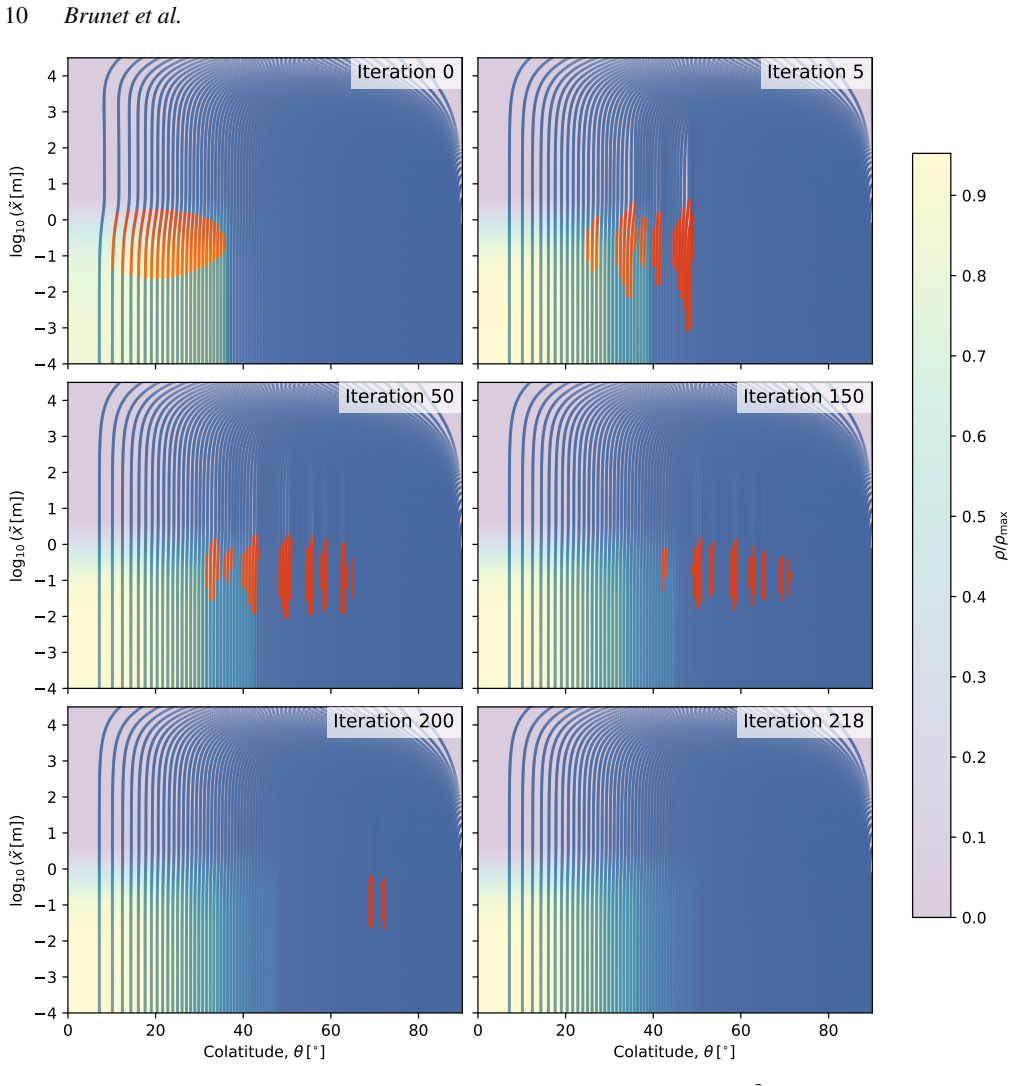
Hydromagnetic instabilities modify the structure of a magnetically confined mountain on an accreting neutron star once the accreted mass exceeds a critical value. Ideal magnetohydrodynamics and flux freezing break down, and mass diffuses across magnetic field lines locally wherever instabilities are excited. A self-consistent iterative numerical scheme evolves an axisymmetric magnetic mountain through a quasistatic sequence of Grad-Shafranov equilibria modified by instability-driven cross-field mass transport obeying the semi-analytic Kulsrud-Sunyaev recipe. The results are compared to an artificially stabilised mountain in which flux freezing does not break down and there is no cross-field
What carries the argument
The iterative numerical evolution of axisymmetric Grad-Shafranov equilibria that incorporates local cross-field mass transport driven by the Kulsrud-Sunyaev instability recipe, which permits the mass-flux distribution to adjust and suppress further instability growth.
If this is right
- The mountain structure self-adjusts locally so that instabilities are nullified rather than amplified.
- A nonzero mass quadrupole moment is maintained indefinitely without ohmic dissipation.
- The outcome differs from the artificially stabilised case that enforces flux freezing and forbids transport.
- The mass-flux distribution evolves to a new equilibrium that remains stable against further hydromagnetic disruption.
Where Pith is reading between the lines
- Persistent quadrupole moments could sustain continuous gravitational-wave emission from accreting neutron stars over long accretion timescales.
- The same local transport adjustment might operate in other systems where magnetic confinement meets plasma instabilities.
- Ohmic dissipation, rather than instability-driven demolition, would then set the ultimate lifetime of such mountains.
Load-bearing premise
The semi-analytic Kulsrud-Sunyaev recipe accurately gives the rate and location of instability-driven cross-field mass transport and the mountain can be evolved as a quasistatic sequence of axisymmetric equilibria.
What would settle it
A calculation or observation showing that the mountain's mass quadrupole moment falls to zero once accreted mass exceeds the critical value, or that the structure is fully demolished by instabilities even when the Kulsrud-Sunyaev transport is included.
Figures





read the original abstract
Hydromagnetic instabilities modify the structure of a magnetically confined mountain on an accreting neutron star, once the accreted mass exceeds a critical value. Ideal magnetohydrodynamics and flux freezing break down, and mass diffuses across magnetic field lines locally, wherever instabilities are excited. Here a self-consistent, iterative, numerical scheme is used to evolve an axisymmetric magnetic mountain through a quasistatic sequence of Grad-Shafranov equilibria as a function of the accreted mass, $M_{\rm a}$, modified by instability-driven cross-field mass transport obeying the semi-analytic, Kulsrud-Sunyaev recipe. The results are compared to an artificially stabilised mountain, in which flux freezing does not break down, and there is no cross-field mass transport. It is shown that cross-field mass transport prevents instabilities from demolishing the mountain. Instead, the mass-flux distribution adjusts locally to nullify the instabilities and preserve a nonzero mass quadrupole moment indefinitely in the absence of ohmic dissipation.
Editorial analysis
A structured set of objections, weighed in public.
Referee Report
Summary. The paper claims that cross-field mass transport, modeled via the semi-analytic Kulsrud-Sunyaev recipe, allows magnetically confined mountains on accreting neutron stars to relax through a quasistatic sequence of axisymmetric Grad-Shafranov equilibria. Instability-driven transport adjusts the local mass-flux distribution to suppress further instabilities, preserving a nonzero mass quadrupole moment indefinitely without ohmic dissipation. This is shown by comparing the evolving mountain to an artificially stabilized case in which flux freezing is enforced and no cross-field transport occurs.
Significance. If the Kulsrud-Sunyaev prescription is physically accurate in this regime, the work provides a self-consistent mechanism for sustaining magnetic mountains against hydromagnetic instabilities. It has implications for neutron-star magnetic-field evolution, spin-down, and gravitational-wave emission from accreting systems. The forward iterative scheme (rather than fitting to a target quadrupole) is a methodological strength.
major comments (3)
- [Abstract / Methods] The central claim—that transport self-adjusts the mass distribution to nullify instabilities and sustain a nonzero quadrupole—rests entirely on the accuracy of the semi-analytic Kulsrud-Sunyaev recipe for local mass fluxes. The manuscript provides no validation, error analysis, or comparison to full MHD simulations to confirm that the recipe remains reliable in the nonlinear, strongly curved-field mountain equilibria (abstract and methods description).
- [Abstract] No numerical resolution, convergence tests, or error estimates are reported for the iterative Grad-Shafranov scheme or the instability-detection step that triggers transport. This is load-bearing because the quasistatic sequence and local adjustment mechanism depend on accurate detection and transport at each accreted-mass increment.
- [Results (comparison section)] The comparison run (artificially stabilized mountain with transport forbidden) demonstrates only the effect of forbidding transport; it does not test whether the chosen Kulsrud-Sunyaev law supplies the correct rates and locations. If the recipe over- or under-estimates transport, the iterative nullification mechanism may fail.
minor comments (1)
- [Abstract] The abstract is concise but could explicitly cite the original Kulsrud-Sunyaev reference for the transport recipe and state the value (or range) adopted for the critical accreted mass that triggers instability onset.
Simulated Author's Rebuttal
We thank the referee for their detailed and constructive report. We address each major comment below and indicate the revisions made to the manuscript.
read point-by-point responses
-
Referee: [Abstract / Methods] The central claim—that transport self-adjusts the mass distribution to nullify instabilities and sustain a nonzero quadrupole—rests entirely on the accuracy of the semi-analytic Kulsrud-Sunyaev recipe for local mass fluxes. The manuscript provides no validation, error analysis, or comparison to full MHD simulations to confirm that the recipe remains reliable in the nonlinear, strongly curved-field mountain equilibria (abstract and methods description).
Authors: We agree that the central results depend on the applicability of the Kulsrud-Sunyaev prescription in the nonlinear regime of curved-field equilibria, and that the manuscript does not include new validation against full MHD simulations. The paper adopts this established semi-analytic recipe (originally derived for interchange instabilities) to explore the consequences of instability-driven transport within a quasistatic Grad-Shafranov framework. In the revised manuscript we have added an explicit limitations paragraph in the Methods section that states the assumptions of the recipe, cites its original derivation and prior uses in related contexts, and notes that direct MHD validation in strongly curved geometries remains an open task for future work. revision: partial
-
Referee: [Abstract] No numerical resolution, convergence tests, or error estimates are reported for the iterative Grad-Shafranov scheme or the instability-detection step that triggers transport. This is load-bearing because the quasistatic sequence and local adjustment mechanism depend on accurate detection and transport at each accreted-mass increment.
Authors: We acknowledge the omission of these numerical details. The revised manuscript now includes a dedicated numerical-methods subsection that specifies the grid resolution (128 radial by 256 angular zones), the convergence criterion for the Grad-Shafranov iteration (maximum residual < 10^{-8}), and the instability-detection threshold. We have performed and reported convergence tests by repeating the evolution at halved and doubled resolution; the final quadrupole moment changes by less than 4 percent. Error estimates on the quadrupole are derived from the GS residual and from the sensitivity to the precise instability threshold, and these are now quoted in the Results section. revision: yes
-
Referee: [Results (comparison section)] The comparison run (artificially stabilized mountain with transport forbidden) demonstrates only the effect of forbidding transport; it does not test whether the chosen Kulsrud-Sunyaev law supplies the correct rates and locations. If the recipe over- or under-estimates transport, the iterative nullification mechanism may fail.
Authors: The comparison is designed to isolate the qualitative effect of permitting cross-field transport versus enforcing strict flux freezing. We accept that it does not independently verify the transport rates or spatial distribution supplied by the Kulsrud-Sunyaev law. In the revised Results section we have clarified that the observed stabilization and sustained quadrupole are predictions of the model under the adopted transport prescription, and we explicitly cross-reference the limitations paragraph added in Methods. revision: partial
- Direct validation of the Kulsrud-Sunyaev recipe against full nonlinear MHD simulations in the relevant curved-field, high-beta regime.
Circularity Check
No significant circularity; forward numerical evolution produces emergent outcome
full rationale
The paper evolves a sequence of axisymmetric Grad-Shafranov equilibria numerically, at each step applying cross-field mass transport according to the cited Kulsrud-Sunyaev semi-analytic recipe wherever instabilities are present. The central result—that the mass-flux distribution self-adjusts to suppress further instabilities and sustain a nonzero quadrupole—is an output of this iterative process, not imposed by construction, parameter fitting to the target quadrupole, or redefinition of inputs. No quoted step in the abstract or described method reduces the claimed prediction to an input quantity by definition or self-citation chain. The recipe is treated as an external physical prescription rather than derived within the paper, so the derivation remains self-contained against the stated assumptions.
Axiom & Free-Parameter Ledger
free parameters (1)
- critical accreted mass for instability onset
axioms (2)
- domain assumption Axisymmetric Grad-Shafranov equilibria remain valid throughout the quasistatic evolution
- domain assumption Kulsrud-Sunyaev recipe gives the correct local cross-field mass flux
Reference graph
Works this paper leans on
-
[1]
Aasi J., et al., 2015, Phys. Rev. D, 91, 062008 Abbott B., et al., 2007, Phys. Rev. D, 76, 082001 Abbott B. P., et al., 2017a, Phys. Rev. D, 95, 122003 Abbott B. P., et al., 2017b, ApJ, 847, 47 Abbott B. P., et al., 2019, Phys. Rev. D, 100, 122002 Abbott R., et al., 2020, ApJ, 902, L21 Abbott R., et al., 2022, Phys. Rev. D, 105, 022002 AnderssonN.,Glamped...
-
[2]
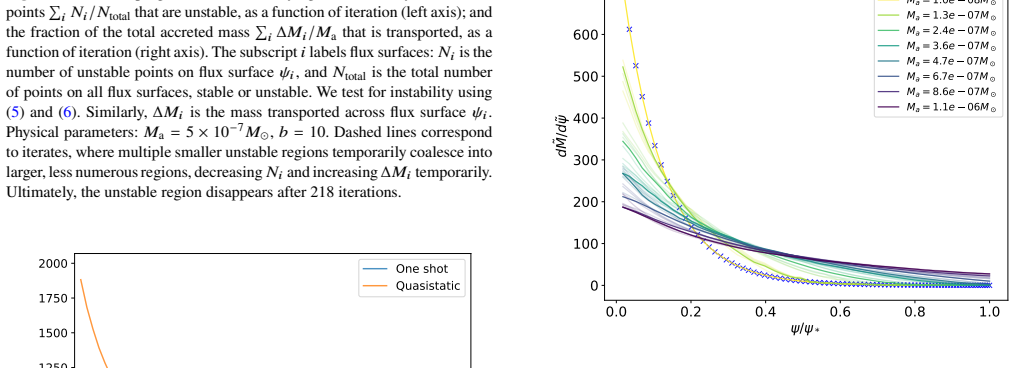
Compared to the exponential form of𝑑𝑀/𝑑𝜓(19) used by Payne & Melatos (2004), the intermediate𝑑𝑀/𝑑𝜓profiles in Figure 7 are shallower. We quantify this in Figure C2 by plotting the mass contained in the polar cap,𝑀(𝜓≤𝜓a), as a function of the accreted mass as the mountain is assembled and comparing it to𝑀(𝜓≤ 𝜓a)without mass transport. In the former case, w...
2004
-
[3]
The curves are fits of the form (23); the points are simulation outputs fitted by the curves
The third (green points and curves) corresponds to the highest mass reached during the assembly sequence. The curves are fits of the form (23); the points are simulation outputs fitted by the curves. APPENDIX D: MOUNTAIN ON A NEWBORN NEUTRON STAR In this paper, we assume accretion occurs over long time-scales 𝑀a/ ¤𝑀a ≳10 8 yr, characteristic of low mass X...
2011
discussion (0)
Sign in with ORCID, Apple, or X to comment. Anyone can read and Pith papers without signing in.