Recognition: unknown
AgentComm: Semantic Communication for Embodied Agents
Pith reviewed 2026-05-10 13:30 UTC · model grok-4.3
The pith
Embodied agents can reduce wireless bandwidth by nearly half while keeping task performance intact by using LLMs to extract and prioritize semantic content.
A machine-rendered reading of the paper's core claim, the machinery that carries it, and where it could break.
Core claim
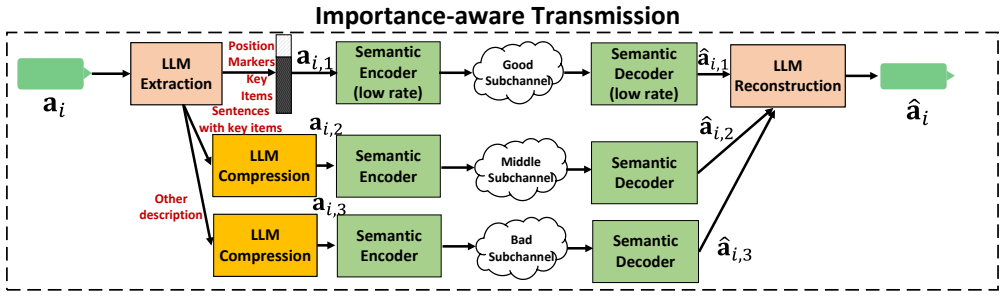
The central claim is that an LLM-based semantic processor can reorganize and condense agent-generated messages by extracting task-relevant content, combined with an importance-aware transmission strategy that adaptively protects semantic components according to their effect on task success and a task-specific knowledge base serving as long-term memory, resulting in nearly 50% bandwidth reduction with negligible degradation in task completion performance relative to conventional full-message transmission schemes.
What carries the argument
LLM-based semantic processor that extracts and condenses task-relevant content from messages, paired with an importance-aware strategy that ranks and protects components by their impact on task outcomes, plus a persistent task-specific knowledge base for repeated elements.
If this is right
- Agents can exchange only condensed semantic units rather than full data streams while completing joint tasks at similar rates.
- Bandwidth savings scale with the use of a shared knowledge base for tasks that recur across episodes.
- Ablation results indicate that removing the importance-aware protection step increases performance loss under aggressive reduction.
- The framework maintains reliability under the tested latency and reliability constraints of embodied scenarios.
Where Pith is reading between the lines
- This approach could be tested in multi-hop relay settings where intermediate agents further refine the semantic payload.
- Integration with existing error-correction codes might amplify the observed bandwidth gains without additional protocol changes.
- The method suggests a path for human-agent teams if the knowledge base is extended to align semantic priorities across human and machine participants.
Load-bearing premise
The LLM can reliably identify task-critical semantic content and rank its importance without introducing errors that degrade the agents' downstream task performance.
What would settle it
An experiment in which the LLM extraction or importance ranking is forced to omit or downgrade a component known to be essential for task success, followed by measurement showing a clear drop in completion rate compared to the baseline.
Figures






read the original abstract
The increasing deployment of agentic artificial intelligence (AI) systems has intensified the demand for efficient agent to agent communication, particularly over bandwidth limited wireless links. In embodied AI applications, agents must exchange task related information under strict latency and reliability constraints. Existing agent communication methods primarily focus on connectivity and protocol efficiency, but lack effective mechanisms to reduce physical layer transmission overhead while preserving task semantics.To address this challenge, this paper proposes a semantic agent communication framework that reduces communication overhead while maintaining task performance and shared understanding among agents. An LLM based semantic processor is first introduced to reorganize and condense agent generated messages by extracting task relevant semantic content. To cope with information loss introduced by aggressive message reduction, an importance-aware semantic transmission strategy is developed, which adaptively protects semantic components according to their task importance. Furthermore, a task specific knowledge base is incorporated as long term semantic memory to support recurring tasks and further reduce bandwidth consumption with minimal performance degradation. Experimental results and ablation studies demonstrate that the proposed framework achieves nearly 50% bandwidth reduction with negligible loss in task completion performance compared to conventional transmission schemes.
Editorial analysis
A structured set of objections, weighed in public.
Referee Report
Summary. The manuscript proposes AgentComm, a semantic communication framework for embodied AI agents communicating over bandwidth-limited wireless links. It introduces an LLM-based semantic processor to condense and reorganize task-relevant content from agent messages, an importance-aware transmission strategy that adaptively protects semantic components, and a task-specific knowledge base serving as long-term memory to further reduce overhead for recurring tasks. Experimental results and ablation studies are reported to support a nearly 50% bandwidth reduction with negligible degradation in task completion performance relative to conventional transmission schemes.
Significance. If the empirical claims hold under rigorous validation, the framework would represent a practical advance in semantic communication for multi-agent embodied systems, where latency and bandwidth constraints are acute. The integration of LLM-driven condensation with an adaptive protection mechanism and persistent knowledge base offers a concrete way to trade transmission overhead for semantic fidelity, building directly on existing semantic communication concepts while addressing agent-specific needs. The reported ablation studies provide initial evidence for component contributions, which is a positive aspect of the work.
major comments (2)
- [Section 3.2] Section 3.2 (importance-aware semantic transmission strategy): The strategy is presented as adaptively protecting semantic components according to their task importance, yet no formal definition, computation procedure, or independence from the LLM processor is given. If importance scores are derived from the same LLM or from aggregate task-success feedback, this creates a risk of systematic bias (e.g., over-protecting frequent but non-critical tokens), which directly undermines the central claim that aggressive reduction incurs negligible performance loss.
- [Section 5] Section 5 (experimental results and ablations): The headline result of ~50% bandwidth reduction with negligible task degradation rests on the unverified assumption that the LLM processor plus importance-aware scheduler never drops information whose absence would cause downstream failure. The manuscript provides no error-propagation analysis, no quantification of how often LLM re-organization alters success-critical facts, and no evaluation on out-of-distribution or harder tasks; without these, the ablation support cannot be considered conclusive for the bandwidth-performance tradeoff.
minor comments (2)
- [Abstract] Abstract: The phrase 'negligible loss in task completion performance' should be accompanied by the specific quantitative thresholds or metrics (e.g., success rate delta, latency bounds) used to define negligibility in the experiments.
- [Section 3] Notation throughout: The distinction between 'semantic components' and raw message tokens is used repeatedly but never formalized; a short definition or example in Section 3 would improve clarity.
Simulated Author's Rebuttal
We thank the referee for the constructive and detailed comments. We address each major point below and describe the revisions that will be incorporated to strengthen the manuscript.
read point-by-point responses
-
Referee: [Section 3.2] Section 3.2 (importance-aware semantic transmission strategy): The strategy is presented as adaptively protecting semantic components according to their task importance, yet no formal definition, computation procedure, or independence from the LLM processor is given. If importance scores are derived from the same LLM or from aggregate task-success feedback, this creates a risk of systematic bias (e.g., over-protecting frequent but non-critical tokens), which directly undermines the central claim that aggressive reduction incurs negligible performance loss.
Authors: We agree that Section 3.2 would benefit from greater rigor. In the revised version we will add a formal mathematical definition of the importance score, computed via a dedicated module that draws exclusively from the task knowledge base and historical task-success statistics. This module is deliberately decoupled from the LLM semantic processor. The computation procedure will be presented as an explicit algorithm with pseudocode and a closed-form expression, thereby removing any ambiguity about bias and clarifying that protection decisions rest on independent, verifiable metrics. revision: yes
-
Referee: [Section 5] Section 5 (experimental results and ablations): The headline result of ~50% bandwidth reduction with negligible task degradation rests on the unverified assumption that the LLM processor plus importance-aware scheduler never drops information whose absence would cause downstream failure. The manuscript provides no error-propagation analysis, no quantification of how often LLM re-organization alters success-critical facts, and no evaluation on out-of-distribution or harder tasks; without these, the ablation support cannot be considered conclusive for the bandwidth-performance tradeoff.
Authors: The referee correctly notes that the current experimental section lacks several robustness checks. We will augment Section 5 with (i) an error-propagation analysis that systematically removes or alters semantic units and measures downstream task failure rates, (ii) a quantification of how frequently LLM re-organization changes success-critical facts on the evaluated benchmarks, and (iii) additional experiments on out-of-distribution and harder task variants. These additions will provide direct evidence supporting the claimed bandwidth-performance tradeoff and will be reported alongside the existing ablation studies. revision: yes
Circularity Check
No circularity: claims rest on experimental validation of a proposed framework, not on derivations that reduce to inputs
full rationale
The manuscript describes a system-level semantic communication framework for embodied agents, introducing an LLM-based processor for message condensation, an importance-aware transmission strategy, and a task-specific knowledge base. Performance results (approximately 50% bandwidth reduction with negligible task degradation) are presented via experiments and ablation studies. No mathematical derivation chain, equations, or fitted parameters are invoked in a manner that reduces predictions to inputs by construction. Self-citations, if present, are not load-bearing for the central claims, which remain independently testable through the reported simulations. The derivation is therefore self-contained against external benchmarks.
Axiom & Free-Parameter Ledger
axioms (2)
- domain assumption LLM can accurately extract and condense task-relevant semantic content without critical loss
- domain assumption Task importance can be reliably scored to guide adaptive protection
Forward citations
Cited by 1 Pith paper
-
Intention-Aware Semantic Agent Communications for AI Glasses
An intention-aware semantic agent system for AI glasses reduces bandwidth by over 50% in simulations while preserving task performance through adaptive preprocessing guided by inferred user intentions.
Reference graph
Works this paper leans on
-
[1]
Multi-agent embodied ai: Advances and future directions.arXiv preprint arXiv:2505.05108,
Z. Feng, R. Xue, L. Yuan, Y . Yu, N. Ding, M. Liu, B. Gao, J. Sun, X. Zheng, and G. Wang, “Multi-agent embodied AI: Advances and future directions,”arXiv preprint arXiv:2505.05108, 2025
-
[2]
Game-theoretic multi- agent control and network cost allocation under communication con- straints,
F. Lian, A. Chakrabortty, and A. Duel-Hallen, “Game-theoretic multi- agent control and network cost allocation under communication con- straints,”IEEE J. Sel. Areas Commun., vol. 35, no. 2, pp. 330–340, Feb. 2017
2017
-
[3]
Embodied AI-enhanced vehicular networks: An integrated vision language models and reinforcement learning method,
R. Zhang, C. Zhao, H. Du, D. Niyato, J. Wang, S. Sawadsitang, X. Shen, and D. I. Kim, “Embodied AI-enhanced vehicular networks: An integrated vision language models and reinforcement learning method,” IEEE Trans. Mobile Comput., 2025
2025
-
[4]
arXiv preprint arXiv:2307.02485
H. Zhang, W. Du, J. Shan, Q. Zhou, Y . Du, J. B. Tenenbaum, T. Shu, and C. Gan, “Building cooperative embodied agents modularly with large language models,”arXiv preprint arXiv:2307.02485, 2023
-
[5]
A survey of embodied AI: From simulators to research tasks,
J. Duan, S. Yu, H. L. Tan, H. Zhu, and C. Tan, “A survey of embodied AI: From simulators to research tasks,”IEEE Trans. Emerg. Topics Comput. Intell., vol. 6, no. 2, pp. 230–244, Apr. 2022
2022
-
[6]
Embodied ai agents: Modeling the world,
P. Fung, Y . Bachrach, A. Celikyilmaz, K. Chaudhuri, D. Chen, W. Chung, E. Dupoux, H. Gong, H. Jégou, A. Lazaricet al., “Embodied AI agents: Modeling the world,”arXiv preprint arXiv:2506.22355, 2025
-
[7]
A. Lazaridou and M. Baroni, “Emergent multi-agent communication in the deep learning era,”arXiv preprint arXiv:2006.02419, 2020
-
[8]
Effective commu- nications: A joint learning and communication framework for multi- agent reinforcement learning over noisy channels,
T.-Y . Tung, S. Kobus, J. P. Roig, and D. Gündüz, “Effective commu- nications: A joint learning and communication framework for multi- agent reinforcement learning over noisy channels,”IEEE J. Sel. Areas Commun., vol. 39, no. 8, pp. 2590–2603, Aug. 2021
2021
-
[9]
Unleashing the power of edge-cloud generative ai in mobile networks: A survey of aigc services,
M. Xu, H. Du, D. Niyato, J. Kang, Z. Xiong, S. Mao, Z. Han, A. Jamalipour, D. I. Kim, X. Shenet al., “Unleashing the power of edge-cloud generative ai in mobile networks: A survey of aigc services,” IEEE Commun. Surv. Tutor., vol. 26, no. 2, pp. 1127–1170, Jan. 2024
2024
-
[10]
Beyond transmitting bits: Context, seman- tics, and task-oriented communications,
D. Gündüz, Z. Qin, I. E. Aguerri, H. S. Dhillon, Z. Yang, A. Yener, K. K. Wong, and C.-B. Chae, “Beyond transmitting bits: Context, seman- tics, and task-oriented communications,”IEEE J. Sel. Areas Commun., vol. 41, no. 1, pp. 5–41, Jan. 2023
2023
-
[11]
Intellicise wireless networks from semantic communications: A survey, research issues, and challenges,
P. Zhang, W. Xu, Y . Liu, X. Qin, K. Niu, S. Cui, G. Shi, Z. Qin, X. Xu, F. Wanget al., “Intellicise wireless networks from semantic communications: A survey, research issues, and challenges,”IEEE Commun. Surveys Tutorials, 2024
2024
-
[12]
Optimizing resource allocation for multi-modal semantic communication in mobile aigc networks: A diffusion-based game approach,
J. Liu, M. Xiao, J. Wen, J. Kang, R. Zhang, T. Zhang, D. Niyato, W. Zhang, and Y . Liu, “Optimizing resource allocation for multi-modal semantic communication in mobile aigc networks: A diffusion-based game approach,”IEEE Trans. Cogn. Commun. Netw., vol. 11, no. 5, pp. 3346–3360, Oct. 2025
2025
-
[13]
A unified multi-task semantic communication system with domain adaptation,
G. Zhang, Q. Hu, Z. Qin, Y . Cai, and G. Yu, “A unified multi-task semantic communication system with domain adaptation,” inIEEE Global Commun. Conf. (Globecom), 2022, pp. 3971–3976
2022
-
[14]
Cross-modal generative semantic communications for mobile aigc: Joint semantic encoding and prompt engineering,
Y . Liu, H. Du, D. Niyato, J. Kang, Z. Xiong, S. Mao, P. Zhang, and X. Shen, “Cross-modal generative semantic communications for mobile aigc: Joint semantic encoding and prompt engineering,”IEEE Trans. Mobile Comput., vol. 23, no. 12, pp. 14 871–14 888, Dec. 2024
2024
-
[15]
Semantic satellite communications based on generative foundation model,
P. Jiang, C.-K. Wen, X. Li, S. Jin, and G. Y . Li, “Semantic satellite communications based on generative foundation model,”IEEE J. Sel. Areas Commun., vol. 43, no. 7, pp. 2431–2445, Jul. 2025
2025
-
[16]
Latent diffusion model-enabled low-latency semantic communication in the presence of semantic ambiguities and wireless channel noises,
J. Pei, C. Feng, P. Wang, H. Tabassum, and D. Shi, “Latent diffusion model-enabled low-latency semantic communication in the presence of semantic ambiguities and wireless channel noises,”IEEE Trans. Wireless Commun., vol. 24, no. 5, pp. 4055–4072, May 2025
2025
-
[17]
Semantic communication for remote spectrum sensing in non-terrestrial networks,
P. Yi, Y . Cao, J. Xu, and Y .-C. Liang, “Semantic communication for remote spectrum sensing in non-terrestrial networks,” in2022 IEEE 32nd Int. Workshop Mach. Learn. Signal Process. (MLSP), 2022, pp. 1–6
2022
-
[18]
Semantic- driven AI agent communications: Challenges and solutions,
K. Yu, M. Sun, Z. Qin, X. Xu, P. Yang, Y . Xiao, and G. Wu, “Semantic-driven ai agent communications: Challenges and solutions,” arXiv preprint arXiv:2510.00381, 2025
-
[19]
Toward goal-oriented communication in multi-agent systems: An overview,
T. Charalambous, N. Pappas, N. Nomikos, and R. Wichman, “Toward goal-oriented communication in multi-agent systems: An overview,” arXiv preprint arXiv:2508.07720, 2025
-
[20]
From large AI models to agentic AI: A tutorial on future intelligent communications,
F. Jiang, C. Pan, L. Dong, K. Wang, O. A. Dobre, and M. Debbah, “From large AI models to agentic AI: A tutorial on future intelligent communications,”arXiv preprint arXiv:2505.22311, 2025
-
[21]
Agentic AI: The era of semantic decoding,
M. Peyrard, M. Josifoski, and R. West, “Agentic ai: The era of semantic decoding,”arXiv preprint arXiv:2403.14562, 2024
-
[22]
Large AI models for wireless physical layer,
J. Guo, Y . Cui, S. Jin, and J. Zhang, “Large AI models for wireless physical layer,”arXiv preprint arXiv:2508.02314, 2025
-
[23]
Prompt-enabled large AI models for csi feedback,
J. Guo, Y . Cui, C.-K. Wen, and S. Jin, “Prompt-enabled large AI models for csi feedback,”IEEE J. Sel. Areas Commun., 2025, Early access
2025
-
[24]
Robotic communications for 5g and beyond: Challenges and research opportunities,
Y . Liu, X. Liu, X. Gao, X. Mu, X. Zhou, O. A. Dobre, and H. V . Poor, “Robotic communications for 5g and beyond: Challenges and research opportunities,”IEEE Commun. Magazine, vol. 59, no. 10, pp. 92–98, Oct. 2021
2021
-
[25]
arXiv preprint arXiv:2410.10762 , year=
J. Zhang, J. Xiang, Z. Yu, F. Teng, X. Chen, J. Chen, M. Zhuge, X. Cheng, S. Hong, J. Wanget al., “Aflow: Automating agentic workflow generation,”arXiv preprint arXiv:2410.10762, 2024
-
[26]
Graph of thoughts: Solving elaborate problems with large language models,
M. Besta, N. Blach, A. Kubicek, R. Gerstenberger, M. Podstawski, L. Gianinazzi, J. Gajda, T. Lehmann, H. Niewiadomski, P. Nyczyket al., “Graph of thoughts: Solving elaborate problems with large language models,” inAAAI Conf. Arti. Intell., vol. 38, no. 16, 2024, pp. 17 682– 17 690
2024
-
[27]
Metagpt: Meta programming for a multi-agent collaborative framework,
S. Hong, M. Zhuge, J. Chen, X. Zheng, Y . Cheng, J. Wang, C. Zhang, Z. Wang, S. K. S. Yau, Z. Linet al., “Metagpt: Meta programming for a multi-agent collaborative framework,” inThe 12th Int. Conf. Learn. Represent. (ICLR), 2023
2023
-
[28]
Chatdev: Communicative agents for software development,
C. Qian, W. Liu, H. Liu, N. Chen, Y . Dang, J. Li, C. Yang, W. Chen, Y . Su, X. Conget al., “Chatdev: Communicative agents for software development,” in62nd Annual Meeting of the Association for Compu- tational Linguistics (Volume 1: Long Papers), 2024, pp. 15 174–15 186
2024
-
[29]
A., Tihanyi, N., and Debbah, M
M. A. Ferrag, N. Tihanyi, and M. Debbah, “From LLM reasoning to autonomous AI agents: A comprehensive review,”arXiv preprint arXiv:2504.19678, 2025
-
[30]
Cognitive archi- tectures for language agents,
T. Sumers, S. Yao, K. Narasimhan, and T. Griffiths, “Cognitive archi- tectures for language agents,”Trans. Mach. Learn. Research, Feb. 2024
2024
-
[31]
H. Zou, Q. Zhao, L. Bariah, M. Bennis, and M. Debbah, “Wireless multi-agent generative ai: From connected intelligence to collective intelligence,”arXiv preprint arXiv:2307.02757, 2023
-
[32]
Enabling mobile ai agent in 6g era: Architecture and key technologies,
Z. Chen, Q. Sun, N. Li, X. Li, Y . Wanget al., “Enabling mobile ai agent in 6g era: Architecture and key technologies,”IEEE Network, vol. 38, no. 5, pp. 66–75, 2024
2024
-
[33]
Corporation
N. Corporation. Phy abstraction tutorial - effective sinr. [Online]. Available: https://nvlabs.github.io/sionna/sys/tutorials/PHY_Abstraction. html#Effective-SINR
-
[34]
Embodied question answering,
A. Das, S. Datta, G. Gkioxari, S. Lee, D. Parikh, and D. Batra, “Embodied question answering,” inIEEE Conf. Computer Vision Patt. Recogn. (CVPR), 2018, pp. 1–10
2018
-
[35]
Alfred: A benchmark for interpreting grounded instructions for everyday tasks,
M. Shridhar, J. Thomason, D. Gordon, Y . Bisk, W. Han, R. Mottaghi, L. Zettlemoyer, and D. Fox, “Alfred: A benchmark for interpreting grounded instructions for everyday tasks,” inIEEE Conf. Comput. Vision Patt. Recog. (CVPR), 2020, pp. 10 740–10 749
2020
-
[36]
Deep learning enabled semantic communication systems,
H. Xie, Z. Qin, G. Y . Li, and B.-H. Juang, “Deep learning enabled semantic communication systems,”IEEE Trans. Signal Process., vol. 69, pp. 2663–2675, Apr. 2021
2021
-
[37]
Deep source-channel coding for sentence semantic transmission with HARQ,
P. Jiang, C.-K. Wen, S. Jin, and G. Y . Li, “Deep source-channel coding for sentence semantic transmission with HARQ,”IEEE Trans. Commun., vol. 70, no. 8, pp. 5225–5240, Aug. 2022
2022
-
[38]
WebArena: A Realistic Web Environment for Building Autonomous Agents
S. Zhou, F. F. Xu, H. Zhu, X. Zhou, R. Lo, A. Sridhar, X. Cheng, T. Ou, Y . Bisk, D. Friedet al., “Webarena: A realistic web environment for building autonomous agents,”arXiv preprint arXiv:2307.13854, 2023
work page Pith review arXiv 2023
-
[39]
A diversity- promoting objective function for neural conversation models,
J. Li, M. Galley, C. Brockett, J. Gao, and W. B. Dolan, “A diversity- promoting objective function for neural conversation models,” in2016 Conference of the North American Chapter of the Association for Computational Linguistics: Human Language Technologies, 2016, pp. 110–119
2016
discussion (0)
Sign in with ORCID, Apple, or X to comment. Anyone can read and Pith papers without signing in.