Recognition: unknown
SJET: An Interactive Solar Jet Extraction Tool
Pith reviewed 2026-05-10 12:49 UTC · model grok-4.3
The pith
SJET standardizes extraction of solar jet length, width, curvature and direction from EUV images.
A machine-rendered reading of the paper's core claim, the machinery that carries it, and where it could break.
Core claim
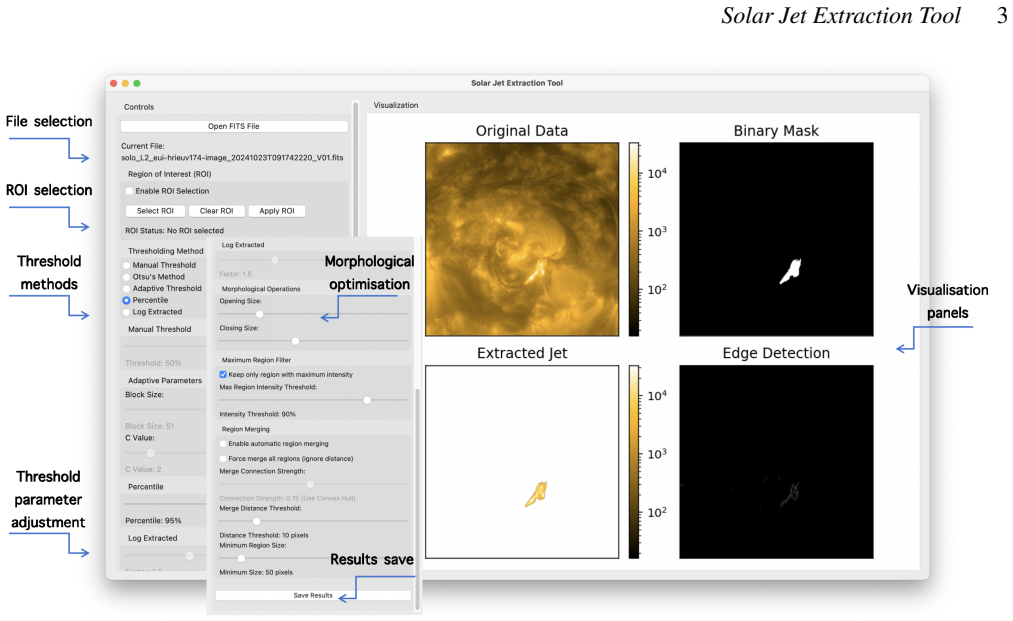
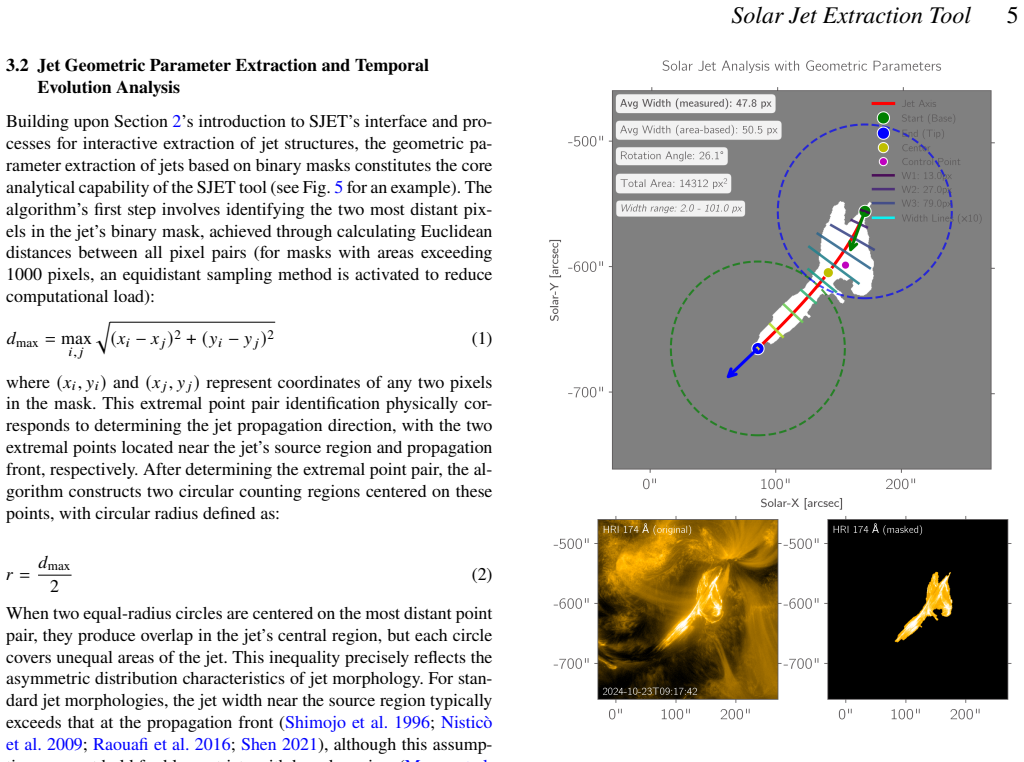
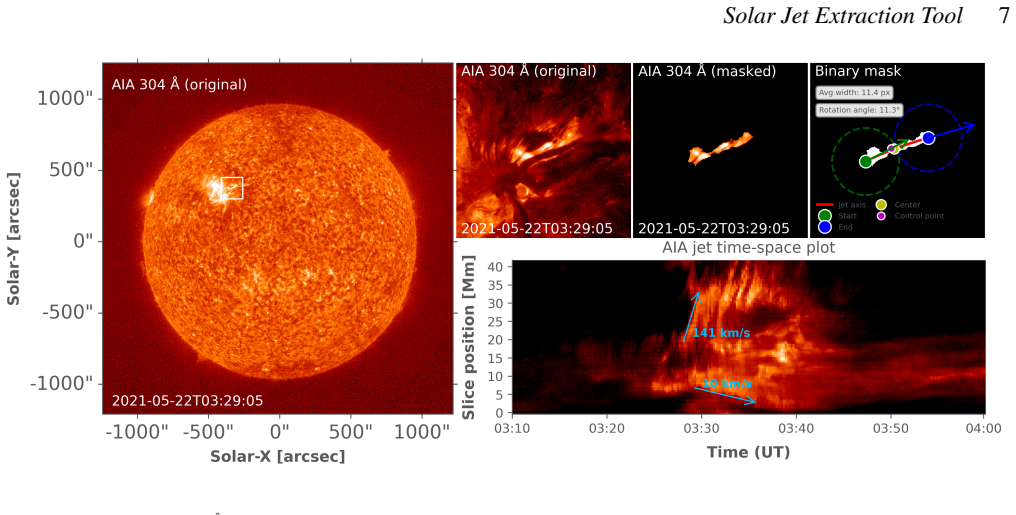
SJET integrates multiple thresholding algorithms with morphological operations and introduces a circular-region method that identifies jet endpoints while determining propagation direction from morphological asymmetry; the jet axis is then represented by a quadratic Bézier curve from which length, width, curvature and deflection angles are extracted. Tests on high-resolution EUV images from Solar Orbiter/EUI and SDO/AIA show that the extracted parameters match those obtained by traditional analysis when user-selected thresholds and regions of interest are held fixed.
What carries the argument
The SJET workflow that combines multi-algorithm thresholding, circular-region asymmetry detection for start and end points, and quadratic Bézier curve fitting of the jet axis.
If this is right
- Geometric parameters such as jet length, width, curvature and deflection angle can be obtained under a single documented procedure rather than varying manual choices.
- Large-sample statistical studies of solar jets become practical because processing steps are standardized and reproducible.
- The same workflow applies to both on-disk and limb jets once appropriate thresholds and regions of interest are selected for each dataset.
- Results from SJET agree with conventional manual tracing on real Solar Orbiter and SDO observations under controlled user input.
Where Pith is reading between the lines
- A shared extraction pipeline could allow direct comparison of jet statistics across different solar-cycle phases or instruments without method-induced scatter.
- The interactive design opens a route to test how sensitive final jet statistics are to small changes in the initial threshold or region selection.
- Consistent curvature and deflection measurements could be fed into models that link jet geometry to the acceleration of the solar wind.
Load-bearing premise
Different users will choose thresholds and regions of interest consistently enough on the same data to produce comparable geometric measurements.
What would settle it
Independent users applying SJET to the identical image sequence produce length or curvature values that differ by amounts larger than the measurement uncertainties stated in the validation tests.
Figures




read the original abstract
Solar jets are dynamic collimated plasma flows in the solar atmosphere that play crucial roles in coronal heating and solar wind acceleration. Their complex and diverse morphologies pose significant challenges for developing universal algorithms for automatic identification and extraction, particularly for on-disk jets affected by projection effects and background contamination. We present SJET, an interactive tool for solar jet feature extraction using multiple algorithms developed in Python that integrates five thresholding algorithms with morphological operations. SJET implements a novel method for identifying start and end points based on circular regions that objectively determines jet propagation direction by exploiting morphological asymmetry, combined with modeling the axis using quadratic B\'ezier curves for accurate extraction of geometric parameters including length, width, curvature, and deflection angles. Validation analyses using Solar Orbiter/EUI high-resolution image and SDO/AIA observations demonstrate SJET's effectiveness across different observational conditions, with good agreement compared to traditional analysis methods, though the tool's accuracy remains dependent on user-defined threshold parameters and region of interest selection. SJET provides a solution to method inconsistency in solar jet research through standardized processing workflows, establishing a technical foundation for large-sample statistical studies.
Editorial analysis
A structured set of objections, weighed in public.
Referee Report
Summary. The manuscript introduces SJET, an interactive Python tool for extracting solar jet features from EUV images. It integrates five thresholding algorithms with morphological operations, employs a novel circular-region approach to identify start and end points and determine propagation direction via morphological asymmetry, and models the jet axis with quadratic Bézier curves to derive geometric parameters including length, width, curvature, and deflection angles. Validation on selected Solar Orbiter/EUI high-resolution and SDO/AIA images is reported to show good agreement with traditional manual methods, although accuracy depends on user-defined thresholds and ROI selection. The tool is positioned as providing standardized workflows to reduce method inconsistency and enable large-sample statistical studies of solar jets.
Significance. If the interactive workflows can be shown to yield reproducible geometric measurements across users and datasets, SJET would address a recognized source of inconsistency in solar jet studies, supporting more reliable statistical analyses of jet properties relevant to coronal heating and solar wind acceleration. The combination of multiple algorithms and Bézier modeling offers flexibility for diverse morphologies, but the lack of demonstrated control over user variability limits the immediate impact on standardization claims.
major comments (2)
- [Abstract] Abstract: The central claim that SJET 'provides a solution to method inconsistency in solar jet research through standardized processing workflows' is not supported by evidence; the text explicitly states that accuracy 'remains dependent on user-defined threshold parameters and region of interest selection' yet provides no quantification (e.g., inter-user standard deviation or repeatability metrics) of variability in extracted parameters such as length, width, curvature, or deflection angles.
- [Validation analyses] Validation analyses: The reported 'good agreement compared to traditional analysis methods' on Solar Orbiter/EUI and SDO/AIA data is described only qualitatively with no error bars, no blinded inter-observer tests, and no assessment of how different users' threshold/ROI choices affect the same jet measurements, which is required to substantiate the foundation for large-sample studies.
minor comments (1)
- [Abstract] The abstract lists integration of 'five thresholding algorithms' but does not name them; including the specific algorithms (e.g., Otsu, adaptive, etc.) would improve clarity for readers evaluating the tool's implementation.
Simulated Author's Rebuttal
We thank the referee for their constructive comments, which help clarify the scope and limitations of our work on the SJET tool. We respond point by point to the major comments and outline specific revisions.
read point-by-point responses
-
Referee: [Abstract] Abstract: The central claim that SJET 'provides a solution to method inconsistency in solar jet research through standardized processing workflows' is not supported by evidence; the text explicitly states that accuracy 'remains dependent on user-defined threshold parameters and region of interest selection' yet provides no quantification (e.g., inter-user standard deviation or repeatability metrics) of variability in extracted parameters such as length, width, curvature, or deflection angles.
Authors: We agree that the abstract claim is not quantitatively supported. The standardization in SJET refers to the fixed sequence of algorithms (thresholding options, morphological operations, circular-region start/end detection, and quadratic Bézier fitting), which replaces ad-hoc manual tracing. However, we acknowledge that user choices for thresholds and ROIs still affect outputs. We will revise the abstract to state that SJET provides standardized processing workflows that can help mitigate method inconsistency, while explicitly noting the dependence on user-defined parameters. We will also add a new paragraph in the Discussion section describing potential variability sources and recommending future inter-user reproducibility assessments. revision: yes
-
Referee: [Validation analyses] Validation analyses: The reported 'good agreement compared to traditional analysis methods' on Solar Orbiter/EUI and SDO/AIA data is described only qualitatively with no error bars, no blinded inter-observer tests, and no assessment of how different users' threshold/ROI choices affect the same jet measurements, which is required to substantiate the foundation for large-sample studies.
Authors: The validation in the manuscript is qualitative, relying on visual comparison and agreement with manual measurements on selected high-resolution images. No quantitative error bars, statistical metrics, or blinded tests were included. We will revise the validation section to explicitly characterize the comparisons as qualitative, provide any available parameter differences from the example cases, and discuss how threshold and ROI selections influence results. We will also add a limitations subsection noting that full quantification of user variability lies beyond the present tool-description paper. revision: partial
- Performing new blinded inter-observer tests or computing inter-user standard deviations on extracted parameters, as these require additional data collection and analysis not present in the current study.
Circularity Check
No circularity: SJET is an algorithmic implementation without derivations or predictions
full rationale
The paper presents an interactive Python tool integrating thresholding algorithms, morphological operations, circular-region start/end detection, and quadratic Bézier curve axis modeling for jet parameter extraction. No equations, first-principles derivations, or statistical predictions appear that could reduce to fitted inputs or self-definitions by construction. The central claim of standardized workflows solving method inconsistency is an implementation statement, not a result derived from prior outputs; the abstract explicitly notes remaining dependence on user thresholds and ROIs, and validation is described only as qualitative agreement with traditional methods on selected images. No self-citations, uniqueness theorems, or ansatzes are load-bearing for any claimed result, leaving the work self-contained as software description.
Axiom & Free-Parameter Ledger
free parameters (2)
- threshold parameters
- region of interest selection
Reference graph
Works this paper leans on
-
[1]
BarnesW.T.,etal.,2020,aiapy:APythonPackageforAnalyzingSolarEUV Image Data from AIA, doi:10.5281/zenodo.4274931 Bradski G., 2000, Dr. Dobb’s Journal: Software Tools for the Professional Programmer, 25, 120 Chen H.-D., Zhang J., Ma S.-L., 2012, Research in Astronomy and Astro- physics, 12, 573 Chierichini S., Bourgeois S., Soós S., Liu J., Korsós M. B., Del...
-
[2]
to (163, 124)). This stability reflects the fact that the extremal point pair identification is based on the global geometry of the mask rather than its precise boundary, making it relatively robust to moderate threshold variations. Thearea-basedwidthshowsastrongersensitivityacrossthethree levels (71.44, 50.17, and 31.42 pixels), as it integrates over the...
2026
discussion (0)
Sign in with ORCID, Apple, or X to comment. Anyone can read and Pith papers without signing in.