Recognition: unknown
Irregularly Sampled Time Series Interpolation for Binary Evolution Simulations Using Dynamic Time Warping
Pith reviewed 2026-05-10 12:41 UTC · model grok-4.3
The pith
Dynamic time warping computes one shared path to align all parameters in binary stellar evolution tracks.
A machine-rendered reading of the paper's core claim, the machinery that carries it, and where it could break.
Core claim
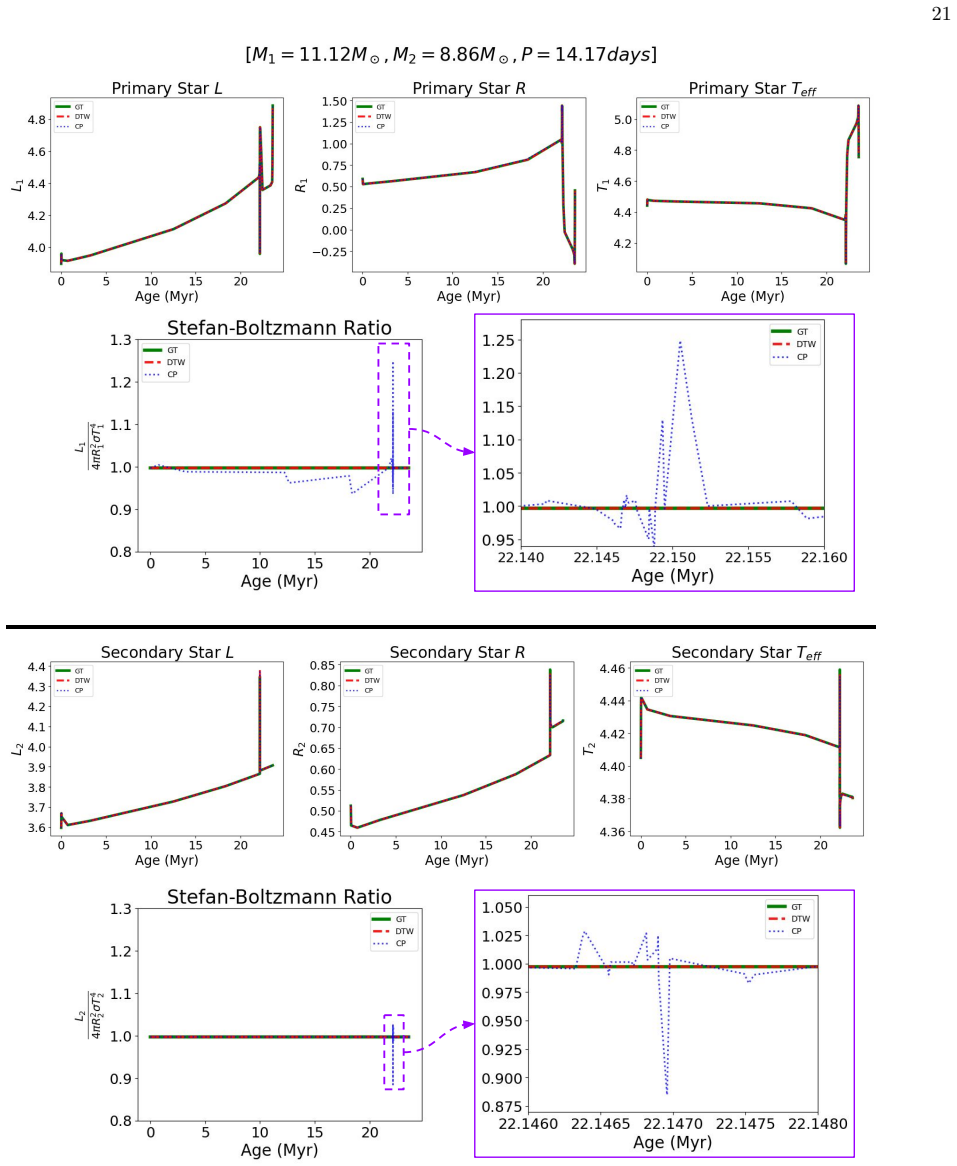
The paper presents a dynamic time warping approach for aligning and averaging binary stellar evolution tracks. It computes a single shared warping path across all physical parameters simultaneously, which places the tracks on a common temporal grid while preserving causal relationships between quantities. Iterative averaging along this path then produces interpolated tracks. The method is shown to maintain physical consistency, such as the Stefan-Boltzmann law, even when stellar interactions introduce discontinuities, and it outperforms standard interpolation techniques across multiple binary configurations.
What carries the argument
A single shared warping path from dynamic time warping applied jointly to every physical parameter, which aligns irregular time samples onto one common grid.
If this is right
- Thousands of binary evolution models can be generated from a smaller set of full simulations for population synthesis work.
- Interpolated tracks remain physically consistent and can be used directly in astrophysical calculations.
- Proper temporal alignment is shown to be essential; without it, standard methods produce inaccurate results for binaries.
- The same joint-alignment idea can be applied to any set of neighboring binary tracks that differ only in initial conditions.
Where Pith is reading between the lines
- The same joint-warping idea could be tested on other multi-parameter astrophysical time series, such as supernova light curves or planetary system evolution, where parameters are physically coupled.
- If the method scales to higher-dimensional parameter spaces, it might reduce the cost of exploring wide ranges of binary initial conditions that are currently too expensive to simulate exhaustively.
- Independent per-parameter warping would likely break physical laws more often, suggesting that joint alignment is a general requirement for any coupled system with irregular sampling.
Load-bearing premise
A single warping path computed across all parameters at once will still respect causal links and physical laws when stellar interactions create jumps in the tracks.
What would settle it
If interpolated tracks violate the Stefan-Boltzmann law or other known physical relations in a set of binary configurations with known interaction points, the shared-path approach would be shown not to preserve the required relationships.
Figures



read the original abstract
Binary stellar evolution simulations are computationally expensive. Stellar population synthesis relies on these detailed evolution models at a fundamental level. Producing thousands of such models requires hundreds of CPU hours, but stellar track interpolation provides one approach to significantly reduce this computational cost. Although single-star track interpolation is straightforward, stellar interactions in binary systems introduce significant complexity to binary evolution, making traditional single-track interpolation methods inapplicable. Binary tracks present fundamentally different challenges compared to single stars, which possess relatively straightforward evolutionary phases identifiable through distinct physical properties. Binary systems are complicated by mutual interactions that can dramatically alter evolutionary trajectories and introduce discontinuities difficult to capture through standard interpolation. In this work, we introduce a novel approach for track alignment and iterative track averaging based on Dynamic Time Warping to address misalignments between neighboring tracks. Our method computes a single shared warping path across all physical parameters simultaneously, placing them on a consistent temporal grid that preserves the causal relationships between parameters. We demonstrate that this joint-alignment strategy maintains key physical relationships such as the Stefan-Boltzmann law in the interpolated tracks. Our comprehensive evaluation across multiple binary configurations demonstrates that proper temporal alignment is crucial for track interpolation methods. The proposed method consistently outperforms existing approaches and enables the efficient generation of more accurate binary population samples for astrophysical studies.
Editorial analysis
A structured set of objections, weighed in public.
Referee Report
Summary. The manuscript introduces a Dynamic Time Warping (DTW) method for aligning and interpolating irregularly sampled binary stellar evolution tracks. It computes a single shared warping path across all physical parameters simultaneously to place them on a consistent temporal grid, claiming this preserves causal relationships between parameters and physical laws such as the Stefan-Boltzmann relation. The approach is evaluated across multiple binary configurations and asserted to outperform existing interpolation techniques, enabling more efficient generation of binary population samples.
Significance. If the preservation of physical invariants holds under the reported conditions, the method could meaningfully lower the computational cost of producing large ensembles of binary evolution models for stellar population synthesis. The emphasis on joint multi-parameter alignment addresses a recognized difficulty with discontinuities from stellar interactions, though its practical impact depends on rigorous quantitative validation.
major comments (2)
- [Abstract] Abstract: The claim that the joint-alignment strategy 'maintains key physical relationships such as the Stefan-Boltzmann law' is asserted without quantitative support (e.g., no reported deviations in L − 4πR²σT⁴, error bars, or tolerance metrics on interpolated tuples relative to the original tracks). Given that binary discontinuities can occur at different times for different quantities, this omission leaves the central preservation guarantee unverified and load-bearing for the method's validity.
- [Abstract] Abstract and evaluation section: No ablation studies, error bars, or details on handling of discontinuities from mass transfer or common-envelope events are provided, making it impossible to assess whether the single shared warping path actually outperforms baselines in a statistically meaningful way or merely shifts misalignment errors.
Simulated Author's Rebuttal
We thank the referee for the constructive feedback on our manuscript. The comments highlight important aspects of quantitative validation that will improve the clarity and rigor of our presentation. We respond to each major comment below.
read point-by-point responses
-
Referee: [Abstract] Abstract: The claim that the joint-alignment strategy 'maintains key physical relationships such as the Stefan-Boltzmann law' is asserted without quantitative support (e.g., no reported deviations in L − 4πR²σT⁴, error bars, or tolerance metrics on interpolated tuples relative to the original tracks). Given that binary discontinuities can occur at different times for different quantities, this omission leaves the central preservation guarantee unverified and load-bearing for the method's validity.
Authors: We agree that explicit quantitative metrics would better substantiate the preservation claim. The manuscript shows through direct comparisons that the joint warping path keeps interpolated tracks consistent with the Stefan-Boltzmann relation because all parameters are aligned simultaneously, but we did not report numerical deviations. In the revised version we will add a dedicated quantitative assessment, including maximum and mean deviations of L − 4πR²σT⁴ on interpolated points relative to the original tracks, together with tolerance metrics. revision: yes
-
Referee: [Abstract] Abstract and evaluation section: No ablation studies, error bars, or details on handling of discontinuities from mass transfer or common-envelope events are provided, making it impossible to assess whether the single shared warping path actually outperforms baselines in a statistically meaningful way or merely shifts misalignment errors.
Authors: The evaluation section already presents comparisons against standard interpolation baselines across multiple binary configurations and reports improved accuracy. Nevertheless, we acknowledge that ablation experiments, error bars, and explicit discussion of discontinuity handling would allow a more rigorous statistical assessment. We will expand the evaluation to include (i) an ablation comparing joint versus per-parameter warping, (ii) error bars on all reported metrics, and (iii) a description of how the shared path aligns discontinuities arising from mass transfer and common-envelope phases by enforcing a single temporal mapping across all quantities. revision: yes
Circularity Check
No significant circularity; standard DTW application with external empirical validation
full rationale
The paper presents a DTW-based alignment algorithm for binary stellar tracks. The central claim—that a single shared warping path across parameters preserves causal relationships and physical invariants like the Stefan-Boltzmann law—is asserted as a demonstrated property of the method rather than derived by construction from fitted parameters or prior self-citations. No equations reduce the output to the input by definition, no predictions are statistically forced from subsets of the same data, and no load-bearing uniqueness theorems or ansatzes are imported via self-citation. The derivation chain is self-contained as an algorithmic procedure whose correctness is evaluated against external physical benchmarks and comparative performance, not internal tautologies.
Axiom & Free-Parameter Ledger
axioms (2)
- standard math Dynamic Time Warping produces an optimal monotonic alignment between time series.
- domain assumption A single shared warping path across all parameters preserves causal and physical relationships.
Reference graph
Works this paper leans on
-
[1]
, " * write output.state after.block = add.period write newline
ENTRY address archivePrefix author booktitle chapter doi edition editor eprint howpublished institution journal key month number organization pages publisher school series title misctitle type volume year version url label extra.label sort.label short.list INTEGERS output.state before.all mid.sentence after.sentence after.block FUNCTION init.state.consts ...
-
[2]
write newline
" write newline "" before.all 'output.state := FUNCTION format.url url empty "" new.block "" url * "" * if FUNCTION format.eprint eprint empty "" archivePrefix empty "" archivePrefix "arXiv" = new.block " " eprint * " " * new.block " " eprint * " " * if if if FUNCTION format.doi doi empty "" " " doi * " " * if FUNCTION format.pid doi empty eprint empty ur...
-
[3]
QzNik /4M?_곳=:_ڜ ?o_ \ ;S PUu> =H.T l@Z )|]0NV mJYr cw(L M]pY肅Y
thebibliography [1] 20pt to REFERENCES 6pt =0pt \@twocolumntrue 12pt -12pt 10pt plus 3pt =0pt =0pt =1pt plus 1pt =0pt =0pt -12pt =13pt plus 1pt =20pt =13pt plus 1pt \@M =10000 =-1.0em =0pt =0pt 0pt =0pt =1.0em @enumiv\@empty 10000 10000 `\.\@m \@noitemerr \@latex@warning Empty `thebibliography' environment \@ifnextchar \@reference \@latexerr Missing key o...
2017
-
[4]
Andrews , J. J., Bavera , S. S., Briel , M., et al. 2024, title POSYDON Version 2: Population Synthesis with Detailed Binary-Evolution Simulations across a Cosmological Range of Metallicities , arXiv e-prints, arXiv:2411.02376, 10.48550/arXiv.2411.02376
-
[5]
Barber, C. B., Dobkin, D. P., & Huhdanpaa, H. 1996, title The quickhull algorithm for convex hulls, ACM Transactions on Mathematical Software, 22, 469, 10.1145/235815.235821
-
[6]
Belczynski , K., Kalogera , V., Rasio , F. A., et al. 2008, title Compact Object Modeling with the StarTrack Population Synthesis Code , , 174, 223, 10.1086/521026
-
[7]
J., & Clifford, J
Berndt, D. J., & Clifford, J. 1994, title Using dynamic time warping to find patterns in time series, in Proceedings of the 3rd International Conference on Knowledge Discovery and Data Mining, AAAIWS'94 (AAAI Press), 359–370
1994
-
[8]
Berrut, J.-P., & Trefethen, L. N. 2004, title Barycentric Lagrange Interpolation , SIAM Review, 46, 501, 10.1137/S0036144502417715
-
[10]
Breivik , K., Coughlin , S., Zevin , M., et al. 2020 b , title COSMIC Variance in Binary Population Synthesis , , 898, 71, 10.3847/1538-4357/ab9d85
-
[11]
Cover, T., & Hart, P. 1967, title Nearest neighbor pattern classification, IEEE Transactions on Information Theory, 13, 21, 10.1109/TIT.1967.1053964
-
[12]
Dickson , D. 2024, title Hydrodynamic 3D Simulation of Roche Lobe Overflow in High-mass X-Ray Binaries , , 975, 130, 10.3847/1538-4357/ad6c0d
-
[13]
Dotter, A. 2016, title MESA Isochrones and Stellar Tracks ( MIST ) 0: Methods for the construction of stellar isochrones, The Astrophysical Journal Supplement Series, 222, 8, 10.3847/0067-0049/222/1/8
-
[14]
Eldridge , J. J., Stanway , E. R., Xiao , L., et al. 2017, title Binary Population and Spectral Synthesis Version 2.1: Construction, Observational Verification, and New Results , , 34, e058, 10.1017/pasa.2017.51
-
[15]
Fragos, T., Andrews, J. J., Bavera, S. S., et al. 2023, title POSYDON : A General - Purpose Population Synthesis Code with Detailed Binary - Evolution Simulations , The Astrophysical Journal Supplement Series, 264, 45, 10.3847/1538-4365/ac90c1
-
[16]
2018, MNRAS, 480, 2011, doi:10.1093/mnras/sty1999
Giacobbo , N., & Mapelli , M. 2018, title The progenitors of compact-object binaries: impact of metallicity, common envelope and natal kicks , , 480, 2011, 10.1093/mnras/sty1999
-
[17]
Hurley , J. R., Pols , O. R., & Tout , C. A. 2000, title Comprehensive analytic formulae for stellar evolution as a function of mass and metallicity , , 315, 543, 10.1046/j.1365-8711.2000.03426.x
-
[18]
Hurley , J. R., Tout , C. A., & Pols , O. R. 2002, title Evolution of binary stars and the effect of tides on binary populations , , 329, 897, 10.1046/j.1365-8711.2002.05038.x
-
[19]
Iorio, G., Mapelli, M., Costa, G., et al. 2023, title Compact object mergers: exploring uncertainties from stellar and binary evolution with <scp>sevn</scp>, Monthly Notices of the Royal Astronomical Society, 524, 426–470, 10.1093/mnras/stad1630
-
[20]
Jermyn , A. S., Bauer , E. B., Schwab , J., et al. 2023, title Modules for Experiments in Stellar Astrophysics (MESA): Time-dependent Convection, Energy Conservation, Automatic Differentiation, and Infrastructure , , 265, 15, 10.3847/1538-4365/acae8d
-
[21]
Keogh, E. J., & Pazzani, M. J. 2001, title Derivative Dynamic Time Warping, , 1 10.1137/1.9781611972719.1
-
[22]
Kruckow , M. U., Tauris , T. M., Langer , N., Kramer , M., & Izzard , R. G. 2018, title Progenitors of gravitational wave mergers: binary evolution with the stellar grid-based code COMBINE , , 481, 1908, 10.1093/mnras/sty2190
-
[23]
Nelemans , G., Yungelson , L. R., Portegies Zwart , S. F., & Verbunt , F. 2001, title Population synthesis for double white dwarfs . I. Close detached systems , , 365, 491, 10.1051/0004-6361:20000147
-
[24]
2011, ApJS, 192, 3, doi: 10.1088/0067-0049/192/1/3 20
Paxton , B., Bildsten , L., Dotter , A., et al. 2011, title Modules for Experiments in Stellar Astrophysics (MESA) , , 192, 3, 10.1088/0067-0049/192/1/3
-
[25]
2013, ApJS, 208, 4, doi: 10.1088/0067-0049/208/1/4
Paxton , B., Cantiello , M., Arras , P., et al. 2013, title Modules for Experiments in Stellar Astrophysics (MESA): Planets, Oscillations, Rotation, and Massive Stars , , 208, 4, 10.1088/0067-0049/208/1/4
work page internal anchor Pith review doi:10.1088/0067-0049/208/1/4 2013
-
[26]
2015, ApJS, 220, 15, doi: 10.1088/0067-0049/220/1/15
Paxton , B., Marchant , P., Schwab , J., et al. 2015, title Modules for Experiments in Stellar Astrophysics (MESA): Binaries, Pulsations, and Explosions , , 220, 15, 10.1088/0067-0049/220/1/15
work page internal anchor Pith review doi:10.1088/0067-0049/220/1/15 2015
-
[27]
Paxton , B., Schwab , J., Bauer , E. B., et al. 2018, title Modules for Experiments in Stellar Astrophysics (MESA): Convective Boundaries, Element Diffusion, and Massive Star Explosions , , 234, 34, 10.3847/1538-4365/aaa5a8
-
[28]
Paxton, B., Smolec, R., Schwab, J., et al. 2019, title Modules for Experiments in Stellar Astrophysics ( MESA ): Pulsating Variable Stars , Rotation , Convective Boundaries , and Energy Conservation , The Astrophysical Journal Supplement Series, 243, 10, 10.3847/1538-4365/ab2241
-
[29]
Pols , O. R., Tout , C. A., Eggleton , P. P., & Han , Z. 1995, title Approximate input physics for stellar modelling , , 274, 964, 10.1093/mnras/274.3.964
-
[30]
Riley , J., Agrawal , P., Barrett , J. W., et al. 2022, title Rapid Stellar and Binary Population Synthesis with COMPAS , , 258, 34, 10.3847/1538-4365/ac416c
-
[31]
Ryu , T., Sari , R., de Mink , S. E., et al. 2025, title Binary mass transfer in 3D: Mass transfer rate and morphology , , 702, A61, 10.1051/0004-6361/202555651
-
[32]
Sakoe, H., & Chiba, S. 1978, title Dynamic programming algorithm optimization for spoken word recognition, IEEE Transactions on Acoustics, Speech, and Signal Processing, 26, 43, 10.1109/TASSP.1978.1163055
-
[34]
Spera, M., Mapelli, M., Giacobbo, N., et al. 2019, title Merging black hole binaries with the SEVN code, Monthly Notices of the Royal Astronomical Society, 485, 889–907, 10.1093/mnras/stz359
-
[35]
M., Demir, U., Katsaggelos, A., et al
Srivastava, P. M., Demir, U., Katsaggelos, A., et al. 2025, title Irregularly Sampled Time Series Interpolation for Detailed Binary Evolution Simulations, The Astrophysical Journal, 984, 154, 10.3847/1538-4357/adbe6b
-
[36]
Stanway , E. R., & Eldridge , J. J. 2018, title Re-evaluating old stellar populations , , 479, 75, 10.1093/mnras/sty1353
-
[37]
2020, title Tslearn, A Machine Learning Toolkit for Time Series Data, Journal of Machine Learning Research, 21, 1
Tavenard, R., Faouzi, J., Vandewiele, G., et al. 2020, title Tslearn, A Machine Learning Toolkit for Time Series Data, Journal of Machine Learning Research, 21, 1. http://jmlr.org/papers/v21/20-091.html
2020
-
[38]
2012, A&A, 546, A70, doi: 10.1051/0004-6361/201218966
Toonen , S., Nelemans , G., & Portegies Zwart , S. 2012, title Supernova Type Ia progenitors from merging double white dwarfs. Using a new population synthesis model , , 546, A70, 10.1051/0004-6361/201218966
-
[39]
Tout , C. A., Aarseth , S. J., Pols , O. R., & Eggleton , P. P. 1997, title Rapid binary star evolution for N-body simulations and population synthesis , , 291, 732, 10.1093/mnras/291.4.732
-
[40]
Zhao, J., & Itti, L. 2018, title shapeDTW: Shape Dynamic Time Warping, Pattern Recognition, 74, 171, https://doi.org/10.1016/j.patcog.2017.09.020
discussion (0)
Sign in with ORCID, Apple, or X to comment. Anyone can read and Pith papers without signing in.