Recognition: unknown
Equivariant cohomology epimorphisms and face ring quotients for Hamiltonian and complexity one GKM₄ manifolds
Pith reviewed 2026-05-10 12:15 UTC · model grok-4.3
The pith
For GKM3 torus actions, restriction maps in equivariant graph cohomology are surjective under any abstract graph extension.
A machine-rendered reading of the paper's core claim, the machinery that carries it, and where it could break.
Core claim
Given a GKM₃ action of a torus K on a manifold M with GKM graph Γ, we show that for any extension of Γ to an abstract GKM graph the corresponding restriction map in equivariant graph cohomology is surjective. While the corresponding statement for extensions of actions is well-known, we observe that this graph-theoretical statement is false in the GKM₂ setting. As a corollary, we obtain a description of the equivariant cohomology ring of Hamiltonian and complexity one GKM₄ actions in terms of generators and relations.
What carries the argument
The restriction map in equivariant graph cohomology induced by an extension of a GKM graph to an abstract GKM graph.
If this is right
- The equivariant cohomology ring of any Hamiltonian GKM4 manifold is a quotient of a face ring.
- The same generators-and-relations description applies to complexity-one GKM4 actions.
- Surjectivity of the restriction map can fail for GKM2 graphs, so the GKM3 hypothesis is essential.
- All such cohomology rings admit combinatorial presentations independent of the underlying manifold geometry.
Where Pith is reading between the lines
- The same surjectivity may hold for other classes of torus actions once they satisfy GKM3 conditions.
- Explicit low-dimensional examples could be used to verify the resulting ring presentations by direct calculation.
- The distinction between GKM2 and GKM3 points to the role of higher connectivity in the graph for preserving algebraic surjectivity.
Load-bearing premise
The original torus action must be GKM3, not merely GKM2, and every graph extension must satisfy the combinatorial axioms that make its equivariant graph cohomology well-defined.
What would settle it
An explicit GKM3 graph together with a concrete abstract extension for which the induced map on equivariant graph cohomology fails to be surjective.
Figures
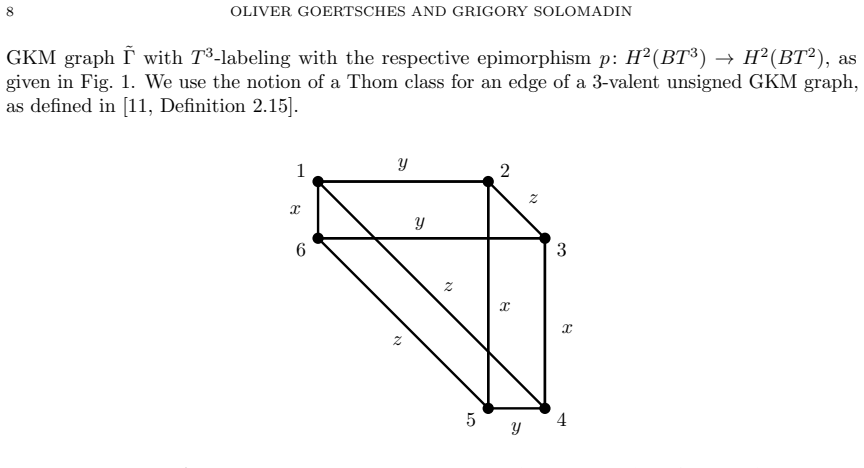
read the original abstract
Given a GKM$_3$ action of a torus $K$ on a manifold $M$ with GKM graph $\Gamma$, we show that for any extension of $\Gamma$ to an abstract GKM graph the corresponding restriction map in equivariant graph cohomology is surjective. While the corresponding statement for extensions of actions is well-known, we observe that this graph-theoretical statement is false in the GKM$_2$ setting. As a corollary, we obtain a description of the equivariant cohomology ring of Hamiltonian and complexity one GKM$_4$ actions in terms of generators and relations.
Editorial analysis
A structured set of objections, weighed in public.
Referee Report
Summary. The manuscript proves that given a GKM₃ torus action on a manifold M with GKM graph Γ, the restriction map in equivariant graph cohomology is surjective for any extension of Γ to an abstract GKM graph. The corresponding statement fails for GKM₂ actions, as shown by a counterexample. As a corollary, the authors derive an explicit generators-and-relations presentation for the equivariant cohomology rings of Hamiltonian and complexity-one GKM₄ manifolds.
Significance. The result supplies a combinatorial criterion that yields concrete presentations of equivariant cohomology rings for two geometrically natural classes of manifolds. The proof is graph-theoretic and independent of additional parameters; the explicit contrast with the GKM₂ case and the corollary description constitute the main contributions.
minor comments (3)
- [§3] §3, Definition 3.4: the precise combinatorial conditions imposed on an abstract GKM graph extension (especially the GKM₃ edge-labeling compatibility) should be stated as a numbered list rather than inline prose to facilitate verification of the surjectivity argument.
- [Corollary 4.2] Corollary 4.2: the generators-and-relations description is stated abstractly; including a single low-dimensional example (e.g., a complexity-one GKM₄ manifold whose graph is explicitly extended) would make the corollary immediately usable for readers.
- [§2] The paper cites the standard GKM references but does not explicitly recall the precise definition of equivariant graph cohomology used here; a one-paragraph reminder in §2 would improve self-containedness.
Simulated Author's Rebuttal
We thank the referee for the careful reading of our manuscript and for the positive assessment, including the recommendation for minor revision. No specific major comments were raised in the report, so we have no point-by-point responses to provide at this stage. We will address any minor issues or suggestions during the revision process.
Circularity Check
No significant circularity detected
full rationale
The paper establishes a combinatorial surjectivity theorem for restriction maps in equivariant graph cohomology when extending GKM3 graphs to abstract GKM graphs, explicitly noting failure in the GKM2 case. This is proved directly from standard definitions of GKM graphs, their cohomology rings, and the combinatorial axioms for abstract GKM graphs. The corollary giving generators-and-relations descriptions for Hamiltonian/complexity-one GKM4 actions follows from the new combinatorial result without reduction to fitted parameters, self-definitional loops, or load-bearing self-citations. The derivation chain is self-contained against external GKM benchmarks and does not match any enumerated circularity pattern.
Axiom & Free-Parameter Ledger
axioms (1)
- domain assumption Standard properties of GKM graphs and the definition of equivariant graph cohomology as in the prior GKM literature
Reference graph
Works this paper leans on
-
[1]
C. Allday, M. Franz, and V. Puppe,Equivariant cohomology, syzygies and orbit structure, Trans. AMS366 (2014), 6567–6589. doi:10.1090/S0002-9947-2014-06165-5, arXiv:1111.0957
-
[2]
doi:10.1515/forum-2020-0188, arXiv:2007.00496
,Syzygies in equivariant cohomology in positive characteristic, Forum Math.33(2)(2021), 547–567. doi:10.1515/forum-2020-0188, arXiv:2007.00496
-
[3]
A. Ayzenberg and M. Masuda,Orbit spaces of equivariantly formal torus actions of complexity one, Transfor- mation Groups (2023). doi:10.1007/s00031-023-09822-3, arXiv:1912.11696
-
[4]
A. Ayzenberg, M. Masuda, and G. Solomadin,How is a graph not like a manifold?, Sbornik: Mathematics 214(6)(2023), 793–815. doi:10.4213/sm9798e, arXiv:2203.10641
-
[5]
Spanning trees in random regular graphs,
A. Bj¨ orner,Regular CW Complexes and Bruhat Order, E. J. Comb.5(1)(1984), 7–16. doi:10.1016/S0195- 6698(84)80012-8
-
[6]
Bourbaki,Commutative Algebra, Elements of Mathematics, Addison-Wesley, Massachusetts, 1972
N. Bourbaki,Commutative Algebra, Elements of Mathematics, Addison-Wesley, Massachusetts, 1972
1972
-
[7]
T. Chang and T. Skjelbred,The topological Schur lemma and related results, Ann. Math.2(100)(1974), 307–321. https://doi.org/10.2307/1971074
-
[8]
M. Franz,A quotient criterion for syzygies in equivariant cohomology, Transformation Groups22(2016), 933–965. doi:10.1007/s00031-016-9408-3, arXiv:1205.4462
-
[9]
M. Franz and V. Puppe,Exact cohomology sequences with integral coefficients for torus actions, Transformation Groups12(2007), 65–76. https://doi.org/10.1007/s00031-005-1127-0, arXiv:math/0505607
-
[10]
O. Goertsches, P. Konstantis, and L. Zoller,Low-dimensional GKM theory, Group actions and equivariant cohomology. AMS special session on equivariant cohomology, virtual, March 19–20, 2022, 2024, pp. 113–146. https://doi.org/10.1090/conm/808/16183, arXiv:2210.06234. EPIMORPHISMS AND FACE RING QUOTIENTS 11
- [11]
-
[12]
O. Goertsches and G. Solomadin,Extensions of realizable Hamiltonian and complexity one GKM 4 graphs, J. Alg. Comb. (accepted). arXiv:2509.00392
-
[13]
O. Goertsches and M. Wiemeler,Non-negatively curved GKM orbifolds, Math. Z.300(2022), 2007–2036. doi:10.1007/s00209-021-02853-0, https://arxiv.org/abs/1802.05871
-
[15]
V. Guillemin, T. Holm, and C. Zara,A GKM description of the equivariant cohomology ring of a homogeneous space, J. Alg. Comb.23(2006), 21–41. https://doi.org/10.1007/s10801-006-6027-4, https://arxiv.org/abs/math/0112184
-
[16]
V. Guillemin and C. Zara,1-skeleta, Betti numbers, and equivariant cohomology, Duke Math. J.107(2)(2001), 283–349. doi:10.1215/S0012-7094-01-10724-2, arXiv:math/9903051
-
[17]
Kuroki,Upper bounds for the dimension of tori acting on GKM manifolds, J
S. Kuroki,Upper bounds for the dimension of tori acting on GKM manifolds, J. Math. Soc. Japan71(2) (2019), 483–513. https://doi.org/10.2969/jmsj/79177917, https://doi.org/10.2969/jmsj/79177917
-
[18]
H. Maeda, M. Masuda, and T. Panov,Torus graphs and simplicial posets, Adv. Math.212(2007), 458–483. https://doi.org/10.1016/j.aim.2006.10.011, https://arxiv.org/abs/math/0511582
-
[19]
Massey,A basic course in algebraic topology, Graduate Texts in Mathematics 127, Springer New York, NY, 1991
W.S. Massey,A basic course in algebraic topology, Graduate Texts in Mathematics 127, Springer New York, NY, 1991
1991
-
[20]
M. Masuda and T. Panov,On the cohomology of torus manifolds, Osaka J. Math.43(2006), 711–746. https://doi.org/10.18910/12823,arXiv:math/0306100
-
[21]
Solomadin,On independent GKM-graphs without nontrivial extensions, Bol
G. Solomadin,On independent GKM-graphs without nontrivial extensions, Bol. Soc. Mat. Mex.29(84)(2023). doi:10.1007/s40590-023-00567-3, arXiv:2205.07197. (O. Goertsches)Philipps-Universit ¨at Marburg, Germany Email address:goertsch@mathematik.uni-marburg.de (G. Solomadin)Philipps-Universit ¨at Marburg, Germany Email address:grigory.solomadin@gmail.com
discussion (0)
Sign in with ORCID, Apple, or X to comment. Anyone can read and Pith papers without signing in.