Recognition: unknown
Probing Coronal Activity Using Radio Signals Based on the 2021 superior conjunction of Mars: the Downlink Data from Tianwen-1
Pith reviewed 2026-05-10 12:33 UTC · model grok-4.3
The pith
A characteristic frequency scintillation parameter extracted from a Mars spacecraft downlink signal identifies coronal streamers, high-speed solar wind, and CMEs through temporal and spatial correlations.
A machine-rendered reading of the paper's core claim, the machinery that carries it, and where it could break.
Core claim
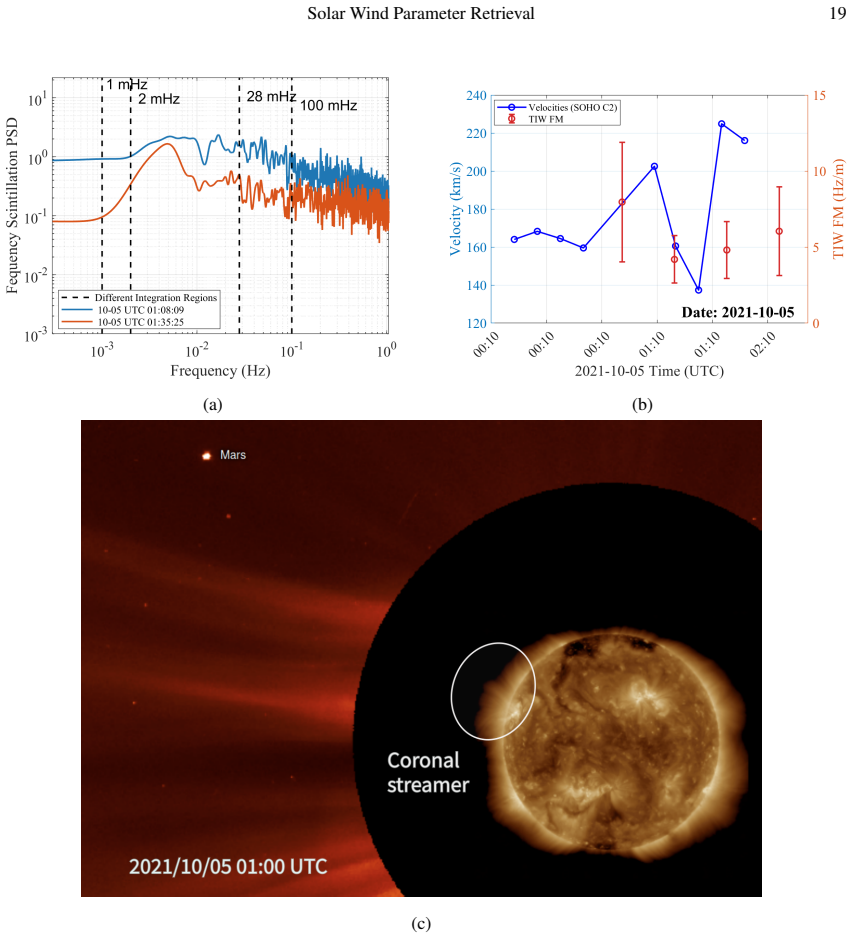
Analysis of the Doppler frequency scintillation spectrum within 10 solar radii yields a characteristic frequency scintillation parameter. This parameter increases with decreasing solar distance and exhibits anomalies on October 5, 13, and 15 that display strong spatio-temporal correlations with coronal activity. The parameter thereby identifies phenomena including coronal streamers, high-speed solar wind, and coronal mass ejections, while the observed temporal correlation and delay with solar wind speed changes confirms the feasibility of spatially localizing the responsible solar activity.
What carries the argument
The characteristic frequency scintillation parameter derived from the Doppler frequency scintillation spectrum of the solar wind.
If this is right
- The parameter increases as the signal path approaches the Sun.
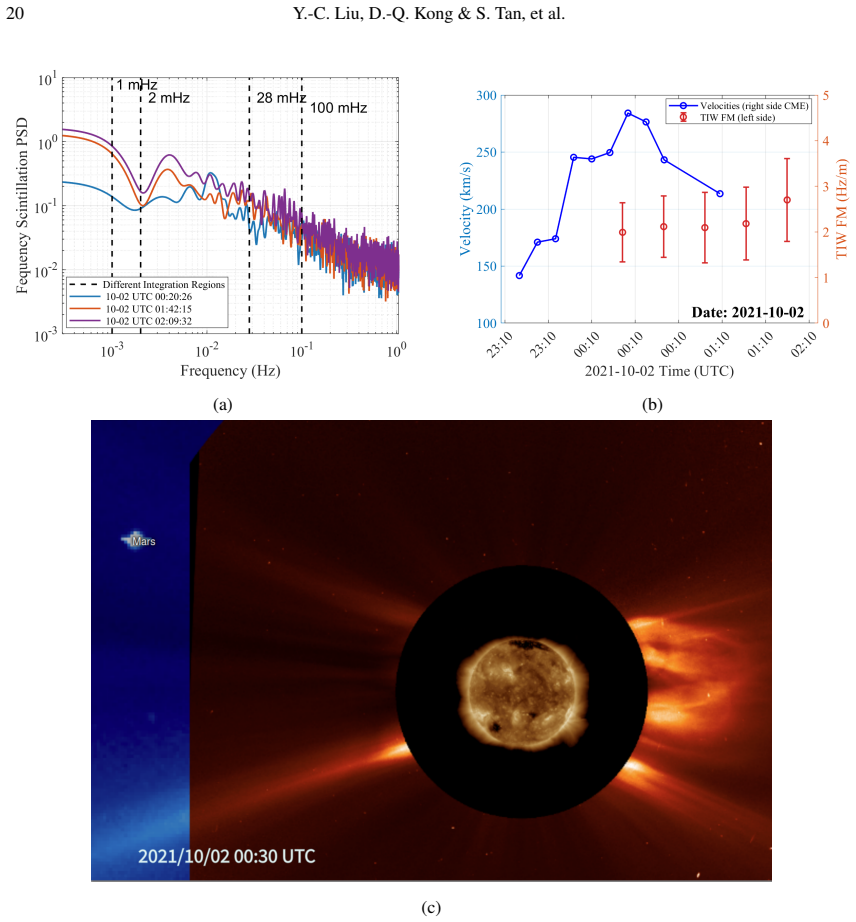
- Anomalies in the parameter correspond to the passage of coronal streamers, high-speed solar wind, and CMEs.
- A distinct temporal correlation and delay exists between frequency scintillation and solar wind speed changes.
- The approach validates the feasibility of spatially localizing solar activity using spacecraft radio signals.
Where Pith is reading between the lines
- Routine downlink signals from any interplanetary probe could supply similar coronal diagnostics during future superior conjunctions.
- The scintillation parameter supplies an independent data stream that could cross-check models of solar wind acceleration derived from imaging alone.
- Multiple simultaneous spacecraft links at different solar longitudes might allow tomographic reconstruction of coronal structures.
Load-bearing premise
The observed frequency scintillation anomalies are produced by specific coronal structures rather than other propagation effects, instrumental artifacts, or coincidental timing.
What would settle it
Absence of any increase in the parameter as the signal path approaches the Sun, or complete lack of correspondence between the dates of parameter anomalies and independent records of coronal streamers or CMEs on those dates.
Figures



read the original abstract
During the first superior conjunction of the Tianwen-1 Mars probe in October 2021, its downlink signal received by the Wuqing 70-m radio telescope passed within 4.53 solar radii of the Sun. The signal was significantly perturbed by the solar wind, providing a mechanism to probe coronal activity. We analyze the Doppler frequency scintillation spectrum of the solar wind within 10 solar radii to derive a characteristic frequency scintillation parameter. Statistical analysis indicates this parameter increases as the signal path approaches the Sun, with notable anomalies observed on October 5, 13, and 15. Comparisons with SOHO and SDO data reveal strong spatio-temporal correlations between these scintillation anomalies and coronal activity. We demonstrate that this parameter effectively identifies solar phenomena, including coronal streamers, high-speed solar wind, and coronal mass ejections (CMEs). Quantitative analysis confirms a distinct temporal correlation and delay between frequency scintillation and solar wind speed changes, validating the feasibility of spatially localizing solar activity.
Editorial analysis
A structured set of objections, weighed in public.
Referee Report
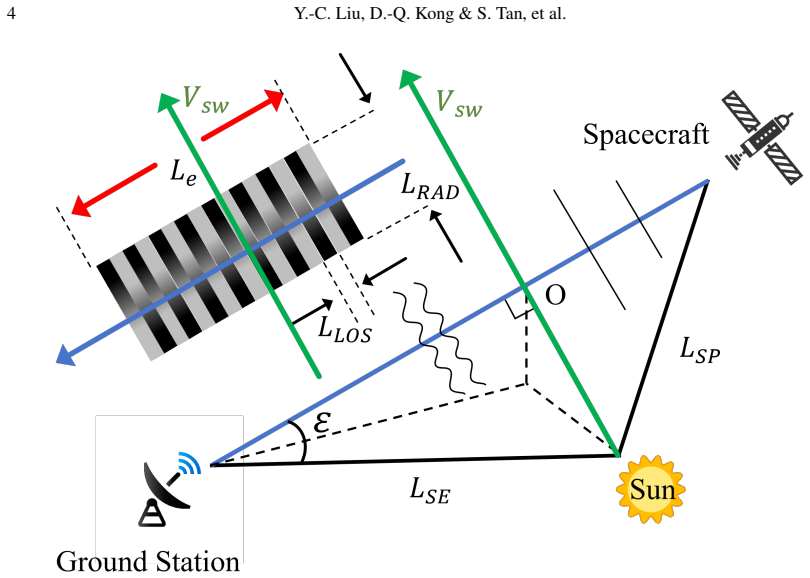
Summary. The manuscript analyzes Doppler frequency scintillation spectra in the Tianwen-1 Mars probe downlink signal received at the Wuqing 70-m telescope during the October 2021 superior conjunction, when the line of sight passed within 4.53 Rs of the Sun. From these spectra the authors derive a characteristic frequency scintillation parameter, report that it increases as the path approaches the Sun, identify anomalies on 5, 13 and 15 October, and show spatio-temporal correlations between those anomalies and coronal streamers, high-speed wind streams, and CMEs visible in contemporaneous SOHO and SDO imagery. They conclude that the parameter can identify these solar-wind structures and that the observed temporal delays validate the feasibility of spatially localizing coronal activity.
Significance. If the reported correlations survive quantitative scrutiny, the work demonstrates a practical, ground-based radio technique for monitoring inner-coronal structures using existing planetary-mission downlinks. The cross-instrument comparison with independent EUV and white-light imagery is a constructive element. However, the absence of forward modeling of the line-of-sight integral and of uncertainty estimates on the scintillation parameter limits the immediate scientific impact.
major comments (2)
- [Abstract / quantitative analysis] Abstract and quantitative-analysis section: the central claim that the frequency-scintillation parameter 'validates the feasibility of spatially localizing solar activity' is not supported by any forward-model calculation that folds the known three-dimensional locations of streamers, high-speed streams, or CMEs into the exact Earth–Tianwen-1 ray-path geometry. Without such modeling, the reported temporal offset between scintillation anomalies and in-situ solar-wind speed changes could arise from integration along distant path segments or from geometric projection effects rather than from the specific coronal features invoked.
- [Statistical analysis] Statistical-analysis section: no error bars, formal uncertainty propagation, or explicit data-selection criteria are supplied for the scintillation parameter or for the identification of the October 5, 13, and 15 anomalies. This omission prevents assessment of whether the claimed 'strong spatio-temporal correlations' exceed the level expected from random fluctuations or post-hoc choices.
minor comments (2)
- [Methods] The explicit mathematical definition of the 'characteristic frequency scintillation parameter' (including any windowing or fitting procedure applied to the Doppler spectrum) should be stated in the methods section with an equation number.
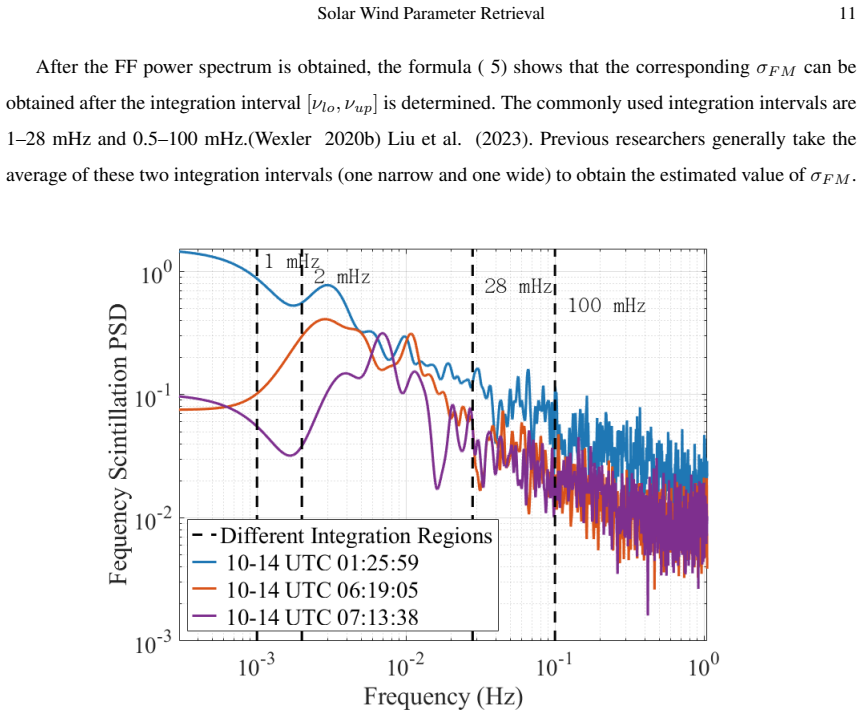
- [Figures] Figure captions should indicate the precise time intervals and frequency ranges used to compute the scintillation parameter for each plotted point.
Simulated Author's Rebuttal
We thank the referee for the constructive and detailed review. The comments highlight important areas for strengthening the quantitative interpretation and statistical rigor of our analysis. We address each major comment below, indicating the revisions incorporated into the manuscript.
read point-by-point responses
-
Referee: [Abstract / quantitative analysis] Abstract and quantitative-analysis section: the central claim that the frequency-scintillation parameter 'validates the feasibility of spatially localizing solar activity' is not supported by any forward-model calculation that folds the known three-dimensional locations of streamers, high-speed streams, or CMEs into the exact Earth–Tianwen-1 ray-path geometry. Without such modeling, the reported temporal offset between scintillation anomalies and in-situ solar-wind speed changes could arise from integration along distant path segments or from geometric projection effects rather than from the specific coronal features invoked.
Authors: We agree that a full forward-modeling calculation incorporating the precise 3D geometry of the coronal structures along the Earth–Tianwen-1 line of sight would provide more definitive support for the spatial-localization interpretation. Our analysis instead relies on direct spatio-temporal correlations between the observed scintillation anomalies and the independently imaged coronal streamers, high-speed streams, and CMEs in contemporaneous SOHO and SDO data, together with the measured temporal delays that are consistent with expected propagation distances. We have revised the quantitative-analysis section to include an expanded discussion of line-of-sight integration effects, possible projection ambiguities, and the limitations of the current approach. We note, however, that performing a complete forward simulation lies beyond the scope of this observational study. revision: partial
-
Referee: [Statistical analysis] Statistical-analysis section: no error bars, formal uncertainty propagation, or explicit data-selection criteria are supplied for the scintillation parameter or for the identification of the October 5, 13, and 15 anomalies. This omission prevents assessment of whether the claimed 'strong spatio-temporal correlations' exceed the level expected from random fluctuations or post-hoc choices.
Authors: We concur that explicit uncertainty estimates and transparent data-selection criteria are necessary to evaluate the robustness of the reported correlations. In the revised manuscript we have added error bars to the frequency-scintillation parameter derived from the Doppler spectral fitting uncertainties and the standard deviation across frequency bins. We have also documented the anomaly-identification criteria (deviations exceeding three standard deviations from the smoothed background trend) and included a brief statistical assessment demonstrating that the spatio-temporal correlations with the coronal features exceed the 95 % confidence level relative to randomized time series. revision: yes
Circularity Check
No significant circularity; derivation remains self-contained
full rationale
The frequency scintillation parameter is extracted directly from the observed Doppler spectrum of the Tianwen-1 downlink. Anomalies are identified via statistical analysis of the parameter's behavior as the ray path approaches the Sun, then cross-checked against independent SOHO/SDO imagery for spatio-temporal correlations. The claim that the parameter identifies specific phenomena (streamers, high-speed wind, CMEs) and supports spatial localization rests on these external data matches and observed time delays, not on any internal redefinition, fitted subset renamed as prediction, or self-citation chain. No equations reduce the output to the input by construction, and the analysis is benchmarked against separate observational datasets.
Axiom & Free-Parameter Ledger
Reference graph
Works this paper leans on
-
[1]
L., & Wackley, J
Berman, A. L., & Wackley, J. A. 1976, Deep Space Netw. Prog. Rep., 33, 159
1976
-
[2]
2022, Reviews of Geophysics, 60,e2022RG000792
Bilitza, D., Pezzopane, M., Truhlik, V., et al. 2022, Reviews of Geophysics, 60,e2022RG000792
2022
-
[3]
2009, Earth Moon Planet, 104, 101
Bruno, R., Carbone, V., V \"o r \"o s, Z., et al. 2009, Earth Moon Planet, 104, 101
2009
-
[4]
2013, Living Rev
Bruno, R., & Carbone, V. 2013, Living Rev. Sol. Phys., 10, 2
2013
-
[5]
Cai, L.-N., Xu, G.-J., Zhang, Q.-Y., et al.2025, IEEE Trans. Veh. Technol., 74, 19743
2025
-
[6]
2022, ApJ, 937, 44
Chen, C., Liu, Y.-D., & Zhu, B. 2022, ApJ, 937, 44
2022
-
[7]
Chen, L., Wang, M., Jian, N.-C., et al. 2023, J. Deep Space Explor., 2023, 10, 80
2023
-
[8]
2022, Sol
Chiba, S., Imamura, T., Tokumaru, M., et al. 2022, Sol. Phys., 297, 34
2022
-
[9]
2025, ApJ, 986, 56
Chougule, P.,Bharati,K., & Amar, K. 2025, ApJ, 986, 56
2025
-
[10]
M., 1972, ApJL, 171, L101
Cronyn, W. M., 1972, ApJL, 171, L101
1972
-
[11]
Edwards, J.,Molera Calv\' e s, G., Kummamuru, P., Said, N. M. M., & Ma, M. 2025, Space Weather, 23, e2024SW004225
2025
-
[12]
Efimov, A.I., Chashei, I.V., Samoznaev, L.N. et al. 2002, Astron. Rep. 46, 579
2002
-
[13]
Efimov, A.I., Samoznaev, L.N., Bird, M.K. et al. 2008, Adv. Space Res., 42, 117
2008
-
[14]
Feria,Y., Belongie,M., McPheeters, T.,& Tan, H., 1997, TDA Prog. Rep. 42, 129
1997
-
[15]
1969, Science,166,598
Goldstein,R.M. 1969, Science,166,598
1969
-
[16]
Geng, Y., Zhou, J.-S., Li, S., et al. 2018, J. Deep Space Explor., 5, 399
2018
-
[17]
2022, Remote Sens
Hu, X., Wu, X., Song, S., et al. 2022, Remote Sens. 14, 2718
2022
-
[18]
2021, Space Sci
Huang, X.-Y., Li, M.-D., Wang, X.-L., et al. 2021, Space Sci. Technol., 2021, 846185
2021
-
[19]
2005, A&A, 439, 1165
Imamura, T., Noguchi, K., Nabatov, A., et al. 2005, A&A, 439, 1165
2005
-
[20]
2014, ApJ, 788, 117
Imamura, T., Tokumaru, M., Isobe, H., et al. 2014, ApJ, 788, 117
2014
-
[21]
N., Choudhary R
Jain R. N., Choudhary R. K., Bhardwaj A., et al. 2023, MNRAS, 525, 373
2023
-
[22]
Space Weather Space Clim
Jakowski, N., & Mainul Hoque, M., 2025, J. Space Weather Space Clim. 2025, 15, 56
2025
-
[23]
2022, RAA, 22, 035013
Kong, D.-Q., Li, C.-L., Zhang, H.-B., et al. 2022, RAA, 22, 035013
2022
-
[24]
Liu, J.-J., Su, Y., Zuo, W., et al. 2018, J. Deep Space Explor., 5, 414
2018
-
[25]
2021, Nat
Liu, J., Wang, W.-B., Qian, L.-Y., et al. 2021, Nat. Phys., 17, 807
2021
-
[26]
2022, Sci
Liu, Q.-H., Huang, Y., Shu, F.-C., et al. 2022, Sci. China: Phys. Mech. Astron., 52, 239507
2022
-
[27]
2023, RAA, 23, 085023
Liu, Y.-C., Kong, D.-Q., Liu, D.-H., et al. 2023, RAA, 23, 085023
2023
-
[28]
2021, AJ, 162, 141
Ma, M.-L., Molera Calv\' e s, G., Cim\` o , G., et al. 2021, AJ, 162, 141
2021
-
[29]
2022, ApJL, 940, L32
Ma, M.-L.,Molera Calv\' e s, G., Cim\` o , G.,et al. 2022, ApJL, 940, L32
2022
-
[30]
2014, A&A, 564, A4
Molera Calv\' e s, G., Pogrebenko, S.V., Cim\` o , G.,et al. 2014, A&A, 564, A4
2014
-
[31]
V., Wagner, J
Molera Calv\' e s, G., Pogrebenko, S. V., Wagner, J. F., et al. 2021, PASA, 38, e065
2021
-
[32]
a tzold, M., H\
P\" a tzold, M., H\" a usler, B., Tyler, G. L., et al. 2016, Planet. Space Sci., 127, 44
2016
-
[33]
D., et al
Shi, C., Velli, M., Bale, S. D., et al. 2022, Phys. Plasmas, 29, 122901
2022
-
[34]
2023, ApJS, 269, 57
Wang, Z.-C., Ma, M.-L., Liu, Q.-H., et al. 2023, ApJS, 269, 57
2023
-
[35]
J., Seaton, D
West, M. J., Seaton, D. B., Wexler, D. B., et al. 2023, Sol. Phys. 298,78
2023
-
[36]
B., Hollweg, J
Wexler, D. B., Hollweg, J. V., Efimov, A. I., et al. 2019a, ApJ, 871, 202
-
[37]
B., Imamura, T., Efimov, A., et al
Wexler, D. B., Imamura, T., Efimov, A., et al. 2020a, Sol. Phys., 295, 111
-
[38]
Wexler, D. B. 2020b, On the Fluctuations of Electron Density and Magnetic Field in the Solar Mid-Corona: Space Radio Observations, Ph.D. thesis (Toowoomba, AU: Univ. of Southern Queensland)
-
[39]
B., Kooi, J
Wexler, D. B., Kooi, J. E., Jensen, E. A., Song, P. 2022, Front. Astron. Space Sci., 9, 1047875
2022
-
[40]
W., Kendall, W
Woo, R., Yang, F.-C., Yip, K. W., Kendall, W. B., 1976, ApJ, 210, 568
1976
-
[41]
2019, IEEE Wirel
Xu, G.-J., & Song, Z.-H. 2019, IEEE Wirel. Commun., 26, 10
2019
-
[42]
2021, China's First Mars Exploration Project (1st ed.; Beijing: China Astronautic Publ
Zhang, R.-Q, et al. 2021, China's First Mars Exploration Project (1st ed.; Beijing: China Astronautic Publ. House)
2021
-
[43]
H., & Richardson, I
Zurbuchen, T. H., & Richardson, I. G. 2006, Space Sci. Rev., 123, 31
2006
-
[44]
@esa (Ref
\@ifclassloaded agu2001 natbib The agu2001 class already includes natbib coding, so you should not add it explicitly Type <Return> for now, but then later remove the command natbib from the document \@ifclassloaded aguplus natbib The aguplus class already includes natbib coding, so you should not add it explicitly Type <Return> for now, but then later rem...
-
[45]
@stdbsttrue NAT@ctr \@lbibitem[ NAT@ctr ] \@lbibitem[#1]#2 \@extra@b@citeb \@ifundefined br@#2\@extra@b@citeb \@namedef br@#2 \@nameuse br@#2\@extra@b@citeb \@ifundefined b@#2\@extra@b@citeb @num @parse #2 [ @natanchorstart #2\@extra@b@citeb \@biblabel @num @natanchorend] @ifcmd#1(@)(@)\@nil #2 @lbibitem\@undefined @lbibitem\@lbibitem \@lbibitem[#1]#2 @lb...
-
[46]
, " * write output.state after.block = add.period write newline
@open @close @open @close and [1] URL: #1 \@ifundefined chapter * \@mkboth \@ifundefined NAT@sectionbib * \@mkboth * \@mkboth\@gobbletwo \@ifclassloaded amsart * \@ifclassloaded amsbook * \@ifundefined bib@heading @heading NAT@ctr thebibliography [1] @ \@biblabel NAT@ctr \@bibsetup #1 NAT@ctr 0 @openbib .11em \@plus.33em \@minus.07em 4000 4000 `\.=1000 \@...
-
[47]
write newline
" write newline "" before.all 'output.state := FUNCTION format.archive archivePrefix empty "" archivePrefix ":" * if FUNCTION format.primaryClass primaryClass empty "" " [" primaryClass * "]" * if FUNCTION format.eprint eprint empty pages empty not booktitle empty not or or "" archive empty ", " * format.archive * eprint * "" ", " * format.archive * eprin...
discussion (0)
Sign in with ORCID, Apple, or X to comment. Anyone can read and Pith papers without signing in.