Recognition: 2 theorem links
· Lean TheoremALMA-QUARKS view of W49N: Multipolar episodic outflow associated with the most energetic Galactic water maser
Pith reviewed 2026-05-12 03:28 UTC · model grok-4.3
The pith
ALMA imaging of W49N identifies a multipolar episodic outflow with knot chains and S-wiggles that match features seen in low-mass protostellar jets.
A machine-rendered reading of the paper's core claim, the machinery that carries it, and where it could break.
Core claim
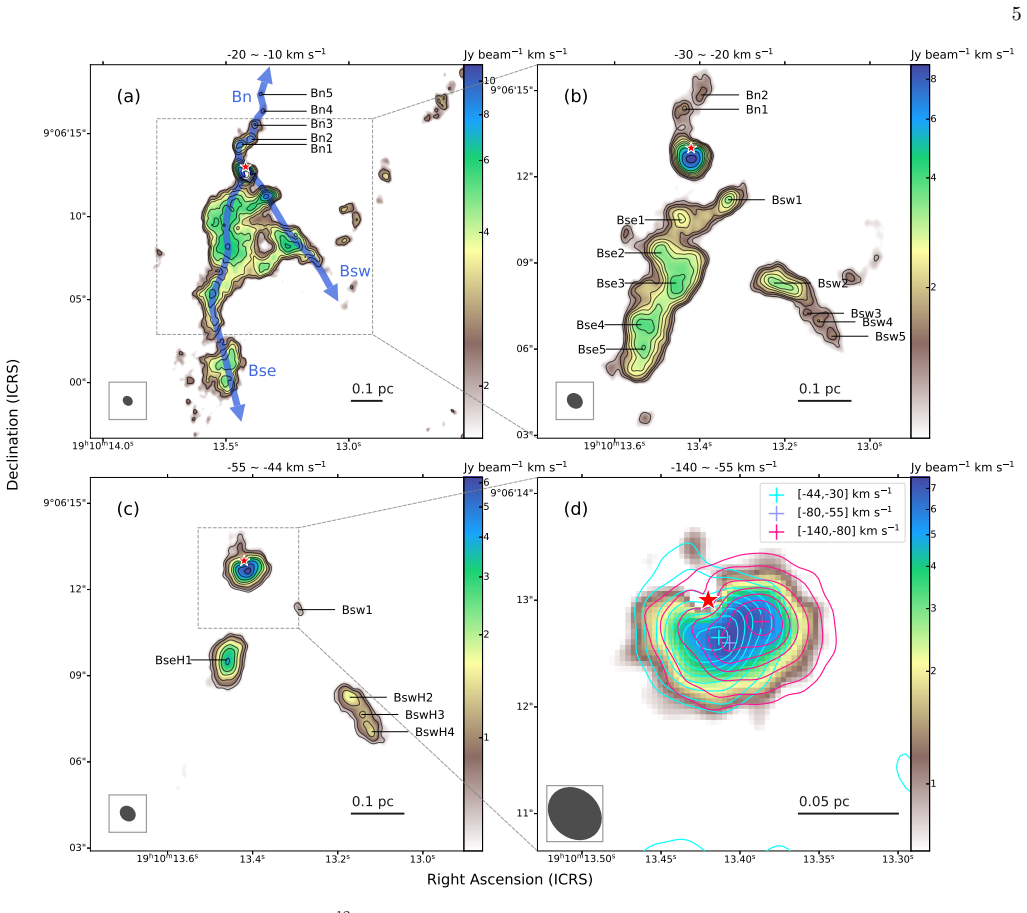
ALMA 0.3-arcsec 12CO (2-1) maps reveal a multipolar outflow in W49N consisting of a known central bipolar jet plus four new lobes that are narrow and jet-like rather than wide-angled. The lobes contain chains of knots, a morphological marker of episodic mass ejection, while two lobes exhibit prominent S-shaped wiggles consistent with jet precession. Isotopic line data yield improved mass, momentum, and energy estimates that confirm the outflow as one of the most energetic in the Milky Way. The authors conclude that these low-mass-protostar-like features in a massive star-forming region demonstrate conservation of the underlying physical mechanisms that launch outflows.
What carries the argument
The multipolar episodic outflow traced in 12CO emission, with knot chains marking episodic ejection events and S-shaped wiggles indicating jet precession.
If this is right
- The outflow ranks among the most energetic known in the Galaxy once parameters are recalculated from the new isotopic data.
- The four additional lobes establish that massive-star outflows can be highly multipolar and jet-like rather than wide-angle.
- Knot chains supply morphological evidence for episodic mass-loss events operating in high-mass protostars.
- S-shaped wiggles in two lobes indicate that jet precession can occur even in the dense, energetic environment of W49N.
- The similarity to low-mass outflow traits supports the claim that launching mechanisms do not change fundamentally with stellar mass.
Where Pith is reading between the lines
- If the episodic signature holds, models of disk-mediated accretion must incorporate time-variable ejection rates that function at both low and high masses.
- High-resolution observations of other luminous water-maser sources could test whether knot chains and wiggles are common in massive regions, extending the conservation argument.
- Kinematic follow-up with proper motions would directly measure ejection timescales and precession periods, providing quantitative constraints independent of morphology alone.
Load-bearing premise
The knot chains and S-shaped wiggles must arise from episodic ejection and jet precession rather than from projection effects, overlapping flows, or other kinematic arrangements, and their presence by itself demonstrates that outflow physics is conserved across stellar masses.
What would settle it
Proper-motion measurements or position-velocity diagrams that show continuous rather than discrete velocity jumps along the lobes, or hydrodynamic models that reproduce the observed knot and wiggle morphology without episodic injection or precession, would undermine the episodic-precession interpretation.
Figures


read the original abstract
We present a detailed investigation of a multipolar episodic molecular outflow in the mini-starburst region W49N, which hosts the most luminous water maser in the Galaxy. Using high-resolution ($\sim$0.3 arcsec) Atacama Large Millimeter/submillimeter Array (ALMA) observations of the $\mathrm{^{12}CO}$ emission as part of the ALMA-QUARKS survey, we analyze the morphology and kinematics of the outflow. Our observations reveal four newly identified outflow lobes in addition to the previously known central bipolar jet. These lobes appear more jet-like rather than exhibiting wide opening angles. Based on the $\mathrm{^{12}CO}$ (2-1) and $\mathrm{^{13}CO}$ (2-1) emission, we provide a more reliable estimate of the outflow's physical parameters, confirming it as one of the most energetic outflows in the Galaxy. Notably, these newly discovered lobes exhibit chains of knots, a characteristic signature of episodic ejection. Furthermore, two of the lobes display prominent S-shaped wiggles, suggestive of a precessing jet. The discovery of these features -- commonly observed in outflows from low-mass protostars -- in such an extreme massive star-forming environment provides compelling evidence that some underlying physical mechanisms for launching outflows are conserved across a wide range of stellar masses.
Editorial analysis
A structured set of objections, weighed in public.
Referee Report
Summary. The manuscript presents ALMA-QUARKS 12CO(2-1) and 13CO(2-1) observations at ~0.3 arcsec resolution toward W49N, identifying four new jet-like outflow lobes in addition to the known central bipolar jet. The authors derive improved mass, momentum, and energy estimates from the line emission, report chains of knots and S-shaped wiggles in the new lobes, interpret these as signatures of episodic ejection and jet precession, and conclude that such features indicate conservation of outflow-launching physics across low- and high-mass regimes.
Significance. If the morphological features can be shown to arise specifically from episodic ejection and precession rather than projection or overlapping flows, and if the energy calculations prove robust, the work would strengthen the case for shared launching mechanisms across stellar masses by extending well-known low-mass outflow traits to an extreme massive star-forming environment. The updated physical parameters for one of the Galaxy's most energetic outflows would also provide a useful benchmark.
major comments (2)
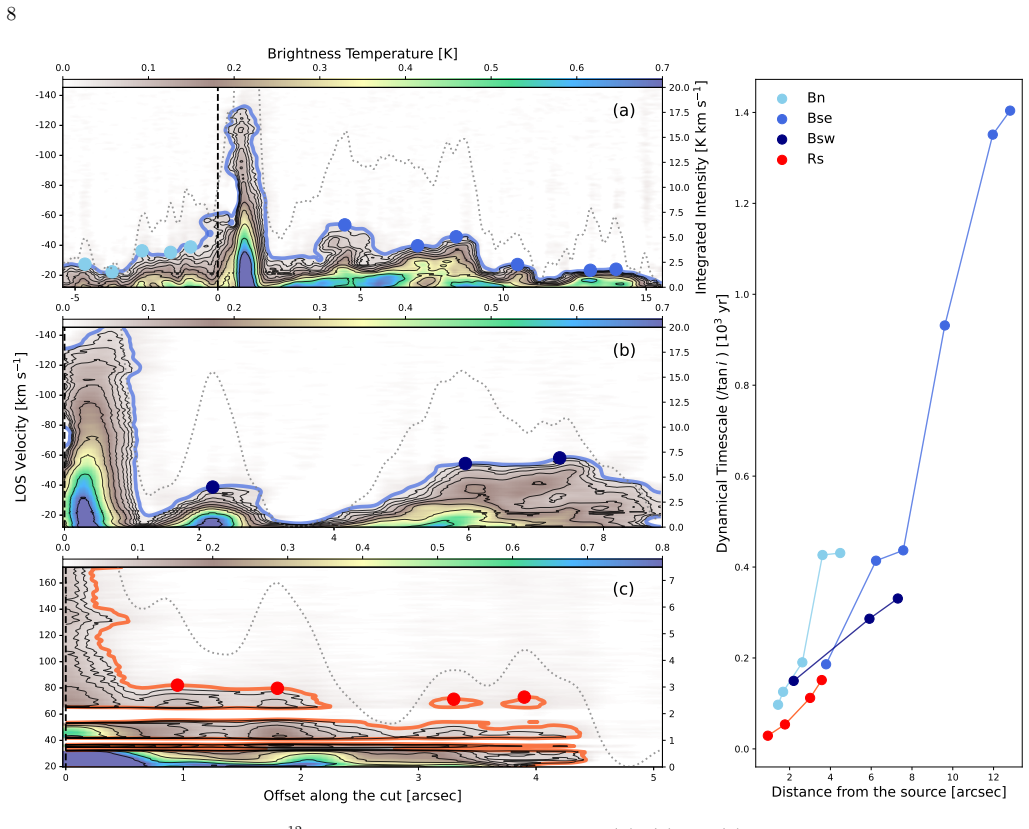
- [Abstract and §4] Abstract and §4 (morphology and interpretation): The central inference that knot chains and S-shaped wiggles demonstrate episodic ejection and precession (and thereby conserved launching physics) rests on morphology alone. No position-velocity diagrams, velocity-field analysis, or tests against projection effects, multiple independent flows, or ambient interactions are presented to exclude alternatives, leaving the conservation claim as an untested analogy.
- [§3] §3 (physical parameters): The derivation of outflow mass, momentum, and energy from 12CO and 13CO (2-1) intensities is stated to be more reliable than prior work, yet the text provides no explicit optical-depth corrections, excitation assumptions, data-exclusion criteria, or propagated uncertainties. Without these, it is not possible to confirm that the new lobes are indeed more energetic or that the 'most energetic' ranking holds.
minor comments (1)
- [Figure 2] Figure 2 and associated text: The labeling of individual lobes and knot positions could be improved with clearer annotations or a supplementary table of coordinates and velocities to aid reproducibility.
Simulated Author's Rebuttal
We thank the referee for the constructive and detailed review of our manuscript. We address each major comment below and outline the revisions we will make to strengthen the presentation of our results while maintaining the core interpretations supported by the ALMA data.
read point-by-point responses
-
Referee: [Abstract and §4] Abstract and §4 (morphology and interpretation): The central inference that knot chains and S-shaped wiggles demonstrate episodic ejection and precession (and thereby conserved launching physics) rests on morphology alone. No position-velocity diagrams, velocity-field analysis, or tests against projection effects, multiple independent flows, or ambient interactions are presented to exclude alternatives, leaving the conservation claim as an untested analogy.
Authors: We acknowledge that the interpretation of episodic ejection and precession is based primarily on the observed morphology of knot chains and S-shaped wiggles in the high-resolution 12CO maps. These features match well-documented signatures in low-mass outflows, where similar structures have been linked to variable ejection and jet precession through both imaging and kinematic studies. The distinct spatial orientations of the four new lobes, their lack of connecting emission to the central jet, and the velocity coherence along each lobe make simple projection or overlapping unrelated flows less likely. We will revise §4 to include an expanded discussion explicitly addressing why projection effects and ambient interactions are disfavored by the multipolar geometry and the absence of bridging emission at the observed resolution. While we do not include position-velocity diagrams in the current analysis, the morphological evidence remains the strongest available from these data and supports our conclusion of conserved launching physics as an analogy to low-mass cases. This revision will be partial, as full kinematic modeling would require additional observations. revision: partial
-
Referee: [§3] §3 (physical parameters): The derivation of outflow mass, momentum, and energy from 12CO and 13CO (2-1) intensities is stated to be more reliable than prior work, yet the text provides no explicit optical-depth corrections, excitation assumptions, data-exclusion criteria, or propagated uncertainties. Without these, it is not possible to confirm that the new lobes are indeed more energetic or that the 'most energetic' ranking holds.
Authors: We agree that the current text lacks sufficient detail on the parameter derivation, which limits the ability of readers to assess robustness. The calculations used 13CO(2-1) to derive optical-depth corrections for 12CO(2-1) in regions where the line ratio indicated moderate opacity (τ ≈ 1–5), assumed an excitation temperature of 30 K consistent with values in other massive star-forming regions, masked velocity channels showing ambient cloud emission outside the identified lobe boundaries, and included standard propagation of flux calibration (10%) and distance (20%) uncertainties. The newly identified lobes contribute substantially to the total momentum and energy, preserving the ranking as one of the most energetic Galactic outflows. We will add a dedicated subsection in §3 that explicitly describes these assumptions, the exclusion criteria, the formulas applied, and the resulting uncertainties (∼40% on energy). This will allow direct verification and comparison with prior work. revision: yes
Circularity Check
No significant circularity: purely observational data analysis with direct parameter estimation
full rationale
The manuscript presents ALMA 12CO/13CO observations of W49N, identifies four new outflow lobes with knot chains and S-shaped wiggles, and computes mass, momentum, and energy directly from integrated line intensities and velocities. No equations, models, or fitted parameters are defined in terms of the target conclusions and then used to 'predict' those same conclusions. The central interpretive claim (morphological similarity implies conserved launching physics) is an analogy drawn from the data rather than a derivation that reduces to its own inputs by construction. No self-citations are invoked as load-bearing uniqueness theorems or ansatzes. The work is self-contained against standard observational benchmarks.
Axiom & Free-Parameter Ledger
axioms (2)
- domain assumption CO (2-1) emission reliably traces the mass and velocity of molecular outflows without significant contamination from ambient cloud or other components
- domain assumption Chains of knots and S-shaped wiggles are unambiguous signatures of episodic ejection and jet precession
Lean theorems connected to this paper
-
IndisputableMonolith/Foundation/RealityFromDistinction.leanreality_from_one_distinction unclear?
unclearRelation between the paper passage and the cited Recognition theorem.
chains of knots, a characteristic signature of episodic ejection... S-shaped wiggles, suggestive of a precessing jet... compelling evidence that some underlying physical mechanisms for launching outflows are conserved across a wide range of stellar masses
-
IndisputableMonolith/Cost/FunctionalEquation.leanwashburn_uniqueness_aczel unclear?
unclearRelation between the paper passage and the cited Recognition theorem.
M = N Ω_s D² / (X μ_H2 m_H) ... P = Σ M(v) v / sin i ... E = ½ Σ M(v) v² / sin² i
What do these tags mean?
- matches
- The paper's claim is directly supported by a theorem in the formal canon.
- supports
- The theorem supports part of the paper's argument, but the paper may add assumptions or extra steps.
- extends
- The paper goes beyond the formal theorem; the theorem is a base layer rather than the whole result.
- uses
- The paper appears to rely on the theorem as machinery.
- contradicts
- The paper's claim conflicts with a theorem or certificate in the canon.
- unclear
- Pith found a possible connection, but the passage is too broad, indirect, or ambiguous to say the theorem truly supports the claim.
Reference graph
Works this paper leans on
-
[1]
G., Shepherd, D., Gueth, F., et al
Arce, H. G., Shepherd, D., Gueth, F., et al. 2007, in Protostars and Planets V, ed. B. Reipurth, D. Jewitt, & K. Keil, 245, doi: 10.48550/arXiv.astro-ph/0603071
-
[2]
Asanok, K., Gray, M. D., Hirota, T., et al. 2023, ApJ, 943, 79, doi: 10.3847/1538-4357/aca6f1 Astropy Collaboration, Price-Whelan, A. M., Lim, P. L., et al. 2022, ApJ, 935, 167, doi: 10.3847/1538-4357/ac7c74
-
[3]
1996, ARA&A, 34, 111, doi: 10.1146/annurev.astro.34.1.111
Bachiller, R. 1996, ARA&A, 34, 111, doi: 10.1146/annurev.astro.34.1.111
-
[4]
, year = 2016, month = sep, volume =
Bally, J. 2016, ARA&A, 54, 491, doi: 10.1146/annurev-astro-081915-023341
-
[5]
Bally, J., Cunningham, N. J., Moeckel, N., et al. 2011, ApJ, 727, 113, doi: 10.1088/0004-637X/727/2/113
-
[6]
Beuther, H., Schilke, P., Sridharan, T. K., et al. 2002, A&A, 383, 892, doi: 10.1051/0004-6361:20011808 12
-
[7]
and Wolfire, Mark and Leroy, Adam K
Bolatto, A. D., Wolfire, M., & Leroy, A. K. 2013, ARA&A, 51, 207, doi: 10.1146/annurev-astro-082812-140944
work page internal anchor Pith review doi:10.1146/annurev-astro-082812-140944 2013
-
[8]
Bontemps, S., Andre, P., Terebey, S., & Cabrit, S. 1996, A&A, 311, 858
work page 1996
-
[9]
Brunthaler, A., Reid, M. J., Menten, K. M., et al. 2011, Astronomische Nachrichten, 332, 461, doi: 10.1002/asna.201111560 de Gouveia Dal Pino, E. M. 1999, ApJ, 526, 862, doi: 10.1086/308037 De Pree, C. G., Wilner, D. J., Goss, W. M., Welch, W. J., & McGrath, E. 2000, ApJ, 540, 308, doi: 10.1086/309315 De Pree, C. G., Wilner, D. J., Kristensen, L. E., et a...
-
[10]
2024, AJ, 167, 72, doi: 10.3847/1538-3881/ad152b
Dutta, S., Lee, C.-F., Johnstone, D., et al. 2024, AJ, 167, 72, doi: 10.3847/1538-3881/ad152b
-
[11]
Eisloffel, J., Smith, M. D., Davis, C. J., & Ray, T. P. 1996, AJ, 112, 2086, doi: 10.1086/118165
-
[12]
Ginsburg, A., Robitaille, T., & Beaumont, C. 2016, pvextractor: Position-Velocity Diagram Extractor, Astrophysics Source Code Library, record ascl:1608.010. http://ascl.net/1608.010
work page 2016
-
[13]
2019, radio-astro-tools/spectral-cube: Release v0.4.5, v0.4.5, Zenodo, doi: 10.5281/zenodo.3558614
Ginsburg, A., Koch, E., Robitaille, T., et al. 2019, radio-astro-tools/spectral-cube: Release v0.4.5, v0.4.5, Zenodo, doi: 10.5281/zenodo.3558614
-
[14]
Gwinn, C. R., Moran, J. M., & Reid, M. J. 1992, ApJ, 393, 149, doi: 10.1086/171493
-
[15]
Hirano, N., Ho, P. P. T., Liu, S.-Y., et al. 2010, ApJ, 717, 58, doi: 10.1088/0004-637X/717/1/58
-
[16]
Hunter, J. D. 2007, Computing in Science and Engineering, 9, 90, doi: 10.1109/MCSE.2007.55
-
[17]
A., Viti, S., Holdship, J., & Jim´ enez-Serra, I
James, T. A., Viti, S., Holdship, J., & Jim´ enez-Serra, I. 2020, A&A, 634, A17, doi: 10.1051/0004-6361/201936536
-
[18]
2016, ApJ, 816, 32, doi: 10.3847/0004-637X/816/1/32
Jhan, K.-S., & Lee, C.-F. 2016, ApJ, 816, 32, doi: 10.3847/0004-637X/816/1/32
-
[19]
2022, ApJL, 931, L5, doi: 10.3847/2041-8213/ac6a53
Jhan, K.-S., Lee, C.-F., Johnstone, D., et al. 2022, ApJL, 931, L5, doi: 10.3847/2041-8213/ac6a53
-
[20]
Kauffmann, J., Bertoldi, F., Bourke, T. L., Evans, II, N. J., & Lee, C. W. 2008, A&A, 487, 993, doi: 10.1051/0004-6361:200809481
-
[21]
2020, A&A Rv, 28, 1, doi: 10.1007/s00159-020-0123-7
Lee, C.-F. 2020, A&A Rv, 28, 1, doi: 10.1007/s00159-020-0123-7
-
[22]
Lee, C.-F., Ho, P. T. P., Li, Z.-Y., et al. 2017, Nature Astronomy, 1, 0152, doi: 10.1038/s41550-017-0152
-
[23]
Lee, C.-F., Ho, P. T. P., Palau, A., et al. 2007, ApJ, 670, 1188, doi: 10.1086/522333
-
[24]
2004, ApJ, 606, 483, doi: 10.1086/381677
Lee, C.-F., & Sahai, R. 2004, ApJ, 606, 483, doi: 10.1086/381677
-
[25]
Liszt, H. S., Guzm´ an, V. V., Pety, J., et al. 2015, A&A, 579, A12, doi: 10.1051/0004-6361/201526232
-
[26]
2025, ApJ, 979, 17, doi: 10.3847/1538-4357/ad9275
Liu, C.-F., Shang, H., Johnstone, D., et al. 2025, ApJ, 979, 17, doi: 10.3847/1538-4357/ad9275
-
[27]
2015, ApJ, 810, 147, doi: 10.1088/0004-637X/810/2/147
Liu, T., Kim, K.-T., Wu, Y., et al. 2015, ApJ, 810, 147, doi: 10.1088/0004-637X/810/2/147
-
[28]
Liu, T., Evans, N. J., Kim, K.-T., et al. 2020, MNRAS, 496, 2790, doi: 10.1093/mnras/staa1577
-
[29]
2024, Research in Astronomy and Astrophysics, 24, 025009, doi: 10.1088/1674-4527/ad0d5c
Liu, X., Liu, T., Zhu, L., et al. 2024, Research in Astronomy and Astrophysics, 24, 025009, doi: 10.1088/1674-4527/ad0d5c
-
[30]
2024, A&A, 690, A372, doi: 10.1051/0004-6361/202451412 Mac Low, M.-M., Elitzur, M., Stone, J
Luo, G., Colzi, L., Liu, T., et al. 2024, A&A, 690, A372, doi: 10.1051/0004-6361/202451412 Mac Low, M.-M., Elitzur, M., Stone, J. M., & Konigl, A. 1994, ApJ, 427, 914, doi: 10.1086/174196
-
[31]
Mangum, J. G., & Shirley, Y. L. 2015, PASP, 127, 266, doi: 10.1086/680323
-
[32]
Maud, L. T., Moore, T. J. T., Lumsden, S. L., et al. 2015, MNRAS, 453, 645, doi: 10.1093/mnras/stv1635
-
[33]
Neufeld, D. A., Black, J. H., Gerin, M., et al. 2015, ApJ, 807, 54, doi: 10.1088/0004-637X/807/1/54
-
[34]
2020, A&A, 636, A38, doi: 10.1051/0004-6361/201937046
Nony, T., Motte, F., Louvet, F., et al. 2020, A&A, 636, A38, doi: 10.1051/0004-6361/201937046
-
[35]
Plunkett, A. L., Arce, H. G., Mardones, D., et al. 2015, Nature, 527, 70, doi: 10.1038/nature15702
-
[36]
2016, A&A, 593, L4, doi: 10.1051/0004-6361/201628876
Podio, L., Codella, C., Gueth, F., et al. 2016, A&A, 593, L4, doi: 10.1051/0004-6361/201628876
-
[37]
2009, ApJ, 696, 66, doi: 10.1088/0004-637X/696/1/66
Qiu, K., Zhang, Q., Wu, J., & Chen, H.-R. 2009, ApJ, 696, 66, doi: 10.1088/0004-637X/696/1/66
-
[38]
C., Canto, J., Binette, L., & Calvet, N
Raga, A. C., Canto, J., Binette, L., & Calvet, N. 1990, ApJ, 364, 601, doi: 10.1086/169443
-
[39]
Raga, A. C., de Gouveia Dal Pino, E. M., Noriega-Crespo, A., Mininni, P. D., & Vel´ azquez, P. F. 2002, A&A, 392, 267, doi: 10.1051/0004-6361:20020851
-
[40]
1989, Nature, 340, 42, doi: 10.1038/340042a0 Rodr´ ıguez, L
Reipurth, B. 1989, Nature, 340, 42, doi: 10.1038/340042a0 Rodr´ ıguez, L. F., Moran, J. M., Franco-Hern´ andez, R., et al. 2008, AJ, 135, 2370, doi: 10.1088/0004-6256/135/6/2370
-
[41]
Rosen, A. L., & Krumholz, M. R. 2020, AJ, 160, 78, doi: 10.3847/1538-3881/ab9abf
-
[42]
Goodman, A. A. 2008, ApJ, 679, 1338, doi: 10.1086/587685
-
[43]
Scoville, N. Z., Sargent, A. I., Sanders, D. B., et al. 1986, ApJ, 303, 416, doi: 10.1086/164086
-
[44]
2023, ApJL, 945, L1, doi: 10.3847/2041-8213/acaeae
Shang, H., Krasnopolsky, R., & Liu, C.-F. 2023, ApJL, 945, L1, doi: 10.3847/2041-8213/acaeae
-
[45]
Jackson, J. M. 2009, MNRAS, 399, 952, doi: 10.1111/j.1365-2966.2009.15343.x
-
[46]
Tang, X. D., Henkel, C., Menten, K. M., et al. 2017, A&A, 598, A30, doi: 10.1051/0004-6361/201629694 13
-
[47]
Terquem, C., Eisl¨ offel, J., Papaloizou, J. C. B., & Nelson, R. P. 1999, ApJL, 512, L131, doi: 10.1086/311880
-
[48]
Volvach, A. E., Volvach, L. N., & Larionov, M. G. 2020, MNRAS, 496, L147, doi: 10.1093/mnrasl/slaa104 —. 2023, MNRAS, 522, L6, doi: 10.1093/mnrasl/slad030
-
[49]
Volvach, L. N., Volvach, A. E., Larionov, M. G., et al. 2019, A&A, 628, A89, doi: 10.1051/0004-6361/201935521
-
[50]
Wilson, T. L., & Rood, R. 1994, ARA&A, 32, 191, doi: 10.1146/annurev.aa.32.090194.001203
-
[51]
2009, ApJ, 698, 184, doi: 10.1088/0004-637X/698/1/184
Wu, P.-F., Takakuwa, S., & Lim, J. 2009, ApJ, 698, 184, doi: 10.1088/0004-637X/698/1/184
-
[52]
2024, Research in Astronomy and Astrophysics, 24, 065011, doi: 10.1088/1674-4527/ad3dc3
Xu, F., Wang, K., Liu, T., et al. 2024, Research in Astronomy and Astrophysics, 24, 065011, doi: 10.1088/1674-4527/ad3dc3
-
[53]
2023, MNRAS, 520, 3259, doi: 10.1093/mnras/stad012
Xu, F.-W., Wang, K., Liu, T., et al. 2023, MNRAS, 520, 3259, doi: 10.1093/mnras/stad012
-
[54]
Zhang, B., Reid, M. J., Menten, K. M., et al. 2013, ApJ, 775, 79, doi: 10.1088/0004-637X/775/1/79
-
[55]
2025, arXiv e-prints, arXiv:2511.04504, doi: 10.48550/arXiv.2511.04504
Zou, J.-H., Liu, T., Xu, F., et al. 2025, arXiv e-prints, arXiv:2511.04504, doi: 10.48550/arXiv.2511.04504
discussion (0)
Sign in with ORCID, Apple, or X to comment. Anyone can read and Pith papers without signing in.