Recognition: unknown
On the Decidability of Verification under Release/Acquire
Pith reviewed 2026-05-10 12:23 UTC · model grok-4.3
The pith
Reachability is undecidable under Release/Acquire even without read-modify-write operations.
A machine-rendered reading of the paper's core claim, the machinery that carries it, and where it could break.
Core claim
We prove that reachability is undecidable even in the RMW-free fragment of Release/Acquire, thereby characterizing the simplest set of communication primitives that gives rise to undecidability. Moreover, we prove that bounding both the number of context switches and the number of RMWs recovers decidability, thus fully characterizing the boundary of decidability along the dimensions of RMW-bounding and context-bounding.
What carries the argument
A reduction from a known undecidable problem to reachability queries that preserves the RMW-free semantics of Release/Acquire and models finite executions under the memory model.
If this is right
- Reachability remains undecidable for RMW-free programs even when the number of context switches is bounded.
- Decidability holds exactly when both context switches and RMW operations are bounded simultaneously.
- Release and acquire without RMWs form the minimal communication primitives that produce undecidability for verification.
- Underapproximations limited to bounded context switching alone cannot decide reachability in the RMW-free model.
Where Pith is reading between the lines
- Verification procedures for Release/Acquire programs must therefore restrict at least one of the two dimensions to guarantee termination.
- The same boundary may mark decidability thresholds in other weak-memory models that expose comparable release and acquire primitives.
- Practical tools could combine bounded-context exploration with RMW counting to obtain sound and complete analyses for realistic programs.
Load-bearing premise
The reduction from a known undecidable problem preserves the RMW-free semantics of Release/Acquire and correctly models finite executions under the memory model.
What would settle it
An algorithm that correctly decides reachability for every finite RMW-free Release/Acquire program, or a specific program encoding an undecidable instance whose reachability status under the model contradicts the reduction.
Figures


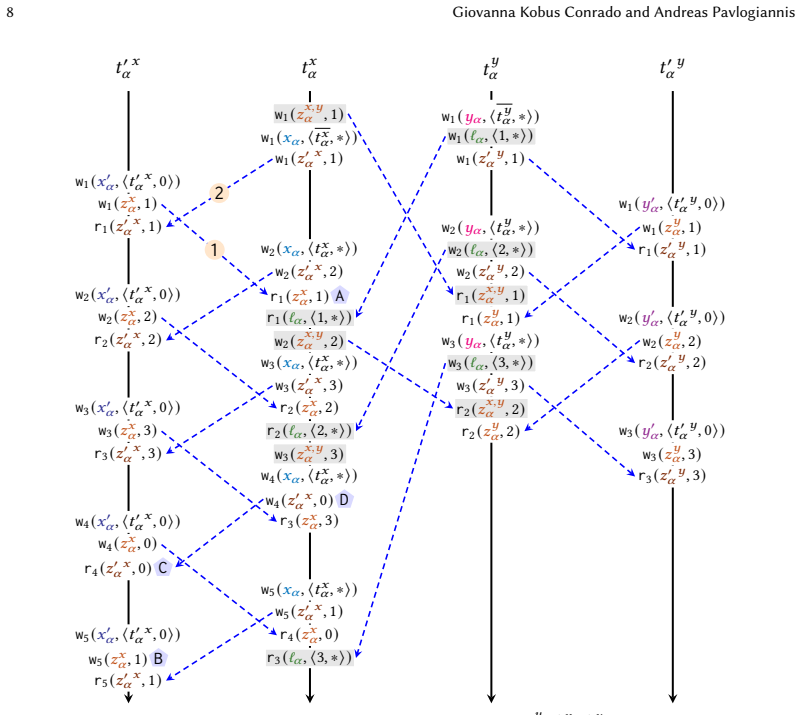
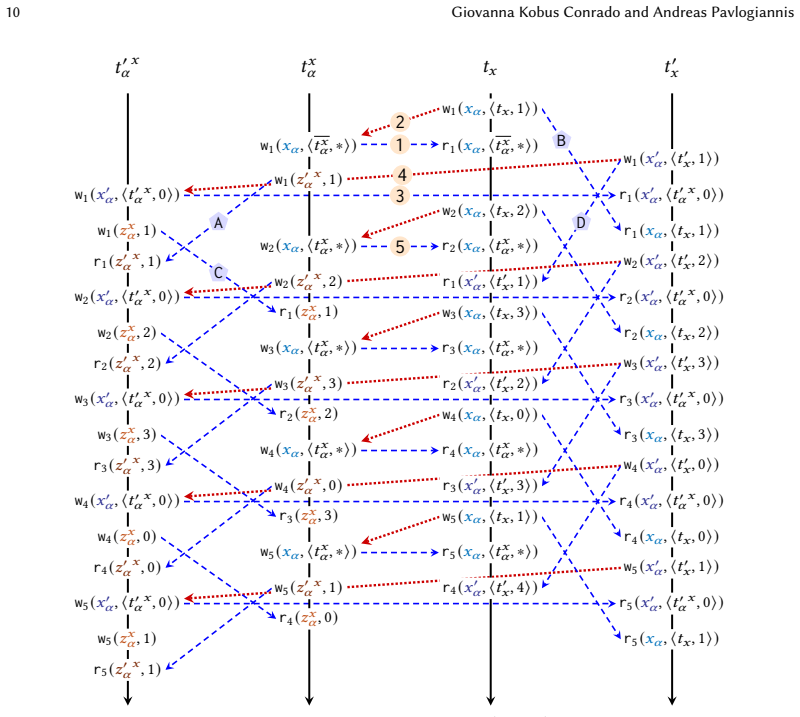
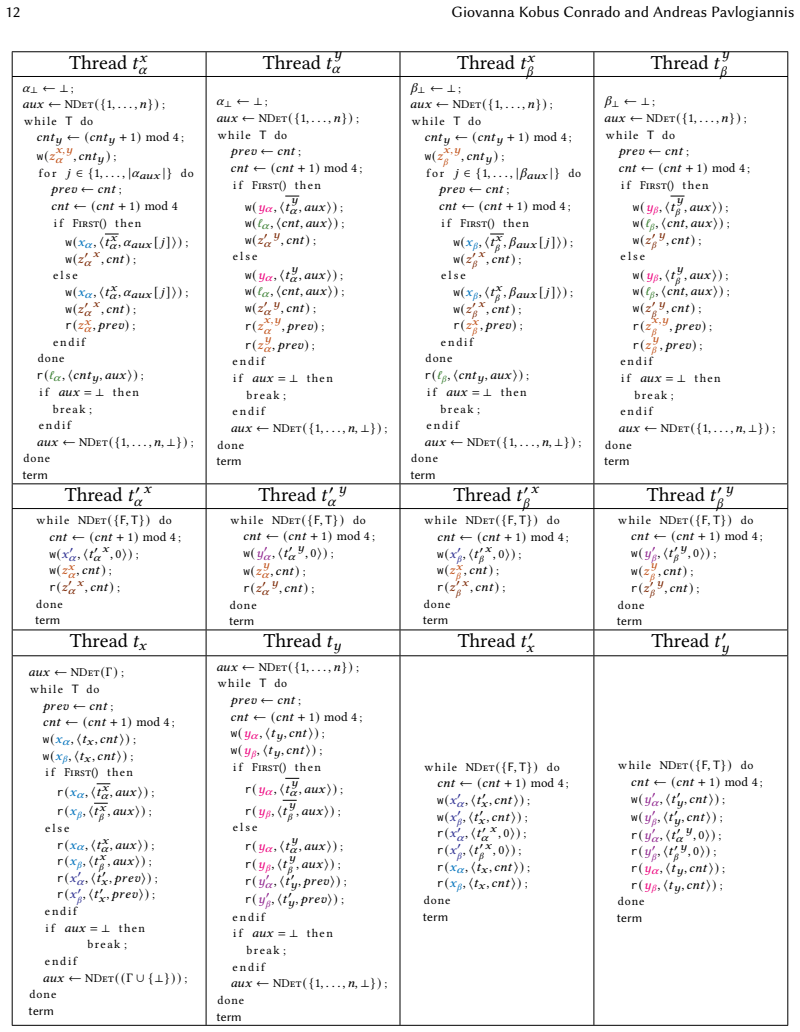


read the original abstract
The verification of concurrent programs under weak-memory models is a burgeoning effort, owing to the increasing adoption of weak memory in concurrent software and hardware. Release/Acquire has become the standard model for high-performance concurrent programming, adopted by common mainstream languages and computer architectures. In a surprising result, Abdulla et al. (PLDI'19) proved that reachability in this model is undecidable when programs have access to atomic Read-Modify-Write (RMW) operations. Moreover, undecidability holds even for executions with just 4 contexts, and is thus immune to underapproximations based on bounded context switching. The canonical, RMW-free case was left as a challenging question, proving a non-primitive recursive lower bound as a first step, and has remained open for the past seven years. In this paper, we settle the above open question by proving that reachability is undecidable even in the RMW-free fragment of Release/Acquire, thereby characterizing the simplest set of communication primitives that gives rise to undecidability. Moreover, we prove that bounding both the number of context switches and the number of RMWs recovers decidability, thus fully characterizing the boundary of decidability along the dimensions of RMW-bounding and context-bounding.
Editorial analysis
A structured set of objections, weighed in public.
Referee Report
Summary. The paper proves that reachability is undecidable for concurrent programs under the Release/Acquire memory model even in the RMW-free fragment, resolving an open question from Abdulla et al. (PLDI'19). It establishes this via a reduction and shows that decidability is recovered when both the number of context switches and RMW operations are bounded, thereby characterizing the decidability boundary along these two dimensions.
Significance. This result fully settles the decidability status of reachability under RA, identifying the minimal set of primitives (release/acquire without RMW) that already yields undecidability. The accompanying positive result on joint context/RMW bounding supplies a concrete, practical frontier for verification algorithms. The manuscript delivers a reduction-based proof from a known undecidable source problem together with a matching decidability theorem; these are clear strengths.
minor comments (2)
- [Abstract] Abstract: the source undecidable problem used in the reduction is not named; adding one sentence identifying it would help readers situate the result without lengthening the abstract.
- [Introduction] The high-level description of the reduction construction is clear, but a short paragraph in the introduction summarizing the key invariants preserved by the encoding (e.g., that only release/acquire accesses are used) would improve accessibility.
Simulated Author's Rebuttal
We thank the referee for their positive assessment of the paper and for recommending acceptance. We appreciate the recognition that the results settle the decidability status of reachability under Release/Acquire by establishing undecidability in the RMW-free fragment and recovering decidability under joint bounds on context switches and RMWs.
Circularity Check
No significant circularity identified
full rationale
The paper proves undecidability of reachability for RMW-free Release/Acquire via reduction from an external undecidable problem (standard in concurrency theory, e.g., from prior results on other weak-memory models). This reduction is described as preserving RMW-free semantics and finite executions, with no self-referential definitions, parameter fitting, or load-bearing self-citations in the derivation chain. The central claim relies on an independent encoding rather than any internal construction that reduces to the paper's own inputs by definition. The positive decidability result under joint bounds is likewise a separate characterization and does not create circularity. This is the expected non-finding for a reduction-based theoretical proof.
Axiom & Free-Parameter Ledger
axioms (2)
- domain assumption The semantics of Release/Acquire as defined in prior literature (Abdulla et al.)
- standard math Reachability problems in concurrent models can be reduced from undecidable problems like the halting problem
Reference graph
Works this paper leans on
-
[1]
InProceedings of 8th Annual IEEE Symposium on Logic in Computer Science
Verifying programs with unreliable channels . InProceedings of 8th Annual IEEE Symposium on Logic in Computer Science. IEEE Computer Society, Los Alamitos, CA, USA, 160,161,162,163,164,165,166,167,168,169,170. doi:10.1109/LICS.1993.287591 Parosh Aziz Abdulla, Jatin Arora, Mohamed Faouzi Atig, and Shankaranarayanan Krishna
-
[2]
Verification of programs under the release-acquire semantics. InProceedings of the 40th ACM SIGPLAN Conference on Programming Language 26 Giovanna Kobus Conrado and Andreas Pavlogiannis Design and Implementation(Phoenix, AZ, USA)(PLDI 2019). Association for Computing Machinery, New York, NY, USA, 1117–1132. doi:10.1145/3314221.3314649 Parosh Aziz Abdulla,...
-
[3]
Context-Bounded Analysis for POWER. InProceedings, Part II, of the 23rd International Conference on Tools and Algorithms for the Construction and Analysis of Systems - Volume 10206. Springer-Verlag, Berlin, Heidelberg, 56–74. doi:10.1007/978-3-662-54580-5_4 Jade Alglave
-
[4]
A Formal Hierarchy of Weak Memory Models.Formal Methods in System Design41, 2 (Oct. 2012), 178–210. doi:10.1007/s10703-012-0161-5 Mohamed Faouzi Atig
-
[5]
What is decidable under the TSO memory model?ACM SIGLOG News7, 4 (March 2021), 4–19. doi:10.1145/3458593.3458595 Mohamed Faouzi Atig, Ahmed Bouajjani, Sebastian Burckhardt, and Madanlal Musuvathi
-
[6]
On the Verification Problem for Weak Memory Models. InProceedings of the 37th Annual ACM SIGPLAN-SIGACT Symposium on Principles of Programming Languages (POPL ’10). Association for Computing Machinery, New York, NY, USA, 7–18. doi:10.1145/ 1706299.1706303 Mohamed Faouzi Atig, Ahmed Bouajjani, Sebastian Burckhardt, and Madanlal Musuvathi
-
[7]
Mathematizing C++ Concurrency. In Proceedings of the 38th Annual ACM SIGPLAN-SIGACT Symposium on Principles of Programming Languages (POPL ’11). Association for Computing Machinery, New York, NY, USA, 55–66. doi:10.1145/1926385.1926394 Pascal Baumann, Rupak Majumdar, Ramanathan S. Thinniyam, and Georg Zetzsche
-
[8]
168), Artur Czumaj, Anuj Dawar, and Emanuela Merelli (Eds.)
(Leibniz International Proceedings in Informatics (LIPIcs), Vol. 168), Artur Czumaj, Anuj Dawar, and Emanuela Merelli (Eds.). Schloss Dagstuhl – Leibniz-Zentrum für Informatik, Dagstuhl, Germany, 111:1–111:16. doi:10.4230/LIPIcs.ICALP.2020.111 Armando Castañeda, Gregory Chockler, Brijesh Dongol, and Ori Lahav
-
[9]
(Leibniz International Proceedings in Informatics (LIPIcs), Vol. 319), Dan Alistarh (Ed.). Schloss Dagstuhl – Leibniz-Zentrum für Informatik, Dagstuhl, Germany, 11:1–11:22. doi:10.4230/LIPIcs.DISC.2024.11 Peter Chini, Jonathan Kolberg, Andreas Krebs, Roland Meyer, and Prakash Saivasan
-
[10]
25th Annual European Symposium on Algorithms (ESA 2017) , pages =
On the Complexity of Bounded Context Switching.LIPIcs, Volume 87, ESA 201787 (2017), 27:1–27:15. doi:10.4230/LIPICS.ESA.2017.27 Edsger W. Dijkstra
-
[11]
Pattern-Based Verification for Multithreaded Programs.ACM Trans. Program. Lang. Syst.36, 3 (Sept. 2014), 9:1–9:29. doi:10.1145/2629644 Dexter Kozen
-
[12]
In18th Annual Symposium on Foundations of Computer Science (sfcs 1977)
Lower bounds for natural proof systems. In18th Annual Symposium on Foundations of Computer Science (sfcs 1977). 254–266. doi:10.1109/SFCS.1977.16 Ori Lahav and Udi Boker
-
[13]
What’s Decidable About Causally Consistent Shared Memory?ACM Transactions on Programming Languages and Systems44, 2 (June 2022), 1–55. doi:10.1145/3505273 Lamport
-
[14]
How to Make a Multiprocessor Computer That Correctly Executes Multiprocess Programs.IEEE Trans. Comput.C-28, 9 (Sept. 1979), 690–691. doi:10.1109/TC.1979.1675439 Madanlal Musuvathi and Shaz Qadeer
-
[15]
SIGPLAN Not.42, 6 (June 2007), 446–455
Iterative context bounding for systematic testing of multithreaded programs. SIGPLAN Not.42, 6 (June 2007), 446–455. doi:10.1145/1273442.1250785 G.L. Peterson
-
[16]
Myths about the mutual exclusion problem.Inform. Process. Lett.12, 3 (1981), 115–116. doi:10.1016/0020- 0190(81)90106-X Emil L. Post
-
[17]
A variant of a recursively unsolvable problem.Bull. Amer. Math. Soc.52 (1946), 264–268. https: //api.semanticscholar.org/CorpusID:122948861 Christopher Pulte, Shaked Flur, Will Deacon, Jon French, Susmit Sarkar, and Peter Sewell
1946
-
[18]
Simplifying ARM concurrency: multicopy-atomic axiomatic and operational models for ARMv8.Proc. ACM Program. Lang.2, POPL, Article 19 (Dec. 2018), 29 pages. doi:10.1145/3158107 On the Decidability of Verification under Release/Acquire 27 Shaz Qadeer and Jakob Rehof
-
[19]
The Semantics of X86-CC Multiprocessor Machine Code. InProceedings of the 36th Annual ACM SIGPLAN-SIGACT Symposium on Principles of Programming Languages (POPL ’09). Association for Computing Machinery, New York, NY, USA, 379–391. doi:10.1145/1480881.1480929 Ph. Schnoebelen
-
[20]
Verifying Lossy Channel Systems Has Nonprimitive Recursive Complexity.Inform. Process. Lett.83, 5 (Sept. 2002), 251–261. doi:10.1016/S0020-0190(01)00337-4 Abhishek Kr Singh and Ori Lahav
-
[21]
Decidable Verification under Localized Release-Acquire Concurrency. InTools and Algorithms for the Construction and Analysis of Systems: 30th International Conference, TACAS 2024, Held as Part of the European Joint Conferences on Theory and Practice of Software, ETAPS 2024, Luxembourg City, Luxembourg, April 6–11, 2024, Proceedings, Part III(Luxembourg Ci...
-
[22]
The complexity of propositional linear temporal logics.J. ACM32, 3 (July 1985), 733–749. doi:10.1145/3828.3837 Salvatore Torre, P. Madhusudan, and Gennaro Parlato
-
[23]
Reducing Context-Bounded Concurrent Reachability to Sequential Reachability. InProceedings of the 21st International Conference on Computer Aided Verification(Grenoble, France)(CA V ’09). Springer-Verlag, Berlin, Heidelberg, 477–492. doi:10.1007/978-3-642-02658-4_36 Viktor Vafeiadis, Thibaut Balabonski, Soham Chakraborty, Robin Morisset, and Francesco Zap...
-
[24]
InProceedings of the 42nd Annual ACM SIGPLAN-SIGACT Symposium on Principles of Programming Languages
Common Compiler Optimisations Are Invalid in the C11 Memory Model and What We Can Do about It. InProceedings of the 42nd Annual ACM SIGPLAN-SIGACT Symposium on Principles of Programming Languages. ACM, Mumbai India, 209–220. doi:10.1145/2676726.2676995 28 Giovanna Kobus Conrado and Andreas Pavlogiannis A Proofs of Section 3 A.1 Proofs of Section 3.3 Lemma...
discussion (0)
Sign in with ORCID, Apple, or X to comment. Anyone can read and Pith papers without signing in.