Recognition: unknown
EMGFlow: Robust and Efficient Surface Electromyography Synthesis via Flow Matching
Pith reviewed 2026-05-10 12:46 UTC · model grok-4.3
The pith
Flow matching generates synthetic sEMG signals that improve gesture recognition more reliably than GANs or diffusion models.
A machine-rendered reading of the paper's core claim, the machinery that carries it, and where it could break.
Core claim
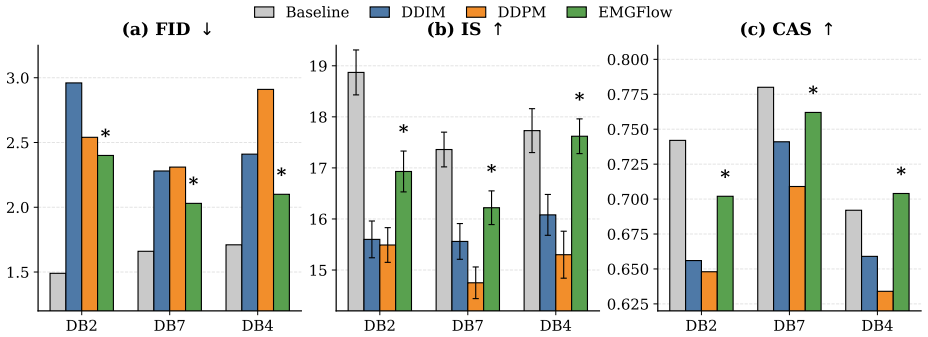
EMGFlow is the first application of flow matching to sEMG synthesis. The model learns continuous vector fields that transport a simple noise distribution into conditional distributions of real sEMG time series. Across three public benchmark datasets the generated signals match real data more closely in both hand-crafted features and geometric distribution measures than conventional augmentation or GAN methods, and models trained solely on the synthetic data achieve higher recognition accuracy on held-out real recordings than models trained on diffusion-generated data.
What carries the argument
Flow matching, a continuous-time generative process that trains a neural network to predict the vector field directing probability mass from noise to data along an ordinary differential equation path.
If this is right
- Synthetic sEMG produced by EMGFlow can augment limited real datasets and raise recognition accuracy under the TSTR protocol.
- The method supplies a more stable training alternative to GANs for biosignal generation.
- Optimized numerical integration and sampling schedules reduce the compute cost of producing usable synthetic signals.
- Flow matching becomes a practical option for addressing data bottlenecks in other myoelectric applications.
Where Pith is reading between the lines
- The same flow-matching recipe could be tested on other physiological time series such as EEG or ECG where data scarcity is also common.
- On-device generation of fresh synthetic examples might become feasible if the efficiency gains scale with smaller models.
- Adaptation experiments could check whether a single EMGFlow model can be fine-tuned quickly for new gesture vocabularies without collecting fresh real data.
Load-bearing premise
That results from the unified protocol on three fixed benchmark datasets will hold when the synthetic data are used with new subjects, different electrode hardware, or real-time myoelectric control loops.
What would settle it
An experiment that trains a gesture classifier on EMGFlow synthetic data from one set of subjects and measures whether its accuracy on recordings from entirely new subjects and a different sEMG acquisition system equals or exceeds the accuracy obtained from training on real data from the same new subjects.
Figures




read the original abstract
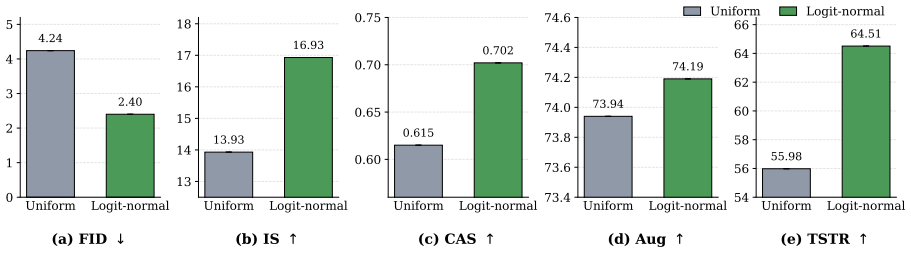
Deep learning-based surface electromyography (sEMG) gesture recognition is frequently bottlenecked by data scarcity and limited subject diversity. While synthetic data generation via Generative Adversarial Networks (GANs) and diffusion models has emerged as a promising augmentation strategy, these approaches often face challenges regarding training stability or inference efficiency. To bridge this gap, we propose EMGFlow, a conditional sEMG generation framework. To the best of our knowledge, this is the first study to investigate the application of Flow Matching (FM) and continuous-time generative modeling in the sEMG domain. To validate EMGFlow across three benchmark sEMG datasets, we employ a unified evaluation protocol integrating feature-based fidelity, distributional geometry, and downstream utility. Extensive evaluations show that EMGFlow outperforms conventional augmentation and GAN baselines, and provides stronger standalone utility than the diffusion baselines considered here under the train-on-synthetic test-on-real (TSTR) protocol. Furthermore, by optimizing generation dynamics through advanced numerical solvers and targeted time sampling, EMGFlow achieves improved quality-efficiency trade-offs. Taken together, these results suggest that Flow Matching is a promising and efficient paradigm for addressing data bottlenecks in myoelectric control systems. Our code is available at: https://github.com/Open-EXG/EMGFlow.
Editorial analysis
A structured set of objections, weighed in public.
Referee Report
Summary. The manuscript introduces EMGFlow, a conditional generative model based on flow matching for synthesizing surface electromyography (sEMG) signals. It claims to be the first application of flow matching in the sEMG domain, demonstrates superior performance over GAN and diffusion baselines in feature fidelity, distributional metrics, and train-on-synthetic test-on-real (TSTR) downstream utility across three benchmark datasets, while achieving better efficiency through optimized solvers.
Significance. If the performance claims hold under rigorous cross-subject and cross-hardware evaluation, this work could provide an efficient alternative to diffusion models for data augmentation in myoelectric control, addressing data scarcity and subject variability issues. The open-sourcing of code is a positive aspect.
major comments (2)
- [Evaluation Protocol] Evaluation Protocol section: The TSTR protocol is described at a high level without specifying whether splits are leave-one-subject-out, intra-subject, or include explicit hardware/sensor variations. This detail is load-bearing for the central claim of 'stronger standalone utility' and robustness, given that sEMG signals vary strongly across subjects and hardware.
- [Abstract and §4] Abstract and §4 (Results): The abstract and high-level evaluation summary report outperformance without quantitative metrics, error bars, or architecture/training details in the provided overview; while tables likely exist in the full text, the lack of these in the summary presentation weakens immediate assessment of the magnitude of gains over diffusion baselines.
minor comments (2)
- [Throughout] Ensure all acronyms (sEMG, FM, TSTR) are defined on first use and used consistently.
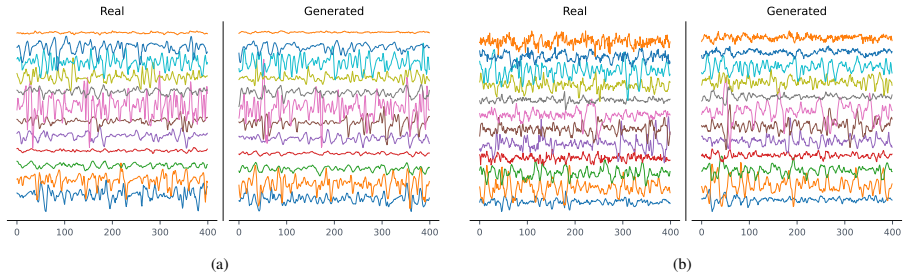
- [Figures] Figure captions should explicitly describe what each panel shows (e.g., real vs. synthetic waveforms) for clarity in qualitative comparisons.
Simulated Author's Rebuttal
We thank the referee for their constructive feedback on our manuscript. We address each major comment below, providing clarifications and committing to revisions that strengthen the presentation of our evaluation protocol and results without altering the core claims.
read point-by-point responses
-
Referee: [Evaluation Protocol] Evaluation Protocol section: The TSTR protocol is described at a high level without specifying whether splits are leave-one-subject-out, intra-subject, or include explicit hardware/sensor variations. This detail is load-bearing for the central claim of 'stronger standalone utility' and robustness, given that sEMG signals vary strongly across subjects and hardware.
Authors: We agree that explicit specification of the data splits is essential for assessing robustness and generalizability in sEMG synthesis, particularly due to inter-subject and hardware variability. The full manuscript (Section 3.3) describes a unified protocol across the three datasets, but we will revise the Evaluation Protocol section to explicitly detail: (i) leave-one-subject-out splits for cross-subject evaluation on all datasets, (ii) intra-subject random splits for within-subject utility where reported, and (iii) notes on hardware/sensor configurations (e.g., electrode placement and sampling rates) for each benchmark. This will directly support the TSTR utility claims and address the concern. revision: yes
-
Referee: [Abstract and §4] Abstract and §4 (Results): The abstract and high-level evaluation summary report outperformance without quantitative metrics, error bars, or architecture/training details in the provided overview; while tables likely exist in the full text, the lack of these in the summary presentation weakens immediate assessment of the magnitude of gains over diffusion baselines.
Authors: We acknowledge that the abstract and the opening of §4 present high-level qualitative statements of outperformance. Quantitative results, including metrics with standard deviations (error bars), are reported in Tables 1–4 and Figures 2–5, with architecture and training details in §3.2 and the appendix. To improve accessibility, we will revise the abstract to include specific quantitative gains (e.g., relative improvements in FID scores and TSTR accuracy) and add a concise summary of key metrics with error bars at the start of §4. This partial update enhances the summary presentation while retaining the detailed tables. revision: partial
Circularity Check
No circularity: empirical application of external flow matching framework
full rationale
The paper presents EMGFlow as an application of the pre-existing flow matching generative modeling technique to the sEMG synthesis task. No derivation chain is claimed that reduces a result to its own inputs by construction; performance claims rest on standard empirical benchmarks (feature fidelity, distributional metrics, and TSTR utility) evaluated against external baselines on three public datasets. The unified protocol and numerical solver optimizations are implementation details, not self-referential definitions or fitted quantities renamed as predictions. Self-citations, if present, are not load-bearing for the core claims, which remain falsifiable against independent data splits and prior GAN/diffusion work.
Axiom & Free-Parameter Ledger
axioms (1)
- domain assumption Flow matching yields stable training and efficient sampling for conditional generation of time-series signals
Reference graph
Works this paper leans on
-
[1]
Kaifosh, T
P. Kaifosh, T. R. Reardon, A generic non-invasive neuromotor interface for human-computer interaction, Nature (2025) 1–10
2025
-
[2]
J. Xu, R. Wang, S. Shang, A. Chen, L. Winterbottom, T.-L. Hsu, W. Chen, K. Ahmed, P. L. La Rotta, X. Zhu, et al., Chatemg: Synthetic data generation to control a robotic hand orthosis for stroke, IEEE Robotics and Automation Letters (2024)
2024
-
[3]
Sivakumar, J
V . Sivakumar, J. Seely, A. Du, S. Bittner, A. Berenzweig, A. Bolarinwa, A. Gramfort, M. Mandel, emg2qwerty: A large dataset with baselines for touch typing using surface electromyography, in: Advances in Neural Infor- mation Processing Systems, V ol. 37, 2024, pp. 91373–91389. 18
2024
-
[4]
J. Yang, D. Cha, D.-G. Lee, S. Ahn, Stcnet: Spatio-temporal cross network with subject-aware contrastive learning for hand gesture recognition in surface EMG, Computers in Biology and Medicine 185 (2025) 109525
2025
-
[5]
M. A. Al-Qaness, S. Ni, Tcnn-kan: Optimized cnn by kolmogorov-arnold network and pruning techniques for sEMG gesture recognition, IEEE Journal of Biomedical and Health Informatics 29 (1) (2025) 188–197. doi:10.1109/JBHI.2024.3467065
-
[6]
Z. Wang, J. Yao, M. Xu, M. Jiang, J. Su, Transformer-based network with temporal depthwise convolutions for sEMG recognition, Pattern Recognition 145 (2024) 109967
2024
-
[7]
Tsinganos, B
P. Tsinganos, B. Cornelis, J. Cornelis, B. Jansen, A. Skodras, Data augmentation of surface electromyography for hand gesture recognition, Sensors 20 (17) (2020) 4892
2020
- [8]
-
[9]
C. Cao, F. Zhou, Y . Dai, J. Wang, K. Zhang, A survey of mix-based data augmentation: Taxonomy, methods, applications, and explainability, ACM Computing Surveys 57 (2) (2024) 1–38
2024
-
[10]
Mendez, C
V . Mendez, C. Lhoste, S. Micera, Emg data augmentation for grasp classification using generative adversarial networks, in: Proceedings of the Annual International Conference of the IEEE Engineering in Medicine and Biology Society, IEEE, 2022, pp. 3619–3622
2022
-
[11]
J. Ao, S. Liang, T. Yan, R. Hou, Z. Zheng, J. Ryu, Overcoming the effect of muscle fatigue on gesture recognition based on sEMG via generative adversarial networks, Expert Systems with Applications 238 (2024) 122304
2024
-
[12]
F. Coelho, M. F. Pinto, A. G. Melo, G. S. Ramos, A. L. M. Marcato, A novel sEMG data augmentation based on wgan-gp, Computer Methods in Biomechanics and Biomedical Engineering 26 (9) (2023) 1008–1017. doi:10.1080/10255842.2022.2102422
-
[13]
J. J. Bird, M. Pritchard, A. Fratini, A. Ekárt, D. R. Faria, Synthetic biological signals machine-generated by gpt- 2 improve the classification of eeg and emg through data augmentation, IEEE Robotics and Automation Letters 6 (2) (2021) 3498–3504
2021
-
[14]
J. Ho, A. Jain, P. Abbeel, Denoising diffusion probabilistic models, in: Advances in Neural Information Process- ing Systems, V ol. 33, 2020, pp. 6840–6851
2020
-
[15]
Dhariwal, A
P. Dhariwal, A. Nichol, Diffusion models beat gans on image synthesis, in: Advances in Neural Information Processing Systems, V ol. 34, 2021, pp. 8780–8794
2021
-
[16]
Xiong, W
B. Xiong, W. Chen, H. Li, Y . Niu, N. Zeng, Z. Gan, Y . Xu, PatchEMG: Few-shot EMG signal generation with diffusion models for data augmentation to improve classification performance, IEEE Transactions on Instrumen- tation and Measurement (2024)
2024
-
[17]
N. Neifar, A. Mdhaffar, A. Ben-Hamadou, M. Jmaiel, Deep generative models for physiologi- cal signals: A systematic literature review, Artificial Intelligence in Medicine 165 (2025) 103127. doi:10.1016/j.artmed.2025.103127
-
[18]
X. Liu, C. Gong, Q. Liu, Flow straight and fast: Learning to generate and transfer data with rectified flow, in: International Conference on Learning Representations, 2022
2022
-
[19]
Lipman, R
Y . Lipman, R. T. Q. Chen, H. Ben-Hamu, M. Nickel, M. Le, Flow matching for generative modeling, in: Inter- national Conference on Learning Representations, 2022
2022
-
[20]
Atzori, A
M. Atzori, A. Gijsberts, I. Kuzborskij, S. Elsig, A.-G. M. Hager, O. Deriaz, C. Castellini, H. Müller, B. Caputo, Characterization of a benchmark database for myoelectric movement classification, IEEE Transactions on Neural Systems and Rehabilitation Engineering 23 (1) (2014) 73–83. 19
2014
-
[21]
L. Meng, X. Jiang, X. Liu, J. Fan, H. Ren, Y . Guo, H. Diao, Z. Wang, C. Chen, C. Dai, W. Chen, User-tailored hand gesture recognition system for wearable prosthesis and armband based on surface electromyogram, IEEE Transactions on Instrumentation and Measurement 71 (2022) 2520616. doi:10.1109/TIM.2022.3217868
-
[22]
Prabhavathy, V
T. Prabhavathy, V . K. Elumalai, E. Balaji, Hand gesture classification framework leveraging the entropy features from sEMG signals and vmd augmented multi-class svm, Expert Systems with Applications 238 (2024) 121972
2024
-
[23]
Q. Dai, Y . Wong, M. Kankanhali, X. Li, W. Geng, Improved network and training scheme for cross- trial surface electromyography (sEMG)-based gesture recognition, Bioengineering 10 (9) (2023) 1101. doi:10.3390/bioengineering10091101
-
[24]
N. K. Karnam, S. R. Dubey, A. C. Turlapaty, B. Gokaraju, Emghandnet: A hybrid cnn and bi-lstm architecture for hand activity classification using surface EMG signals, Biocybernetics and Biomedical Engineering 42 (1) (2022) 325–340. doi:10.1016/j.bbe.2022.02.005
-
[25]
Y . Chen, M. Orlandi, P. M. Rapa, S. Benatti, L. Benini, Y . Li, Waveformer: A lightweight transformer model for sEMG-based gesture recognition, arXiv preprint arXiv:2506.11168 (2025). doi:10.48550/arXiv.2506.11168
-
[26]
X. Jiang, X. Liu, J. Fan, X. Ye, C. Dai, E. A. Clancy, D. Farina, W. Chen, Optimization of hd-semg-based cross-day hand gesture classification by optimal feature extraction and data augmentation, IEEE Transactions on Human-Machine Systems 52 (6) (2022) 1281–1291. doi:10.1109/THMS.2022.3175408
-
[27]
Zhang, M
H. Zhang, M. Cisse, Y . N. Dauphin, D. Lopez-Paz, mixup: Beyond empirical risk minimization, in: International Conference on Learning Representations, 2018
2018
-
[28]
T. T. Um, F. M. Pfister, D. Pichler, S. Endo, M. Lang, S. Hirche, U. Fietzek, D. Kuli ´c, Data augmentation of wearable sensor data for parkinson’s disease monitoring using convolutional neural networks, in: Proceedings of the ACM International Conference on Multimodal Interaction, 2017, pp. 216–220
2017
-
[29]
Semenoglou, E
A.-A. Semenoglou, E. Spiliotis, V . Assimakopoulos, Data augmentation for univariate time series forecasting with neural networks, Pattern Recognition 134 (2023) 109132
2023
- [30]
-
[31]
Zhang, R
X. Zhang, R. R. Chowdhury, J. Shang, R. Gupta, D. Hong, Towards diverse and coherent augmentation for time-series forecasting, in: Proceedings of the IEEE International Conference on Acoustics, Speech and Signal Processing, IEEE, 2023, pp. 1–5
2023
-
[32]
A. Venugopal, D. Resende Faria, Boosting eeg and ecg classification with synthetic biophysical data generated via generative adversarial networks, Applied Sciences 14 (23) (2024) 10818. doi:10.3390/app142310818
-
[33]
J. Ho, T. Salimans, Classifier-free diffusion guidance, in: Advances in Neural Information Processing Systems Workshop, 2021
2021
-
[34]
J. Song, C. Meng, S. Ermon, Denoising diffusion implicit models, in: International Conference on Learning Representations, 2020
2020
-
[35]
Atzori, A
M. Atzori, A. Gijsberts, C. Castellini, B. Caputo, A.-G. M. Hager, S. Elsig, G. Giatsidis, F. Bassetto, H. Müller, Electromyography data for non-invasive naturally-controlled robotic hand prostheses, Scientific Data 1 (1) (2014) 1–13
2014
-
[36]
Pizzolato, L
S. Pizzolato, L. Tagliapietra, M. Cognolato, M. Reggiani, H. Müller, M. Atzori, Comparison of six electromyo- graphy acquisition setups on hand movement classification tasks, PLoS ONE 12 (10) (2017) e0186132
2017
-
[37]
Krasoulis, I
A. Krasoulis, I. Kyranou, M. S. Erden, K. Nazarpour, S. Vijayakumar, Improved prosthetic hand control with concurrent use of myoelectric and inertial measurements, Journal of NeuroEngineering and Rehabilitation 14 (1) (2017) 71. 20
2017
-
[38]
C. Esteban, S. L. Hyland, G. Rätsch, Real-valued (medical) time series generation with recurrent conditional GANs, arXiv preprint arXiv:1706.02633 (2017). arXiv:1706.02633
-
[39]
Heusel, H
M. Heusel, H. Ramsauer, T. Unterthiner, B. Nessler, S. Hochreiter, Gans trained by a two time-scale update rule converge to a local nash equilibrium, in: Advances in Neural Information Processing Systems, V ol. 30, 2017
2017
-
[40]
Kynkäänniemi, T
T. Kynkäänniemi, T. Karras, S. Laine, J. Lehtinen, T. Aila, Improved precision and recall metric for assessing generative models, in: Advances in Neural Information Processing Systems, 2019
2019
-
[41]
M. F. Naeem, S. J. Oh, Y . Uh, Y . Choi, J. Yoo, Reliable fidelity and diversity metrics for generative models, in: International Conference on Machine Learning, 2020
2020
- [42]
-
[43]
L. Fan, K. Chen, D. Krishnan, D. Katabi, P. Isola, Y . Tian, Scaling laws of synthetic images for model training ... for now, in: Proceedings of the IEEE/CVF Conference on Computer Vision and Pattern Recognition, 2024, pp. 7382–7392
2024
-
[44]
Karras, M
T. Karras, M. Aittala, T. Aila, S. Laine, Elucidating the design space of diffusion-based generative models, in: Advances in Neural Information Processing Systems, 2022. 21
2022
discussion (0)
Sign in with ORCID, Apple, or X to comment. Anyone can read and Pith papers without signing in.