Recognition: unknown
Projections of Earth's Technosphere: Civilization Collapse-Recovery Dynamics and Detectability
Pith reviewed 2026-05-10 12:19 UTC · model grok-4.3
The pith
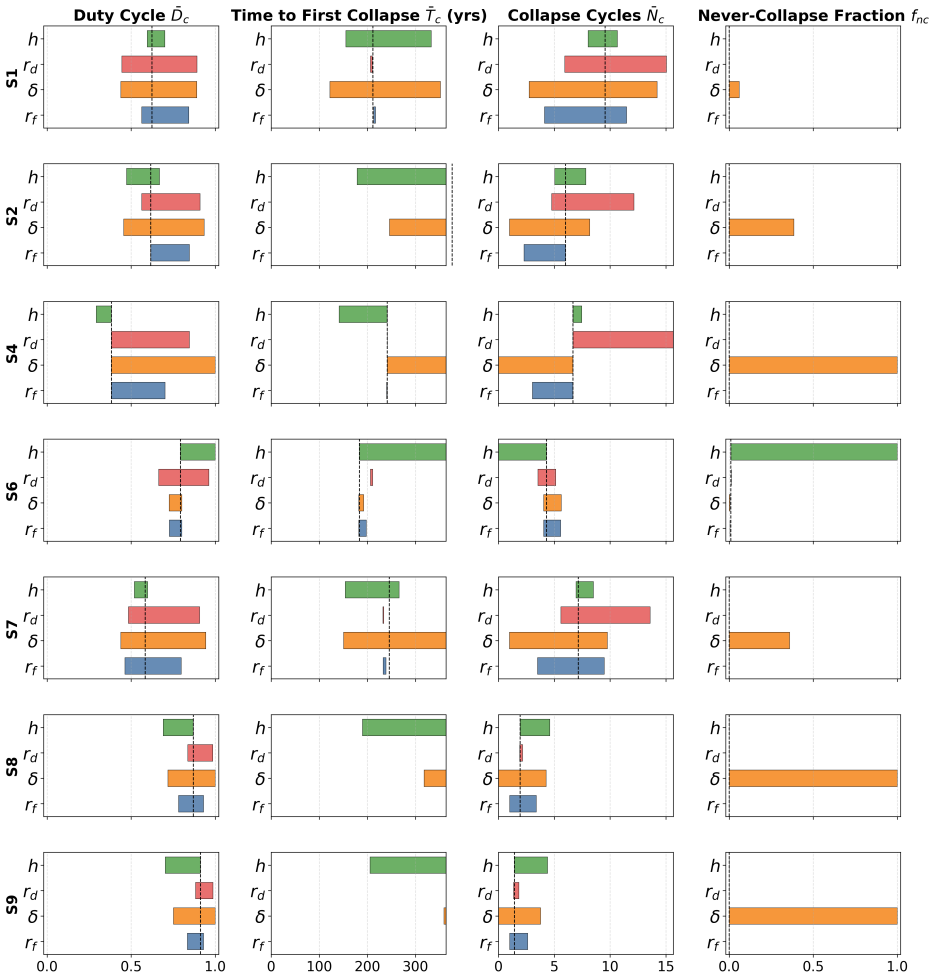
Simulations across ten futures show technological civilizations can be active only 38 to 100 percent of their lifespan, so the lack of extraterrestrial signals may reflect common intermittency rather than rare intelligence.
A machine-rendered reading of the paper's core claim, the machinery that carries it, and where it could break.
Core claim
By running the hybrid simulation on ten scenarios, the authors find duty cycles ranging from 0.38 to 1.00. They define an effective detectability duration that folds in the inactive intervals created by collapse and slow recovery. The central result is that widespread low-duty-cycle behavior among technological civilizations would reduce the probability of detecting a steady signal even if intelligent life is common.
What carries the argument
Hybrid deterministic-stochastic simulation of collapse-recovery dynamics that computes duty cycle as the fraction of a civilization's total lifespan during which technology is active.
If this is right
- Slowing the resource depletion rate can shift trajectories from collapse-prone to persistent across multiple scenarios.
- Increasing the post-collapse recovery fraction extends the active technological period even when hazards occur.
- Governance structures that manage resource pressure produce higher duty cycles than those that do not.
- For humanity, resource sustainability measures may be as decisive for avoiding collapse as hazard mitigation.
- SETI search strategies must incorporate the possibility of intermittent rather than continuous signals.
Where Pith is reading between the lines
- If low duty cycles turn out to be typical, the total number of technological civilizations in the galaxy needed to match the observed silence would be larger than models assuming continuous activity.
- The same simulation framework could be rerun with parameters drawn from Earth's own historical collapses to check whether the modeled duty cycles match past patterns.
- The finding reframes sustainability policy as also serving the goal of increasing the detectability window for any future observers of Earth.
Load-bearing premise
The ten chosen scenarios and the way governance, resource pressure, and hazard exposure are mapped onto model parameters accurately represent real collapse-recovery dynamics over century timescales.
What would settle it
A long-term monitoring campaign that detects a repeating technosignature remaining continuously active across multiple centuries without the on-off pattern expected from collapse and recovery would contradict the prevalence of low duty cycles.
Figures




read the original abstract
How long a technological civilization remains active, and what determines whether it collapses or persists, is a central question for both projecting humanity's future and assessing the prevalence of detectable intelligence in the galaxy. We model collapse-recovery dynamics across ten plausible futures for Earth-originating civilization using a hybrid deterministic-stochastic simulation over a 1000-year window. The duty cycle, defined as the fraction of its total lifespan that a civilization is technologically active, ranges from ~0.38 to 1.00, with trajectory outcomes shaped by the interplay of governance structure, resource pressure, and hazard exposure. Several model parameters map onto actionable resilience levers, and modest improvements can qualitatively alter long-term trajectories. Sensitivity analysis reveals that the resource depletion rate and the post-collapse recovery fraction are consistently the most impactful levers across scenarios, suggesting that reducing resource consumption may be at least as important as mitigating existential hazards for avoiding civilizational collapse. We discuss implications for Earth's civilizational resilience and for the search for extraterrestrial technosignatures. We also derive an effective detectability duration that accounts for intermittent civilizational activity, and show that the apparent absence of extraterrestrial signals may reflect the prevalence of low-duty-cycle civilizations rather than the rarity of intelligent life.
Editorial analysis
A structured set of objections, weighed in public.
Referee Report
Summary. The manuscript develops a hybrid deterministic-stochastic simulation of Earth's technosphere over a 1000-year horizon across ten scenarios. It computes duty cycles (fraction of lifespan spent technologically active) ranging from ~0.38 to 1.00, shaped by governance structure, resource pressure, and hazard exposure. Sensitivity analysis identifies resource depletion rate and post-collapse recovery fraction as the most impactful parameters. The work derives an effective detectability duration that adjusts for intermittency and concludes that low-duty-cycle civilizations may explain the absence of extraterrestrial technosignatures rather than the rarity of intelligent life.
Significance. If the structural assumptions and parameter mappings prove representative of real dynamics, the results would supply a quantitative framework connecting civilizational resilience to SETI observables, offering one mechanism for the Fermi paradox via reduced detectability windows. The consistent identification of resource-related levers across scenarios also provides actionable insight for long-term human planning. The hybrid modeling approach and explicit sensitivity analysis are strengths that could be built upon with further grounding.
major comments (3)
- [§2–3 (Model and Scenarios)] Model description and scenario construction (likely §2–3): The ten scenarios map governance, resource pressure, and hazard exposure onto the hybrid model parameters, yet no quantitative calibration or out-of-sample validation against historical collapse-recovery episodes (e.g., post-Roman or post-industrial timescales) is supplied. Because the reported duty-cycle range (0.38–1.00) is an output of these untested mappings, the central claim that low duty cycles can account for non-detections rests on ungrounded structural assumptions rather than constrained data.
- [§4–5 (Results and Detectability)] Results and detectability derivation (likely §4–5): The effective detectability duration is obtained by a direct algebraic adjustment of the simulated duty cycle. Without error propagation through the stochastic components or sensitivity of the final duration bounds to the free parameters (resource depletion rate, post-collapse recovery fraction), the robustness of the implication for extraterrestrial signal absence cannot be assessed.
- [§4 (Sensitivity Analysis)] Sensitivity analysis (likely §4): While resource depletion rate and recovery fraction are identified as dominant, the analysis does not include uncertainty quantification on the stochastic realizations or a systematic exploration of how variations in the ten scenario definitions propagate to the duty-cycle bounds. This limits the strength of the conclusion that modest improvements in these levers can qualitatively alter trajectories.
minor comments (2)
- [Methods] A dedicated table listing all model parameters, their ranges, and the exact mapping from scenario descriptors (governance, hazards) to numerical values would improve reproducibility and clarity.
- [Abstract and Results] The abstract states the duty-cycle range as '~0.38 to 1.00'; the main text should report the precise minimum and maximum values obtained across the ten runs together with any stochastic variability.
Simulated Author's Rebuttal
We thank the referee for their constructive and detailed comments, which identify key areas where the manuscript can be strengthened in terms of grounding, uncertainty quantification, and robustness. We have revised the paper accordingly and respond to each major comment below.
read point-by-point responses
-
Referee: Model description and scenario construction (likely §2–3): The ten scenarios map governance, resource pressure, and hazard exposure onto the hybrid model parameters, yet no quantitative calibration or out-of-sample validation against historical collapse-recovery episodes (e.g., post-Roman or post-industrial timescales) is supplied. Because the reported duty-cycle range (0.38–1.00) is an output of these untested mappings, the central claim that low duty cycles can account for non-detections rests on ungrounded structural assumptions rather than constrained data.
Authors: We agree that the ten scenarios rely on qualitative mappings rather than quantitative calibration to specific historical episodes, as direct parameter fitting is limited by the sparse and contextually distinct nature of historical data. The scenarios are constructed as plausible exploratory futures drawing on existing literature on governance, resources, and hazards. In the revised manuscript we have added a new subsection (2.4) explicitly discussing these limitations, the rationale for the scenario-based approach, and suggested pathways for future empirical validation using available historical datasets on societal collapses. The duty-cycle range is now framed as illustrative of possible outcomes under the stated assumptions. revision: partial
-
Referee: Results and detectability derivation (likely §4–5): The effective detectability duration is obtained by a direct algebraic adjustment of the simulated duty cycle. Without error propagation through the stochastic components or sensitivity of the final duration bounds to the free parameters (resource depletion rate, post-collapse recovery fraction), the robustness of the implication for extraterrestrial signal absence cannot be assessed.
Authors: We have revised §5 to incorporate error propagation. Using the stochastic simulation outputs, we now compute 95% confidence intervals on duty cycles via bootstrapping across realizations and propagate these to the effective detectability durations. We also added a sensitivity analysis (new Figure 7) showing how the detectability bounds respond to variations in resource depletion rate and post-collapse recovery fraction, confirming that the qualitative implication for reduced detectability windows remains robust across the explored parameter ranges. revision: yes
-
Referee: Sensitivity analysis (likely §4): While resource depletion rate and recovery fraction are identified as dominant, the analysis does not include uncertainty quantification on the stochastic realizations or a systematic exploration of how variations in the ten scenario definitions propagate to the duty-cycle bounds. This limits the strength of the conclusion that modest improvements in these levers can qualitatively alter trajectories.
Authors: We have expanded the sensitivity analysis in §4 to include uncertainty quantification, reporting standard deviations and 95% intervals across the stochastic realizations for each scenario. We additionally performed a systematic perturbation of the scenario parameter mappings (±20% around baseline values) and recomputed the resulting duty-cycle distributions. The revised analysis shows that resource depletion rate and recovery fraction remain the dominant levers, and that modest improvements in these can shift trajectories from collapse to persistence in multiple scenarios. These results are now presented with error bars and a new supplementary table. revision: yes
Circularity Check
No significant circularity; model outputs are generated forward from assumptions
full rationale
The paper defines duty cycle explicitly as an output metric from its hybrid simulation runs across ten scenarios and then computes effective detectability duration via a direct algebraic rescaling of that output. No equation or parameter is fitted to external data and then relabeled as a prediction, no self-citation supplies a load-bearing uniqueness theorem or ansatz, and the derivation chain does not reduce any claimed result to its own inputs by construction. The central projections remain sensitive to the chosen governance/resource/hazard mappings, but that is a modeling assumption issue rather than circularity.
Axiom & Free-Parameter Ledger
free parameters (2)
- resource depletion rate
- post-collapse recovery fraction
axioms (2)
- domain assumption Ten plausible futures adequately span the space of governance structures, resource pressures, and hazard exposures relevant to collapse-recovery
- domain assumption Hybrid deterministic-stochastic rules capture the dominant mechanisms of civilizational collapse and recovery on 1000-year timescales
Reference graph
Works this paper leans on
-
[1]
doi:10.1089/bio.2018.0025. A. Balbi. The impact of the temporal distribution of communicating civilizations on their de- tectability.Astrobiology, 18(1):54–58, January
-
[2]
doi:10.1089/ast.2017.1652. A. Balbi and M. M. ´Cirkovi´ c. Longevity is the key factor in the search for technosignatures.Astron. J., 161(5):222, May
-
[3]
doi:10.3847/1538-3881/abec48. A. Balbi and C. Grimaldi. Technosignature longevity and lindy’s law.Astron. J., 167(3):119, March
-
[4]
doi:10.3847/1538-3881/ad217d. A. B. Bhattacharya, A. Sarkar, and J. Pandit. Some computations on the drake equation to encapsulate the probable number of broadcasting civilizations.International Journal of Applied Engineering Research, 2(2):590–594,
-
[5]
S Calla, C Guinchard, A Moine, N Novello-Paglianti, L Nuninger, and L Ogorzelec-Guinchard
doi:10.1038/186670a0. S Calla, C Guinchard, A Moine, N Novello-Paglianti, L Nuninger, and L Ogorzelec-Guinchard. Confronting the uncertainties associated with long-time scales: Analysis of the modes of preser- vation of memory of radioactive waste burial sites.Worldwide Waste: Journal of Interdisciplinary Studies, 6(1):1–12,
-
[6]
doi:10.5334/wwwj.75. M. M. ´Cirkovi´ c, B. Vukoti´ c, and M. Stojanovi´ c. Persistence of technosignatures: A comment on lingam and loeb. May
-
[7]
doi:10.48550/arXiv.1905.03146. 20 Colossal Biosciences. Colossal biovault.https://colossalfoundation.org/project/ species-biobank/. Accessed: 2026-4-7. R. T. Daly, C. M. Ernst, O. S. Barnouin, et al. Successful kinetic impact into an asteroid for planetary defence.Nature, 616(7957):443–447, April
-
[8]
doi:10.1038/s41586-023-05810-5. L. Dartnell.The Knowledge: How to Rebuild Our World from Scratch. Penguin Press,
-
[9]
doi:10.1016/j.actaastro.2010.02.027. F. D. Drake. The radio search for intelligent extraterrestrial life. InCurrent Aspects of Exobiology, pages 323–345. Elsevier,
-
[10]
doi:10.1016/b978-1-4832-0047-7.50015-0. R. H. Gray. Intermittent signals and planetary days in SETI.Int. J. Astrobiology, 19(4):299–307, August
-
[11]
doi:10.1017/s1473550420000038. D. Grinspoon.Lonely planets. HarperCollins eBooks, March
-
[12]
J. Haqq-Misra, G. Profitiliotis, and R. Kopparapu. Projections of earth’s technosphere: Scenario modeling, worldbuilding, and overview of remotely detectable technosignatures.Technol. Fore- cast. Soc. Change, 218(124194):124194, September 2025a. doi:10.1016/j.techfore.2025.124194. J. Haqq-Misra, C. Vidal, and G. Profitiliotis. Projections of earth’s techn...
-
[13]
Francesco Mazzucchelli and Nanta Novello Paglianti
doi:10.1177/27539687231174242. Francesco Mazzucchelli and Nanta Novello Paglianti. How to remember a place to forget? The semiotic design of deep geological nuclear repositories, from long-term communication to memory transmission.Linguistic Frontiers, 5(3):22–36,
-
[14]
Brendan Mullan and Jacob Haqq-Misra
doi:10.2478/lf-2022-0026. Brendan Mullan and Jacob Haqq-Misra. Population growth, energy use, and the implications for the search for extraterrestrial intelligence.Futures, 106:4–17,
-
[15]
Accessed: 2025-6-16. T. Ord.The Precipice: Existential Risk and the Future of Humanity. Hachette Books,
2025
-
[16]
doi:10.1016/j.gloenvcha.2010.07.004. 21 M. D. Papagiannis. The importance of exploring the asteroid belt.Acta Astronaut., 10(10):709–712, October
-
[17]
doi:10.1016/0094-5765(83)90071-1. Huiming Ren. The distinction between knowledge-that and knowledge-how.Philosophia, 40(4): 857–875,
-
[18]
doi:10.1007/s11406-012-9361-x. C. T. Rubin. L factor: hope and fear in the search for extraterrestrial intelligence. In S. A. Kingsley and R. Bhathal, editors,The Search for Extraterrestrial Intelligence (SETI) in the Optical Spectrum III, volume 4273, pages 230–239. SPIE, August
-
[19]
John Sandlos, Arn Keeling, Caitlynn Beckett, and Rosanna Nicol
doi:10.1117/12.435379. John Sandlos, Arn Keeling, Caitlynn Beckett, and Rosanna Nicol. There is a monster under the ground: Commemorating the history of arsenic contamination at Giant Mine as a warning to future generations.Papers in Canadian History and Environment, (3):1–55, October
-
[20]
doi:10.25071/10315/36516. S. Z. Sheikh, M. J. Huston, P. Fan, J. T. Wright, T. Beatty, C. Martini, R. Kopparapu, and A. Frank. Earth detecting earth: At what distance could earth’s constellation of technosig- natures be detected with present-day technology?Astron. J., 169(2):118, February
-
[21]
doi:10.3847/1538-3881/ada3c7. M. Shermer. Why ET hasn’t called.Sci. Am., 287(2):33–33, August
-
[22]
doi:10.1038/scientificamerican0802-33. J. Smith. Review and viability of a Dyson swarm as a form of Dyson sphere.Phys. Scr., 97(12): 122001,
-
[23]
doi:10.1088/1402-4896/ac9e78. H. Socas-Navarro. Possible photometric signatures of moderately advanced civilizations: The clarke exobelt.Astrophys. J., 855(2):110, March
-
[24]
doi:10.3847/1538-4357/aaae66. J. A. Tainter.The Collapse of Complex Societies. Cambridge University Press,
-
[25]
doi:10.5194/acp- 16-11733-2016. O. Vinn. Potential incompatibility of inherited behavior patterns with civilization: Implications for fermi paradox.Sci. Prog., 107(3):368504241272491, July
-
[26]
doi:10.1177/00368504241272491. C. Walters, R. A. Hoover, and R. K. Kotra. Interstellar colonization: A new parameter for the drake equation?Icarus, 41(2):193–197, February
-
[27]
doi:10.1016/0019-1035(80)90003-2. S. Webb.If the Universe Is Teeming with Aliens ... WHERE IS EVERYBODY? Seventy-Five Solutions to the Fermi Paradox and the Problem of Extraterrestrial Life. Springer International Publishing, 2nd edition,
-
[28]
doi:10.1007/978-3-319-13236-5. P. Wesson. Cosmology, extraterrestrial intelligence, and a resolution of the fermi-hart paradox. Quarterly journal of the royal astronomical society, 31:161–170, June
-
[29]
doi:10.1098/rsif.2022.0029. J. T. Wright. Dyson spheres.Serbian Astron. J., (200):1–18,
-
[30]
doi:10.2298/saj2000001w. 22 J. T. Wright, J. Haqq-Misra, A. Frank, R. Kopparapu, M. Lingam, and S. Z. Sheikh. The case for technosignatures: Why they may be abundant, long-lived, highly detectable, and unambiguous. Astrophys. J. Lett., 927(2):L30, March
-
[31]
doi:10.3847/2041-8213/ac5824. L. Xia, A. Robock, K. Scherrer, et al. Global food insecurity and famine from reduced crop, marine fishery and livestock production due to climate disruption from nuclear war soot injection.Nat. Food, 3(8):586–596, August
-
[32]
doi:10.1038/s43016-022-00573-0. 23
discussion (0)
Sign in with ORCID, Apple, or X to comment. Anyone can read and Pith papers without signing in.