Recognition: unknown
Balanced Contributions in Networks and Games with Externalities
Pith reviewed 2026-05-10 12:18 UTC · model grok-4.3
The pith
A unique component-efficient allocation rule satisfies balanced contributions for every edge in networks with externalities.
A machine-rendered reading of the paper's core claim, the machinery that carries it, and where it could break.
Core claim
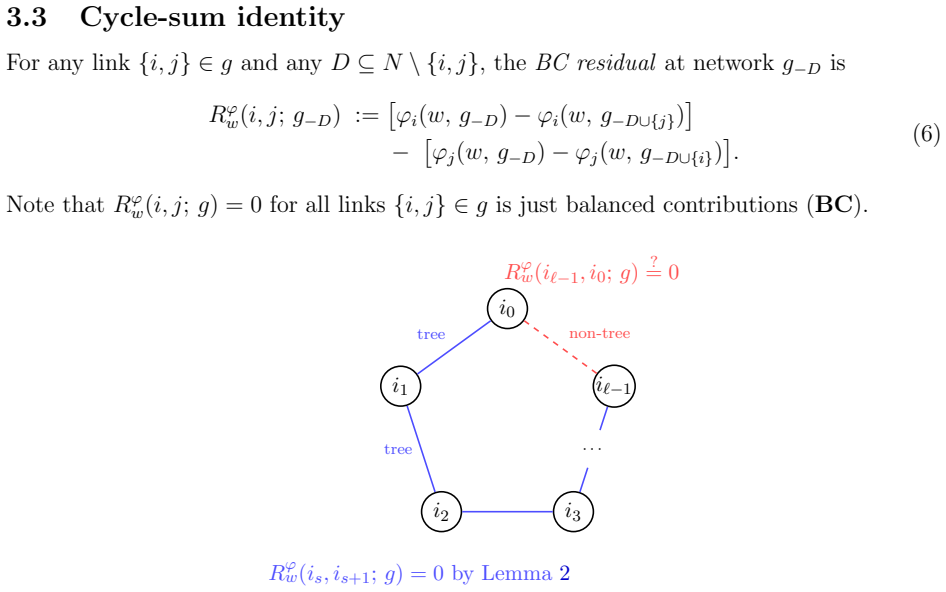
The BCE rule is the unique component-efficient allocation rule that satisfies balanced contributions on every possible edge. Its existence is shown by first defining shares on the edges of any spanning tree so that the balanced-contributions condition holds there, then using the cycle-sum identity to verify that the same condition automatically holds for every non-tree edge; this identity reduces the required equality on a cycle to a sum of balanced-contributions relations already satisfied in strictly smaller subnetworks.
What carries the argument
The cycle-sum identity, which equates a linear combination of balanced-contributions differences around any cycle to a relation among allocations in the proper subnetworks obtained by deleting edges of that cycle.
If this is right
- The BCE rule coincides with the Myerson value on transferable-utility games.
- It coincides with the Jackson-Wolinsky value on network games that have no externalities.
- On the complete network it returns the externality-free value.
- Unlike the fairness-based FCE rule, the BCE rule cannot be obtained by applying a graph-free formula to the graph-restricted game.
Where Pith is reading between the lines
- The same construction technique may extend to other fairness axioms once an analogous cycle-reduction identity is identified.
- In applications such as supply chains or social networks, the BCE rule supplies a computable benchmark that treats every possible link symmetrically rather than privileging a particular spanning tree.
- The distinction between BCE and FCE suggests that empirical tests could separate whether agents care more about equal marginal impact of links or about equal treatment of symmetric positions.
Load-bearing premise
The cycle-sum identity holds for any cycle, so that balanced contributions on non-tree edges reduce to already-established relations in smaller networks.
What would settle it
Exhibit a concrete network with externalities in which the candidate BCE shares violate the balanced-contributions equality on at least one non-tree edge, or show that two distinct component-efficient rules both satisfy balanced contributions on all edges.
Figures



read the original abstract
For networks with externalities, where each component's worth may depend on the full network structure, balanced contributions and fairness lead to distinct component-efficient allocation rules. We characterize the unique component-efficient allocation rule satisfying balanced contributions -- the BCE rule. Existence is the main challenge: balanced contributions must hold on every edge, but the construction uses only spanning-tree edges. A cycle-sum identity bridges this gap by reducing balanced contributions on non-tree edges to relations in proper subnetworks. The BCE rule coincides with the Myerson value for TU games and with its generalization by Jackson--Wolinsky for network games without externalities, it recovers the externality-free value on the complete network, and -- unlike the fairness-based FCE rule -- it does not reduce to a graph-free formula applied to the graph-restricted game.
Editorial analysis
A structured set of objections, weighed in public.
Referee Report
Summary. The manuscript characterizes the unique component-efficient allocation rule satisfying the balanced contributions axiom in network games with externalities, termed the BCE rule. It addresses the challenge of ensuring balanced contributions on all edges by constructing the rule using spanning trees and invoking a cycle-sum identity to handle non-tree edges. The rule is shown to coincide with the Myerson value for TU games and the Jackson-Wolinsky value for network games without externalities, while differing from the fairness-based FCE rule by not reducing to a graph-free formula.
Significance. If the cycle-sum identity holds as claimed, the BCE rule offers a principled way to allocate value in networks where component worth depends on the entire structure, providing an alternative to fairness axioms. This could have implications for economic models involving externalities in networks, such as in collaboration or trade networks. The paper credits the axiomatic approach and shows consistency with prior special cases.
major comments (1)
- [Existence proof (cycle-sum identity)] The central existence argument relies on a cycle-sum identity to extend balanced contributions from spanning-tree edges to all edges. However, it is unclear whether this identity holds for arbitrary externality dependencies in v(S, g) without additional assumptions, or if overlapping cycles could lead to inconsistent allocations. This is load-bearing for the uniqueness claim, as failure would mean the rule either violates BC or is not well-defined.
minor comments (1)
- [Abstract] The abstract could more explicitly reference the theorem number for the main characterization result.
Simulated Author's Rebuttal
We thank the referee for their careful reading of the manuscript and for identifying the cycle-sum identity as central to the existence and uniqueness argument. We respond to the major comment below.
read point-by-point responses
-
Referee: [Existence proof (cycle-sum identity)] The central existence argument relies on a cycle-sum identity to extend balanced contributions from spanning-tree edges to all edges. However, it is unclear whether this identity holds for arbitrary externality dependencies in v(S, g) without additional assumptions, or if overlapping cycles could lead to inconsistent allocations. This is load-bearing for the uniqueness claim, as failure would mean the rule either violates BC or is not well-defined.
Authors: The cycle-sum identity is proved by induction on network size. The allocation rule is first defined on spanning trees to satisfy balanced contributions and component efficiency on those edges. For any non-tree edge, the identity equates the balanced-contributions difference on that edge to a signed sum of the same differences over a collection of proper subnetworks obtained by deleting edges from the cycle. Because each subnetwork is strictly smaller, the inductive hypothesis applies and the identity holds for arbitrary v(S,g). Overlapping cycles do not produce inconsistency: the relations are linear and the cycle space is spanned by the fundamental cycles of any spanning tree; once the tree edges satisfy the axiom, every linear combination (including overlapping cycles) is automatically satisfied. The construction therefore yields a unique well-defined rule that meets balanced contributions on every edge for any externality structure. No additional assumptions on v are required. revision: no
Circularity Check
No circularity: axiomatic characterization remains independent of its own outputs
full rationale
The paper defines the BCE rule via the standard axioms of component efficiency and balanced contributions, then proves uniqueness and existence by an inductive construction on spanning trees together with a cycle-sum identity that reduces non-tree edges to subnetwork relations. No quoted step shows the rule being fitted to data, renamed from a known result, or derived from a self-citation whose content is itself unverified; the cycle-sum identity is presented as a derived property of the value function rather than an assumption smuggled in to force the conclusion. The derivation is therefore self-contained against the stated axioms and does not reduce to its inputs by construction.
Axiom & Free-Parameter Ledger
axioms (2)
- domain assumption Balanced contributions must hold on every edge, yet the allocation is constructed using only spanning-tree edges.
- domain assumption Component efficiency requires each connected component to divide exactly the value it creates.
Reference graph
Works this paper leans on
-
[1]
Decomposition of solutions and the Shapley value
Casajus, A., Huettner, F., 2018. Decomposition of solutions and the Shapley value. Games and Economic Behavior 108, 37–48. De Clippel, G., Serrano, R., 2008. Marginal contributions and externalities in the value. Econometrica 76, 1413–1436
2018
-
[2]
Bargaining, coalition formation and value
Feldman, B., 1996. Bargaining, coalition formation and value. Ph.D. thesis. State University of New York at Stony Brook
1996
-
[3]
Potential, value, and consistency
Hart, S., Mas-Colell, A., 1989. Potential, value, and consistency. Econometrica 57, 589–614
1989
-
[4]
A strategic model of social and economic networks
Jackson, M.O., Wolinsky, A., 1996. A strategic model of social and economic networks. Journal of Economic Theory 71, 44–74
1996
-
[5]
Implementing cooperative solution concepts: a generalized bidding approach
Ju, Y., Wettstein, D., 2025. Implementing cooperative solution concepts: a generalized bidding approach. Economic Theory 79, 221–258
2025
-
[6]
Game Theory
Maschler, M., Solan, E., Zamir, S., 2013. Game Theory. Cambridge University Press, Cambridge
2013
-
[7]
Conference structures and fair allocation rules
Myerson, R.B., 1980. Conference structures and fair allocation rules. International Journal of Game Theory 9, 169–182
1980
-
[8]
Fair allocation in networks with externalities
Navarro, N., 2007. Fair allocation in networks with externalities. Games and Economic Behavior 58, 354–364
2007
-
[9]
A Course in Game Theory
Osborne, M.J., Rubinstein, A., 1994. A Course in Game Theory. MIT Press. P´ erez-Castrillo, D., Wettstein, D., 2001. Bidding for the surplus: A non-cooperative ap- proach to the Shapley value. Journal of Economic Theory 100, 274–294. Pham Do, K.H., Norde, H., 2007. The Shapley value for partition function form games. International Game Theory Review 9, 353–360
1994
-
[10]
A value forn-person games, in: Kuhn, H.W., Tucker, A.W
Shapley, L.S., 1953. A value forn-person games, in: Kuhn, H.W., Tucker, A.W. (Eds.), Contributions to the Theory of Games II. Princeton University Press. number 28 in Annals of Mathematics Studies, pp. 307–317
1953
-
[11]
Bidding for surplus in network allocation problems
Slikker, M., 2007. Bidding for surplus in network allocation problems. Journal of Economic Theory 137, 493–511
2007
-
[12]
Naval Research Logistics Quarterly 10, 281–298
Thrall, R.M., Lucas, W.F., 1963.n-person games in partition function form. Naval Research Logistics Quarterly 10, 281–298. 20
1963
discussion (0)
Sign in with ORCID, Apple, or X to comment. Anyone can read and Pith papers without signing in.