Recognition: unknown
dqc_simulator: an easy-to-use distributed quantum computing simulator
Pith reviewed 2026-05-10 12:59 UTC · model grok-4.3
The pith
A Python toolkit automates simulation of both hardware and software in distributed quantum computing.
A machine-rendered reading of the paper's core claim, the machinery that carries it, and where it could break.
Core claim
Distributed quantum computing offers a path around single-device scalability limits, yet few classical simulators exist to test full systems. The work presents dqc_simulator as a Python toolkit that handles many of the hardest simulation tasks automatically. This allows straightforward modeling of both hardware layouts and software protocols, so that realistic and robust tests become feasible for the complete DQC stack.
What carries the argument
dqc_simulator, a Python toolkit that automates the most challenging parts of the DQC simulation workflow to support joint hardware and software modeling.
If this is right
- Researchers gain the ability to run realistic tests on proposed DQC hardware configurations.
- Software protocols for distributed quantum operations can be evaluated together with hardware models.
- The full DQC stack becomes subject to systematic benchmarks that were previously hard to construct.
- The shortage of classical simulation tools for DQC devices is reduced, lowering barriers to system-level evaluation.
Where Pith is reading between the lines
- Wider use of such a simulator could speed up the cycle of proposing and checking DQC architectures that address scalability.
- Standardized benchmark suites built on the toolkit might emerge, allowing different research groups to compare DQC designs on common ground.
- The tool opens a route to hybrid simulations that combine classical network models with quantum circuit execution for end-to-end performance estimates.
Load-bearing premise
The automated simulations produce results that match what would be seen on real DQC hardware without users having to add extensive custom code or perform separate validation.
What would settle it
A direct comparison of benchmark outputs from dqc_simulator against either manual calculations for small DQC instances or measurements from early physical distributed quantum devices, checking for both numerical agreement and the amount of user effort required.
Figures
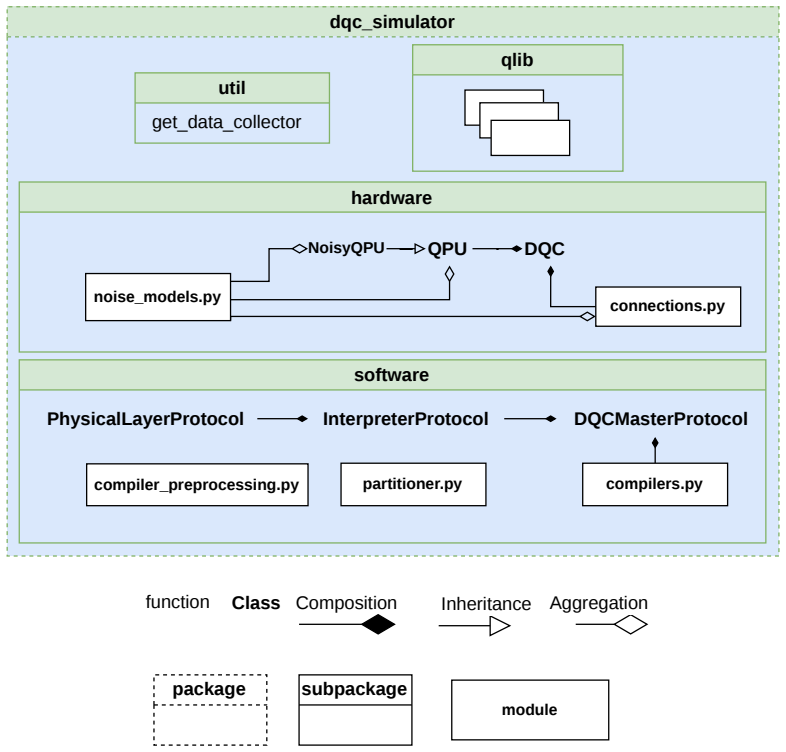
read the original abstract
Distributed quantum computing (DQC) is a promising proposal for overcoming the scalability challenges of quantum computing. However, the evaluation of DQC hardware and software is difficult due to the relative dearth of classical simulation tools available for DQC devices. In this work, we introduce dqc_simulator, a novel simulation toolkit, written in Python, which automates many of the most challenging aspects of the DQC simulation workflow. dqc_simulator enables the easy simulation of both hardware and software, making it easy to create realistic and robust tests and benchmarks for the full DQC stack.
Editorial analysis
A structured set of objections, weighed in public.
Referee Report
Summary. The manuscript introduces dqc_simulator, a Python-based toolkit for simulating distributed quantum computing (DQC) that automates many of the most challenging aspects of the DQC simulation workflow, enabling easy simulation of both hardware and software to create realistic and robust tests and benchmarks for the full DQC stack.
Significance. If the automation claims hold, the toolkit would address a genuine gap in DQC research by lowering the barrier to evaluating hardware and software proposals, which is important given the scarcity of classical simulation tools for distributed quantum systems.
major comments (2)
- The abstract asserts that dqc_simulator 'automates many of the most challenging aspects of the DQC simulation workflow' and 'enables the easy simulation of both hardware and software,' but the manuscript supplies no architecture description, pseudocode, complexity analysis, scaling results, or side-by-side comparisons with manual implementations using existing libraries. This absence is load-bearing for the central claim of reduced workflow burden and realistic output.
- No benchmarks, validation against known DQC cases, error analysis, or demonstration of handling distributed entanglement management, inter-node communication, or realistic noise are provided, leaving the assertion that the tool produces 'realistic and robust tests' without concrete support.
Simulated Author's Rebuttal
We thank the referee for the constructive comments on our manuscript introducing dqc_simulator. The major comments correctly identify areas where additional technical details and empirical support are needed to substantiate the claims of workflow automation and realistic simulation outputs. We address each point below and will revise the manuscript to incorporate the requested elements.
read point-by-point responses
-
Referee: The abstract asserts that dqc_simulator 'automates many of the most challenging aspects of the DQC simulation workflow' and 'enables the easy simulation of both hardware and software,' but the manuscript supplies no architecture description, pseudocode, complexity analysis, scaling results, or side-by-side comparisons with manual implementations using existing libraries. This absence is load-bearing for the central claim of reduced workflow burden and realistic output.
Authors: We agree that the manuscript would benefit from these supporting details to make the automation claims more concrete. In the revised version, we will add a new section describing the software architecture, including pseudocode for the key automation routines (such as distributed circuit partitioning and inter-node synchronization). We will also include a complexity analysis of the core simulation steps, preliminary scaling results from test cases, and explicit comparisons showing the reduction in manual effort relative to implementing equivalent functionality with libraries like Qiskit or PennyLane. revision: yes
-
Referee: No benchmarks, validation against known DQC cases, error analysis, or demonstration of handling distributed entanglement management, inter-node communication, or realistic noise are provided, leaving the assertion that the tool produces 'realistic and robust tests' without concrete support.
Authors: We acknowledge that the current manuscript lacks these validation elements. The revised manuscript will include benchmark timings and resource usage for representative DQC workloads, validation against analytically solvable distributed quantum circuits, an error analysis comparing simulated outputs to exact results, and explicit demonstrations of distributed entanglement management, inter-node communication latency modeling, and integration of realistic noise channels (e.g., depolarizing and amplitude damping). revision: yes
Circularity Check
No circularity: software tool announcement with no derivations or self-referential claims
full rationale
The manuscript is a straightforward description of a new Python simulation toolkit for distributed quantum computing. It contains no equations, no fitted parameters, no predictions derived from data, and no self-citations that serve as load-bearing premises for any result. The claim that the tool 'automates many of the most challenging aspects' is an assertion about software functionality rather than a derivation that reduces to its own inputs by construction. No patterns of self-definition, fitted-input-as-prediction, or uniqueness imported via author citation appear. The paper is therefore self-contained as a tool announcement with no circular derivation chain.
Axiom & Free-Parameter Ledger
Reference graph
Works this paper leans on
-
[1]
P. Webster, L. Berent, O. Chandra, E. T. Hockings, N. Baspin, F. Thomsen,et al., “The Pinnacle architecture: Reducing the cost of breaking RSA-2048 to 100 000 physical qubits using quantum LDPC codes,” 2026. https://arxiv.org/abs/2602.11457
work page internal anchor Pith review Pith/arXiv arXiv 2048
-
[2]
How to factor 2048 bit RSA integers with less than a million noisy qubits
C. Gidney, “How to factor 2048 bit RSA integers with less than a million noisy qubits,” 2025. https://arxiv.org/abs/2505.15917
work page internal anchor Pith review arXiv 2048
-
[3]
Distributed quantum computing: A survey,
M. Caleffi, M. Amoretti, D. Ferrari, J. Illiano, A. Manzalini, and A. S. Cacciapuoti, “Distributed quantum computing: A survey,”Comput. Netw., vol. 254, no. 110672, 2024. https://www.sciencedirect.com/science/article/pii/S1389128624005048
2024
-
[4]
Netsquid, a network simulator for quantum information using discrete events,
T. Coopmans, R. Knegjens, A. Dahlberg, D. Maier, L. Nijsten, J. de Oliveira, M. Papendrecht,et al., “NetSquid, a NETwork Simulator for QUantum Information using Discrete events,”Commun. Phys, vol. 4, no. 164, 2021. https://doi.org/10.1038/s42005-021-00647-8. 12
-
[5]
SeQUeNCe: a customizable discrete-event simulator of quantum networks,
X. Wu, A. Kolar, J. Chung, D. Jin, T. Zhong, R. Kettimuthu,et al., “SeQUeNCe: a customizable discrete-event simulator of quantum networks,”Quantum Sci. Technol., vol. 6, no. 045027, 2021
2021
-
[7]
A distributed simulation framework for quantum networks and channels
T. Matsuo, “Simulation of a Dynamic, RuleSet-based Quantum Network.” arXiv:1908.10758, 2019. https://doi.org/10.48550/arXiv.1808.07047
-
[8]
QuNetSim: A software framework for quantum networks,
S. DiAdamo, J. Nötzel, B. Zanger, and M. Mert Beşe, “QuNetSim: A software framework for quantum networks,”IEEE Trans. Quantum Eng., vol. 2, pp. 1–12, 2020. https://doi.org/10.1109/TQE.2021.3092395
-
[9]
CUNQA: a distributed quantum computing emulator for HPC
J. Vázquez-Pérez, D. Expósito-Patiño, M. Losada, A. Carballido, A. Gómez, and T. F. Pena, “CUNQA: a distributed quantum computing emulator for HPC.” arXiv:2511.05209, 2025. https://doi.org/10.48550/arXiv.2511.05209
-
[10]
Quantum algorithms and simulation for parallel and distributed quantum computing,
R. Parekh, A. Ricciardi, A. Darwish, and S. DiAdamo, “Quantum algorithms and simulation for parallel and distributed quantum computing,” in2021 IEEE/ACM Second International Workshop on Quantum Computing Software (QCS), pp. 9–19, 2021. https://doi.org/10.1109/QCS54837.2021.00005
-
[11]
The simulation of distributed quantum algorithms,
S. Muralidharan, “The simulation of distributed quantum algorithms,” J. Supercomput., vol. 81, no. 645, 2025. https://doi.org/10.1007/s11227-025-07125-w
-
[12]
dqc-executor
D. Ferrari and M. Amoretti, “dqc-executor.” Version unspecified [software]. Last Accessed Apr 2026. https://github.com/qis-unipr/dqc-executor
2026
-
[13]
An end-to-end distributed quantum circuit simulator
S. Zhang, L. Xiong, Y. Liu, B. L. Mark, L. Yang, Z. Yang,et al., “An end-to-end distributed quantum circuit simulator.” arXiv:2511.19791,
-
[14]
https://doi.org/10.48550/arXiv.2511.19791
-
[15]
Quantum data centres: a simulation-based comparative noise analysis,
K. Campbell, A. Lawey, and M. Razavi, “Quantum data centres: a simulation-based comparative noise analysis,”Quantum Sci Technol., vol. 10, no. 015052, 2024. https://doi.org/10.1088/2058-9565/ad9cb8. 13
-
[16]
Combatting noise in near-term quantum data centres
K. Campbell, A. Lawey, and M. Razavi, “Combatting noise in near-term quantum data centres.” arXiv:2601.14845, 2026. https://doi.org/10.48550/arXiv.2601.14845
-
[17]
Unified markup language (uml)
OMG Standards Development Organisation, “Unified markup language (uml).” Version 2.5.1. https://www.omg.org/spec/UML/2.5.1
-
[18]
nuqasm2,
J. Woehr, “nuqasm2,” 2022. Version 0.3.3 [software]. https://github.com/jwoehr/nuqasm2
2022
-
[19]
Open Quantum Assembly Language
A. Cross, L. Bishop, A. Smolin, and J. Gambetta, “Open Quantum Assembly Language.” arXiv:1707.03429, 2017. https://doi.org/10.48550/arXiv.1707.03429. 14
discussion (0)
Sign in with ORCID, Apple, or X to comment. Anyone can read and Pith papers without signing in.