Recognition: unknown
Three-dimensional photon transport in spinodal photocatalytic aerogels: how bicontinuous morphology controls kinetic rate constants
Pith reviewed 2026-05-10 12:30 UTC · model grok-4.3
The pith
Bicontinuous aerogel pores channel photons preferentially to the solid catalyst, increasing its illumination by 50 to 70 percent and shifting extracted kinetic rates by 34 percent from diffusion predictions.
A machine-rendered reading of the paper's core claim, the machinery that carries it, and where it could break.
Core claim
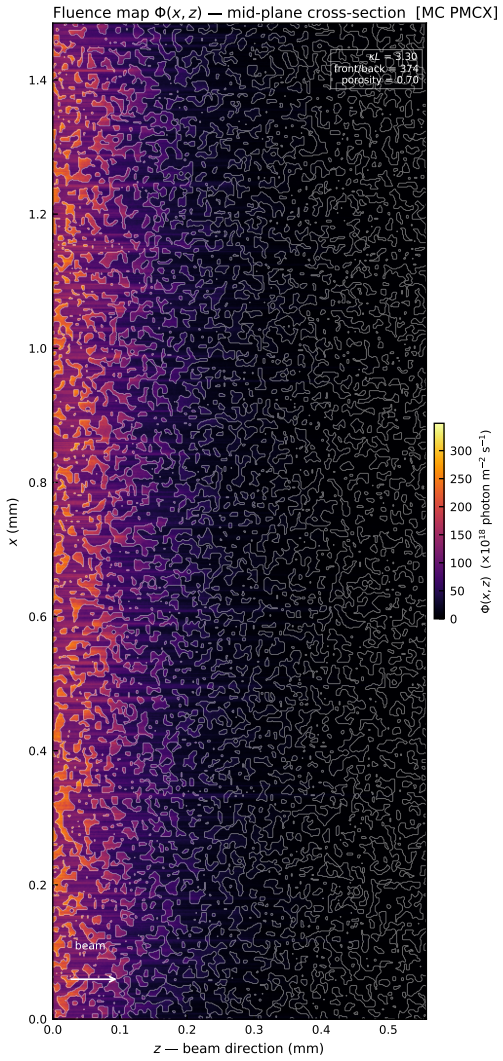
Three-dimensional spinodal masks generated by Cahn-Hilliard simulations are combined with GPU Monte Carlo photon transport to compute the fluence specifically within the solid catalytic phase. At 70 percent porosity the solid receives 50 percent more photons than a volume average, rising to 70 percent more at 90 percent porosity; the excess is traced to photon channelling along continuous pore pathways. The kinetic descriptor obtained from the 3D model differs by 34 percent from the value given by a diffusion approximation, and homogeneous control calculations attribute approximately half of the 73 percent total discrepancy to the intrinsic bicontinuous structure rather than to shortcomings,
What carries the argument
The solid-phase fluence estimator applied to Cahn-Hilliard-generated spinodal masks inside a Monte Carlo photon-transport simulation, which tracks individual photon trajectories to reveal preferential illumination of the catalyst phase.
Load-bearing premise
The Cahn-Hilliard spinodal structures and the chosen optical parameters in the Monte Carlo model accurately represent the morphology and light-scattering properties of actual experimental TiO2-silica aerogels.
What would settle it
Fabricate TiO2-silica aerogels with controlled porosities matching the simulated masks, measure local reaction rates or absorbed-photon distributions under controlled illumination, and test whether the observed rates align with the 3D Monte Carlo predictions rather than with diffusion-model outputs.
Figures




read the original abstract
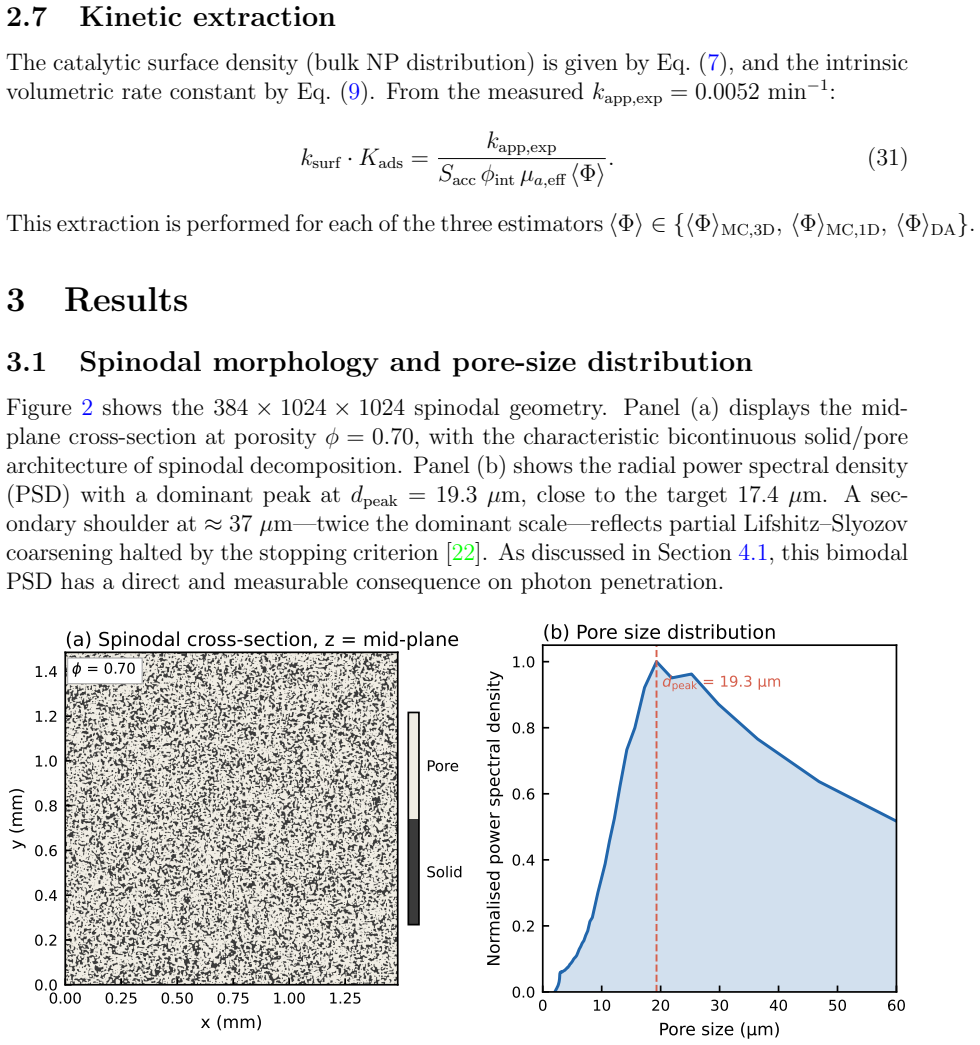
Porous monolithic photocatalysts based on anatase TiO2 in silica aerogels are promising for air purification. Their bicontinuous spinodal architecture offers high surface area and strong light scattering. However, extracting intrinsic kinetic rates requires accurate optical models. Current methods replace the complex 3D pore network with a homogeneous 1D slab, an approximation whose error is unknown for spinodal geometries. We combine 3D spinodal masks from Cahn-Hilliard simulations with GPU Monte Carlo photon transport to quantify this. We introduce a solid-phase fluence estimator that accounts for catalytic site distribution, comparing it to volume averages and diffusion approximations. The solid phase receives 50% more photons than volume averages at porosity 0.70, rising to 70% at 0.90. This preferential illumination stems from quasi-ballistic paths through pore channels, termed photon channelling. The extracted kinetic descriptor differs by 34% between 3D Monte Carlo and diffusion models. Homogeneous controls show that roughly 50% of the total 73% discrepancy is intrinsic to the bicontinuous structure and cannot be fixed by effective medium theories. These results provide the first quantitative correction for kinetic extraction in such photocatalysts and establish design rules linking synthesis coarsening, pore size, and light efficiency.
Editorial analysis
A structured set of objections, weighed in public.
Referee Report
Summary. The manuscript uses Cahn-Hilliard simulations to generate bicontinuous spinodal masks for TiO2-silica aerogels and GPU-accelerated Monte Carlo photon transport to model 3D light propagation. It introduces a solid-phase fluence estimator that accounts for catalytic site distribution and reports that the solid phase receives 50% more photons than volume averages at 0.70 porosity (rising to 70% at 0.90 porosity) due to quasi-ballistic photon channelling through pore channels. This produces a 34% difference in an extracted kinetic descriptor relative to diffusion approximations; homogeneous controls indicate that roughly half of the total 73% discrepancy is intrinsic to the bicontinuous morphology and cannot be recovered by effective-medium theories.
Significance. If the quantitative corrections hold, the work supplies the first morphology-specific adjustment for kinetic-rate extraction in spinodal photocatalysts and supplies design rules connecting coarsening time, pore size, and light utilization. The direct forward Monte Carlo approach (rather than parameter fitting) and the use of homogeneous controls as an external check are methodological strengths that avoid circularity in the fluence comparison.
major comments (3)
- [Abstract and Results] Abstract and Results: the reported 50–70% solid-phase fluence excess and 34% kinetic shift are presented as specific numbers without any sensitivity sweeps on the optical constants (refractive indices, absorption/scattering lengths) or on the Cahn-Hilliard coarsening parameters. Because the mean free path relative to pore size controls the quasi-ballistic channelling, these percentages are not shown to be robust; the central claim that the bicontinuous structure intrinsically accounts for half the discrepancy therefore rests on untested inputs.
- [Methods] Methods: the solid-phase fluence estimator and the precise definition of the kinetic descriptor are introduced without an equation or algorithmic description of how photon paths are binned onto the solid voxels or how the 73% total discrepancy is partitioned between structure and effective-medium error. This prevents independent verification of the 50% intrinsic attribution.
- [Results] Results: no experimental benchmark or even a comparison to measured transmittance/reflectance of real TiO2-silica aerogels is provided. Without such grounding, it remains unclear whether the Monte Carlo model with the chosen parameters reproduces the actual photon transport regime of the experimental materials.
minor comments (2)
- [Introduction] The term 'photon channelling' is used without reference to analogous quasi-ballistic transport concepts already present in the porous-media optics literature.
- [Figures] Figure captions should explicitly state the porosity values, optical parameters, and number of photon trajectories used for each panel to allow direct comparison with the reported percentages.
Simulated Author's Rebuttal
We thank the referee for the constructive comments and for recognizing the methodological strengths of the direct Monte Carlo approach and homogeneous controls. We address each major comment point by point below, with planned revisions indicated.
read point-by-point responses
-
Referee: [Abstract and Results] Abstract and Results: the reported 50–70% solid-phase fluence excess and 34% kinetic shift are presented as specific numbers without any sensitivity sweeps on the optical constants (refractive indices, absorption/scattering lengths) or on the Cahn-Hilliard coarsening parameters. Because the mean free path relative to pore size controls the quasi-ballistic channelling, these percentages are not shown to be robust; the central claim that the bicontinuous structure intrinsically accounts for half the discrepancy therefore rests on untested inputs.
Authors: We agree that the absence of sensitivity sweeps leaves the quantitative robustness untested. In the revised manuscript we will add sweeps over refractive index, absorption/scattering lengths, and Cahn-Hilliard coarsening times, confirming that the 50–70 % fluence excess and 34 % kinetic shift remain qualitatively stable within the physically relevant range for TiO2-silica aerogels. revision: yes
-
Referee: [Methods] Methods: the solid-phase fluence estimator and the precise definition of the kinetic descriptor are introduced without an equation or algorithmic description of how photon paths are binned onto the solid voxels or how the 73% total discrepancy is partitioned between structure and effective-medium error. This prevents independent verification of the 50% intrinsic attribution.
Authors: We accept that explicit equations and algorithmic details are required for reproducibility. The revised Methods section will include the mathematical definition of the solid-phase fluence estimator, the precise binning algorithm for photon paths onto solid voxels, and the step-by-step procedure used to partition the 73 % discrepancy between bicontinuous morphology and effective-medium error. revision: yes
-
Referee: [Results] Results: no experimental benchmark or even a comparison to measured transmittance/reflectance of real TiO2-silica aerogels is provided. Without such grounding, it remains unclear whether the Monte Carlo model with the chosen parameters reproduces the actual photon transport regime of the experimental materials.
Authors: The study is computational and quantifies morphology-specific corrections via Monte Carlo transport; the homogeneous controls already provide an internal consistency check that avoids circularity. Direct experimental transmittance/reflectance data for the exact simulated structures are not available to the authors. In revision we will expand the discussion of model assumptions and applicability limits, but cannot add new experimental benchmarks. revision: partial
- Direct experimental transmittance or reflectance measurements on real TiO2-silica aerogels matching the simulated structures for model benchmarking.
Circularity Check
No circularity: all quantitative claims are direct outputs of forward Monte Carlo simulation on independently generated morphologies
full rationale
The paper generates spinodal masks via Cahn-Hilliard simulation, then runs GPU Monte Carlo photon transport to compute fluence distributions. The solid-phase fluence estimator is a defined post-processing step applied to the simulated photon paths; the reported 50-70% excess, 34% kinetic descriptor difference, and homogeneous-control breakdown are computed results rather than inputs or self-referential definitions. No fitted parameters are relabeled as predictions, no uniqueness theorems or ansatzes are smuggled via self-citation, and the derivation chain does not reduce any central claim to its own inputs by construction. The work is self-contained forward modeling whose outputs can be independently reproduced or falsified by changing the optical parameters or morphology generator.
Axiom & Free-Parameter Ledger
free parameters (2)
- porosity
- Cahn-Hilliard coarsening parameters
axioms (2)
- domain assumption Cahn-Hilliard equation produces representative spinodal bicontinuous morphologies for the aerogels
- domain assumption Monte Carlo photon transport with the chosen optical properties correctly models light propagation in the porous medium
invented entities (2)
-
solid-phase fluence estimator
no independent evidence
-
photon channelling
no independent evidence
Reference graph
Works this paper leans on
-
[1]
M.R. Hoffmann, S.T. Martin, W. Choi, D.W. Bahnemann, Environmental ap- plications of semiconductor photocatalysis, Chem. Rev. 95 (1995) 69–96.https: //doi.org/10.1021/cr00033a004
-
[2]
A. Vardon, M.-A. Dourges, ´E. Laurichesse, V. Schmitt, A. Bentaleb, F. Nallet, I. Ly, R. Backov, Mastering syntheses of siliceous hierarchical porous self-standing monoliths through the integration of the sol–gel process, complex fluids, and a plan- etary mixer, Langmuir 41 (2025) 26760–26769.https://doi.org/10.1021/acs. langmuir.5c03237
work page doi:10.1021/acs 2025
-
[3]
´E. Layan, G. Clermont, I. Ly, F. Nallet, R.A.L. Vall´ ee, et al., Bulk photocatalysis within anatase-TiO 2–SiO2 monoliths for efficient VOC photodegradation, Chem. Commun. 61 (2025) 12345.https://doi.org/10.1039/d5cc02552d
-
[4]
Ollis, Kinetics of photocatalyzed reactions: Five lessons learned, Front
D.F. Ollis, Kinetics of photocatalyzed reactions: Five lessons learned, Front. Chem. 6 (2018) 378.https://doi.org/10.3389/fchem.2018.00378
-
[5]
Bloh, A holistic approach to model the kinetics of heterogeneous photocatalysis, Front
J.Z. Bloh, A holistic approach to model the kinetics of heterogeneous photocatalysis, Front. Chem. 7 (2019) 128.https://doi.org/10.3389/fchem.2019.00128
-
[6]
Garnett, Colours in metal glasses and in metallic films, Philos
J.C.M. Garnett, Colours in metal glasses and in metallic films, Philos. Trans. R. Soc. A 203 (1904) 385–420.https://doi.org/10.1098/rsta.1904.0024
-
[7]
Ishimaru, Wave Propagation and Scattering in Random Media, IEEE Press, New York, 1978
A. Ishimaru, Wave Propagation and Scattering in Random Media, IEEE Press, New York, 1978
1978
-
[8]
R.A.L. Vall´ ee, R. Backov, From light diffusion to photocatalytic rates: Compact scal- ing laws for strongly scattering porous slabs, J. Quant. Spectrosc. Radiat. Transfer 352 (2026) 109819.https://doi.org/10.1016/j.jqsrt.2026.109819
-
[9]
K. Vynck, R. Pierrat, R. Carminati, L.S. Froufe-P´ erez, F. Scheffold, R. Sapienza, S. Vignolini, J.J. Sa´ enz, Light in correlated disordered media, Rev. Mod. Phys. 95 (2023) 045003.https://doi.org/10.1103/RevModPhys.95.045003 18
-
[10]
S. Leyre, E. Coutino-Gonzalez, J.J. Joos, J. Ryckaert, Y. Meuret, D. Poelman, P.F. Smet, G. Durinck, J. Hofkens, G. Deconinck, P. Hanselaer, Absolute determination of photoluminescence quantum efficiency using an integrating sphere setup, Rev. Sci. Instrum. 91 (2020) 013108.https://doi.org/10.1063/1.5136060
-
[11]
S. Leyre, B. Meuris, J.J. Joos, P.F. Smet, G. Deconinck, P. Hanselaer, Determination of the optical properties of turbid media using a single integrating sphere setup, Appl. Opt. 61 (2022) 792–802.https://doi.org/10.1364/AO.445979
-
[12]
S.S. Brunser, F.L. Bargardi, R. Libanori, N. Kaufmann, H. Braun, A. Steinfeld, A.R. Studart, Solar-driven redox splitting of CO 2 using 3D-printed hierarchically channelled ceria structures, Adv. Mater. Interfaces 10 (2023) 2300452.https:// doi.org/10.1002/admi.202300452
-
[13]
Q. Liu, K. Pan, Y. Lu, X. Zhang, Data-driven for accelerated design strategy of photocatalytic degradation activity prediction of doped TiO2 photocatalyst, J. Water Process Eng. 49 (2022) 103126.https://doi.org/10.1016/j.jwpe.2022.103126
-
[14]
J.W. Cahn, J.E. Hilliard, Free energy of a nonuniform system. I. Interfacial free energy, J. Chem. Phys. 28 (1958) 258–267.https://doi.org/10.1063/1.1744102
-
[15]
Cahn, Free energy of a nonuniform system
J.W. Cahn, Free energy of a nonuniform system. II. Thermodynamic basis, J. Chem. Phys. 30 (1959) 1121–1124.https://doi.org/10.1063/1.1730145
-
[16]
N. Provatas, K. Elder, Phase-Field Methods in Materials Science and Engineering, Wiley-VCH, Weinheim, 2010.https://doi.org/10.1002/9783527631520
-
[17]
Q. Fang, D.A. Boas, Monte Carlo simulation of photon migration in 3D turbid media accelerated by graphics processing units, Opt. Express 17 (2009) 20178–20190. https://doi.org/10.1364/OE.17.20178
-
[18]
P.-A. Geslin, I. McCue, B. Gaskey, J. Erlebacher, A. Karma, Topology-generating interfacial pattern formation during liquid metal dealloying, Nat. Commun. 6 (2015) 8887.https://doi.org/10.1038/ncomms9887
-
[19]
Cahn, On spinodal decomposition, Acta Metall
J.W. Cahn, On spinodal decomposition, Acta Metall. 9 (1961) 795–801.https: //doi.org/10.1016/0001-6160(61)90182-1
-
[20]
J. Zhu, L.-Q. Chen, J. Shen, V. Tikare, Coarsening kinetics from a variable-mobility Cahn–Hilliard equation: Application of a semi-implicit Fourier spectral method, Phys. Rev. E 60 (1999) 3564–3572.https://doi.org/10.1103/PhysRevE.60.3564
-
[21]
Okuta, Y
R. Okuta, Y. Unno, D. Nishino, S. Hido, C. Loomis, CuPy: A NumPy-compatible library for NVIDIA GPU calculations, Proc. Workshop on Machine Learning Systems (LearningSys) at NeurIPS, 2017
2017
-
[22]
Lifshitz, V.V
I.M. Lifshitz, V.V. Slyozov, The kinetics of precipitation from supersaturated solid solutions, J. Phys. Chem. Solids 19 (1961) 35–50.https://doi.org/10.1016/ 0022-3697(61)90054-3
1961
-
[23]
Wagner, Theorie der Alterung von Niederschl¨ agen durch Uml¨ osen (Ostwald- Reifung), Z
C. Wagner, Theorie der Alterung von Niederschl¨ agen durch Uml¨ osen (Ostwald- Reifung), Z. Elektrochem. 65 (1961) 581–591. 19
1961
-
[24]
Jolivet, C
J.-P. Jolivet, C. Chan´ eac, E. Tronc, Iron oxide chemistry. From molecular clusters to extended solid networks, Chem. Commun. (2004) 481–487
2004
-
[25]
L. Yu, F. Nina-Paravecino, D. Kaeli, Q. Fang, Scalable and massively parallel Monte Carlo photon transport simulations for heterogeneous computing platforms, J. Biomed. Opt. (2018), 23(1), 010504
2018
-
[26]
R.C. Haskell, L.O. Svaasand, T.-T. Tsay, T.-C. Feng, M.S. McAdams, B.J. Tromberg, Boundary conditions for the diffusion equation in radiative transfer, J. Opt. Soc. Am. A 11 (1994) 2727–2741.https://doi.org/10.1364/josaa.11. 002727 20 Supplementary Information Three-dimensional photon transport in spinodal photocatalytic aerogels: how bicontinuous morphol...
discussion (0)
Sign in with ORCID, Apple, or X to comment. Anyone can read and Pith papers without signing in.