Recognition: unknown
Optimal Majoranas in Mesoscopic Kitaev Chains
Pith reviewed 2026-05-10 12:17 UTC · model grok-4.3
The pith
Parity crossings of Andreev bound states identify optimal regimes for localized Majorana zero modes in mesoscopic Kitaev chains.
A machine-rendered reading of the paper's core claim, the machinery that carries it, and where it could break.
Core claim
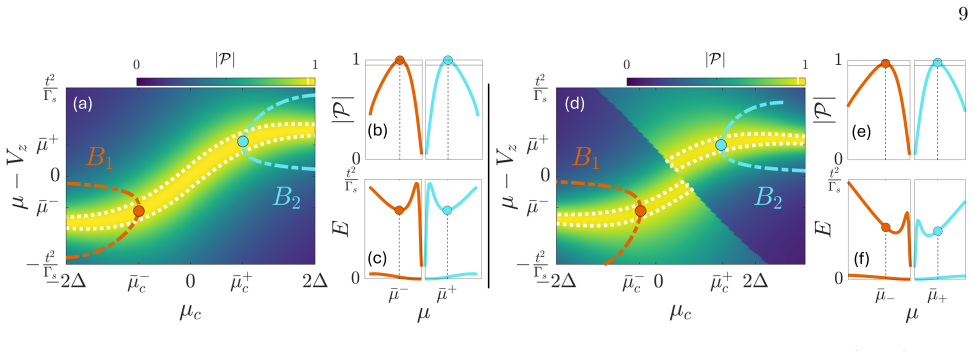
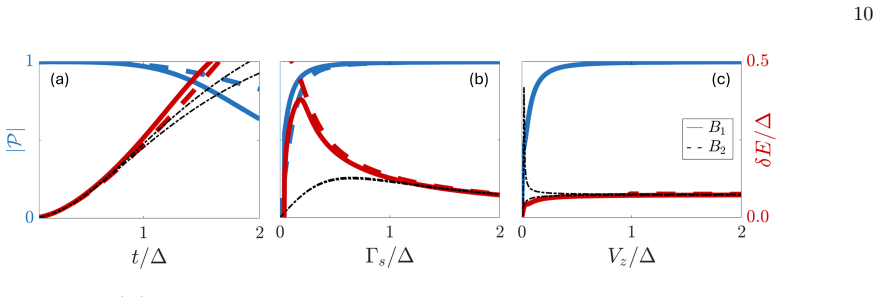
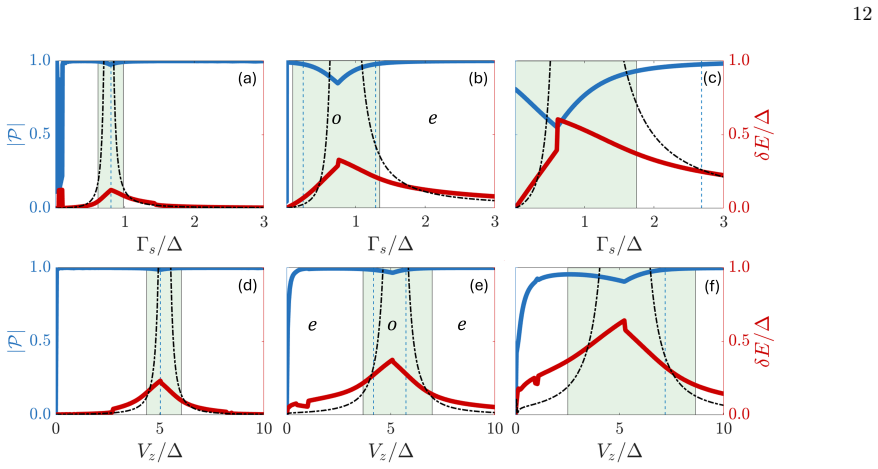
The paper claims that a full microscopic treatment of the mesoscopic hybrid region, incorporating the quasiparticle continuum and spin-split Andreev bound states, alters the minimal picture of Kitaev chains. It derives analytical expressions for the renormalized couplings and sweet-spot conditions that link microscopic parameters directly to Majorana optimization. Critically, the parity-crossings of the Andreev bound states mark the onset of an odd-parity spin-polarized regime and identify the optimal operating windows where MZMs are simultaneously well localized with a large gap to excited states.
What carries the argument
the parity crossings of the spin-split Andreev bound states within the hybrid superconducting segment, which identify the optimal windows for Majorana localization and gap protection
If this is right
- Analytical expressions connect microscopic parameters to sweet-spot conditions for MZMs.
- Optimal windows occur at Andreev bound state parity crossings where the system enters an odd-parity spin-polarized regime.
- MZMs become well localized with a large gap to excited states in these regimes.
- The treatment improves understanding of device performance in mesoscopic Kitaev chains.
Where Pith is reading between the lines
- Tuning to these parity crossings could be a practical guide for experiments seeking robust Majoranas.
- The microscopic approach may extend to optimizing segments in longer or more complex chains.
- Disorder effects, if present, might shift the locations of these optimal points from the ideal crossings.
Load-bearing premise
The microscopic model of the hybrid segment accurately captures the physics without additional effects like disorder or higher-order processes that could shift the parity crossings.
What would settle it
An experiment or simulation where the best Majorana localization and gaps do not occur at the predicted Andreev bound state parity crossings would disprove the identification of optimal operating windows.
Figures




read the original abstract
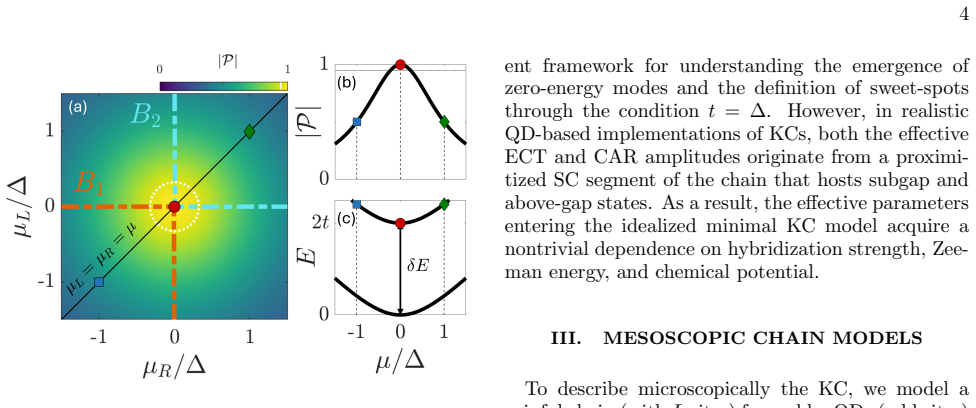
Kitaev chains realized in quantum dots coupled via superconducting segments provide a controllable platform for engineering Majorana zero modes (MZMs). In these systems, subgap states in the hybrid region mediate the effective coupling between quantum dots and determine the emergence of sweet-spots where MZMs are strongly localized. However, existing minimal treatments often oversimplify the mesoscopic hybrid region. We perform a full microscopic treatment of this hybrid segment, capturing the quasiparticle continuum and spin-split Andreev bound states (ABSs), and show that it fundamentally alters the minimal picture. We derive analytical expressions for the renormalized couplings and sweet-spot conditions, establishing a direct link between microscopic chain parameters and Majorana optimization and identifying experimentally relevant regimes for improved device performance. Critically, we find that parity-crossings of the ABS, marking the onset of an odd-parity spin-polarized regime in the segment, identify the optimal operating windows where MZMs are simultaneously well localized with a large gap to excited states.
Editorial analysis
A structured set of objections, weighed in public.
Referee Report
Summary. The manuscript develops a microscopic model of the hybrid superconducting segment in quantum-dot-based Kitaev chains, incorporating the quasiparticle continuum and spin-split Andreev bound states (ABS). It derives renormalized inter-dot couplings and sweet-spot conditions analytically, and concludes that parity crossings of the ABS—signaling the onset of an odd-parity spin-polarized regime—identify the optimal operating windows in which Majorana zero modes are simultaneously well localized and separated by a large gap from excited states.
Significance. If the central identification holds, the work supplies an experimentally accessible criterion (ABS parity crossings) for locating sweet spots in mesoscopic Kitaev devices, improving upon minimal models that omit the full hybrid-segment spectrum. The provision of closed-form expressions for renormalized couplings and sweet-spot conditions constitutes a concrete, falsifiable link between microscopic parameters and MZM optimization.
major comments (1)
- The central claim that ABS parity crossings mark the optimal windows for simultaneous MZM localization and large gap rests on the completeness of the hybrid-segment Hamiltonian (quasiparticle continuum plus spin-split ABSs). The manuscript does not examine whether disorder, interface scattering, or higher-order virtual processes shift the crossing locations or close the gap, which directly affects the robustness of the proposed optimization criterion.
Simulated Author's Rebuttal
We thank the referee for the careful reading and for acknowledging the value of our microscopic treatment. We address the single major comment below.
read point-by-point responses
-
Referee: The central claim that ABS parity crossings mark the optimal windows for simultaneous MZM localization and large gap rests on the completeness of the hybrid-segment Hamiltonian (quasiparticle continuum plus spin-split ABSs). The manuscript does not examine whether disorder, interface scattering, or higher-order virtual processes shift the crossing locations or close the gap, which directly affects the robustness of the proposed optimization criterion.
Authors: We agree that the analysis is performed for an ideal, clean hybrid segment whose Hamiltonian includes the full quasiparticle continuum together with the spin-split Andreev bound states. The manuscript derives the renormalized couplings and the sweet-spot condition from this complete microscopic description and identifies the ABS parity crossings as the optimal operating windows within that model. We have not incorporated disorder, interface scattering, or additional higher-order processes beyond those already resummed by exact diagonalization of the hybrid segment; such extensions lie outside the present scope. Higher-order virtual processes between the dots and the continuum are already accounted for in the effective low-energy theory we obtain. In the revised manuscript we will add a clarifying paragraph stating the assumptions of the model and noting that the parity-crossing criterion is proposed as a benchmark for clean mesoscopic devices, with robustness against disorder and scattering to be addressed in future work. revision: partial
Circularity Check
No circularity: sweet-spot conditions derived from microscopic Hamiltonian
full rationale
The paper's central result follows from a full microscopic treatment of the hybrid segment Hamiltonian that includes the quasiparticle continuum and spin-split ABSs. Analytical expressions for renormalized couplings and sweet-spot conditions are derived directly from this model, and the identification of ABS parity crossings as optimal windows is presented as an output of those equations rather than an input or a self-referential definition. No load-bearing step reduces by construction to a fitted parameter renamed as a prediction, a self-citation chain, or an ansatz smuggled from prior work by the same authors. The derivation remains self-contained within the stated microscopic model.
Axiom & Free-Parameter Ledger
axioms (1)
- domain assumption The hybrid segment is described by a microscopic Bogoliubov-de Gennes Hamiltonian that includes the quasiparticle continuum and spin-split Andreev bound states.
Forward citations
Cited by 2 Pith papers
-
Poor man's Majorana bound states in quantum dot based Kitaev chain coupled to a photonic cavity
Cavity photons screen attractive or repulsive interactions in a quantum-dot Kitaev chain, allowing the system to reach the sweet spot for poor man's Majorana bound states.
-
Sensitive dependence of Poor Man's Majorana modes on the length of the superconductor
Poor Man's Majorana modes in a two-quantum-dot plus finite superconductor hybrid oscillate in number between zero and two with superconductor length on the scale of one angstrom, and separately localized modes at both...
Reference graph
Works this paper leans on
-
[1]
Talento Program
However, as the coupling strength increases, the MP becomes progres- sively suppressed, as shown in Fig. 7 (b,c) and similar to the spin-degenerate limit of the ABS in the previous section. Similarly, the evolution of the sweet-spots with the Zeeman field also displays aδEpeak in the spin- polarized region, see Figs. 7 (d-f). Therefore, in- creasing the Z...
2022
-
[2]
Our goal is to explicitly account for the asymmetries ob- served when going beyond low energy descriptions
Spin-Degenerate ABS Here, we provide an analytical characterization of the excitation gap and the renormalization effects in the spin-degenerate ABS case assumingV z,c = 0. Our goal is to explicitly account for the asymmetries ob- served when going beyond low energy descriptions. Building on the GF formalism introduced previ- ously, we approximate the gap...
-
[3]
Spin-Split ABS We turn to the case of an explicitly finiteV z,c ̸= 0 in the SC hybrid section, arising from a spatially ho- mogeneousg-factor along the chain. Our goal is to ex- plicitly derive the effective coupling between the outer QDs mediated by the hybrid section when includ- ing renormalization effects going beyond the weak- coupling description. A...
-
[4]
A. Y. Kitaev, Unpaired majorana fermions in quan- tum wires, Physics-Uspekhi44, 131 (2001)
2001
-
[5]
Alicea, New directions in the pursuit of majorana fermions in solid state systems, Reports on progress in physics75, 076501 (2012)
J. Alicea, New directions in the pursuit of majorana fermions in solid state systems, Reports on progress in physics75, 076501 (2012)
2012
-
[6]
Leijnse and K
M. Leijnse and K. Flensberg, Introduction to topolog- ical superconductivity and majorana fermions, Semi- conductor Science and Technology27, 124003 (2012)
2012
-
[7]
S. R. Elliott and M. Franz, Colloquium: Majorana fermions in nuclear, particle, and solid-state physics, Rev. Mod. Phys.87, 137 (2015)
2015
-
[8]
Aguado, Majorana quasiparticles in condensed matter, La Rivista del Nuovo Cimento40, 523 (2017)
R. Aguado, Majorana quasiparticles in condensed matter, La Rivista del Nuovo Cimento40, 523 (2017)
2017
-
[9]
C. W. J. Beenakker, Search for non-Abelian Majorana braiding statistics in superconductors, SciPost Phys. Lect. Notes , 15 (2020)
2020
-
[10]
Tanaka, S
Y. Tanaka, S. Tamura, and J. Cayao, Theory of majo- rana zero modes in unconventional superconductors, Progress of Theoretical and Experimental Physics , ptae065 (2024)
2024
-
[11]
M. Pita-Vidal, R. S. Souto, S. Goswami, C. K. An- dersen, G. Katsaros, J. Shabani, and R. Aguado, Novel qubits in hybrid semiconductor-superconductor nanostructures, arXiv preprint arXiv:2512.23336 (2025)
-
[12]
A. Y. Kitaev, Fault-tolerant quantum computation by anyons, Annals of physics303, 2 (2003)
2003
-
[13]
Nayak, S
C. Nayak, S. H. Simon, A. Stern, M. Freedman, and S. Das Sarma, Non-abelian anyons and topological quantum computation, Rev. Mod. Phys.80, 1083 (2008)
2008
-
[14]
S. D. Sarma, M. Freedman, and C. Nayak, Majorana zero modes and topological quantum computation, npj Quantum Information1, 15001 (2015)
2015
-
[15]
Wilczek, Majorana returns, Nature Physics5, 614 (2009)
F. Wilczek, Majorana returns, Nature Physics5, 614 (2009)
2009
-
[16]
Aguado and L
R. Aguado and L. P. Kouwenhoven, Majorana qubits for topological quantum computing, Physics Today 73, 44 (2020)
2020
-
[17]
G. Wang, T. Dvir, G. P. Mazur, C.-X. Liu, N. van Loo, S. L. Ten Haaf, A. Bordin, S. Gazibegovic, G. Badawy, E. P. Bakkers, et al., Singlet and triplet cooper pair splitting in hybrid superconducting nanowires, Nature612, 448 (2022)
2022
-
[18]
Q. Wang, S. L. Ten Haaf, I. Kulesh, D. Xiao, C. Thomas, M. J. Manfra, and S. Goswami, Triplet correlations in cooper pair splitters realized in a two- dimensional electron gas, Nature Communications14, 4876 (2023)
2023
-
[19]
Bordin, G
A. Bordin, G. Wang, C.-X. Liu, S. L. Ten Haaf, N. Van Loo, G. P. Mazur, D. Xu, D. Van Driel, F. Za- telli, S. Gazibegovic, et al., Tunable crossed andreev reflection and elastic cotunneling in hybrid nanowires, Physical Review X13, 031031 (2023)
2023
-
[20]
C.-X. Liu, G. Wang, T. Dvir, and M. Wim- mer, Tunable superconducting coupling of quantum dots via andreev bound states in semiconductor- superconductor nanowires, Phys. Rev. Lett.129, 267701 (2022)
2022
-
[21]
T. Dvir, G. Wang, N. van Loo, C.-X. Liu, G. P. Mazur, A. Bordin, S. L. Ten Haaf, J.-Y. Wang, D. van Driel, F. Zatelli, et al., Realization of a minimal ki- taev chain in coupled quantum dots, Nature614, 445 (2023)
2023
-
[22]
Bordin, X
A. Bordin, X. Li, D. van Driel, J. C. Wolff, Q. Wang, S. L. D. ten Haaf, G. Wang, N. van Loo, L. P. Kouwen- hoven, and T. Dvir, Crossed andreev reflection and elastic cotunneling in three quantum dots coupled by superconductors, Phys. Rev. Lett.132, 056602 (2024)
2024
-
[23]
S. L. Ten Haaf, Q. Wang, A. M. Bozkurt, C.-X. Liu, I. Kulesh, P. Kim, D. Xiao, C. Thomas, M. J. Man- fra, T. Dvir, et al., A two-site kitaev chain in a two- dimensional electron gas, Nature630, 329 (2024)
2024
-
[24]
Bordin, C.-X
A. Bordin, C.-X. Liu, T. Dvir, F. Zatelli, S. L. Ten Haaf, D. van Driel, G. Wang, N. Van Loo, Y. Zhang, J. C. Wolff, et al., Enhanced majorana sta- bility in a three-site kitaev chain, Nature Nanotech- nology , 1 (2025)
2025
-
[25]
A. Bordin, F. J. B. Evertsz, B. Roovers, J. D. T. 18 Luna, W. D. Huisman, F. Zatelli, G. P. Mazur, S. L. ten Haaf, G. Badawy, E. P. Bakkers, et al., Probing majorana localization of a phase-controlled three-site kitaev chain with an additional quantum dot, arXiv preprint arXiv:2504.13702 (2025)
-
[26]
van Loo, F
N. van Loo, F. Zatelli, G. O. Steffensen, B. Roovers, G. Wang, T. Van Caekenberghe, A. Bordin, D. van Driel, Y. Zhang, W. D. Huisman, et al., Single-shot parity readout of a minimal kitaev chain, Nature650, 334 (2026)
2026
-
[27]
S. L. D. ten Haaf, Y. Zhang, Q. Wang, A. Bordin, C.-X. Liu, I. Kulesh, V. P. M. Sietses, C. G. Prosko, D. Xiao, C. Thomas, M. J. Manfra, M. Wimmer, and S. Goswami, Observation of edge and bulk states in a three-site kitaev chain, Nature641, 890 (2025)
2025
-
[28]
Kulesh, S
I. Kulesh, S. L. D. ten Haaf, Q. Wang, V. P. M. Siet- ses, Y. Zhang, S. R. Roelofs, C. G. Prosko, D. Xiao, C. Thomas, M. J. Manfra, and S. Goswami, Flux- controlled two-site kitaev chain, Phys. Rev. Lett.135, 056301 (2025)
2025
-
[29]
Leijnse and K
M. Leijnse and K. Flensberg, Parity qubits and poor man’s majorana bound states in double quantum dots, Phys. Rev. B86, 134528 (2012)
2012
-
[30]
J. D. Sau and S. D. Sarma, Realizing a robust practi- cal majorana chain in a quantum-dot-superconductor linear array, Nature communications3, 964 (2012)
2012
-
[31]
I. C. Fulga, A. Haim, A. R. Akhmerov, and Y. Oreg, Adaptive tuning of majorana fermions in a quantum dot chain, New journal of physics15, 045020 (2013)
2013
- [32]
-
[33]
Tsintzis, R
A. Tsintzis, R. S. Souto, and M. Leijnse, Creating and detecting poor man’s majorana bound states in interacting quantum dots, Phys. Rev. B106, L201404 (2022)
2022
-
[34]
R. S. Souto, A. Tsintzis, M. Leijnse, and J. Danon, Probing majorana localization in minimal kitaev chains through a quantum dot, Phys. Rev. Res.5, 043182 (2023)
2023
-
[35]
Tsintzis, R
A. Tsintzis, R. S. Souto, K. Flensberg, J. Danon, and M. Leijnse, Majorana qubits and non-abelian physics in quantum dot–based minimal kitaev chains, PRX Quantum5, 010323 (2024)
2024
-
[36]
Miles, D
S. Miles, D. van Driel, M. Wimmer, and C.-X. Liu, Kitaev chain in an alternating quantum dot-andreev bound state array, Phys. Rev. B110, 024520 (2024)
2024
-
[37]
C.-X. Liu, A. M. Bozkurt, F. Zatelli, S. L. ten Haaf, T. Dvir, and M. Wimmer, Enhancing the excitation gap of a quantum-dot-based kitaev chain, Communi- cations Physics7, 235 (2024)
2024
-
[38]
Samuelson, V
W. Samuelson, V. Svensson, and M. Leijnse, Mini- mal quantum dot based kitaev chain with only local superconducting proximity effect, Phys. Rev. B109, 035415 (2024)
2024
-
[39]
Zatelli, D
F. Zatelli, D. van Driel, D. Xu, G. Wang, C.-X. Liu, A. Bordin, B. Roovers, G. P. Mazur, N. van Loo, J. C. Wolff, et al., Robust poor man’s majorana zero modes using yu-shiba-rusinov states, Nature Commu- nications15, 7933 (2024)
2024
-
[40]
R. A. Dourado, J. C. Egues, and P. H. Penteado, Two-site kitaev sweet spots evolving into topological islands, Phys. Rev. B113, 035432 (2026)
2026
-
[41]
G. O. Steffensen, J. C. E. Salda≈na, A. Vekris, P. Krogstrup, K. Grove-Rasmussen, J. Nyg˚ ard, A. L. Yeyati, and J. Paaske, Direct transport between su- perconducting subgap states in a double quantum dot, Phys. Rev. B105, L161302 (2022)
2022
-
[42]
Seoane Souto and R
R. Seoane Souto and R. Aguado, Subgap states in semiconductor-superconductor de- vices for quantum technologies: Andreev qubits and minimal majorana chains, in New Trends and Platforms for Quantum Technologies, edited by R. Aguado, R. Citro, M. Lewenstein, and M. Stern (Springer Nature Switzerland, Cham, 2024) pp. 133–223
2024
-
[43]
Alvarado, A
M. Alvarado, A. L. Yeyati, R. Aguado, and R. S. Souto, Interplay between majorana and shiba states in a minimal kitaev chain coupled to a superconduc- tor, Phys. Rev. B110, 245144 (2024)
2024
-
[44]
Alvarado, A
M. Alvarado, A. L. Yeyati, R. Aguado, and R. S. Souto, Characterizing local majorana properties using andreev states, Phys. Rev. B112, L241403 (2025)
2025
-
[45]
Bordin, F
A. Bordin, F. J. Bennebroek Evertsz’, G. O. Stef- fensen, T. Dvir, G. P. Mazur, D. van Driel, N. van Loo, J. C. Wolff, E. P. A. M. Bakkers, A. L. Yeyati, and L. P. Kouwenhoven, Impact of andreev bound states within the leads of a quantum dot josephson junction, Phys. Rev. X15, 011046 (2025)
2025
-
[46]
Z.-L. Zhang, G.-J. Qiao, and C. Sun, Poor man’s majoranon in two quantum dots dressed by superconducting quasi-excitations, arXiv preprint arXiv:2506.10367 (2025)
-
[47]
D. M. Pino, Y. Meir, and R. Aguado, Thermodynam- ics of non-hermitian josephson junctions with excep- tional points, Phys. Rev. B111, L140503 (2025)
2025
-
[48]
Cayao and R
J. Cayao and R. Aguado, Non-hermitian minimal ki- taev chains, Phys. Rev. B111, 205432 (2025)
2025
- [49]
-
[50]
E. J. H. Lee, X. Jiang, M. Houzet, R. Aguado, C. M. Lieber, and S. De Franceschi, Spin-resolved andreev levels and parity crossings in hybrid superconductor– semiconductor nanostructures, Nature Nanotechnol- ogy9, 79 (2014)
2014
-
[51]
Luh, Bound state in superconductors with param- agnetic impurities, Acta Physica Sinica21, 75 (1965)
Y. Luh, Bound state in superconductors with param- agnetic impurities, Acta Physica Sinica21, 75 (1965)
1965
-
[52]
Shiba, Classical spins in superconductors, Progress of theoretical Physics40, 435 (1968)
H. Shiba, Classical spins in superconductors, Progress of theoretical Physics40, 435 (1968)
1968
-
[53]
A. I. Rusinov, On the Theory of Gapless Supercon- ductivity in Alloys Containing Paramagnetic Impuri- ties, Soviet Journal of Experimental and Theoretical Physics29, 1101 (1969)
1969
-
[54]
Sakurai, Comments on Superconductors with Mag- netic Impurities, Progress of Theoretical Physics44, 1472 (1970)
A. Sakurai, Comments on Superconductors with Mag- netic Impurities, Progress of Theoretical Physics44, 1472 (1970)
1970
-
[55]
M. E. Flatt´ e and J. M. Byers, Local electronic struc- ture of a single magnetic impurity in a superconduc- tor, Phys. Rev. Lett.78, 3761 (1997)
1997
-
[56]
Glazman and K
L. Glazman and K. Matveev, Resonant josephson cur- rent through kondo impurities in a tunnel barrier, JETP Lett49, 659 (1989). 19
1989
-
[57]
Vecino, A
E. Vecino, A. Mart´ ın-Rodero, and A. L. Yeyati, Josephson current through a correlated quantum level: Andreev states andπjunction behavior, Phys. Rev. B68, 035105 (2003)
2003
-
[58]
Mart´ ın-Rodero and A
A. Mart´ ın-Rodero and A. Levy Yeyati, Josephson and andreev transport through quantum dots, Advances in Physics60, 899 (2011)
2011
-
[59]
ˇZitko, J
R. ˇZitko, J. S. Lim, R. L´ opez, and R. Aguado, Shiba states and zero-bias anomalies in the hybrid normal- superconductor anderson model, Phys. Rev. B91, 045441 (2015)
2015
-
[60]
V. V. Baran and D. R. Nichita, Reduced basis emu- lation of pairing in finite systems, Phys. Rev. B107, 144503 (2023)
2023
-
[61]
V. V. Baran, E. J. P. Frost, and J. Paaske, Surro- gate model solver for impurity-induced superconduct- ing subgap states, Phys. Rev. B108, L220506 (2023)
2023
-
[62]
Deb, An efficient constraint handling method for genetic algorithms, Computer methods in applied me- chanics and engineering186, 311 (2000)
K. Deb, An efficient constraint handling method for genetic algorithms, Computer methods in applied me- chanics and engineering186, 311 (2000)
2000
-
[63]
2016, arXiv e-prints, arXiv:1604.00772, doi: 10.48550/arXiv.1604.00772
N. Hansen, The cma evolution strategy: A tutorial, arXiv preprint arXiv:1604.00772 (2016)
-
[64]
J. C. Cuevas, A. Mart´ ın-Rodero, and A. L. Yeyati, Hamiltonian approach to the transport properties of superconducting quantum point contacts, Phys. Rev. B54, 7366 (1996)
1996
-
[65]
Zazunov, R
A. Zazunov, R. Egger, and A. Levy Yeyati, Low- energy theory of transport in majorana wire junctions, Phys. Rev. B94, 014502 (2016)
2016
-
[66]
Alvarado, A
M. Alvarado, A. Iks, A. Zazunov, R. Egger, and A. L. Yeyati, Boundary green’s function approach for spinful single-channel and multichannel majorana nanowires, Physical Review B101, 094511 (2020)
2020
-
[67]
Sedlmayr and C
N. Sedlmayr and C. Bena, Visualizing majorana bound states in one and two dimensions using the generalized majorana polarization, Phys. Rev. B92, 115115 (2015)
2015
-
[68]
Sedlmayr, J
N. Sedlmayr, J. M. Aguiar-Hualde, and C. Bena, Ma- jorana bound states in open quasi-one-dimensional and two-dimensional systems with transverse rashba coupling, Phys. Rev. B93, 155425 (2016)
2016
-
[69]
G lodzik, N
S. G lodzik, N. Sedlmayr, and T. Doma´ nski, How to measure the majorana polarization of a topological planar josephson junction, Phys. Rev. B102, 085411 (2020)
2020
-
[70]
S. V. Aksenov, A. O. Zlotnikov, and M. S. Shustin, Strong coulomb interactions in the problem of majo- rana modes in a wire of the nontrivial topological class bdi, Phys. Rev. B101, 125431 (2020)
2020
-
[71]
O. A. Awoga and J. Cayao, Identifying trivial and majorana zero-energy modes using the majorana po- larization, Phys. Rev. B110, 165404 (2024)
2024
-
[72]
W. Samuelson, J. D. T. Luna, S. Miles, A. M. Bozkurt, M. Leijnse, M. Wimmer, and V. Svens- son, Quantifying robustness and locality of majorana bound states in interacting systems, arXiv preprint arXiv:2510.20538 (2025)
-
[73]
Dom´ ınguez and A
F. Dom´ ınguez and A. L. Yeyati, Quantum interference in a cooper pair splitter: The three sites model, Phys- ica E: Low-dimensional Systems and Nanostructures 75, 322 (2016)
2016
-
[74]
R. A. Dourado, M. Leijnse, and R. S. Souto, Majorana sweet spots in three-site kitaev chains, Phys. Rev. B 111, 235409 (2025)
2025
-
[75]
Zazunov, A
A. Zazunov, A. Iks, M. Alvarado, A. L. Yeyati, and R. Egger, Josephson effect in junctions of conventional and topological superconductors, Beilstein Journal of Nanotechnology9, 1659 (2018)
2018
-
[76]
Alvarado and A
M. Alvarado and A. L. Yeyati, 2D topological mat- ter from a boundary Green’s functions perspective: Faddeev-LeVerrier algorithm implementation, SciPost Phys.13, 009 (2022)
2022
-
[77]
J. E. Sanches, L. T. Lustosa, L. S. Ricco, H. Sigurs- son, M. de Souza, M. S. Figueira, E. Marinho Jr, and A. C. Seridonio, Spin-exchange induced spillover on poor man’s majoranas in minimal kitaev chains, Jour- nal of Physics: Condensed Matter37, 205601 (2025)
2025
-
[78]
Sanches, T
J. Sanches, T. Sobreira, L. Ricco, M. Figueira, and A. Seridonio, Revisiting the poor man’s majoranas: the spin–exchange induced spillover effect, Journal of Physics: Condensed Matter38, 023001 (2026)
2026
-
[79]
D. M. Pino, R. S. Souto, and R. Aguado, Minimal kitaev-transmon qubit based on double quantum dots, Phys. Rev. B109, 075101 (2024)
2024
-
[80]
H. Pan, S. Das Sarma, and C.-X. Liu, Rabi and ram- sey oscillations of a majorana qubit in a quantum dot-superconductor array, Phys. Rev. B111, 075416 (2025)
2025
discussion (0)
Sign in with ORCID, Apple, or X to comment. Anyone can read and Pith papers without signing in.