Recognition: unknown
Poor man's Majorana bound states in quantum dot based Kitaev chain coupled to a photonic cavity
Pith reviewed 2026-05-10 09:58 UTC · model grok-4.3
The pith
Coupling a quantum-dot Kitaev chain to a photonic cavity lets photon states screen particle interactions and reach the sweet spot for poor man's Majorana bound states.
A machine-rendered reading of the paper's core claim, the machinery that carries it, and where it could break.
Core claim
In a microscopic model for the Kitaev chain based on quantum dots with proximity effect embedded in a photonic cavity, the photon coupling produces an effective Hamiltonian in which the cavity affects the pairing term. Even so, it remains possible to screen particle interactions and reach the sweet spot condition for the emergence of the poor man's Majorana bound states. Attractive particle interactions can be canceled for the cavity prepared in the zero-photon state, while repulsive ones can be screened with a cavity prepared in the one-photon state. When the cavity contains a large number of photons the hopping amplitudes are suppressed, resulting in a degenerate spectrum.
What carries the argument
Photon-number-dependent screening of interaction terms in the cavity-modified effective Hamiltonian of the two-site Kitaev chain, used to reach the sweet spot.
If this is right
- Attractive interactions are canceled when the cavity is prepared in the zero-photon state.
- Repulsive interactions are screened when the cavity is prepared in the one-photon state.
- Large photon numbers suppress hopping amplitudes and produce a degenerate spectrum.
- Quantum light offers a route to engineer poor man's Majorana bound states through cavity embedding.
Where Pith is reading between the lines
- Controlling the photon number could provide a way to tune the system dynamically without changing the underlying quantum-dot parameters.
- The same screening might extend to longer chains or other topological models where interaction tuning is difficult.
- Hybrid cavity-quantum-dot devices could be tested by measuring the spectrum while varying the photon occupation in a superconducting resonator.
- This mechanism suggests new routes for light-matter control of topological properties in mesoscopic systems.
Load-bearing premise
The microscopic model of the quantum-dot Kitaev chain with proximity effect and photon coupling produces an effective Hamiltonian that remains accurate without higher-order corrections or decoherence that would block the sweet spot.
What would settle it
Prepare the cavity in the zero- or one-photon state and measure whether the expected zero-energy states or spectral degeneracy appear; their absence when interactions should be screened would show the claim is incorrect.
Figures




read the original abstract
Quantum dot based platforms offer a promising route towards realizing the Kitaev chain Hamiltonian hosting Majorana bound states (MBSs). Poor man's MBSs arise in a two-site Kitaev chain when the parameters of the system are fine-tuned to the sweet spot. Based on our previous work [Phys. Rev. B 111, 155410 (2025)], we consider a microscopic model for the Kitaev chain based on quantum dots with proximity effect embedded in a photonic cavity. We find that the photon coupling in the microscopic model yields an effective Hamiltonian where the cavity affects the pairing term. However, we demonstrate that even in this case, it is possible to screen particle interactions and reach the sweet spot condition for the emergence of the poor man's MBSs. In particular, we find that attractive particle interactions can be canceled for the cavity prepared in the zero-photon state, while repulsive ones can be screened with a cavity prepared in the one-photon state. Furthermore, in case of a large number of photons in the cavity, we find that the hopping amplitudes are suppressed resulting in a degenerate spectrum. This motivates the use of quantum light for engineering poor man's MBSs with cavity embedding.
Editorial analysis
A structured set of objections, weighed in public.
Referee Report
Summary. The manuscript presents a microscopic model of a two-site Kitaev chain realized with quantum dots under proximity-induced superconductivity, embedded in a photonic cavity. It derives an effective Hamiltonian in which the cavity photon number is used to screen particle interactions, allowing the system to reach the sweet-spot condition for poor man's Majorana bound states: the zero-photon state cancels attractive interactions while the one-photon state screens repulsive ones. For large photon numbers the hopping amplitudes are suppressed, producing a degenerate spectrum. The work builds directly on the authors' prior microscopic model.
Significance. If the effective-Hamiltonian derivation is free of uncanceled higher-order corrections, the result would provide a concrete route to use cavity photons for interaction screening in quantum-dot Kitaev chains, extending the authors' earlier work and offering a tunable platform for engineering poor man's MBSs. The approach is novel in its use of quantum light to restore the sweet spot without requiring additional electrostatic gates.
major comments (2)
- [Derivation of the effective Hamiltonian] The central claim that photon-number preparation exactly screens the interaction while leaving only a controllable modification to the pairing term (abstract and effective-Hamiltonian section) is load-bearing. The manuscript must explicitly display the projected effective Hamiltonian in the |0⟩ and |1⟩ subspaces, including all terms generated by the photon-dot coupling up to the working order, and demonstrate that no residual off-diagonal hopping or pairing operators survive that would shift the sweet-spot equations away from simultaneous satisfaction for both interaction and pairing.
- [Large-photon-number limit] In the large-photon-number regime the claim that hopping is suppressed to produce a degenerate spectrum (abstract) requires the explicit scaling of the effective hopping amplitudes with photon number; it is not shown whether this degeneracy preserves the topological character of the poor man's MBSs or merely produces an accidental degeneracy.
Simulated Author's Rebuttal
We thank the referee for their careful reading of our manuscript and for the constructive comments. We appreciate the positive assessment of the novelty of using cavity photons to screen interactions in a quantum-dot Kitaev chain. We address each major comment below and will revise the manuscript to strengthen the presentation of the effective Hamiltonian and the large-photon-number analysis.
read point-by-point responses
-
Referee: [Derivation of the effective Hamiltonian] The central claim that photon-number preparation exactly screens the interaction while leaving only a controllable modification to the pairing term (abstract and effective-Hamiltonian section) is load-bearing. The manuscript must explicitly display the projected effective Hamiltonian in the |0⟩ and |1⟩ subspaces, including all terms generated by the photon-dot coupling up to the working order, and demonstrate that no residual off-diagonal hopping or pairing operators survive that would shift the sweet-spot equations away from simultaneous satisfaction for both interaction and pairing.
Authors: We agree that an explicit projection of the effective Hamiltonian onto the zero- and one-photon subspaces is required to fully substantiate the central claim. Our derivation proceeds from the microscopic model via a perturbative treatment of the photon-dot interaction (building on the Schrieffer-Wolff approach used in our prior work). While the effective Hamiltonian after tracing out the cavity was presented, the explicit matrix elements in the |0⟩ and |1⟩ photon sectors were not displayed. In the revised manuscript we will add this projection, listing all generated terms up to the working order in the coupling strength. We will demonstrate that any residual off-diagonal hopping or pairing operators are either identically zero or appear only at higher order that does not shift the sweet-spot conditions for simultaneous cancellation of interactions and adjustment of pairing. This addition will be placed in the effective-Hamiltonian section or as a short appendix. revision: yes
-
Referee: [Large-photon-number limit] In the large-photon-number regime the claim that hopping is suppressed to produce a degenerate spectrum (abstract) requires the explicit scaling of the effective hopping amplitudes with photon number; it is not shown whether this degeneracy preserves the topological character of the poor man's MBSs or merely produces an accidental degeneracy.
Authors: We thank the referee for highlighting the need for explicit scaling. In the revised manuscript we will derive and display the photon-number dependence of the effective hopping amplitudes, which scale as 1/√N in the large-N coherent-state limit of the cavity field. This suppression produces the reported degeneracy by decoupling the dots. Concerning the character of the degeneracy, we note that poor-man’s Majorana states in a two-site chain arise from fine-tuning to the sweet spot rather than from bulk topology; the large-N degeneracy is therefore a direct consequence of the screened-interaction effective model. We will add a clarifying paragraph stating that the degeneracy is tied to the sweet-spot condition and is not merely accidental, while acknowledging the finite-size nature of the system. revision: partial
Circularity Check
No significant circularity in the derivation of cavity-induced interaction screening
full rationale
The paper extends the microscopic quantum-dot Kitaev-chain model (cited from prior work) by adding photonic-cavity coupling, derives an effective low-energy Hamiltonian in which the cavity modifies the pairing term, and then shows by direct analysis that preparing the cavity in the |0⟩ Fock state cancels attractive interactions while the |1⟩ state screens repulsive ones, thereby restoring the sweet-spot condition for poor-man’s MBSs. The new screening result is obtained from the extended Hamiltonian in specific photon-number subspaces and does not reduce by construction to the parameters or equations of the cited prior model; no parameters are fitted and then relabeled as predictions, no ansatz is imported via self-citation, and no uniqueness theorem or self-referential definition is invoked. The self-citation supplies only the cavity-free base model and is not load-bearing for the central claim. The derivation chain is therefore self-contained against external benchmarks.
Axiom & Free-Parameter Ledger
axioms (1)
- domain assumption The effective Hamiltonian obtained after tracing out or adiabatically eliminating the cavity degrees of freedom remains valid near the sweet spot.
Reference graph
Works this paper leans on
-
[1]
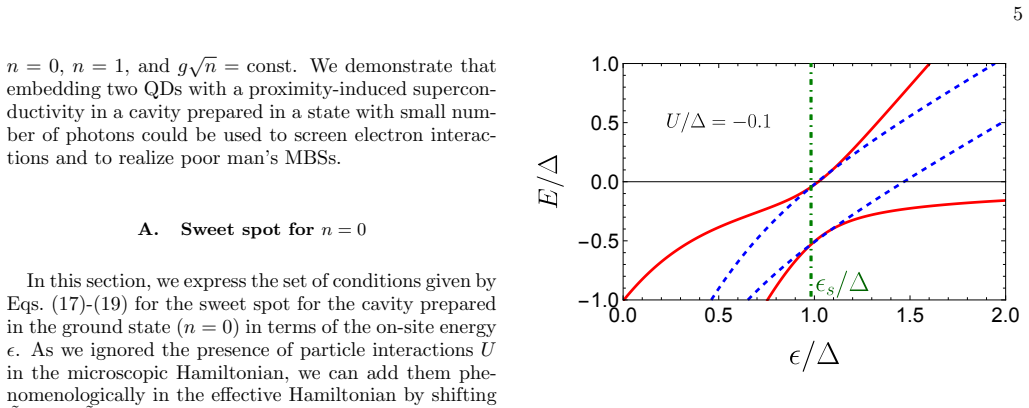
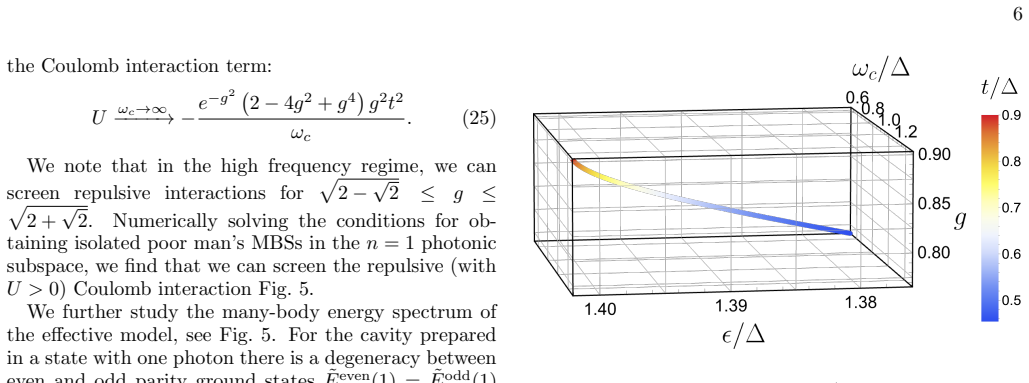
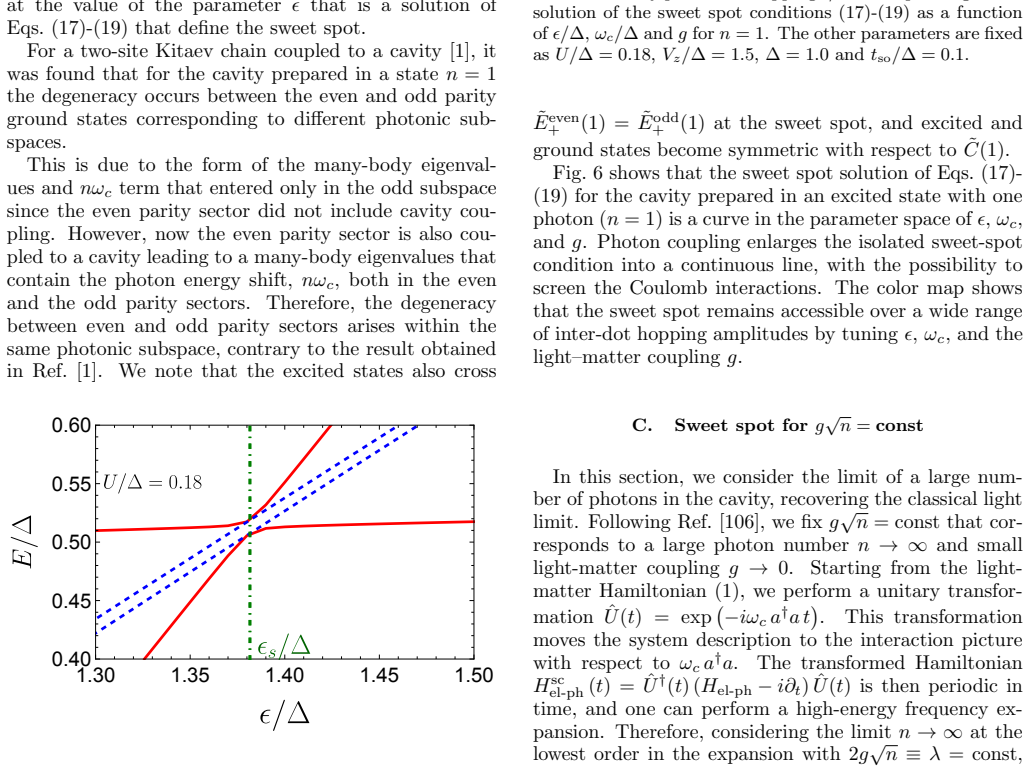
Numerically solving the conditions for ob- taining isolated poor man’s MBSs in then= 1 photonic subspace, we find that we can screen the repulsive (with U >0) Coulomb interaction Fig. 5. We further study the many-body energy spectrum of the effective model, see Fig. 5. For the cavity prepared in a state with one photon there is a degeneracy between even a...
-
[2]
Y n,n +H D QD (C6) H OD odd = X m̸=n n tm,n(g) 2γ(n) h (γ(n)−ϵ)α † 1α2 −(γ(n) +ϵ)α † 2α1 i + h.c
+nω c Eα(n) α† 1α1 +α † 2α2 + 2 (ϵ−γ(n)) (C5) Continuing the analysis for the odd electronic many- body subspace, we obtain for the Hamiltonian in the pho- tonic number basis HD odd =− X n ϵ te−g2/2 γ(n) Ln(g2) α† 1α2 + h.c. Y n,n +H D QD (C6) H OD odd = X m̸=n n tm,n(g) 2γ(n) h (γ(n)−ϵ)α † 1α2 −(γ(n) +ϵ)α † 2α1 i + h.c. o Y n,m.(C7) Here,H D odd is the d...
-
[3]
G´ omez-Le´ on, M
A. G´ omez-Le´ on, M. Schir` o, and O. Dmytruk, Majorana bound states from cavity embedding in an interacting two-site Kitaev chain, Phys. Rev. B111, 155410 (2025)
2025
-
[4]
A. Y. Kitaev, Unpaired Majorana fermions in quantum wires, Physics-Uspekhi44, 131 (2001)
2001
-
[5]
Kitaev, Fault-tolerant quantum computation by anyons, Annals of Physics303, 2 (2003)
A. Kitaev, Fault-tolerant quantum computation by anyons, Annals of Physics303, 2 (2003)
2003
-
[6]
Y. Oreg, G. Refael, and F. von Oppen, Helical liquids and Majorana bound states in quantum wires, Phys. Rev. Lett.105, 177002 (2010)
2010
-
[7]
R. M. Lutchyn, J. D. Sau, and S. Das Sarma, Ma- jorana fermions and a topological phase transition in semiconductor-superconductor heterostructures, Phys. Rev. Lett.105, 077001 (2010)
2010
-
[8]
Alicea, New directions in the pursuit of Majorana fermions in solid state systems, Reports on Progress in Physics75, 076501 (2012)
J. Alicea, New directions in the pursuit of Majorana fermions in solid state systems, Reports on Progress in Physics75, 076501 (2012)
2012
-
[9]
V. Mourik, K. Zuo, S. M. Frolov, S. R. Plissard, E. P. A. M. Bakkers, and L. P. Kouwenhoven, Signatures of Majorana fermions in hybrid superconductor-semiconductor nanowire devices, Science336, 1003 (2012), https://www.science.org/doi/pdf/10.1126/science.1222360
-
[10]
Aghaee and et al
M. Aghaee and et al. (Microsoft Quantum), InAs-Al hy- brid devices passing the topological gap protocol, Phys. Rev. B107, 245423 (2023)
2023
-
[11]
Aghaee, A
Microsoft Azure Quantum, M. Aghaee, A. Al- caraz Ramirez, Z. Alam, R. Ali, M. Andrzejczuk, A. An- tipov, M. Astafev, A. Barzegar, B. Bauer,et al., Inter- ferometric single-shot parity measurement in InAs–Al hybrid devices, Nature638, 651 (2025)
2025
-
[12]
J. Liu, A. C. Potter, K. T. Law, and P. A. Lee, Zero- bias peaks in the tunneling conductance of spin-orbit- coupled superconducting wires with and without Majo- rana end-states, Phys. Rev. Lett.109, 267002 (2012)
2012
-
[13]
Kells, D
G. Kells, D. Meidan, and P. W. Brouwer, Near-zero- energy end states in topologically trivial spin-orbit cou- pled superconducting nanowires with a smooth confine- ment, Phys. Rev. B86, 100503 (2012)
2012
-
[14]
Prada, P
E. Prada, P. San-Jose, and R. Aguado, Transport spectroscopy ofN Snanowire junctions with Majorana fermions, Phys. Rev. B86, 180503 (2012)
2012
-
[15]
C.-X. Liu, J. D. Sau, T. D. Stanescu, and S. Das Sarma, Andreev bound states versus Majorana bound states in quantum dot-nanowire-superconductor hybrid struc- tures: Trivial versus topological zero-bias conductance peaks, Phys. Rev. B96, 075161 (2017)
2017
-
[16]
C. Reeg, O. Dmytruk, D. Chevallier, D. Loss, and J. Kli- novaja, Zero-energy Andreev bound states from quan- tum dots in proximitized Rashba nanowires, Phys. Rev. B98, 245407 (2018)
2018
-
[17]
Pe˜ naranda, R
F. Pe˜ naranda, R. Aguado, P. San-Jose, and E. Prada, Quantifying wave-function overlaps in inhomogeneous Majorana nanowires, Phys. Rev. B98, 235406 (2018)
2018
-
[18]
Prada, P
E. Prada, P. San-Jose, M. W. A. de Moor, A. Geresdi, E. J. H. Lee, J. Klinovaja, D. Loss, J. Nyg˚ ard, R. Aguado, and L. P. Kouwenhoven, From Andreev to Majorana bound states in hybrid superconductor– semiconductor nanowires, Nature Reviews Physics2, 575 (2020). 13
2020
-
[19]
R. Hess, H. F. Legg, D. Loss, and J. Klinovaja, Local and nonlocal quantum transport due to Andreev bound states in finite Rashba nanowires with superconducting and normal sections, Phys. Rev. B104, 075405 (2021)
2021
-
[20]
R. Hess, H. F. Legg, D. Loss, and J. Klinovaja, Triv- ial Andreev band mimicking topological bulk gap re- opening in the nonlocal conductance of long Rashba nanowires, Phys. Rev. Lett.130, 207001 (2023)
2023
-
[21]
D. Sahu, V. Khade, and S. Gangadharaiah, Effect of topological length on bound state signatures in a topo- logical nanowire, Phys. Rev. B108, 205426 (2023)
2023
-
[22]
S. Prem, O. Dmytruk, and M. Trif, Distinguishing Ma- jorana bound states from accidental zero-energy modes with a microwave cavity, Phys. Rev. B113, 085420 (2026)
2026
-
[23]
Seoane Souto and R
R. Seoane Souto and R. Aguado, Subgap states in semiconductor-superconductor devices for quantum technologies: Andreev qubits and minimal Majorana chains, inNew Trends and Platforms for Quantum Tech- nologies, edited by R. Aguado, R. Citro, M. Lewenstein, and M. Stern (Springer Nature Switzerland, Cham,
-
[24]
Leijnse and K
M. Leijnse and K. Flensberg, Parity qubits and poor man’s Majorana bound states in double quantum dots, Phys. Rev. B86, 134528 (2012)
2012
-
[25]
J. D. Sau and S. D. Sarma, Realizing a robust prac- tical Majorana chain in a quantum-dot-superconductor linear array, Nature Communications3, 964 (2012)
2012
-
[26]
I. C. Fulga, A. Haim, A. R. Akhmerov, and Y. Oreg, Adaptive tuning of Majorana fermions in a quantum dot chain, New Journal of Physics15, 045020 (2013)
2013
-
[27]
Tsintzis, R
A. Tsintzis, R. S. Souto, and M. Leijnse, Creating and detecting poor man’s Majorana bound states in in- teracting quantum dots, Phys. Rev. B106, L201404 (2022)
2022
-
[28]
C.-X. Liu, G. Wang, T. Dvir, and M. Wimmer, Tun- able superconducting coupling of quantum dots via An- dreev bound states in semiconductor-superconductor nanowires, Phys. Rev. Lett.129, 267701 (2022)
2022
-
[29]
R. S. Souto, A. Tsintzis, M. Leijnse, and J. Danon, Probing Majorana localization in minimal Kitaev chains through a quantum dot, Phys. Rev. Res.5, 043182 (2023)
2023
-
[30]
Samuelson, V
W. Samuelson, V. Svensson, and M. Leijnse, Minimal quantum dot based Kitaev chain with only local super- conducting proximity effect, Phys. Rev. B109, 035415 (2024)
2024
-
[31]
Svensson and M
V. Svensson and M. Leijnse, Quantum dot based Kitaev chains: Majorana quality measures and scaling with in- creasing chain length, Phys. Rev. B110, 155436 (2024)
2024
-
[32]
Miles, D
S. Miles, D. van Driel, M. Wimmer, and C.-X. Liu, Kitaev chain in an alternating quantum dot-Andreev bound state array, Phys. Rev. B110, 024520 (2024)
2024
-
[33]
C.-X. Liu, A. M. Bozkurt, F. Zatelli, S. L. ten Haaf, T. Dvir, and M. Wimmer, Enhancing the excitation gap of a quantum-dot-based Kitaev chain, Communications Physics7, 235 (2024)
2024
-
[34]
D. M. Pino, R. S. Souto, and R. Aguado, Minimal Kitaev-transmon qubit based on double quantum dots, Phys. Rev. B109, 075101 (2024)
2024
-
[35]
J. D. T. Luna, A. M. Bozkurt, M. Wimmer, and C.-X. Liu, Flux-tunable Kitaev chain in a quantum dot array, SciPost Phys. Core7, 065 (2024)
2024
-
[36]
Z.-H. Liu, C. Zeng, and H. Q. Xu, Coupling of quantum- dot states via elastic cotunneling and crossed Andreev reflection in a minimal Kitaev chain, Phys. Rev. B110, 115302 (2024)
2024
-
[37]
Luethi, H
M. Luethi, H. F. Legg, D. Loss, and J. Klinovaja, From perfect to imperfect poor man’s Majoranas in minimal Kitaev chains, Phys. Rev. B110, 245412 (2024)
2024
-
[38]
Luethi, H
M. Luethi, H. F. Legg, D. Loss, and J. Klinovaja, Fate of poor man’s Majoranas in the long Kitaev chain limit, Phys. Rev. B111, 115419 (2025)
2025
-
[39]
Luethi, H
M. Luethi, H. F. Legg, D. Loss, and J. Klinovaja, Prop- erties and prevalence of false poor man’s Majoranas in two- and three-site artificial Kitaev chains, Phys. Rev. B112, 205426 (2025)
2025
-
[40]
Sanches, L
J. Sanches, L. Lustosa, L. Ricco, H. Sigurdsson, M. de Souza, M. Figueira, E. Marinho Jr, and A. Seri- donio, Spin-exchange induced spillover on poor man’s Majoranas in minimal Kitaev chains, Journal of Physics: Condensed Matter37, 205601 (2025)
2025
-
[41]
Sanches, T
J. Sanches, T. Sobreira, L. Ricco, M. Figueira, and A. Seridonio, Revisiting the poor man’s Majoranas: the spin–exchange induced spillover effect, Journal of Physics: Condensed Matter38, 023001 (2026)
2026
-
[42]
Sensitive dependence of Poor Man's Majorana modes on the length of the superconductor
Z.-L. Zhang, X. Yue, G.-J. Qiao, and C. P. Sun, Sen- sitive dependence of poor man’s Majorana modes on the length of superconductor (2026), arXiv:2604.12950 [cond-mat.mes-hall]
work page internal anchor Pith review Pith/arXiv arXiv 2026
-
[43]
Optimal Majoranas in Mesoscopic Kitaev Chains
M. Alvarado, R. S. Souto, M. J. Calder´ on, and R. Aguado, Optimal Majoranas in mesoscopic Kitaev chains (2026), arXiv:2604.13945 [cond-mat.mes-hall]
work page internal anchor Pith review Pith/arXiv arXiv 2026
-
[44]
T. Dvir, G. Wang, N. van Loo, C.-X. Liu, G. P. Mazur, A. Bordin, S. L. D. ten Haaf, J.-Y. Wang, D. van Driel, F. Zatelli, X. Li, F. K. Malinowski, S. Gazibegovic, G. Badawy, E. P. A. M. Bakkers, M. Wimmer, and L. P. Kouwenhoven, Realization of a minimal Kitaev chain in coupled quantum dots, Nature614, 445 (2023)
2023
-
[45]
S. L. D. ten Haaf, Q. Wang, A. M. Bozkurt, C.-X. Liu, I. Kulesh, P. Kim, D. Xiao, C. Thomas, M. J. Man- fra, T. Dvir, M. Wimmer, and S. Goswami, A two-site Kitaev chain in a two-dimensional electron gas, Nature 630, 329 (2024)
2024
-
[46]
Zatelli, D
F. Zatelli, D. van Driel, D. Xu, G. Wang, C.-X. Liu, A. Bordin, B. Roovers, G. P. Mazur, N. van Loo, J. C. Wolff, A. M. Bozkurt, G. Badawy, S. Gazibegovic, E. P. A. M. Bakkers, M. Wimmer, L. P. Kouwenhoven, and T. Dvir, Robust poor man’s Majorana zero modes using Yu-Shiba-Rusinov states, Nature Communications15, 7933 (2024)
2024
-
[47]
van Loo, F
N. van Loo, F. Zatelli, G. O. Steffensen, B. Roovers, G. Wang, T. Van Caekenberghe, A. Bordin, D. van Driel, Y. Zhang, W. D. Huisman, G. Badawy, E. P. A. M. Bakkers, G. P. Mazur, R. Aguado, and L. P. Kouwenhoven, Single-shot parity readout of a minimal Kitaev chain, Nature650, 334 (2026)
2026
-
[48]
A. Bordin, C.-X. Liu, T. Dvir, F. Zatelli, S. L. D. ten Haaf, D. van Driel, G. Wang, N. van Loo, Y. Zhang, J. C. Wolff, T. Van Caekenberghe, G. Badawy, S. Gaz- ibegovic, E. P. A. M. Bakkers, M. Wimmer, L. P. Kouwenhoven, and G. P. Mazur, Enhanced Majorana stability in a three-site Kitaev chain, Nature Nanotech- nology 10.1038/s41565-025-01894-4 (2025)
-
[49]
S. L. Ten Haaf, Y. Zhang, Q. Wang, A. Bordin, C.-X. Liu, I. Kulesh, V. P. Sietses, C. G. Prosko, D. Xiao, C. Thomas,et al., Observation of edge and bulk states in a three-site Kitaev chain, Nature , 1 (2025). 14
2025
-
[50]
F. J. Garcia-Vidal, C. Ciuti, and T. W. Ebbesen, Ma- nipulating matter by strong coupling to vacuum fields, Science373, eabd0336 (2021)
2021
-
[51]
Schlawin, D
F. Schlawin, D. M. Kennes, and M. A. Sentef, Cavity quantum materials, Applied Physics Reviews9(2022)
2022
-
[52]
H. M. Bretscher, L. Graziotto, M. H. Michael, A. Mon- tanaro, I.-T. Lu, A. Grankin, J. W. McIver, J. Faist, D. Fausti, M. Eckstein, M. Ruggenthaler, A. Rubio, D. Basov, M. Hafezi, M. Claassen, D. M. Kennes, and M. A. Sentef, Fluctuation engineering in cavity quantum materials (2026), arXiv:2604.08666 [cond-mat.mes-hall]
work page internal anchor Pith review Pith/arXiv arXiv 2026
-
[53]
Appugliese, J
F. Appugliese, J. Enkner, G. L. Paravicini-Bagliani, M. Beck, C. Reichl, W. Wegscheider, G. Scalari, C. Ciuti, and J. Faist, Breakdown of topological pro- tection by cavity vacuum fields in the integer quantum Hall effect, Science375, 1030 (2022)
2022
-
[54]
Enkner, L
J. Enkner, L. Graziotto, D. Bori¸ ci, F. Appugliese, C. Re- ichl, G. Scalari, N. Regnault, W. Wegscheider, C. Ciuti, and J. Faist, Tunable vacuum-field control of fractional and integer quantum Hall phases, Nature641, 884 (2025)
2025
-
[55]
G. Jarc, S. Y. Mathengattil, A. Montanaro, F. Giusti, E. M. Rigoni, R. Sergo, F. Fassioli, S. Winnerl, S. Dal Zilio, D. Mihailovic, P. Prelovˇ sek, M. Eck- stein, and D. Fausti, Cavity-mediated thermal control of metal-to-insulator transition in 1T-TaS2, Nature622, 487 (2023)
2023
-
[56]
Keren, T
I. Keren, T. A. Webb, S. Zhang, J. Xu, D. Sun, B. S. Y. Kim, D. Shin, S. S. Zhang, J. Zhang, G. Pereira, J. Yao, T. Okugawa, M. H. Michael, E. Vi˜ nas Bostr¨ om, J. H. Edgar, S. Wolf, M. Julian, R. P. Prasankumar, K. Miya- gawa, K. Kanoda, G. Gu, M. Cothrine, D. Mandrus, M. Buzzi, A. Cavalleri, C. R. Dean, D. M. Kennes, A. J. Millis, Q. Li, M. A. Sentef, ...
2026
-
[57]
Trif and Y
M. Trif and Y. Tserkovnyak, Resonantly tunable Majo- rana polariton in a microwave cavity, Phys. Rev. Lett. 109, 257002 (2012)
2012
-
[58]
Cottet, T
A. Cottet, T. Kontos, and B. Dou¸ cot, Squeezing light with Majorana fermions, Phys. Rev. B88, 195415 (2013)
2013
-
[59]
Dmytruk, M
O. Dmytruk, M. Trif, and P. Simon, Cavity quantum electrodynamics with mesoscopic topological supercon- ductors, Phys. Rev. B92, 245432 (2015)
2015
-
[60]
Dmytruk, M
O. Dmytruk, M. Trif, and P. Simon, Josephson effect in topological superconducting rings coupled to a mi- crowave cavity, Phys. Rev. B94, 115423 (2016)
2016
-
[61]
M. C. Dartiailh, T. Kontos, B. Dou¸ cot, and A. Cottet, Direct cavity detection of Majorana pairs, Phys. Rev. Lett.118, 126803 (2017)
2017
-
[62]
Trif and P
M. Trif and P. Simon, Braiding of Majorana fermions in a cavity, Phys. Rev. Lett.122, 236803 (2019)
2019
-
[63]
F. P. M. M´ endez-C´ ordoba, J. J. Mendoza-Arenas, F. J. G´ omez-Ruiz, F. J. Rodr´ ıguez, C. Tejedor, and L. Quiroga, R´ enyi entropy singularities as signatures of topological criticality in coupled photon-fermion sys- tems, Phys. Rev. Res.2, 043264 (2020)
2020
-
[64]
L. C. Contamin, M. R. Delbecq, B. Dou¸ cot, A. Cottet, and T. Kontos, Hybrid light-matter networks of Ma- jorana zero modes, npj Quantum Information7, 171 (2021)
2021
-
[65]
Dmytruk and M
O. Dmytruk and M. Trif, Microwave detection of gliding Majorana zero modes in nanowires, Phys. Rev. B107, 115418 (2023)
2023
-
[66]
Bacciconi, G
Z. Bacciconi, G. M. Andolina, and C. Mora, Topologi- cal protection of Majorana polaritons in a cavity, Phys. Rev. B109, 165434 (2024)
2024
-
[67]
Dmytruk and M
O. Dmytruk and M. Schir` o, Hybrid light-matter states in topological superconductors coupled to cavity pho- tons, Phys. Rev. B110, 075416 (2024)
2024
- [68]
-
[69]
A. Kobia lka, A. K. Ghosh, R. Arouca, and A. M. Black-Schaffer, Topology and energy dependence of Majorana bound states in a photonic cavity (2026), arXiv:2602.03553 [cond-mat.mes-hall]
-
[70]
M. A. Sentef, M. Ruggenthaler, and A. Rubio, Cav- ity quantum-electrodynamical polaritonically enhanced electron-phonon coupling and its influence on supercon- ductivity, Science Advances4, eaau6969
-
[71]
Schlawin, A
F. Schlawin, A. Cavalleri, and D. Jaksch, Cavity- mediated electron-photon superconductivity, Phys. Rev. Lett.122, 133602 (2019)
2019
-
[72]
J. B. Curtis, Z. M. Raines, A. A. Allocca, M. Hafezi, and V. M. Galitski, Cavity quantum Eliashberg enhance- ment of superconductivity, Phys. Rev. Lett.122, 167002 (2019)
2019
-
[73]
A. A. Allocca, Z. M. Raines, J. B. Curtis, and V. M. Galitski, Cavity superconductor-polaritons, Phys. Rev. B99, 020504 (2019)
2019
-
[74]
V. K. Kozin, E. Thingstad, D. Loss, and J. Klinovaja, Cavity-enhanced superconductivity via band engineer- ing, Phys. Rev. B111, 035410 (2025)
2025
-
[75]
Mazza and A
G. Mazza and A. Georges, Superradiant quantum ma- terials, Phys. Rev. Lett.122, 017401 (2019)
2019
-
[76]
Passetti, C
G. Passetti, C. J. Eckhardt, M. A. Sentef, and D. M. Kennes, Cavity light-matter entanglement through quantum fluctuations, Phys. Rev. Lett.131, 023601 (2023)
2023
- [77]
-
[78]
Fadler, K
P. Fadler, K. P. Schmidt, J. Li, and M. Eckstein, En- gineering photon-mediated long-range spin interactions in Mott insulators, Phys. Rev. B109, 085149 (2024)
2024
-
[79]
Nguyen, G
D.-P. Nguyen, G. Arwas, Z. Lin, W. Yao, and C. Ciuti, Electron-photon Chern number in cavity-embedded 2D moir´ e materials, Phys. Rev. Lett.131, 176602 (2023)
2023
-
[80]
Ciuti, Cavity-mediated electron hopping in disor- dered quantum Hall systems, Phys
C. Ciuti, Cavity-mediated electron hopping in disor- dered quantum Hall systems, Phys. Rev. B104, 155307 (2021)
2021
discussion (0)
Sign in with ORCID, Apple, or X to comment. Anyone can read and Pith papers without signing in.