Recognition: unknown
KindHML: formal verification of smart contracts based on Hennessy-Milner logic
Pith reviewed 2026-05-10 12:54 UTC · model grok-4.3
The pith
An automated encoding of a Solidity subset and temporal specifications into Lustre enables the Kind 2 model checker to verify whether smart contracts respect complex properties.
A machine-rendered reading of the paper's core claim, the machinery that carries it, and where it could break.
Core claim
Our approach provides a fully automated encoding into Lustre of an expressive subset of Solidity contracts and temporal specifications based on first-order Hennessy-Milner Logic. This encoding allows us to leverage Kind 2 to determine whether the contract respects the specification or not. We implement the approach in a toolchain that integrates the translation and verification steps and evaluate it on a benchmark of smart contracts and temporal properties that capture complex attack scenarios.
What carries the argument
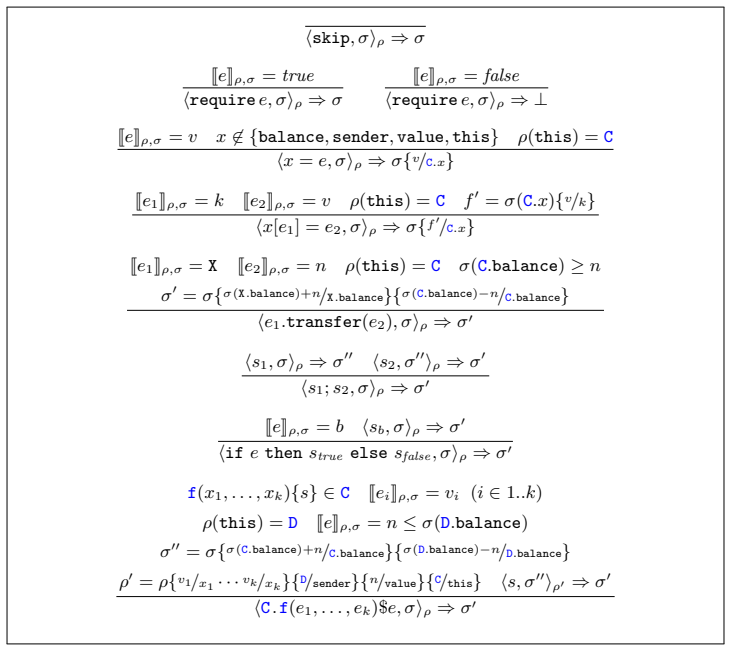
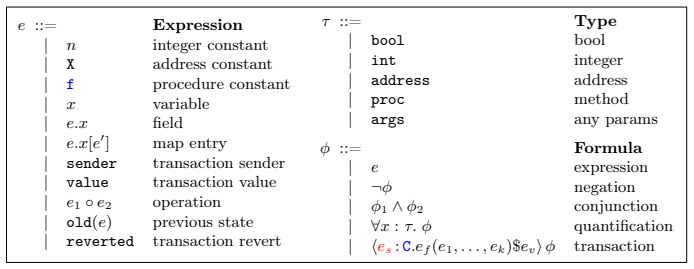
The automated encoding from an expressive subset of Solidity together with first-order Hennessy-Milner logic specifications into Lustre, which preserves the semantics required for checking properties that span multiple transactions.
If this is right
- Non-trivial temporal properties spanning multiple transactions become checkable for smart contracts.
- Violations corresponding to complex attack scenarios can be detected automatically.
- The integrated toolchain performs both translation and verification without manual steps in between.
- The method handles benchmarks that capture real-world attack patterns beyond the reach of prior tools.
Where Pith is reading between the lines
- The same translation strategy could be adapted to other contract languages provided the semantic preservation holds.
- Verification results could be combined with on-chain monitoring to check live contracts against the same properties.
- Increasing the handled subset of Solidity would widen the set of verifiable contracts if the encoding remains sound.
Load-bearing premise
The chosen subset of Solidity and its translation into Lustre preserve the original semantics of the temporal properties when the contract runs on a real blockchain.
What would settle it
Running the toolchain on a contract that Kind 2 reports as correct, then observing a violation of the stated property during actual execution on a blockchain.
Figures




read the original abstract
Smart contracts deployed on blockchains such as Ethereum routinely manage large amounts of assets, making their security critical. Empirical studies show that real-world attacks often exploit flaws in the business logic of contracts that unfold across multiple transactions, such as liquidity or front-running attacks. Detecting these attacks requires reasoning about expressive temporal properties beyond the capabilities of existing analysis tools. In this paper, we present an automated approach to the formal verification of smart contracts, enabling the specification and verification of complex temporal properties. Our approach provides a fully automated encoding into Lustre -- the specification language supported by the Kind 2 model checker -- of an expressive subset of Solidity contracts and temporal specifications based on first-order Hennessy-Milner Logic. This encoding allows us to leverage Kind 2 to determine whether the contract respects the specification or not. We implement our approach in a toolchain that integrates the translation and verification steps, and we evaluate its effectiveness and performance on a benchmark of smart contracts and temporal properties capturing complex attack scenarios. Our results show that the proposed approach can effectively verify non-trivial temporal properties of smart contracts and detect violations that are beyond the reach of existing analysis tools.
Editorial analysis
A structured set of objections, weighed in public.
Referee Report
Summary. The manuscript presents KindHML, a toolchain for the formal verification of an expressive subset of Solidity smart contracts against temporal specifications written in first-order Hennessy-Milner Logic. Contracts and specifications are automatically encoded into Lustre and checked for satisfaction using the Kind 2 model checker; the authors claim this enables detection of multi-transaction attacks (e.g., liquidity and front-running) that lie beyond existing tools. They report an implementation and an evaluation on a benchmark of contracts and properties.
Significance. If the encoding is shown to preserve semantics, the work would be significant: it combines an expressive temporal logic (first-order HML) with a mature synchronous model checker (Kind 2) to address a recognized gap in smart-contract verification. The approach is parameter-free and offers a fully automated translation, which is a strength. However, the absence of any semantic-preservation argument currently limits the strength of the central claim.
major comments (2)
- [Abstract / encoding section] Abstract and the description of the encoding (presumably §3): the claim that the translation 'preserves the original semantics for temporal properties across multiple transactions' is load-bearing for the entire contribution, yet no bisimulation, inductive invariant, or even a small hand-checked example is supplied to justify that Lustre streams correctly model Solidity storage, msg.sender, external calls, and HML diamond modalities over transaction traces.
- [Evaluation / benchmarks] Evaluation section: the abstract asserts that the approach 'can effectively verify non-trivial temporal properties' and 'detect violations beyond existing tools,' but supplies no tables, concrete verdicts, performance numbers, or comparison against baselines; without these data the effectiveness claim cannot be assessed.
minor comments (2)
- [Introduction] The precise definition of the 'expressive subset of Solidity' (e.g., which language constructs are supported and which are excluded) should be stated explicitly early in the paper rather than left implicit.
- [Preliminaries / encoding] Notation for first-order HML modalities and their Lustre encoding could be clarified with a small running example that shows both the source formula and the generated Lustre node.
Simulated Author's Rebuttal
We thank the referee for the constructive comments on our manuscript. We address the major points below, indicating where revisions will be made to improve clarity and support for our claims.
read point-by-point responses
-
Referee: [Abstract / encoding section] Abstract and the description of the encoding (presumably §3): the claim that the translation 'preserves the original semantics for temporal properties across multiple transactions' is load-bearing for the entire contribution, yet no bisimulation, inductive invariant, or even a small hand-checked example is supplied to justify that Lustre streams correctly model Solidity storage, msg.sender, external calls, and HML diamond modalities over transaction traces.
Authors: We acknowledge that the manuscript does not supply a formal semantic-preservation argument such as a bisimulation or inductive invariant. Section 3 describes the encoding by mapping Solidity state variables and storage to Lustre streams, transaction sequences to discrete steps, msg.sender and call contexts to auxiliary streams, and first-order HML diamond modalities to Lustre temporal operators. While we maintain that the translation is faithful by construction, we agree an explicit justification is needed. In the revision we will insert a small hand-checked example (a simple contract with a multi-transaction property) that walks through the encoding of storage, sender, and a diamond modality, thereby providing concrete evidence of the correspondence. revision: partial
-
Referee: [Evaluation / benchmarks] Evaluation section: the abstract asserts that the approach 'can effectively verify non-trivial temporal properties' and 'detect violations beyond existing tools,' but supplies no tables, concrete verdicts, performance numbers, or comparison against baselines; without these data the effectiveness claim cannot be assessed.
Authors: The evaluation section does describe a benchmark of contracts and properties (including liquidity and front-running scenarios) together with the toolchain's ability to detect violations. However, we accept that the current presentation lacks explicit tables, verdicts, timings, and baseline comparisons. We will revise the section to add tables listing each contract, the encoded property, the Kind 2 outcome (satisfied/violated), verification time, and a short discussion of how the temporal properties go beyond the reach of existing static analyzers. revision: yes
Circularity Check
No circularity: translation-based encoding of Solidity subset and HML into Lustre
full rationale
The paper's core contribution is a constructive, automated translation from a Solidity subset plus first-order Hennessy-Milner Logic specifications into Lustre for Kind 2 model checking. No equations, parameters, or derivations are presented that reduce the claimed semantic preservation or verification results to quantities defined inside the paper by construction. The approach is evaluated on external benchmarks of contracts and attack scenarios, providing independent content rather than self-referential fitting or renaming. No self-citation chains or uniqueness theorems are invoked as load-bearing premises. This is a standard formal-methods translation paper whose claims rest on the correctness of the encoding rules themselves, not on any internal circular reduction.
Axiom & Free-Parameter Ledger
Reference graph
Works this paper leans on
-
[1]
Smart contract weakness classification (SWC): Transaction order dependence,ht tps://swcregistry.io/docs/SWC-114, accessed on March 23, 2026
2026
-
[2]
Cambridge University Press (2007)
Aceto, L., Ingólfsdóttir, A., Larsen, K.G., Srba, J.: Reactive Systems: Modelling, Specification and Verification. Cambridge University Press (2007)
2007
-
[3]
Alois, J.: Ethereum Parity hack may impact ETH 500,000 or $146 million.https: //www.crowdfundinsider.com/2017/11/124200-ethereum-parity-hack-may-i mpact-eth-500000-146-million/(2017), accessed on April 1, 2026
2017
-
[4]
In: Computer Aided Verification
Alt, L., Blicha, M., Hyvärinen, A.E.J., Sharygina, N.: SolCMC: Solidity compiler’s model checker. In: Computer Aided Verification. LNCS, vol. 13371, pp. 325–338. Springer (2022).https://doi.org/10.1007/978-3-031-13185-1_16
-
[5]
Alur, R., Henzinger, T.A., Kupferman, O.: Alternating-time temporal logic. J. ACM49(5), 672–713 (2002).https://doi.org/10.1145/585265.585270
-
[6]
In: Handbook of Satisfiability (2021).https://doi.org/10.3233/978-1-586 03-929-5-825
Barrett, C.W., Sebastiani, R., Seshia, S.A., Tinelli, C.: Satisfiability modulo theo- ries. In: Handbook of Satisfiability (2021).https://doi.org/10.3233/978-1-586 03-929-5-825
-
[7]
Bartoletti, M., Crafa, S., Lipparini, E.: Formal Verification in Solidity and Move: Insights from a Comparative Analysis. In: FMBC. OASIcs, vol. 129, pp. 3:1–3:18. Schloss Dagstuhl (2025).https://doi.org/10.4230/OASIcs.FMBC.2025.3
-
[8]
Bartoletti, M., Ferrando, A., Lipparini, E., Malvone, V.: Solvent: Liquidity verifi- cation of smart contracts15234, 256–266 (2024).https://doi.org/10.1007/97 8-3-031-76554-4_14
work page doi:10.1007/97 2024
-
[9]
Bartoletti, M., Fioravanti, F., Matricardi, G., Pettinau, R., Sainas, F.: Towards benchmarking of Solidity verification tools. In: FMBC. OASIcs, vol. 118, pp. 6:1– 6:15. Schloss Dagstuhl (2024).https://doi.org/10.4230/OASICS.FMBC.2024.6
-
[10]
Bartoletti, M., Lipparini, E., Pompianu, L.: LLMs as verification oracles for Solid- ity. In: Financial Cryptography (2026).https://doi.org/10.48550/arXiv.2509. 19153
-
[11]
Handbook of satisfiability185(99), 457–481 (2009)
Biere, A.: Bounded model checking. Handbook of satisfiability185(99), 457–481 (2009)
2009
-
[12]
Biere, A., Kröning, D.: SAT-Based Model Checking, pp. 277–303. Springer (2018). https://doi.org/10.1007/978-3-319-10575-8_10
-
[13]
Bliudze, S., Cimatti, A., Jaber, M., Mover, S., Roveri, M., Saab, W., Wang, Q.: Formal verification of infinite-state BIP models. In: ATVA. LNCS, vol. 9364, pp. 326–343. Springer (2015).https://doi.org/10.1007/978-3-319-24953-7_25
-
[14]
Bohn, J., Damm, W., Grumberg, O., Hungar, H., Laster, K.: First-order-ctl model checking. In: Arvind, V., Ramanujam, S. (eds.) Foundations of Software Technol- ogy and Theoretical Computer Science. pp. 283–294. Springer Berlin Heidelberg, Berlin, Heidelberg (1998).https://doi.org/10.1007/978-3-540-49382-2_27
-
[15]
Bose, P., Das, D., Chen, Y., Feng, Y., Kruegel, C., Vigna, G.: SAILFISH: vetting smart contract state-inconsistency bugs in seconds. In: S&P. pp. 161–178. IEEE (2022).https://doi.org/10.1109/SP46214.2022.9833721
-
[16]
In: VMCAI
Bradley, A.R.: SAT-based model checking without unrolling. In: VMCAI. pp. 70–
-
[17]
Springer (2011).https://doi.org/10.1007/978-3-642-18275-4_7
-
[18]
In: OVERLAY
Chahoki, A.Z., Roveri, M., Amyot, D., Mylopoulos, J.: Revisiting formal verifica- tion in VeriSolid: An analysis and enhancements. In: OVERLAY. CEUR, vol. 3629, pp. 55–60 (2023)
2023
-
[19]
Knowlog: Knowledge enhanced pre-trained language model for log understanding
Chaliasos, S., Charalambous, M.A., Zhou, L., Galanopoulou, R., Gervais, A., Mitropoulos, D., Livshits, B.: Smart contract and DeFi security: Insights from tool evaluations and practitioner surveys. In: ICSE. pp. 60:1–60:13. ACM (2024). https://doi.org/10.1145/3597503.3623302
-
[20]
Champion, A., Mebsout, A., Sticksel, C., Tinelli, C.: The Kind 2 model checker. In: CAV. pp. 510–517. Springer (2016).https://doi.org/10.1007/978-3-319-4 1540-6_29
-
[21]
De Nicola, R., Vaandrager, F.: Action versus state based logics for transition sys- tems. In: Guessarian, I. (ed.) Semantics of Systems of Concurrent Processes. pp. 407–419. Springer Berlin Heidelberg, Berlin, Heidelberg (1990).https://doi.or g/10.1007/3-540-53479-2_17
-
[22]
Ding, H., Liu, Y., Piao, X., Song, H., Ji, Z.: Smartguard: An LLM-enhanced frame- work for smart contract vulnerability detection. Expert Syst. Appl.269(2025). https://doi.org/doi.org/10.1016/j.eswa.2025.126479
-
[23]
In: Financial Cryptography and Data Security
Eskandari, S., Moosavi, S., Clark, J.: SoK: Transparent Dishonesty: Front-Running Attacks on Blockchain. In: Financial Cryptography and Data Security. pp. 170–
-
[24]
Springer (2020).https://doi.org/10.1007/978-3-030-43725-1_13
-
[25]
Feist, J., Grieco, G., Groce, A.: Slither: a static analysis framework for smart contracts. In: WETSEB. pp. 8–15 (2019).https://doi.org/10.1109/WETSEB.201 9.00008
-
[26]
In: AAMAS (2026), to appear
Ferrando, A., Kana, B., Malvone, V.: Wallet ATL: Towards reliable smart contract verification. In: AAMAS (2026), to appear
2026
-
[27]
In: Financial Cryptography and Data Security (to appear) (2026)
Gervais, A., Zhou, L.: AI agent smart contract exploit generation. In: Financial Cryptography and Data Security (to appear) (2026)
2026
-
[28]
Hajdu, Á., Jovanovic, D.: solc-verify: A modular verifier for Solidity smart con- tracts. In: VSTTE. LNCS, vol. 12031, pp. 161–179. Springer (2019).https: //doi.org/10.1007/978-3-030-41600-3_11
-
[29]
Proceedings of the IEEE79(9), 1305–1320 (1991)
Halbwachs, N., Caspi, P., Raymond, P., Pilaud, D.: The synchronous data flow programming language lustre. Proceedings of the IEEE79(9), 1305–1320 (1991). https://doi.org/10.1109/5.97300
-
[30]
Hennessy, M., Milner, R.: Algebraic laws for nondeterminism and concurrency. J. ACM32(1), 137–161 (1985).https://doi.org/10.1145/2455.2460
-
[31]
Holmström, S.: Hennessy-milner logic with recursion as a specification language, and a refinement calculus based on it. In: Rattray, C. (ed.) Specification and Ver- ification of Concurrent Systems. pp. 294–330. Springer London, London (1990). https://doi.org/10.1007/978-1-4471-3534-0_15
-
[32]
Jackson, D., Nandi, C., Sagiv, M.: Certora technology white paper.https://docs .certora.com/en/latest/docs/whitepaper/index.html(2022)
2022
-
[33]
In: NDSS
Kalra, S., Goel, S., Dhawan, M., Sharma, S.: ZEUS: analyzing safety of smart contracts. In: NDSS. The Internet Society (2018)
2018
-
[34]
Kolluri, A., Nikolic, I., Sergey, I., Hobor, A., Saxena, P.: Exploiting the laws of order in smart contracts. In: ACM SIGSOFT Int. Symp. on Software Testing and Analysis. pp. 363–373. ACM (2019).https://doi.org/10.1145/3293882.3330560
-
[35]
Kröger, F., Merz, S.: First-Order Linear Temporal Logic, pp. 153–179. Springer Berlin Heidelberg, Berlin, Heidelberg (2008).https://doi.org/10.1007/978-3-5 40-68635-4_5,https://doi.org/10.1007/978-3-540-68635-4_5
-
[36]
IEEE Access10, 57037–57062 (2022).https: //doi.org/10.1109/ACCESS.2022.3169902
Kushwaha,S.S.,Joshi,S.,Singh,D.,Kaur,M.,Lee,H.N.:Ethereumsmartcontract analysis tools: A systematic review. IEEE Access10, 57037–57062 (2022).https: //doi.org/10.1109/ACCESS.2022.3169902
-
[37]
In: Enjalbert, P., Mayr, E.W., Wagner, K.W
Laroussinie, F., Schnoebelen, P.: A hierarchy of temporal logics with past. In: Enjalbert, P., Mayr, E.W., Wagner, K.W. (eds.) STACS 94. pp. 47–58. Springer Berlin Heidelberg, Berlin, Heidelberg (1994).https://doi.org/10.1007/3-540-5 7785-8_130
-
[38]
Deep Learning with Differential Privacy
Luu, L., Chu, D., Olickel, H., Saxena, P., Hobor, A.: Making smart contracts smarter. In: ACM SIGSAC CCS. pp. 254–269 (2016).https://doi.org/10.114 5/2976749.2978309
-
[39]
Nelaturu, K., Mavridou, A., Stachtiari, E., Veneris, A.G., Laszka, A.: Correct-by- design interacting smart contracts and a systematic approach for verifying ERC20 and ERC721 contracts with VeriSolid. IEEE Trans. Dependable Secur. Comput. 20(4), 3110–3127 (2023).https://doi.org/10.1109/TDSC.2022.3200840
-
[40]
Nguyen,T.D.,Pham,L.H.,Sun,J.,Lin,Y.,Minh,Q.T.:sFuzz:anefficientadaptive fuzzer for Solidity smart contracts. In: ICSE. pp. 778–788. ACM (2020).https: //doi.org/10.1145/3377811.3380334
-
[41]
Nikolic, I., Kolluri, A., Sergey, I., Saxena, P., Hobor, A.: Finding the greedy, prodigal, and suicidal contracts at scale. In: ACSAC. pp. 653–663. ACM (2018). https://doi.org/10.1145/3274694.3274743
-
[42]
Permenev, A., Dimitrov, D.K., Tsankov, P., Drachsler-Cohen, D., Vechev, M.T.: VerX: Safety verification of smart contracts. In: S&P. pp. 1661–1677. IEEE (2020). https://doi.org/10.1109/SP40000.2020.00024
-
[43]
Ressi, D., Spanò, A., Benetollo, L., Bugliesi, M., Piazza, C., Rossi, S.: Vulnerability detection in solidity smart contracts via machine learning: A qualitative analysis. BCRA p. 100390 (2025).https://doi.org/10.1016/j.bcra.2025.100390
-
[44]
In2024 IEEE Symposium on Security and Privacy (SP)
Sendner, C., Petzi, L., Stang, J., Dmitrienko, A.: Large-scale study of vulnerability scanners for Ethereum smart contracts. In: EuroS&P. pp. 220–220. IEEE (2024). https://doi.org/10.1109/SP54263.2024.00230
-
[45]
In: FMCAD
Sheeran, M., Singh, S., Stålmarck, G.: Checking safety properties using induction and a sat-solver. In: FMCAD. pp. 127–144. Springer (2000)
2000
-
[46]
Stephens, J., Ferles, K., Mariano, B., Lahiri, S.K., Dillig, I.: SmartPulse: Auto- mated checking of temporal properties in smart contracts. In: S&P. pp. 555–571. IEEE (2021).https://doi.org/10.1109/SP40001.2021.00085
-
[47]
Tikhomirov, S., Voskresenskaya, E., Ivanitskiy, I., Takhaviev, R., Marchenko, E., Alexandrov, Y.: SmartCheck: Static analysis of Ethereum smart contracts. In: WETSEB. pp. 9–16. ACM (2018).https://doi.org/10.1145/3194113.3194115
-
[48]
A survey of smart contract formal specification and verification,
Tolmach, P., Li, Y., Lin, S., Liu, Y., Li, Z.: A survey of smart contract formal specification and verification. ACM Comput. Surv.54(7), 148:1–148:38 (2022). https://doi.org/10.1145/3464421
-
[49]
In: USENIX Security Symp
Torres, C.F., Camino, R., State, R.: Frontrunner Jones and the Raiders of the Dark Forest: An empirical study of frontrunning on the Ethereum blockchain. In: USENIX Security Symp. pp. 1343–1359 (2021)
2021
-
[50]
Torres, C.F., Iannillo, A.K., Gervais, A., State, R.: ConFuzzius: A data dependency-aware hybrid fuzzer for smart contracts. In: EuroS&P. pp. 103–119. IEEE (2021).https://doi.org/10.1109/EUROSP51992.2021.00018
-
[51]
Securify: Practical security analysis of smart contracts,
Tsankov, P., Dan, A.M., Drachsler-Cohen, D., Gervais, A., Bünzli, F., Vechev, M.T.: Securify: Practical security analysis of smart contracts. In: ACM SIGSAC CCS. pp. 67–82. ACM (2018).https://doi.org/10.1145/3243734.3243780
-
[52]
IEEE TSE (2025).https://doi.org/10 .1109/TSE.2025.3597319
Wei, Z., Sun, J., Sun, Y., Liu, Y., Wu, D., Zhang, Z., Zhang, X., Li, M., Liu, Y., Li, C., Wan, M., Dong, J., Zhu, L.: Advanced smart contract vulnerability detection via LLM-powered multi-agent systems. IEEE TSE (2025).https://doi.org/10 .1109/TSE.2025.3597319
-
[53]
Wesley, S., Christakis, M., Navas, J.A., Trefler, R.J., Wüstholz, V., Gurfinkel, A.: Verifying Solidity smart contracts via communication abstraction in SmartACE. In: VMCAI. LNCS, vol. 13182, pp. 425–449. Springer (2022).https://doi.org/ 10.1007/978-3-030-94583-1_21
-
[54]
In: ACISP
Xiao,Z.,Li,Y.,Wang,Q.,Chen,S.:PrompttoPwn:Automatedexploitgeneration for smart contracts. In: ACISP. pp. 1–28. LNCS, Springer (2026)
2026
-
[55]
Zhang, Z., Zhang, B., Xu, W., Lin, Z.: Demystifying exploitable bugs in smart contracts. In: ICSE. pp. 615–627. IEEE (2023).https://doi.org/10.1109/ICSE 48619.2023.00061
discussion (0)
Sign in with ORCID, Apple, or X to comment. Anyone can read and Pith papers without signing in.