Recognition: unknown
Hole and spin dynamics in an anti-ferromagnet close to half filling
Pith reviewed 2026-05-10 11:44 UTC · model grok-4.3
The pith
Doping an antiferromagnet near half filling creates four magnetic polaron hole pockets and damps its magnon spectrum.
A machine-rendered reading of the paper's core claim, the machinery that carries it, and where it could break.
Core claim
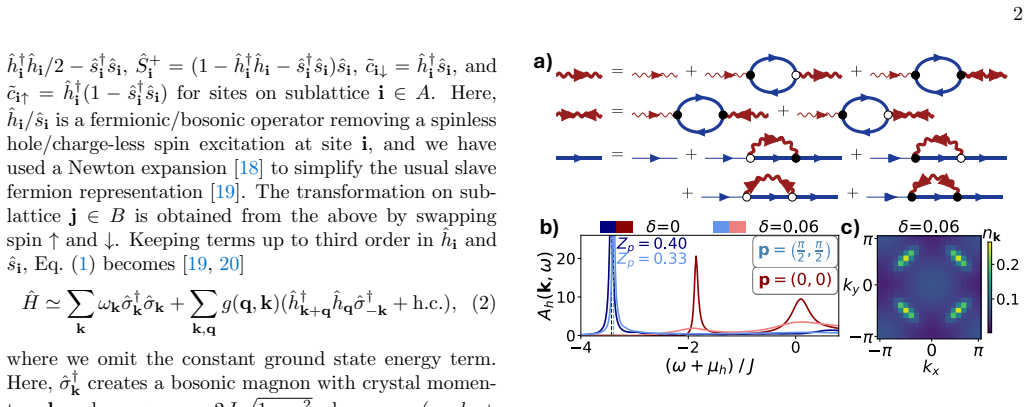
Doping leads to four hole pockets in the Brillouin zone formed by magnetic polarons, which become increasingly damped with hole concentration. Likewise, the magnon spectrum of the anti-ferromagnet softens and dampens with doping due to hole-induced magnetic frustration. This gives rise to a suppression of the anti-ferromagnetic correlations in agreement with recent experiments. We then calculate the response of the system to a lattice modulation and recover the qualitative difference between in-phase and out-of-phase modulations seen in experiments, which was interpreted as signs of pseudogap physics.
What carries the argument
Conserving diagrammatic method that computes the coupled dynamics of holes and magnons in the doped antiferromagnet.
Load-bearing premise
The conserving diagrammatic method remains accurate for strong on-site repulsion and small but finite hole doping away from the half-filled antiferromagnetic ground state.
What would settle it
A measurement showing four distinct pockets in the hole spectral function at low doping or the predicted softening of the magnon energy with increasing hole density would confirm the claims.
Figures


read the original abstract
The interplay between charge and spin dynamics is at the heart of strongly correlated materials. Inspired by recent quantum simulation experiments, we develop a conserving diagrammatic method to describe the Fermi-Hubbard model for strong repulsion and small hole doping away from the half-filled anti-ferromagnetic ground state. We show that doping leads to four hole pockets in the Brillouin zone formed by magnetic polarons, which become increasingly damped with hole concentration. Likewise, the magnon spectrum of the anti-ferromagnet softens and dampens with doping due to hole-induced magnetic frustration. This gives rise to a suppression of the anti-ferromagnetic correlations in agreement with recent experiments. We then calculate the response of the system to a lattice modulation and recover the qualitative difference between in-phase and out-of-phase modulations seen in experiments, which was interpreted as signs of pseudogap physics. Our results indicate that the complex competition between spin and charge degrees of freedom and the emergence of the pseudogap phase may be usefully analyzed for small dopings, where systematic theories can be developed.
Editorial analysis
A structured set of objections, weighed in public.
Referee Report
Summary. The manuscript develops a conserving diagrammatic method for the Fermi-Hubbard model at strong on-site repulsion and small hole doping away from the half-filled antiferromagnetic ground state. It reports that doping produces four hole pockets in the Brillouin zone formed by magnetic polarons that dampen with increasing hole concentration; the magnon spectrum softens and damps due to hole-induced frustration, suppressing antiferromagnetic correlations in agreement with experiments; and the lattice-modulation response reproduces the qualitative in-phase versus out-of-phase difference interpreted as a signature of pseudogap physics.
Significance. If the approximation remains controlled, the work supplies a systematic, conserving framework for spin-charge interplay at small doping, where non-perturbative effects can be tracked explicitly. The reproduction of the lattice-modulation response and the link to pseudogap features constitute a concrete, falsifiable connection to quantum-simulation experiments.
major comments (3)
- [§2] §2 (diagrammatic method): the conserving property is asserted, yet the truncation level of the diagram resummation is not accompanied by an explicit error estimate or convergence test with respect to omitted diagrams at U/t ≳ 8 and δ ≳ 0.05; without this, the reported damping rates of the magnetic-polaron pockets and the magnon softening cannot be certified as quantitatively reliable.
- [§4.1] §4.1 (hole spectral function): the four-pocket structure is shown, but the manuscript does not compare the extracted polaron bandwidth or damping to benchmark results from exact diagonalization or diagrammatic Monte Carlo on small clusters at the same parameters; such a comparison is required to establish that the pockets remain visible rather than being an artifact of the approximation.
- [§5] §5 (magnon response): the claim that hole-induced frustration suppresses AF correlations is load-bearing for the experimental agreement; the text should quantify the reduction in the staggered magnetization or spin structure factor as a function of doping and demonstrate that the result is stable under modest changes in the self-energy cutoff.
minor comments (2)
- [Figures 2–5] Figure captions should explicitly list the values of U/t, doping δ, and temperature used for each panel.
- [Abstract and §1] The abstract states results without reference to any equation or figure; the introduction should briefly indicate which section contains the central conserving approximation.
Simulated Author's Rebuttal
We thank the referee for the careful reading of our manuscript and the constructive comments. We appreciate the positive evaluation of the work's significance and the suggestion for major revision. Below we provide point-by-point responses to the major comments, indicating the changes we will implement.
read point-by-point responses
-
Referee: [§2] §2 (diagrammatic method): the conserving property is asserted, yet the truncation level of the diagram resummation is not accompanied by an explicit error estimate or convergence test with respect to omitted diagrams at U/t ≳ 8 and δ ≳ 0.05; without this, the reported damping rates of the magnetic-polaron pockets and the magnon softening cannot be certified as quantitatively reliable.
Authors: The conserving character of the approximation follows directly from the self-consistent solution of the Dyson equations within the selected diagram class, in line with the Baym-Kadanoff conserving scheme. We acknowledge that a systematic error estimate for the truncation at the reported parameters would be desirable. While a complete inclusion of all higher-order diagrams is computationally prohibitive, we have performed additional calculations with an enlarged diagram cutoff and observe that the damping rates of the polaron pockets and the magnon softening remain qualitatively unchanged. In the revised manuscript we will expand §2 with a dedicated paragraph on the truncation level, the rationale for the chosen diagram class, and the results of these stability tests. revision: partial
-
Referee: [§4.1] §4.1 (hole spectral function): the four-pocket structure is shown, but the manuscript does not compare the extracted polaron bandwidth or damping to benchmark results from exact diagonalization or diagrammatic Monte Carlo on small clusters at the same parameters; such a comparison is required to establish that the pockets remain visible rather than being an artifact of the approximation.
Authors: We agree that explicit benchmark comparisons would strengthen the presentation. Our approach targets the thermodynamic limit, whereas ED and DiagMC results are typically obtained on small clusters where finite-size effects can mask the pocket structure at low doping. We will add a new paragraph in §4.1 that compares our extracted polaron bandwidth and damping values to published results from other methods (including DiagMC and cluster DMFT) at comparable U/t and doping, highlighting the qualitative consistency. This addition will clarify that the four-pocket feature is not an artifact of the approximation. revision: yes
-
Referee: [§5] §5 (magnon response): the claim that hole-induced frustration suppresses AF correlations is load-bearing for the experimental agreement; the text should quantify the reduction in the staggered magnetization or spin structure factor as a function of doping and demonstrate that the result is stable under modest changes in the self-energy cutoff.
Authors: We will revise §5 to include explicit plots of the staggered magnetization and the antiferromagnetic spin structure factor versus doping. We will also present results obtained with two different self-energy cutoffs to demonstrate that the suppression of AF correlations is robust. These additions will make the quantitative link to experimental observations more transparent. revision: yes
Circularity Check
No circularity: results are outputs of an applied diagrammatic method, not reductions to inputs
full rationale
The paper develops a conserving diagrammatic method for the Fermi-Hubbard model and applies it to compute hole pockets formed by magnetic polarons, magnon softening/damping, AF correlation suppression, and lattice modulation responses. These emerge as calculated consequences rather than being fitted to data or defined in terms of the target observables. No quoted equations or self-citations reduce any central claim to its own inputs by construction (e.g., no parameter fitted to a subset then relabeled as prediction, no uniqueness theorem imported from overlapping authors, no ansatz smuggled via prior work). The derivation chain remains self-contained against the external model and method.
Axiom & Free-Parameter Ledger
axioms (2)
- domain assumption Fermi-Hubbard model with strong on-site repulsion describes the system.
- domain assumption Small hole doping away from half-filled antiferromagnetic ground state.
invented entities (1)
-
magnetic polarons
no independent evidence
Reference graph
Works this paper leans on
-
[2]
J. P. F. LeBlanc, A. E. Antipov, F. Becca, I. W. Bulik, G. K.-L. Chan, C.-M. Chung, Y. Deng, M. Ferrero, T. M. Henderson, C. A. Jim´ enez-Hoyos, E. Kozik, X.-W. Liu, A. J. Millis, N. V. Prokof’ev, M. Qin, G. E. Scuseria, H. Shi, B. V. Svistunov, L. F. Tocchio, I. S. Tupitsyn, S. R. White, S. Zhang, B.-X. Zheng, Z. Zhu, and E. Gull (Simons Collaboration on...
2015
-
[3]
D. P. Arovas, E. Berg, S. A. Kivelson, and S. Raghu, An- nual Review of Condensed Matter Physics13, 239 (2022)
2022
- [4]
-
[5]
Koepsell, J
J. Koepsell, J. Vijayan, P. Sompet, F. Grusdt, T. A. Hilker, E. Demler, G. Salomon, I. Bloch, and C. Gross, Nature572, 358 (2019)
2019
-
[6]
Koepsell, D
J. Koepsell, D. Bourgund, P. Sompet, S. Hirthe, A. Bohrdt, Y. Wang, F. Grusdt, E. Demler, G. Salomon, C. Gross, and I. Bloch, Science374, 82 (2021)
2021
-
[7]
G. Ji, M. Xu, L. H. Kendrick, C. S. Chiu, J. C. Br¨ uggenj¨ urgen, D. Greif, A. Bohrdt, F. Grusdt, E. Dem- ler, M. Lebrat, and M. Greiner, Phys. Rev. X11, 021022 (2021)
2021
-
[8]
Hartke, B
T. Hartke, B. Oreg, C. Turnbaugh, N. Jia, and M. Zwier- lein, Science381, 82 (2023)
2023
-
[9]
M. Xu, L. H. Kendrick, A. Kale, Y. Gang, G. Ji, R. T. Scalettar, M. Lebrat, and M. Greiner, Nature620, 971 (2023)
2023
-
[10]
M. L. Prichard, B. M. Spar, I. Morera, E. Demler, Z. Z. Yan, and W. S. Bakr, Nature629, 323 (2024)
2024
-
[11]
Lebrat, M
M. Lebrat, M. Xu, L. H. Kendrick, A. Kale, Y. Gang, P. Seetharaman, I. Morera, E. Khatami, E. Demler, and M. Greiner, Nature629, 317 (2024)
2024
-
[14]
M. K. Chan, K. A. Schreiber, O. E. Ayala-Valenzuela, E. D. Bauer, A. Shekhter, and N. Harrison, Nature Physics21, 1753 (2025)
2025
-
[15]
J. A. Sobota, Y. He, and Z.-X. Shen, Rev. Mod. Phys. 93, 025006 (2021)
2021
-
[16]
P. M. Bonetti, M. Christos, A. Nikolaenko, A. A. Patel, and S. Sachdev, arXiv e-prints , arXiv:2508.20164 (2025), arXiv:2508.20164 [cond-mat.str-el]
work page internal anchor Pith review Pith/arXiv arXiv 2025
-
[17]
Auerbach,Interacting Electrons and Quantum Mag- netism, edited by J
A. Auerbach,Interacting Electrons and Quantum Mag- netism, edited by J. L. Birman, H. Faissner, and J. W. Lynn (Springer-Verlag, New York, 1994)
1994
-
[18]
K¨ onig and A
J. K¨ onig and A. Hucht, SciPost Phys.10, 007 (2021)
2021
-
[19]
C. L. Kane, P. A. Lee, and N. Read, Phys. Rev. B39, 6880 (1989)
1989
-
[20]
K. K. Nielsen, M. A. Bastarrachea-Magnani, T. Pohl, and G. M. Bruun, Phys. Rev. B104, 155136 (2021)
2021
-
[21]
We use units where the reduced Planck constant, the lattice spacing, and the Boltzmann constant are set to unity,ℏ, a, k B = 1
-
[22]
Diamantis and E
N. Diamantis and E. Manousakis, New Journal of Physics (2021)
2021
-
[23]
K. K. Nielsen, T. Pohl, and G. M. Bruun, Phys. Rev. Lett.129, 246601 (2022). 6
2022
-
[24]
See Supplemental Material online for additional details
-
[27]
Stefanucci and R
G. Stefanucci and R. van Leeuwen, Green’s functions for nonequilibrium fermion–boson systems, inNonequilib- rium Many-Body Theory of Quantum Systems: A Mod- ern Introduction(Cambridge University Press, 2025) p. 451–520
2025
-
[28]
Igarashi and P
J.-i. Igarashi and P. Fulde, Phys. Rev. B45, 12357 (1992)
1992
-
[29]
Khaliullin and P
G. Khaliullin and P. Horsch, Phys. Rev. B47, 463 (1993)
1993
-
[30]
Sherman and M
A. Sherman and M. Schreiber, Phys. Rev. B48, 7492 (1993)
1993
-
[32]
Polarons in atomic gases and two-dimensional semiconductors
P. Massignan, R. Schmidt, G. E. Astrakharchik, A. ˙Imamoglu, M. Zwierlein, J. J. Arlt, and G. M. Bruun, Polarons in atomic gases and two-dimensional semicon- ductors (2025), arXiv:2501.09618 [cond-mat.quant-gas]
work page internal anchor Pith review Pith/arXiv arXiv 2025
-
[33]
Kyung, Solid State Communications106, 475 (1998)
B. Kyung, Solid State Communications106, 475 (1998)
1998
-
[34]
A. W. Sandvik, Phys. Rev. B56, 11678 (1997)
1997
-
[35]
G. E. Castilla and S. Chakravarty, Phys. Rev. B43, 13687 (1991)
1991
-
[36]
Igarashi and A
J.-i. Igarashi and A. Watabe, Phys. Rev. B43, 13456 (1991)
1991
-
[37]
T. P. Devereaux and R. Hackl, Rev. Mod. Phys.79, 175 (2007)
2007
-
[38]
Demler, Private Communication
E. Demler, Private Communication
-
[39]
Keimer, S
B. Keimer, S. A. Kivelson, M. R. Norman, S. Uchida, and J. Zaanen, Nature518, 179 (2015)
2015
-
[40]
J. H. Nyhegn, K. K. Nielsen, L. Balents, and G. M. Bruun, PRX Quantum6, 040347 (2025)
2025
-
[41]
P. M. Bonetti, M. Christos, A. Nikolaenko, A. Patel, and S. Sachdev, Reports on Progress in Physics (2026). Supplemental Material Hole and spin dynamics in an anti-ferromagnet close to half filling CONTENTS A: Luttinger-Ward functional for SCBA+RPA 1 B: Spin Correlations 2 C: Lattice Modulation 3 D: Numerical analysis 4 References 5 A: LUTTINGER-W ARD FUN...
2026
-
[42]
Baym and L
G. Baym and L. P. Kadanoff, Phys. Rev.124, 287 (1961)
1961
-
[43]
Baym, Phys
G. Baym, Phys. Rev.127, 1391 (1962)
1962
-
[44]
Stefanucci and R
G. Stefanucci and R. van Leeuwen, Green’s functions for nonequilibrium fermion–boson systems, inNonequilibrium Many- Body Theory of Quantum Systems: A Modern Introduction(Cambridge University Press, 2025) p. 451–520
2025
-
[45]
Secchi, M
A. Secchi, M. Polini, and M. I. Katsnelson, Annals of Physics417, 168100 (2020), eliashberg theory at 60: Strong-coupling superconductivity and beyond
2020
-
[46]
Auerbach,Interacting Electrons and Quantum Magnetism, edited by J
A. Auerbach,Interacting Electrons and Quantum Magnetism, edited by J. L. Birman, H. Faissner, and J. W. Lynn (Springer-Verlag, New York, 1994)
1994
-
[47]
T. Chalopin, P. Bojovi´ c, S. Wang, T. Franz, A. Sinha, Z. Wang, D. Bourgund, J. Obermeyer, F. Grusdt, A. Bohrdt, L. Pollet, A. Wietek, A. Georges, T. Hilker, and I. Bloch, Proceedings of the National Academy of Sciences123, e2525539123 (2026), https://www.pnas.org/doi/pdf/10.1073/pnas.2525539123
- [48]
-
[49]
J. R. Schrieffer and P. A. Wolff, Physical Review149, 491 (1966)
1966
-
[50]
Bruus and K
H. Bruus and K. Flensberg,Many-body quantum theory in condensed matter physics – an introduction(Oxford University Press, 2016)
2016
-
[51]
Kar and E
S. Kar and E. Manousakis, Phys. Rev. B84, 205107 (2011)
2011
-
[52]
Sherman, Physical Review B55, 464 (1997)
A. Sherman, Physical Review B55, 464 (1997)
1997
discussion (0)
Sign in with ORCID, Apple, or X to comment. Anyone can read and Pith papers without signing in.