Recognition: unknown
Analysis of Eruptive Prominence Plasma Parameters' Effects on the ion{He}{2} 304~AA\ Line with Solar Orbiter EUI Observations
Pith reviewed 2026-05-10 11:55 UTC · model grok-4.3
The pith
Column mass and temperature profile steepness control the He II 304 Å line in erupting solar prominences, with radiation dominating formation.
A machine-rendered reading of the paper's core claim, the machinery that carries it, and where it could break.
Core claim
In the observed erupting prominence, column mass and the steepness of the temperature profile emerge as the key factors shaping the He II 304 Å line intensity and profile; radiative processes remain the dominant excitation mechanism throughout the eruption.
What carries the argument
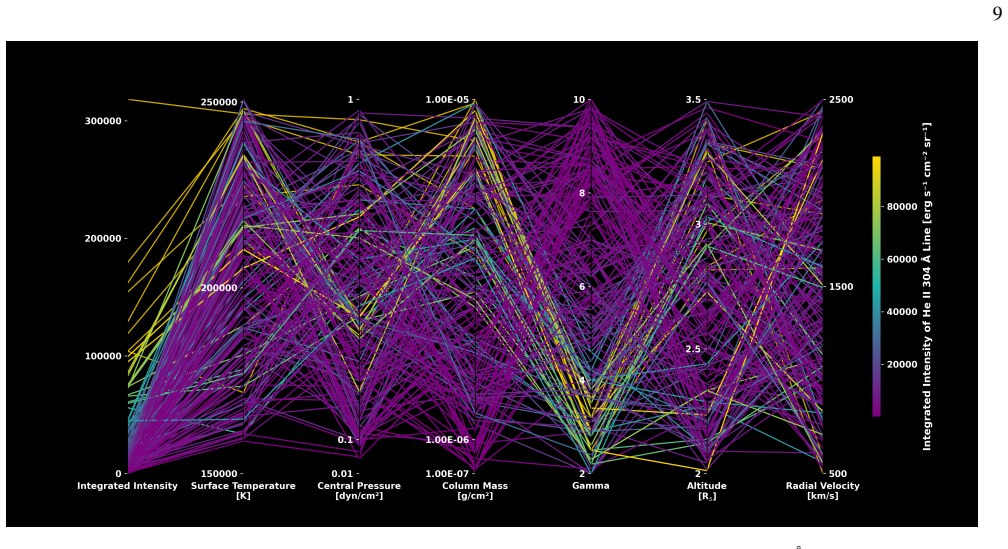
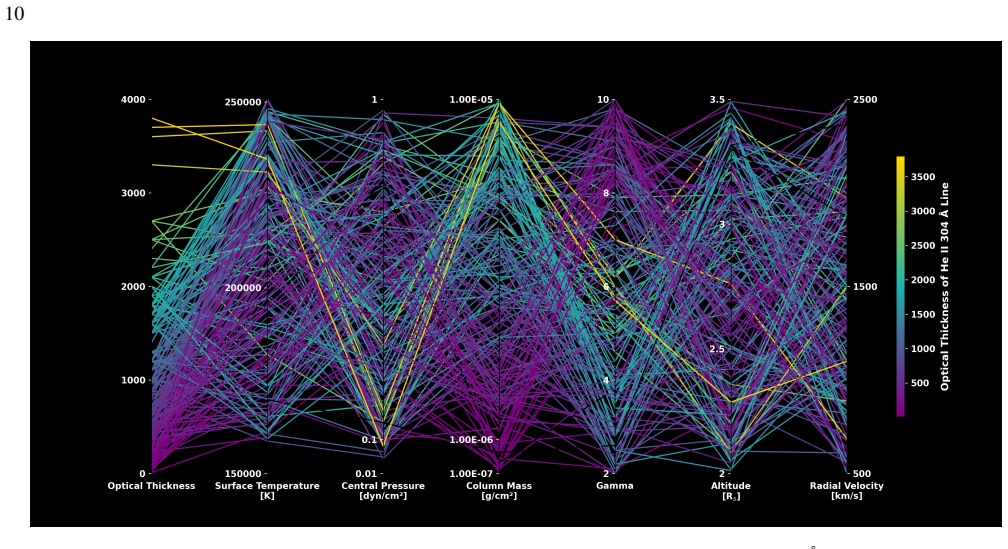
Two hundred randomly generated prominence models that solve radiative transfer for the He II 304 Å line, with results visualized through parallel coordinate plots to isolate the effects of each plasma parameter.
If this is right
- Higher column mass increases the line intensity because more helium atoms participate in the emission.
- Steeper temperature gradients concentrate the line-forming region and alter the ionization balance, changing the observed profile shape.
- Radiative dominance implies the line can form efficiently even when electron densities are too low for significant collisions.
- Velocity and altitude shifts mainly affect the line position and width rather than its core strength.
Where Pith is reading between the lines
- The same parameter-sensitivity approach could be applied to other EUV lines observed in the same event to cross-validate the inferred column mass.
- If the identified controls hold, simple scaling relations derived from these models might allow rough column-mass estimates from 304 Å images without running full radiative-transfer calculations each time.
- Extending the modeling to a larger sample of eruptions would test whether column mass and temperature steepness remain the leading factors across different events.
Load-bearing premise
The 200 random models adequately sample the realistic range of prominence plasma conditions and the radiative transfer calculations correctly capture the main physical processes without large unaccounted errors.
What would settle it
An independent measurement of the prominence column mass, for example from white-light scattering or Lyman-alpha absorption, that produces a 304 Å line intensity or profile shape outside the range predicted by the models for that mass.
Figures





read the original abstract
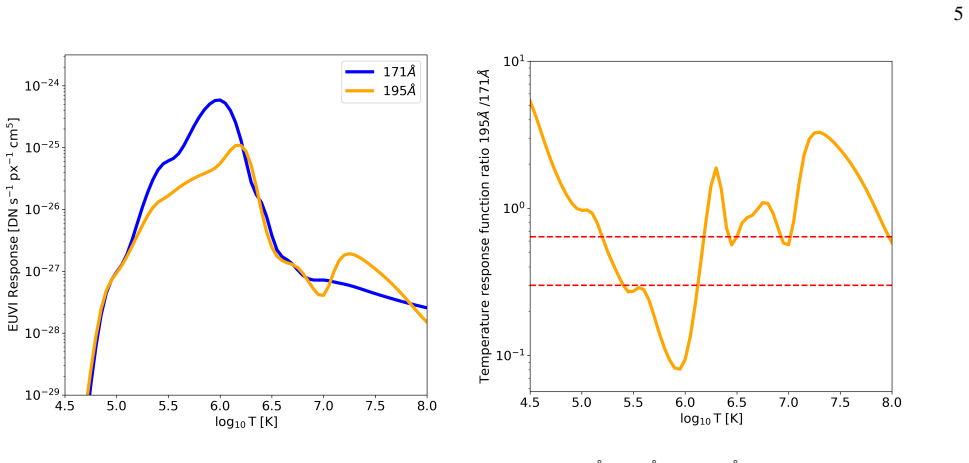
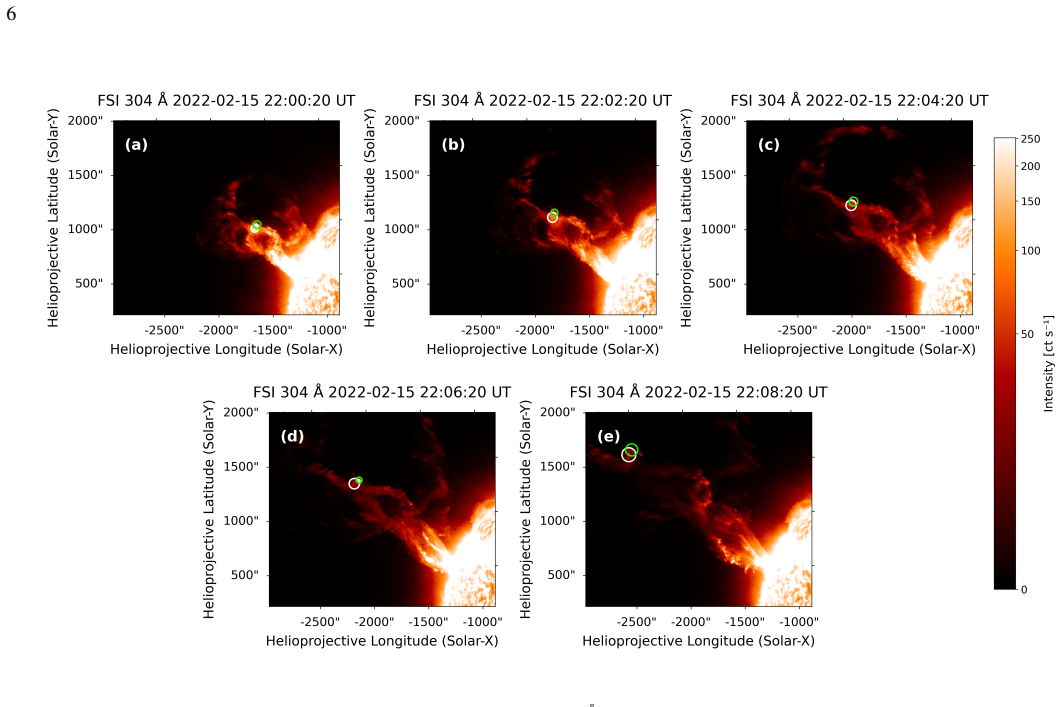
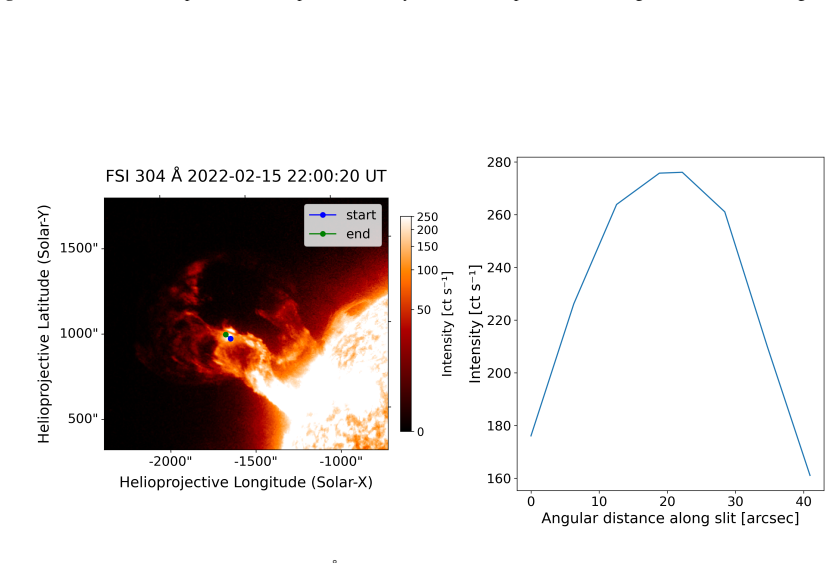
An observation of a large prominence on the solar limb took place on February 15, 2022, by the Extreme Ultraviolet Imager (EUI) on board Solar Orbiter. We aim to determine the range of physical parameters of this prominence, such as temperature, radial velocity, and altitude, and examine how these parameters affect the formation of the 304~\AA\ line of \ion{He}{2}, especially how collisional excitation and radiative processes contribute to line formation. After constraining these parameters, we generate 200 random models and compute the \ion{He}{2} 304~\AA\ line profile. We present these results using parallel coordinate plots to explore how these parameters affect the results. This allows us to infer the key physical parameters that impact the formation of the \ion{He}{2} 304~\AA\ line. This study demonstrates that column mass and the steepness of the temperature profile are key factors in the formation of the \ion{He}{2} 304~\AA\ line during the solar prominence eruption on February 15, 2022. Radiative processes remain dominant in the formation of the \ion{He}{2} 304~\AA\ line. These insights provide a foundation for future research and comparative studies.
Editorial analysis
A structured set of objections, weighed in public.
Referee Report
Summary. The manuscript analyzes Solar Orbiter EUI observations of a large eruptive prominence on 15 February 2022. After constraining parameters such as temperature, radial velocity, and altitude from the data, the authors generate an ensemble of 200 random models, compute the He II 304 Å line profiles via radiative transfer, and employ parallel-coordinate plots to identify column mass and the steepness of the temperature profile as the dominant factors influencing line formation. They further conclude that radiative processes dominate over collisional excitation in the line formation.
Significance. If the identification of column mass and temperature-profile steepness as the primary controls holds under more rigorous sampling and validation, the work would provide useful guidance for interpreting He II 304 Å observations of eruptive prominences and for prioritizing parameters in future radiative-transfer modeling. The ensemble approach and visualization technique represent a constructive step toward mapping parameter sensitivities, though the current implementation lacks the quantitative diagnostics needed to make the ranking robust.
major comments (2)
- [Methods (model ensemble generation)] The central claim that column mass and temperature-profile steepness are the key factors rests on visual inspection of parallel-coordinate plots from only 200 randomly sampled models. No variance decomposition, partial-dependence analysis, or one-at-a-time sensitivity runs are reported, leaving open the possibility that the ranking is influenced by sampling artifacts in the multi-dimensional parameter space (Methods section on model generation).
- [Abstract and Results] The assertion that radiative processes remain dominant is derived solely from the internal bookkeeping of the chosen radiative-transfer solver applied to the same 200-model ensemble. No direct comparison to the observed line profiles, error bars, or tests against alternative collision rates or incident radiation fields is provided, so the dominance conclusion lacks external validation (Abstract and Results sections).
minor comments (2)
- [Figure captions] The parallel-coordinate plots would benefit from explicit labeling of the color scale (e.g., line intensity or optical depth) and from inclusion of a quantitative measure of correlation strength alongside the visual ranking.
- [Introduction/Methods] The description of how the initial parameter constraints were derived from the EUI observations could be expanded to include the specific observational diagnostics or fitting procedure used.
Simulated Author's Rebuttal
We thank the referee for their constructive feedback, which highlights opportunities to strengthen the quantitative support for our conclusions. We respond to each major comment below and indicate the revisions planned for the manuscript.
read point-by-point responses
-
Referee: [Methods (model ensemble generation)] The central claim that column mass and temperature-profile steepness are the key factors rests on visual inspection of parallel-coordinate plots from only 200 randomly sampled models. No variance decomposition, partial-dependence analysis, or one-at-a-time sensitivity runs are reported, leaving open the possibility that the ranking is influenced by sampling artifacts in the multi-dimensional parameter space (Methods section on model generation).
Authors: We agree that visual inspection alone of the parallel-coordinate plots from the 200-model ensemble leaves the ranking vulnerable to potential sampling effects. In the revised manuscript we will add a quantitative global sensitivity analysis based on Sobol indices to decompose the variance in the computed He II 304 Å intensities and thereby rank parameter influence with statistical measures. This analysis will be presented alongside the existing parallel-coordinate plots. revision: yes
-
Referee: [Abstract and Results] The assertion that radiative processes remain dominant is derived solely from the internal bookkeeping of the chosen radiative-transfer solver applied to the same 200-model ensemble. No direct comparison to the observed line profiles, error bars, or tests against alternative collision rates or incident radiation fields is provided, so the dominance conclusion lacks external validation (Abstract and Results sections).
Authors: The dominance statement originates from the excitation-rate diagnostics internal to the radiative-transfer code across the ensemble. Because the EUI observations are narrow-band images without spectral resolution, direct comparison to observed line profiles is not possible. We will therefore revise the Abstract and Results to qualify the claim, add a short sensitivity test varying collision rates and incident radiation within plausible ranges, and explicitly note the lack of external observational validation as a limitation. revision: partial
- Direct comparison of modeled line profiles to observed profiles cannot be performed, as the available EUI data provide only integrated intensities in the 304 Å channel and lack spectroscopic resolution.
Circularity Check
No significant circularity in forward-modeling parameter study
full rationale
The paper first constrains prominence parameters (temperature, velocity, altitude) from the February 15 2022 EUI observation, then draws 200 random models inside those bounds and solves the radiative-transfer problem for the He II 304 Å line. Parallel-coordinate plots are subsequently inspected to rank the influence of column mass and temperature-gradient steepness on the computed line profiles; radiative dominance is likewise read off from the internal bookkeeping of the same solver. Because the reported key factors and process dominance are direct numerical outputs of the varied inputs rather than redefinitions, fitted re-labelings, or self-citation chains, the derivation chain remains self-contained and does not reduce to its own premises by construction.
Axiom & Free-Parameter Ledger
free parameters (2)
- column mass
- temperature profile steepness
axioms (1)
- domain assumption Non-LTE radiative transfer accurately describes He II 304 Å line formation in prominence plasma
Reference graph
Works this paper leans on
-
[1]
2024, Solar Physics, 299, 94
Antolin, P., Auchère, F., Winch, E., Soubrié, E., & Oliver, R. 2024, Solar Physics, 299, 94
2024
-
[2]
1999, A&A, 349, 974 Del Zanna, G., O’Dwyer, B., & Mason, H
Anzer, U., & Heinzel, P. 1999, A&A, 349, 974 Del Zanna, G., O’Dwyer, B., & Mason, H. E. 2011, A&A, 535, A46, doi: 10.1051/0004-6361/201117470
-
[3]
2024, The Astrophysical Journal, 974, 71
Dufresne, R., Del Zanna, G., Young, P., et al. 2024, The Astrophysical Journal, 974, 71
2024
-
[4]
Edsall, R. M. 2003, Computational Statistics & Data Analysis, 43, 605
2003
-
[5]
Freeland, S. L., & Handy, B. N. 1998, SoPh, 182, 497, doi: 10.1023/A:1005038224881
-
[6]
2007, SoPh, 243, 63, doi: 10.1007/s11207-007-0182-1
Golub, L., DeLuca, E., Austin, G., et al. 2007, SoPh, 243, 63, doi: 10.1007/s11207-007-0182-1
-
[7]
2009, A&A, 503, 663, doi: 10.1051/0004-6361/200811483
Gouttebroze, P., & Labrosse, N. 2009, A&A, 503, 663, doi: 10.1051/0004-6361/200811483
-
[8]
Howard, R. A., Moses, J. D., Vourlidas, A., et al. 2008, SSRv, 136, 67, doi: 10.1007/s11214-008-9341-4
-
[9]
Kaiser, M. L., Kucera, T. A., Davila, J. M., et al. 2008, SSRv, 136, 5, doi: 10.1007/s11214-007-9277-0
-
[10]
2007, SoPh, 243, 3, doi: 10.1007/s11207-007-9014-6
Kosugi, T., Matsuzaki, K., Sakao, T., et al. 2007, SoPh, 243, 3, doi: 10.1007/s11207-007-9014-6
-
[11]
2001, A&A, 380, 323, doi: 10.1051/0004-6361:20011395
Labrosse, N., & Gouttebroze, P. 2001, A&A, 380, 323, doi: 10.1051/0004-6361:20011395
-
[12]
2004, ApJ, 617, 614, doi: 10.1086/425168
Labrosse, N., & Gouttebroze, P. 2004, ApJ, 617, 614, doi: 10.1086/425168
-
[13]
Labrosse, N., Gouttebroze, P., & Vial, J. C. 2007, A&A, 463, 1171, doi: 10.1051/0004-6361:20065775
-
[14]
2006, A&A, 455, 719, doi: 10.1051/0004-6361:20065059
Labrosse, N., Li, X., & Li, B. 2006, A&A, 455, 719, doi: 10.1051/0004-6361:20065059
-
[15]
2012, A&A, 537, A100, doi: 10.1051/0004-6361/201117801
Labrosse, N., & McGlinchey, K. 2012, A&A, 537, A100, doi: 10.1051/0004-6361/201117801
-
[16]
Labrosse, N., & Rodger, A. S. 2016, A&A, 587, A113, doi: 10.1051/0004-6361/201526897
-
[17]
2011, A&A, 531, A69, doi: 10.1051/0004-6361/201015064
Labrosse, N., Schmieder, B., Heinzel, P., & Watanabe, T. 2011, A&A, 531, A69, doi: 10.1051/0004-6361/201015064
-
[18]
Labrosse, N., Vial, J. C., & Gouttebroze, P. 2008, Annales Geophysicae, 26, 2961, doi: 10.5194/angeo-26-2961-2008
-
[19]
Lemen, J. R., Title, A. M., Akin, D. J., et al. 2012, SoPh, 275, 17, doi: 10.1007/s11207-011-9776-8
-
[20]
Mierla, M., Zhukov, A. N., Berghmans, D., et al. 2022, A&A, 662, L5, doi: 10.1051/0004-6361/202244020
-
[21]
Mulay, S. M., Del Zanna, G., & Mason, H. 2017, A&A, 606, A4, doi: 10.1051/0004-6361/201730429 Müller, D., St. Cyr, O. C., Zouganelis, I., et al. 2020, A&A, 642, A1, doi: 10.1051/0004-6361/202038467 14
-
[22]
2012, The Astrophysical Journal, 754, 66
Parenti, S., Schmieder, B., Heinzel, P., & Golub, L. 2012, The Astrophysical Journal, 754, 66
2012
-
[23]
2020, A&A, 642, A8, doi: 10.1051/0004-6361/201936663
Rochus, P., Auchère, F., Berghmans, D., et al. 2020, A&A, 642, A8, doi: 10.1051/0004-6361/201936663
-
[24]
Schiralli, J. L. 2014, Master’s thesis, University of North Dakota The SunPy Community, Barnes, W. T., Bobra, M. G., et al. 2020, The Astrophysical Journal, 890, 68, doi: 10.3847/1538-4357/ab4f7a
-
[25]
Wang, H., Chae, J., Gurman, J. B., & Kucera, T. A. 1998, SoPh, 183, 91, doi: 10.1023/A:1005010504873
-
[26]
R., Tarbell, T
Wuelser, J.-P., Lemen, J. R., Tarbell, T. D., et al. 2004, in Society of Photo-Optical Instrumentation Engineers (SPIE) Conference
2004
-
[27]
5171, Telescopes and Instrumentation for Solar Astrophysics, ed
Series, Vol. 5171, Telescopes and Instrumentation for Solar Astrophysics, ed. S. Fineschi & M. A. Gummin, 111–122, doi: 10.1117/12.506877
-
[28]
Zhang, Y., Labrosse, N., Parenti, S., & Kucera, T. A. 2026b, Monthly Notices of the Royal Astronomical Society, stag104, doi: 10.1093/mnras/stag104
discussion (0)
Sign in with ORCID, Apple, or X to comment. Anyone can read and Pith papers without signing in.