Recognition: unknown
Exploring new resonances with direct top flavor changing interactions
Pith reviewed 2026-05-10 13:03 UTC · model grok-4.3
The pith
New physics resonances coupling to top quarks through flavor changes are captured by SMEFT operators at the electroweak scale.
A machine-rendered reading of the paper's core claim, the machinery that carries it, and where it could break.
Core claim
We investigate three typical new physics resonances which couple to the standard model (SM) quarks via direct top-quark flavor-changing interactions. We identify the possible SMEFT operators at the electroweak scale and analyze their phenomenology.
What carries the argument
SMEFT operators that encode direct top-quark flavor-changing couplings to the new resonances
If this is right
- Each resonance maps to a distinct set of SMEFT operators whose coefficients control production and decay rates.
- Phenomenological predictions include observable signals in top-quark pair production and single-top processes at hadron colliders.
- Existing experimental limits on flavor-changing top couplings translate directly into bounds on the resonance parameters.
Where Pith is reading between the lines
- The same operator language could be applied to flavor-changing processes involving bottom or charm quarks to check consistency across sectors.
- If future precision measurements show deviations that require additional operators, the resonances would need to be matched to a more complete ultraviolet model.
- High-luminosity LHC runs or future colliders could test whether the electroweak-scale approximation remains valid at higher energies.
Load-bearing premise
The interactions and effects of the new resonances can be fully described by SMEFT operators at the electroweak scale without important contributions from higher-dimensional terms or non-perturbative dynamics.
What would settle it
LHC data on top-quark flavor-changing neutral currents that cannot be reproduced by any combination of the identified SMEFT operators, or direct observation of a resonance whose mass and couplings fall outside the effective description.
Figures

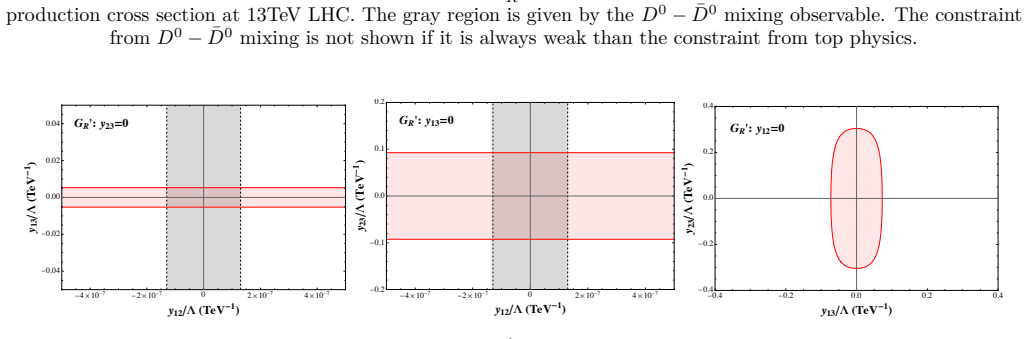

read the original abstract
In this work, we investigate three typical new physics resonances which couple to the standard model (SM) quarks via direct top-quark flavor-changing interactions. We identify the possible SMEFT operators electroweak scale and analyze their phenomenology.
Editorial analysis
A structured set of objections, weighed in public.
Referee Report
Summary. The manuscript investigates three typical classes of new physics resonances that couple to SM quarks through direct top-quark flavor-changing neutral current interactions. It matches these resonances onto SMEFT operators at the electroweak scale and examines the resulting collider phenomenology.
Significance. If the operator matching and subsequent phenomenology are robust, the work supplies a concrete dictionary between UV resonances with top FCNC couplings and SMEFT operators, which can help organize LHC searches for anomalous top-quark interactions and guide model-building in the top sector.
minor comments (1)
- [Abstract] Abstract: the phrase 'identify the possible SMEFT operators electroweak scale' is grammatically incomplete and should read 'at the electroweak scale'.
Simulated Author's Rebuttal
We thank the referee for the positive summary, significance assessment, and recommendation of minor revision. No specific major comments were provided in the report.
Circularity Check
No significant circularity detected
full rationale
The paper conducts an exploratory matching of three classes of heavy resonances (with direct top-quark FCNC couplings) onto SMEFT operators at the electroweak scale, followed by standard collider phenomenology. No equations, fitting procedures, or self-referential definitions appear in the provided abstract or described content. The central procedure follows conventional EFT integration of heavy states, with no load-bearing self-citations, uniqueness theorems imported from prior work, or renaming of known results as new derivations. The derivation chain remains self-contained and independent of its own outputs.
Axiom & Free-Parameter Ledger
Reference graph
Works this paper leans on
-
[1]
S. L. Glashow, J. Iliopoulos, and L. Maiani, Weak Inter- actions with Lepton-Hadron Symmetry, Phys. Rev. D2, 1285 (1970)
1970
- [2]
-
[3]
G. Aadet al.(ATLAS), Search for flavour-changing neutral-current couplings between the top quark and the photon with the ATLAS detector at s=13 TeV, Phys. Lett. B842, 137379 (2023), arXiv:2205.02537 [hep-ex]
- [4]
-
[5]
Moreno Llacer (ATLAS, CMS), Studies of rare top quark processes: tZq, tγq, t¯tt¯t flavour changing neutral currents, PoSLHCP2019, 106 (2019)
M. Moreno Llacer (ATLAS, CMS), Studies of rare top quark processes: tZq, tγq, t¯tt¯t flavour changing neutral currents, PoSLHCP2019, 106 (2019)
2019
-
[6]
G. Aadet al.(ATLAS), Search for flavour-changing neutral-current interactions of a top quark and a gluon in pp collisions at√s = 13 TeV with the ATLAS detector, Eur. Phys. J. C82, 334 (2022), arXiv:2112.01302 [hep-ex]
-
[7]
C. Zhang, Effective field theory approach to top-quark decay at next-to-leading order in qcd, Physical Review D 90, 10.1103/physrevd.90.014008 (2014)
- [8]
-
[9]
P. M. Ferreira and R. Santos, Strong-flavor-changing ef- fective operator contributions to single top quark produc- tion, Physical Review D73, 10.1103/physrevd.73.054025 (2006)
-
[10]
R. A. Coimbra, P. M. Ferreira, R. B. Guedes, O. Oliveira, A. Onofre, R. Santos, and M. Won, Dimension six FCNC operators and top production at the LHC, Phys. Rev. D 8 S R:y 23=0 -4 -2 0 2 4-4 -2 0 2 4 y13/Λ(TeV -1) y13/Λ(TeV -1) S R:y 13=0 -4 -2 0 2 4-4 -2 0 2 4 y13/Λ(TeV -1) y23/Λ(TeV -1) S R:y 12=0 -6 -4 -2 0 2 4 6-0.10 -0.05 0.00 0.05 0.10 y13/Λ(TeV...
-
[11]
F. Bach and T. Ohl, Anomalous Top Couplings at Hadron Colliders Revisited, Phys. Rev. D86, 114026 (2012), arXiv:1209.4564 [hep-ph]
-
[12]
Andrea and N
J. Andrea and N. Chanon, Single-top quark physics at the lhc: From precision measurements to rare processes and top quark properties, Universe9, 439 (2023)
2023
-
[13]
A. Cordero-Cid, M. A. P´ erez, G. Tavares-Velasco, and J. J. Toscano, Effective lagrangian approach to higgs-mediated flavor changing neutral current top quark decays, Physical Review D70, 10.1103/physrevd.70.074003 (2004)
-
[14]
C. Degrande, F. Maltoni, J. Wang, and C. Zhang, Au- tomatic computations at next-to-leading order in qcd for top-quark flavor-changing neutral processes, Physical Review D91, 10.1103/physrevd.91.034024 (2015)
-
[15]
Khanpour, S
H. Khanpour, S. Khatibi, M. K. Yanehsari, and M. M. Najafabadi, Single top quark production as a probe of anomalous tqγand tqz couplings at the fcc-ee, Physics Letters B775, 25–31 (2017)
2017
-
[16]
C. Zhang and F. Maltoni, Top-quark decay into Higgs boson and a light quark at next-to-leading order in QCD, Phys. Rev. D88, 054005 (2013), arXiv:1305.7386 [hep- ph]
-
[17]
Cheyette, Derivative Expansion of the Effective Action, Phys
O. Cheyette, Derivative Expansion of the Effective Action, Phys. Rev. Lett.55, 2394 (1985)
1985
-
[18]
Dimension-Six Terms in the Standard Model Lagrangian
B. Grzadkowski, M. Iskrzynski, M. Misiak, and J. Rosiek, Dimension-Six Terms in the Standard Model Lagrangian, JHEP10, 085, arXiv:1008.4884 [hep-ph]
work page internal anchor Pith review arXiv
- [19]
- [20]
- [21]
-
[22]
R. Alonso, E. E. Jenkins, A. V. Manohar, and M. Trott, Renormalization Group Evolution of the Standard Model Dimension Six Operators III: Gauge Coupling Dependence and Phenomenology, JHEP04, 159, arXiv:1312.2014 [hep- ph]
-
[23]
Aguilar-Saavedra, A minimal set of top anomalous couplings, Nuclear Physics B812, 181–204 (2009)
J. Aguilar-Saavedra, A minimal set of top anomalous couplings, Nuclear Physics B812, 181–204 (2009)
2009
-
[24]
C. Zhang and S. Willenbrock, Effective-field-theory ap- proach to top-quark production and decay, Physical Re- view D83, 10.1103/physrevd.83.034006 (2011)
-
[25]
O. Bessidskaia Bylund, F. Maltoni, I. Tsinikos, E. Vry- onidou, and C. Zhang, Probing top quark neutral cou- plings in the Standard Model Effective Field Theory at NLO in QCD, JHEP05, 052, arXiv:1601.08193 [hep-ph]
-
[26]
J. Aebischer, J. Kumar, and D. M. Straub, A python pack- age for the running and matching of wilson coefficients above and below the electroweak scale, The European Physical Journal C78, 10.1140/epjc/s10052-018-6492-7 (2018)
- [27]
-
[28]
J. Alwall, R. Frederix, S. Frixione, V. Hirschi, F. Maltoni, O. Mattelaer, H. S. Shao, T. Stelzer, P. Torrielli, and M. Zaro, The automated computation of tree-level and next-to-leading order differential cross sections, and their matching to parton shower simulations, JHEP07, 079, arXiv:1405.0301 [hep-ph]
work page internal anchor Pith review arXiv
- [29]
-
[30]
E. Golowich, J. Hewett, S. Pakvasa, and A. A. Petrov, Implications of D0 - ¯D0 Mixing for New Physics, Phys. Rev. D76, 095009 (2007), arXiv:0705.3650 [hep-ph]
-
[31]
Ablikimet al.(BESIII), Precision Measurement of the Branching Fraction ofD+→µ+νµ, Phys
M. Ablikimet al.(BESIII), Precision Measurement of the Branching Fraction ofD+→µ+νµ, Phys. Rev. Lett.135, 061801 (2025), arXiv:2410.07626 [hep-ex]
-
[32]
Navaset al.(Particle Data Group), Review of particle physics, Phys
S. Navaset al.(Particle Data Group), Review of particle physics, Phys. Rev. D110, 030001 (2024)
2024
- [33]
- [34]
- [35]
-
[36]
Aadet al.(ATLAS), Climbing to the Top of the ATLAS 13 TeV data, Phys
G. Aadet al.(ATLAS), Climbing to the Top of the ATLAS 13 TeV data, Phys. Rept.1116, 127 (2025), arXiv:2404.10674 [hep-ex]
-
[37]
G. Aadet al.(ATLAS), Search for same-charge top-quark pair production in pp collisions at √s = 13 TeV with the ATLAS detector, JHEP02, 084, arXiv:2409.14982 [hep-ex]
- [38]
- [39]
discussion (0)
Sign in with ORCID, Apple, or X to comment. Anyone can read and Pith papers without signing in.