Recognition: unknown
Radial Distribution of Star Formation and Gas-phase Metallicity in Spiral-Elliptical Galaxy Pairs
Pith reviewed 2026-05-10 12:29 UTC · model grok-4.3
The pith
Spirals paired with ellipticals show suppressed central star formation and higher central metallicities.
A machine-rendered reading of the paper's core claim, the machinery that carries it, and where it could break.
Core claim
In spiral-elliptical pairs the spiral galaxy exhibits suppressed central star formation and elevated gas-phase metallicities, while spirals in spiral-spiral pairs show centrally enhanced star formation and reduced metallicities. The degree of suppression and enrichment scales with companion mass and with the symmetry of the spiral's gas velocity field. The authors conclude that the spiral experiences suppressed gas accretion upon entering the hot circumgalactic medium of its early-type companion, and that tidal perturbations during close encounters compress cold gas, triggering star formation and rapid chemical enrichment.
What carries the argument
the hot circumgalactic medium of the elliptical companion that suppresses gas accretion into the spiral galaxy, combined with tidal perturbations that can trigger localized star formation
Load-bearing premise
The observed differences in star-formation and metallicity radial profiles are caused by the elliptical companion's hot circumgalactic medium and tidal effects rather than by selection biases, mass mismatches, or other environmental factors.
What would settle it
A large sample of mass-matched spiral galaxies in S+E pairs showing no systematic central suppression of star formation or elevation of metallicity compared with field spirals or S+S pairs.
Figures


read the original abstract
Using integral field spectroscopy from SDSS-IV MaNGA, we investigate the radial distributions of star formation rate (SFR) and gas-phase metallicity in spiral galaxies that reside in spiral-elliptical (S+E) pairs. Spirals in S+E pairs show suppressed central star formation and elevated metallicities, whereas spirals in spiral-spiral pairs exhibit centrally enhanced star formation and reduced metallicities. The degree of SFR suppression and metallicity enhancement in S+E pairs depends on the masses of the pair members. Spirals with more massive elliptical companions experience stronger star-formation suppression and larger increases in metallicity, while lower-mass spirals show more pronounced metallicity enhancement. In addition, within S+E systems, galaxies with asymmetric gas velocity fields display enhanced SFR and higher metallicities, whereas those with symmetric velocity fields exhibit clear central suppression. Based on these results, we infer that in S+E pairs, the spiral galaxy experiences suppressed gas accretion once it enters the hot circumgalactic medium of its early-type companion, which leads to the observed decline in star-formation activity. When a close encounter takes place, tidal perturbations can compress the remaining cold gas and trigger enhanced star formation, producing rapid chemical enrichment and the associated increase in metallicity.
Editorial analysis
A structured set of objections, weighed in public.
Referee Report
Summary. The manuscript analyzes MaNGA integral-field spectroscopy of spiral galaxies in spiral-elliptical (S+E) pairs, reporting that these spirals exhibit centrally suppressed star-formation rates and elevated gas-phase metallicities relative to spirals in spiral-spiral (S+S) pairs, which instead show central SFR enhancement and metallicity reduction. The strength of the S+E effects scales with companion mass and is modulated by gas-velocity-field symmetry (asymmetric fields show the opposite trend). The authors interpret the differences as arising from hot-CGM accretion suppression by the elliptical companion, with tidal encounters triggering star formation and enrichment in the asymmetric subset.
Significance. If the radial-profile differences can be shown to be caused specifically by the elliptical companion rather than by unmatched environmental factors, the work would supply useful observational constraints on the role of hot circumgalactic media in regulating cold-gas accretion and on the efficiency of tidal triggering in galaxy pairs. The use of resolved IFS data to separate central versus outer behavior is a strength, but the current interpretive step from observation to mechanism remains provisional.
major comments (3)
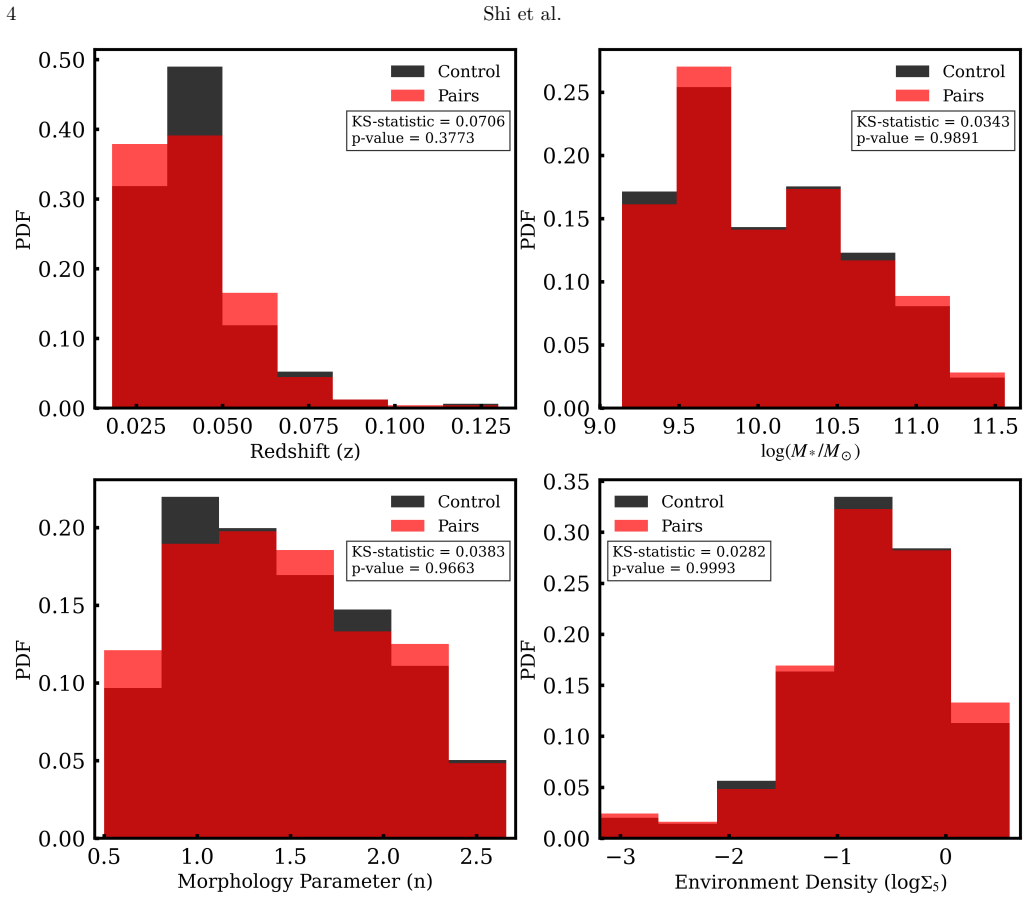
- [Section 2] Section 2 (Sample Selection): The S+E and S+S samples are compared after binning only on pair mass ratio; no matching on local galaxy density, group membership, or halo mass is described. Because ellipticals preferentially occupy denser environments, the reported central SFR suppression and metallicity enhancement could reflect pre-existing environmental quenching rather than the elliptical’s hot CGM. A density-matched control sample or explicit environmental metrics are required to support the causal attribution.
- [Section 4] Section 4 (Discussion and Interpretation): The claim that asymmetric gas velocity fields trace tidal encounters (while symmetric fields trace pure CGM suppression) is presented without quantitative validation of the asymmetry metric or comparison to hydrodynamical simulations of pair interactions. Internal instabilities or minor mergers unrelated to the companion can also produce velocity asymmetries, weakening the tidal-triggering inference.
- [Results] Results (velocity-field split): The reported reversal of trends between symmetric and asymmetric subsets is central to the tidal-encounter argument, yet no statistical significance, bootstrap uncertainties, or Kolmogorov-Smirnov tests on the profile differences are provided. Without these, the robustness of the dichotomy cannot be assessed.
minor comments (3)
- [Figures] Figure 3 and 4: Error bands on the stacked radial profiles are not shown in all panels; adding 1σ shaded regions would improve readability and allow direct visual assessment of the reported differences.
- [Section 3.2] Section 3.2: The definition of “asymmetric” versus “symmetric” velocity fields is stated qualitatively; a quantitative threshold (e.g., kinematic asymmetry parameter value) should be given explicitly.
- [Abstract] Abstract and Section 1: The phrase “the degree depends on the masses of the pair members” is repeated without a supporting figure or table reference; a brief pointer to the relevant mass-binned results would aid readers.
Simulated Author's Rebuttal
We thank the referee for their thoughtful and constructive comments, which have helped us identify areas where the manuscript can be strengthened. We address each major comment point by point below, with clear indications of planned revisions.
read point-by-point responses
-
Referee: Section 2 (Sample Selection): The S+E and S+S samples are compared after binning only on pair mass ratio; no matching on local galaxy density, group membership, or halo mass is described. Because ellipticals preferentially occupy denser environments, the reported central SFR suppression and metallicity enhancement could reflect pre-existing environmental quenching rather than the elliptical’s hot CGM. A density-matched control sample or explicit environmental metrics are required to support the causal attribution.
Authors: We agree that the absence of explicit environmental matching represents a limitation in the current analysis, since ellipticals are known to prefer denser environments that could contribute to quenching effects. Our sample selection emphasized binning by mass ratio to isolate the influence of companion morphology. In the revised manuscript we will incorporate local density and group membership metrics drawn from MaNGA ancillary catalogs and discuss whether the reported trends persist at fixed environment. revision: yes
-
Referee: Section 4 (Discussion and Interpretation): The claim that asymmetric gas velocity fields trace tidal encounters (while symmetric fields trace pure CGM suppression) is presented without quantitative validation of the asymmetry metric or comparison to hydrodynamical simulations of pair interactions. Internal instabilities or minor mergers unrelated to the companion can also produce velocity asymmetries, weakening the tidal-triggering inference.
Authors: The asymmetry metric is defined quantitatively in Section 3 as a measure of deviation from ordered rotation. We recognize that internal instabilities or unrelated minor mergers can also generate kinematic disturbances. In the revision we will expand the discussion to include references to existing hydrodynamical simulations of tidal interactions, provide additional detail on the asymmetry quantification procedure, and explicitly note the interpretive caveats. revision: partial
-
Referee: Results (velocity-field split): The reported reversal of trends between symmetric and asymmetric subsets is central to the tidal-encounter argument, yet no statistical significance, bootstrap uncertainties, or Kolmogorov-Smirnov tests on the profile differences are provided. Without these, the robustness of the dichotomy cannot be assessed.
Authors: We agree that quantitative statistical support is necessary to assess the robustness of the symmetric versus asymmetric dichotomy. In the revised results section we will add Kolmogorov-Smirnov tests comparing the radial profiles of the two subsets, together with bootstrap-derived uncertainties and reported significance levels for the observed differences. revision: yes
Circularity Check
No circularity: purely observational profile comparison with interpretive inference
full rationale
The paper reports direct empirical comparisons of radial SFR and metallicity profiles in MaNGA-observed S+E versus S+S pairs, stratified by companion mass and velocity-field symmetry. No equations, parameter fits, predictions, or self-citations appear in the derivation chain; the central results are measured differences, and the physical interpretation (hot CGM suppression plus tidal triggering) is presented as inference rather than a reduction to prior self-defined inputs. The analysis is therefore self-contained against external data and does not exhibit any of the enumerated circularity patterns.
Axiom & Free-Parameter Ledger
axioms (2)
- domain assumption Gas-phase metallicity is reliably traced by strong-line ratios calibrated on local galaxies
- domain assumption Star-formation rate is correctly recovered from H-alpha or other tracers after dust correction
Reference graph
Works this paper leans on
-
[1]
Abazajian, K. N., Adelman-McCarthy, J. K., Agüeros, M. A., et al. 2009, ApJS, 182, 543, doi: 10.1088/0067-0049/182/2/543
-
[2]
arXiv , author =:1211.5140 , journal =
Anderson, M. E., Bregman, J. N., & Dai, X. 2013, ApJ, 762, 106, doi: 10.1088/0004-637X/762/2/106
-
[3]
Anderson, M. E., Gaspari, M., White, S. D. M., Wang, W., & Dai, X. 2015, MNRAS, 449, 3806, doi: 10.1093/mnras/stv437
-
[4]
Babyk, I. V., McNamara, B. R., Nulsen, P. E. J., et al. 2018, ApJ, 857, 32, doi: 10.3847/1538-4357/aab3c9
-
[5]
Baldry, I. K., Balogh, M. L., Bower, R. G., et al. 2006, MNRAS, 373, 469, doi: 10.1111/j.1365-2966.2006.11081.x
-
[6]
Baldry, I. K., Liske, J., Brown, M. J. I., et al. 2018, MNRAS, 474, 3875, doi: 10.1093/mnras/stx3042
-
[7]
Barnes, J. E., & Hernquist, L. 1996, ApJ, 471, 115, doi: 10.1086/177957
-
[8]
Barrera-Ballesteros, J. K., Sánchez, S. F., García-Lorenzo, B., et al. 2015, A&A, 579, A45, doi: 10.1051/0004-6361/201425397
-
[9]
Belfiore, F., Westfall, K. B., Schaefer, A., et al. 2019, AJ, 158, 160, doi: 10.3847/1538-3881/ab3e4e
-
[10]
Blanton, M. R., Schlegel, D. J., Strauss, M. A., et al. 2005, AJ, 129, 2562, doi: 10.1086/429803
-
[11]
Blanton, M. R., Bershady, M. A., Abolfathi, B., et al. 2017, AJ, 154, 28, doi: 10.3847/1538-3881/aa7567
-
[12]
Bregman, J. N., Anderson, M. E., Miller, M. J., et al. 2018, ApJ, 862, 3, doi: 10.3847/1538-4357/aacafe
-
[13]
Overview of the SDSS-IV MaNGA Survey: Mapping Nearby Galaxies at Apache Point Observatory
Bundy, K., Bershady, M. A., Law, D. R., et al. 2015, ApJ, 798, 7, doi: 10.1088/0004-637X/798/1/7
-
[14]
Bustamante, S., Ellison, S. L., Patton, D. R., & Sparre, M. 2020, MNRAS, 494, 3469, doi: 10.1093/mnras/staa1025
-
[15]
The Dust Content and Opacity of Actively Star-Forming Galaxies
Calzetti, D., Armus, L., Bohlin, R. C., et al. 2000, ApJ, 533, 682, doi: 10.1086/308692
work page internal anchor Pith review doi:10.1086/308692 2000
-
[16]
Cao, C., Xu, C. K., Domingue, D., et al. 2016, ApJS, 222, 16, doi: 10.3847/0067-0049/222/2/16
-
[17]
2004, A&A, 422, 941, doi: 10.1051/0004-6361:20040283
Casasola, V., Bettoni, D., & Galletta, G. 2004, A&A, 422, 941, doi: 10.1051/0004-6361:20040283 12 Shi et al
-
[18]
2018, MNRAS, 476, 875, doi: 10.1093/mnras/sty089
Catinella, B., Saintonge, A., Janowiecki, S., et al. 2018, MNRAS, 476, 875, doi: 10.1093/mnras/sty089
-
[19]
2022, A&A, 666, A156, doi: 10.1051/0004-6361/202243101
Comparat, J., Truong, N., Merloni, A., et al. 2022, A&A, 666, A156, doi: 10.1051/0004-6361/202243101
-
[20]
Dekel, A. 2008, MNRAS, 384, 386, doi: 10.1111/j.1365-2966.2007.12730.x Di Matteo, P., Bournaud, F., Martig, M., et al. 2008, A&A, 492, 31, doi: 10.1051/0004-6361:200809480
-
[21]
Monthly Notices of the Royal Astronomical Society , author =
Ellison, S. L., Patton, D. R., Mendel, J. T., & Scudder, J. M. 2011, MNRAS, 418, 2043, doi: 10.1111/j.1365-2966.2011.19624.x
-
[22]
Ellison, S. L., Patton, D. R., Simard, L., & McConnachie, A. W. 2008, AJ, 135, 1877, doi: 10.1088/0004-6256/135/5/1877
-
[23]
Ellison, S. L., Sánchez, S. F., Ibarra-Medel, H., et al. 2018, MNRAS, 474, 2039, doi: 10.1093/mnras/stx2882
-
[24]
Feng, S., Shen, S.-Y., Yuan, F.-T., Dai, Y. S., & Masters, K. L. 2022, ApJS, 262, 6, doi: 10.3847/1538-4365/ac80f2
-
[25]
Feng, S., Shen, S.-Y., Yuan, F.-T., Riffel, R. A., & Pan, K. 2020, ApJL, 892, L20, doi: 10.3847/2041-8213/ab7dba
-
[26]
2024, ApJ, 965, 60, doi: 10.3847/1538-4357/ad343e —
Feng, S., Shen, S.-Y., Yuan, F.-T., et al. 2024, ApJ, 965, 60, doi: 10.3847/1538-4357/ad343e —. 2019, ApJ, 880, 114, doi: 10.3847/1538-4357/ab24da
-
[27]
Finlator, K., & Davé, R. 2008, MNRAS, 385, 2181, doi: 10.1111/j.1365-2966.2008.12991.x
-
[28]
Goulding, A. D., Greene, J. E., Ma, C.-P., et al. 2016, ApJ, 826, 167, doi: 10.3847/0004-637X/826/2/167
-
[29]
, year = 1972, month = aug, volume =
Gunn, J. E., & Gott, III, J. R. 1972, ApJ, 176, 1, doi: 10.1086/151605
-
[30]
Gunn, J. E., Siegmund, W. A., Mannery, E. J., et al. 2006, AJ, 131, 2332, doi: 10.1086/500975
-
[31]
K., Domingue, D., Cao, C., & Huang, J.-s
He, C., Xu, C. K., Domingue, D., Cao, C., & Huang, J.-s. 2022, ApJS, 261, 34, doi: 10.3847/1538-4365/ac73ec
-
[32]
Hopkins, P. F., Hernquist, L., Cox, T. J., & Kereš, D. 2008, ApJS, 175, 356, doi: 10.1086/524362
work page internal anchor Pith review doi:10.1086/524362 2008
-
[33]
Hung, C.-L., Hayward, C. C., Smith, H. A., et al. 2016, ApJ, 816, 99, doi: 10.3847/0004-637X/816/2/99
-
[34]
2015, ApJ, 805, 131, doi: 10.1088/0004-637X/805/2/131
Hwang, J.-S., & Park, C. 2015, ApJ, 805, 131, doi: 10.1088/0004-637X/805/2/131
-
[35]
Kauffmann, G., Heckman, T. M., Tremonti, C., et al. 2003, MNRAS, 346, 1055, doi: 10.1111/j.1365-2966.2003.07154.x
-
[36]
Kennicutt, Jr., R. C. 1998, ApJ, 498, 541, doi: 10.1086/305588
-
[37]
Kewley, L. J., Geller, M. J., & Barton, E. J. 2006, AJ, 131, 2004, doi: 10.1086/500295 Krajnović, D., Cappellari, M., de Zeeuw, P. T., & Copin, Y. 2006, MNRAS, 366, 787, doi: 10.1111/j.1365-2966.2005.09902.x
-
[38]
R., Cherinka, B., Yan, R., et al
Law, D. R., Cherinka, B., Yan, R., et al. 2016, AJ, 152, 83, doi: 10.3847/0004-6256/152/4/83
-
[39]
White, S. D. M. 2008, MNRAS, 385, 1903, doi: 10.1111/j.1365-2966.2008.13000.x
-
[40]
Lilly, S. J., Carollo, C. M., Pipino, A., Renzini, A., & Peng, Y. 2013, ApJ, 772, 119, doi: 10.1088/0004-637X/772/2/119
-
[41]
2019, ApJ, 872, 50, doi: 10.3847/1538-4357/aafa84
Lin, L., Hsieh, B.-C., Pan, H.-A., et al. 2019, ApJ, 872, 50, doi: 10.3847/1538-4357/aafa84
-
[42]
Lisenfeld, U., Xu, C. K., Gao, Y., et al. 2019, A&A, 627, A107, doi: 10.1051/0004-6361/201935536
-
[43]
Liu, X., Shen, Y., Strauss, M. A., & Hao, L. 2011, ApJ, 737, 101, doi: 10.1088/0004-637X/737/2/101
-
[44]
L., Zhao, Y.-H., Zhao, G., et al
Luo, A. L., Zhao, Y.-H., Zhao, G., et al. 2015, Research in Astronomy and Astrophysics, 15, 1095, doi: 10.1088/1674-4527/15/8/002
-
[45]
Mathews, W. G., & Brighenti, F. 2003, ARA&A, 41, 191, doi: 10.1146/annurev.astro.41.090401.094542
-
[46]
McCarthy, I. G., Frenk, C. S., Font, A. S., et al. 2008, MNRAS, 383, 593, doi: 10.1111/j.1365-2966.2007.12577.x
-
[47]
Tissera, P. 2008, MNRAS, 386, L82, doi: 10.1111/j.1745-3933.2008.00466.x
-
[48]
Mihos, J. C., & Hernquist, L. 1996, ApJ, 464, 641, doi: 10.1086/177353
-
[49]
Montuori, M., Di Matteo, P., Lehnert, M. D., Combes, F., & Semelin, B. 2010, A&A, 518, A56, doi: 10.1051/0004-6361/201014304
-
[50]
2019, ApJ, 882, 14, doi: 10.3847/1538-4357/ab3401
Moon, J.-S., An, S.-H., & Yoon, S.-J. 2019, ApJ, 882, 14, doi: 10.3847/1538-4357/ab3401
-
[51]
Moreno, J., Torrey, P., Ellison, S. L., et al. 2021, MNRAS, 503, 3113, doi: 10.1093/mnras/staa2952
-
[52]
Cox, T. J. 2011, MNRAS, 415, 3750, doi: 10.1111/j.1365-2966.2011.18984.x
-
[53]
E., & Ferland, G
Osterbrock, D. E., & Ferland, G. J. 2006, Astrophysics of gaseous nebulae and active galactic nuclei
2006
-
[54]
Pan, H.-A., Lin, L., Sánchez, S. F., Barrera-Ballesteros, J. K., & Hsieh, B.-C. 2025, ApJ, 982, 130, doi: 10.3847/1538-4357/adbbd2
-
[55]
2018, ApJ, 868, 132, doi: 10.3847/1538-4357/aaeb92
Pan, H.-A., Lin, L., Hsieh, B.-C., et al. 2018, ApJ, 868, 132, doi: 10.3847/1538-4357/aaeb92 —. 2019, ApJ, 881, 119, doi: 10.3847/1538-4357/ab311c
-
[56]
2009, ApJ, 691, 1828, doi: 10.1088/0004-637X/691/2/1828
Park, C., & Choi, Y.-Y. 2009, ApJ, 691, 1828, doi: 10.1088/0004-637X/691/2/1828
-
[57]
Patton, D. R., Qamar, F. D., Ellison, S. L., et al. 2016, MNRAS, 461, 2589, doi: 10.1093/mnras/stw1494 Spiral-Ellipical Pairs in MaNGA 13
-
[58]
Scudder, J. M. 2013, MNRAS, 433, L59, doi: 10.1093/mnrasl/slt058
-
[59]
2015, Nature, 521, 192, doi: 10.1038/nature14439
Peng, Y., Maiolino, R., & Cochrane, R. 2015, Nature, 521, 192, doi: 10.1038/nature14439
-
[60]
Pettini, M., & Pagel, B. E. J. 2004, MNRAS, 348, L59, doi: 10.1111/j.1365-2966.2004.07591.x
-
[61]
Rupke, D. S. N., Kewley, L. J., & Barnes, J. E. 2010, ApJL, 710, L156, doi: 10.1088/2041-8205/710/2/L156
-
[62]
Monthly Notices of the Royal Astronomical Society , author =
Saintonge, A., Kauffmann, G., Kramer, C., et al. 2011, MNRAS, 415, 32, doi: 10.1111/j.1365-2966.2011.18677.x Sánchez, S. F., Barrera-Ballesteros, J. K., Lacerda, E., et al. 2022, ApJS, 262, 36, doi: 10.3847/1538-4365/ac7b8f
-
[63]
Mendel, J. T. 2012, MNRAS, 426, 549, doi: 10.1111/j.1365-2966.2012.21749.x
-
[64]
L., Genzel, R., Förster Schreiber, N
Shapiro, K. L., Genzel, R., Förster Schreiber, N. M., et al. 2008, ApJ, 682, 231, doi: 10.1086/587133
-
[65]
2016, Research in Astronomy and Astrophysics, 16, 43, doi: 10.1088/1674-4527/16/3/043
Shen, S.-Y., Argudo-Fernández, M., Chen, L., et al. 2016, Research in Astronomy and Astrophysics, 16, 43, doi: 10.1088/1674-4527/16/3/043
-
[66]
McConnachie, A. W. 2011, ApJS, 196, 11, doi: 10.1088/0067-0049/196/1/11
-
[67]
Smee, S. A., Gunn, J. E., Uomoto, A., et al. 2013, AJ, 146, 32, doi: 10.1088/0004-6256/146/2/32
-
[68]
Springel, V., Di Matteo, T., & Hernquist, L. 2005, MNRAS, 361, 776, doi: 10.1111/j.1365-2966.2005.09238.x
-
[69]
Steffen, J. L., Fu, H., Comerford, J. M., et al. 2021, ApJ, 909, 120, doi: 10.3847/1538-4357/abe2a5
-
[70]
Steffen, J. L., Fu, H., Brownstein, J. R., et al. 2023, ApJ, 942, 107, doi: 10.3847/1538-4357/aca768
-
[71]
Strauss, M. A., Weinberg, D. H., Lupton, R. H., et al. 2002, AJ, 124, 1810, doi: 10.1086/342343
-
[72]
Tacchella, S., Dekel, A., Carollo, C. M., et al. 2016, MNRAS, 458, 242, doi: 10.1093/mnras/stw303
-
[73]
J., Kewley, L., & Hernquist, L
Torrey, P., Cox, T. J., Kewley, L., & Hernquist, L. 2012, ApJ, 746, 108, doi: 10.1088/0004-637X/746/1/108
-
[74]
2020, MNRAS, 491, 5406, doi: 10.1093/mnras/stz3286
Trussler, J., Maiolino, R., Maraston, C., et al. 2020, MNRAS, 491, 5406, doi: 10.1093/mnras/stz3286
-
[75]
A., Bundy, K., Diamond-Stanic, A
Wake, D. A., Bundy, K., Diamond-Stanic, A. M., et al. 2017, AJ, 154, 86, doi: 10.3847/1538-3881/aa7ecc
-
[76]
B., Cappellari, M., Bershady, M
Westfall, K. B., Cappellari, M., Bershady, M. A., et al. 2019, AJ, 158, 231, doi: 10.3847/1538-3881/ab44a2
-
[77]
K., Domingue, D., Cheng, Y.-W., et al
Xu, C. K., Domingue, D., Cheng, Y.-W., et al. 2010, ApJ, 713, 330, doi: 10.1088/0004-637X/713/1/330
-
[78]
Yan, R., Tremonti, C., Bershady, M. A., et al. 2016a, AJ, 151, 8, doi: 10.3847/0004-6256/151/1/8
-
[79]
Yan, R., Bundy, K., Law, D. R., et al. 2016b, AJ, 152, 197, doi: 10.3847/0004-6256/152/6/197
-
[80]
2022, ApJ, 934, 114, doi: 10.3847/1538-4357/ac78e6
Yu, Q., Fang, T., Feng, S., et al. 2022, ApJ, 934, 114, doi: 10.3847/1538-4357/ac78e6
discussion (0)
Sign in with ORCID, Apple, or X to comment. Anyone can read and Pith papers without signing in.