Recognition: unknown
Revisiting the Dynamical Properties of Pedlosky's Two-Layer Model for Finite Amplitude Baroclinic Waves
Pith reviewed 2026-05-10 11:23 UTC · model grok-4.3
The pith
Pedlosky's two-layer baroclinic wave model becomes chaotic through period-doubling as Ekman dissipation rises from an integrable inviscid state.
A machine-rendered reading of the paper's core claim, the machinery that carries it, and where it could break.
Core claim
The geophysical state of the baroclinic wave in Pedlosky's model shows a rich diversity of dynamical regimes controlled by Ekman dissipation. The inviscid limit is integrable, while increasing dissipation causes bifurcations to deterministic chaos and coexistence of multiple attractors. The minimal low-order truncation, structurally equivalent to the Lorenz model, reveals the transition from stable wave equilibration to periodic oscillations terminating in homoclinic orbits and then to chaos via period-doubling.
What carries the argument
The bifurcation diagram of the low-order truncated system of ODEs, which is structurally equivalent to the Lorenz model and controls the wave amplitude transitions.
If this is right
- Deterministic chaos induced by dissipation provides a genuine mechanism for destabilization of the baroclinic wave.
- Initial-condition dependence allows multiple attractors to coexist in regimes where the wave equilibrates.
- The sequence of bifurcations and the period-doubling route remain robust when the model is extended to higher dimensions.
Where Pith is reading between the lines
- Atmospheric wave prediction may require explicit accounting for initial-condition sensitivity even at moderate dissipation levels.
- Similar bifurcation structures could govern baroclinic instability in three-layer or continuously stratified models.
- Climate simulations that parameterize Ekman friction might exhibit abrupt shifts between wave states as friction coefficients vary.
Load-bearing premise
The low-order truncation of the governing equations is sufficient to capture the essential nonlinear dynamics of the full two-layer system.
What would settle it
Direct numerical integration of the full two-layer partial differential equations showing no period-doubling cascade to chaos or absence of multiple coexisting attractors at the same dissipation parameter values.
Figures



read the original abstract
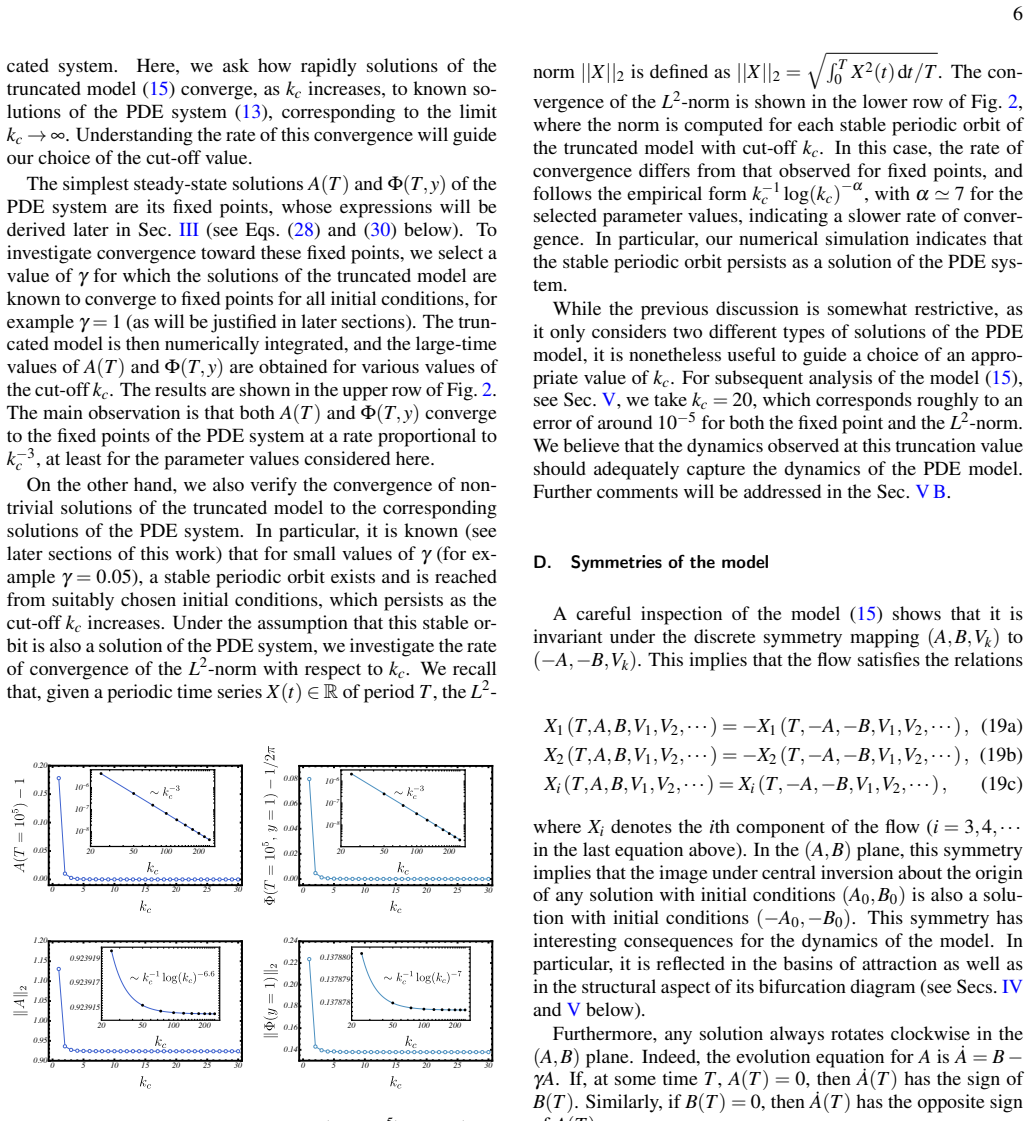
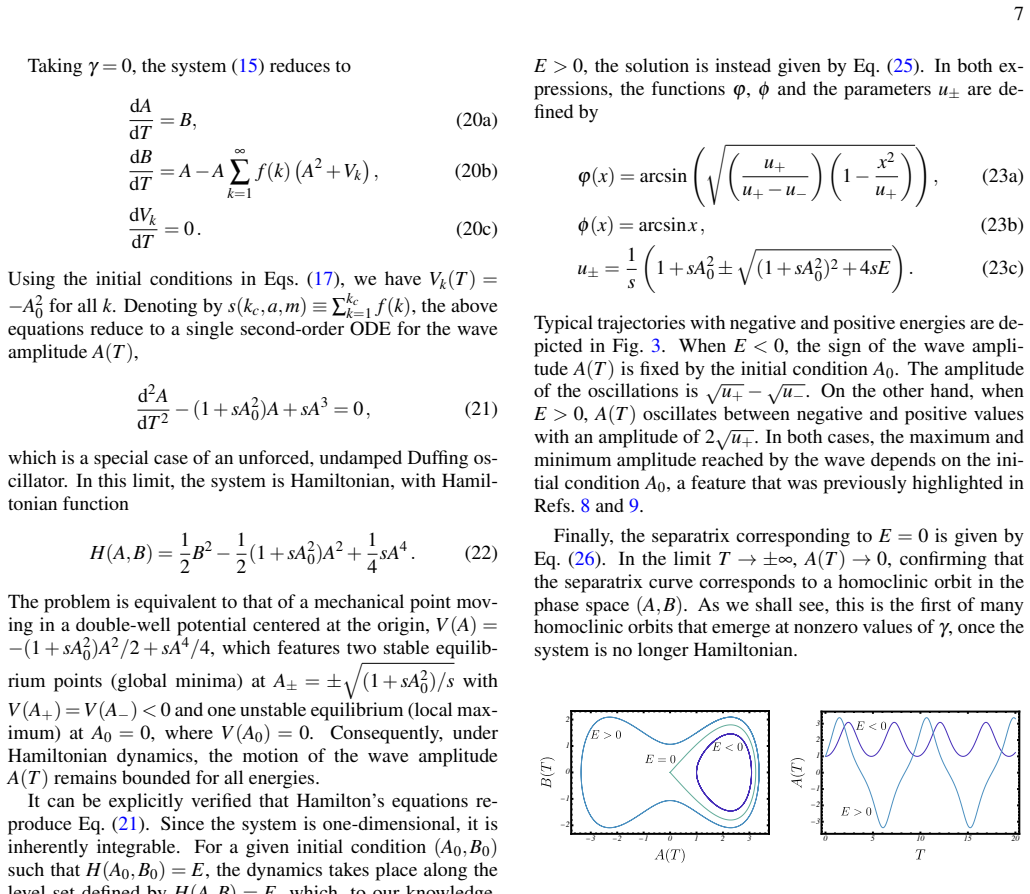
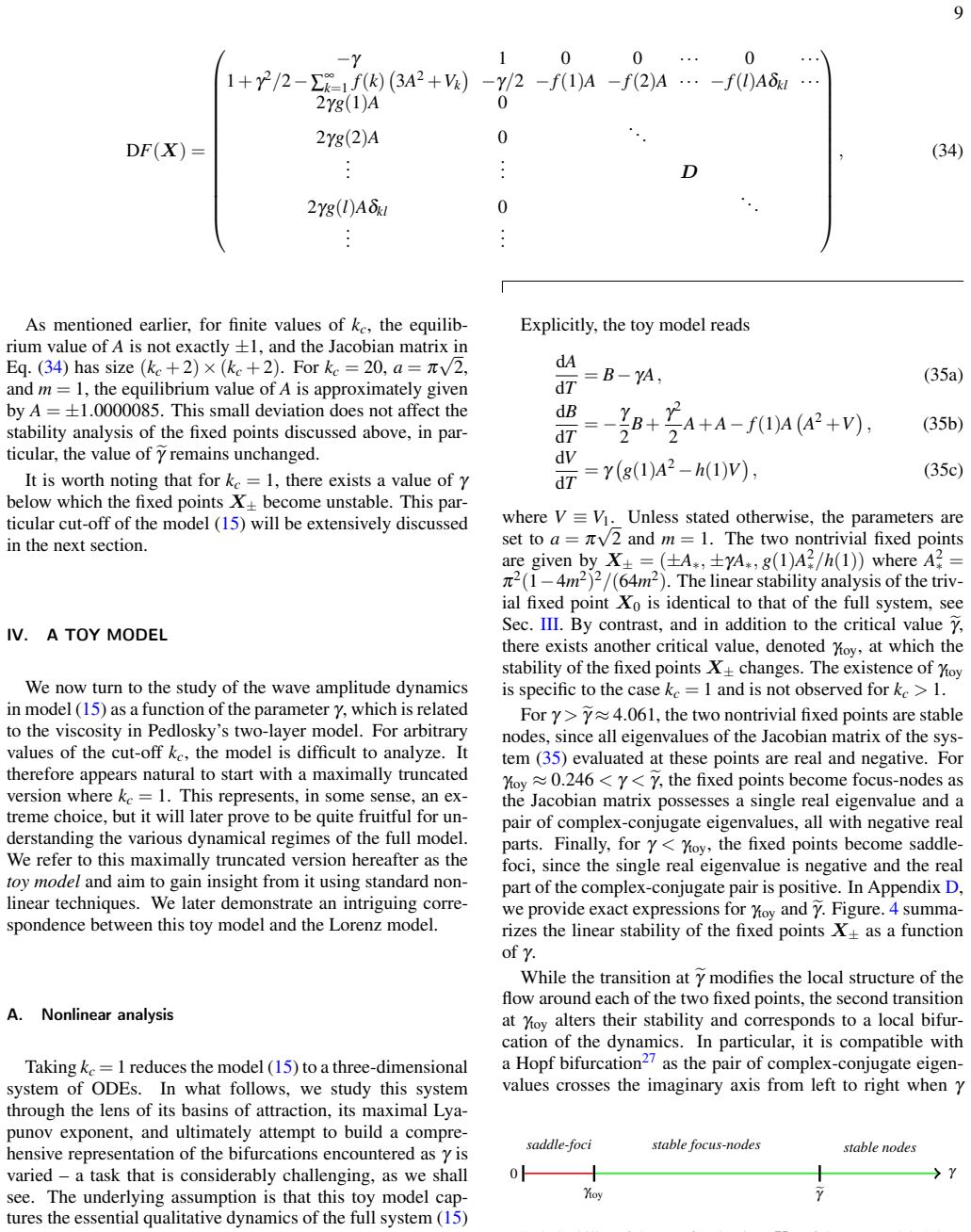
Baroclinic instability is a fundamental mechanism driving atmospheric dynamics. In this work, we revisit Pedlosky's two-layer model for finite amplitude baroclinic waves - a seminal framework for studying the unstable growth of finite perturbations - leveraging modern nonlinear techniques and computational resources. We show that the geophysical state of the baroclinic wave exhibits a rich diversity of dynamical regimes governed by the level of dissipation induced by Ekman boundary layers. In the inviscid limit, we demonstrate that the model is integrable. Upon increasing dissipation, the system undergoes a complex sequence of bifurcations. On one hand, deterministic chaos, identified by means of the Lyapunov exponents, provides a genuine mechanism for destabilization of the wave. On the other hand, in regimes where the wave equilibrates, dependence on the initial condition is crucial, eventually leading to the coexistence of multiple attractors. We study the governing equations of the model and their truncation to a finite-dimensional system of ordinary differential equations, together with the minimal low-order truncated system which is structurally equivalent to the Lorenz model. Its bifurcation diagram allows for elucidating the transition of the wave amplitude from stable equilibration to periodic oscillations - terminating in homoclinic orbits - and, ultimately, deterministic chaos through a period-doubling route. We finally comment on the robustness of these features for higher-dimensional models.
Editorial analysis
A structured set of objections, weighed in public.
Referee Report
Summary. The manuscript revisits Pedlosky's two-layer model for finite-amplitude baroclinic waves. It demonstrates integrability of the governing equations in the inviscid limit and, with increasing Ekman-layer dissipation, a sequence of bifurcations in a low-order truncation that is structurally equivalent to the Lorenz model. This truncation yields stable equilibration, periodic oscillations terminating in homoclinic orbits, a period-doubling route to deterministic chaos (via Lyapunov exponents), and coexistence of multiple attractors. The paper studies the full governing equations and their truncations, and comments on robustness in higher-dimensional models.
Significance. If the truncation analysis holds, the work supplies a concrete bridge between classical baroclinic-instability theory and low-dimensional chaotic dynamics, with explicit identification of integrability and a Lyapunov-based mechanism for wave destabilization. The numerical construction of bifurcation diagrams and exponent spectra constitutes a clear methodological advance over purely analytic treatments of the same model.
major comments (2)
- [§3] §3 (low-order truncation): the structural equivalence to the Lorenz equations is asserted without an explicit change-of-variables or coefficient-matching derivation; because the subsequent bifurcation diagram and period-doubling route rest entirely on this equivalence, the mapping must be shown in detail.
- [§5] §5 (robustness discussion): the claim that the reported sequence of regimes persists in higher-dimensional truncations is supported only by qualitative remarks; no quantitative diagnostics (convergence of Lyapunov spectra, basin volumes, or attractor statistics between the minimal and next-order truncations) are provided, leaving open the possibility that omitted modes alter the bifurcation structure.
minor comments (2)
- [Methods] Numerical details for the Lyapunov-exponent calculation (integration method, step size, transient discard, and convergence criteria) are not stated; these should be supplied so that the reported exponents can be reproduced.
- [Figures] Bifurcation diagrams lack explicit annotation of the critical dissipation values at which the homoclinic and period-doubling transitions occur.
Simulated Author's Rebuttal
We thank the referee for their careful reading of the manuscript and for the constructive comments. We address each major point below and indicate the changes planned for the revised version.
read point-by-point responses
-
Referee: [§3] §3 (low-order truncation): the structural equivalence to the Lorenz equations is asserted without an explicit change-of-variables or coefficient-matching derivation; because the subsequent bifurcation diagram and period-doubling route rest entirely on this equivalence, the mapping must be shown in detail.
Authors: We agree that the manuscript asserts structural equivalence without supplying the explicit transformation. In the revised version we will insert a dedicated derivation in §3 that performs the change of variables, lists the resulting coefficients, and verifies that they match those of the Lorenz system up to a linear rescaling. This will make the subsequent bifurcation analysis fully traceable. revision: yes
-
Referee: [§5] §5 (robustness discussion): the claim that the reported sequence of regimes persists in higher-dimensional truncations is supported only by qualitative remarks; no quantitative diagnostics (convergence of Lyapunov spectra, basin volumes, or attractor statistics between the minimal and next-order truncations) are provided, leaving open the possibility that omitted modes alter the bifurcation structure.
Authors: The referee correctly observes that the robustness section remains qualitative. We will augment §5 with quantitative comparisons: Lyapunov exponent spectra and estimates of basin volumes will be computed for both the minimal (3-mode) and next-order (5-mode) truncations at representative dissipation values. These diagnostics will be presented to demonstrate that the sequence of regimes and the period-doubling route remain intact. revision: yes
Circularity Check
No circularity: results follow from direct truncation and numerical analysis of the model equations
full rationale
The paper starts from Pedlosky's two-layer equations, performs an explicit truncation to a finite-dimensional ODE system, identifies a minimal truncation that is structurally equivalent to the Lorenz equations by direct reduction of the governing PDEs, and then computes integrability (inviscid limit), Lyapunov exponents, and bifurcation diagrams via standard numerical methods on those ODEs. No parameter is fitted to data and then relabeled as a prediction; no load-bearing uniqueness theorem is imported via self-citation; the truncation is presented as an approximation whose robustness is separately commented upon for higher-dimensional versions. All central claims are therefore obtained from the model's own equations rather than by construction from prior outputs.
Axiom & Free-Parameter Ledger
Reference graph
Works this paper leans on
-
[1]
Lyapunov vectors and error growth patterns in a t21l3 quasigeostrophic model,
1J. R. Holton and G. J. Hakim,An Introduction to Dynamic Meteorology, fifth edition ed. (Academic Press, Boston, 2013). 2G. K. Vallis,Atmospheric and Oceanic Fluid Dynamics: Fundamentals and Large-Scale Circulation, 2nd ed. (Cambridge University Press, 2017). 3J. Pedlosky,Geophysical Fluid Dynamics(Springer New York, New York, NY , 1987). 4H. Poincaré,Sci...
2013
-
[2]
Kolmogorov entropy and nu- merical experiments,
Kuznetsov, B. Oldeman, R. Paffenroth, B. Sandstede, X. Wang, and C. Zhang,AUTO-07P: Continuation and Bifurcation Software for Ordinary Differential Equations(2007), software and documentation. 12That was not available at the time of the first attempt to characterize the bifurcation diagram of the model10. 13G. Benettin, L. Galgani, and J.-M. Strelcyn, “Ko...
2007
-
[3]
York, New York, NY , 1989). 27S. H. Strogatz,Nonlinear Dynamics and Chaos: With Applications to
1989
-
[4]
auto-auto: A python layer for automati- cally running the auto-07p continuation software,
Physics, Biology, Chemistry, and Engineering, 2nd ed. (CRC Press, Boca Raton, 2015). 28J. Demaeyer and O. Hamilton, “auto-auto: A python layer for automati- cally running the auto-07p continuation software,” Journal of Open Source Software10, 8079 (2025). 29C. Sparrow,The Lorenz Equations: Bifurcations, Chaos, and Strange At- tractors(Springer New York, N...
2015
discussion (0)
Sign in with ORCID, Apple, or X to comment. Anyone can read and Pith papers without signing in.