Recognition: unknown
The Radial and Vertical Structure of Molecular Gas in the Edge-On Galaxy NGC 4565
Pith reviewed 2026-05-10 12:19 UTC · model grok-4.3
The pith
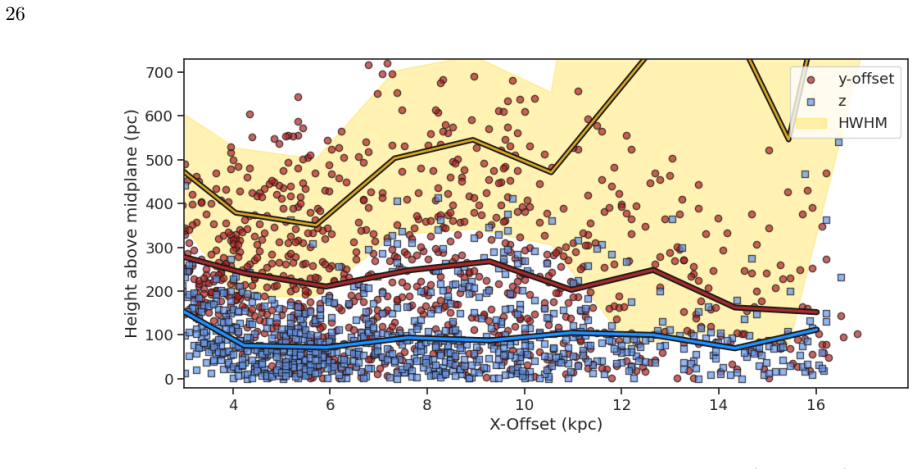
ALMA maps show the molecular gas disk in edge-on NGC 4565 stays thin with a constant 79 parsec scale height and little flaring.
A machine-rendered reading of the paper's core claim, the machinery that carries it, and where it could break.
Core claim
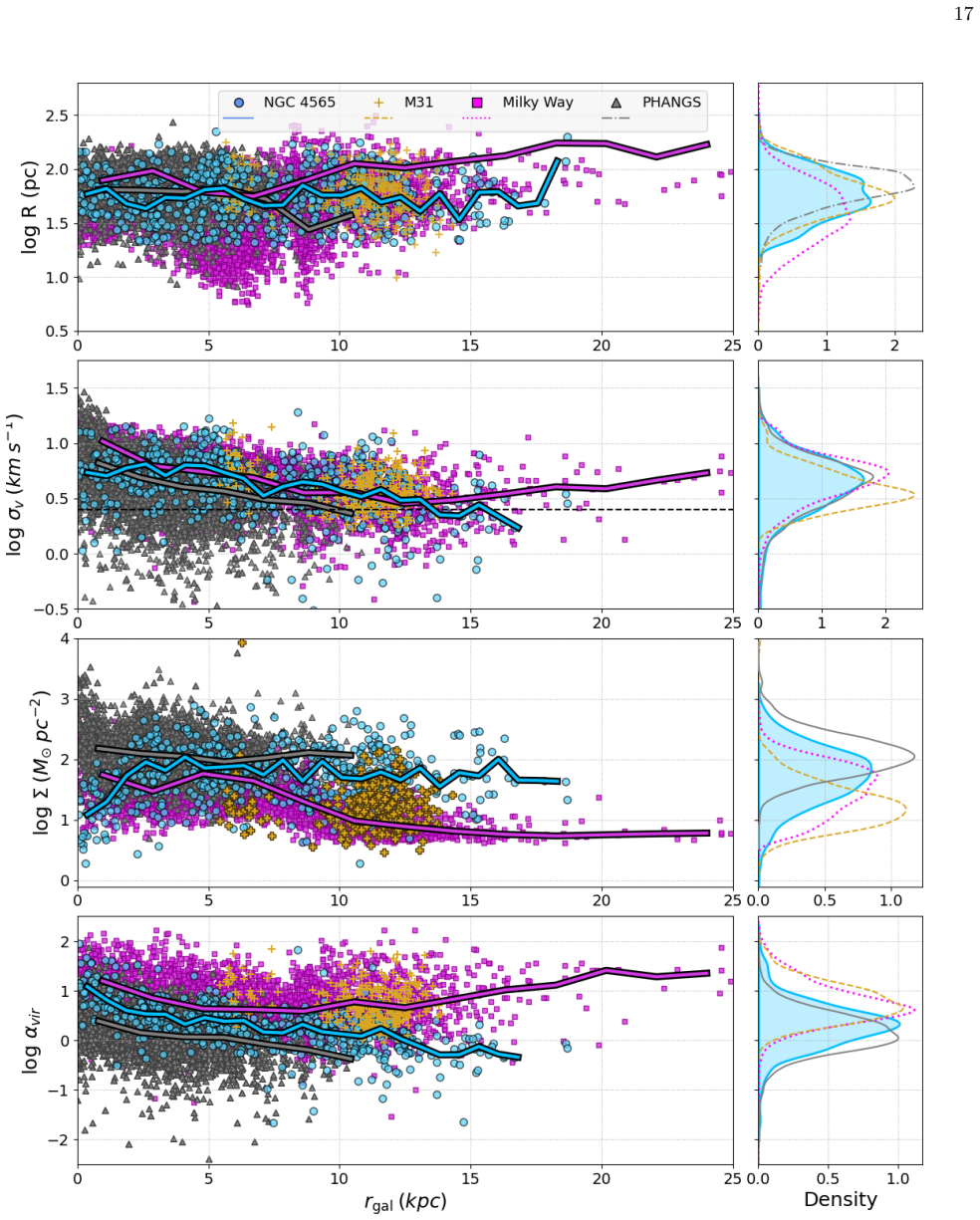
Fits to position-velocity slices of the CO(2-1) emission yield a molecular disk with FWHM scale height 79.1 ± 1.6 pc that shows little evidence for vertical flaring out to Rgal > 17 kpc. The 13CO/12CO intensity ratio stays steady at 0.086 ± 0.009 between 5 and 13 kpc, and individual molecular clouds display sizes, linewidths, and surface densities consistent with those in the PHANGS-ALMA sample and in M31. A prominent overdensity termed the East Ring Pileup contains a compact, bright star-forming region called the Jewel. Effects of the high inclination appear as second-order corrections that are strongest in the measured velocity dispersion, while the clouds themselves align with the disk.
What carries the argument
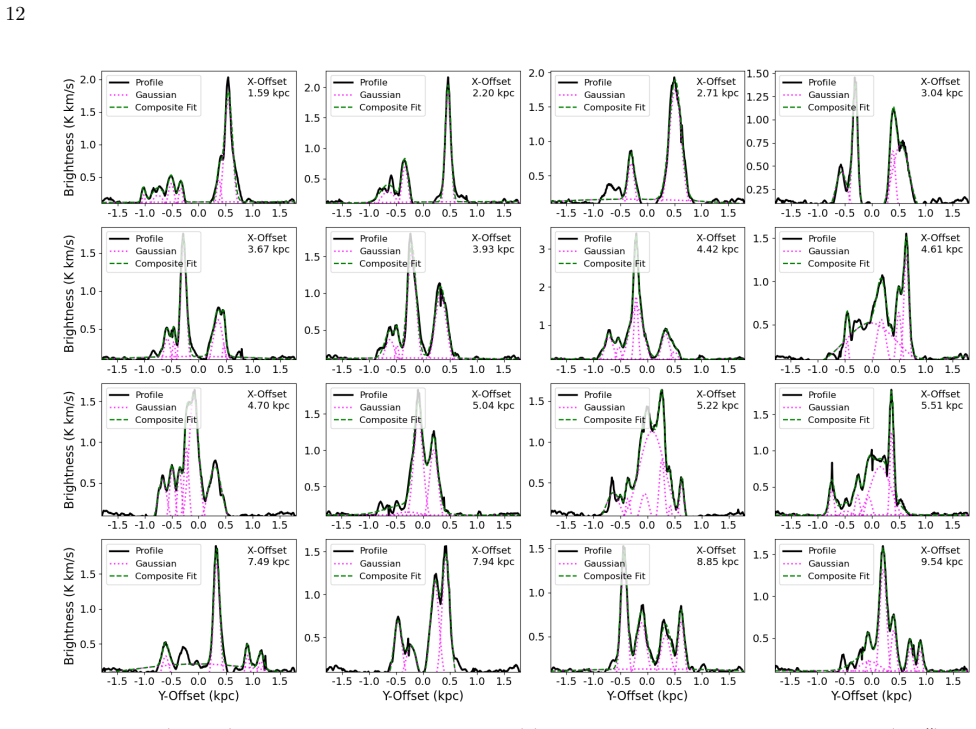
Vertical intensity profiles extracted from position-velocity slices of the CO(2-1) emission, which directly measure the thickness of the molecular layer.
If this is right
- The molecular gas layer remains vertically confined even where the atomic gas dominates the outer disk.
- Molecular cloud properties are largely insensitive to the edge-on viewing angle except for a modest boost in observed velocity dispersion.
- A central molecular gap and an outer gas overdensity produce a radial profile more like M31 than the Milky Way.
- Clouds align with the galactic plane and appear elongated along the line of nodes by a factor of about two.
Where Pith is reading between the lines
- Constant thinness may be a general feature of molecular disks in spirals, which would simplify vertical structure assumptions in galaxy evolution models.
- The Jewel complex offers a resolved laboratory for how gas overdensities trigger compact star formation within rings.
- High-resolution edge-on data such as these can be used to test and calibrate deprojection methods applied to face-on galaxy surveys.
Load-bearing premise
The adopted inclination of 87.5 degrees and the adopted conversion from CO line intensity to molecular gas mass introduce no large systematic offsets in the derived scale height or cloud properties.
What would settle it
An independent geometric measurement of the inclination or an alternate gas tracer that returns a vertical FWHM significantly larger than 80 pc or shows clear increase with radius.
Figures






read the original abstract
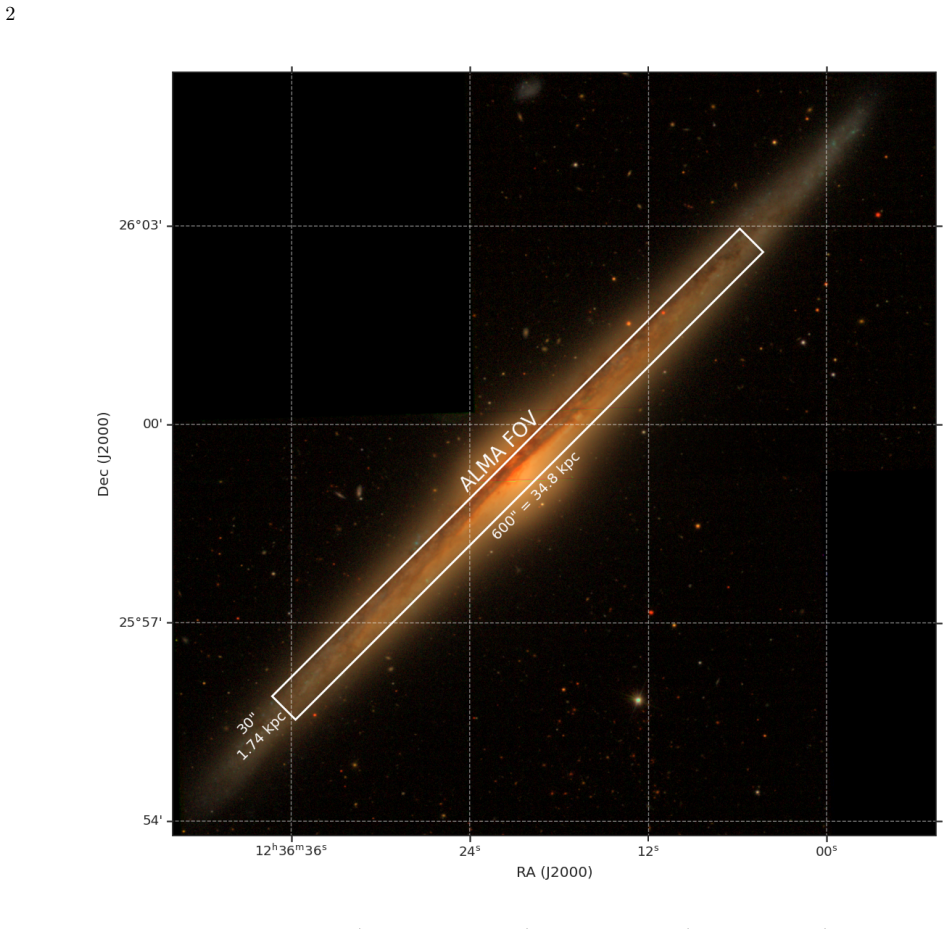
We present high-resolution (0.94" $\approx$ 55 pc) ALMA CO(2-1) and 13CO(2-1) observations of the highly inclined (i~87.5 deg) galaxy NGC 4565 covering out to galactocentric radius Rgal > $\pm$ 17 kpc. The combination of sensitivity and resolution enables the detection of CO emission well into the HI-dominated outer disk while isolating individual molecular clouds across the full extent of the galaxy. Although often described as an edge-on Milky Way analog, the molecular gas profile of NGC 4565 has a central gap which is more similar to M31. The 13CO/12CO ratio remains consistent at 0.086 $\pm$ 0.009 from Rgal = 5-13 kpc. Based on fits to position-velocity slices, the molecular disk remains thin, with a FWHM scale height of 79.1 $\pm$ 1.6 pc measured from the vertical intensity profile with little evidence for vertical flaring. Molecular clouds in NGC 4565 show sizes, linewidths, and surface densities consistent with those found in similar environments in PHANGS-ALMA galaxies and in M31. We identify a prominent star-forming complex on the ring-an overdensity of molecular gas we term the East Ring Pileup. This feature hosts a compact, multiwavelength-bright region, which we call the Jewel. Effects of galaxy inclination on molecular cloud radius, velocity dispersion, surface density, and virial parameter appear as second-order effects that are strongest in velocity dispersion. At this resolution, GMCs are preferentially aligned with the disk of the galaxy and horizontally elongated by a factor of~2.
Editorial analysis
A structured set of objections, weighed in public.
Referee Report
Summary. The paper reports high-resolution ALMA CO(2-1) and 13CO(2-1) observations of the edge-on galaxy NGC 4565 (i ≈ 87.5°), covering galactocentric radii out to >17 kpc at ~55 pc resolution. It finds a central molecular gas gap resembling M31, a constant 13CO/12CO intensity ratio of 0.086 ± 0.009 between 5–13 kpc, a thin molecular disk with FWHM scale height 79.1 ± 1.6 pc and little vertical flaring from vertical intensity profiles and PV-slice fits, GMC properties (sizes, linewidths, surface densities) consistent with PHANGS-ALMA and M31 samples, and identifies the East Ring Pileup and Jewel star-forming complex. Inclination effects on cloud parameters are described as second-order, with GMCs preferentially aligned and elongated along the disk.
Significance. If the thin-disk result and lack of flaring are robust, the work supplies a rare, resolved benchmark for molecular gas vertical structure in a highly inclined spiral, enabling direct comparison to the Milky Way and face-on systems. The consistency of cloud scaling relations across environments and the identification of outer-disk molecular gas strengthen constraints on disk stability and GMC formation models.
major comments (3)
- [§3.3] §3.3 (vertical intensity profile and scale-height measurement): The reported FWHM of 79.1 ± 1.6 pc is only ~1.4× the 0.94″ (~55 pc) beam; the text does not describe an explicit beam deconvolution step or forward-modeling of the observed profile, so the thinness and lack of flaring could partly reflect resolution rather than intrinsic structure.
- [§3.2] §3.2 (PV-slice fits for disk thickness): At i = 87.5°, the line of sight still integrates over ~1–2 kpc radially at large Rgal; the fitting procedure does not appear to marginalize over plausible inclination uncertainty (±0.5–1°), which would directly affect the deprojected scale height and the claim of no flaring.
- [§4] §4 (cloud property comparisons): The statement that inclination effects are “second-order” and strongest only in velocity dispersion is not accompanied by a quantitative test (e.g., mock observations at varying i); this weakens the assertion that the reported sizes, linewidths, and virial parameters are directly comparable to face-on samples.
minor comments (3)
- [§2] The abstract and §2 should state the exact method and assumptions used to convert 12CO intensity to H2 surface density, including any adopted X_CO value and its uncertainty.
- Figure captions for the vertical profiles and PV diagrams should explicitly note whether the displayed curves include beam convolution or are deconvolved.
- Add a short paragraph in the discussion comparing the derived 79 pc scale height to literature values for the Milky Way and other edge-on galaxies (e.g., NGC 891, NGC 5907).
Simulated Author's Rebuttal
We thank the referee for their careful and constructive review of our manuscript. We address each major comment in detail below and agree that several clarifications will strengthen the presentation of our results on the vertical structure and cloud properties. We will revise the manuscript accordingly.
read point-by-point responses
-
Referee: [§3.3] §3.3 (vertical intensity profile and scale-height measurement): The reported FWHM of 79.1 ± 1.6 pc is only ~1.4× the 0.94″ (~55 pc) beam; the text does not describe an explicit beam deconvolution step or forward-modeling of the observed profile, so the thinness and lack of flaring could partly reflect resolution rather than intrinsic structure.
Authors: We acknowledge that the reported scale height is comparable to the beam size and that the manuscript would benefit from an explicit description of how the beam was accounted for. The vertical intensity profiles were extracted from the primary beam corrected data cube and fitted with Gaussians after subtracting the contribution from the synthesized beam in quadrature for the reported FWHM. To address the concern directly, we will add a dedicated paragraph in §3.3 describing this procedure and include a simple forward-modeling test (convolving model thin disks of varying intrinsic heights with the beam and comparing to the data) to demonstrate that the lack of flaring is not an artifact of resolution. These changes will be incorporated in the revised version. revision: yes
-
Referee: [§3.2] §3.2 (PV-slice fits for disk thickness): At i = 87.5°, the line of sight still integrates over ~1–2 kpc radially at large Rgal; the fitting procedure does not appear to marginalize over plausible inclination uncertainty (±0.5–1°), which would directly affect the deprojected scale height and the claim of no flaring.
Authors: The PV-slice analysis in §3.2 used the nominal inclination of 87.5° derived from the HI kinematics. At such high inclination the deprojected height is relatively insensitive to small changes in i, but we agree that explicitly testing the effect of the quoted uncertainty is warranted. In the revision we will add a short sensitivity analysis in which we repeat the fits at i = 87.0° and 88.0° and show that the conclusion of little vertical flaring remains unchanged. We will also note the approximate radial integration length along the line of sight at large Rgal for context. revision: yes
-
Referee: [§4] §4 (cloud property comparisons): The statement that inclination effects are “second-order” and strongest only in velocity dispersion is not accompanied by a quantitative test (e.g., mock observations at varying i); this weakens the assertion that the reported sizes, linewidths, and virial parameters are directly comparable to face-on samples.
Authors: Our statement that inclination effects are second-order is based on the clear horizontal elongation of GMCs seen in the data and on the fact that the derived sizes, linewidths, and surface densities remain consistent with PHANGS-ALMA and M31 samples despite the high inclination. We agree that a quantitative mock-observation test would provide stronger support. Performing a full suite of mocks is beyond the scope of the present work, but we will expand the discussion in §4 to include a simple geometric projection model that quantifies the expected bias in radius and velocity dispersion as a function of inclination, and we will cite relevant literature on projection effects in edge-on systems. This will be added as a partial revision. revision: partial
Circularity Check
No significant circularity: purely observational measurements from direct fits
full rationale
The central result (FWHM scale height 79.1 ± 1.6 pc, no flaring) is obtained by fitting observed vertical intensity profiles and position-velocity slices extracted from the ALMA CO data cubes. All reported quantities (cloud sizes, linewidths, surface densities, 13CO/12CO ratio) are likewise measured directly from the data with explicit assumptions about inclination (87.5°) and X_CO conversion. No theoretical derivation, self-referential equation, or load-bearing self-citation is invoked to obtain these values; the paper contains no predictions that reduce to its own inputs by construction. The derivation chain is therefore self-contained against external benchmarks.
Axiom & Free-Parameter Ledger
axioms (2)
- domain assumption CO(2-1) emission traces molecular hydrogen with a standard conversion factor
- domain assumption The galaxy inclination is 87.5 degrees
Reference graph
Works this paper leans on
-
[1]
Abolfathi, B., Aguado, D. S., Aguilar, G., et al. 2018, ApJS, 235, 42, doi: 10.3847/1538-4365/aa9e8a
-
[2]
Athanassoula, E. 1992, MNRAS, 259, 345, doi: 10.1093/mnras/259.2.345
-
[3]
Barnes, J. E., & Hernquist, L. 1996, ApJ, 471, 115, doi: 10.1086/177957
-
[4]
Belfiore, F., Leroy, A. K., Williams, T. G., et al. 2023, A&A, 678, A129, doi: 10.1051/0004-6361/202347175
-
[5]
Bendo, G. J., Galliano, F., & Madden, S. C. 2012, MNRAS, 423, 197, doi: 10.1111/j.1365-2966.2012.20784.x
-
[6]
L., Bournaud, F., Combes, F., et al
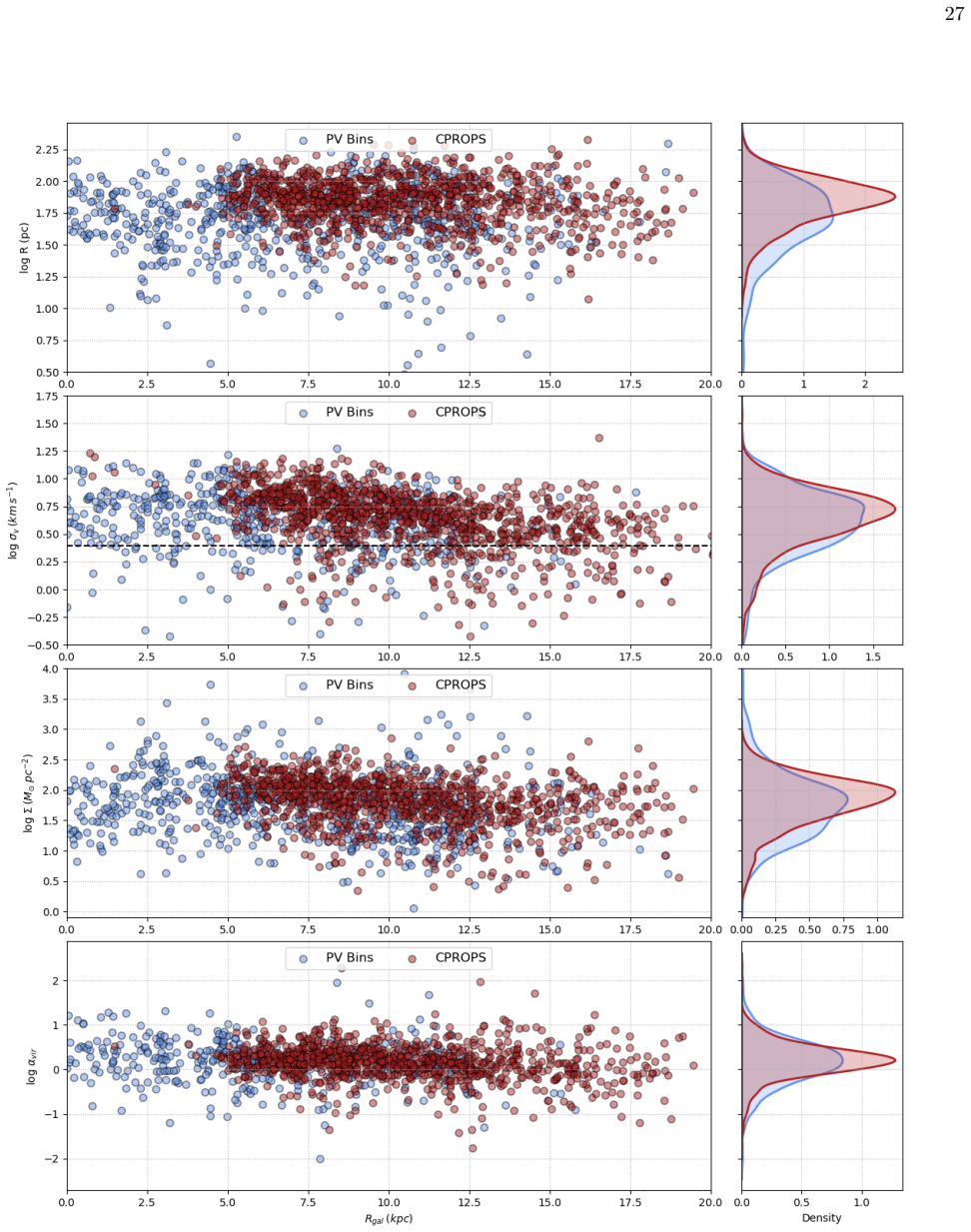
Block, D. L., Bournaud, F., Combes, F., et al. 2006, Nature, 443, 832, doi: 10.1038/nature05184 27 Figure 16.Distributions of GMC properties as a function of galactocentric radius comparing the multi-gaussian decomposition method to theCPROPSalgorithm. 28
-
[7]
and Wolfire, Mark and Leroy, Adam K
Bolatto, A. D., Wolfire, M., & Leroy, A. K. 2013, ARA&A, 51, 207, doi: 10.1146/annurev-astro-082812-140944
work page Pith review doi:10.1146/annurev-astro-082812-140944 2013
-
[8]
D., Wong, T., Utomo, D., et al
Bolatto, A. D., Wong, T., Utomo, D., et al. 2017, ApJ, 846, 159, doi: 10.3847/1538-4357/aa86aa
-
[9]
1988, ApJ, 324, 248, doi: 10.1086/165892
Thaddeus, P. 1988, ApJ, 324, 248, doi: 10.1086/165892
-
[10]
Brown, T., Wilson, C. D., Zabel, N., et al. 2021, ApJS, 257, 21, doi: 10.3847/1538-4365/ac28f5
-
[11]
J., Natarajan, P., Baldassare, V
Burke, C. J., Natarajan, P., Baldassare, V. F., & Geha, M. 2025, ApJ, 978, 77, doi: 10.3847/1538-4357/ad94d9
-
[12]
Burton, W. B., Gordon, M. A., Bania, T. M., & Lockman, F. J. 1975, ApJ, 202, 30, doi: 10.1086/153950
-
[13]
1996, FCPh, 17, 95 Cald´ u-Primo, A., & Schruba, A
Buta, R., & Combes, F. 1996, FCPh, 17, 95 Cald´ u-Primo, A., & Schruba, A. 2016, AJ, 151, 34, doi: 10.3847/0004-6256/151/2/34 CASA Team, Bean, B., Bhatnagar, S., et al. 2022, PASP, 134, 114501, doi: 10.1088/1538-3873/ac9642
-
[14]
2024, A&A, 690, A348, doi: 10.1051/0004-6361/202451033
Chastenet, J., De Looze, I., Rela˜ no, M., et al. 2024, A&A, 690, A348, doi: 10.1051/0004-6361/202451033
-
[15]
2025, MNRAS, 536, 2392, doi: 10.1093/mnras/stae2697
Chiang, I.-D., Hirashita, H., Chastenet, J., et al. 2025, MNRAS, 536, 2392, doi: 10.1093/mnras/stae2697
-
[16]
Chung, A., van Gorkom, J. H., Kenney, J. D. P., Crowl, H., & Vollmer, B. 2009, AJ, 138, 1741, doi: 10.1088/0004-6256/138/6/1741
-
[17]
Clemens, D. P., Sanders, D. B., & Scoville, N. Z. 1988, ApJ, 327, 139, doi: 10.1086/166177
-
[18]
Cormier, D., Bigiel, F., Jim´ enez-Donaire, M. J., et al. 2018, MNRAS, 475, 3909, doi: 10.1093/mnras/sty059
-
[19]
Dame, T. M., & Thaddeus, P. 1985, ApJ, 297, 751, doi: 10.1086/163573 den Brok, J. S., Chatzigiannakis, D., Bigiel, F., et al. 2021, MNRAS, 504, 3221, doi: 10.1093/mnras/stab859
-
[20]
Draine, B. T. 2011, Physics of the Interstellar and Intergalactic Medium (Princeton University Press)
2011
-
[21]
2024, A&A, 691, A163, doi: 10.1051/0004-6361/202449944
Eibensteiner, C., Sun, J., Bigiel, F., et al. 2024, A&A, 691, A163, doi: 10.1051/0004-6361/202449944
-
[22]
Elmegreen, B. G. 1989, ApJ, 338, 178, doi: 10.1086/167192
-
[23]
Federrath, C., & Klessen, R. S. 2012, ApJ, 761, 156, doi: 10.1088/0004-637X/761/2/156
-
[24]
, archivePrefix = "arXiv", eprint =
Field, G. B., Blackman, E. G., & Keto, E. R. 2011, MNRAS, 416, 710, doi: 10.1111/j.1365-2966.2011.19091.x
-
[25]
Finn, M. K., Johnson, K. E., Brogan, C. L., et al. 2019, ApJ, 874, 120, doi: 10.3847/1538-4357/ab0d1e
-
[26]
Fraser-McKelvie, A., van de Sande, J., Gadotti, D. A., et al. 2025, A&A, 700, A237, doi: 10.1051/0004-6361/202452891
-
[27]
F., Heyer , M., Narayanan , G., et al
Goldsmith, P. F., Heyer, M., Narayanan, G., et al. 2008, ApJ, 680, 428, doi: 10.1086/587166
-
[28]
Harmsen, B., Monachesi, A., Bell, E. F., et al. 2017, MNRAS, 466, 1491, doi: 10.1093/mnras/stw2992
-
[29]
2011, A&A, 526, A118, doi: 10.1051/0004-6361/201015938 —
Heald, G., J´ ozsa, G., Serra, P., et al. 2011, A&A, 526, A118, doi: 10.1051/0004-6361/201015938 —. 2012, A&A, C1, doi: 10.1051/0004-6361/201015938e
-
[30]
N., Pety, J., Hughes, A., et al
Herrera, C. N., Pety, J., Hughes, A., et al. 2020, A&A, 634, A121, doi: 10.1051/0004-6361/201936060
-
[31]
Heyer, M., & Dame, T. M. 2015, ARA&A, 53, 583, doi: 10.1146/annurev-astro-082214-122324
-
[32]
Heyer, M., Krawczyk, C., Duval, J., & Jackson, J. M. 2009, ApJ, 699, 1092, doi: 10.1088/0004-637X/699/2/1092
-
[33]
Hughes, A., Meidt, S. E., Colombo, D., et al. 2013, ApJ, 779, 46, doi: 10.1088/0004-637X/779/1/46
-
[34]
Hunter, T. R., Indebetouw, R., Brogan, C. L., et al. 2023, PASP, 135, 074501, doi: 10.1088/1538-3873/ace216
-
[35]
Koch, E. W., Leroy, A. K., Rosolowsky, E. W., et al. 2025, ApJS, 279, 35, doi: 10.3847/1538-4365/ade0ad
-
[36]
2019, ApJ, 872, 106, doi: 10.3847/1538-4357/aafdff
Kormendy, J., & Bender, R. 2019, ApJ, 872, 106, doi: 10.3847/1538-4357/aafdff
-
[37]
Krahm, G., Finn, M. K., Indebetouw, R., et al. 2024, ApJ, 964, 166, doi: 10.3847/1538-4357/ad2451
-
[38]
Krumholz, M. R. 2017, Star Formation (World Scientific Publishing), doi: 10.1142/10091
-
[39]
Krumholz, M. R., & McKee, C. F. 2005, ApJ, 630, 250, doi: 10.1086/431734
-
[40]
Langer, W. D., & Penzias, A. A. 1990, ApJ, 357, 477, doi: 10.1086/168935
-
[41]
K., Walter, F., Bigiel, F., et al
Leroy, A. K., Walter, F., Bigiel, F., et al. 2009, AJ, 137, 4670, doi: 10.1088/0004-6256/137/6/4670
-
[42]
Leroy, A. K., Hughes, A., Schruba, A., et al. 2016, ApJ, 831, 16, doi: 10.3847/0004-637X/831/1/16
-
[43]
Leroy, A. K., Sandstrom, K. M., Lang, D., et al. 2019, ApJS, 244, 24, doi: 10.3847/1538-4365/ab3925
-
[44]
K., Hughes, A., Liu, D., et al
Leroy, A. K., Hughes, A., Liu, D., et al. 2021a, ApJS, 255, 19, doi: 10.3847/1538-4365/abec80
-
[45]
K., Schinnerer, E., Hughes, A., et al
Leroy, A. K., Schinnerer, E., Hughes, A., et al. 2021b, ApJS, 257, 43, doi: 10.3847/1538-4365/ac17f3
-
[46]
K., Sandstrom, K., Rosolowsky, E., et al
Leroy, A. K., Sandstrom, K., Rosolowsky, E., et al. 2023, ApJL, 944, L9, doi: 10.3847/2041-8213/acaf85
-
[47]
Leung, H. W., Bovy, J., Mackereth, J. T., et al. 2023, MNRAS, 519, 948, doi: 10.1093/mnras/stac3529
-
[48]
2025, ApJ, 990, L37, doi:10.3847/2041-8213/adfc73
Lian, J., Wang, T., Feng, Q., Huang, Y., & Guo, H. 2025, ApJL, 990, L37, doi: 10.3847/2041-8213/adfc73
-
[49]
Lucy, L. B. 1974, AJ, 79, 745, doi: 10.1086/111605
-
[50]
2024, A&A, 690, A372, doi: 10.1051/0004-6361/202451412 Mac Low, M.-M., Elitzur, M., Stone, J
Luo, G., Colzi, L., Liu, T., et al. 2024, A&A, 690, A372, doi: 10.1051/0004-6361/202451412
-
[51]
McKee, C. F., & Ostriker, E. C. 2007, ARA&A, 45, 565, doi: 10.1146/annurev.astro.45.051806.110602
-
[52]
Wyckoff, S. 2005, ApJ, 634, 1126, doi: 10.1086/497123 29 Miville-Deschˆ enes, M.-A., Murray, N., & Lee, E. J. 2017, ApJ, 834, 57, doi: 10.3847/1538-4357/834/1/57
-
[53]
2006, PASJ, 58, 847, doi: 10.1093/pasj/58.5.847
Nakanishi, H., & Sofue, Y. 2006, PASJ, 58, 847, doi: 10.1093/pasj/58.5.847
-
[54]
Neufeld, D. A., Lepp, S., & Melnick, G. J. 1995, ApJS, 100, 132, doi: 10.1086/192211
-
[55]
2006, A&A, 453, 459, doi: 10.1051/0004-6361:20035672
Nieten, C., Neininger, N., Gu´ elin, M., et al. 2006, A&A, 453, 459, doi: 10.1051/0004-6361:20035672
-
[56]
Olling, R. P. 1996, AJ, 112, 457, doi: 10.1086/118028
-
[57]
Ostriker, E. C., & Kim, C.-G. 2022, ApJ, 936, 137, doi: 10.3847/1538-4357/ac7de2
-
[58]
Pathak, D., Leroy, A. K., Thompson, T. A., et al. 2024, AJ, 167, 39, doi: 10.3847/1538-3881/ad110d
-
[59]
Peltonen, J., Rosolowsky, E., Johnson, L. C., et al. 2023, MNRAS, 522, 6137, doi: 10.1093/mnras/stad1430
-
[60]
Pineda, J. E., Rosolowsky, E. W., & Goodman, A. A. 2009, ApJL, 699, L134, doi: 10.1088/0004-637X/699/2/L134
-
[61]
Richardson, W. H. 1972, Journal of the Optical Society of America (1917-1983), 62, 55 Rodr´ ıguez, M. J., Lee, J. C., Indebetouw, R., et al. 2025, ApJ, 983, 137, doi: 10.3847/1538-4357/adbb69
-
[62]
Roman-Duval, J., Heyer, M., Brunt, C. M., et al. 2016, ApJ, 818, 144, doi: 10.3847/0004-637X/818/2/144
-
[63]
2006, PASP, 118, 590, doi: 10.1086/502982
Rosolowsky, E., & Leroy, A. 2006, PASP, 118, 590, doi: 10.1086/502982
-
[65]
Rosolowsky, E., Hughes, A., Leroy, A. K., et al. 2021, MNRAS, 502, 1218, doi: 10.1093/mnras/stab085 S´ anchez, S. F., Barrera-Ballesteros, J. K., S´ anchez-Menguiano, L., et al. 2017, MNRAS, 469, 2121, doi: 10.1093/mnras/stx808
-
[66]
Schinnerer, E., & Leroy, A. K. 2024, ARA&A, 62, 369, doi: 10.1146/annurev-astro-071221-052651
-
[67]
2019, A&A, 632, A12, doi: 10.1051/0004-6361/201834995
Schmidt, P., Krause, M., Heesen, V., et al. 2019, A&A, 632, A12, doi: 10.1051/0004-6361/201834995
-
[68]
Schneider, F. R. N., Sana, H., Evans, C. J., et al. 2018, Science, 359, 69, doi: 10.1126/science.aan0106
-
[69]
Schruba, A., Kruijssen, J. M. D., & Leroy, A. K. 2019, ApJ, 883, 2, doi: 10.3847/1538-4357/ab3a43
-
[70]
Scoville, N. Z., & Solomon, P. M. 1975, ApJL, 199, L105, doi: 10.1086/181859
-
[71]
2013, ApJ, 769, 100, doi: 10.1088/0004-637X/769/2/100
Seo, W.-Y., & Kim, W.-T. 2013, ApJ, 769, 100, doi: 10.1088/0004-637X/769/2/100
-
[72]
Sheth, K., Regan, M., Hinz, J. L., et al. 2010, PASP, 122, 1397, doi: 10.1086/657638
-
[73]
C., Heesen, V., Br¨ uggen, M., et al
Smolinski, D. C., Heesen, V., Br¨ uggen, M., et al. 2026, A&A, 706, A374, doi: 10.1051/0004-6361/202557531 S¨ oding, L., Edenhofer, G., Enßlin, T. A., et al. 2024, arXiv e-prints, arXiv:2407.02859, doi: 10.48550/arXiv.2407.02859
-
[74]
Solomon, P. M., Rivolo, A. R., Barrett, J., & Yahil, A. 1987, ApJ, 319, 730, doi: 10.1086/165493
-
[75]
Sormani, M. C., Barnes, A. T., Sun, J., et al. 2023, MNRAS, 523, 2918, doi: 10.1093/mnras/stad1554
-
[76]
and Schruba, Andreas and Rosolowsky, Erik and Hughes, Annie and Kruijssen, J
Sun, J., Leroy, A. K., Schruba, A., et al. 2018, ApJ, 860, 172, doi: 10.3847/1538-4357/aac326
-
[77]
Sun, J., Leroy, A. K., Schinnerer, E., et al. 2020a, ApJL, 901, L8, doi: 10.3847/2041-8213/abb3be
-
[78]
Sun, J., Leroy, A. K., Ostriker, E. C., et al. 2020b, ApJ, 892, 148, doi: 10.3847/1538-4357/ab781c
-
[79]
Sun, J., Leroy, A. K., Rosolowsky, E., et al. 2022, AJ, 164, 43, doi: 10.3847/1538-3881/ac74bd
-
[80]
Sun, J., Teng, Y.-H., Chiang, I.-D., et al. 2025, arXiv e-prints, arXiv:2510.05214, doi: 10.48550/arXiv.2510.05214 van de Sande, J., Fraser-McKelvie, A., Fisher, D. B., et al. 2024, in IAU Symposium, Vol. 377, Early Disk-Galaxy Formation from JWST to the Milky Way, ed. F. Tabatabaei, B. Barbuy, & Y.-S. Ting, 27–33, doi: 10.1017/S1743921323001138
-
[81]
Walter, F., Brinks, E., de Blok, W. J. G., et al. 2008, AJ, 136, 2563, doi: 10.1088/0004-6256/136/6/2563
discussion (0)
Sign in with ORCID, Apple, or X to comment. Anyone can read and Pith papers without signing in.