Recognition: unknown
Quantum matter is weakly entangled at low energies
Pith reviewed 2026-05-10 11:44 UTC · model grok-4.3
The pith
Quantum states with fixed low energy under local Hamiltonians have bounded half-system entanglement entropies.
A machine-rendered reading of the paper's core claim, the machinery that carries it, and where it could break.
Core claim
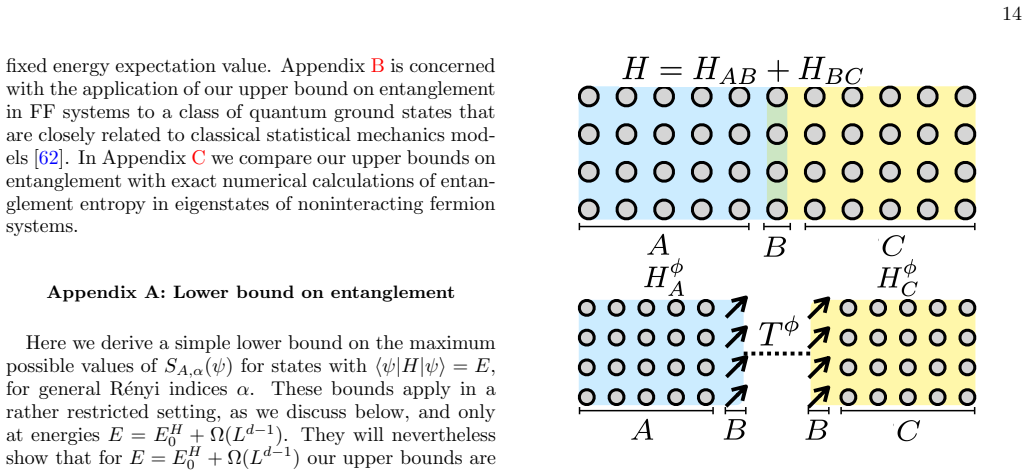
For a quantum state whose energy expectation value is fixed with respect to a geometrically local Hamiltonian, the von Neumann entanglement entropy of a half-system is upper-bounded by half the sum of the thermal entropies of two fictitious systems at equal temperature, with the temperature fixed by matching the sum of the fictitious thermal energies to the original energy constraint; an additional area-law contribution appears in some systems. Analogous bounds hold for Rényi entropies. These upper bounds on half-system entanglement entropies are optimal, up to subleading corrections, in wide varieties of systems.
What carries the argument
Mapping of the fixed-energy constraint to thermal ensembles of two fictitious subsystems at equal temperature whose combined energy matches the constraint.
If this is right
- Ground-state Schmidt ranks in frustration-free systems are upper-bounded by the ground-state degeneracies of Hamiltonians acting on subsystems.
- Ground-state von Neumann and Rényi entanglement entropies follow an area law whenever the zero-temperature thermal entropies of subsystems scale with surface area rather than volume, independently of the spectral gap.
- Thermodynamic quantities such as specific heat capacities can be converted into constraints on pure-state entanglement at both subextensive and extensive energies.
- Half-system entanglement entropies are optimal up to subleading corrections in wide varieties of systems.
Where Pith is reading between the lines
- Low-energy quantum matter is therefore only weakly entangled across spatial cuts in a broad class of models.
- Calorimetric measurements of specific heat could be translated into quantitative upper limits on entanglement in quantum simulators or materials.
- The fictitious-subsystem construction may be adaptable to time-dependent or open quantum systems that preserve locality.
Load-bearing premise
The Hamiltonian is geometrically local, allowing the energy constraint to be mapped onto thermal states of fictitious subsystems.
What would settle it
A counterexample would be any geometrically local Hamiltonian together with a pure state of subextensive energy whose half-system von Neumann entanglement entropy exceeds half the sum of the thermal entropies of the two fictitious systems at the temperature that reproduces the energy constraint.
Figures



read the original abstract
We construct upper bounds on entanglement entropies of many-body quantum states that have fixed energy expectation values with respect to geometrically local Hamiltonians. Our focus is on entanglement entropies of subsystems that make up approximately half of the full system. The upper bound on the von Neumann entanglement entropy is half the sum of the thermal entropies of two fictitious systems at the same temperature as one another, with an additional area-law contribution in some systems. The effective temperature is chosen such that the sum of the thermal energies of the two fictitious systems matches the constraint on the energy of the state in the original problem; at subextensive energies, this temperature decreases with increasing system size. Our upper bounds on R\'{e}nyi entanglement entropies take an analogous form. As a first application we show that ground-state Schmidt ranks in frustration-free (FF) systems are upper bounded by the ground-state degeneracies of Hamiltonians acting on subsystems. Ground-state von Neumann and R\'{e}nyi entanglement entropies therefore follow an area law when the zero-temperature thermal entropies of subsystems scale with surface areas, rather than with subsystem volumes. This result holds independently of the spectral gap. For physical models of quantum matter, which have well-defined specific heat capacities (and are not necessarily FF), our bounds provide a way to convert this thermodynamic data into constraints on pure-state entanglement at both subextensive and extensive energies. We also show that our upper bounds on half-system entanglement entropies are optimal, up to subleading corrections, in wide varieties of systems. Our results relate physical thermodynamic properties to the structure of many-body Hilbert space at low energies.
Editorial analysis
A structured set of objections, weighed in public.
Referee Report
Summary. The paper constructs upper bounds on von Neumann and Rényi entanglement entropies of many-body states with fixed energy expectation value under geometrically local Hamiltonians. For subsystems comprising roughly half the system, the bound is half the sum of the thermal entropies of two fictitious subsystems at the same effective temperature (chosen so their energies sum to the target energy), plus an area-law term in some cases. The effective temperature decreases with system size at subextensive energies. Applications include bounding ground-state Schmidt ranks in frustration-free (FF) systems by subsystem ground-state degeneracies (yielding area laws when subsystem thermal entropies scale with area, independent of gap) and converting specific-heat data into entanglement constraints for general models with well-defined thermodynamics. The bounds are asserted to be optimal up to subleading corrections in wide classes of systems.
Significance. If the derivations hold, the result supplies a rigorous, locality-based link between thermodynamic quantities (specific heat, low-energy density of states) and entanglement structure, showing that fixed-energy states cannot be more entangled than thermal states of fictitious subsystems. The FF application is notable for producing gap-independent area laws from degeneracy bounds alone. The optimality claims, if substantiated with explicit examples, would indicate the bounds are tight rather than loose. The work provides a concrete method to translate measurable thermodynamic data into Hilbert-space constraints at low energies without requiring full diagonalization.
major comments (2)
- [§3, main theorem] The central mapping from the energy constraint to the sum of two fictitious thermal energies (abstract and §3) assumes geometric locality to justify the fictitious-system construction; while the assumption is stated explicitly, the precise locality range (e.g., finite-range vs. power-law) under which the bound remains rigorous should be stated in the main theorem to avoid ambiguity for long-range models.
- [abstract and §5] The optimality claim (abstract: 'optimal, up to subleading corrections, in wide varieties of systems') is load-bearing for the paper's title and conclusions, yet the provided text does not exhibit the explicit examples or scaling arguments that establish tightness; if these appear only in supplementary material or later sections, they should be summarized with concrete models (e.g., 1D Ising, 2D toric code) and the subleading term quantified.
minor comments (2)
- [§2] Notation for the effective temperature and the two fictitious systems should be introduced with a single equation that makes the matching condition E_1(T) + E_2(T) = E_target explicit, rather than described only in prose.
- [abstract and §4] The area-law contribution is mentioned as 'additional in some systems'; a brief statement of the precise condition (e.g., when the fictitious thermal states obey area-law entanglement) would improve readability.
Simulated Author's Rebuttal
We thank the referee for their careful reading, positive assessment, and recommendation for minor revision. We address the two major comments point by point below.
read point-by-point responses
-
Referee: [§3, main theorem] The central mapping from the energy constraint to the sum of two fictitious thermal energies (abstract and §3) assumes geometric locality to justify the fictitious-system construction; while the assumption is stated explicitly, the precise locality range (e.g., finite-range vs. power-law) under which the bound remains rigorous should be stated in the main theorem to avoid ambiguity for long-range models.
Authors: We agree that explicitly specifying the locality range in the main theorem statement will remove any potential ambiguity. The proof in §3 relies on the Hamiltonian being geometrically local with finite range (each interaction term supported on a bounded number of sites within a fixed distance independent of system size). In the revised manuscript we will add this precise condition to the statement of the main theorem and note that the bound does not necessarily extend to long-range interactions with power-law decay slower than a certain threshold. revision: yes
-
Referee: [abstract and §5] The optimality claim (abstract: 'optimal, up to subleading corrections, in wide varieties of systems') is load-bearing for the paper's title and conclusions, yet the provided text does not exhibit the explicit examples or scaling arguments that establish tightness; if these appear only in supplementary material or later sections, they should be summarized with concrete models (e.g., 1D Ising, 2D toric code) and the subleading term quantified.
Authors: Section 5 already contains the explicit constructions establishing optimality up to subleading corrections, including the 1D transverse-field Ising model (where the bound is saturated up to O(log L) corrections for the von Neumann entropy) and the 2D toric code (saturated up to an area-law term). We will add a short summary paragraph at the end of the introduction (and a parenthetical remark in the abstract) that quantifies these subleading terms and cites the concrete models, to make the tightness argument more immediately visible without altering the existing §5 content. revision: partial
Circularity Check
No significant circularity; bounds derived directly from locality and energy constraint
full rationale
The derivation constructs upper bounds on half-system entanglement entropy by mapping a fixed-energy constraint for a geometrically local Hamiltonian onto the thermal entropies of two fictitious subsystems whose energies sum to the target value, with temperature defined by that matching condition. This mapping is explicitly conditioned on geometric locality (a stated premise) and produces the bound (half the sum of thermal entropies plus possible area-law term) by standard thermodynamic inequalities without any reduction to fitted parameters, self-citations, or renamed inputs. Optimality up to subleading corrections is asserted via explicit constructions in wide classes of systems (including FF models and those with finite specific heat), which are independent of the bound itself. No load-bearing step collapses by definition or self-citation chain; the argument is self-contained against external thermodynamic benchmarks.
Axiom & Free-Parameter Ledger
axioms (2)
- domain assumption Hamiltonians are geometrically local
- domain assumption Thermal states exist for the fictitious subsystems at the effective temperature
invented entities (1)
-
two fictitious systems at the same effective temperature
no independent evidence
Reference graph
Works this paper leans on
-
[1]
describes spin-one degrees of freedom (qutrits) with nearest-neighbor interactions in one spatial dimension, and withperiodicboundary conditions its ground state is unique. The full Hamiltonian is H= L−1X j=0 ΠAKLT j,j+1 ,(29) where Πj,j+1 is a projector into the spin-two subspace of two adjacent spin-one degrees of freedom, here indexed byjandj+ 1, with ...
-
[2]
Gapped phases arise in wide var- ities of physical settings, and are characterized by the exponential decay of correlations between local observ- ables [50]
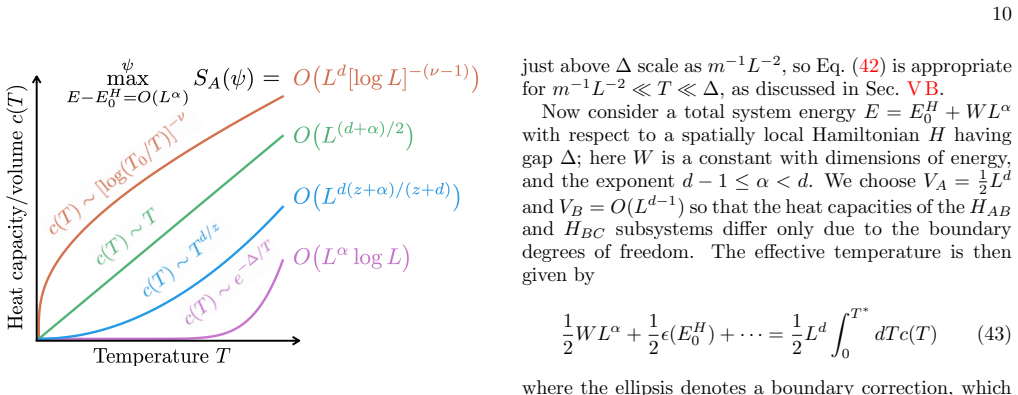
Essential singularity in the heat capacity In gapped quantum phases of matter, in the limit of largeLthere is by definition a finite separation ∆ be- tween the energy of the ground state subspace and the lowest excited states. Gapped phases arise in wide var- ities of physical settings, and are characterized by the exponential decay of correlations betwee...
-
[3]
Power-law heat capacity Quantum systems with gapless branches of excitations often have low-temperature heat capacities that grow with a power of temperature. Key examples are met- als whose lowest-energy excitations are associated with transitions across a Fermi surface, quantum critical sys- tems [52], and certain quantum spin liquids [53]. Power- law h...
-
[4]
For example, in spin chains described by infinite-randomness fixed points [58], one finds [34] c(T) = c0 lnν(T0/T) +
Inverse-logarithmic heat capacity Spatial disorder is naturally associated with the emer- gence of low-energy quantum degrees of freedom, and these can lead to exotic thermodynamic properties. For example, in spin chains described by infinite-randomness fixed points [58], one finds [34] c(T) = c0 lnν(T0/T) +. . .(55) where, as above, the ellipsis denotes ...
-
[5]
D. N. Page, Average entropy of a subsystem, Phys. Rev. Lett.71, 1291 (1993)
1993
-
[6]
Holzhey, F
C. Holzhey, F. Larsen, and F. Wilczek, Geometric and renormalized entropy in conformal field theory, Nucl. Phys. B424, 443 (1994)
1994
-
[7]
Calabrese and J
P. Calabrese and J. Cardy, Entanglement entropy and quantum field theory, J. Stat. Mech.: Theory Exp.2004 (06), P06002
2004
-
[8]
Refael and J
G. Refael and J. E. Moore, Entanglement entropy of random quantum critical points in one dimension, Phys. Rev. Lett.93, 260602 (2004)
2004
-
[9]
Fradkin and J
E. Fradkin and J. E. Moore, Entanglement entropy of 2D conformal quantum critical points: Hearing the shape of a quantum drum, Phys. Rev. Lett.97, 050404 (2006)
2006
-
[10]
M. B. Hastings, An area law for one-dimensional quan- tum systems, J. Stat. Mech.: Theory Exp.2007(08), P08024
2007
-
[11]
Gioev and I
D. Gioev and I. Klich, Entanglement entropy of fermions in any dimension and the Widom conjecture, Phys. Rev. Lett.96, 100503 (2006)
2006
-
[12]
M. M. Wolf, Violation of the entropic area law for fermions, Phys. Rev. Lett.96, 010404 (2006)
2006
- [13]
-
[14]
J. I. Cirac, D. P´ erez-Garc´ ıa, N. Schuch, and F. Ver- straete, Matrix product states and projected entangled pair states: Concepts, symmetries, theorems, Rev. Mod. Phys.93, 045003 (2021)
2021
-
[15]
Gottesman and M
D. Gottesman and M. B. Hastings, Entanglement versus gap for one-dimensional spin systems, New J. Phys.12, 025002 (2010)
2010
-
[16]
Irani, Ground state entanglement in one-dimensional translationally invariant quantum systems, J
S. Irani, Ground state entanglement in one-dimensional translationally invariant quantum systems, J. Math. Phys.51, 022101 (2010)
2010
-
[17]
Movassagh and P
R. Movassagh and P. W. Shor, Supercritical entangle- ment in local systems: Counterexample to the area law for quantum matter, Proc. Natl. Acad. Sci.113, 13278 (2016)
2016
-
[18]
Zhang, A
Z. Zhang, A. Ahmadain, and I. Klich, Novel quantum phase transition from bounded to extensive entangle- ment, Proc. Natl. Acad. Sci.114, 5142 (2017)
2017
-
[19]
S. Balasubramanian, E. Lake, and S. Choi, 2d Hamilto- nians with exotic bipartite and topological entanglement (2023), arXiv:2305.07028 [quant-ph]
-
[20]
Zhang and I
Z. Zhang and I. Klich, Coupled Fredkin and Motzkin chains from quantum six- and nineteen-vertex models, SciPost Phys.15, 044 (2023)
2023
-
[21]
M. Ippoliti and D. M. Long, Infinite temperature at zero energy (2025), arXiv:2509.04410 [quant-ph]
-
[22]
Zhang and I
Z. Zhang and I. Klich, Quantum lozenge tiling and en- tanglement phase transition, Quantum8, 1497 (2024)
2024
-
[23]
J. M. Deutsch, Quantum statistical mechanics in a closed system, Phys. Rev. A43, 2046 (1991)
2046
-
[24]
Srednicki, Chaos and quantum thermalization, Phys
M. Srednicki, Chaos and quantum thermalization, Phys. Rev. E50, 888 (1994)
1994
-
[25]
Goldstein, J
S. Goldstein, J. L. Lebowitz, R. Tumulka, and N. Zangh` ı, Canonical typicality, Phys. Rev. Lett.96, 050403 (2006)
2006
-
[26]
Popescu, A
S. Popescu, A. J. Short, and A. Winter, Entanglement and the foundations of statistical mechanics, Nat. Phys. 2, 754 (2006)
2006
-
[27]
Vidmar and M
L. Vidmar and M. Rigol, Entanglement entropy of eigen- states of quantum chaotic Hamiltonians, Phys. Rev. Lett. 119, 220603 (2017)
2017
-
[28]
Lu and T
T.-C. Lu and T. Grover, Renyi entropy of chaotic eigen- states, Phys. Rev. E99, 032111 (2019)
2019
-
[29]
Murthy and M
C. Murthy and M. Srednicki, Structure of chaotic eigen- states and their entanglement entropy, Phys. Rev. E100, 022131 (2019)
2019
-
[30]
F. G. S. L. Brand˜ ao and M. Cramer, Entanglement area law from specific heat capacity, Phys. Rev. B92, 115134 (2015)
2015
-
[31]
Swingle and J
B. Swingle and J. McGreevy, Area law for gapless states from local entanglement thermodynamics, Phys. Rev. B 93, 205120 (2016)
2016
-
[32]
Aharonov, W
D. Aharonov, W. van Dam, J. Kempe, Z. Landau, S. Lloyd, and O. Regev, Adiabatic quantum computation is equivalent to standard quantum computation, SIAM Review50, 755 (2008)
2008
-
[33]
Mizel, D
A. Mizel, D. A. Lidar, and M. Mitchell, Simple proof of equivalence between adiabatic quantum computation and the circuit model, Phys. Rev. Lett.99, 070502 (2007)
2007
-
[34]
N. P. Breuckmann and B. M. Terhal, Space-time circuit- to-Hamiltonian construction and its applications, J. Phys. A: Math. Theor.47, 195304 (2014)
2014
-
[35]
Anshu, I
A. Anshu, I. Arad, and D. Gosset, An area law for 2d frustration-free spin systems, inProceedings of the 54th Annual ACM SIGACT Symposium on Theory of Com- puting, STOC 2022 (Association for Computing Machin- ery, New York, NY, USA, 2022) p. 12–18
2022
-
[36]
de Beaudrap, M
N. de Beaudrap, M. Ohliger, T. J. Osborne, and J. Eisert, Solving frustration-free spin systems, Phys. Rev. Lett. 105, 060504 (2010)
2010
-
[37]
J. Chen, X. Chen, R. Duan, Z. Ji, and B. Zeng, No-go theorem for one-way quantum computing on naturally occurring two-level systems, Phys. Rev. A83, 050301 (2011)
2011
-
[38]
D. S. Fisher, Critical behavior of random transverse-field Ising spin chains, Phys. Rev. B51, 6411 (1995)
1995
-
[39]
D’Alessio, Y
L. D’Alessio, Y. Kafri, A. Polkovnikov, and M. Rigol, From quantum chaos and eigenstate thermalization to statistical mechanics and thermodynamics, Adv. Phys. 65, 239 (2016)
2016
-
[40]
Dymarsky, Bound on eigenstate thermalization from transport, Phys
A. Dymarsky, Bound on eigenstate thermalization from transport, Phys. Rev. Lett.128, 190601 (2022)
2022
-
[41]
Gogolin and J
C. Gogolin and J. Eisert, Equilibration, thermalisation, 18 and the emergence of statistical mechanics in closed quantum systems, Rep. Prog. Phys.79, 056001 (2016)
2016
-
[42]
D. K. Mark, F. Surace, A. Elben, A. L. Shaw, J. Choi, G. Refael, M. Endres, and S. Choi, Maximum entropy principle in deep thermalization and in Hilbert-space er- godicity, Phys. Rev. X14, 041051 (2024)
2024
-
[43]
Teufel, R
S. Teufel, R. Tumulka, and C. Vogel, Canonical typical- ity for other ensembles than micro-canonical, Ann. Henri Poincar´ e26, 1477 (2025)
2025
-
[44]
The Scrooge ensemble in many-body quantum systems,
M. McGinley and T. Schuster, The Scrooge ensemble in many-body quantum systems (2025), arXiv:2511.17172 [quant-ph]
- [45]
-
[46]
Jozsa, D
R. Jozsa, D. Robb, and W. K. Wootters, Lower bound for accessible information in quantum mechanics, Phys. Rev. A49, 668 (1994)
1994
-
[47]
Schuch, M
N. Schuch, M. M. Wolf, F. Verstraete, and J. I. Cirac, En- tropy scaling and simulability by matrix product states, Phys. Rev. Lett.100, 030504 (2008)
2008
-
[48]
Giudice, A
G. Giudice, A. C ¸ akan, J. I. Cirac, and M. C. Ba˜ nuls, R´ enyi free energy and variational approximations to ther- mal states, Phys. Rev. B103, 205128 (2021)
2021
-
[49]
Kim and D
H. Kim and D. A. Huse, Ballistic spreading of entan- glement in a diffusive nonintegrable system, Phys. Rev. Lett.111, 127205 (2013)
2013
-
[50]
N. d. Beaudrap, T. J. Osborne, and J. Eisert, Ground states of unfrustrated spin Hamiltonians satisfy an area law, New J. Phys.12, 095007 (2010)
2010
-
[51]
Affleck, T
I. Affleck, T. Kennedy, E. H. Lieb, and H. Tasaki, Valence bond ground states in isotropic quantum antiferromag- nets, Commun. Math. Phys.115, 477 (1988)
1988
-
[52]
Hirano and Y
T. Hirano and Y. Hatsugai, Entanglement entropy of one- dimensional gapped spin chains, J. Phys. Soc. Jpn.76, 074603 (2007)
2007
-
[53]
Bravyi, L
S. Bravyi, L. Caha, R. Movassagh, D. Nagaj, and P. W. Shor, Criticality without frustration for quantum spin-1 chains, Phys. Rev. Lett.109, 207202 (2012)
2012
-
[54]
M. B. Hastings, Lieb-Schultz-Mattis in higher dimen- sions, Phys. Rev. B69, 104431 (2004)
2004
-
[55]
Masanes, Area law for the entropy of low-energy states, Phys
L. Masanes, Area law for the entropy of low-energy states, Phys. Rev. A80, 052104 (2009)
2009
-
[56]
Sachdev,Quantum Phase Transitions, 2nd ed
S. Sachdev,Quantum Phase Transitions, 2nd ed. (Cam- bridge University Press, 2011)
2011
-
[57]
O. I. Motrunich, Variational study of triangular lattice spin-1/2 model with ring exchanges and spin liquid state inκ−(ET) 2Cu2(CN)3, Phys. Rev. B72, 045105 (2005)
2005
-
[58]
M. J. Thill and D. A. Huse, Equilibrium behaviour of quantum Ising spin glass, Physica A214, 321 (1995)
1995
-
[59]
M. Guo, R. N. Bhatt, and D. A. Huse, Quantum Griffiths singularities in the transverse-field Ising spin glass, Phys. Rev. B54, 3336 (1996)
1996
-
[60]
Rieger and A
H. Rieger and A. P. Young, Griffiths singularities in the disordered phase of a quantum Ising spin glass, Phys. Rev. B54, 3328 (1996)
1996
-
[61]
F. D. M. Haldane, ’Luttinger liquid theory’ of one- dimensional quantum fluids. I. properties of the Luttinger model and their extension to the general 1D interacting spinless Fermi gas, J. Phys. C: Solid State Physics14, 2585 (1981)
1981
-
[62]
D. S. Fisher, Random antiferromagnetic quantum spin chains, Phys. Rev. B50, 3799 (1994)
1994
-
[63]
Vidal, Efficient classical simulation of slightly entan- gled quantum computations, Phys
G. Vidal, Efficient classical simulation of slightly entan- gled quantum computations, Phys. Rev. Lett.91, 147902 (2003)
2003
-
[64]
Bonitz,Quantum kinetic theory, Vol
M. Bonitz,Quantum kinetic theory, Vol. 412 (Springer, 2016)
2016
- [65]
-
[66]
Verstraete, M
F. Verstraete, M. M. Wolf, D. Perez-Garcia, and J. I. Cirac, Criticality, the area law, and the computational power of projected entangled pair states, Phys. Rev. Lett. 96, 220601 (2006)
2006
discussion (0)
Sign in with ORCID, Apple, or X to comment. Anyone can read and Pith papers without signing in.