Recognition: unknown
Correlative Microstructural Analysis of a Weathered Nantan Meteorite Fragment
Pith reviewed 2026-05-08 02:20 UTC · model gemini-3-flash-preview
The pith
Weathering transforms meteorite minerals into distinct chemical records of their original space-born structure.
A machine-rendered reading of the paper's core claim, the machinery that carries it, and where it could break.
Core claim
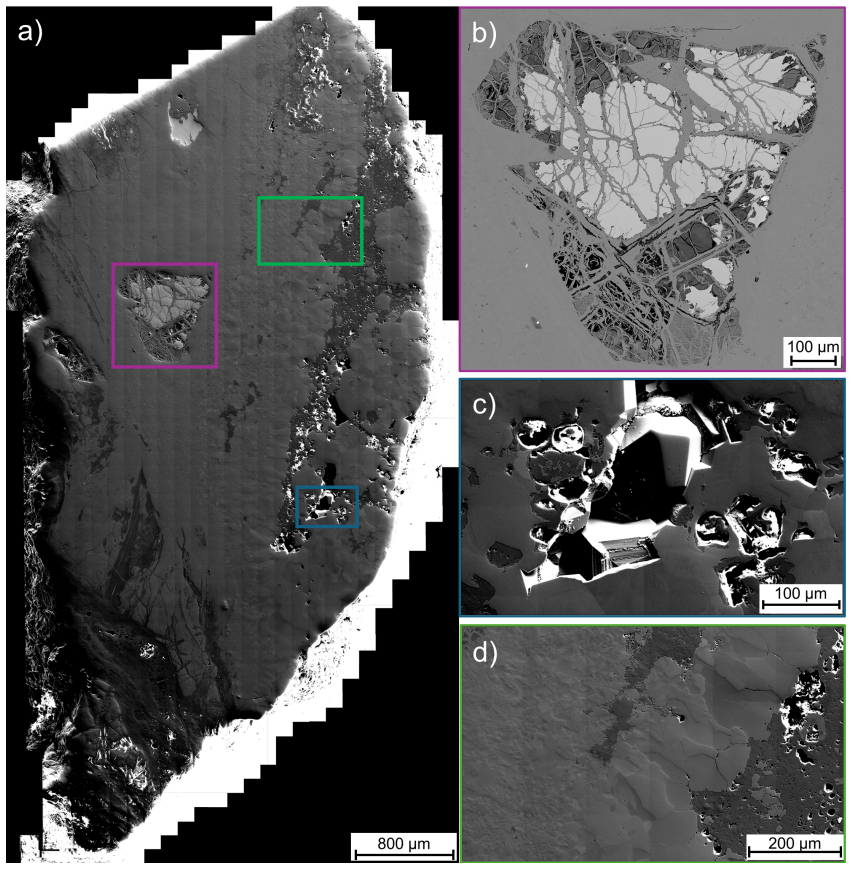
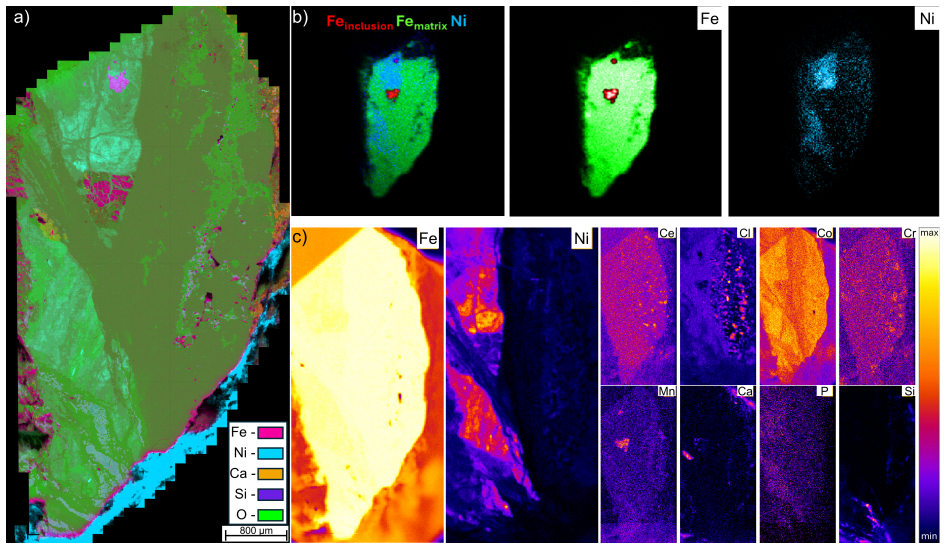
The researchers established that the Nantan meteorite's weathered matrix consists of distinct regions that correlate with its primary mineral phases. High-nickel regions (above 2.6%) formed fine-grained magnetite through the aqueous alteration of kamacite, while low-nickel regions (below 0.9%) produced significantly larger magnetite grains through the direct dissolution of the bulk iron-nickel metal. Furthermore, the presence of brecciated cohenite veins containing nickel oxide and carbonates indicates that these terrestrial products act as specific markers for how the meteorite interacted with groundwater and the atmosphere over time.
What carries the argument
Correlative microstructural analysis. This approach layers multiple imaging and spectroscopy techniques—including electron backscatter diffraction and X-ray photoelectron spectroscopy—to link the physical crystal orientation of the minerals directly to their chemical signatures on the same sample area.
If this is right
- Heavily weathered iron meteorites can be reverse-engineered to determine their original space-born mineralogy even if the primary metal has been completely oxidized.
- The grain size of secondary magnetite in a weathered meteorite can serve as a proxy for the nickel concentration of the original source metal.
- The specific carbonate deposits found within weathered carbide veins can be used to identify the chemical environment and moisture levels of the landing site over centuries.
- Planetary scientists can use these distinct microstructural signatures to differentiate between terrestrial weathering and alteration that occurred in space.
Where Pith is reading between the lines
- This method could be applied to identify 'fossil' meteorites in the deep geological record where only the oxide shells remain, potentially revealing the flux of iron meteorites in Earth's distant past.
- The sharp grain-size boundaries suggest that weathering rates in iron-nickel alloys are highly sensitive to local chemical gradients, which might allow for more precise dating of meteorite 'finds' based on rust thickness.
- The preservation of original structural boundaries within the rust suggests that iron oxide replacement is a pseudomorphic process, maintaining the 'ghost' of the extraterrestrial crystal lattice.
Load-bearing premise
The analysis assumes that the chemical and structural patterns observed in a single small fragment are representative of the entire Nantan fall and its diverse environmental exposure across the landing site.
What would settle it
The discovery of Nantan fragments where high-nickel regions do not produce fine-grained magnetite, or where the grain size of the weathered matrix is uniform regardless of the original nickel content, would invalidate the claim that the matrix preserves the primary mineral structure.
Figures


read the original abstract
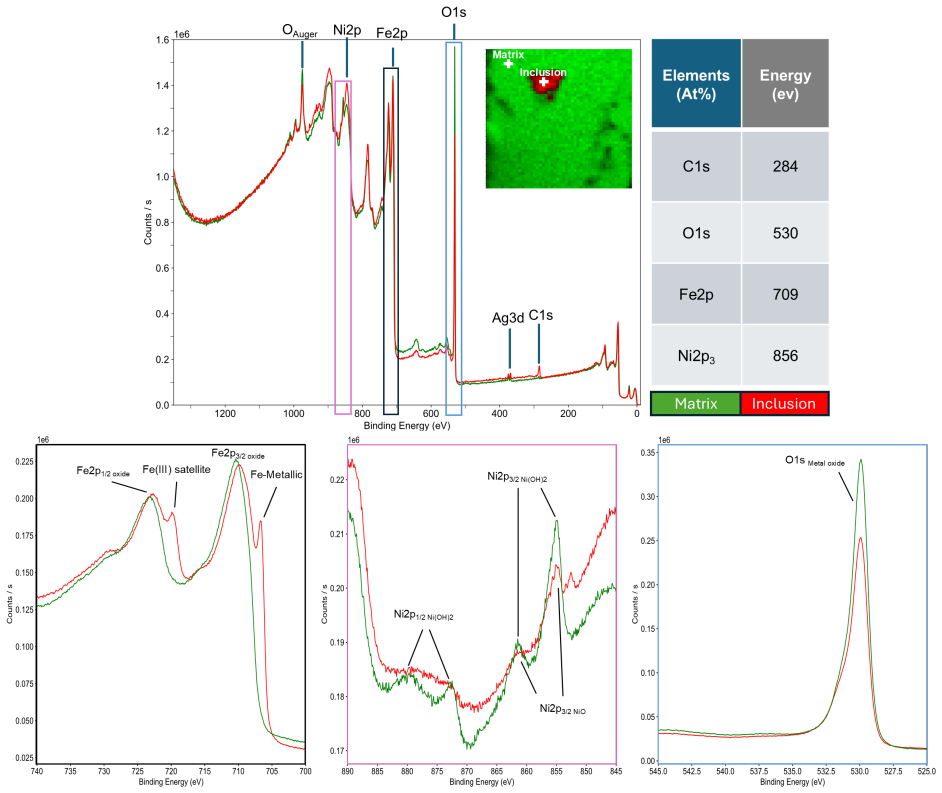
The weathering of iron-rich phases within meteorites is a process that significantly alters the microstructure and chemical composition based on the environmental conditions at the location of landing and exposure time since fall. This work investigates the resulting phases in a correlative and comparative manner using a Nantan meteorite fragment. Techniques including X-ray Photoelectron Spectroscopy, Energy Dispersive X-ray Spectroscopy, and X-ray Fluorescence Spectroscopy were used for compositional determination and X-ray Diffraction and Electron Backscatter Diffraction for phase determination and microstructural analysis. These techniques revealed the meteorite matrix to be predominantly composed of magnetite, with distinct regions of high Ni content. The grain size was found to be approximately 5 $\mu$m in $\geq$ 2.6 at$\%$ Ni content regions with a visible boundary of 100-200 $\mu$m extending into $\leq$ 0.9 at$\%$ Ni regions, wherein the grain size averaged 10s of $\mu$m. Additionally, a brecciated cohenite phase was found with a vein-line structure, composed of NiO, magnetite, and deposits of iron and nickel carbonates. This indicates that the matrix regions formed through the weathering of discrete primary phases, with the high Ni regions forming from aqueous alteration of kamacite and the low Ni regions forming from direct dissolution and oxidation of the source Fe-Ni metal.
Editorial analysis
A structured set of objections, weighed in public.
Referee Report
Summary. This manuscript presents a multi-modal characterization of a weathered Nantan meteorite fragment, employing XPS, EDS, XRF, XRD, and EBSD. The study identifies magnetite as the primary component of the weathering matrix and distinguishes two distinct zones based on nickel concentration (2.6 at% and 0.9 at%) and grain size (5 µm vs. 10s of µm). The authors also report the presence of nickel carbonates and a brecciated cohenite phase, ultimately proposing that the variations in the matrix reflect different primary metallic precursors and varying modes of aqueous alteration.
Significance. The paper demonstrates the efficacy of a correlative microscopy workflow on complex, heterogeneous geological samples. Specifically, the successful application of EBSD to map orientation and grain size within the oxide matrix of a weathered meteorite is a technical achievement that provides valuable structural data beyond simple chemical mapping. The identification of carbonate deposits within the cohenite-rich regions provides useful data points for the terrestrial alteration history of IAB meteorites in humid environments.
major comments (2)
- [Section 4 (Discussion)] The claim that the matrix regions formed from 'discrete primary phases' (specifically distinguishing the low-Ni regions as coming from a different source than kamacite) is problematic. Nantan is an IAB-MG iron meteorite; its primary metallic phases are kamacite (~6.5–7 at% Ni) and taenite (>25 at% Ni). The authors' measurement of 2.6 at% Ni in a magnetite matrix (Fe3O4) corresponds to ~6.1 at% Ni relative to the metal content, which is a plausible isochemical weathering product of kamacite. However, the 0.9 at% Ni region (~2.1 at% relative to metal) has no primary metallic analog in this meteorite. It is more scientifically sound to interpret the 0.9 at% Ni region as a product of Ni leaching/transport from kamacite rather than a 'discrete primary phase.' The authors should revise the discussion to account for Ni mobility during terrestrial weathering.
- [Table 2 and Section 3.2] The comparison between XRF, EDS, and XPS values is presented without sufficient discussion of the vastly different sampling volumes of these techniques. XRF probes deep into the bulk, EDS probes ~1-2 µm, and XPS probes the top ~10 nm. Discrepancies in Ni and O concentration between these methods likely reflect vertical compositional gradients (surface oxidation/hydration vs. bulk) rather than just lateral heterogeneity. The paper needs to contextualize these measurements to avoid misleading the reader regarding the 'bulk' composition of the fragment.
minor comments (3)
- [Section 1 (Introduction)] The manuscript should explicitly state the classification of the Nantan meteorite (IAB-MG) to justify the expected primary mineralogy (kamacite, taenite, cohenite, schreibersite) for the reader.
- [Figure 3] The elemental maps for Ni and O in Figure 3 would benefit from a shared scale or a line-scan profile to more clearly demonstrate the 'visible boundary' of 100-200 µm mentioned in the abstract.
- [Terminology] In several places, 'at%' and 'wt%' appear to be used somewhat loosely. Please ensure all compositional values are consistently labeled, especially when comparing to literature values of the Nantan bulk composition.
Simulated Author's Rebuttal
The authors thank the referee for their constructive evaluation and technical insights, particularly regarding the metallurgical constraints of the Nantan meteorite. We agree that the distinction between the high-Ni and low-Ni matrix regions requires a more nuanced interpretation involving nickel mobility during terrestrial weathering rather than purely discrete primary precursors. We have also updated the manuscript to explicitly discuss the sampling depths of our multi-modal analytical suite, which clarifies the observed compositional differences across XRF, EDS, and XPS. These revisions strengthen the scientific rigor of the work without detracting from the primary microstructural findings.
read point-by-point responses
-
Referee: The claim that the matrix regions formed from 'discrete primary phases' (specifically distinguishing the low-Ni regions as coming from a different source than kamacite) is problematic. ... The 0.9 at% Ni region (~2.1 at% relative to metal) has no primary metallic analog in this meteorite. It is more scientifically sound to interpret the 0.9 at% Ni region as a product of Ni leaching/transport from kamacite.
Authors: The referee is correct that the IAB-MG group does not contain a primary alloy with only ~2 at% Ni. Our initial suggestion of 'discrete primary phases' was intended to contrast the cohenite-rich regions from the bulk metallic regions, but we acknowledge that the low-Ni oxide matrix (0.9 at% Ni) cannot originate from a distinct low-Ni primary metal. We have revised the Discussion to propose that this region represents a secondary weathering front where Ni has been selectively leached or redistributed during the oxidation of kamacite. The boundary observed in the EBSD and EDS maps likely marks a transition in the weathering regime or a localized diffusion barrier rather than a metallurgical boundary in the original fragment. The abstract and section 4 have been updated to reflect Ni mobility as the primary driver for these compositional variations. revision: yes
-
Referee: The comparison between XRF, EDS, and XPS values is presented without sufficient discussion of the vastly different sampling volumes of these techniques. ... Discrepancies in Ni and O concentration between these methods likely reflect vertical compositional gradients (surface oxidation/hydration vs. bulk).
Authors: We agree that the disparate probe depths of XRF (bulk/sub-surface), EDS (~1-2 µm), and XPS (~10 nm) are critical for interpreting the absolute concentration values. The higher oxygen content and varied Ni signatures in XPS likely reflect the presence of surface hydroxides and adsorbates that are not representative of the deeper oxide matrix captured by EDS or XRF. We have added a paragraph to Section 3.2 (Compositional Analysis) and a footnote to Table 2 explicitly defining these probe depths and discussing how surface-sensitive effects contribute to the observed variance. This contextualization ensures that the reader understands we are measuring a vertical gradient as well as lateral heterogeneity. revision: yes
Circularity Check
Empirical microstructural study with no logical circularity
full rationale
The paper is a descriptive empirical study of a weathered Nantan meteorite fragment. It utilizes a suite of standard analytical techniques (EBSD, EDX, XPS, XRD) to characterize the sample's chemistry and mineralogy. The logic of the paper is purely inductive: measurements of Nickel (Ni) content and grain size are taken, and the authors propose a mineralogical history (weathering of kamacite vs. source metal) to explain these observations. There is no predictive model, parameter fitting, or self-referential derivation chain present. The authors cite their own previous work primarily for methodological software tools (e.g., AstroEBSD, dictionary indexing) rather than to import load-bearing conclusions or 'uniqueness theorems'. While a skeptic might dispute the interpretation that 0.9 at% Ni regions represent a discrete 'source metal' precursor (arguing instead for Ni leaching), this is a matter of geological interpretation and empirical correctness rather than logical circularity. The study remains a self-contained characterization of an external physical object.
Axiom & Free-Parameter Ledger
axioms (2)
- domain assumption EBSD pattern indexing for magnetite and cohenite correctly identifies the crystal phases.
- domain assumption The current state of the fragment is the result of terrestrial weathering since the 1516 fall.
Reference graph
Works this paper leans on
-
[1]
Macro-classification of meteorites by portable energy dispersive X-ray fluorescence spectroscopy (pED-XRF), principal component analysis (PCA) and machine learning algorithms. Talanta 212, 120785. URL:https://www.sciencedirect.com/science/article/pii/S003991402030076X, doi:10. 1016/j.talanta.2020.120785. Bachmann,F.,Hielscher,R.,Schaeben,H.,2010. TextureA...
-
[2]
(Eds.), Meteorites and the Early Solar System II
Weathering of Chondritic Meteorites, in: Lauretta, D.S., McSween, H.Y. (Eds.), Meteorites and the Early Solar System II. University of Arizona Press, pp. 853–868. doi:10.2307/j.ctv1v7zdmm. Bland, P.A., Sexton, A.S., Jull, A.J.T., Bevan, A.W.R., Berry, F.J., Thornley, D.M., Astin, T.R., Britt, D.T., Pillinger, C.T.,
-
[3]
Geochimica et Cosmochimica Acta 62, 3169–3184
Climate and rock weathering: a study of terrestrial age dated ordinary chondritic meteorites from hot desert regions. Geochimica et Cosmochimica Acta 62, 3169–3184. doi:10.1016/S0016-7037(98)00199-9. Buchwald, V.F., Clarke, R.S.,
-
[4]
Evaluating the effects of space weathering on magnetite on airless planetary bodies. Icarus 402, 115634. URL:https://www.sciencedirect.com/science/article/pii/ S0019103523002117, doi:10.1016/j.icarus.2023.115634. :Preprint submitted to Elsevier Page 14 of 15 Faust,G.T.,Fahey,J.J.,Mason,B.H.,Dwornik,E.J.,1973. ThedisintegrationoftheWolfCreekmeteoriteandthe...
-
[5]
Materials Characterization 222, 114838
Microstructural characterization to reveal evidence of shock deformation in a Campo del Cielo meteorite fragment. Materials Characterization 222, 114838. doi:10.1016/j.matchar.2025.114838. Gemelli, M., D’Orazio, M., Folco, L.,
-
[6]
Geostandards and Geoanalytical Research 39, 55–69
Chemical Analysis of Iron Meteorites Using a Hand-Held X-Ray Fluorescence Spectrometer. Geostandards and Geoanalytical Research 39, 55–69. doi:10.1111/j.1751-908X.2014.00291.x. van Ginneken, M., Debaille, V., Decrée, S., Goderis, S., Woodland, A.B., Wozniakiewicz, P., De Ceukelaire, M., Leduc, T., Claeys, P.,
-
[7]
Meteoritics & Planetary Science 57, 1247–1266
Artificial weathering of an ordinary chondrite: Recommendations for the curation of Antarctic meteorites. Meteoritics & Planetary Science 57, 1247–1266. doi:10.1111/maps.13818. publisher: John Wiley & Sons, Ltd. Gooding, J.L.,
-
[8]
Meteoritics & Planetary Science 58, 875–884
Characterization of iron meteorites by scanning electron microscopy, X-ray diffraction, magnetization measurements, and Mössbauer spectroscopy: Gibeon IVA. Meteoritics & Planetary Science 58, 875–884. URL:https://onlinelibrary.wiley.com/doi/abs/10. 1111/maps.13984, doi:10.1111/maps.13984. Gurdziel, A.,
-
[9]
Geochimica et Cosmochimica Acta 68, 893–916
Mechanisms of weathering of meteorites recovered from hot and cold deserts and the formation of phyllosilicates1. Geochimica et Cosmochimica Acta 68, 893–916. doi:10.1016/S0016-7037(03)00486-1. Leedahl, B., Korolev, A.V., Zhidkov, I.S., Skornyakov, S.L., Anisimov, V.I., Belozerov, A.S., Kukharenko, A.I., Kurmaev, E.Z., Grokhovskii, V.I., Cholakh, S.O., Mo...
-
[10]
Searching for pure iron in nature: the Chelyabinsk meteorite. RSC Advances 6, 85844–85851. URL: https://pubs.rsc.org/en/content/articlelanding/2016/ra/c6ra16598b, doi:10.1039/C6RA16598B. Machado, A.S., de Araújo, O.M.O., Leitão, R.G., dos Anjos, M.J., de Oliveira, D.F., Lopes, R.T.,
-
[11]
X-Ray Spectrometry 54, 632–642
Structural and Elemental Characterization of Martian Meteorites Using X-Ray Microtomography, X-Ray Microfluorescence, and Energy-Dispersive Spectroscopy. X-Ray Spectrometry 54, 632–642. URL:https://onlinelibrary.wiley.com/doi/abs/10.1002/xrs.3500, doi:10.1002/xrs.3500. Momma, K., Izumi, F.,
-
[12]
VESTA3 for three-dimensional visualization of crystal, volumetric and morphology data
VESTA 3 for three-dimensional visualization of crystal, volumetric and morphology data. Journal of Applied Crystallography 44, 1272–1276. doi:10.1107/S0021889811038970. publisher: International Union of Crystallography. Palmer, E.E., Lauretta, D.S.,
-
[13]
Geochimica et Cosmochimica Acta 140, 259–274
Investigation of schreibersite and intrinsic oxidation products from Sikhote-Alin, Seymchan, and Odessa meteorites and Fe3P and Fe2NiP synthetic surrogates. Geochimica et Cosmochimica Acta 140, 259–274. doi:10.1016/j.gca.2014.05.027. Pratomo, S.B., Oktadinata, H., Widodo, T.W.,
-
[14]
IOP Conference Series: Materials Science and Engineering 541, 012050
Effect of nickel additions on microstructure evolution and mechanical properties of low-alloy Cr-Mo cast steel. IOP Conference Series: Materials Science and Engineering 541, 012050. doi:10.1088/1757-899X/541/1/012050. publisher: IOP Publishing. Rubin,A.E.,1997. Mineralogyofmeteoritegroups. Meteoritics&PlanetaryScience32,231–247. doi:10.1111/j.1945-5100.19...
-
[15]
Materials Science and Engineering: B 268, 115092
Effects of Ni-doping on microstructure, magnetic and microwave absorption properties of CoFe2O4. Materials Science and Engineering: B 268, 115092. doi:10.1016/j.mseb.2021.115092. White,Jr.,J.S.,Henderson,E.P.,Mason,B.,1967.SecondaryMineralsProducedbyWeatheringoftheWolfCreekMeteorite.AmericanMineralogist 52, 1190–1179. Winkelmann,A.,Jablon,B.,Tong,V.,Trage...
discussion (0)
Sign in with ORCID, Apple, or X to comment. Anyone can read and Pith papers without signing in.