Recognition: 2 theorem links
· Lean TheoremA Local Gauge-Covariant Formulation of Classical Dynamics
Pith reviewed 2026-05-13 22:15 UTC · model grok-4.3
The pith
Classical dynamics emerge from the asynchronous relaxation of a local gauge-invariant incompatibility measure between state and transport geometry.
A machine-rendered reading of the paper's core claim, the machinery that carries it, and where it could break.
Core claim
Dynamics arise as the finite-rate relaxation of a gauge-invariant quadratic incompatibility measure defined by the covariant difference between neighboring states under a dynamical transport connection. The state variables and transport geometry adapt together to reduce this mismatch without an a priori action principle. In suitable limits the compatibility-restoration dynamics reproduce the standard continuum equations of diffusion, incompressible Navier-Stokes, and the Ampère-Maxwell relation, with global time emerging only as an effective coarse-grained limit.
What carries the argument
The local incompatibility, defined as the covariant difference between neighboring states under a dynamical transport connection, which locality, gauge covariance, and coercivity restrict to a globally additive quadratic gauge-invariant measure whose asynchronous relaxation defines the admissible dynamics.
If this is right
- Standard continuum equations appear as effective limits of the local relaxation process rather than as fundamental postulates.
- Global time and fixed background geometry arise only as coarse-grained outcomes of asynchronous local compatibility restoration.
- No separate action principle is required; dynamics follow directly from the demand for local gauge consistency under the stated constraints.
- The same relaxation mechanism can recover distinct physical regimes (diffusion, fluid flow, electromagnetism) by changing the choice of state variables and connection.
Where Pith is reading between the lines
- The relational treatment of geometry suggests that apparent fundamental laws in other domains could likewise be derived from local consistency requirements rather than imposed globally.
- The framework could be extended to relativistic or quantum settings by allowing the transport connection itself to carry additional internal degrees of freedom.
- Non-equilibrium or highly disordered systems might exhibit measurable deviations from the quadratic relaxation law if higher-order mismatch terms become relevant.
Load-bearing premise
Locality, gauge covariance, and coercivity necessarily force the incompatibility to a quadratic gauge-invariant measure whose relaxation directly produces the target continuum equations without additional fitting parameters.
What would settle it
A controlled numerical or laboratory system in which the joint evolution of state and transport geometry produces observable dynamics that systematically deviate from the diffusion or incompressible Navier-Stokes limits while still obeying the stated locality and gauge principles would falsify the central claim.
Figures
read the original abstract
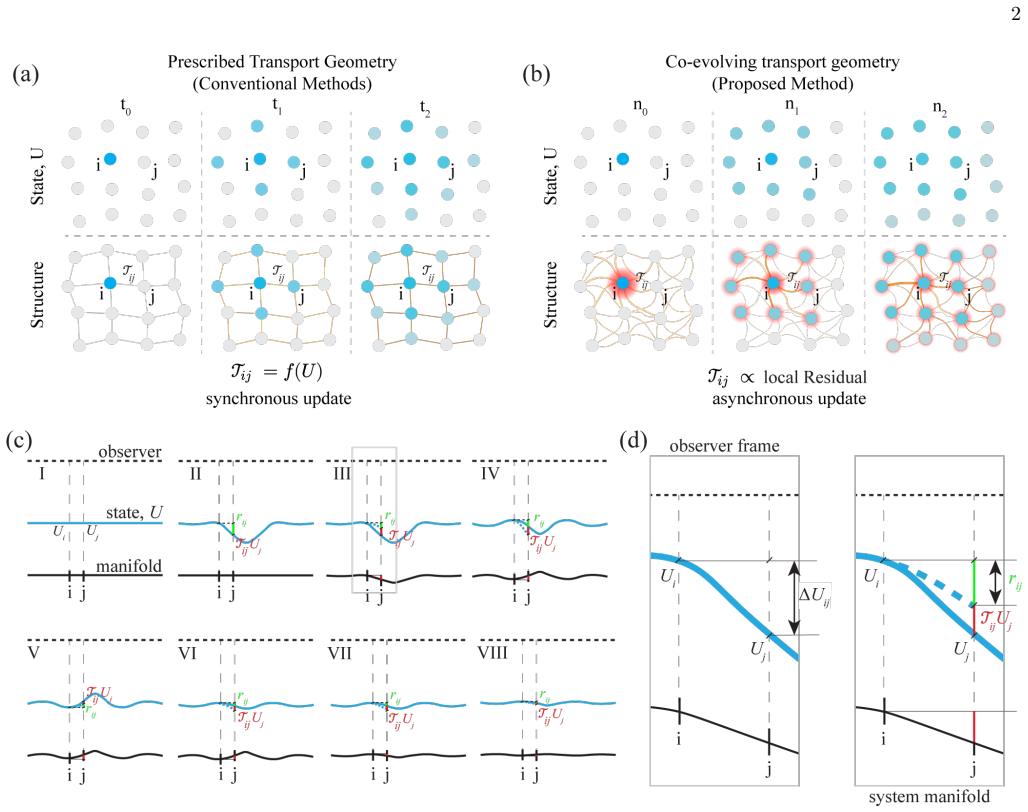
Classical dynamical laws are conventionally formulated as closed evolution equations defined on fixed geometric backgrounds and a global time parameter. We develop a formulation in which neither prescribed evolution laws nor an external clock are assumed a priori. Grounded in the principles of conservation, locality of interaction, and independent local frame freedom, the framework treats spatial geometry as a relational structure that may evolve together with the state. We introduce a notion of local incompatibility defined as the covariant difference between neighboring states under a dynamical transport connection. Because the transport relations are not fixed, restoring compatibility requires the joint adaptation of both state variables and transport geometry. We show that locality, gauge covariance, and coercivity strongly restrict the admissible form of this incompatibility and lead to a simple, globally additive, gauge-invariant quadratic measure of mismatch. Admissible dynamics are then defined as the asynchronous, finite-rate relaxation of this measure, without assuming a predefined action principle. A global time description appears only as an effective coarse-grained limit of this local relaxation process. In appropriate limits, the resulting compatibility-restoration dynamics recovers familiar continuum equations, including diffusion, incompressible Navier--Stokes, and the Amp\`ere--Maxwell relation. In this sense, dynamics arises from the coupled evolution of state and transport geometry toward local gauge consistency. The formulation provides a constructive framework in which effective physical laws emerge from local relational constraints.
Editorial analysis
A structured set of objections, weighed in public.
Referee Report
Summary. The manuscript develops a local gauge-covariant formulation of classical dynamics in which neither fixed evolution equations nor an external time parameter are presupposed. Spatial geometry is treated as a relational structure that evolves jointly with the state. Local incompatibility is defined as the covariant difference between neighboring states under a dynamical transport connection. The authors argue that locality, gauge covariance, and coercivity restrict this incompatibility to a globally additive, gauge-invariant quadratic measure; admissible dynamics are then defined as the asynchronous finite-rate relaxation of this measure. In appropriate limits the relaxation recovers diffusion, incompressible Navier-Stokes, and the Ampère-Maxwell relation, with global time appearing only as a coarse-grained effective description.
Significance. If the restriction to the quadratic measure and the subsequent recovery of the target continuum equations can be made fully explicit, the work would supply a constructive, principle-based route to classical field equations that does not rely on an action principle or a fixed background geometry. Such a framework could illuminate how effective dynamical laws emerge from local relational consistency requirements.
major comments (3)
- [Section introducing the incompatibility measure and its quadratic restriction] The central claim that locality, gauge covariance, and coercivity 'strongly restrict' the admissible incompatibility to a quadratic measure lacks an explicit uniqueness argument. No functional-analytic or representation-theoretic derivation is supplied showing why non-quadratic (e.g., quartic or non-local) gauge-covariant scalars are excluded by coercivity alone; without this step the quadratic form functions as an additional postulate rather than a necessary consequence.
- [Section on relaxation dynamics and continuum limits] The recovery of the incompressible Navier-Stokes and Ampère-Maxwell equations is asserted but not demonstrated with explicit derivation steps, error estimates, or verification that the relaxation dynamics reproduces the target PDEs without hidden assumptions or parameter tuning. This verification is load-bearing for the claim that dynamics emerges from the stated principles.
- [Section defining admissible dynamics via relaxation] Defining dynamics as the relaxation of the same quadratic incompatibility measure whose form is justified by the same locality and gauge-covariance principles creates a risk of circularity; it is unclear whether the recovered equations are genuine predictions or are built in by the choice of measure and relaxation rule.
minor comments (2)
- [Early sections on geometric setup] Notation for the transport connection, covariant difference, and incompatibility measure should be introduced with explicit component expressions or coordinate-free definitions at the first appearance to improve readability.
- [Introduction or discussion] The manuscript would benefit from a brief comparison table or paragraph contrasting the present relational approach with existing gauge-theoretic or relational formulations of continuum mechanics.
Simulated Author's Rebuttal
We thank the referee for the detailed and constructive report. The comments highlight important points where the presentation can be made more rigorous. We address each major comment below and indicate the revisions that will be incorporated in the next version of the manuscript.
read point-by-point responses
-
Referee: [Section introducing the incompatibility measure and its quadratic restriction] The central claim that locality, gauge covariance, and coercivity 'strongly restrict' the admissible incompatibility to a quadratic measure lacks an explicit uniqueness argument. No functional-analytic or representation-theoretic derivation is supplied showing why non-quadratic (e.g., quartic or non-local) gauge-covariant scalars are excluded by coercivity alone; without this step the quadratic form functions as an additional postulate rather than a necessary consequence.
Authors: We agree that a more explicit argument would strengthen the claim. The manuscript derives the quadratic form by requiring (i) locality implying additivity over infinitesimal patches, (ii) gauge covariance under local frame transformations, and (iii) coercivity ensuring a positive-definite minimum at zero incompatibility. In the revised version we will expand the relevant section with a step-by-step argument showing that any higher-order or non-local term either violates additivity in the continuum limit or fails to remain coercive while preserving gauge invariance. This will clarify that the quadratic is the unique leading-order term consistent with the three principles, rather than an additional postulate. revision: yes
-
Referee: [Section on relaxation dynamics and continuum limits] The recovery of the incompressible Navier-Stokes and Ampère-Maxwell equations is asserted but not demonstrated with explicit derivation steps, error estimates, or verification that the relaxation dynamics reproduces the target PDEs without hidden assumptions or parameter tuning. This verification is load-bearing for the claim that dynamics emerges from the stated principles.
Authors: We accept that the continuum limits require explicit verification. In the revised manuscript we will add an appendix containing the detailed expansion of the asynchronous relaxation equations to first order in the incompatibility measure, including the identification of the relaxation timescale with transport coefficients (viscosity for Navier-Stokes, conductivity for Ampère-Maxwell). We will also sketch the leading-order error estimates confirming that the target PDEs are recovered without additional tuning. These steps will be presented for the incompressible Navier-Stokes case and the Ampère-Maxwell relation. revision: yes
-
Referee: [Section defining admissible dynamics via relaxation] Defining dynamics as the relaxation of the same quadratic incompatibility measure whose form is justified by the same locality and gauge-covariance principles creates a risk of circularity; it is unclear whether the recovered equations are genuine predictions or are built in by the choice of measure and relaxation rule.
Authors: We maintain that there is no circularity. The incompatibility measure is fixed solely by the three static principles (locality, gauge covariance, coercivity) before any dynamics is introduced. The relaxation rule is then defined as the minimal finite-rate process that reduces this measure to zero, without invoking an action principle or presupposing the target equations. The subsequent recovery of Navier-Stokes and Maxwell dynamics therefore constitutes a non-trivial consistency check. In the revision we will insert a short clarifying paragraph that separates the construction of the measure from the definition of the dynamics to make this logical order explicit. revision: partial
Circularity Check
No significant circularity detected; derivation presented as independent from stated principles
full rationale
The provided abstract and description outline a framework grounded in conservation, locality, and gauge covariance, asserting that these principles restrict incompatibility to a quadratic measure whose relaxation yields known continuum equations in limits. No explicit quotes or equations demonstrate self-definition (e.g., dynamics defined directly in terms of the measure it is claimed to derive), fitted parameters renamed as predictions, or load-bearing self-citations that reduce the central claim to prior author work. The recovery of diffusion, Navier-Stokes, and Maxwell relations is framed as an emergent consequence rather than a built-in input, and the paper explicitly disclaims additional fitting. Without evidence of reduction by construction in the given text, the chain remains self-contained against external benchmarks.
Axiom & Free-Parameter Ledger
axioms (1)
- domain assumption Conservation, locality of interaction, and independent local frame freedom are the only principles needed to restrict admissible dynamics.
invented entities (1)
-
local incompatibility
no independent evidence
Lean theorems connected to this paper
-
IndisputableMonolith/Cost/FunctionalEquation.leanwashburn_uniqueness_aczel echoesWe show that locality, gauge covariance, and coercivity strongly restrict the admissible form of this incompatibility and lead to a simple, globally additive, gauge-invariant quadratic measure of mismatch.
-
IndisputableMonolith/Cost.leanJcost_pos_of_ne_one echoesrij ≡ ϕ (Tij Uj − Ui) ... L[U, W] = ½ Σ ⟨Ri, Ri⟩ + λ/2 Σ ⟨Wij, Wij⟩
Reference graph
Works this paper leans on
-
[1]
Covariant difference LetMbe a smoothn-dimensional manifold represent- ing the configuration or physical space of the system [Ax- iom (3)]. We consider a collection of points onMlabeled by indicesi, j:j∈ N(i), whereN(i) denotes the neigh- borhood of pointi. Each associated with coordinates xi ∈R n in a chosen external chart. The labelsiandj identify locati...
-
[2]
Local smoothness and tangent-space representation We now formalize the local smoothness of underlying the transport geometry. Under [Axiom (7)], whenever transport relations are well defined, each point admits a neighborhood in which the transport operators can be represented within a single local coordinate chart of the Lie group. This permits a tangent-...
-
[3]
Incompatibility The assumed symmetry of the description is the free- dom to choose independent local frames at each point, represented by gauge transformations of the formU i 7→ giUi. Two neighboring state descriptions (Ui, Uj) are said to be locally compatible under the current transport ge- ometry if there exists a frame-consistent identification of the...
-
[4]
Variation with respect toW ij: structure relaxation We first compute the gradient ofLwith respect to an individual edge connectionW ij, holding all other variables fixed. Under the directed convention adopted throughout this work, the interfacial incompatibilityr ij is expressed in the local frame at nodei. Consequently, the transport parameterW ij appear...
-
[5]
Variation with respect toU i: state relaxation We compute the variation ofLwith respect to the state variablesU i, holding the transport structureW ij fixed. Unlike the structural parameters, the stateU i enters the global incompatibility measure through two distinct channels: One, nodeias a Destination:U i ap- pears directly in the local residualR i, whe...
-
[6]
Topological Persistence: A limitation of the present formulation is that the neighborhood structure is not treated as a fully dynamical variable. While the 13 transport parameters (W ij) evolve and may effec- tively suppress or deactivate interactions, the cre- ation of new connections is not modeled. In this sense, the framework permits adaptive reweight...
-
[7]
Perturbative Regime: The framework character- izes dynamics in regimes where compatibility is locally attainable through continuous adaptation. Systems characterized by singular transitions, dis- continuous rewiring, or genuinely non-perturbative geometric changes—where incompatibility cannot be expressed as a covariant difference in a shared tangent spac...
-
[8]
Holonomy along closed loops Curvature is a relational property defined by transport around closed paths. For any oriented loop γ= (i 0 →i 1 → · · · →i n), i n =i 0,(A1) the holonomy based at nodei 0 is defined as the ordered product Hγ(i0) =T i0i1 Ti1i2 · · · Tin−1in .(A2) If the transport structure is locally integrable alongγ, parallel transport returns...
-
[9]
Plaquette holonomy On a mesh with faces, we take the minimal loops to be the oriented boundaries of plaquettes. For a plaquettef with ordered boundary ∂f= (i→j→k→ℓ→i),(A3) the plaquette holonomy is Hf(i) =T ijTjk TkℓTℓi.(A4) On general graphs without explicit faces, minimal cycles (e.g. triangles) may be used in an analogous manner
-
[10]
Under local changes of frame,κ f(i) transforms covariantly in the adjoint representation
Curvature as a Lie-algebra element We define the discrete curvature associated with pla- quettefby the logarithm of its holonomy, κf(i)≡log Hf(i) ∈g.(A5) Vanishing curvature,κ f(i) = 0, is equivalent to trivial holonomyH f(i) =Iand characterizes locally integrable transport geometry. Under local changes of frame,κ f(i) transforms covariantly in the adjoin...
-
[11]
Non-Abelian structure SubstitutingT ij = exp(W ij), the plaquette holonomy becomes a product of exponentials, Hf(i) = Y (a→b)∈∂f exp(Wab),(A6) and its logarithm generates nonlinear commutator cor- rections via the Baker–Campbell–Hausdorff expansion, κf(i) = X (a→b)∈∂f Wab + 1 2 X e<e′ [We, We′] +O(W 3).(A7) These commutator terms encode non-Abelian curvat...
-
[12]
Node-wise curvature diagnostic For later use, a node-wise curvature (curl) diagnostic may be defined by averaging the plaquette curvatures incident to nodei, κi = 1P f∋i Af X f∋i Af κf(i),(A8) whereA f denotes the plaquette area (or unity for un- weighted graphs)
-
[13]
A. Einstein, B. Podolsky, and N. Rosen, Can quantum- mechanical description of physical reality be considered complete?, Phys. Rev.47, 777 (1935)
work page 1935
-
[14]
J. C. Maxwell, VIII. A dynamical theory of the electro- magnetic field, Phil. Trans. R. Soc. Lond. , 459 (1865)
-
[15]
H. Goldstein, C. P. Poole, and J. Safko,Classical me- chanics, Vol. 2 (Addison-wesley Reading, MA, 1950)
work page 1950
-
[16]
Poincar´ e,Les m´ ethodes nouvelles de la m´ ecanique c´ eleste, Vol
H. Poincar´ e,Les m´ ethodes nouvelles de la m´ ecanique c´ eleste, Vol. 3 (Gauthier-Villars, 1899)
-
[17]
S. H. Strogatz,Nonlinear dynamics and chaos: with ap- plications to physics, biology, chemistry, and engineering (Chapman and Hall, New York, 2024)
work page 2024
-
[18]
C. N. Yang and R. L. Mills, Conservation of isotopic spin and isotopic gauge invariance, Phys. Rev.96, 191 (1954)
work page 1954
-
[19]
Onsager, Reciprocal Relations in Irreversible Pro- cesses
L. Onsager, Reciprocal Relations in Irreversible Pro- cesses. I., Phys. Rev.37, 405 (1931)
work page 1931
-
[20]
Onsager, Reciprocal Relations in Irreversible Pro- cesses
L. Onsager, Reciprocal Relations in Irreversible Pro- cesses. II., Phys. Rev.38, 2265 (1931)
work page 1931
-
[21]
I. Prigogine and G. Nicolis, On symmetry-breaking insta- bilities in dissipative systems, J. Chem. Phys.46, 3542 (1967). 15
work page 1967
-
[22]
M. C. Cross and P. C. Hohenberg, Pattern formation outside of equilibrium, Rev. Mod. Phys.65, 851 (1993)
work page 1993
-
[23]
Ramaswamy, The mechanics and statistics of active matter, Annu
S. Ramaswamy, The mechanics and statistics of active matter, Annu. Rev. Condens. Matter Phys.1, 323 (2010)
work page 2010
-
[24]
M. C. Marchetti, J. F. Joanny, S. Ramaswamy, T. B. Liverpool, J. Prost, M. Rao, and R. A. Simha, Hydrody- namics of soft active matter, Rev. Mod. Phys.85, 1143 (2013)
work page 2013
-
[25]
D. Saintillan and M. J. Shelley, Active suspensions and their nonlinear models, C. R. Phys.14, 497 (2013)
work page 2013
-
[26]
A. J. Chorin, O. H. Hald, and R. Kupferman, Optimal prediction and the mori–zwanzig representation of irre- versible processes, Proc. Natl. Acad. Sci. USA97, 2968 (2000)
work page 2000
-
[27]
M. Z. Bazant, M. S. Kilic, B. D. Storey, and A. Ajdari, Towards an understanding of induced-charge electroki- netics at large applied voltages in concentrated solutions, Adv. Colloid Interface Sci.152, 48 (2009)
work page 2009
-
[28]
J. A. Wheeler and R. P. Feynman, Interaction with the absorber as the mechanism of radiation, Rev. Mod. Phys. 17, 157 (1945)
work page 1945
-
[29]
J. A. Wheeler and R. P. Feynman, Classical electrody- namics in terms of direct interparticle action, Rev. Mod. Phys.21, 425 (1949)
work page 1949
-
[30]
Rovelli, Time in quantum gravity: An hypothesis, Phys
C. Rovelli, Time in quantum gravity: An hypothesis, Phys. Rev. D43, 442 (1991)
work page 1991
-
[31]
C. Rovelli, “Forget time” Essay written for the FQXi contest on the Nature of Time, Found. Phys.41, 1475 (2011)
work page 2011
-
[32]
K. G. Wilson, Confinement of quarks, Phys. Rev. D10, 2445 (1974)
work page 1974
-
[33]
J. B. Kogut, An introduction to lattice gauge theory and spin systems, Rev. Mod. Phys.51, 659 (1979)
work page 1979
-
[34]
S.-i. Amari and H. Nagaoka,Methods of information geometry, Vol. 191 (American Mathematical Society, Rhode Island, USA, 2000)
work page 2000
-
[35]
M. M. Bronstein, J. Bruna, Y. LeCun, A. Szlam, and P. Vandergheynst, Geometric deep learning: going be- yond euclidean data, IEEE Signal Process. Mag.34, 18 (2017)
work page 2017
-
[36]
J. Bruna, W. Zaremba, A. Szlam, and Y. LeCun, Spec- tral networks and locally connected networks on graphs, in2nd International Conference on Learning Represen- tations, ICLR 2014, Banff, AB, Canada, April 14-16, 2014, Conference Track Proceedings, edited by Y. Ben- gio and Y. LeCun (2014)
work page 2014
-
[37]
A. Dawid and Y. LeCun, Introduction to latent variable energy-based models: a path toward autonomous ma- chine intelligence, Journal of Statistical Mechanics: The- ory and Experiment2024, 104011 (2024)
work page 2024
-
[38]
G. Auti, H. Daiguji, and G. Tanaka, Hebbian physics networks: A self-organizing computational architecture based on local physical laws, Phys. Rev. Res.8, 013309 (2026)
work page 2026
-
[39]
L. D. Landau and E. M. Lifshitz,Fluid Mechanics, 2nd ed., Vol. 6 (Pergamon Press, Oxford, 1987)
work page 1987
-
[40]
T. Levi-Civita, Notion of parallelism on a generic mani- fold and consequent geometrical specification of the rie- mannian curvature (2022), translated by Marco Godina and Julian Delens from the Italian edition of original Levi-Civita paper: Rend. Circ. Mat. Palermo, (1917), Vol.42 (1), pp. 173-204., arXiv:2210.13239 [gr-qc]
-
[41]
C. Truesdell and W. Noll, The non-linear field theories of mechanics, inThe non-linear field theories of mechanics (Springer Berlin, Heidelberg, 2004)
work page 2004
-
[42]
S. R. De Groot and P. Mazur,Non-equilibrium thermo- dynamics(Dover Publications, New York, 2013)
work page 2013
-
[43]
Proca, Sur la th´ eorie ondulatoire des ´ electrons positifs et n´ egatifs, J
A. Proca, Sur la th´ eorie ondulatoire des ´ electrons positifs et n´ egatifs, J. Phys. Radium7, 347 (1936)
work page 1936
-
[44]
F. W. Hehl, Gauge theory of gravity and spacetime, inTowards a Theory of Spacetime Theories, edited by D. Lehmkuhl, G. Schiemann, and E. Scholz (Springer New York, New York, NY, 2017) pp. 145–169
work page 2017
-
[45]
Amari, Mathematical theory of neural learning, New Generation Computing8, 281 (1991)
S.-i. Amari, Mathematical theory of neural learning, New Generation Computing8, 281 (1991)
work page 1991
-
[46]
W. Gerstner, M. Lehmann, V. Liakoni, D. Corneil, and J. Brea, Eligibility traces and plasticity on behavioral time scales: experimental support of neohebbian three- factor learning rules, Frontiers in neural circuits12, 53 (2018)
work page 2018
-
[47]
Meta, I-JEPA: The first AI model based on Yann LeCun’s vision for more human-like AI,https://ai.meta.com/ blog/yann-lecun-ai-model-i-jepa(2023)
work page 2023
-
[48]
Mitchell, AI’s challenge of understanding the world, Science382, eadm8175 (2023)
M. Mitchell, AI’s challenge of understanding the world, Science382, eadm8175 (2023)
work page 2023
-
[49]
Nvidia on-demand, Fireside Chat with Ilya Sutskever and Jensen Huang: AI Today and Vision of the Future, https://www.nvidia.com/en-us/on-demand/session/ gtcspring23-s52092(2023)
work page 2023
discussion (0)
Sign in with ORCID, Apple, or X to comment. Anyone can read and Pith papers without signing in.