Recognition: 2 theorem links
· Lean TheoremOn Computational CUDA Studies of Black Hole Shadows
Pith reviewed 2026-05-10 17:46 UTC · model grok-4.3
The pith
Rotating charged Euler-Heisenberg black holes with global monopoles produce shadows and emission rates that depend on monopole strength, charge and spin but not on the nonlinear parameter.
A machine-rendered reading of the paper's core claim, the machinery that carries it, and where it could break.
Core claim
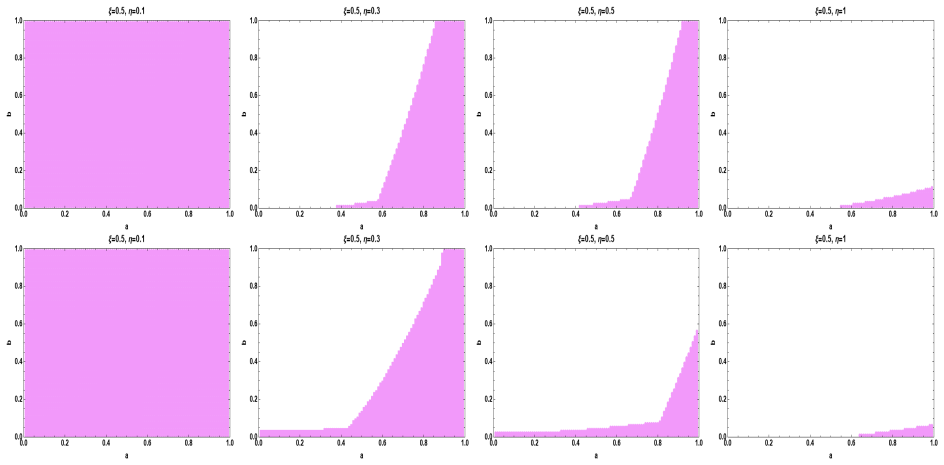
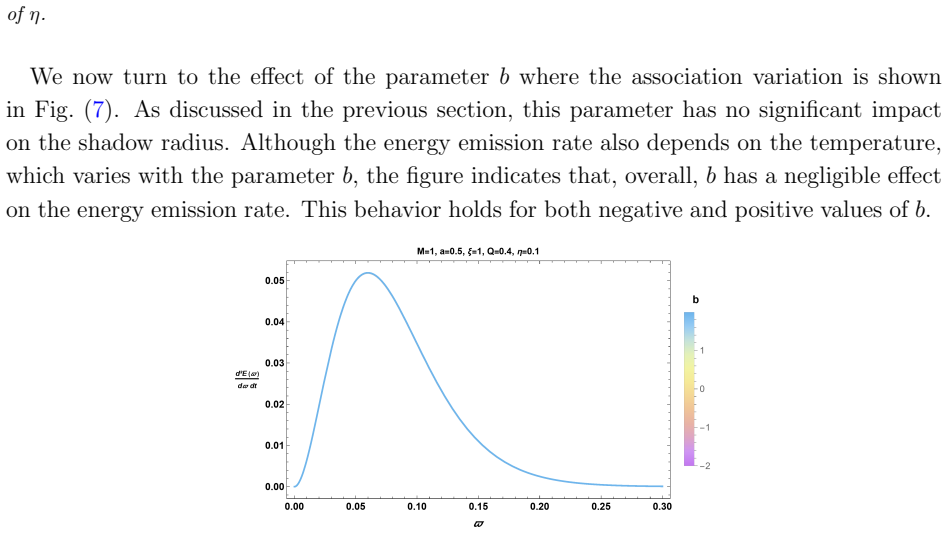
Both the shadow structure and the energy emission rate depend on the global monopole parameter, the electric charge, and the rotation parameter. However, the Euler-Heisenberg nonlinear parameter does not significantly affect either the shadow or the energy emission rate. A CUDA-based computational approach establishes strict bounds on the GM parameter, the electric charge, and the rotation parameter to reconcile the predictions with Event Horizon Telescope observations.
What carries the argument
CUDA-accelerated numerical integration of null geodesics using the Hamilton-Jacobi formalism in the rotating charged Euler-Heisenberg metric with global monopoles.
If this is right
- Increasing the global monopole parameter enlarges the black hole shadow.
- Higher electric charge and faster rotation also enlarge or distort the shadow.
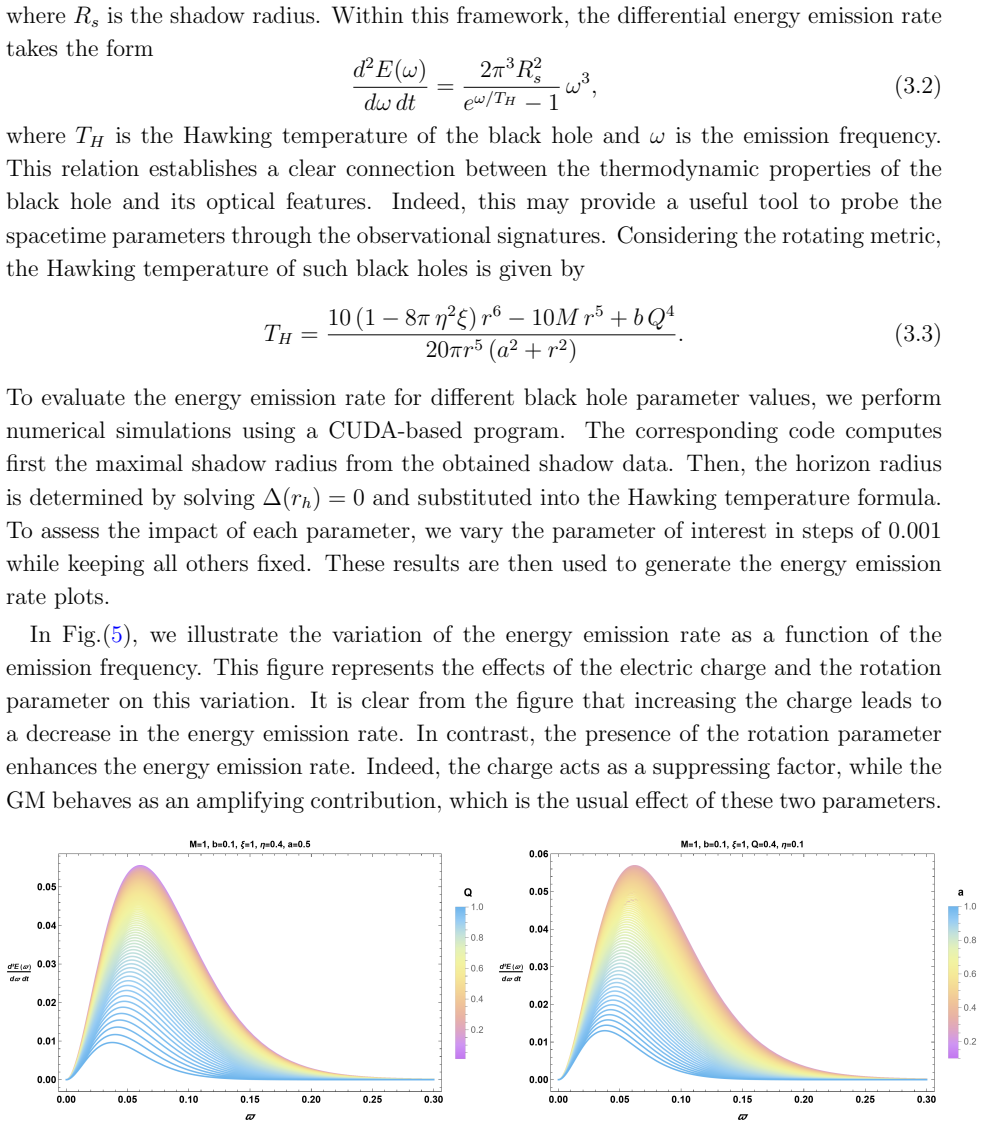
- The energy emission rate increases with the monopole parameter, charge and rotation rate.
- The nonlinear Euler-Heisenberg term can be neglected for shadow and emission calculations.
- Event Horizon Telescope data translate into concrete upper bounds on the allowed values of the three parameters.
Where Pith is reading between the lines
- The same CUDA ray-tracing pipeline could be applied to other nonlinear electrodynamics or modified-gravity models to test their shadow predictions against future telescope data.
- The observed insensitivity to the nonlinear parameter suggests that classical Maxwell electrodynamics suffices for shadow phenomenology in this class of solutions.
- If global monopoles are present, their density would leave a measurable imprint on the silhouettes of supermassive black holes observed at higher resolution.
Load-bearing premise
The assumed metric is the correct spacetime geometry around a rotating charged Euler-Heisenberg black hole with a global monopole and the ray-tracing code faithfully reproduces the null geodesics without numerical artifacts.
What would settle it
A high-resolution shadow observation that exhibits clear dependence on the Euler-Heisenberg nonlinear parameter or that falls outside the derived bounds on monopole strength, charge and rotation would contradict the central results.
Figures





read the original abstract
Combining high-performance CUDA numerical codes with the Hamilton--Jacobi formalism, we investigate the shadows properties of rotating charged Euler--Heisenberg black holes in the presence of global monopoles. Then, we discuss the associated energy emission rate by varying the involved black hole parameters. As a result, we show that both the shadow structure and the energy emission rate depend on the global monopole parameter, the electric charge, and the rotation parameter. However, we observe that the Euler--Heisenberg nonlinear parameter does not significantly affect either the shadow or the energy emission rate. In order to reconcile the present theoretical predictions with the shadow observations reported by the Event Horizon Telescope collaboration, we employ a CUDA-based computational approach to establish strict bounds on the GM parameter, the electric charge, and the rotation parameter.
Editorial analysis
A structured set of objections, weighed in public.
Referee Report
Summary. The manuscript combines CUDA numerical codes with the Hamilton-Jacobi formalism to study shadows and energy emission rates of rotating charged Euler-Heisenberg black holes with global monopoles. It claims that both the shadow structure and energy emission rate depend on the global monopole parameter, electric charge, and rotation parameter, but are insensitive to the Euler-Heisenberg nonlinear parameter. Bounds on the first three parameters are derived to match Event Horizon Telescope observations.
Significance. If the numerical results are reliable, the reported insensitivity to the nonlinear parameter would be a useful simplification for modeling such black holes, and the parameter bounds could constrain exotic solutions against real data. The CUDA approach facilitates exploration of complex metrics beyond analytic reach.
major comments (2)
- Numerical Methods section: The CUDA implementation of Hamilton-Jacobi ray-tracing is not validated against known analytic limits, such as the Schwarzschild photon-sphere radius r=3M or the Kerr shadow boundary. This validation is required to establish that the reported null dependence on the nonlinear parameter and the quoted EHT bounds are not due to truncation errors or incorrect metric insertion in the effective potential.
- Section on observational constraints: The bounds on the global monopole, charge, and rotation parameters are obtained by tuning the model until the computed shadow matches the EHT measurement. This direct fitting procedure, rather than an independent prediction from the metric, weakens the claim that the CUDA runs 'establish strict bounds' and introduces circularity between the theoretical setup and the target observable.
minor comments (2)
- Abstract: The phrase 'strict bounds' is used without specifying the quantitative matching criterion (e.g., shadow diameter within a stated sigma of the EHT value) or reporting uncertainties from the numerical runs.
- Figures: Shadow plots for varying parameters would be clearer if they overlaid the EHT observational contour or error region for direct visual assessment of the claimed agreement.
Simulated Author's Rebuttal
We thank the referee for the constructive comments, which help strengthen the manuscript. We address each major point below and will revise the paper accordingly.
read point-by-point responses
-
Referee: Numerical Methods section: The CUDA implementation of Hamilton-Jacobi ray-tracing is not validated against known analytic limits, such as the Schwarzschild photon-sphere radius r=3M or the Kerr shadow boundary. This validation is required to establish that the reported null dependence on the nonlinear parameter and the quoted EHT bounds are not due to truncation errors or incorrect metric insertion in the effective potential.
Authors: We agree that explicit validation against analytic limits is necessary to confirm the numerical reliability. In the revised manuscript we will add a new subsection to the Numerical Methods section that directly compares our CUDA ray-tracing output with the known Schwarzschild photon-sphere radius (r=3M) and with the Kerr shadow boundary for several spin values. These tests will verify correct insertion of the metric into the effective potential and will rule out truncation or implementation errors as the source of the reported insensitivity to the Euler-Heisenberg parameter. revision: yes
-
Referee: Section on observational constraints: The bounds on the global monopole, charge, and rotation parameters are obtained by tuning the model until the computed shadow matches the EHT measurement. This direct fitting procedure, rather than an independent prediction from the metric, weakens the claim that the CUDA runs 'establish strict bounds' and introduces circularity between the theoretical setup and the target observable.
Authors: We acknowledge the referee’s concern about the language used to describe the constraints. Our procedure evaluates the shadow radius over a grid of the three parameters and retains only those values whose predicted shadow lies inside the EHT uncertainty interval; this is a standard consistency check rather than a fit of the metric itself. Nevertheless, to remove any ambiguity we will revise the text to replace “establish strict bounds” with “derive observational constraints” and will add a short paragraph clarifying that the comparison is performed after the metric and ray-tracing are fully specified. This change addresses the perception of circularity while preserving the scientific result. revision: partial
Circularity Check
No significant circularity; standard numerical parameter exploration and observational constraints
full rationale
The paper applies the Hamilton-Jacobi formalism to null geodesics in a given rotating charged Euler-Heisenberg metric with global monopoles, then uses CUDA ray-tracing to numerically compute shadow boundaries and energy emission rates while varying the global monopole, charge, rotation, and nonlinear parameters. Dependence on parameters is reported from this exploration, and bounds are set by requiring the computed shadow to be consistent with EHT data. This constitutes standard model exploration and parameter constraint from observation, not a derivation that reduces to its own inputs by construction. No self-definitional steps, fitted inputs renamed as predictions, load-bearing self-citations, or ansatz smuggling are present in the abstract or described chain. The numerical implementation may require external validation for correctness, but that does not create circularity in the logical structure.
Axiom & Free-Parameter Ledger
free parameters (3)
- global monopole parameter
- electric charge
- rotation parameter
axioms (2)
- domain assumption The spacetime metric of a rotating charged Euler-Heisenberg black hole with global monopoles is given and correct
- standard math Hamilton-Jacobi formalism yields the correct null geodesics for shadow calculation
Lean theorems connected to this paper
-
IndisputableMonolith/Foundation/AlexanderDuality.leanalexander_duality_circle_linking unclear?
unclearRelation between the paper passage and the cited Recognition theorem.
Combining high-performance CUDA numerical codes with the Hamilton–Jacobi formalism, we investigate the shadows properties of rotating charged Euler–Heisenberg black holes in the presence of global monopoles.
-
IndisputableMonolith/Foundation/BlackBodyRadiationDeep.leanblackBodyRadiationDeepCert unclear?
unclearRelation between the paper passage and the cited Recognition theorem.
the differential energy emission rate takes the form d²E(ω)/dω dt = 2π³ R_s² ω³ / (e^{ω/T_H} – 1)
What do these tags mean?
- matches
- The paper's claim is directly supported by a theorem in the formal canon.
- supports
- The theorem supports part of the paper's argument, but the paper may add assumptions or extra steps.
- extends
- The paper goes beyond the formal theorem; the theorem is a base layer rather than the whole result.
- uses
- The paper appears to rely on the theorem as machinery.
- contradicts
- The paper's claim conflicts with a theorem or certificate in the canon.
- unclear
- Pith found a possible connection, but the passage is too broad, indirect, or ambiguous to say the theorem truly supports the claim.
Reference graph
Works this paper leans on
-
[1]
S. W. Hawking, D. N. Page,Thermodynamics of black holes in anti-de Sitter space, Commun. Math. Phys. 87 (4) 577 (1983)
1983
- [2]
- [3]
-
[4]
Belhaj, H
A. Belhaj, H. Belmahi, M. Benali, Y. Hassouni, M. B. Sedra,Optical behaviors of black holes in Starobinsky-Bel-Robinson gravity, Gen.Rel.Grav. 55 110 (2023)
2023
-
[5]
H. Belmahi,Constrained Deflection Angle and Shadows of Rotating Black Holes in Einstein-Maxwell-scalar Theory,arXiv:2411.11622
-
[6]
Event Horizon Telescope Collaboration.First M87 Event Horizon Telescope results. I. The shadow of the supermassive black hole, the Astrophysical Journal Letters, 875 1 L1 (2019)
2019
-
[7]
Event Horizon Telescope Collaboration.First Sagittarius A Event Horizon Telescope results. I. The shadow of the supermassive black hole in the center of the Milky Way the Astrophysical Journal Letters, 930 2 L12 (2022)
2022
-
[8]
Akiyama et al., First M87 Event Horizon Telescope Results
K. Akiyama and al.,First M87 Event Horizon Telescope Results. IV. Imaging the Cen- tral Supermassive Black Hole, Astrophys. J. 875 L4 (2019),arXiv:1906.11241
-
[9]
Akiyama and al.,First M87 Event Horizon Telescope Results
K. Akiyama and al.,First M87 Event Horizon Telescope Results. V. Imaging the Central Supermassive Black Hole, Astrophys. J. 875 L5 (2019)
2019
-
[10]
Akiyama and al.,First M87 Event Horizon Telescope Results
K. Akiyama and al.,First M87 Event Horizon Telescope Results. VI. Imaging the Cen- tral Supermassive Black Hole, Astrophys. J. 875 L6 (2019)
2019
-
[11]
R. A. Konoplya, A. Zhidenko,Quasinormal modes of black holes: From astrophysics to string theory, Rev. Mod. Phys. 83 793 (2011),arXiv:1102.4014 [gr-qc]
work page internal anchor Pith review arXiv 2011
- [12]
-
[13]
T. W. B. Kibble,Topology of cosmic domains and strings, J. Phys. A 9, 1387 (1976)
1976
-
[14]
Vilenkin,Cosmic strings and domain walls, Phys
A. Vilenkin,Cosmic strings and domain walls, Phys. Rep. 121, 263 (1985)
1985
- [15]
-
[16]
P. Sedaghatnia, H. Hassanabadi, A. A. Ara´ ujo Filho,P. J. Porfirio, and W. S. Chung, Thermodynamical properties of a deformed Schwarzschild black hole via Dunkl general- ization,Int.J.Mod.Phys.A 40 07 2550019 (2025),arXiv:2302.11460
- [17]
- [18]
-
[19]
Elafrou, G
A. Elafrou, G. Thomas Collignon,Introduction to CUDA Performance Optimization, Nvidia
-
[20]
Nvidia,CUDA C++ Programming Guide
- [21]
-
[22]
P. Berczik, R. Spurzem, L. Wang, S. Zhong, O. Veles, I. Zinchenko, S. Huang, M. Tsai, G. Kennedy, S. Li, L. Naso, and C. Li,Up to 700k GPU cores, Kepler, and the Ex ascale future for simulations of star clusters around black holes,arXiv:1312.1789 [astro-ph.IM]
- [23]
-
[24]
R. Ginjupalli and G. Khanna,High-Precision Numerical Simulations of Rotating Black Holes Accelerated by CUDA,arXiv:1006.0663 [physics.comp-ph]
-
[25]
Janis-Newman algorithm: generating rotating and NUT charged black holes
H. Erbin,Janis- Newman algorithm: generating rotating and NUT charged black holes, Universe 3 19 (2017),arXiv:1701.00037 [gr-qc]
work page Pith review arXiv 2017
-
[26]
A. Kamenshchik, P. Petriakova,Newman–Janis algorithm’s application to regular black hole models, Phys. Rev. D107, 124020 (2023),arXiv:2305.04697 [gr-qc]
- [27]
-
[28]
D. Magos, N. Bret` on,Thermodynamics of the Euler-Heisenberg-AdS black hole, Phys. Rev. D 102, 084011 (2020),arXiv:2009.05904 [gr-qc]
- [29]
-
[30]
Charged AdS Black Holes and Catastrophic Holography
A. Chamblin, R. Emparan, C. V. Johnson, and R. C. Myers,Charged AdS Black Holes and Catastrophic Holography, Phys. Rev. D 60, 064018 (1999),arXiv:hep-th/9902170
work page Pith review arXiv 1999
- [31]
-
[32]
Y. D ˆA´ecanini, A. Folacci, G. Esposito-Far‘ese,Universality of high-energy absorp- tion cross sections for black holes, Phys. Rev. D 83 044032 (2011),arXiv:1101.0781 [gr-qc]
- [33]
-
[34]
V. Perlick,Calculating black hole shadows: Review of analytical studies,Phys. Rep. 924 1 (2022),arXiv:2105.07101 [gr-qc]
-
[35]
Kocherlakota et al
P. Kocherlakota et al. [Event Horizon Telescope],Constraints on black-hole charges with the 2017 EHT observations of M87*, Phys. Rev. D 103, no.10 104047 (2021)
2017
-
[36]
Chakhchi, H
L. Chakhchi, H. El Moumni and K. Masmar,Signatures of the accelerating black holes with a cosmological constant from the Sgr A* and M87* shadow prospects, Phys. Dark Univ. 44 101501 (2024)
2024
-
[37]
D. J. Gogoi and S. Ponglertsakul,Constraints on quasinormal modes from black hole shadows in regular non-minimal Einstein Yang Mills gravity, Eur. Phys. J. C 84, no.6 652 (2024). 18
2024
discussion (0)
Sign in with ORCID, Apple, or X to comment. Anyone can read and Pith papers without signing in.