Recognition: unknown
TOPCELL: Topology Optimization of Standard Cell via LLMs
Pith reviewed 2026-05-10 14:09 UTC · model grok-4.3
The pith
By reframing transistor topology search as a generative task, fine-tuned large language models produce standard cell layouts that match exhaustive solvers while running 86 times faster.
A machine-rendered reading of the paper's core claim, the machinery that carries it, and where it could break.
Core claim
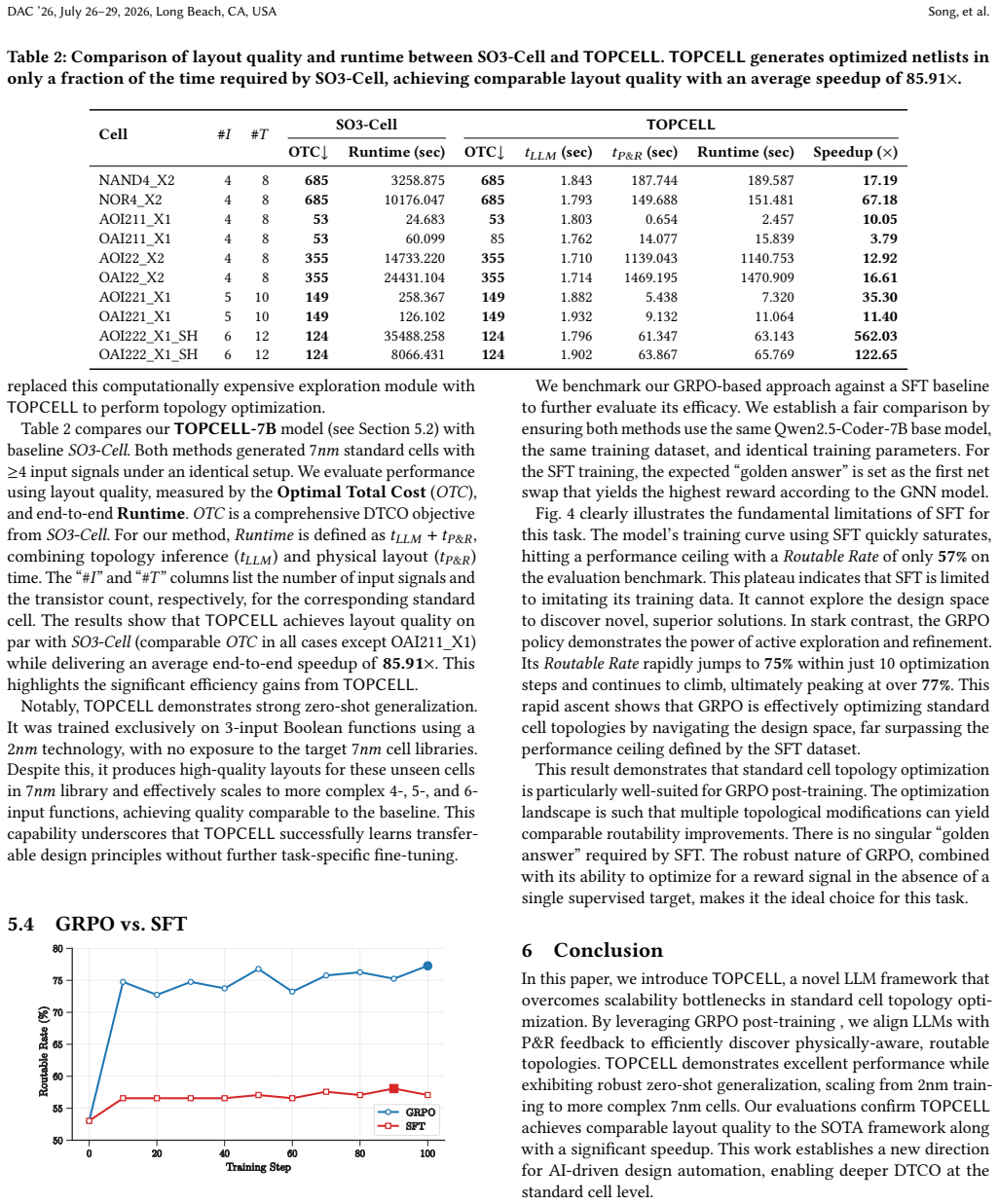
TOPCELL reformulates high-dimensional topology exploration as a generative task using large language models. Group Relative Policy Optimization fine-tunes the model to align generated topologies with logical circuit constraints and spatial layout constraints. On an advanced 2 nm technology node the method outperforms base models in producing routable, physically-aware topologies. When inserted into a state-of-the-art automation flow for 7 nm library generation, it matches the layout quality of exhaustive solvers while delivering an 85.91 times speedup and exhibits robust zero-shot generalization to new cases.
What carries the argument
A large language model fine-tuned via Group Relative Policy Optimization to generate transistor topologies that satisfy both logical and spatial constraints.
If this is right
- Standard-cell library creation becomes practical for circuits too complex for exhaustive enumeration.
- Existing industrial automation flows can adopt the generator without redesigning the surrounding toolchain.
- Zero-shot transfer to new technology nodes reduces repeated training costs when moving between process generations.
- Design teams can iterate cell libraries faster, shortening the overall time from architecture to tape-out.
Where Pith is reading between the lines
- The same generative framing could be tried on neighboring layout problems such as power-grid planning or pin assignment.
- Interactive tools might let engineers prompt the model for topology variants under different area or performance targets.
- Combining the generator with fast physical simulation feedback loops could tighten constraint satisfaction without losing speed.
- If constraint violations remain rare, the method could support fully automated library expansion for entire standard-cell families.
Load-bearing premise
The fine-tuning step produces topologies that already meet all logical and spatial constraints at scale, so no post-processing or extra validation is needed that would cancel the reported speedup.
What would settle it
Running the method on a high-transistor-count cell and measuring whether post-hoc fixes or constraint checks add enough time to erase the 85.91 times advantage over exhaustive search.
Figures


read the original abstract
Transistor topology optimization is a critical step in standard cell design, directly dictating diffusion sharing efficiency and downstream routability. However, identifying optimal topologies remains a persistent bottleneck, as conventional exhaustive search methods become computationally intractable with increasing circuit complexity in advanced nodes. This paper introduces TOPCELL, a novel and scalable framework that reformulates high-dimensional topology exploration as a generative task using Large Language Models (LLMs). We employ Group Relative Policy Optimization (GRPO) to fine-tune the model, aligning its topology optimization strategy with logical (circuit) and spatial (layout) constraints. Experimental results within an industrial flow targeting an advanced 2nm technology node demonstrate that TOPCELL significantly outperforms foundation models in discovering routable, physically-aware topologies. When integrated into a state-of-the-art (SOTA) automation flow for a 7nm library generation task, TOPCELL exhibits robust zero-shot generalization and matches the layout quality of exhaustive solvers while achieving an 85.91x speedup.
Editorial analysis
A structured set of objections, weighed in public.
Referee Report
Summary. The paper introduces TOPCELL, a framework that reformulates transistor topology optimization for standard cell design as a generative task using LLMs fine-tuned via Group Relative Policy Optimization (GRPO) to align with logical and spatial constraints. It claims superior performance over foundation models and, when integrated into a SOTA automation flow for a 7nm library generation task, matches the layout quality of exhaustive solvers while delivering an 85.91x speedup with robust zero-shot generalization.
Significance. If the empirical claims are substantiated with full experimental details, the work could provide a practical acceleration for a known bottleneck in advanced-node EDA flows by repurposing LLM alignment techniques for constrained combinatorial generation. The reported speedup and quality parity would represent a meaningful engineering contribution if the outputs require no substantial post-processing.
major comments (2)
- [Abstract] Abstract: The headline claims of 85.91x speedup and matching layout quality are presented without any description of the experimental protocol, test circuits, baseline implementations, number of samples, validity rate of generated topologies, or statistical measures. This absence makes the central empirical result impossible to evaluate or reproduce from the given text.
- [Abstract] Abstract: The speedup and zero-shot generalization claims rest on the unverified assumption that GRPO outputs satisfy all circuit-logic and layout-spatial constraints out of the box. No data on the fraction of valid generations, rejection rate, or runtime overhead of any downstream validation/repair pipeline is supplied; if such steps are required, the net advantage over exhaustive solvers is not demonstrated.
Simulated Author's Rebuttal
We thank the referee for the constructive comments, which help clarify the presentation of our empirical results. We address each major comment point by point below. The full experimental details are in the manuscript body, but we agree the abstract should be expanded for self-containment and will revise accordingly.
read point-by-point responses
-
Referee: [Abstract] Abstract: The headline claims of 85.91x speedup and matching layout quality are presented without any description of the experimental protocol, test circuits, baseline implementations, number of samples, validity rate of generated topologies, or statistical measures. This absence makes the central empirical result impossible to evaluate or reproduce from the given text.
Authors: We acknowledge that the abstract prioritizes brevity and omits granular protocol details. These are fully specified in Section 4 (Experimental Setup), which covers the 2nm/7nm industrial flows, specific test circuits from standard cell libraries, baseline implementations (foundation LLMs and exhaustive solvers), sample counts (multiple runs with 1000+ generations), validity rates, and statistical measures (means, standard deviations). Section 5 reports the results with tables and figures. To improve accessibility, we will revise the abstract to concisely reference the evaluation protocol, key test cases, and metrics while retaining the headline claims. revision: yes
-
Referee: [Abstract] Abstract: The speedup and zero-shot generalization claims rest on the unverified assumption that GRPO outputs satisfy all circuit-logic and layout-spatial constraints out of the box. No data on the fraction of valid generations, rejection rate, or runtime overhead of any downstream validation/repair pipeline is supplied; if such steps are required, the net advantage over exhaustive solvers is not demonstrated.
Authors: GRPO is explicitly trained to enforce logical and spatial constraints, and experiments confirm high out-of-the-box validity. Section 5.2 and 5.3 report validity fractions exceeding 95% in zero-shot 7nm tests, near-zero rejection rates, and end-to-end speedup measurements (85.91x) that include any negligible validation overhead—far smaller than exhaustive search costs. No substantial repair pipeline is applied in the reported flows. We will add a clarifying clause to the abstract stating the validity rates and confirming the net speedup with minimal post-processing. revision: yes
Circularity Check
No circularity in derivation chain; empirical LLM application
full rationale
The paper frames TOPCELL as an empirical application of existing LLM techniques (specifically GRPO fine-tuning) to reformulate topology optimization as a generative task. No equations, derivations, or first-principles results are presented that reduce to fitted parameters, self-definitions, or self-citation chains. Experimental claims of matching exhaustive solver quality with 85.91x speedup are supported by integration into an industrial flow and zero-shot generalization tests, not by any closed-loop theoretical reduction. No load-bearing self-citations, ansatz smuggling, or renaming of known results appear in the provided text. The work is self-contained against external benchmarks via direct comparison to SOTA automation flows.
Axiom & Free-Parameter Ledger
Reference graph
Works this paper leans on
-
[1]
Josh Achiam, Steven Adler, Sandhini Agarwal, Lama Ahmad, Ilge Akkaya, Floren- cia Leoni Aleman, Diogo Almeida, Janko Altenschmidt, Sam Altman, Shyamal Anadkat, et al. 2023. Gpt-4 technical report.arXiv preprint arXiv:2303.08774 (2023)
work page internal anchor Pith review Pith/arXiv arXiv 2023
-
[2]
Robert Brayton and Alan Mishchenko. 2010. ABC: An academic industrial- strength verification tool. InComputer Aided Verification: 22nd International Conference, CA V 2010, Edinburgh, UK, July 15-19, 2010. Proceedings 22. Springer, 24–40
2010
-
[3]
Alessandro Tempia Calvino, Alan Mishchenko, Herman Schmit, Ethan Mahin- torabi, Giovanni De Micheli, and Xiaoqing Xu. 2023. Improving standard-cell design flow using factored form optimization. In2023 60th ACM/IEEE Design Automation Conference (DAC). IEEE, 1–6
2023
- [4]
-
[5]
Chung-Kuan Cheng, Andrew B Kahng, Byeonggon Kang, Seokhyeong Kang, Jakang Lee, and Bill Lin. [n. d.]. SO3-Cell: Standard Cell Layout Automation Framework for Simultaneous Optimization of Topology, Placement, and Routing. ([n. d.])
-
[6]
Chung-Kuan Cheng, Byeonggon Kang, Bill Lin, and Yucheng Wang. 2025. Stan- dard Cell Layout Generation: Review, Challenges, and Future Works. InProceed- ings of the 30th Asia and South Pacific Design Automation Conference. 372–378
2025
-
[7]
Sehyeon Chung, Hyunbae Seo, Handong Cho, Kyumyung Choi, and Taewhan Kim. 2024. Optimal Layout Synthesis of Multi-Row Standard Cells for Advanced Technology Nodes. InProceedings of the 43rd IEEE/ACM International Conference on Computer-Aided Design. 1–8
2024
-
[8]
Gheorghe Comanici, Eric Bieber, Mike Schaekermann, Ice Pasupat, Noveen Sachdeva, Inderjit Dhillon, Marcel Blistein, Ori Ram, Dan Zhang, Evan Rosen, et al. 2025. Gemini 2.5: Pushing the frontier with advanced reasoning, multi- modality, long context, and next generation agentic capabilities.arXiv preprint arXiv:2507.06261(2025)
work page internal anchor Pith review Pith/arXiv arXiv 2025
-
[9]
Matthias Fey and Jan Eric Lenssen. 2019. Fast graph representation learning with PyTorch Geometric.arXiv preprint arXiv:1903.02428(2019)
work page internal anchor Pith review arXiv 2019
-
[10]
Yonggan Fu, Yongan Zhang, Zhongzhi Yu, Sixu Li, Zhifan Ye, Chaojian Li, Cheng Wan, and Yingyan Celine Lin. 2023. Gpt4aigchip: Towards next-generation ai accelerator design automation via large language models. In2023 IEEE/ACM International Conference on Computer Aided Design (ICCAD). IEEE, 1–9
2023
-
[11]
Aaron Grattafiori, Abhimanyu Dubey, Abhinav Jauhri, Abhinav Pandey, Abhishek Kadian, Ahmad Al-Dahle, Aiesha Letman, Akhil Mathur, Alan Schelten, Alex Vaughan, et al. 2024. The llama 3 herd of models.arXiv preprint arXiv:2407.21783 (2024)
work page internal anchor Pith review Pith/arXiv arXiv 2024
-
[12]
Daya Guo, Dejian Yang, Haowei Zhang, Junxiao Song, Ruoyu Zhang, Runxin Xu, Qihao Zhu, Shirong Ma, Peiyi Wang, Xiao Bi, et al . 2025. Deepseek-r1: Incentivizing reasoning capability in llms via reinforcement learning.arXiv preprint arXiv:2501.12948(2025)
work page internal anchor Pith review Pith/arXiv arXiv 2025
-
[13]
Daya Guo, Qihao Zhu, Dejian Yang, Zhenda Xie, Kai Dong, Wentao Zhang, Guanting Chen, Xiao Bi, Yu Wu, YK Li, et al. 2024. DeepSeek-Coder: When the Large Language Model Meets Programming–The Rise of Code Intelligence.arXiv preprint arXiv:2401.14196(2024)
work page internal anchor Pith review arXiv 2024
-
[14]
Kairong Guo and Yibo Lin. 2025. Multi-row standard cell layout synthesis with enhanced scalability. In2025 International Symposium of Electronics Design Au- tomation (ISEDA). IEEE, 317–323
2025
-
[15]
Chia-Tung Ho, Alvin Ho, Matthew Fojtik, Minsoo Kim, Shang Wei, Yaguang Li, Brucek Khailany, and Haoxing Ren. 2023. NVCell 2: Routability-driven standard cell layout in advanced nodes with lattice graph routability model. InProceedings of the 2023 International Symposium on Physical Design. 44–52
2023
-
[16]
Chia-Tung Ho and Haoxing Ren. 2024. Large language model (LLM) for standard cell layout design optimization. In2024 IEEE LLM Aided Design Workshop (LAD). IEEE, 1–6
2024
-
[17]
Hao-Hsiang Hsiao, Yi-Chen Lu, Sung Kyu Lim, and Haoxing Ren. 2025. BUFFALO: PPA-Configurable, LLM-based Buffer Tree Generation via Group Relative Policy Optimization. InProceedings of the 44th IEEE/ACM International Conference on Computer-Aided Design (ICCAD)
2025
-
[18]
Binyuan Hui, Jian Yang, Zeyu Cui, Jiaxi Yang, Dayiheng Liu, Lei Zhang, Tianyu Liu, Jiajun Zhang, Bowen Yu, Keming Lu, et al. 2024. Qwen2. 5-coder technical report.arXiv preprint arXiv:2409.12186(2024)
work page internal anchor Pith review Pith/arXiv arXiv 2024
-
[19]
Albert Q Jiang, Alexandre Sablayrolles, Arthur Mensch, Chris Bamford, De- vendra Singh Chaplot, Diego de las Casas, Florian Bressand, Gianna Lengyel, Guillaume Lample, Lucile Saulnier, et al . 2023. Mistral 7B.arXiv preprint arXiv:2310.06825(2023)
work page internal anchor Pith review Pith/arXiv arXiv 2023
-
[20]
Minwei Lin, Duy-Hieu Bui, Chao Wang, Wangzilu Lu, Ruoyu Tang, Qing Zhang, Yuhang Zhang, Jian Zhao, Xuan-Tu Tran, and Yongfu Li. 2025. LogicCraft: LLM- Assisted Optimization of Netlist to Layout for Complex Custom Standard Cell Designs. In2025 IEEE 7th International Conference on Artificial Intelligence Circuits and Systems (AICAS). IEEE, 1–5
2025
-
[21]
Aixin Liu, Bei Feng, Bing Xue, Bingxuan Wang, Bochao Wu, Chengda Lu, Cheng- gang Zhao, Chengqi Deng, Chenyu Zhang, Chong Ruan, et al. 2024. Deepseek-v3 technical report.arXiv preprint arXiv:2412.19437(2024)
work page internal anchor Pith review Pith/arXiv arXiv 2024
-
[22]
Mingjie Liu, Nathaniel Pinckney, Brucek Khailany, and Haoxing Ren. 2023. Ver- ilogeval: Evaluating large language models for verilog code generation. In2023 IEEE/ACM International Conference on Computer Aided Design (ICCAD). IEEE, 1–8
2023
-
[23]
Mingju Liu, Daniel Robinson, Yingjie Li, Johannes Maximilian Kuehn, Rongjian Liang, Haoxing Ren, and Cunxi Yu. 2026. Maptune: Versatile asic technology mapping via reinforcement learning guided library tuning.ACM Transactions on Design Automation of Electronic Systems31, 4 (2026), 1–21
2026
-
[24]
Mingju Liu, Daniel Robinson, Yingjie Li, and Cunxi Yu. 2024. Maptune: Advancing asic technology mapping via reinforcement learning guided library tuning. In Proceedings of the 43rd IEEE/ACM International Conference on Computer-Aided Design. 1–10
2024
-
[25]
Shang Liu, Wenji Fang, Yao Lu, Jing Wang, Qijun Zhang, Hongce Zhang, and Zhiyao Xie. 2024. RTLCoder: Fully open-source and efficient LLM-assisted RTL code generation technique.IEEE Transactions on Computer-Aided Design of Integrated Circuits and Systems(2024)
2024
-
[26]
Neel Rajani, Aryo Pradipta Gema, Seraphina Goldfarb-Tarrant, and Ivan Titov
-
[27]
Hammer: GRPO Amplifies Existing Capabilities, SFT Replaces Them , author=
Scalpel vs. Hammer: GRPO Amplifies Existing Capabilities, SFT Replaces Them.arXiv preprint arXiv:2507.10616(2025)
-
[28]
Haoxing Ren and Matthew Fojtik. 2021. Nvcell: Standard cell layout in advanced technology nodes with reinforcement learning. In2021 58th ACM/IEEE Design Automation Conference (DAC). IEEE, 1291–1294
2021
-
[29]
Baptiste Roziere, Jonas Gehring, Fabian Gloeckle, Sten Sootla, Itai Gat, Xiao- qing Ellen Tan, Yossi Adi, Jingyu Liu, Romain Sauvestre, Tal Remez, et al. 2023. Code llama: Open foundation models for code.arXiv preprint arXiv:2308.12950 (2023)
work page internal anchor Pith review arXiv 2023
-
[30]
Fabrice Salvaire. 2021. PySpice. https://pyspice.fabrice-salvaire.fr. Version 1.5, released 2021-05-15
2021
-
[31]
John Schulman, Filip Wolski, Prafulla Dhariwal, Alec Radford, and Oleg Klimov
-
[32]
Proximal policy optimization algorithms.arXiv preprint arXiv:1707.06347 (2017)
work page internal anchor Pith review Pith/arXiv arXiv 2017
-
[33]
Zhihong Shao, Peiyi Wang, Qihao Zhu, Runxin Xu, Junxiao Song, Xiao Bi, Haowei Zhang, Mingchuan Zhang, YK Li, Yang Wu, et al. 2024. Deepseekmath: Pushing the limits of mathematical reasoning in open language models.arXiv preprint arXiv:2402.03300(2024)
work page internal anchor Pith review Pith/arXiv arXiv 2024
-
[34]
Guangming Sheng, Chi Zhang, Zilingfeng Ye, Xibin Wu, Wang Zhang, Ru Zhang, Yanghua Peng, Haibin Lin, and Chuan Wu. 2025. Hybridflow: A flexible and efficient rlhf framework. InProceedings of the Twentieth European Conference on Computer Systems. 1279–1297
2025
-
[35]
Xi Wang, Gwok-Waa Wan, Sam-Zaak Wong, Layton Zhang, Tianyang Liu, Qi Tian, and Jianmin Ye. 2024. Chatcpu: An agile cpu design and verification platform with llm. InProceedings of the 61st ACM/IEEE Design Automation Conference. 1–6
2024
- [36]
-
[37]
Weihua Xiao, Shanshan Han, Yue Yang, Shaoze Yang, Cheng Zheng, Jingsong Chen, Tingyuan Liang, Lei Li, and Weikang Qian. 2023. MiniTNtk: An Exact Synthesis-based Method for Minimizing Transistor Network. In2023 IEEE/ACM International Conference on Computer Aided Design (ICCAD). IEEE, 01–09
2023
-
[38]
Kangwei Xu, Grace Li Zhang, Xunzhao Yin, Cheng Zhuo, Ulf Schlichtmann, and Bing Li. 2024. Automated c/c++ program repair for high-level synthesis via large language models. InProceedings of the 2024 ACM/IEEE International Symposium on Machine Learning for CAD. 1–9
2024
-
[39]
An Yang, Anfeng Li, Baosong Yang, Beichen Zhang, Binyuan Hui, Bo Zheng, Bowen Yu, Chang Gao, Chengen Huang, Chenxu Lv, et al. 2025. Qwen3 technical report.arXiv preprint arXiv:2505.09388(2025)
work page internal anchor Pith review Pith/arXiv arXiv 2025
- [40]
- [41]
-
[42]
Lianmin Zheng, Liangsheng Yin, Zhiqiang Xie, Chuyue Livia Sun, Jeff Huang, Cody Hao Yu, Shiyi Cao, Christos Kozyrakis, Ion Stoica, Joseph E Gonzalez, et al. 2024. Sglang: Efficient execution of structured language model programs. Advances in neural information processing systems37 (2024), 62557–62583
2024
discussion (0)
Sign in with ORCID, Apple, or X to comment. Anyone can read and Pith papers without signing in.