Recognition: unknown
Cold vs. Hot Gas Accretion and Angular Momentum in FIRE Simulations: From Halo to Galaxy Scales
Pith reviewed 2026-05-10 12:10 UTC · model grok-4.3
The pith
Gas accretion switches from cold to hot as halos virialize, setting whether stars form in bursts or steadily with disk rotation.
A machine-rendered reading of the paper's core claim, the machinery that carries it, and where it could break.
Core claim
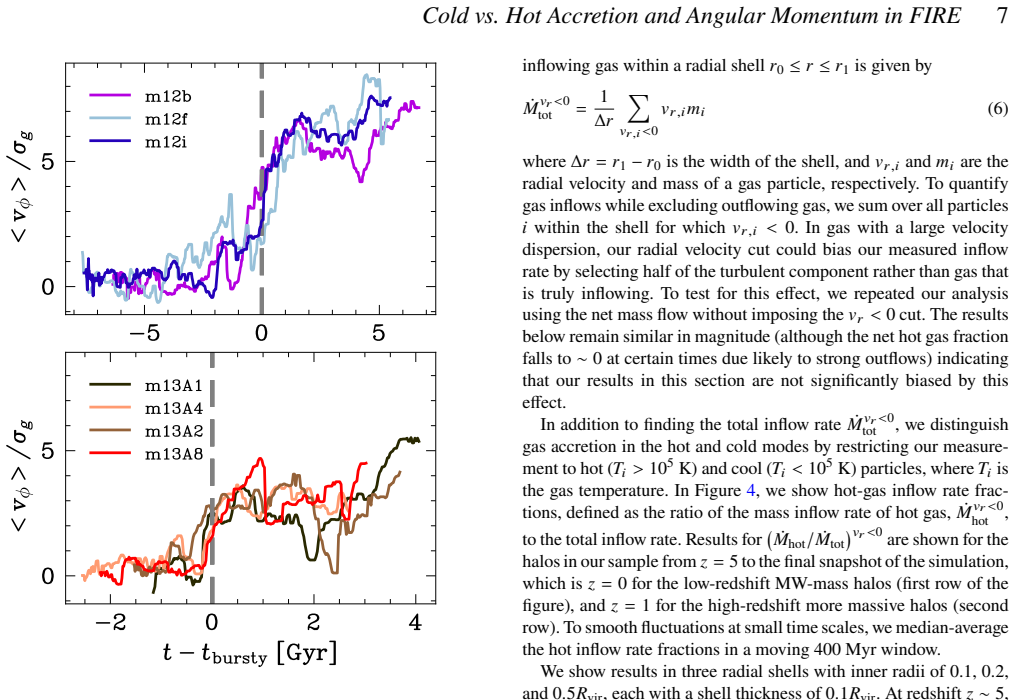
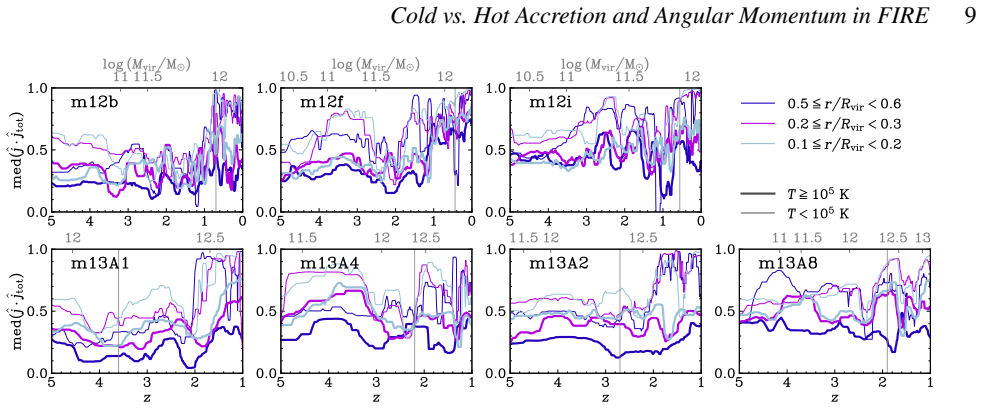
The authors find that the temperature of gas accreting onto galaxies correlates directly with whether the inner gas reservoir around the galaxy has virialized. In pre-virialized halos inflows are almost entirely cold while hot inflows dominate once virialization sets in, and in the hot case cooling proceeds together with circularization at galaxy radii. Cold inflows carry higher specific angular momentum than hot gas or dark matter, yet in bursty low-mass galaxies this gas forms stars before circularizing, whereas in steady massive galaxies the hot inflows circularize, cool, and form stars with disk-like kinematics. Accreted gas forms stars after fewer than about five galaxy free-fall times,
What carries the argument
The correlation between the temperature of accreting gas and the virialization state of the inner gas reservoir around the galaxy, which controls whether inflows circularize before forming stars and how long the gas persists before turning into stars.
If this is right
- Halos below the virialization threshold grow via rapid star formation from cold gas that never settles into stable rotation.
- Halos above the threshold sustain steady star formation because hot gas has time to gain circular motion and cool at galaxy scales.
- The higher angular momentum carried by cold inflows does not produce early disks in low-mass galaxies because star formation occurs too quickly.
- Even at high redshift where cold streams can still exist, hot inflows can dominate circularization and disk formation in massive halos.
Where Pith is reading between the lines
- Surveys could check the prediction by comparing the orbital motions of the youngest stars in low-mass versus high-mass galaxies.
- The residence-time difference implies that chemical enrichment and feedback efficiency should vary systematically with galaxy mass and star-formation steadiness.
- If the virialization threshold shifts with redshift, models should expect a corresponding shift in the mass at which disks emerge.
- Higher-resolution runs could test whether the reported free-fall time ratios remain stable when cooling and mixing are treated more finely.
Load-bearing premise
The simulations correctly capture cooling, heating, and angular-momentum changes in the gas around galaxies without being dominated by resolution limits or model choices.
What would settle it
Observations of real galaxies showing no systematic difference in the rotation of young stars or in the time between gas arrival and star formation between low-mass bursty systems and high-mass steady systems.
Figures






read the original abstract
We present a systematic study of gas accretion and angular momentum in the circumgalactic medium (CGM) using high-resolution FIRE cosmological simulations. Our analysis includes halos spanning the critical $\sim 10^{12}\ \mathrm{M}_{\odot}$ scale where several transitions have been identified, including inner CGM virialization, the transition from bursty to steady star formation, and the emergence of thin disks. We find that the temperature of inflowing gas is correlated with the virialization of the inner CGM. CGM inflows are almost entirely cold ($T < 10^5$ K) in pre-virialized halos, while hot inflows ($T > 10^5$ K) dominate in virialized halos. When hot inflows dominate, cooling generally occurs simultaneously with circularization at galaxy radii. The dominance of hot inflows onto massive galaxies persists even at high redshift, where cold streams may coexist. Consistent with previous studies, cold inflows have higher specific angular momentum than dark matter and hot gas. However, in bursty, low-mass galaxies, cold inflows do not circularize prior to star formation, while in steady, massive galaxies, hot inflows circularize, cool, and form stars with disk-like kinematics. We additionally find that in bursty galaxies, accreted gas typically forms stars after residing in the galaxy for less than $\sim 5$ galaxy free-fall times, while in steady galaxies, gas can persist for up to $\sim 25$ free-fall times before forming stars. This highlights a key difference between star formation in bursty galaxies fed by cold accretion and steady equilibrium disks fed by hot accretion.
Editorial analysis
A structured set of objections, weighed in public.
Referee Report
Summary. The manuscript analyzes gas accretion and angular momentum in the CGM using high-resolution FIRE cosmological zoom-in simulations for halos spanning the ~10^12 M_sun scale. It reports that CGM inflows are almost entirely cold (T < 10^5 K) in pre-virialized halos but hot inflows (T > 10^5 K) dominate once the inner CGM virializes; when hot inflows dominate, cooling occurs simultaneously with circularization at galaxy radii. Cold inflows carry higher specific angular momentum than dark matter or hot gas. In bursty low-mass galaxies, accreted gas forms stars after residing less than ~5 galaxy free-fall times, while in steady massive galaxies gas persists up to ~25 free-fall times before forming stars with disk-like kinematics.
Significance. If the numerical results hold, the work provides a direct link between the cold-to-hot accretion transition, inner-CGM virialization, and the shift from bursty to steady star formation, with quantitative residence-time statistics in free-fall units. The systematic halo sample and tracking of angular momentum from halo to galaxy scales offer concrete predictions for CGM observations and constraints on subgrid models. The simulation-based approach supplies falsifiable, resolution-dependent measurements rather than fitted parameters.
major comments (2)
- [Methods and §4] Methods and §4 (Results on temperature and timescales): No resolution convergence tests or subgrid variations are presented for the inner CGM (r ≲ 0.1 R_vir), where the cold/hot inflow fractions, simultaneous cooling-circularization, and <5 vs ~25 free-fall-time statistics are measured. These quantities are sensitive to metal-line cooling, thermal conduction, and torque resolution; without demonstrated convergence, the reported dichotomy and bursty-vs-steady contrast remain vulnerable to numerical artifacts.
- [§3 and temperature analysis] §3 (virialization definition) and temperature analysis: The correlation between inflow temperature and inner-CGM virialization is central, yet the manuscript does not quantify how the adopted T = 10^5 K threshold or the precise virialization criterion (e.g., t_cool/t_ff or entropy) affects the reported dominance fractions; small shifts in these definitions could weaken or strengthen the claimed transition.
minor comments (2)
- [Abstract and §2] Abstract and §2: The specific FIRE version (FIRE-2 or FIRE-3) and the mass resolution in the inner CGM should be stated explicitly so readers can assess the applicability of the results.
- [Figures] Figure captions: Panels showing inflow properties should list the halo mass, redshift, and virialization state for each example to improve traceability of the trends.
Simulated Author's Rebuttal
We thank the referee for the positive evaluation of our work's significance and for the detailed comments. We address each major comment below, agreeing on the need for additional tests and planning revisions accordingly.
read point-by-point responses
-
Referee: [Methods and §4] Methods and §4 (Results on temperature and timescales): No resolution convergence tests or subgrid variations are presented for the inner CGM (r ≲ 0.1 R_vir), where the cold/hot inflow fractions, simultaneous cooling-circularization, and <5 vs ~25 free-fall-time statistics are measured. These quantities are sensitive to metal-line cooling, thermal conduction, and torque resolution; without demonstrated convergence, the reported dichotomy and bursty-vs-steady contrast remain vulnerable to numerical artifacts.
Authors: We acknowledge the importance of demonstrating numerical convergence for these key quantities in the inner CGM. While the FIRE simulations have been validated for convergence in global galaxy properties across multiple resolutions in previous studies (e.g., Hopkins et al. 2018), we did not explicitly test the CGM inflow metrics in this work. In the revised manuscript, we will add an appendix with resolution convergence tests using available lower-resolution counterparts from the FIRE suite, focusing on the cold/hot inflow fractions and residence time distributions at r < 0.1 R_vir. Regarding subgrid variations, we note that FIRE uses a fixed subgrid model, but we will discuss the potential impact of metal-line cooling and conduction based on sensitivity tests from related FIRE papers. This will be a partial revision as full subgrid variations would require new simulations. revision: partial
-
Referee: [§3 and temperature analysis] §3 (virialization definition) and temperature analysis: The correlation between inflow temperature and inner-CGM virialization is central, yet the manuscript does not quantify how the adopted T = 10^5 K threshold or the precise virialization criterion (e.g., t_cool/t_ff or entropy) affects the reported dominance fractions; small shifts in these definitions could weaken or strengthen the claimed transition.
Authors: We agree that quantifying the sensitivity to these definitions would improve the robustness of our claims. The T = 10^5 K threshold is motivated by the sharp drop in the cooling function below this temperature, but we will revise §3 to include a brief sensitivity analysis. Specifically, we will present the hot inflow fraction as a function of threshold temperature (varying from 5×10^4 K to 2×10^5 K) and show that the transition at the virialization mass scale remains qualitatively unchanged. For the virialization criterion, we use the condition where the inner CGM has t_cool/t_ff > 1 (or similar entropy-based definition as in the manuscript), and we will add a note or small test showing the effect of alternative thresholds. These additions will be included in the revised version. revision: yes
Circularity Check
No significant circularity; central results are direct measurements from simulation snapshots.
full rationale
The paper presents findings from post-processing of FIRE cosmological simulation outputs, including temperature distributions of inflows, correlations with inner CGM virialization, angular momentum comparisons, and gas residence times before star formation. These are reported as empirical results extracted from snapshots across halo masses and redshifts, without any fitted parameters that are then relabeled as predictions, self-definitional equations, or load-bearing self-citations that reduce the claims to prior unverified work. The abstract and described analysis contain no equations or derivations that loop back to their own inputs by construction. Self-citations to prior FIRE work are present but serve only as context for the simulation suite; the new measurements stand independently. This matches the default expectation for simulation-based papers whose value lies in the numerical data rather than closed-form theory.
Axiom & Free-Parameter Ledger
axioms (2)
- standard math Standard Lambda-CDM cosmology and initial conditions
- domain assumption FIRE sub-grid prescriptions for cooling, star formation, and stellar feedback accurately represent unresolved physics
Reference graph
Works this paper leans on
-
[1]
Ade P., et al., 2019, Journal of Cosmology and Astroparticle Physics, 2019, 056 Agertz O., Kravtsov A. V., 2016, The Astrophysical Journal, 824, 79 Anglés-AlcázarD.,Faucher-GiguèreC.-A.,KerešD.,HopkinsP.F.,Quataert E., Murray N., 2017a, Monthly Notices of the Royal Astronomical Soci- ety, 470, 4698 Anglés-Alcázar D., Faucher-GiguèreC.-A., Quataert E., Hop...
work page internal anchor Pith review Pith/arXiv arXiv doi:10.48550/arxiv.1907.07648 2019
discussion (0)
Sign in with ORCID, Apple, or X to comment. Anyone can read and Pith papers without signing in.