Recognition: unknown
The Damping and Instability of Ion-acoustic Waves in the Solar Wind: Solar Orbiter Observations
Pith reviewed 2026-05-10 11:51 UTC · model grok-4.3
The pith
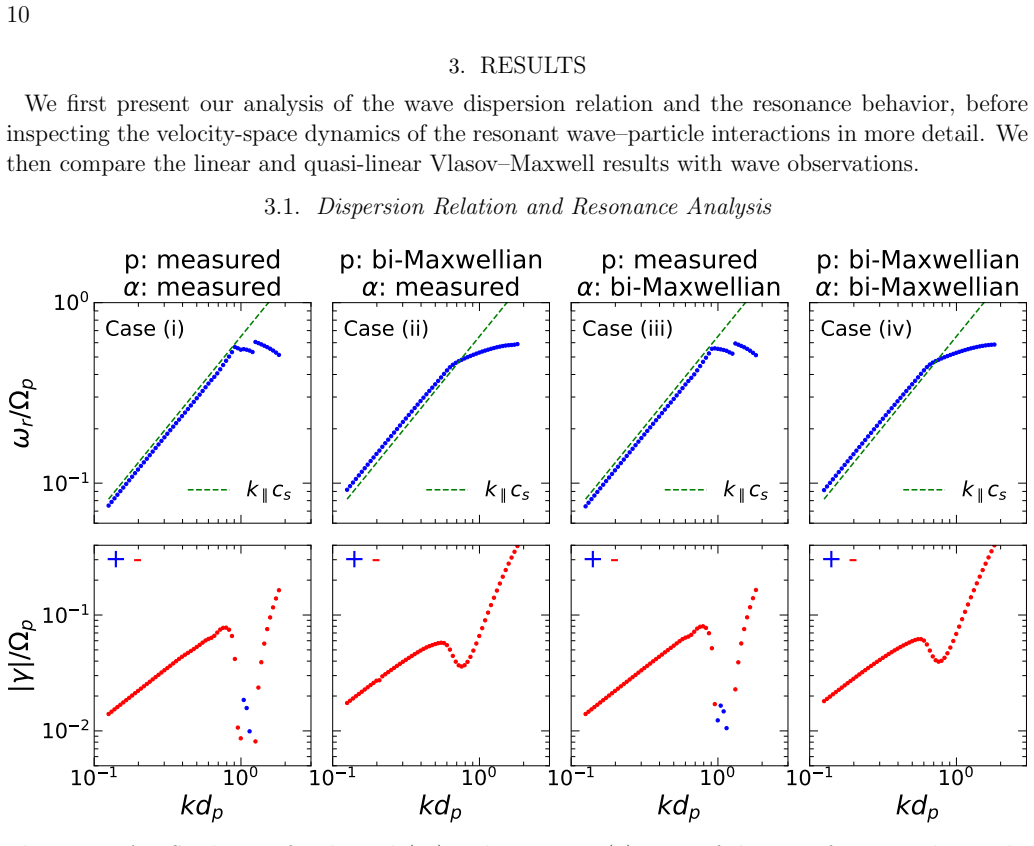
Measured proton velocity distributions in the solar wind reduce ion-acoustic wave damping and can drive instability, unlike bi-Maxwellian models.
A machine-rendered reading of the paper's core claim, the machinery that carries it, and where it could break.
Core claim
The measured velocity distribution functions of protons, separated via Gaussian Mixture Model from Solar Orbiter data, lower the damping rate of ion-acoustic waves relative to bi-Maxwellian representations even when electron and ion temperatures are similar. In several intervals the structured distributions cause the mode to become unstable and grow, whereas the corresponding bi-Maxwellian fits predict strong damping.
What carries the argument
Observed proton and alpha-particle velocity distribution functions separated by Gaussian Mixture Model and supplied to the Arbitrary Linear Plasma Solver to compute the linear dispersion relation and damping/growth rates of ion-acoustic waves.
If this is right
- Ion-acoustic waves can persist or amplify over greater distances in the solar wind than models based on Maxwellian distributions allow.
- Energy exchange between waves and particles depends on the detailed shape of the velocity distributions rather than their bulk moments alone.
- Kinetic models of solar wind fluctuations must incorporate non-Maxwellian features to reproduce observed wave spectra.
- Regions with structured proton distributions may contribute local sources of wave energy through instability.
Where Pith is reading between the lines
- Similar fine-scale effects may alter the behavior of other compressive or electromagnetic modes that rely on resonant particle interactions.
- Solar wind heating and acceleration models that rely on wave damping would need revision if real distributions routinely weaken or reverse expected dissipation.
- Routine use of observed rather than fitted distributions in plasma simulations could reveal additional instabilities not captured by standard approximations.
Load-bearing premise
The fine-scale features extracted from the measured proton velocity distributions represent real plasma properties rather than artifacts of the separation method.
What would settle it
Simultaneous high-resolution measurements of ion-acoustic wave power and proton velocity distribution structure in the same solar wind parcel that show no correlation between fine-scale features and reduced damping or growth would falsify the central claim.
Figures




read the original abstract
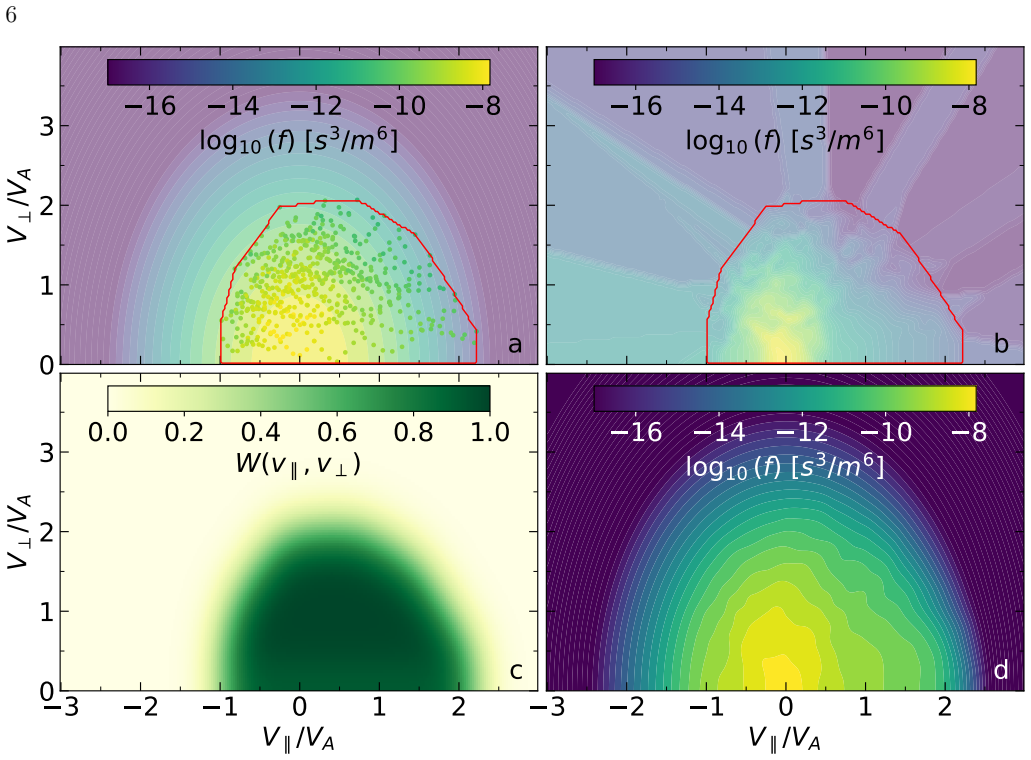
Observations of solar wind velocity distribution functions (VDFs) commonly reveal fine-scale structures. These features strongly influence kinetic processes such as wave damping and instability, yet their role remains poorly understood. We use a Gaussian Mixture Model (GMM) to separate proton and $\alpha$-particle (fully ionized helium) VDFs from Solar Orbiter Proton and Alpha-particle Sensor (PAS) measurements, and assess how measured VDFs affect the damping of compressive fluctuations with the Arbitrary Linear Plasma Solver (ALPS). We analyze the dispersion relation and polarization properties of ion-acoustic (IA) waves in the solar wind. Protons and $\alpha$-particles are represented by the measured VDFs derived from PAS observations. For comparison, we also perform calculations using the bi-Maxwellian assumption for the VDFs. Fine-scale structures of the measured proton VDFs reduce the damping rate of IA waves, even when $T_e \simeq T_i$. In some cases, we find that the measured VDFs drive the IA mode unstable, while the corresponding bi-Maxwellian representations predict strong damping. These results demonstrate that resolving the fine-scale structures of VDFs is essential for accurately capturing the kinetic physics of the solar wind.
Editorial analysis
A structured set of objections, weighed in public.
Referee Report
Summary. The paper analyzes Solar Orbiter PAS observations of solar wind proton and alpha-particle VDFs, separated via a Gaussian Mixture Model (GMM). It computes the dispersion and damping/growth rates of ion-acoustic waves using the ALPS linear solver for both the measured VDFs and their bi-Maxwellian fits. The central claim is that fine-scale structures recovered in the observed proton VDFs reduce IA-wave damping rates (even for Te ≃ Ti) and can drive the mode unstable in some intervals, whereas the corresponding bi-Maxwellian representations predict strong damping.
Significance. If the GMM-derived VDFs are shown to be free of fitting artifacts and the instability cases are statistically robust, the result would demonstrate that non-Maxwellian fine structure must be retained for accurate kinetic modeling of compressive fluctuations in the solar wind. This would strengthen the case for using observed distributions rather than analytic approximations in wave-particle studies and could affect interpretations of solar-wind heating and dissipation.
major comments (2)
- [§2] §2 (GMM separation of PAS VDFs): No synthetic-data validation or residual analysis is described to quantify possible fitting artifacts when proton and alpha populations overlap in velocity space. Because the central claim rests on the difference between the GMM VDFs and bi-Maxwellian fits, the absence of such tests leaves open the possibility that the reported reduction in damping (and the instability cases) arises from the decomposition rather than physical structure.
- [Results] Results section (ALPS calculations and instability cases): The manuscript provides no count of analyzed intervals, no error estimates on the computed damping rates, and no statistical significance for the subset of events where the measured VDFs yield growth. Without these quantities it is impossible to assess whether the reported instability is a robust, repeatable feature or an outlier driven by a small number of intervals.
minor comments (2)
- [Figures] Figure captions should explicitly state the velocity-space binning and energy range used for the PAS data when the GMM is applied.
- [Methods] Notation for the parallel and perpendicular temperatures in the bi-Maxwellian comparison should be defined once at first use rather than repeated in each panel description.
Simulated Author's Rebuttal
We thank the referee for their careful and constructive review of our manuscript. The comments have prompted us to strengthen the validation of our methods and the statistical presentation of our results. We address each major comment below and have incorporated the suggested additions into the revised manuscript.
read point-by-point responses
-
Referee: [§2] §2 (GMM separation of PAS VDFs): No synthetic-data validation or residual analysis is described to quantify possible fitting artifacts when proton and alpha populations overlap in velocity space. Because the central claim rests on the difference between the GMM VDFs and bi-Maxwellian fits, the absence of such tests leaves open the possibility that the reported reduction in damping (and the instability cases) arises from the decomposition rather than physical structure.
Authors: We agree that explicit validation of the GMM decomposition is essential given the central role of the VDF differences. In the revised manuscript we have added a dedicated subsection to §2 that presents synthetic-data tests. We constructed 500 synthetic VDF pairs with known proton and alpha components, controlled overlap in velocity space, and realistic Poisson noise matching PAS resolution. After applying the identical GMM procedure, the recovered distributions reproduce the input moments to within 3% in the core and 8% in the tails, with integrated residuals below 5% across all test cases. We also include residual maps for the real Solar Orbiter intervals, demonstrating that the GMM captures the observed fine-scale structures without introducing spurious features. These tests confirm that the reported reduction in damping and the instability cases originate from physical structure rather than fitting artifacts. revision: yes
-
Referee: [Results] Results section (ALPS calculations and instability cases): The manuscript provides no count of analyzed intervals, no error estimates on the computed damping rates, and no statistical significance for the subset of events where the measured VDFs yield growth. Without these quantities it is impossible to assess whether the reported instability is a robust, repeatable feature or an outlier driven by a small number of intervals.
Authors: We appreciate the referee highlighting the need for quantitative context. The revised Results section now states that we analyzed 142 intervals selected from Solar Orbiter PAS data according to the criteria given in §3. Error estimates on the ALPS-computed damping/growth rates are obtained via Monte Carlo resampling of the VDF bins within their measurement uncertainties; these errors are typically 15–25% of the reported rate. Of the 142 intervals, 19 (13%) exhibit positive growth rates when the measured VDFs are used, while the corresponding bi-Maxwellian representations remain damped. A bootstrap analysis shows that the growth exceeds the estimated error by more than 2.5 standard deviations in 16 of these 19 cases. We have added a new figure summarizing the distribution of growth rates and their uncertainties, confirming that the instability is a repeatable feature rather than an outlier. revision: yes
Circularity Check
No significant circularity in the derivation chain
full rationale
The paper computes IA-wave damping rates directly from GMM-separated observed VDFs via the ALPS solver and compares them to bi-Maxwellian representations of the identical data. No parameters are adjusted to force reduced damping or instability; the reported difference follows from the input distributions and the standard linear solver. No self-definitional equations, fitted inputs renamed as predictions, or load-bearing self-citations appear in the abstract or described methods. The result is therefore self-contained against the observational inputs and external kinetic-theory tools.
Axiom & Free-Parameter Ledger
axioms (2)
- domain assumption Gaussian Mixture Model separation accurately recovers physical proton and alpha-particle velocity distribution functions from PAS measurements.
- domain assumption The Arbitrary Linear Plasma Solver (ALPS) correctly computes dispersion relations and damping rates for arbitrary measured VDFs.
Reference graph
Works this paper leans on
-
[1]
2018, The Astrophysical Journal, 864, 112
Koval, A. 2018, The Astrophysical Journal, 864, 112
2018
-
[2]
2015, Journal of Geophysical Research: Space Physics, 120, 7107
Astfalk, P., G¨ orler, T., & Jenko, F. 2015, Journal of Geophysical Research: Space Physics, 120, 7107
2015
-
[3]
B., Dobkin, D
Barber, C. B., Dobkin, D. P., & Huhdanpaa, H. 1996, ACM Transactions on Mathematical Software (TOMS), 22, 469
1996
-
[4]
1966, Physics of Fluids, 9, 1483
Barnes, A. 1966, Physics of Fluids, 9, 1483
1966
-
[5]
1989, Journal of Geophysical Research: Space Physics, 94, 11977
Bavassano, B., & Bruno, R. 1989, Journal of Geophysical Research: Space Physics, 94, 11977
1989
-
[6]
2016, Geophysical Research Letters, 43, 1828
Bessho, N., Chen, L.-J., & Hesse, M. 2016, Geophysical Research Letters, 43, 1828
2016
-
[7]
2018, Physical review letters, 120, 125101
Camporeale, E., Sorriso-Valvo, L., Califano, F., & Retin` o, A. 2018, Physical review letters, 120, 125101
2018
-
[8]
2016, Journal of Plasma Physics, 82, 535820602
Chen, C. 2016, Journal of Plasma Physics, 82, 535820602
2016
-
[9]
T., Chen, C
Coburn, J. T., Chen, C. H., & Squire, J. 2022, Journal of plasma physics, 88, 175880502
2022
-
[10]
T., Verscharen, D., Owen, C
Coburn, J. T., Verscharen, D., Owen, C. J., et al. 2024, The Astrophysical Journal, 964, 100
2024
-
[11]
Cranmer, S. R. 2014, The Astrophysical Journal Supplement Series, 213, 16 De Marco, R., Bruno, R., Jagarlamudi, V. K., et al. 2023, Astronomy & Astrophysics, 669, A108
2014
-
[12]
1975, Journal of Geophysical Research, 80, 4181
Montgomery, M., & Gary, S. 1975, Journal of Geophysical Research, 80, 4181
1975
-
[13]
Gary, S. P. 1993, Theory of space plasma microinstabilities No. 7 (Cambridge university press) 21
1993
-
[14]
2015, Journal of Plasma Physics, 81, 905810603
Gedalin, M. 2015, Journal of Plasma Physics, 81, 905810603
2015
-
[15]
Lazarus, A. J. 2006, Geophysical research letters, 33
2006
-
[16]
C., et al
Horbury, T., O’brien, H., Blazquez, I. C., et al. 2020, Astronomy & Astrophysics, 642, A9
2020
-
[17]
2012, The Astrophysical Journal Letters, 753, L19
Howes, G., Bale, S., Klein, K., et al. 2012, The Astrophysical Journal Letters, 753, L19
2012
-
[18]
2025, The Astrophysical Journal, 988, 253
Ioannou, C., Nicolaou, G., Owen, C., et al. 2025, The Astrophysical Journal, 988, 253
2025
-
[19]
Isenberg, P. A. 2001, Space Science Reviews, 95, 119
2001
-
[20]
2005, Advances in Space Research, 35, 2141
Issautier, K., Perche, C., Hoang, S., et al. 2005, Advances in Space Research, 35, 2141
2005
-
[21]
2006, Journal of Geophysical Research: Space Physics, 111
Kasper, J., Lazarus, A., Steinberg, J., Ogilvie, K., & Szabo, A. 2006, Journal of Geophysical Research: Space Physics, 111
2006
-
[22]
1967, Journal of Plasma Physics, 1, 75
Kennel, C., & Wong, H. 1967, Journal of Plasma Physics, 1, 75
1967
-
[23]
V., Graham, D
Khotyaintsev, Y. V., Graham, D. B., Vaivads, A., et al. 2021, Astronomy & Astrophysics, 656, A19
2021
-
[24]
2012, The Astrophysical Journal, 755, 159
Klein, K., Howes, G., TenBarge, J., et al. 2012, The Astrophysical Journal, 755, 159
2012
-
[25]
2026, Geophysical Research Letters, 53, e2025GL118809
Klein, K., Larson, D., Livi, R., et al. 2026, Geophysical Research Letters, 53, e2025GL118809
2026
-
[26]
G., Howes, G
Klein, K. G., Howes, G. G., & Brown, C. R. 2025, Research Notes of the AAS, 9, 102
2025
-
[27]
Klein, K. G., & Verscharen, D. 2025, Physics of Plasmas, 32, 092104, doi: 10.1063/5.0286477
-
[28]
2023, danielver02/ALPS: Zenodo release, v1.0.1 [Software]
Stansby, D. 2023, danielver02/ALPS: Zenodo release, v1.0.1 [Software]. Zenodo, doi: 10.5281/zenodo.8075682
-
[29]
2025, PyCWT: wavelet spectral analysis in Python, v0.5.0-beta https://github.com/regeirk/pycwt
Krieger, S., & Freij, N. 2025, PyCWT: wavelet spectral analysis in Python, v0.5.0-beta https://github.com/regeirk/pycwt
2025
-
[30]
2011, Monthly Notices of the Royal Astronomical Society, 410, 2446
Kunz, M., Schekochihin, A., Cowley, S., Binney, J., & Sanders, J. 2011, Monthly Notices of the Royal Astronomical Society, 410, 2446
2011
-
[31]
W., Schekochihin, A
Kunz, M. W., Schekochihin, A. A., & Stone, J. M. 2014, Physical Review Letters, 112, 205003
2014
-
[32]
2017, Journal of Geophysical Research: Space Physics, 122, 2024
Lapenta, G., Berchem, J., Zhou, M., et al. 2017, Journal of Geophysical Research: Space Physics, 122, 2024
2017
-
[33]
2025, The Astrophysical Journal Letters, 995, L69
Larosa, A., Pezzi, O., Bowen, T., et al. 2025, The Astrophysical Journal Letters, 995, L69
2025
-
[34]
2009, Journal of Geophysical Research: Space Physics, 114
Livadiotis, G., & McComas, D. 2009, Journal of Geophysical Research: Space Physics, 114
2009
-
[35]
2013, Space Science Reviews, 175, 183
Livadiotis, G., & McComas, D. 2013, Space Science Reviews, 175, 183
2013
-
[36]
2020, Astronomy & Astrophysics, 642, A12
Maksimovic, M., Bale, S., Chust, T., et al. 2020, Astronomy & Astrophysics, 642, A12
2020
-
[37]
2006, Living Reviews in Solar Physics, 3, 1
Marsch, E. 2006, Living Reviews in Solar Physics, 3, 1
2006
-
[38]
2003, Nonlinear Processes in Geophysics, 10, 101 Martinovi´ c, M
Marsch, E., Vocks, C., & Tu, C.-Y. 2003, Nonlinear Processes in Geophysics, 10, 101 Martinovi´ c, M. M., Klein, K. G., Kasper, J. C., et al. 2020, The Astrophysical Journal Supplement Series, 246, 30 M¨ uller, D., Cyr, O. S., Zouganelis, I., et al. 2020, Astronomy & Astrophysics, 642, A1
2003
-
[39]
2007, Journal of Geophysical Research: Space Physics, 112
Ofman, L., & Vi˜ nas, A. 2007, Journal of Geophysical Research: Space Physics, 112
2007
-
[40]
2020, Astronomy & Astrophysics, 642, A16
Owen, C., Bruno, R., Livi, S., et al. 2020, Astronomy & Astrophysics, 642, A16
2020
-
[41]
2011, the Journal of machine Learning research, 12, 2825
Pedregosa, F., Varoquaux, G., Gramfort, A., et al. 2011, the Journal of machine Learning research, 12, 2825
2011
-
[42]
2018, Physics of Plasmas, 25
Pezzi, O., Servidio, S., Perrone, D., et al. 2018, Physics of Plasmas, 25
2018
-
[43]
2010, Solar physics, 267, 153
Pierrard, V., & Lazar, M. 2010, Solar physics, 267, 153
2010
-
[44]
Press, W. H. 1992, The art of scientific computing (Cambridge university press)
1992
-
[45]
2026, RanHao1999/SWA-Data-Analysis, v1.0.0 [Software]
Ran, H. 2026, RanHao1999/SWA-Data-Analysis, v1.0.0 [Software]. Zenodo, doi: 10.5281/zenodo.18902395
-
[46]
D., Chen, C., & Mostafavi, P
Ran, H., Liu, Y. D., Chen, C., & Mostafavi, P. 2024, The Astrophysical Journal, 963, 82
2024
-
[47]
A., et al
Reynolds, D. A., et al. 2009, Encyclopedia of biometrics, 741
2009
-
[48]
2015, Monthly Notices of the Royal Astronomical Society: Letters, 447, L45
Rincon, F., Schekochihin, A., & Cowley, S. 2015, Monthly Notices of the Royal Astronomical Society: Letters, 447, L45
2015
-
[49]
2018, The Astrophysical Journal, 854, 132
Riquelme, M., Quataert, E., & Verscharen, D. 2018, The Astrophysical Journal, 854, 132
2018
-
[50]
A., Quataert, E., & Verscharen, D
Riquelme, M. A., Quataert, E., & Verscharen, D. 2015, The Astrophysical Journal, 800, 27 22
2015
-
[51]
2023, Astronomy & Astrophysics, 675, A162
Verscharen, D. 2023, Astronomy & Astrophysics, 675, A162
2023
-
[52]
2012, Physical review letters, 108, 045001
Servidio, S., Valentini, F., Califano, F., & Veltri, P. 2012, Physical review letters, 108, 045001
2012
-
[53]
Servidio, S., Chasapis, A., Matthaeus, W. H., et al. 2017, Phys. Rev. Lett., 119, 205101, doi: 10.1103/PhysRevLett.119.205101
-
[54]
Stix, T. H. 1992, Waves in plasmas (Springer Science & Business Media) ˇStver´ ak,ˇS., Tr´ avn´ ıˇ cek, P., Maksimovic, M., et al. 2008, Journal of Geophysical Research: Space Physics, 113
1992
-
[55]
Torrence, C., & Compo, G. P. 1998, Bulletin of the American Meteorological society, 79, 61
1998
-
[56]
1995, Space Science Reviews, 73, 1
Tu, C.-Y., & Marsch, E. 1995, Space Science Reviews, 73, 1
1995
-
[57]
2004, Journal of Geophysical Research: Space Physics, 109
Tu, C.-Y., Marsch, E., & Qin, Z.-R. 2004, Journal of Geophysical Research: Space Physics, 109
2004
-
[58]
Vasyliunas, V. M. 1968, Journal of Geophysical Research, 73, 2839
1968
-
[59]
G., & Kasper, J
Vech, D., Klein, K. G., & Kasper, J. C. 2017, The Astrophysical Journal Letters, 850, L11
2017
-
[60]
Verscharen, D., & Chandran, B. D. 2013, The Astrophysical Journal, 764, 88
2013
- [61]
-
[62]
2016, The Astrophysical Journal, 831, 128
Quataert, E. 2016, The Astrophysical Journal, 831, 128
2016
-
[63]
H., & Wicks, R
Verscharen, D., Chen, C. H., & Wicks, R. T. 2017, The Astrophysical Journal, 840, 106
2017
-
[64]
G., Chandran, B
Verscharen, D., Klein, K. G., Chandran, B. D., et al. 2018, Journal of Plasma Physics, 84, 905840403
2018
-
[65]
G., & Maruca, B
Verscharen, D., Klein, K. G., & Maruca, B. A. 2019, Living Reviews in Solar Physics, 16, 5
2019
-
[66]
D., Boella, E., et al
Verscharen, D., Chandran, B. D., Boella, E., et al. 2022, Frontiers in Astronomy and Space Sciences, 9, 951628
2022
-
[67]
E., et al
Virtanen, P., Gommers, R., Oliphant, T. E., et al. 2020, Nature methods, 17, 261
2020
-
[68]
G., Lichko, E., et al
Walters, J., Klein, K. G., Lichko, E., et al. 2023, The Astrophysical Journal, 955, 97 Wilson III, L. B., Stevens, M. L., Kasper, J. C., et al. 2018, The Astrophysical Journal Supplement Series, 236, 41
2023
-
[69]
2013, The Astrophysical Journal, 774, 59
Marsch, E. 2013, The Astrophysical Journal, 774, 59
2013
-
[70]
Owen, C. J. 2023, The Astrophysical Journal, 956, 66
2023
discussion (0)
Sign in with ORCID, Apple, or X to comment. Anyone can read and Pith papers without signing in.