Recognition: unknown
An Improved Fit for Linear Halo Bias at High Redshift
Pith reviewed 2026-05-10 11:55 UTC · model grok-4.3
The pith
Halo biases at redshifts 6 to 19 are 3 to 4 percent higher than low-redshift calibrations predict.
A machine-rendered reading of the paper's core claim, the machinery that carries it, and where it could break.
Core claim
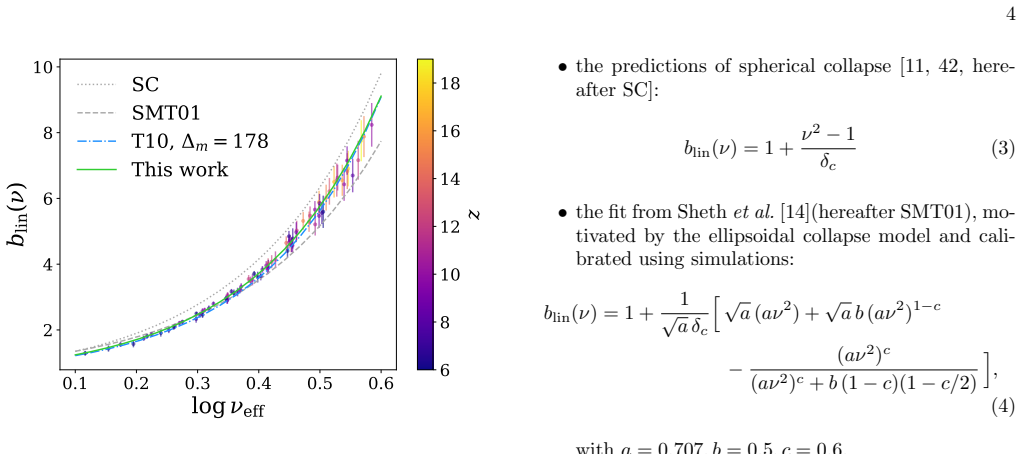
We measure dark matter halo biases at z=6-19 from simulation data, and find they are ∼3-4% higher than canonical results calibrated at low z. We provide an updated linear-bias fit at these early times, reducing the mean systematic offset to <1%.
What carries the argument
An updated fitting function for linear halo bias calibrated directly on high-redshift simulation measurements instead of low-redshift extrapolations.
Load-bearing premise
The N-body simulations accurately capture halo formation and clustering physics at z=6-19 without resolution artifacts, missing baryonic effects, or volume limitations that would change the measured linear bias.
What would settle it
A new suite of higher-resolution or larger-volume simulations at z=10-15 that recovers the original low-redshift bias values rather than the new high-redshift fit would falsify the claim.
Figures


read the original abstract
High- to ultrahigh-redshift clustering of halos provides a powerful tool to understand cosmology and galaxy formation. However, theoretical predictions are not firmly established in the first billion years, where current and upcoming surveys are beginning to reach percent-level precision. Here we measure dark matter halo biases at $z=6$ - 19 from simulation data, and find they are $\sim$ 3 - 4$\%$ higher than canonical results calibrated at low $z$. We provide an updated linear-bias fit at these early times, reducing the mean systematic offset to $< 1\%$. These results will enable robust interpretation of early-Universe galaxy clustering from JWST, Roman, and intensity-mapping surveys.
Editorial analysis
A structured set of objections, weighed in public.
Referee Report
Summary. The paper measures linear dark matter halo biases from N-body simulations at redshifts z=6 to 19, reports that these biases are 3-4% higher than canonical low-redshift calibrations, and proposes an updated fitting formula for the linear bias that reduces the mean systematic offset to less than 1%.
Significance. If the underlying simulation measurements prove robust and the fit is shown to generalize, the result would be useful for percent-level interpretations of high-redshift halo clustering in JWST, Roman, and intensity-mapping surveys, where current low-z bias fits introduce systematic errors at early times.
major comments (2)
- [Abstract and methods description] The abstract and main text provide no information on simulation volume, particle resolution, halo finder algorithm, or the precise procedure used to extract linear bias, leaving the claimed <1% accuracy unsupported by any visible convergence or validation evidence.
- [Fitting and comparison section] The updated fit is calibrated directly on the same simulation measurements that were used to identify the original 3-4% offset; the reported reduction to <1% is therefore achieved by construction on the calibration sample, with no independent validation set, cross-validation, or out-of-sample test mentioned.
minor comments (1)
- [Updated fit formula] Notation for the bias fit parameters should be defined explicitly with units or normalization conventions to allow immediate use by readers.
Simulated Author's Rebuttal
We thank the referee for their thoughtful review and valuable suggestions. We have carefully considered the major comments and will revise the manuscript to address them. Below we provide point-by-point responses.
read point-by-point responses
-
Referee: [Abstract and methods description] The abstract and main text provide no information on simulation volume, particle resolution, halo finder algorithm, or the precise procedure used to extract linear bias, leaving the claimed <1% accuracy unsupported by any visible convergence or validation evidence.
Authors: We agree with the referee that the current manuscript lacks sufficient details on the simulation parameters and the bias measurement procedure. In the revised manuscript, we will expand the methods section to include the simulation volume, particle resolution, the halo finder algorithm employed, and a detailed description of how the linear bias was extracted (e.g., from the ratio of halo-matter power spectra in the linear regime). Additionally, we will include tests demonstrating convergence with respect to resolution and volume to support the accuracy of our measurements and the resulting fit. revision: yes
-
Referee: [Fitting and comparison section] The updated fit is calibrated directly on the same simulation measurements that were used to identify the original 3-4% offset; the reported reduction to <1% is therefore achieved by construction on the calibration sample, with no independent validation set, cross-validation, or out-of-sample test mentioned.
Authors: The referee correctly points out that the updated fitting formula was derived from the same set of simulation measurements used to quantify the offset relative to low-redshift calibrations. The reduction in systematic offset to less than 1% is indeed the result of fitting to these data. To strengthen the manuscript, we will add a validation section in the revision. This will include either a cross-validation approach by partitioning the redshift range or simulation outputs, or comparison against independent high-redshift simulation suites if accessible. We will also explicitly report the fit residuals and any goodness-of-fit metrics to better substantiate the improvement. revision: yes
Circularity Check
No significant circularity identified
full rationale
The paper reports direct measurements of linear halo bias from N-body simulations at z=6-19, compares these to existing low-z calibrations (finding a 3-4% offset), and supplies a new fitting function calibrated to the high-z measurements. This constitutes a standard empirical update to a parametrization rather than any derivation chain that reduces to its own inputs by construction. No equations, self-definitions, fitted quantities relabeled as predictions, or load-bearing self-citations appear in the abstract or described claims. The <1% residual offset after refitting is the expected statistical outcome of calibration to the same sample and is not presented as an independent test or prediction.
Axiom & Free-Parameter Ledger
free parameters (1)
- updated linear bias fit coefficients
axioms (1)
- domain assumption Standard Lambda-CDM cosmology governs the simulations
Reference graph
Works this paper leans on
-
[1]
S. D. M. White and M. J. Rees, Mon. Not. R. Astron. Soc.183, 341 (1978)
1978
-
[2]
G. R. Blumenthal, S. M. Faber, J. R. Primack, and M. J. Rees, Nature (London)311, 517 (1984)
1984
-
[3]
Halo Models of Large Scale Structure
A. Cooray and R. Sheth, Phys. Rep.372, 1 (2002), arXiv:astro-ph/0206508 [astro-ph]
work page Pith review arXiv 2002
- [4]
- [5]
-
[6]
R. H. Wechsler and J. L. Tinker, Annu. Rev. Astron. As- trophys.56, 435 (2018), arXiv:1804.03097 [astro-ph.GA]
work page Pith review arXiv 2018
-
[7]
UniverseMachine: The Correlation between Galaxy Growth and Dark Matter Halo Assembly from z=0-10
P. Behroozi, R. H. Wechsler, A. P. Hearin, and C. Con- roy, Mon. Not. R. Astron. Soc.488, 3143 (2019), arXiv:1806.07893 [astro-ph.GA]
work page Pith review arXiv 2019
- [8]
-
[9]
L. Y. A. Yung, R. S. Somerville, S. L. Finkelstein, P. Behroozi, R. Dav´ e, H. C. Ferguson, J. P. Gardner, G. Popping, S. Malhotra, C. Papovich, J. E. Rhoads, M. B. Bagley, M. Hirschmann, and A. M. Koeke- moer, Mon. Not. R. Astron. Soc.519, 1578 (2023), arXiv:2210.04902 [astro-ph.GA]
-
[10]
Kaiser, Astrophys
N. Kaiser, Astrophys. J. Lett.284, L9 (1984)
1984
- [11]
-
[12]
R. K. Sheth and G. Tormen, Mon. Not. R. Astron. Soc. 308, 119 (1999), arXiv:astro-ph/9901122 [astro-ph]
work page Pith review arXiv 1999
- [13]
- [14]
-
[15]
J. L. Tinker, B. E. Robertson, A. V. Kravtsov, A. Klypin, M. S. Warren, G. Yepes, and S. Gottl¨ ober, Astrophys. J. 724, 878 (2010), arXiv:1001.3162 [astro-ph.CO]
work page Pith review arXiv 2010
-
[16]
S. Bhattacharya, K. Heitmann, M. White, Z. Luki´ c, C. Wagner, and S. Habib, Astrophys. J.732, 122 (2011), arXiv:1005.2239 [astro-ph.CO]
- [17]
- [18]
-
[19]
A. Nasirudin, I. T. Iliev, and K. Ahn, Mon. Not. R. Astron. Soc.494, 3294 (2020), arXiv:1910.12452 [astro- ph.CO]
- [20]
- [21]
-
[22]
J. Mirocha, P. La Plante, and A. Liu, Mon. Not. R. Astron. Soc.507, 3872 (2021), arXiv:2012.09189 [astro- ph.CO]
-
[23]
M. Shuntov, P. A. Oesch, S. Toft, R. A. Meyer, A. Covelo- Paz, L. Paquereau, R. Bouwens, G. Brammer, V. Gelli, E. Giovinazzo, T. Herard-Demanche, G. D. Illingworth, C. Mason, R. P. Naidu, A. Weibel, and M. Xiao, Astron. Astrophys.699, A231 (2025), arXiv:2503.14280 [astro- ph.GA]
- [24]
-
[25]
V. Desjacques, D. Jeong, and F. Schmidt, Phys. Rep. 733, 1 (2018), arXiv:1611.09787 [astro-ph.CO]
work page Pith review arXiv 2018
-
[26]
J. P. Gardner, J. C. Mather, M. Clampin, R. Doyon, M. A. Greenhouse, H. B. Hammel, J. B. Hutchings, P. Jakobsen, S. J. Lilly, K. S. Long, J. I. Lunine, M. J. McCaughrean, M. Mountain, J. Nella, G. H. Rieke, M. J. Rieke, H.-W. Rix, E. P. Smith, G. Sonneborn, M. Sti- avelli, H. S. Stockman, R. A. Windhorst, and G. S. Wright, Space Sci. Rev.123, 485 (2006), ...
-
[27]
Wide-Field InfrarRed Survey Telescope-Astrophysics Focused Telescope Assets WFIRST-AFTA 2015 Report
D. Spergel, N. Gehrels, C. Baltay, D. Bennett, J. Breckin- ridge, M. Donahue, A. Dressler, B. S. Gaudi, T. Greene, O. Guyon, C. Hirata, J. Kalirai, N. J. Kasdin, B. Macin- tosh, W. Moos, S. Perlmutter, M. Postman, B. Rauscher, J. Rhodes, Y. Wang, D. Weinberg, D. Benford, M. Hud- son, W. S. Jeong, Y. Mellier, W. Traub, T. Yamada, P. Capak, J. Colbert, D. M...
work page internal anchor Pith review Pith/arXiv arXiv 2015
-
[28]
D. R. DeBoer, A. R. Parsons, J. E. Aguirre, P. Alexan- der, Z. S. Ali, A. P. Beardsley, G. Bernardi, J. D. Bow- man, R. F. Bradley, C. L. Carilli, C. Cheng, E. de Lera Acedo, J. S. Dillon, A. Ewall-Wice, G. Fadana, N. Fagnoni, R. Fritz, S. R. Furlanetto, B. Glenden- ning, B. Greig, J. Grobbelaar, B. J. Hazelton, J. N. He- witt, J. Hickish, D. C. Jacobs, A...
-
[29]
L. Koopmans, J. Pritchard, G. Mellema, J. Aguirre, K. Ahn, R. Barkana, I. van Bemmel, G. Bernardi, A. Bonaldi, F. Briggs, A. G. de Bruyn, T. C. Chang, E. Chapman, X. Chen, B. Ciardi, P. Dayal, A. Ferrara, A. Fialkov, F. Fiore, K. Ichiki, I. T. Illiev, S. Inoue, V. Jelic, M. Jones, J. Lazio, U. Maio, S. Majumdar, K. J. Mack, A. Mesinger, M. F. Morales, A. ...
- [30]
- [31]
-
[32]
Planck Collaboration, P. A. R. Ade, N. Aghanim, M. Arnaud, M. Ashdown, J. Aumont, C. Bacci- galupi, A. J. Banday, R. B. Barreiro, J. G. Bartlett, N. Bartolo, E. Battaner, R. Battye, K. Benabed, A. Benoˆ ıt, A. Benoit-L´ evy, J.-P. Bernard, M. Bersanelli, P. Bielewicz, J. J. Bock, A. Bonaldi, L. Bonavera, J. R. Bond, J. Borrill, F. R. Bouchet, F. Boulanger...
work page Pith review arXiv 2016
- [33]
-
[34]
K. Wang, Y.-Y. Mao, A. R. Zentner, J. U. Lange, F. C. van den Bosch, and R. H. Wechsler, Mon. Not. R. Astron. Soc.498, 4450 (2020), arXiv:2004.13732 [astro-ph.GA]
-
[35]
B. Diemer, Astrophys. J.909, 112 (2021), arXiv:2007.10992 [astro-ph.CO]
-
[36]
S. D. Landy and A. S. Szalay, Astrophys. J.412, 64 (1993)
1993
-
[37]
Sinha and L
M. Sinha and L. Garrison, inSoftware Challenges to Ex- ascale Computing, edited by A. Majumdar and R. Arora (Springer Singapore, Singapore, 2019) pp. 3–20
2019
-
[38]
Sinha and L
M. Sinha and L. H. Garrison, Mon. Not. R. Astron. Soc. 491, 3022 (2020)
2020
- [39]
-
[40]
COLOSSUS: A python toolkit for cosmology, large-scale structure, and dark matter halos
B. Diemer, Astrophys. J. Suppl. Ser.239, 35 (2018), arXiv:1712.04512 [astro-ph.CO]
work page Pith review arXiv 2018
- [41]
-
[42]
Cole and N
S. Cole and N. Kaiser, Mon. Not. R. Astron. Soc.237, 1127 (1989)
1989
-
[43]
T. McClintock, E. Rozo, A. Banerjee, M. R. Becker, J. DeRose, S. McLaughlin, J. L. Tinker, R. H. Wechsler, and Z. Zhai, arXiv e-prints , arXiv:1907.13167 (2019), arXiv:1907.13167 [astro-ph.CO]
-
[44]
N. Dalmasso, G. Ferrami, N. Leethochawalit, E. M. Ven- tura, and M. Trenti, Mon. Not. R. Astron. Soc.546, stag001 (2026), arXiv:2601.01697 [astro-ph.GA]
-
[45]
Y. Harikane, Y. Ono, M. Ouchi, C. Liu, M. Sawicki, T. Shibuya, P. S. Behroozi, W. He, K. Shimasaku, S. Arnouts, J. Coupon, S. Fujimoto, S. Gwyn, J. Huang, A. K. Inoue, N. Kashikawa, Y. Komiyama, Y. Matsuoka, and C. J. Willott, Astrophys. J. Suppl. Ser.259, 20 (2022), arXiv:2108.01090 [astro-ph.GA]
- [46]
- [47]
-
[48]
Z. Luki´ c, D. Reed, S. Habib, and K. Heitmann, Astro- phys. J.692, 217 (2009), arXiv:0803.3624 [astro-ph]
-
[49]
E. Pizzati, J. F. Hennawi, J. Schaye, and M. Schaller, Mon. Not. R. Astron. Soc.528, 4466 (2024), arXiv:2311.17181 [astro-ph.GA]
-
[50]
P. Ocvirk, N. Gillet, P. R. Shapiro, D. Aubert, I. T. Iliev, R. Teyssier, G. Yepes, J.-H. Choi, D. Sullivan, A. Knebe, S. Gottl¨ ober, A. D’Aloisio, H. Park, Y. Hoffman, and T. Stranex, Mon. Not. R. Astron. Soc.463, 1462 (2016), arXiv:1511.00011 [astro-ph.GA]
work page Pith review arXiv 2016
- [51]
-
[52]
C. Hern´ andez-Aguayo, V. Springel, R. Pakmor, M. Bar- rera, F. Ferlito, S. D. M. White, L. Hernquist, B. Hadzhiyska, A. M. Delgado, R. Kannan, S. Bose, and C. Frenk, Mon. Not. R. Astron. Soc.524, 2556 (2023), arXiv:2210.10059 [astro-ph.CO]
- [53]
- [54]
-
[55]
Precision measurement of the local bias of dark matter halos
T. Lazeyras, C. Wagner, T. Baldauf, and F. Schmidt, J. Cosmol. Astropart. Phys.2016(2), 018, arXiv:1511.01096 [astro-ph.CO]
work page Pith review arXiv 2016
-
[56]
A. Paranjape and N. Padmanabhan, Mon. Not. R. As- tron. Soc.468, 2984 (2017), arXiv:1612.02833 [astro- ph.CO]
-
[57]
P. Mansfield and A. V. Kravtsov, Mon. Not. R. Astron. Soc.493, 4763 (2020), arXiv:1902.00030 [astro-ph.CO]. 9
- [58]
-
[59]
H. Gil-Mar´ ın, C. Wagner, L. Verde, R. Jimenez, and A. F. Heavens, Mon. Not. R. Astron. Soc.407, 772 (2010), arXiv:1003.3238 [astro-ph.CO]
-
[60]
K. Hoffmann, J. Bel, and E. Gazta˜ naga, Mon. Not. R. Astron. Soc.465, 2225 (2017), arXiv:1607.01024 [astro- ph.CO]
-
[61]
M. Schmittfull, M. Simonovi´ c, V. Assassi, and M. Zaldarriaga, Phys. Rev. D100, 043514 (2019), arXiv:1811.10640 [astro-ph.CO]
- [62]
- [63]
- [64]
discussion (0)
Sign in with ORCID, Apple, or X to comment. Anyone can read and Pith papers without signing in.