Recognition: unknown
Magnet-Free Nonreciprocal frequency conversion using Sequential Temporal modulation: Theory and Simulations
Pith reviewed 2026-05-10 11:38 UTC · model grok-4.3
The pith
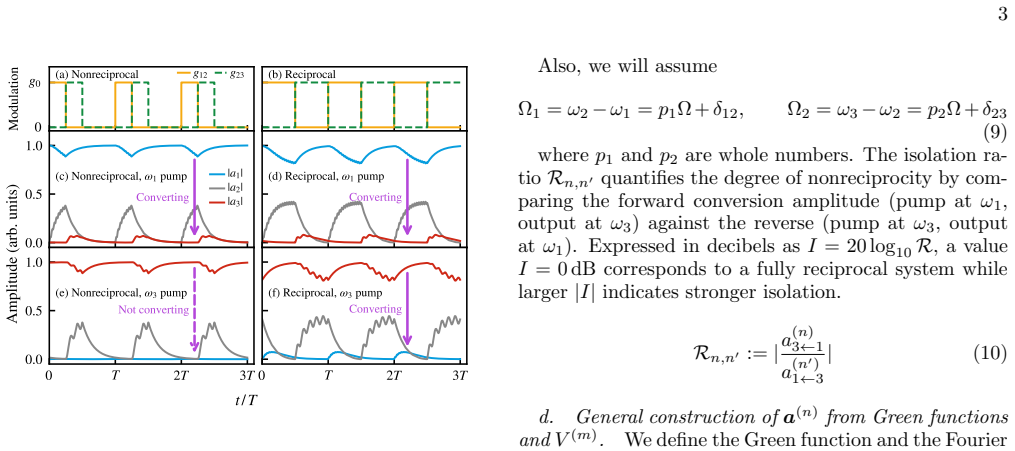
Activating couplings in a fixed temporal order in a three-mode system makes forward and reverse frequency conversions have unequal dwell times in a lossy mode, enabling strong magnet-free nonreciprocity.
A machine-rendered reading of the paper's core claim, the machinery that carries it, and where it could break.
Core claim
By activating interactions in a fixed temporal order in a three-mode system, the forward and reverse frequency conversion pathways acquire unequal dwell times in a lossy intermediate mode. This produces strong nonreciprocity in frequency conversion without the need for nonlinearities or magnetic materials. The effect is analyzed using a harmonic-balance formulation and a Dyson-Born expansion to obtain a compact analytical expression for the isolation ratio, which is verified by direct time-domain simulations.
What carries the argument
Sequential time-gated couplings in a three-mode system that cause forward and reverse paths to have unequal dwell times in the lossy intermediate mode.
If this is right
- Strong isolation can be obtained by engineering the temporal sequence and the loss in the intermediate mode.
- The isolation ratio depends on Floquet sidebands, duty cycle, modulation frequency, and dissipation.
- The scheme provides a general framework applicable to photonics, phononics, microwave electronics, and superconducting circuits.
- Design rules allow optimization through temporal sequencing and loss engineering.
Where Pith is reading between the lines
- This method could allow nonreciprocal devices to be integrated on chips where magnetic fields or nonlinear materials are difficult to incorporate.
- The principle of asymmetric dwell times via timing control may apply to other wave-based systems with tunable couplings.
- Further analysis could reveal how this interacts with quantum effects in superconducting circuit implementations.
Load-bearing premise
Precise temporal sequencing of the couplings can be achieved in a physical device without introducing extra loss, phase noise, or unwanted couplings that would eliminate the dwell time difference.
What would settle it
A time-domain simulation or measurement in which the isolation ratio does not show the predicted dependence on the modulation timing or the loss of the intermediate mode would falsify the proposed mechanism.
Figures



read the original abstract
Nonreciprocal conversion is essential for protecting sources and enabling unidirectional signal routing in photonic, phononic, electronics, and quantum systems, yet conventional implementations rely on magnetic bias that could be challenging to integrate on chip. We propose a magnet-free scheme for frequency-domain nonreciprocity based on sequential, time-gated couplings in a three-mode system. By activating interactions in a fixed temporal order, the forward and reverse frequency conversion pathways acquire unequal dwell times in a lossy intermediate mode, producing strong nonreciprocity without requiring nonlinearities or magnetic materials. Using a harmonic-balance formulation and a Dyson-Born expansion, we derive a compact analytical expression for the isolation ratio that reveals the roles of Floquet sidebands, duty-cycle control, modulation frequency, and dissipation. The results are confirmed by direct time-domain simulations over a wide parameter range. From these results, we extract practical design rules for optimizing isolation through temporal sequencing, loss engineering, and modulation timing. The framework is general and directly applicable to integrated platforms in photonics, phononics, microwave electronics, and superconducting circuits.
Editorial analysis
A structured set of objections, weighed in public.
Referee Report
Summary. The paper introduces a magnet-free approach to nonreciprocal frequency conversion in a three-mode system by using sequential temporal modulation of couplings. This creates unequal dwell times in a lossy intermediate mode for forward and reverse paths, leading to isolation. An analytical expression for the isolation ratio is derived using harmonic-balance and Dyson-Born methods, accounting for Floquet sidebands, duty cycle, modulation frequency, and dissipation. The theory is validated with time-domain simulations across a wide parameter range, from which design rules are extracted for loss engineering and timing.
Significance. If the central claim holds, this work is significant as it provides a general, integrable method for nonreciprocity without relying on magnetic materials or nonlinearities, applicable to photonics, phononics, microwave electronics, and superconducting circuits. The combination of analytical derivation and extensive simulations, along with practical design rules, strengthens the contribution. The absence of free parameters in the model is a positive aspect.
major comments (1)
- [Theory (harmonic-balance and Dyson-Born sections)] The harmonic-balance formulation and Dyson-Born expansion are said to yield a compact analytical expression for the isolation ratio; to confirm the mechanism does not reduce by construction to a fitted parameter, the explicit mapping from fixed temporal order to asymmetric dwell times (via the lossy intermediate mode) should be shown with intermediate steps in the main derivation.
minor comments (2)
- [Simulations and design rules] The time-domain simulations confirm the analytical results over a broad parameter space; adding a table or figure summarizing the specific parameter ranges, modulation frequencies, and achieved isolation values would improve clarity and reproducibility.
- [Abstract] The abstract refers to 'strong nonreciprocity' without a numerical benchmark; defining 'strong' quantitatively (e.g., isolation ratio > X dB) in the abstract or introduction would help readers assess the practical impact.
Simulated Author's Rebuttal
We thank the referee for their positive evaluation and constructive suggestion for minor revision. We address the comment on the theoretical derivation below.
read point-by-point responses
-
Referee: [Theory (harmonic-balance and Dyson-Born sections)] The harmonic-balance formulation and Dyson-Born expansion are said to yield a compact analytical expression for the isolation ratio; to confirm the mechanism does not reduce by construction to a fitted parameter, the explicit mapping from fixed temporal order to asymmetric dwell times (via the lossy intermediate mode) should be shown with intermediate steps in the main derivation.
Authors: We agree that additional intermediate steps will strengthen the clarity of the derivation. The analytical expression is obtained directly from the time-dependent Hamiltonian without fitted parameters: the modulation sequence is fixed by the temporal order of the couplings, the loss is introduced as a constant rate in the intermediate mode, and the harmonic-balance equations are solved in the Floquet basis. The Dyson-Born expansion then propagates the sequential interactions. In the revised manuscript we will insert explicit intermediate steps showing how the forward path (modulation of coupling 1-2 followed by 2-3) produces a longer effective dwell time in the lossy mode than the reverse path, with the asymmetry appearing in the time-ordered products before the final isolation-ratio formula is obtained. This addition will be placed in the main text of the harmonic-balance and Dyson-Born sections. revision: yes
Circularity Check
No significant circularity; derivation applies standard methods to proposed mechanism
full rationale
The paper's central derivation applies standard harmonic-balance formulation and Dyson-Born expansion to the proposed sequential temporal modulation in a three-mode system, producing an explicit isolation-ratio expression that incorporates Floquet sidebands, duty cycle, modulation frequency, and dissipation as independent inputs. This is cross-validated by direct time-domain simulations over a wide parameter range, from which design rules are extracted. The nonreciprocity arises directly from the fixed-order activation of couplings creating unequal dwell times in the lossy intermediate mode, without reduction to a fitted parameter, self-definition, or load-bearing self-citation. The framework remains self-contained against external benchmarks and does not rename known results or smuggle ansatzes via prior work.
Axiom & Free-Parameter Ledger
axioms (2)
- domain assumption The system dynamics can be accurately captured by a harmonic-balance formulation combined with a Dyson-Born expansion
- domain assumption Temporal sequencing of couplings produces controllable unequal dwell times in the lossy intermediate mode
Reference graph
Works this paper leans on
-
[1]
Jalas, A
D. Jalas, A. Petrov, M. Eich, W. Freude, S. Fan, Z. Yu, R. Baets, M. Popovi´ c, A. Melloni, J. D. Joannopoulos, M. Vanwolleghem, C. R. Doerr, and H. Renner, What is—and what is not—an optical isolator, Nature Photon- ics7, 579 (2013)
2013
-
[2]
Metelmann and A
A. Metelmann and A. A. Clerk, Nonreciprocal photon transmission and amplification via reservoir engineering, Physical Review X5, 021025 (2015)
2015
-
[3]
G. A. Peterson, F. Lecocq, K. Cicak, R. W. Simmonds, J. A. Aumentado, and J. D. Teufel, Demonstration of efficient nonreciprocity in a microwave optomechanical circuit, Physical Review X7, 031001 (2017)
2017
-
[4]
F. D. M. Haldane and S. Raghu, Possible realization of directional optical waveguides in photonic crystals with broken time-reversal symmetry, Physical Review Letters 100, 013904 (2008)
2008
-
[5]
Onsager, Reciprocal relations in irreversible processes
L. Onsager, Reciprocal relations in irreversible processes. i., Physical Review37, 405 (1931)
1931
-
[6]
Faraday, Experimental researches in electricity
M. Faraday, Experimental researches in electricity. nine- teenth series: On the magnetization of light and the illu- mination of magnetic lines of force, Philosophical Trans- actions of the Royal Society of London136, 1 (1846)
-
[7]
B. J. H. Stadler and T. Mizumoto, Integrated magneto- optical materials and isolators: A review, IEEE Photon- ics Journal6, 0600215 (2014)
2014
-
[8]
L. Fan, J. Wang, L. T. Varghese, H. Shen, B. Niu, Y. Xuan, A. M. Weiner, and M. Qi, An all-silicon passive optical diode, Science335, 447 (2012)
2012
-
[9]
K. Wang, Y. Shi, A. S. Solntsev, S. Fan, A. A. Sukho- rukov, and D. N. Neshev, Non-reciprocal geometric phase in nonlinear frequency conversion, Optics Letters42, 1990 (2017)
1990
-
[10]
Y. Shi, Z. Yu, and S. Fan, Limitations of nonlinear optical isolators due to dynamic reciprocity, Nature Photonics9, 388 (2015)
2015
-
[11]
Hafezi and P
M. Hafezi and P. Rabl, Optomechanically induced non- reciprocity in microring resonators, Optics Express20, 7672 (2012)
2012
-
[12]
C.-H. Dong, V. Fiore, M. C. Kuzyk, and H. Wang, Brillouin-scattering-induced transparency and non- reciprocal light storage, Nature Communications6, 6193 (2015)
2015
-
[13]
H. Tian, J. Liu, A. Siddharth, R.-N. Wang, T. Bl´ esin, J. He, T. J. Kippenberg, and S. A. Bhave, Integrated acousto-optic nonreciprocal devices in thin-film plat- forms, Nature Photonics15, 828 (2021)
2021
-
[14]
Aspelmeyer, T
M. Aspelmeyer, T. J. Kippenberg, and F. Marquardt, Cavity optomechanics, Reviews of Modern Physics86, 1391 (2014)
2014
-
[15]
Z. Wang, Y. D. Chong, J. D. Joannopoulos, and M. Soljaˇ ci´ c, Observation of unidirectional backscattering- immune topological electromagnetic states, Nature461, 772 (2009)
2009
-
[16]
M. C. Rechtsman, J. M. Zeuner, Y. Plotnik, Y. Lumer, S. Nolte, M. Segev, and A. Szameit, Photonic floquet topological insulators, Nature496, 196 (2013)
2013
-
[17]
N. R. Bernier, L. D. T´ oth, A. Koottandavida, M. A. Ioannou, D. Malz, A. Nunnenkamp, A. K. Feofanov, and T. J. Kippenberg, Nonreciprocal reconfigurable mi- crowave optomechanical circuit, Nature Communications 8, 604 (2017)
2017
-
[18]
E. J. Post, Sagnac effect, Reviews of Modern Physics39, 475 (1967)
1967
-
[19]
Caloz, A
C. Caloz, A. Al` u, S. Tretyakov, D. L. Sounas, K. Achouri, and Z. Deck-L´ eger, Electromagnetic nonreciprocity, Physical Review Applied10, 047001 (2018)
2018
-
[20]
Yu and S
Z. Yu and S. Fan, Complete optical isolation created by indirect interband photonic transitions, Nature Photon- ics3, 91 (2009)
2009
-
[21]
H. Lira, Z. Yu, S. Fan, and M. Lipson, Electrically driven nonreciprocity induced by interband photonic transition on a silicon chip, Physical Review Letters109, 033901 (2012)
2012
-
[22]
Doerr, L
C. Doerr, L. Chen, and D. Vermeulen, Silicon photon- ics broadband modulation-based isolator, Optics Express 22, 4493 (2014)
2014
-
[23]
K. Wang, Y. Wang, S. Gao, A. Nirmalathas, C. Lim, K. Alameh, H. Li, and E. Skafidas, Improved broadband modulation-based isolation in silicon photonics, IEEE Photonics Technology Letters29, 1261 (2017)
2017
-
[24]
Ranzani and J
N. Ranzani and J. Aumentado, Graph-based analysis of nonreciprocity in coupled-mode systems, New Journal of Physics17, 023024 (2015)
2015
-
[25]
Kamal, A
A. Kamal, A. Metelmann, and A. A. Clerk, Paramet- ric amplification and directionality in quantum systems, Physical Review Applied7, 034031 (2017)
2017
-
[26]
Shen, Y.-L
Z. Shen, Y.-L. Zhang, Y. Chen, Y.-F. Xiao, C.-L. Zou, G.-C. Guo, and C.-H. Dong, Nonreciprocal frequency conversion and mode routing in a microresonator, Phys. Rev. Lett.130, 013601 (2023)
2023
-
[27]
Onsager, Reciprocal relations in irreversible processes
L. Onsager, Reciprocal relations in irreversible processes. ii., Physical Review38, 2265 (1931)
1931
-
[28]
Ballantine, Reciprocity in electromagnetic, mechani- cal, acoustical, and interconnected systems, Proceedings of the Institute of Radio Engineers17, 927 (1929)
S. Ballantine, Reciprocity in electromagnetic, mechani- cal, acoustical, and interconnected systems, Proceedings of the Institute of Radio Engineers17, 927 (1929)
1929
-
[29]
J. R. Carson, Reciprocal theorems in radio communica- tion, Proceedings of the Institute of Radio Engineers17, 952 (1929)
1929
-
[30]
A. L. Fetter and J. D. Walecka,Quantum Theory of Many-Particle Systems(McGraw-Hill, New York, 1971)
1971
-
[31]
Zhang, C
M. Zhang, C. Wang, Y. Hu, A. Shams-Ansari, T. Ren, S. Fan, and M. Lonˇ car, Electronically programmable pho- tonic molecule, Nature Photonics13, 36 (2019)
2019
-
[32]
J. Ji, J. G. Thomas, Z. Xi, L. Jin, D. P. Briggs, I. I. Kravchenko, A. G. Pour, L. Zhu, Y. Zhu, and L. Shao, On-chip cavity electro-acoustics using lithium niobate phononic crystal resonators, arXiv preprint arXiv:2510.27496 (2025)
work page internal anchor Pith review Pith/arXiv arXiv 2025
-
[33]
D. Zhu, L. Shao, M. Yu, R. Cheng, B. Desiatov, C. J. Xin, Y. Hu, J. Holzgrafe, S. Ghosh, A. Shams-Ansari, C. Reimer, M. Zhang, and M. Lonˇ car, Integrated pho- tonics on thin-film lithium niobate, Advances in Optics and Photonics13, 242 (2021)
2021
-
[34]
Eichenfield, J
M. Eichenfield, J. Chan, R. M. Camacho, K. J. Vahala, 11 and O. Painter, Optomechanical crystals, Nature462, 78 (2009)
2009
-
[35]
L. Shao, D. Zhu, M. Colangelo, D. Lee, N. Sinclair, Y. Hu, P. T. Rakich, K. Lai, K. K. Berggren, and M. Lonˇ car, Electrical control of surface acoustic waves, Nature Electronics5, 348 (2022)
2022
-
[36]
Krantz, M
P. Krantz, M. Kjeldsen, M. Malekakhlagh, Y. Kisley, M. Kjaergaard, J. Bylander, W. D. Oliver,et al., A quan- tum engineer’s guide to superconducting qubits, Applied Physics Reviews6(2019)
2019
-
[37]
M. W. Doherty, N. B. Manson, P. Delaney, F. Jelezko, J. Wrachtrup, and L. C. Hollenberg, The nitrogen- vacancy colour centre in diamond, Physics Reports528, 1 (2013)
2013
-
[38]
Jelezko, T
F. Jelezko, T. Gaebel, I. Popa, A. Gruber, and J. Wrachtrup, Observation of coherent oscillation of a single nuclear spin, Physical Review Letters92, 076401 (2004). Appendix A: Harmonic-Balance F ormulation and Born Expansion This appendix details the harmonic-balance formalism used to solve the time-periodic equations of motion and provides the derivatio...
2004
-
[39]
F ourier representation and recurrence relation We begin by expanding the time-periodic interaction HamiltonianV(t) into its Fourier components and defin- ing the diagonal bare resolvent (Green’s function) for the uncoupled system: V(t) = X m∈Z V (m) e−imΩt,G 0(ω) := (ωI−H 0)−1. Projecting the time-domain equation of motion onto the n-th Floquet sideband ...
-
[40]
We construct a supervector Acontaining amplitudes across all sidebands,A:= (
Lift to Floquet space To solve this recursion, we lift the system into a global Floquet space. We construct a supervector Acontaining amplitudes across all sidebands,A:= (. . . ,a(−1),a (0),a (+1), . . .)⊤, and introduce the corre- sponding block-diagonal propagator and Toeplitz inter- action matrix: G0 nn′ =δ nn′ G0(ωp+nΩ), V nn′ =V (n−n′), B n =F δ n0 u...
-
[41]
Lippmann-Schwinger solution Rearranging the linear equation isolates the state vec- torA, yielding the formal Lippmann-Schwinger solution: (I−G 0V)A=G 0B=⇒A= (I−G 0V) −1 G0 B
-
[42]
Substituting this back into the solution forAgenerates the Dyson series [30]: A= ∞X k=0 (G0V) k G0 B=G 0B+G0VG 0B+G0VG 0VG 0B+· · ·
Perturbative expansion Under the condition of weak coupling or large detuning—specifically when the spectral radius ρ(G0V)<1—the inverse operator can be expanded as a Neumann series: (I−X) −1 = ∞X k=0 X k (whereX:=G 0V). Substituting this back into the solution forAgenerates the Dyson series [30]: A= ∞X k=0 (G0V) k G0 B=G 0B+G0VG 0B+G0VG 0VG 0B+· · ·
-
[43]
The terma (n) (2) represents the lowest-order non-vanishing contribution to the sequential two-hop transport dis- cussed in Sec
Extraction of harmonic components Projecting the block-vector equation back onto the specificn-th harmonic subspace recovers the iterative contributions to the sideband amplitudea (n): 12 a(n) (0) =G 0(ωp+nΩ)F δ n0 u, a(n) (1) =G 0(ωp+nΩ)V (n) G0(ωp)Fu, a(n) (2) =G 0(ωp+nΩ) X m V (m) G0(ωp+(n−m)Ω)V (n−m) G0(ωp)Fu. The terma (n) (2) represents the lowest-o...
-
[44]
The pump frequencyω p is chosen to match the input mode of the directional process: ωp = ( ω1,forward case (1→3 conversion), ω3,reverse case (3→1 conversion)
Model and Drive The system is characterized by bare modal frequen- cies (ω1, ω2, ω3) and decay rates (κ 1, κ2, κ3). The pump frequencyω p is chosen to match the input mode of the directional process: ωp = ( ω1,forward case (1→3 conversion), ω3,reverse case (3→1 conversion). a. Transformation to the rotating frame.In the lab- oratory frame, the modal ampli...
-
[45]
Numerical Integration We integrate the differential equation ˙b(t) =−i H ′(t)b(t) +Fu using a fixed-step fourth-order Runge-Kutta (RK4) scheme. To ensure numerical stability and accuracy, the time stepdtis chosen to resolve the fastest dynamical timescale: dt≤ 2π PPW·ω max , whereω max = max{p 1Ω, p 2Ω,|ω 3 −ω 1|}and PPW (points per wavelength) is an over...
-
[46]
The Floquet sideband amplitudes are extracted via the Fourier integral: a(n) j = 1 T Z t0+T t0 bj(t)e inΩt dt, j∈ {1,2,3},(B4) 13 where we consider harmonicsn∈[−N harm,
Floquet Amplitude Extraction Once steady state is established, the trajectoryb(t) is recorded over a single periodT. The Floquet sideband amplitudes are extracted via the Fourier integral: a(n) j = 1 T Z t0+T t0 bj(t)e inΩt dt, j∈ {1,2,3},(B4) 13 where we consider harmonicsn∈[−N harm, . . . , Nharm]. These amplitudes correspond to the spectral components ...
discussion (0)
Sign in with ORCID, Apple, or X to comment. Anyone can read and Pith papers without signing in.