Recognition: unknown
Interactive Exploration of Large-scale Streamlines of Vector Fields via a Curve Segment Neighborhood Graph
Pith reviewed 2026-05-10 11:14 UTC · model grok-4.3
The pith
A curve segment neighborhood graph encodes neighbors to support interactive community detection on large streamline sets.
A machine-rendered reading of the paper's core claim, the machinery that carries it, and where it could break.
Core claim
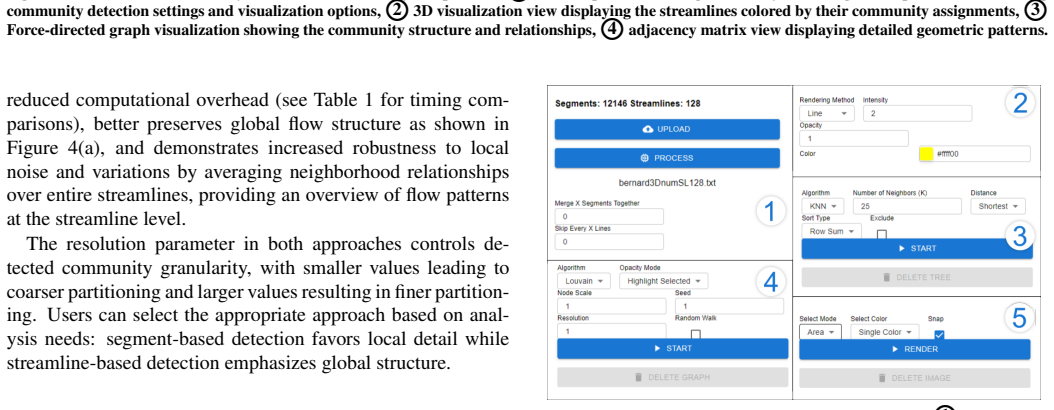
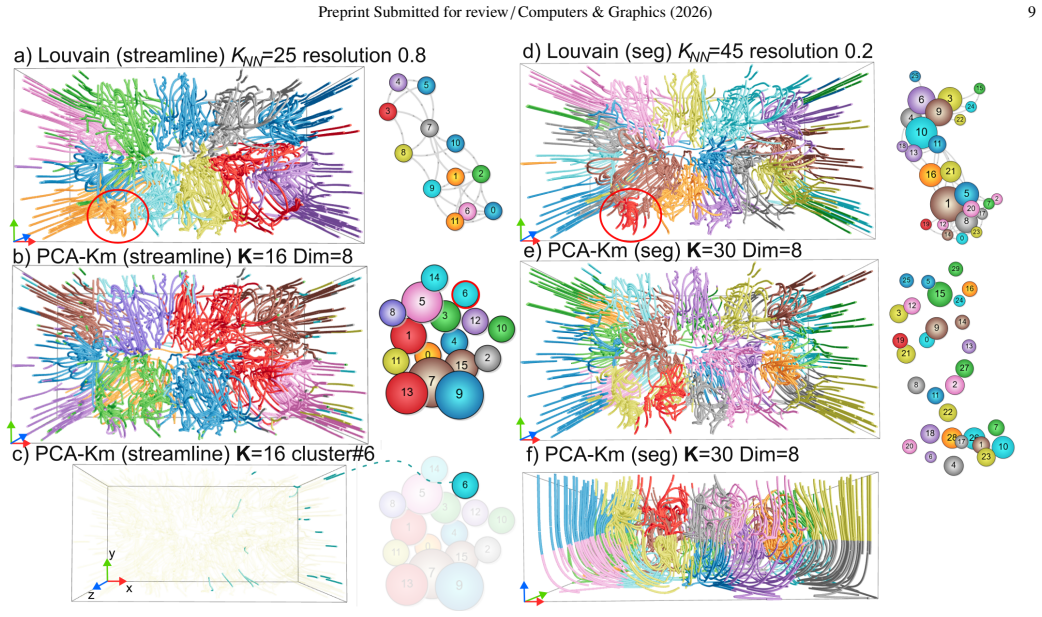
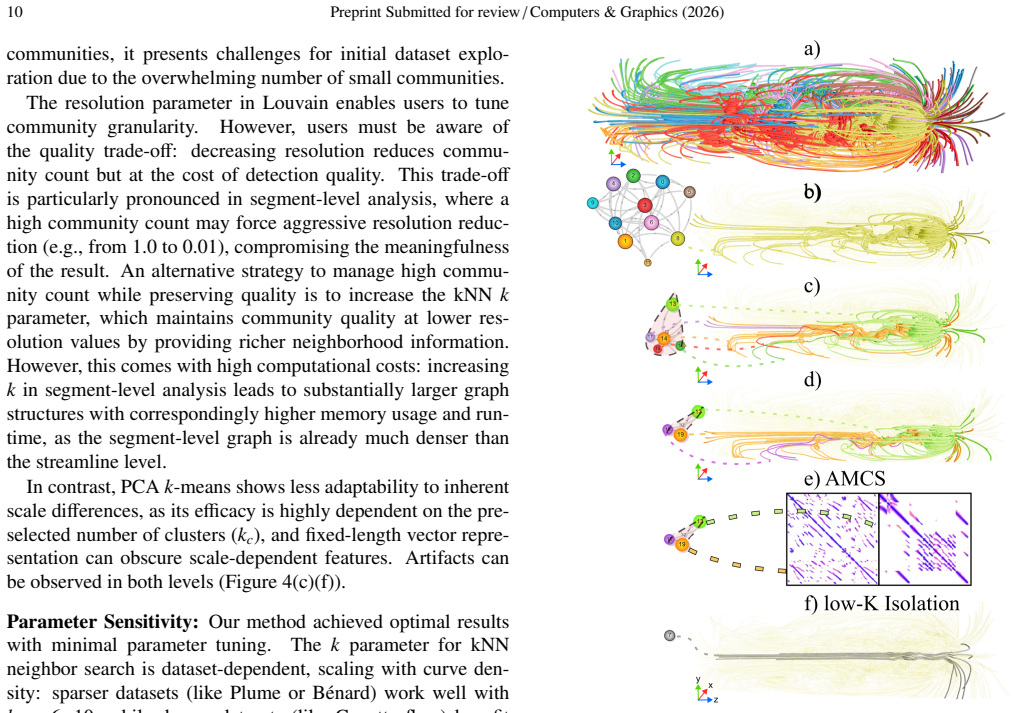
The authors build a Curve Segment Neighborhood Graph (CSNG) whose edges record spatial proximity between segments of streamlines. Community detection applied to this graph produces clusters that correspond to coherent flow structures and spatial groupings. The CSNG additionally drives an enhanced force-directed layout for multi-level exploration and supplies an adjacency-matrix view for examining fine-grained relations among segments, all while sustaining real-time interaction through compressed storage and parallel computation.
What carries the argument
The Curve Segment Neighborhood Graph (CSNG), a structure that records spatial neighbor relations among curve segments so that community detection can extract coherent flow groups.
If this is right
- Users can perform level-of-detail exploration of streamline data without pre-computing all possible groupings.
- Parameter changes such as neighborhood distance or community resolution update the displayed structures immediately.
- An adjacency-matrix pane reveals which specific segments connect across clusters.
- The method scales to datasets with hundreds of thousands of segments inside a standard web browser.
Where Pith is reading between the lines
- The same neighbor-graph idea could be tested on unsteady flow data by adding time as an extra dimension to the proximity measure.
- If the CSNG clusters align with known physical features such as vortices or separation lines, the graph could serve as input for automated feature extraction.
- Further compression of the adjacency information might allow the technique to handle millions of segments without leaving the browser.
Load-bearing premise
The spatial neighbor relations stored in the CSNG are sufficient to produce clusters that match meaningful flow structures without omitting important patterns or generating misleading groups.
What would settle it
Running community detection on the CSNG and then visually or physically comparing the resulting clusters against the original vector field to check whether any expected flow feature is absent or any spurious grouping appears.
Figures




read the original abstract
Streamlines have been widely used to represent and analyze various steady vector fields. To sufficiently represent important features in complex vector fields (like flow), a large number of streamlines are required. Due to the lack of a rigorous definition of features or patterns in streamlines, user interaction and exploration are required to achieve effective interpretation. Existing approaches based on clustering or pattern search, while valuable for specific analysis tasks, often face challenges in supporting interactive and level-of-detail exploration of large-scale curve-based data, particularly when real-time parameter adjustment and iterative refinement are needed. To address this, we design and implement an interactive web-based system. Our system utilizes a Curve Segment Neighborhood Graph (CSNG) to encode the neighboring relationships between curve segments. CSNG enables us to adapt a fast community detection algorithm to identify coherent flow structures and spatial groupings in the streamlines interactively. CSNG also supports a multi-level exploration through an enhanced force-directed layout. Furthermore, our system integrates an adjacency matrix representation to reveal detailed inter-relations among segments. To achieve real-time performance within a web browser, our system employs matrix compression for memory-efficient CSNG storage and parallel processing. We have applied our system to analyze and interpret complex patterns in several streamline datasets. Our experiments show that we achieve real-time performance on datasets with hundreds of thousands of segments.
Editorial analysis
A structured set of objections, weighed in public.
Referee Report
Summary. The paper presents an interactive web-based system for exploring large-scale streamline data from vector fields. It introduces a Curve Segment Neighborhood Graph (CSNG) to encode neighboring relationships between curve segments, enabling adaptation of fast community detection algorithms to identify coherent flow structures and spatial groupings interactively. The system supports multi-level exploration via an enhanced force-directed layout and an adjacency matrix for revealing inter-relations, with matrix compression and parallel processing to achieve real-time performance in browsers on datasets with hundreds of thousands of segments. The approach is demonstrated on several streamline datasets.
Significance. If the CSNG construction and community detection reliably produce clusters that align with actual flow coherence rather than spatial artifacts, the system could advance interactive visualization tools for complex vector field analysis, offering better support for level-of-detail exploration than prior clustering or pattern-search methods. The web-based, real-time focus addresses practical accessibility needs in scientific computing.
major comments (2)
- [Abstract] Abstract: The central claims of 'real-time performance on datasets with hundreds of thousands of segments' and 'effective identification of flow structures' are asserted without any quantitative metrics, validation details (e.g., agreement with known features), construction algorithm specifics for CSNG, or comparison results against alternatives. This leaves the effectiveness of the community detection unsupported.
- [CSNG and community detection sections] CSNG definition and community detection (likely §3-4): If edges are added based on spatial proximity (standard for neighborhood graphs), segments from distinct but adjacent flow features can be linked, risking community detection outputs that mix unrelated structures instead of respecting flow coherence. No evidence or test is provided that the resulting clusters are meaningful rather than proximity artifacts, directly undermining the claim that CSNG enables identification of coherent flow structures.
Simulated Author's Rebuttal
We thank the referee for the constructive comments and the opportunity to clarify our work. We address each major comment below, indicating where revisions will be made to strengthen the presentation of results and validation.
read point-by-point responses
-
Referee: [Abstract] Abstract: The central claims of 'real-time performance on datasets with hundreds of thousands of segments' and 'effective identification of flow structures' are asserted without any quantitative metrics, validation details (e.g., agreement with known features), construction algorithm specifics for CSNG, or comparison results against alternatives. This leaves the effectiveness of the community detection unsupported.
Authors: We agree that the abstract is high-level and does not include supporting quantitative details. In the revised version, we will expand the abstract to reference key performance numbers (e.g., frame rates achieved on datasets of 200k–500k segments) and note that CSNG construction and community detection are detailed in Sections 3 and 4. A concise statement on validation through application to datasets containing known flow features will also be added. Detailed timing tables, construction pseudocode, and comparisons to alternatives (e.g., feature-based clustering) will be incorporated into the experiments section rather than the abstract due to length constraints. revision: yes
-
Referee: [CSNG and community detection sections] CSNG definition and community detection (likely §3-4): If edges are added based on spatial proximity (standard for neighborhood graphs), segments from distinct but adjacent flow features can be linked, risking community detection outputs that mix unrelated structures instead of respecting flow coherence. No evidence or test is provided that the resulting clusters are meaningful rather than proximity artifacts, directly undermining the claim that CSNG enables identification of coherent flow structures.
Authors: The referee correctly identifies a potential limitation: CSNG construction relies on spatial neighborhood relationships between curve segments. This can indeed connect segments belonging to adjacent but distinct flow features. The manuscript presents CSNG as enabling both coherent flow structures and spatial groupings, and the interactive system allows users to adjust parameters and refine communities. However, we acknowledge that the current text provides no dedicated test or quantitative evidence (such as agreement with ground-truth features on synthetic data) to demonstrate that detected communities are not primarily proximity artifacts. In the revision, we will add a new validation subsection with results on controlled synthetic vector fields containing known adjacent structures, including qualitative visualizations and a simple agreement metric, plus an explicit discussion of this limitation. revision: yes
Circularity Check
No circularity: system implementation with independent design choices
full rationale
The paper describes the design and implementation of an interactive web-based system for streamline exploration. It introduces CSNG as a graph encoding neighboring relationships between curve segments, then adapts a community detection algorithm and force-directed layout for interactive analysis. No mathematical derivations, fitted parameters, or predictions are presented that reduce to the inputs by construction. No self-citations are invoked as load-bearing uniqueness theorems or ansatzes. The work is self-contained as an applied system with reported performance on external datasets, consistent with the reader's assessment of no circular reasoning.
Axiom & Free-Parameter Ledger
axioms (1)
- domain assumption Streamlines in steady vector fields contain identifiable coherent flow structures and spatial groupings that can be revealed through neighboring segment relationships.
invented entities (1)
-
Curve Segment Neighborhood Graph (CSNG)
no independent evidence
Reference graph
Works this paper leans on
-
[1]
Hierarchical streamline bundles
Yu, H, Wang, C, Shene, CK, Chen, JH. Hierarchical streamline bundles. IEEE Transactions on Visualization and Computer Graphics 2012;18(8):1353–1367. doi:10.1109/TVCG.2011.155
-
[2]
Blood flow clustering and applications invirtual stenting of intracranial aneurysms
Oeltze, S, Lehmann, DJ, Kuhn, A, Janiga, G, Theisel, H, Preim, B. Blood flow clustering and applications invirtual stenting of intracranial aneurysms. IEEE Transactions on Visualization and Computer Graphics 2014;20(5):686–701. doi:10.1109/TVCG.2013.2297914
-
[3]
Physics-based pathline clustering and exploration
Nguyen, DB, Zhang, L, Laramee, RS, Thompson, D, Monico, RO, Chen, G. Physics-based pathline clustering and exploration. Computer Graphics Forum 2021;40(1):22–37. doi:10.1111/cgf.14093
-
[4]
Streamline clustering and simplification for flow visualization: A comparative evaluation
Shi, L, Laramee, R, Chen, G. Streamline clustering and simplification for flow visualization: A comparative evaluation. IEEE transactions on visualization and computer graphics 2021;27(3):1967 – 1985. doi:10. 1109/TVCG.2019.2940935
-
[5]
Exploring vector fields with distribution-based streamline analysis
Lu, K, Chaudhuri, A, Lee, TY , Shen, HW, Wong, PC. Exploring vector fields with distribution-based streamline analysis. In: IEEE Pacific Visualization Symposium (PacificVis). 2013, p. 257–264. doi:10.1109/ PacificVis.2013.6596153
-
[6]
A vocabulary approach to partial streamline matching and exploratory flow visualization
Tao, J, Wang, C, Shene, CK, Shaw, RA. A vocabulary approach to partial streamline matching and exploratory flow visualization. IEEE Transactions on Visualization and Computer Graphics 2016;22(5):1503–
2016
-
[7]
doi:10.1109/TVCG.2015.2440252
-
[8]
Stream line–based pattern search in flows
Wang, Z, Esturo, JM, Seidel, HP, Weinkauf, T. Stream line–based pattern search in flows. Computer Graphics Forum 2016;:n/a–n/adoi:10. 1111/cgf.12990
2016
-
[9]
Phan, N, Chen, G. Curve segment neighborhood-based vector field exploration. In: 2024 IEEE Visualization and Visual Analytics (VIS). 2024, p. 326–330. doi:10.1109/VIS55277.2024.00075
-
[10]
Extracting flow features via su- pervised streamline segmentation
Li, Y , Wang, C, Shene, CK. Extracting flow features via su- pervised streamline segmentation. Comput Graph 2015;52(C):79–92. doi:10.1016/j.cag.2015.06.003
-
[11]
Blondel, VD, Guillaume, JL, Lambiotte, R, Lefebvre, E. Fast unfolding of communities in large networks. Journal of statistical mechanics: the- ory and experiment 2008;2008(10):P10008. doi:10.1088/1742-5468/ 2008/10/P10008
-
[12]
Li, M, Yang, D. Direct numerical simulation and statistical analysis of stress-driven turbulent couette flow with a free-slip boundary. Physics of Fluids 2019;31(8). doi:10.1063/1.5099650
-
[13]
Extract and characterize hairpin vortices in turbulent flows
Zafar, A, Yang, D, Chen, G. Extract and characterize hairpin vortices in turbulent flows. IEEE Transactions on Visualization and Computer Graphics 2023;30(1):716–726. doi:10.1109/TVCG.2023.3326603
-
[14]
McLoughlin, T, Laramee, RS, Peikert, R, Post, FH,, , Chen, M. Over two decades of integration-based, geometric flow visualization. In: pro- ceeding of EUROGRAPHICS, State of the Art Reports. 2009, p. 73–92. doi:10.1111/j.1467-8659.2010.01650.x
-
[15]
Surface-based flow visualization
Edmunds, M, Laramee, RS, Chen, G, Max, N, Zhang, E, Ware, C. Surface-based flow visualization. Computers & Graphics 2012;36(8):974–990. doi:10.1016/j.cag.2012.07.006
-
[16]
A survey of seed placement and streamline selection techniques
Sane, S, Bujack, R, Garth, C, Childs, H. A survey of seed placement and streamline selection techniques. In: Computer Graphics Forum; vol. 39. 2020, p. 785–809. doi:10.1111/cgf.14036
-
[17]
Creating evenly-spaced streamlines of arbi- trary density
Jobard, B, Lefer, W. Creating evenly-spaced streamlines of arbi- trary density. In: Visualization in Scientific Computing. 1997, p. 43–55. doi:10.1007/978-3-7091-6876-9_5
-
[18]
An advanced evenly-spaced streamline placement algorithm
Liu, Z, Moorhead, R, Groner, J. An advanced evenly-spaced streamline placement algorithm. IEEE Transactions on Visualization and Computer Graphics 2006;12(5):965–972. doi:10.1109/TVCG.2006.116
-
[19]
Farthest point seeding for efficient placement of streamlines
Mebarki, A, Alliez, P, Devillers, O. Farthest point seeding for efficient placement of streamlines. In: IEEE Visualization (VIS). 2005, p. 479–
2005
-
[20]
doi:10.1109/VISUAL.2005.1532832
-
[21]
Similarity-guided streamline placement with error evaluation
Chen, Y , Cohen, J, Krolik, J. Similarity-guided streamline placement with error evaluation. IEEE Transactions on Visualization and Computer Graphics 2007;13(6):1448–1455. doi:10.1109/TVCG.2007.70595
-
[22]
Image-guided streamline placement
Turk, G, Banks, D. Image-guided streamline placement. In: Proceed- ings of the 23rd annual conference on Computer graphics and interactive techniques. 1996, p. 453–460. doi:10.1145/237170.237285
-
[23]
Computer Graphics Forum29(2), 419–428 (2010) https://doi.org/10.1111/j.1467-8659.2009.01611.x
Spencer, B, Laramee, RS, Chen, G, Zhang, E. Evenly spaced stream- lines for surfaces: An image-based approach. In: Computer Graphics Fo- rum; vol. 28. 2009, p. 1618–1631. doi:10.1111/j.1467-8659.2009. 01352.x
-
[24]
Image-based streamline generation and ren- dering
Li, L, Shen, HW. Image-based streamline generation and ren- dering. IEEE Transactions on Visualization and Computer Graphics 2007;13(3):630–640. doi:10.1109/TVCG.2007.8093671
-
[25]
A flow-guided streamline seeding strat- egy
Verma, V , Kao, D, Pang, A. A flow-guided streamline seeding strat- egy. In: Proc. of IEEE Visualization. 2000, p. 163–170. doi:10.1109/ VISUAL.2000.885690
-
[26]
Vector Field Editing and Periodic Orbit Extraction Using Morse Decom- position
Chen, G, Mischaikow, K, Laramee, RS, Pilarczyk, P, Zhang, E. Vector Field Editing and Periodic Orbit Extraction Using Morse Decom- position. IEEE Transactions on Visualization and Computer Graphics 2007;13(4):769–785. doi:10.1109/TVCG.2007.1021
-
[27]
Topology-aware evenly spaced streamline placement
Wu, K, Liu, Z, Zhang, S, Moorhead II, RJ. Topology-aware evenly spaced streamline placement. IEEE Transactions on Visualization and Computer Graphics 2009;16(5):791–801. doi:10.1109/TVCG.2009. 206
-
[28]
An information-theoretic framework for flow visualization
Xu, L, Lee, TY , Shen, HW. An information-theoretic framework for flow visualization. IEEE Transactions on Visualization and Computer Graphics 2010;16(6):1216–1224. doi:10.1109/TVCG.2010.131
-
[29]
A survey of parallel particle tracing algorithms in flow visualization
Zhang, J, Yuan, X. A survey of parallel particle tracing algorithms in flow visualization. Journal of Visualization 2018;21(3):351–368. doi:10. 1007/s12650-017-0470-2. 14 Preprint Submitted for review/Computers & Graphics (2026)
2018
-
[30]
Opacity optimization for 3d line fields
G ¨unther, T, R ¨ossl, C, Theisel, H. Opacity optimization for 3d line fields. ACM Transactions on Graphics (TOG) 2013;32(4):1–8. doi:10. 1145/2461912.2461930
-
[31]
View-dependent streamline deformation and exploration
Tong, X, Edwards, J, Chen, CM, Shen, HW, Johnson, CR, Wong, PC. View-dependent streamline deformation and exploration. IEEE trans- actions on visualization and computer graphics 2015;22(7):1788–1801. doi:10.1109/TVCG.2015.2502583
-
[32]
Curve complexity heuristic kd-trees for neighborhood-based exploration of 3d curves
Lu, Y , Cheng, L, Isenberg, T, Fu, CW, Chen, G, Liu, H, et al. Curve complexity heuristic kd-trees for neighborhood-based exploration of 3d curves. In: Computer Graphics Forum; vol. 40. 2021, p. 461–474. doi:10.1111/cgf.142647
-
[33]
View point eval- uation and streamline filtering for flow visualization
Lee, TY , Mishchenko, O, Shen, HW, Crawfis, R. View point eval- uation and streamline filtering for flow visualization. In: Battista, GD, Fekete, JD, Qu, H, editors. PacificVis. 2011, p. 83–90. doi:10.1109/ PACIFICVIS.2011.5742376
-
[34]
A unified approach to stream- line selection and viewpoint selection for 3d flow visualization
Tao, J, Ma, J, Wang, C, Shene, CK. A unified approach to stream- line selection and viewpoint selection for 3d flow visualization. IEEE Transactions on Visualization and Computer Graphics 2012;19(3):393–
2012
-
[35]
doi:10.1109/TVCG.2012.143
-
[36]
Feature extraction and visualisation of flow fields
Post, FH, Vrolijk, B, Hauser, H, Laramee, RS, Doleisch, H. Feature extraction and visualisation of flow fields. In: Eurographics (State of the Art Reports). 2002,doi:10.2312/egst.20021053
-
[37]
Post, FH, Vrolijk, B, Hauser, H, Laramee, RS, Doleisch, H. The state of the art in flow visualisation: Feature extraction and tracking. In: Computer Graphics Forum; vol. 22. 2003, p. 775–792. doi:10.1111/j. 1467-8659.2003.00723.x
work page doi:10.1111/j 2003
-
[38]
Clustering of aortic vortex flow in cardiac 4d pc-mri data
Meuschke, M, Lawonn, K, K ¨ohler, B, Preim, U, Preim, B. Clustering of aortic vortex flow in cardiac 4d pc-mri data. In: Bildverarbeitung f ¨ur die Medizin: Algorithmen–Systeme–Anwendungen. 2016, p. 182–187. doi:10.1007/978-3-662-49465-3_33
-
[39]
Exploration of blood flow patterns in cerebral aneurysms during the cardiac cycle
Meuschke, M, V oß, S, Preim, B, Lawonn, K. Exploration of blood flow patterns in cerebral aneurysms during the cardiac cycle. Computers & Graphics 2018;72:12–25. doi:10.1016/j.cag.2018.01.012
-
[40]
Evaluation of fiber clustering methods for diffusion tensor imaging
Moberts, B, Vilanova, A, Van Wijk, JJ. Evaluation of fiber clustering methods for diffusion tensor imaging. In: IEEE Visualization Conference. 2005, p. 65–72. doi:10.1109/VISUAL.2005.1532779
-
[41]
Effectiveness of Animation in Trend Visualization
Everts, MH, Begue, E, Bekker, H, Roerdink, JB, Isenberg, T. Explo- ration of the brain’s white matter structure through visual abstraction and multi-scale local fiber tract contraction. IEEE transactions on visualiza- tion and computer graphics 2015;21(7):808–821. doi:10.1109/TVCG. 2015.2403323
-
[42]
Flownet: A deep learning framework for clustering and selection of streamlines and stream surfaces
Han, J, Tao, J, Wang, C. Flownet: A deep learning framework for clustering and selection of streamlines and stream surfaces. IEEE trans- actions on visualization and computer graphics 2018;26(4):1732–1744. doi:10.1109/TVCG.2018.2880207
-
[43]
Streamline embedding for 3d vector field ex- ploration
Rossl, C, Theisel, H. Streamline embedding for 3d vector field ex- ploration. IEEE Transactions on Visualization and Computer Graphics 2011;18(3):407–420. doi:10.1109/TVCG.2011.78
-
[44]
Pattern search in flows based on similarity of stream line segments
Wang, Z, Esturo, JM, Seidel, HP, Weinkauf, T. Pattern search in flows based on similarity of stream line segments. In: 19th Interna- tional Workshop on Vision, Modeling and Visualization. 2014, p. 23–30. doi:10.2312/vmv.20141272
-
[45]
Wang, Z, Seidel, HP, Weinkauf, T. Multi-field pattern matching based on sparse feature sampling. IEEE Transactions on Visualization and Computer Graphics 2015;22(1):807–816. doi:10.1109/TVCG.2015. 2467292
-
[46]
Tao, J, Wang, C, Shene, CK. Flowstring: Partial streamline match- ing using shape invariant similarity measure for exploratory flow visu- alization. In: IEEE Pacific Visualization Symposium. 2014, p. 9–16. doi:10.1109/PacificVis.2014.12
-
[47]
Flow web: a graph based user interface for 3d flow field exploration
Xu, L, Shen, HW. Flow web: a graph based user interface for 3d flow field exploration. In: Visualization and Data Analysis 2010; vol. 7530. 2010, p. 152–163. doi:10.1117/12.838659
-
[48]
Flowgraph: A compound hierarchical graph for flow field exploration
Ma, J, Wang, C, Shene, CK. Flowgraph: A compound hierarchical graph for flow field exploration. In: IEEE Pacific Visualization Sympo- sium (PacificVis). 2013, p. 233–240. doi:10.1109/PacificVis.2013. 6596150
-
[49]
Fortunato, S. Community detection in graphs. Physics reports 2010;486(3-5):75–174. doi:10.48550/arXiv.0906.0612
-
[50]
Community detection algorithms: a comparative analysis
Lancichinetti, A, Fortunato, S. Community detection algorithms: a comparative analysis. Physical review E 2009;80(5):056117. doi:https: //doi.org/10.1103/PhysRevE.80.056117
-
[51]
An improved force-directed auto- matic layout method for undirected compound graphs
Liu, J, Wang, Z, Yu, J, Liu, H, Li, T. An improved force-directed auto- matic layout method for undirected compound graphs. In: Man-Machine- Environment System Engineering: Proceedings of the 22nd International Conference on MMESE; vol. 927 ofLecture Notes in Electrical Engineer- ing. Springer; 2022, p. 242–249. doi:10.1007/978-981-19-4786-5_ 34
-
[52]
Graph- assisted visualization of microvascular networks
Govyadinov, P, Womack, T, Eriksen, J, Mayerich, D, Chen, G. Graph- assisted visualization of microvascular networks. In: IEEE visualization conference (VIS). 2019, p. 1–5. doi:10.1109/VISUAL.2019.8933682
-
[53]
Navigating clustered graphs using force-directed methods
Eades, P, Huang, ML. Navigating clustered graphs using force-directed methods. In: Graph Algorithms And Applications 2. 2004, p. 191–215. doi:10.7155/jgaa.00029
-
[54]
Compressed adjacency matrices: Untangling gene regulatory networks
Dinkla, K, Westenberg, MA, van Wijk, JJ. Compressed adjacency matrices: Untangling gene regulatory networks. IEEE Transactions on Visualization and Computer Graphics 2012;18(12):2457–2466. doi:10. 1109/TVCG.2012.208
2012
-
[55]
Matlink: Enhanced matrix visualization for ana- lyzing social networks
Henry, N, Fekete, JD. Matlink: Enhanced matrix visualization for ana- lyzing social networks. In: Human-Computer Interaction–INTERACT: 11th IFIP TC 13 International Conference, Rio de Janeiro, Brazil, September 10-14, Proceedings, Part II 11. 2007, p. 288–302. doi:doi. org/10.1007/978-3-540-74800-7_24
-
[56]
An optimal algorithm for approximate nearest neighbor searching fixed di- mensions
Arya, S, Mount, DM, Netanyahu, NS, Silverman, R, Wu, AY . An optimal algorithm for approximate nearest neighbor searching fixed di- mensions. Journal of the ACM (JACM) 1998;45(6):891–923. doi:doi. org/10.1145/293347.293348
-
[57]
Zafar, A, Poorshayegh, Z, Yang, D, Chen, G. Topological separation of vortices. In: IEEE Visualization and Visual Analytics (VIS). 2024, p. 311–315. doi:10.1109/VIS55277.2024.00070
discussion (0)
Sign in with ORCID, Apple, or X to comment. Anyone can read and Pith papers without signing in.