Recognition: unknown
Astrophysical bounds on the high-energy evolution of neutrino mixing
Pith reviewed 2026-05-10 12:24 UTC · model grok-4.3
The pith
High-energy astrophysical neutrinos can constrain the renormalization-group evolution of neutrino mixing parameters.
A machine-rendered reading of the paper's core claim, the machinery that carries it, and where it could break.
Core claim
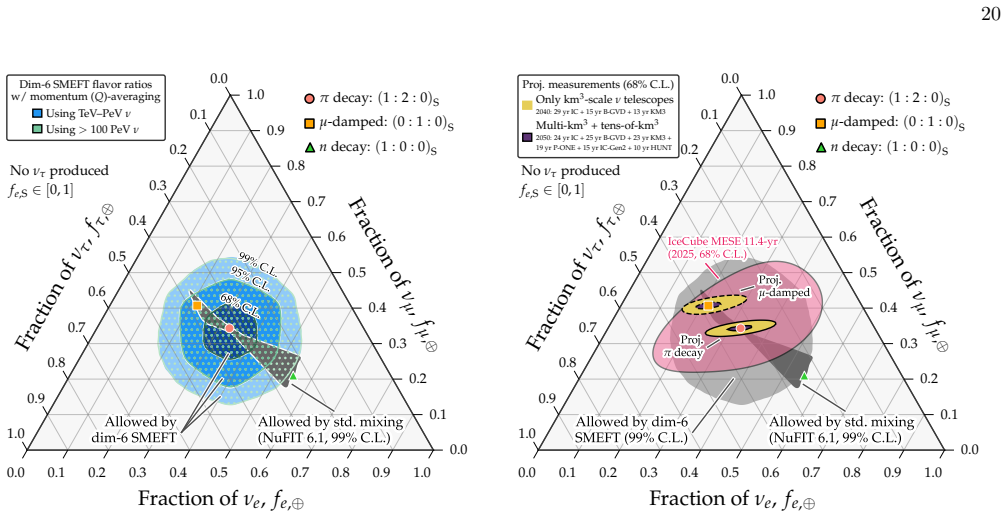
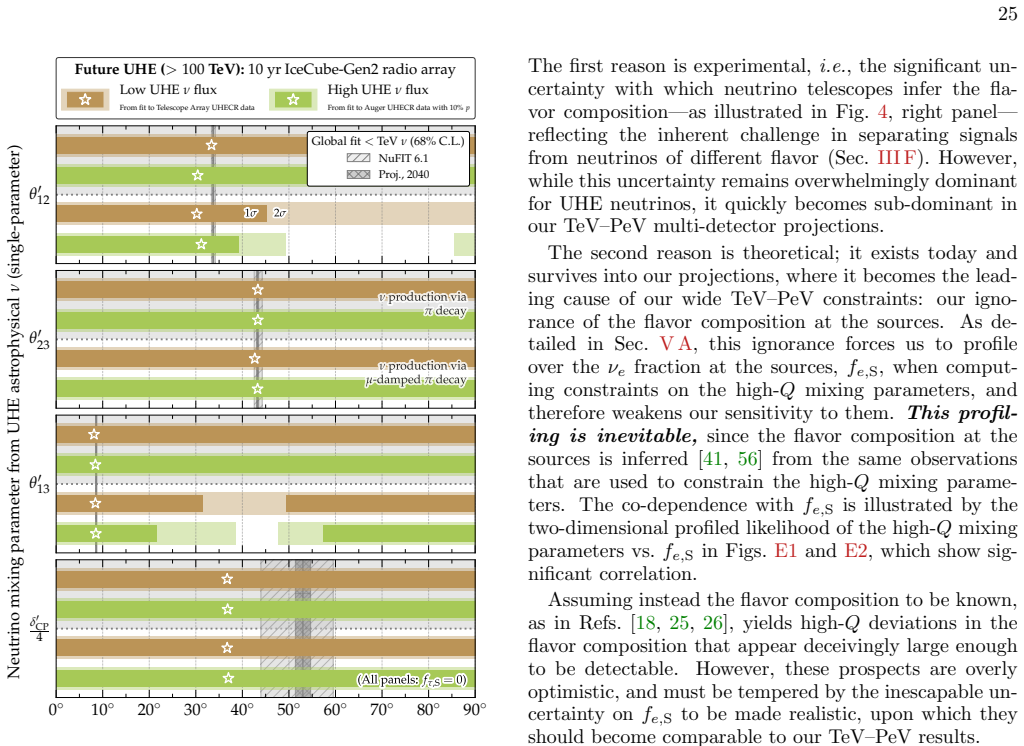
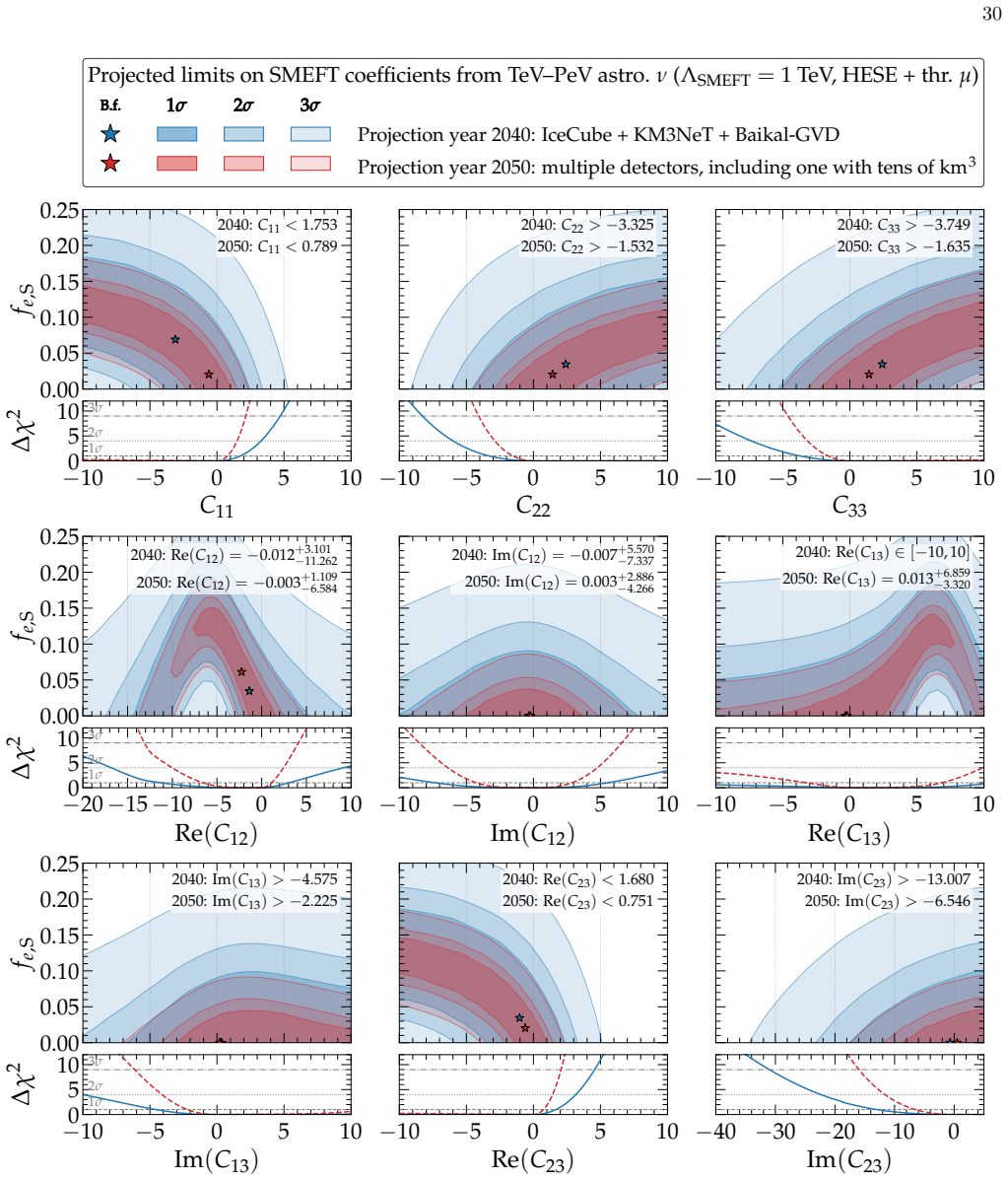
We use the flavor composition of these neutrinos -- the relative proportions of νe, νμ, and ντ -- to constrain this evolution, both phenomenologically and within dimension-6 Standard Model Effective Field Theory. We account for astrophysical uncertainties -- an unavoidable requirement to obtain realistic results, even though this weakens the bounds. Although present IceCube measurements lack the sensitivity to detect this running, we forecast that upcoming multi-detector combinations will place unprecedented bounds on the high-energy evolution of neutrino mixing.
What carries the argument
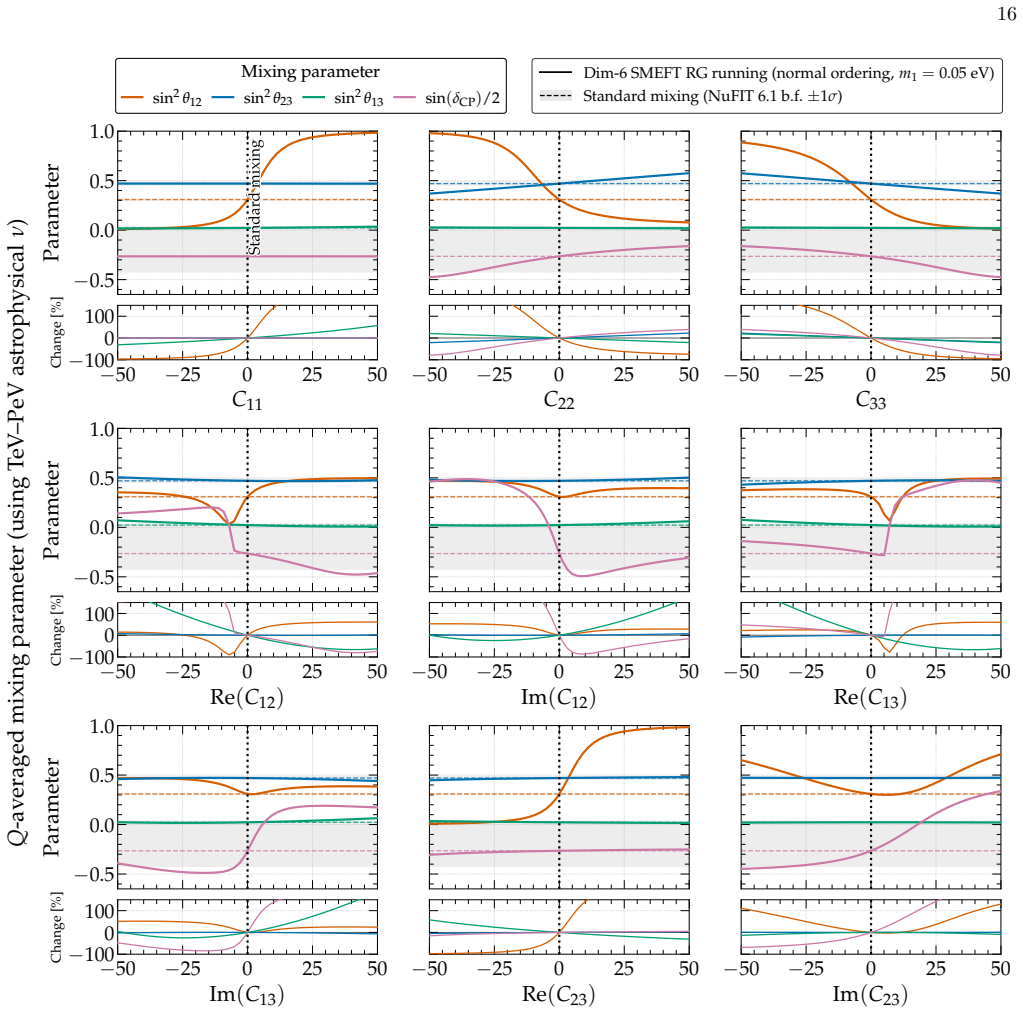
The flavor composition of high-energy astrophysical neutrinos, serving as a direct probe of the Q-dependence induced by renormalization-group running of the mixing matrix elements.
If this is right
- Current IceCube data cannot detect running of the mixing parameters.
- Upcoming multi-detector arrays will set the first realistic upper limits on the size of any high-energy evolution.
- The same method yields bounds both on standard-model renormalization-group flow and on dimension-6 SMEFT operators that modify the neutrino sector.
- The resulting limits remain conservative once source and propagation uncertainties are folded in.
Where Pith is reading between the lines
- This astrophysical approach accesses energy scales orders of magnitude above those reachable in terrestrial oscillation experiments.
- A positive detection of running would require new physics contributions at intermediate scales that alter the beta functions of the mixing parameters.
- The technique could be cross-checked against other high-energy neutrino observables such as cross-section measurements or arrival-time distributions.
- Non-observation of running would tighten the allowed parameter space for any new physics that couples to neutrinos above the TeV scale.
Load-bearing premise
Astrophysical uncertainties in neutrino sources, distances, and production mechanisms can be modeled sufficiently well to yield realistic bounds on the mixing evolution.
What would settle it
A high-statistics measurement of the flavor ratios at energies above 10 TeV by future detectors that is statistically consistent with the no-running prediction from low-energy parameters and excludes all but tiny values of the running coefficients within the forecasted experimental errors.
Figures





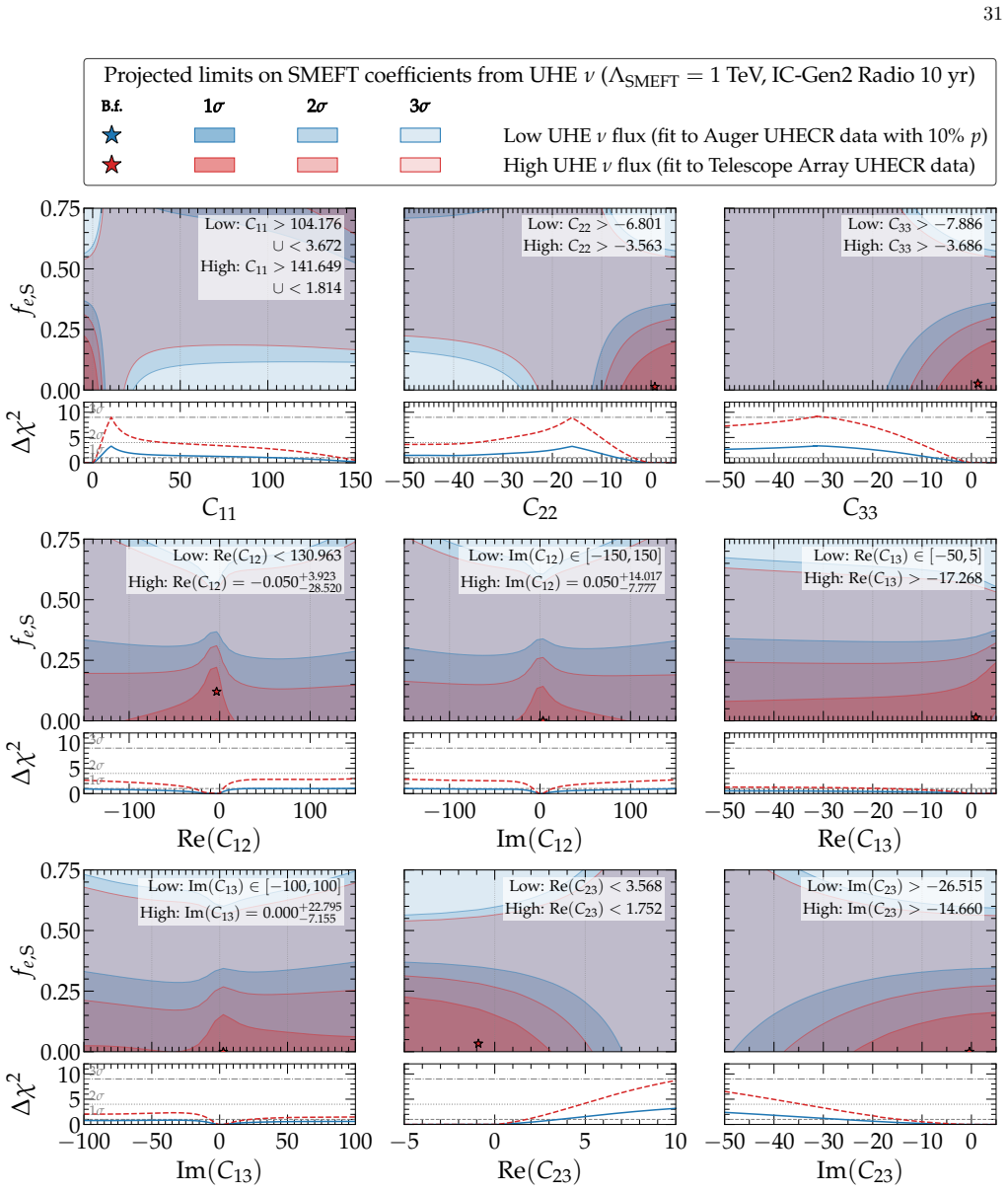
read the original abstract
While conventional oscillation experiments measure neutrino mixing parameters with high precision, these measurements are strictly confined to sub-TeV scales. At higher energies, renormalization-group effects can cause these parameters to evolve with the transferred momentum, $Q$. High-energy and ultra-high-energy astrophysical neutrinos, spanning TeV to EeV energies, probe high values of $Q$ unreachable by conventional experiments, offering an unprecedented test of high-energy mixing. We use the flavor composition of these neutrinos -- the relative proportions of $\nu_e$, $\nu_\mu$, and $\nu_\tau$ -- to constrain this evolution, both phenomenologically and within dimension-6 Standard Model Effective Field Theory. We account for astrophysical uncertainties -- an unavoidable requirement to obtain realistic results, even though this weakens the bounds. Although present IceCube measurements lack the sensitivity to detect this running, we forecast that upcoming multi-detector combinations will place unprecedented bounds on the high-energy evolution of neutrino mixing.
Editorial analysis
A structured set of objections, weighed in public.
Referee Report
Summary. The manuscript claims that the flavor composition of TeV–EeV astrophysical neutrinos can be used to constrain the high-scale renormalization-group evolution of neutrino mixing parameters, both in a phenomenological parametrization and within dimension-6 SMEFT. After marginalizing over astrophysical uncertainties in source flavor ratios, production channels, and propagation, current IceCube data are shown to lack sensitivity, while forecasted multi-detector combinations (IceCube-Gen2, KM3NeT, etc.) are projected to yield unprecedented bounds on the running.
Significance. If the projected constraints survive a fully conservative treatment of astrophysical systematics, the work would provide the first direct probe of neutrino mixing evolution above the TeV scale, complementing terrestrial oscillation experiments and offering a novel test of SMEFT operators at high Q. Explicit inclusion of uncertainties is a methodological strength, though it necessarily weakens the final bounds relative to idealized forecasts.
major comments (2)
- [§4.3] §4.3 and Fig. 7: the claim that residual astrophysical uncertainties remain sub-dominant after marginalization is not demonstrated quantitatively; the effective width of the marginalized posterior on the running parameters appears comparable to the size of the RG-induced shift itself, which would render the forecasted 'unprecedented' bounds uninformative rather than constraining.
- [Eq. (22)] Eq. (22) and Table 2: the SMEFT running coefficients are evolved from a fixed matching scale of 1 TeV; no scan over the matching scale or inclusion of higher-dimensional operators is performed, so the quoted bounds on the Wilson coefficients are conditional on this choice and may not be robust.
minor comments (2)
- [Abstract] The abstract states that 'present IceCube measurements lack the sensitivity' but does not cite the specific IceCube flavor-composition results or energy range used for this statement.
- [§2] Notation for the high-energy mixing angles (θ12(Q), etc.) is introduced without an explicit definition of the renormalization scale Q in the phenomenological section.
Simulated Author's Rebuttal
We thank the referee for the careful reading of our manuscript and the constructive comments, which have helped us identify areas for improvement. We address each major comment point by point below, outlining the revisions we will make to strengthen the presentation of our results.
read point-by-point responses
-
Referee: [§4.3] §4.3 and Fig. 7: the claim that residual astrophysical uncertainties remain sub-dominant after marginalization is not demonstrated quantitatively; the effective width of the marginalized posterior on the running parameters appears comparable to the size of the RG-induced shift itself, which would render the forecasted 'unprecedented' bounds uninformative rather than constraining.
Authors: We agree that a more explicit quantitative demonstration is required to support the claim that astrophysical uncertainties remain sub-dominant. In the revised manuscript, we will add a new panel to Fig. 7 (or a supplementary figure) that directly compares the 68% credible interval width of the marginalized posterior on each running parameter to the magnitude of the RG-induced shift for the multi-detector forecast. This will show that, while marginalization broadens the posteriors, the shifts remain larger than the residual widths at the forecasted sensitivities, preserving the informativeness of the bounds. The text in §4.3 will be updated to reference this comparison explicitly. revision: yes
-
Referee: [Eq. (22)] Eq. (22) and Table 2: the SMEFT running coefficients are evolved from a fixed matching scale of 1 TeV; no scan over the matching scale or inclusion of higher-dimensional operators is performed, so the quoted bounds on the Wilson coefficients are conditional on this choice and may not be robust.
Authors: We concur that the quoted bounds are conditional on the fixed matching scale of 1 TeV. In the revision, we will explicitly state this assumption in the text following Eq. (22) and in the caption of Table 2. To assess robustness, we will include a short supplementary scan over matching scales between 500 GeV and 2 TeV, demonstrating that the bounds on the Wilson coefficients change by at most ~25% and remain of the same order of magnitude. Inclusion of higher-dimensional operators lies beyond the scope of this work, as it would necessitate a dedicated global EFT fit; we will add a clarifying sentence noting this limitation and that the present bounds apply specifically within the dimension-6 SMEFT framework. revision: partial
Circularity Check
No circularity: bounds derived from standard RG evolution applied to external astrophysical data and forecasts
full rationale
The paper applies standard renormalization-group evolution equations for neutrino mixing parameters (both phenomenologically and in dim-6 SMEFT) to high-energy astrophysical neutrinos, using their flavor composition to derive constraints. It explicitly incorporates astrophysical uncertainties in sources, distances, and production mechanisms, which the abstract states weakens the bounds but is required for realism. Present IceCube data are stated to lack sensitivity, while forecasts for future multi-detector combinations are presented as projections. No load-bearing step reduces by construction to a fitted parameter defined inside the paper, no self-citation supplies a uniqueness theorem, and no ansatz or renaming is smuggled in. The derivation chain is self-contained against external benchmarks (standard RG equations and SMEFT), yielding a score of 0.
Axiom & Free-Parameter Ledger
axioms (1)
- standard math Renormalization-group evolution of neutrino mixing parameters is governed by Standard Model (or SMEFT) beta functions
Reference graph
Works this paper leans on
-
[1]
Pontecorvo, Mesonium and Antimesonium, Sov
B. Pontecorvo, Mesonium and Antimesonium, Sov. Phys. JETP6, 429 (1958)
1958
-
[2]
Z. Maki, M. Nakagawa, and S. Sakata, Remarks on the unified model of elementary particles, Prog. Theor. Phys.28, 870 (1962)
1962
- [3]
-
[4]
F. Capozzi, E. Di Valentino, E. Lisi, A. Marrone, A. Melchiorri, and A. Palazzo, Unfinished fabric of the three neutrino paradigm, Phys. Rev. D104, 083031 (2021), arXiv:2107.00532 [hep-ph]
-
[5]
NuFit-6.0: Updated global analysis of three-flavor neutrino oscillations
I. Esteban, M. C. Gonz´ alez-Garc´ ıa, M. Maltoni, I. Mart´ ınez-Soler, J. P. Pinheiro, and T. Schwetz, NuFit- 6.0: updated global analysis of three-flavor neutrino os- cillations, JHEP12, 216, arXiv:2410.05380 [hep-ph]
work page internal anchor Pith review arXiv
-
[6]
M. Bustamante, Q. Liu, and G. Barenboim, Measuring neutrino mixing above 1 TeV with astrophysical neutri- nos, (2026), arXiv:2602.14308 [hep-ph]
-
[7]
Weinberg, Baryon and lepton nonconserving pro- cesses, Phys
S. Weinberg, Baryon and lepton nonconserving pro- cesses, Phys. Rev. Lett.43, 1566 (1979)
1979
- [8]
-
[9]
M. E. Peskin and D. V. Schroeder,An Introduction to quantum field theory(Addison-Wesley, Reading, USA, 1995)
1995
-
[10]
Dimopoulos and H
S. Dimopoulos and H. Georgi, Softly Broken Supersym- metry and SU(5), Nucl. Phys. B193, 150 (1981)
1981
-
[11]
H. E. Haber and G. L. Kane, The Search for Supersym- metry: Probing Physics Beyond the Standard Model, Phys. Rept.117, 75 (1985)
1985
-
[12]
S. Antusch, J. Kersten, M. Lindner, and M. Ratz, Run- ning neutrino mass parameters in see-saw scenarios, Phys. Lett. B538, 87 (2002), arXiv:hep-ph/0203233
-
[13]
Running neutrino mass parameters in see-saw scenarios,
S. Antusch, J. Kersten, M. Lindner, M. Ratz, and M. A. Schmidt, Running neutrino mass parameters in see-saw scenarios, JHEP03, 024, arXiv:hep-ph/0501272
-
[14]
Buchmuller and D
W. Buchmuller and D. Wyler, Effective Lagrangian Analysis of New Interactions and Flavor Conservation, Nucl. Phys. B268, 621 (1986)
1986
-
[15]
I. Brivio and M. Trott, The Standard Model as an Effective Field Theory, Phys. Rept.793, 1 (2019), arXiv:1706.08945 [hep-ph]
- [16]
- [17]
- [18]
- [19]
- [20]
- [21]
-
[22]
Brocket al.(CTEQ), Handbook of perturbative QCD: Version 1.0, Rev
R. Brocket al.(CTEQ), Handbook of perturbative QCD: Version 1.0, Rev. Mod. Phys.67, 157 (1995)
1995
- [23]
- [24]
-
[25]
M. Bustamante, A. M. Gago, and J. Jones P´ erez, SUSY Renormalization Group Effects in Ultra High Energy Neutrinos, JHEP05, 133, arXiv:1012.2728 [hep-ph]
- [26]
- [27]
-
[28]
Ackermannet al., Fundamental Physics with High- Energy Cosmic Neutrinos, Bull
M. Ackermannet al., Fundamental Physics with High- Energy Cosmic Neutrinos, Bull. Am. Astron. Soc.51, 215 (2019), arXiv:1903.04333 [astro-ph.HE]
- [29]
-
[30]
M. Ackermannet al., High-energy and ultra-high-energy neutrinos: A Snowmass white paper, JHEAp36, 55 (2022), arXiv:2203.08096 [hep-ph]
- [31]
-
[32]
Mammen Abrahamet al., Tau neutrinos in the next decade: from GeV to EeV, J
R. Mammen Abrahamet al., Tau neutrinos in the next decade: from GeV to EeV, J. Phys. G49, 110501 (2022), arXiv:2203.05591 [hep-ph]
-
[33]
M. G. Aartsenet al.(IceCube), Evidence for High- Energy Extraterrestrial Neutrinos at the IceCube De- tector, Science342, 1242856 (2013), arXiv:1311.5238 [astro-ph.HE]
work page Pith review arXiv 2013
-
[34]
Adri´ an-Mart´ ınezet al.(KM3Net), Letter of in- tent for KM3NeT 2.0, J
S. Adri´ an-Mart´ ınezet al.(KM3Net), Letter of in- tent for KM3NeT 2.0, J. Phys. G43, 084001 (2016), arXiv:1601.07459 [astro-ph.IM]
-
[35]
V. A. Allakhverdyanet al.(Baikal-GVD), Overview of the Baikal-GVD neutrino telescope: 2024 status, EPJ Web Conf.319, 04002 (2025)
2024
-
[36]
C. Gu´ epin, K. Kotera, and F. Oikonomou, High- energy neutrino transients and the future of multi- messenger astronomy , Nature Rev. Phys.4, 697 (2022), arXiv:2207.12205 [astro-ph.HE]
-
[37]
Aielloet al.(KM3NeT), Observation of an ultra-high- energy cosmic neutrino with KM3NeT, Nature638, 376 (2025), [Erratum: Nature 640, E3 (2025)]
S. Aielloet al.(KM3NeT), Observation of an ultra-high- energy cosmic neutrino with KM3NeT, Nature638, 376 (2025), [Erratum: Nature 640, E3 (2025)]
2025
- [38]
-
[39]
T. Kashti and E. Waxman, Flavoring astrophysical neu- trinos: Flavor ratios depend on energy, Phys. Rev. Lett. 95, 181101 (2005), arXiv:astro-ph/0507599
-
[40]
M. Bustamante, J. F. Beacom, and W. Winter, The- oretically palatable flavor combinations of astrophys- ical neutrinos, Phys. Rev. Lett.115, 161302 (2015), arXiv:1506.02645 [astro-ph.HE]
- [41]
- [42]
- [43]
-
[44]
G. Barenboim and C. Quigg, Neutrino Observatories can Characterize Cosmic Sources and Neutrino Prop- erties, Phys. Rev. D67, 073024 (2003), arXiv:hep- ph/0301220
- [45]
- [46]
- [47]
-
[48]
M. Kachelrieß and R. Tom` as, High energy neutrino yields from astrophysical sources I: Weakly magnetized sources, Phys. Rev. D74, 063009 (2006), arXiv:astro- ph/0606406
- [49]
-
[50]
A. Esmaili and Y. Farzan, An Analysis of Cosmic Neu- trinos: Flavor Composition at Source and Neutrino Mixing Parameters, Nucl. Phys. B821, 197 (2009), arXiv:0905.0259 [hep-ph]
-
[51]
S. Choubey and W. Rodejohann, Flavor Composition of UHE Neutrinos at Source and at Neutrino Telescopes, Phys. Rev. D80, 113006 (2009), arXiv:0909.1219 [hep- ph]
-
[52]
S. H¨ ummer, M. Maltoni, W. Winter, and C. Yaguna, Energy dependent neutrino flavor ratios from cosmic ac- celerators on the Hillas plot, Astropart. Phys.34, 205 (2010), arXiv:1007.0006 [astro-ph.HE]
-
[53]
Winter, Photohadronic Origin of the TeV-PeV Neu- trinos Observed in IceCube, Phys
W. Winter, Photohadronic Origin of the TeV-PeV Neu- trinos Observed in IceCube, Phys. Rev. D88, 083007 (2013), arXiv:1307.2793 [astro-ph.HE]
-
[54]
A. Palladino, G. Pagliaroli, F. L. Villante, and F. Vis- sani, What is the Flavor of the Cosmic Neutrinos Seen by IceCube?, Phys. Rev. Lett.114, 171101 (2015), arXiv:1502.02923 [astro-ph.HE]
- [55]
-
[56]
M. Bustamante and M. Ahlers, Inferring the flavor of high-energy astrophysical neutrinos at their sources, Phys. Rev. Lett.122, 241101 (2019), arXiv:1901.10087 [astro-ph.HE]
-
[57]
Ackermannet al., Astrophysics Uniquely Enabled by Observations of High-Energy Cosmic Neutrinos, Bull
M. Ackermannet al., Astrophysics Uniquely Enabled by Observations of High-Energy Cosmic Neutrinos, Bull. Am. Astron. Soc.51, 185 (2019), arXiv:1903.04334 [astro-ph.HE]
-
[58]
M. Bustamante and I. Tamborra, Using high-energy neutrinos as cosmic magnetometers, Phys. Rev. D102, 123008 (2020), arXiv:2009.01306 [astro-ph.HE]
-
[59]
R. Alves Batistaet al., EuCAPT White Paper: Op- portunities and Challenges for Theoretical Astroparticle Physics in the Next Decade, (2021), arXiv:2110.10074 [astro-ph.HE]
- [60]
-
[61]
A. Bhattacharya, R. Enberg, M. H. Reno, and I. Sarce- vic, Energy-dependent flavour ratios in neutrino tele- scopes from charm, JCAP03, 057, arXiv:2309.09139 [astro-ph.HE]
-
[62]
B. Telalovic and M. Bustamante, Flavor anisotropy in the high-energy astrophysical neutrino sky, JCAP05, 013, arXiv:2310.15224 [astro-ph.HE]
- [63]
- [64]
- [65]
- [66]
- [67]
-
[68]
S. Pakvasa, W. Rodejohann, and T. J. Weiler, Flavor Ratios of Astrophysical Neutrinos: Implications for Pre- cision Measurements, JHEP02, 005, arXiv:0711.4517 [hep-ph]
-
[69]
Esmaili, Pseudo-Dirac Neutrino Scenario: Cosmic Neutrinos at Neutrino Telescopes, Phys
A. Esmaili, Pseudo-Dirac Neutrino Scenario: Cosmic Neutrinos at Neutrino Telescopes, Phys. Rev. D81, 013006 (2010), arXiv:0909.5410 [hep-ph]
-
[70]
A. Bhattacharya, S. Choubey, R. Gandhi, and A. Watanabe, Diffuse Ultra-High Energy Neutrino Fluxes and Physics Beyond the Standard Model, Phys. Lett. B690, 42 (2010), arXiv:0910.4396 [hep-ph]
-
[71]
A. Bhattacharya, S. Choubey, R. Gandhi, and A. Watanabe, Ultra-high neutrino fluxes as a probe for non-standard physics, JCAP09, 009, arXiv:1006.3082 [hep-ph]
-
[72]
M. Bustamante, A. M. Gago, and C. Pe˜ na-Garay, Energy-Independent New Physics in the Flavour Ra- tios of High-Energy Astrophysical Neutrinos, JHEP04, 066, arXiv:1001.4878 [hep-ph]
-
[73]
P. Mehta and W. Winter, Interplay of energy dependent astrophysical neutrino flavor ratios and new physics ef- fects, JCAP03, 041, arXiv:1101.2673 [hep-ph]
-
[74]
P. Baerwald, M. Bustamante, and W. Winter, Neu- trino Decays over Cosmological Distances and the Im- plications for Neutrino Telescopes, JCAP10, 020, arXiv:1208.4600 [astro-ph.CO]
- [75]
-
[76]
S. Pakvasa, A. Joshipura, and S. Mohanty, Expla- nation for the low flux of high energy astrophysical muon-neutrinos, Phys. Rev. Lett.110, 171802 (2013), arXiv:1209.5630 [hep-ph]
-
[77]
A. Chatterjee, M. M. Devi, M. Ghosh, R. Moharana, and S. K. Raut, Probing CP violation with the first three years of ultrahigh energy neutrinos from IceCube, Phys. Rev. D90, 073003 (2014), arXiv:1312.6593 [hep- ph]
- [78]
-
[79]
E. Aeikens, H. P¨ as, S. Pakvasa, and P. Sicking, Flavor ratios of extragalactic neutrinos and neutrino shortcuts in extra dimensions, JCAP10, 005, arXiv:1410.0408 [hep-ph]
- [80]
discussion (0)
Sign in with ORCID, Apple, or X to comment. Anyone can read and Pith papers without signing in.