Recognition: unknown
Varieties of nilpotent Jordan superalgebras of dimension five
Pith reviewed 2026-05-10 11:33 UTC · model grok-4.3
The pith
All isomorphism classes of complex five-dimensional nilpotent Jordan superalgebras are enumerated along with the irreducible components of their varieties and the full set of degenerations between them.
A machine-rendered reading of the paper's core claim, the machinery that carries it, and where it could break.
Core claim
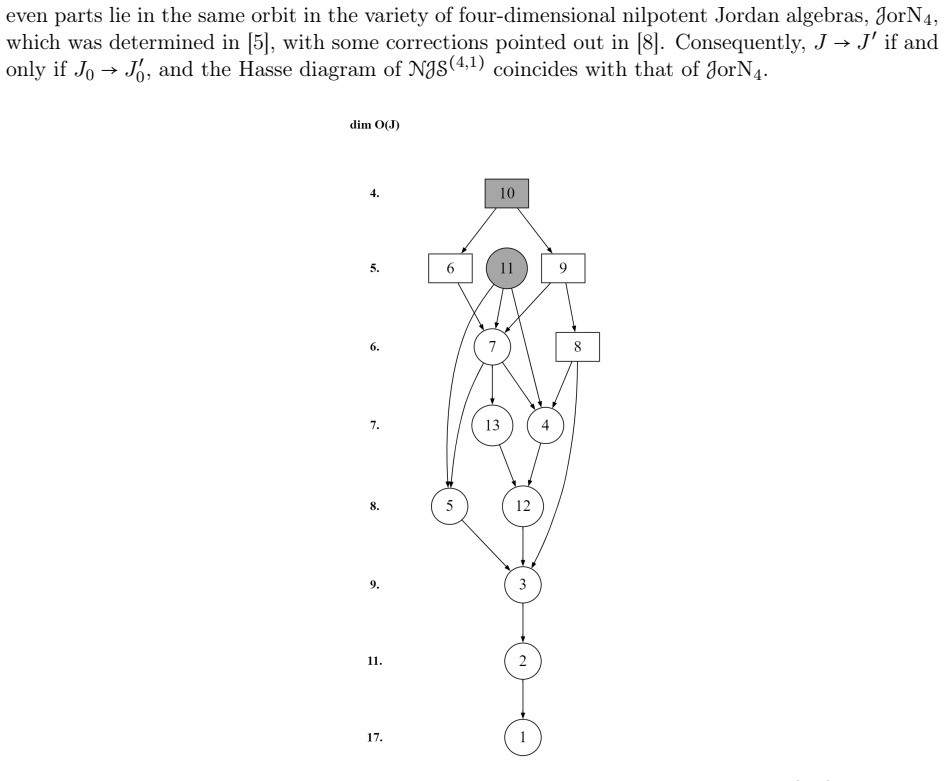
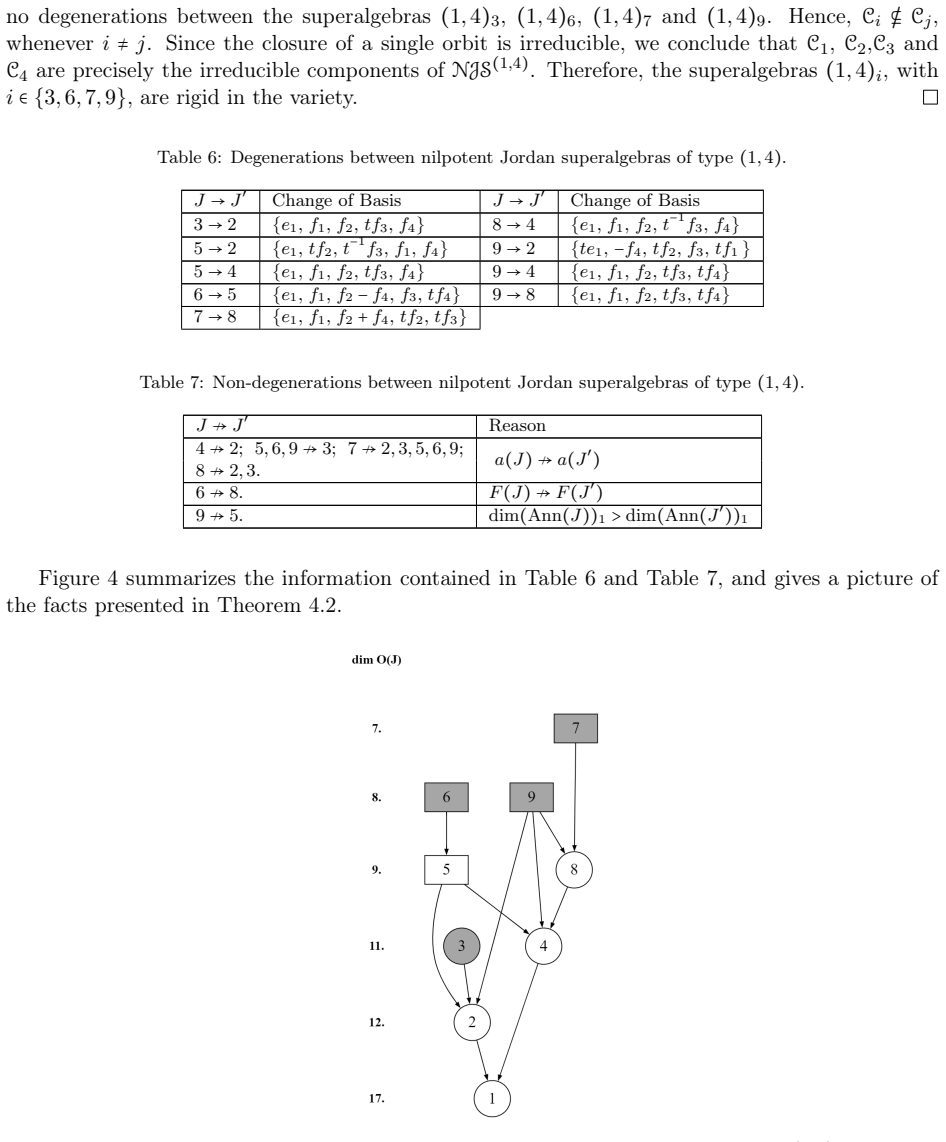
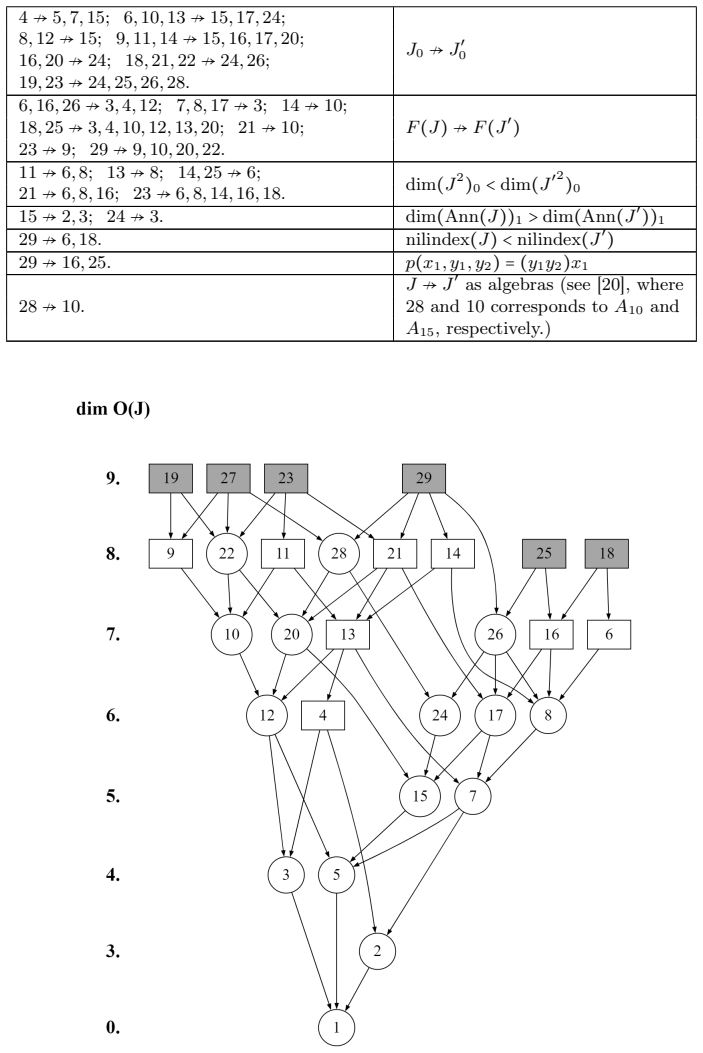
Using the Jordan normal form, simultaneous matrix triangularization, the Jordan-Kronecker theorem on pairs of skew-symmetric bilinear forms, and Burde-Grunewald module arguments, the authors obtain a finite list of representatives for all isomorphism classes. They determine the irreducible components of the varieties these classes form and describe every degeneration and non-degeneration, employing certain Z2-graded subspaces as distinguishing invariants.
What carries the argument
Exhaustive enumeration of all possible multiplication operators on a Z2-graded five-dimensional vector space via Jordan normal forms, simultaneous triangularization, and the Jordan-Kronecker theorem.
If this is right
- There are only finitely many isomorphism classes.
- The variety of all such superalgebras decomposes into a known collection of irreducible components.
- Every possible degeneration between classes is listed and can be realized by a concrete path in the parameter space.
- Graded subspaces serve as complete invariants that separate non-degenerate classes.
- Any further property of five-dimensional nilpotent Jordan superalgebras can now be checked on the finite list of representatives.
Where Pith is reading between the lines
- The same linear-algebra toolkit may be reusable for classifying nilpotent Jordan superalgebras in nearby dimensions.
- The degeneration diagrams supply a concrete model for studying moduli problems in other graded algebraic varieties.
- The explicit list makes it possible to test uniform statements about identities or representations across the entire family.
Load-bearing premise
The cited linear-algebra techniques together capture every possible multiplication structure on a five-dimensional Z2-graded space without missing any irreducible cases.
What would settle it
An explicit five-dimensional nilpotent Jordan superalgebra over the complexes whose multiplication table is not isomorphic to any of the listed representatives would show the enumeration is incomplete.
Figures

read the original abstract
The paper is devoted to the description of the varieties of complex 5-dimensional nilpotent Jordan superalgebras. We find all representatives for the isomorphism classes, using the Jordan normal form, results of simultaneous matrix triangularization, the Jordan-Kronecker theorem for a pair of skew-symmetric bilinear forms and similar arguments developed for $\Delta$-modules by Burde and Grunewald. We also provide a complete geometric classification, determining the irreducible components of the corresponding varieties and describing all possible degenerations and non-degenerations between these superalgebras, in particular, applying some $\mathbb{Z}_2$-graded subspaces as invariants.
Editorial analysis
A structured set of objections, weighed in public.
Referee Report
Summary. The paper classifies all isomorphism classes of complex 5-dimensional nilpotent Jordan superalgebras, listing explicit representatives obtained via the Jordan normal form, simultaneous triangularization, the Jordan-Kronecker theorem on pairs of skew-symmetric forms, and Burde-Grunewald module techniques. It further determines the irreducible components of the corresponding varieties and describes all degenerations and non-degenerations, employing Z2-graded subspaces as invariants.
Significance. If the enumeration is exhaustive, the work supplies a complete low-dimensional classification together with its geometric structure, which is a useful reference point for the theory of Jordan superalgebras and their degeneration theory. The explicit use of graded linear-algebra invariants and the degeneration diagram constitute concrete, checkable contributions.
major comments (3)
- [§3] §3 (classification of multiplication operators): the central claim that every nilpotent Jordan superalgebra structure arises from the listed normal forms rests on the applicability of the Jordan-Kronecker theorem and Burde-Grunewald arguments to all parity-preserving and parity-reversing operator pairs on a 5-dimensional Z2-graded space; the manuscript does not supply an explicit verification that the Jordan identity imposes no additional constraints that would produce operators outside the enumerated blocks.
- [Table 1] Table 1 (list of representatives): while the algebras are listed, the case-by-case reduction from the normal forms to each representative is not reproduced in sufficient detail to allow independent confirmation that no isomorphism class has been omitted; this is load-bearing for the completeness assertion.
- [§5] §5 (irreducible components and degenerations): the argument that the Z2-graded subspace invariants separate the irreducible components assumes that every degeneration path is captured by the listed families, but the interaction between nilpotency and the superalgebra identity in the limit is not checked for each component.
minor comments (3)
- The notation for the even and odd parts of the multiplication operators could be made uniform across sections; currently the parity of the bilinear forms is sometimes implicit.
- A short appendix or subsection summarizing the precise statements of the Jordan-Kronecker and Burde-Grunewald results as applied here would improve readability for readers unfamiliar with the superalgebra setting.
- [Figure 2] The degeneration diagram (Figure 2) would benefit from explicit labels indicating which components are irreducible and which arrows represent non-degenerations.
Simulated Author's Rebuttal
We thank the referee for the careful reading and constructive comments. We address each major comment below and indicate planned revisions to strengthen the manuscript.
read point-by-point responses
-
Referee: [§3] §3 (classification of multiplication operators): the central claim that every nilpotent Jordan superalgebra structure arises from the listed normal forms rests on the applicability of the Jordan-Kronecker theorem and Burde-Grunewald arguments to all parity-preserving and parity-reversing operator pairs on a 5-dimensional Z2-graded space; the manuscript does not supply an explicit verification that the Jordan identity imposes no additional constraints that would produce operators outside the enumerated blocks.
Authors: In §3 the possible forms of the multiplication operators are obtained by applying the Jordan normal form and simultaneous triangularization to the even part, the Jordan-Kronecker theorem to the relevant skew-symmetric forms on the odd part, and Burde-Grunewald module techniques to the graded actions. The Jordan superalgebra identity is imposed at each stage to restrict parameters inside these blocks. We agree that an explicit verification that the identity produces no structures outside the enumerated blocks would make the completeness argument more transparent. In the revised manuscript we will add a dedicated paragraph (or short subsection) that checks the identity on basis elements for each normal-form block and confirms that no further constraints arise. revision: yes
-
Referee: [Table 1] Table 1 (list of representatives): while the algebras are listed, the case-by-case reduction from the normal forms to each representative is not reproduced in sufficient detail to allow independent confirmation that no isomorphism class has been omitted; this is load-bearing for the completeness assertion.
Authors: The reductions from the normal forms to the concrete representatives in Table 1 are currently summarized rather than fully expanded. To permit independent verification that every isomorphism class has been accounted for, we will include an expanded appendix or subsection that records the explicit isomorphisms, parameter eliminations, and basis changes used in each case. revision: yes
-
Referee: [§5] §5 (irreducible components and degenerations): the argument that the Z2-graded subspace invariants separate the irreducible components assumes that every degeneration path is captured by the listed families, but the interaction between nilpotency and the superalgebra identity in the limit is not checked for each component.
Authors: The degeneration families are constructed so that the structure constants vary continuously; both the Jordan identity and the nilpotency condition are polynomial and therefore closed under limits. The Z2-graded subspace invariants are likewise preserved under degeneration. Nevertheless, we acknowledge that explicit verification of the limiting identities for each component would remove any doubt. In the revised §5 we will add a short paragraph confirming that every listed degeneration limit satisfies the superalgebra identity and remains nilpotent. revision: yes
Circularity Check
Classification via external linear-algebra theorems with no self-referential reduction
full rationale
The paper's derivation applies cited external results (Jordan normal form, simultaneous triangularization, Jordan-Kronecker theorem for skew-symmetric forms, and Burde-Grunewald Δ-module arguments) to enumerate multiplication operators on 5-dimensional Z2-graded spaces satisfying the Jordan identity and nilpotency. These tools are invoked as independent linear-algebra facts rather than derived or fitted within the paper; no equation or isomorphism class is obtained by renaming a fitted parameter, by self-definition, or by a load-bearing self-citation chain. The geometric classification of varieties and degenerations follows directly from the resulting case division on normal forms and graded invariants. The skeptic concern addresses possible incompleteness of coverage in the super-graded setting but does not identify any step that reduces to its own input by construction.
Axiom & Free-Parameter Ledger
axioms (1)
- domain assumption Standard axioms of Jordan superalgebras (graded Jordan identity and nilpotency condition)
Reference graph
Works this paper leans on
-
[1]
Abdelwahab, I
H. Abdelwahab, I. Kaygorodov, K. Khudoyberdiyev, The algebraic and geometric classification of right alternative superalgebras, Rend. Circ. Mat. Palermo (2) 75 (3) (2026) 82
2026
-
[2]
K.Abdurasulov, R.Lubkov, A.Saydaliyev, ThealgebraicandgeometricclassificationofJordan superalgebras, SEMR 22 (1) (2025) 813–852
2025
-
[3]
Alvarez, I
M.A. Alvarez, I. Hernández, On degenerations of Lie superalgebras, Linear Multilinear Algebra 68 (1) (2020) 29–44
2020
-
[4]
Alvarez, I
M.A. Alvarez, I. Hernández, I. Kaygorodov, Degenerations of Jordan superalgebras, Bull. Malays. Math. Sci. Soc. 42 (6) (2019) 3289–3301
2019
-
[5]
Ancochea Bermúdez, J
J.M. Ancochea Bermúdez, J. Fresán, J.M. Bentabol, Contractions of low-dimensional nilpotent Jordan algebras, Commun. Algebra 39 (3) (2011) 1139–1151
2011
-
[6]
Burde, F
D. Burde, F. Grunewald, Modules for certain Lie algebras of maximal class, J. Pure Appl. Algebra 99 (1995) 239–254
1995
-
[7]
Fehlberg Júnior, I
R. Fehlberg Júnior, I. Kaygorodov, A. Saydaliyev, The complete classification of irreducible components of varieties of Jordan superalgebras, Commun. Math. 33 (3) (2025) 15
2025
-
[8]
Fernández Ouaridi, I
A. Fernández Ouaridi, I. Kaygorodov, M. Khrypchenko, Yu. Volkov, Degenerations of nilpotent algebras, J. Pure Appl. Algebra 226 (3) (2022) 106850. 28
2022
-
[9]
Grunewald, J
F. Grunewald, J. O’Halloran, Varieties of nilpotent Lie algebras of dimension less than six, J. Algebra 112 (1998) 315–325
1998
-
[10]
Hegazi, H
A.S. Hegazi, H. Abdelwahab, Classification of five-dimensional nilpotent Jordan algebras, Lin- ear Algebra Appl. 494 (2016) 165–218
2016
-
[11]
Hernández, M.E
I. Hernández, M.E. Martin, R.L. Rodrigues, Irreducible components of the varieties of Jordan superalgebras of types (1,3) and (3,1), J. Algebra 681 (2025) 482–501
2025
-
[12]
I. Hernández, M.E. Martin, R.L. Rodrigues, The Variety of Jordan Superalgebras of dimension four and even part of dimension two, arXiv preprint, arXiv:2501.18067
-
[13]
Hernández, R.L
I. Hernández, R.L. Rodrigues, E.O. Quintero Vanegas, Low-dimensional commutative pow- erassociative superalgebras, Int. J. Algebra Comput. 31 (2021) 1613–1632
2021
-
[14]
Jordan, J
P. Jordan, J. von Neumann, E. Wigner, On an algebraic generalization of the quantum me- chanical formalism, Ann. of Math. 35 (1934) 29–64
1934
-
[15]
Kashuba, I
I. Kashuba, I. Shestakov, Jordan algebras of dimension three: geometric classification and representation type, in: Actas del XVI Coloquio Latinoamericano de Álgebra, Colonia del Sacramento, Uruguay, in: Biblioteca de la Revista Matemática Iberoamericana, vol. 1, 2007, pp. 295–315
2007
-
[16]
Kashuba, M.E
I. Kashuba, M.E. Martin, Deformations of Jordan algebras of dimension four, J. Algebra 399 (2014) 277–289
2014
-
[17]
Kashuba, M.E
I. Kashuba, M.E. Martin, Geometric classification of nilpotent Jordan algebras of dimension five, J. Pure Appl. Algebra 222 (2018) 546–559
2018
-
[18]
Kaygorodov, Non-associative algebraic structures: classification and structure, Commun
I. Kaygorodov, Non-associative algebraic structures: classification and structure, Commun. Math. 32 (3) (2024) 1–62
2024
-
[19]
Kaygorodov, M
I. Kaygorodov, M. Khrypchenko, P. Páez-Guillán, The geometric classification of non- associative algebras: a survey, Commun. Math. 32 (3) (2024) 185–284
2024
-
[20]
Kaygorodov, S
I. Kaygorodov, S. Lopes, Yu. Popov, Degenerations of nilpotent associative commutative alge- bras, Commun. Algebra 48 (4) (2020) 1632–1639
2020
-
[21]
Kozlov, An elementary proof of the Jordan-Kronecker theorem, Math Notes 94 (2013) 885–896
I.K. Kozlov, An elementary proof of the Jordan-Kronecker theorem, Math Notes 94 (2013) 885–896
2013
-
[22]
Lang, Algebra, Graduate Texts in Mathematics, 211, Springer-Verlag, New York, 2002
S. Lang, Algebra, Graduate Texts in Mathematics, 211, Springer-Verlag, New York, 2002
2002
-
[23]
Martin, Four-dimensional Jordan algebras, Int
M.E. Martin, Four-dimensional Jordan algebras, Int. J. Math. Game Theory Algebra 20 (4) (2013) 41–59
2013
-
[24]
Martin, Classification of three-dimensional Jordan superalgebras, arXiv preprint, arXiv:1708.01963
M.E. Martin, Classification of three-dimensional Jordan superalgebras, arXiv preprint, arXiv:1708.01963
-
[25]
McCrimmon, A Taste of Jordan Algebras, Universitext, Springer-Verlag, New York, 2004
K. McCrimmon, A Taste of Jordan Algebras, Universitext, Springer-Verlag, New York, 2004
2004
-
[26]
Osborn, Varieties of algebras, Adv
J.M. Osborn, Varieties of algebras, Adv. Math. 8 (1972) 163–369. 29
1972
-
[27]
Radjavi, P
H. Radjavi, P. Rosenthal, Simultaneous Triangularization, Springer Science & Business Media, 2000
2000
-
[28]
Seeley, Degenerations of6-dimensional nilpotent Lie algebras overC, Commun
C. Seeley, Degenerations of6-dimensional nilpotent Lie algebras overC, Commun. Algebra 18 (1990) 3493–3505
1990
-
[29]
Shestakov, Superalgebras and counterexamples, Sib
I.P. Shestakov, Superalgebras and counterexamples, Sib. Math. J. 32 (1991) 1052–1060
1991
-
[30]
Shestakov, K
I. Shestakov, K. Okunev, Engel Theorem for Jordan superalgebras, in: Groups, Rings and Group Rings, in: Lect. Notes Pure Appl. Math., vol. 248, Chapman & Hall/CRC, Boca Raton, FL, 2006, pp. 315–319
2006
-
[31]
Zhevlakov, A.M
K.A. Zhevlakov, A.M. Slinko, I.P. Shestakov, A.I. Shirshov, Rings that are Nearly Associative, Nauka, Moscow, 1978; Academic Press, New York, 1982. 30
1978
discussion (0)
Sign in with ORCID, Apple, or X to comment. Anyone can read and Pith papers without signing in.