pith. machine review for the scientific record. sign in

math.RA

Rings and Algebras

Non-commutative rings and algebras, non-associative algebras, universal algebra and lattice theory, linear algebra, semigroups

0
math.RA 2026-05-13 2 theorems

Endomorphism rings of uniserial modules admit one-sided trace ideals

Trace ideals and uniserial modules

An intrinsic description separates right and left trace ideals and yields an alternative construction of non-serial summands inside serial模块

abstract click to expand
We thoroughly investigate the trace ideals of projective modules over the endomorphism ring of a uniserial module. After the work of Dubrovin and Puninski, it is known that this class of rings provides examples of trace ideals of projective right modules that are not trace ideals of projective left modules. In this paper we further investigate when this happens, giving an intrinsic description of such trace ideals and their properties. We also use the theory associated to lifting projective modules modulo a trace ideal to give an alternative approach to Puninski's construction of a direct summand of a serial module that is not serial.
0
0
math.RA 2026-05-13 1 theorem

Even restrictions yield explicit groups and monoids of permutations

Groups of permutations that are even on maximal proper subsets, and related monoids

Γ_n, Δ_n and Σ_n defined by evenness on every (n-1)-subset receive full descriptions, sizes, ranks and minimal generators.

abstract click to expand
Let $n$ be a positive integer and let $[n]=\{1,2,\ldots,n\}$. Let $\Gamma_n$ denote the group of permutations on $[n]$ whose restrictions to maximal proper subsets of $[n]$ are even, let $\Sigma_n$ denote the monoid of transformations on $[n]$ whose injective restrictions to maximal proper subsets of $[n]$ are even and let $\Delta_n$ denote the submonoid of $\Sigma_n$ generated by transformations of rank at least $n-1$. In this paper, we present descriptions of $\Gamma_n$, $\Delta_n$ and $\Sigma_n$, determine their cardinalities and ranks, and provide minimal generating sets for each of them.
0
0
math.RA 2026-05-13 Recognition

Uniqueness theorem holds for twisted Steinberg algebras

Uniqueness Theorems for Twisted Steinberg Algebras

The result requires an ample Hausdorff groupoid and discrete twist, and yields a Cuntz-Krieger corollary when the groupoid is effective.

abstract click to expand
Given an ample Hausdorff groupoid $G$, a unital commutative ring $R$, and a discrete twist $(\Sigma,i,q)$, we establish a generalised uniqueness theorem for the twisted Steinberg algebra $A_R(G;\Sigma)$. By applying this theorem when $G$ is effective, we establish a Cuntz-Krieger uniqueness theorem as a corollary. We also prove a generalised graded uniqueness theorem for $A_R(G;\Sigma)$.
0
0
math.RA 2026-05-11 Recognition

Comaximal graph of sl_2(F_q) is connected and non-planar

The comaximal graph of a finite-dimensional Lie algebra

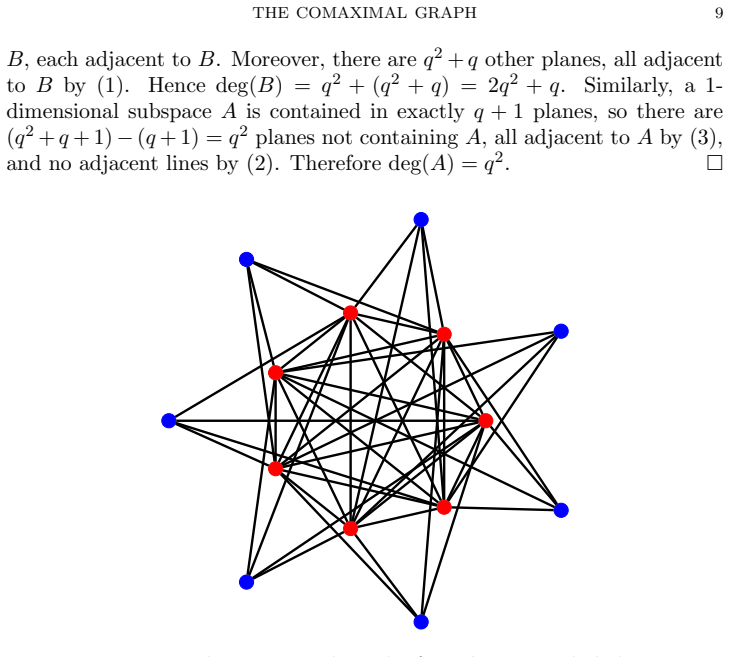
Explicit invariants show a large clique from nonsplit lines and Borels, with restricted adjacency for nilpotents and split lines.

Figure from the paper full image
abstract click to expand
In this paper, we introduce the comaximal graph $\Gamma(L)$ of a finite-dimensional Lie algebra $L$, whose vertices are the nontrivial proper Lie subalgebras of $L$ over a field $\mathbb{F}$, and two vertices $A$ and $B$ are adjacent if and only if $\langle A, B\rangle =L$. We establish general structural properties, including a characterization of isolated vertices via the Frattini subalgebra and a criterion for completeness in terms of $\mu$-algebras. We classify $\Gamma(L)$ for all Lie algebras of dimension at most three over a finite field $\mathbb{F}_q$, providing an explicit description in each case. The resulting graphs exhibit a rich range of behaviors, depending on the structure of the derived algebra and the action of $\operatorname{ad}x$. For $L\cong \mathfrak{sl}_2(\mathbb{F}_q)$, we determine several graph invariants, including the degree sequence, clique number, chromatic number, domination number, diameter, and radius, and show that $\Gamma(L)$ is connected and non-planar. The graph contains a large clique formed by the nonsplit semisimple lines together with the Borel subalgebras, while the nilpotent and split semisimple lines have a more restricted adjacency structure governed by their containment in Borel subalgebras.
0
0
math.RA 2026-05-11 2 theorems

Bicommutative varieties with cubic identities fully classified

Varieties of bicommutative algebras with identity of degree three

Over characteristic-zero fields every such variety is described and a criterion for distributive subvariety lattices is given.

abstract click to expand
The variety of bicommutative algebras is the class of all nonassociative algebras satisfying the polynomial identities $(x_1x_2)x_3=(x_1x_3)x_2$ and $x_1(x_2x_3)=x_2(x_1x_3)$. In this paper we provide a complete description of varieties of bicommutative algebras over a field of characteristic zero that satisfy a polynomial identity of degree three. Furthermore, we establish a sufficient and necessary condition for a variety of bicommutative algebras to have a distributive lattice of subvarieties.
0
0
math.RA 2026-05-11 2 theorems

Commutator of order n implies matrix ring if idempotents meet condition

Commutators of finite multiplicative order

In a unital ring the equation [a,b]^n equals 1 produces idempotents whose properties can force the ring to be isomorphic to M_n over another

abstract click to expand
This article studies the equation $[A,B]^k = {\rm Id}_n$ for matrices over $\mathbb{C}$, characterizing the pairs $(k,n)$ for which solutions exist via a classical result of Lam and Leung on sums of roots of unity. The problem is next generalized to matrix rings $M_n(S)$ over arbitrary unital rings $S$, where a sufficient condition on $1_S$ is established and explicit constructions of solutions are provided. Beyond matrix rings, the structural implications of the equation $[a,b]^n = 1$ in a general unital ring $R$ are investigated, yielding a collection of idempotents whose properties govern the ring's structure. We prove that under a suitable condition on these idempotents, $[a,b]^n = 1$ implies $R \cong M_n(S)$ for some unital ring $S$. These results together establish a framework connecting commutator equations and classical criteria for recognizing full matrix rings.
0
0
math.RA 2026-05-11 2 theorems

Coxeter-Dickson E8 order closes under para-octonions

Integral elements of Okubo algebra and the E8-lattice

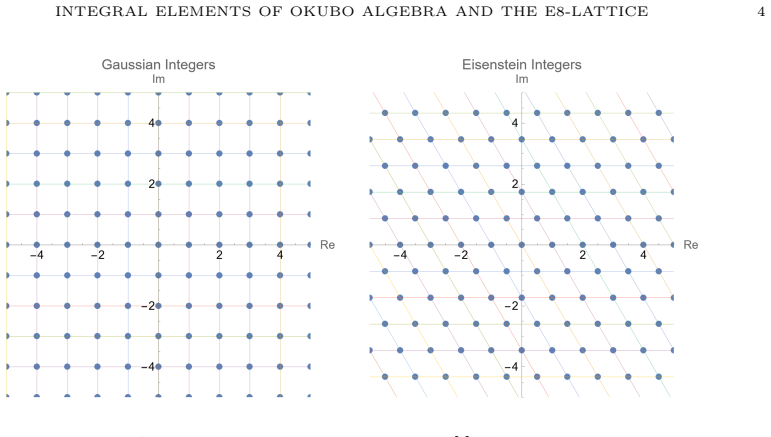
The Okubo product needs sqrt(3) coefficients and 2-adic scaling to reach a conductor sublattice of E8, recovered by saturation or gluing.

Figure from the paper full image
abstract click to expand
In this work we study the interplay between the Coxeter-Dickson $E_{8}$-order, the para-octonions, and the real Okubo algebra. We prove that the Coxeter-Dickson order remains closed for the para-octonionic product, so that one recovers a genuine $\mathbb{Z}$-integral system with underlying lattice $E_{8}$. Intriguingly, the Okubo product behaves in a different and more arithmetic way: it forces $\mathbb{Q}(\sqrt{3})$-coefficients and does not preserve the same $\mathbb{Z}$-order. After a diagonal $2$-adic scaling we obtain a closed $\mathbb{Z}[\sqrt{3}]$-order, whose direct metric shadow is a $2$-primary conductor sublattice of $E_{8}$, not $E_{8}$ itself. The lattice $E_{8}$ is recovered only by $2$-adic saturation, equivalently by gluing, and this recovery is metric-arithmetic rather than multiplicative.
0
0
math.RA 2026-05-11 2 theorems

Nilpotent Rota-Baxter algebras get explicit normal forms

A Gr\"obner--Shirshov Basis for Nilpotent Rota--Baxter Algebras of Weight Zero

Six families of relations form a Gröbner-Shirshov basis that decides equality in the free algebras of weight zero.

abstract click to expand
We construct an explicit Gr\"obner--Shirshov basis for free associative Rota--Baxter algebras of weight zero with nilpotent operator $R^n=0$, where $n\ge 2$. First, we define a monomial order on the standard linear basis $RS(X)$ of the free algebra $R\mathrm{As}\langle X\rangle$ and establish fundamental identities for Rota--Baxter operators. For the case $n=2$, the basis consists of the Rota--Baxter relation $R(u)R(v)\to R(uR(v))+R(R(u)v)$ and the nilpotency relation $R(R(w))\to 0$. For general $n\ge 3$, we prove that the Gr\"obner--Shirshov basis is finite and consists of six families of relations $(R1)$--$(R6)$ derived from resolving all composition ambiguities. Using the Composition-Diamond Lemma, we describe the corresponding irreducible basis $\operatorname{Irr}(S)$, which provides normal forms for elements in the quotient algebra. This result gives a complete solution to the word problem for nilpotent Rota--Baxter algebras and establishes their operadic Gr\"obner--Shirshov basis.
0
0
math.RA 2026-05-11 2 theorems

Nilpotent Rota-Baxter algebras have finite Gröbner-Shirshov bases

A Gr\"obner--Shirshov Basis for Nilpotent Rota--Baxter Algebras of Weight Zero

Six families of relations for n at least three give irreducible normal forms and solve the word problem for weight-zero cases.

abstract click to expand
We construct an explicit Gr\"obner--Shirshov basis for free associative Rota--Baxter algebras of weight zero with nilpotent operator $R^n=0$, where $n\ge 2$. First, we define a monomial order on the standard linear basis $RS(X)$ of the free algebra $R\mathrm{As}\langle X\rangle$ and establish fundamental identities for Rota--Baxter operators. For the case $n=2$, the basis consists of the Rota--Baxter relation $R(u)R(v)\to R(uR(v))+R(R(u)v)$ and the nilpotency relation $R(R(w))\to 0$. For general $n\ge 3$, we prove that the Gr\"obner--Shirshov basis is finite and consists of six families of relations $(R1)$--$(R6)$ derived from resolving all composition ambiguities. Using the Composition-Diamond Lemma, we describe the corresponding irreducible basis $\operatorname{Irr}(S)$, which provides normal forms for elements in the quotient algebra. This result gives a complete solution to the word problem for nilpotent Rota--Baxter algebras and establishes their operadic Gr\"obner--Shirshov basis.
0
0
math.RA 2026-05-11 2 theorems

Factor systems classify strongly graded rings up to isomorphism

Factor systems and geometric structures of strongly graded rings

Conjugacy classes of data on the principal component and grading group reconstruct the full ring structure.

abstract click to expand
Graded rings provide a natural algebraic framework for encoding symmetry via decompositions into homogeneous components indexed by a group, together with multiplication rules reflecting the group operation. Among graded rings, strongly graded rings form a particularly well-behaved and structurally rich class. In this paper we introduce a notion of factor systems for strongly graded rings, consisting of algebraic data that encode both the bimodule structure of the homogeneous components and their multiplication relations. In particular, this framework makes it possible to carry out explicit computations. We show that strongly graded rings with fixed principal component are classified, up to isomorphism, by conjugacy classes of such factor systems. Conversely, every abstract factor system gives rise to a strongly graded ring realizing it. In this way, the global structure of a strongly graded ring can be reconstructed from algebraic data on the principal component together with the grading group. Factor systems also provide a convenient framework for studying the problem of lifting derivations from the principal component to graded derivations of the whole ring. We derive explicit compatibility conditions for the existence of such lifts and interpret the resulting obstruction in cohomological terms. This leads to an algebraic analogue of the Atiyah sequence for strongly graded rings and to curvature-type invariants measuring the failure of graded lifts to form Lie algebra homomorphisms. The theory is illustrated by Leavitt path algebras.
0
0
math.RA 2026-05-11 Recognition

Square commutativity forces additive maps to be scaled homo-anti-homo sums

Commutativity preserving mappings in Banach algebras

In Banach algebras without ℂ or M₂(ℂ) quotients and with B semisimple, surjective additive Φ obeying [Φ(x²), Φ(x)] = 0 equals λΨ(x) + ζ(x) (

abstract click to expand
Let $A$ and $B$ be unital complex Banach algebras having no quotients isomorphic to $\mathbb{C}$ or $M_2(\mathbb{C})$. Assume additionally that $B$ is semisimple. If a surjective additive mapping $\Phi\colon A\to B$ satisfies $[\Phi(x^2),\Phi(x)] = 0$ for all $x\in A$, then there exist a surjective direct sum of an additive homomorphism and an additive anti-homomorphism $\Psi\colon A\to B$, an invertible element $\lambda\in\mathcal{Z}(B)$, and an additive mapping $\zeta\colon A\to\mathcal{Z}(B)$ such that $\Phi(x)=\lambda\Psi(x)+\zeta(x)$ for all $x\in A$.
0
0
math.RA 2026-05-11 2 theorems

Opposite brace triples equate to Hopf braces under cocommutativity

Opposite brace triples, Hopf braces and matched pairs of Hopf algebras

In braided monoidal categories the new triples also match the categories of matched pairs when one Hopf algebra is fixed.

abstract click to expand
In this paper the category of opposite brace triples is introduced in a general braided monoidal setting. Under cocommutativity, it is proved to be isomorphic to the category of Hopf braces. Furthermore, if one considers the subcategories arising from fixing one of the underlying Hopf algebras, then these two categories are also isomorphic to the category of matched pairs over that Hopf algebra.
0
0
math.RA 2026-05-08

Distinct cardinalities force monoid automorphisms to act on separate factors

Automorphism groups of direct products of multiplicative monoids of certain rings

For D-rings that are total rings of fractions, the automorphism group of the product monoid decomposes as a direct product, determining theZ

abstract click to expand
In this paper, we establish a rigidity result for automorphisms of multiplicative direct products of $D$-rings which are total ring of fraction that have pairwise distinct cardinalities. Under these assumptions, every automorphism acts independently on each factor, so that no interaction between distinct components occurs; in particular, the automorphism group decomposes canonically as the direct product of the automorphism groups of the factors. As a consequence, the automorphism group of the multiplicative monoid of integers modulo $n$ is entirely determined by its $p$-power components.
0
0
math.RA 2026-05-08 Recognition

Automorphisms of product monoids split by component when sizes differ

Automorphism groups of direct products of multiplicative monoids of certain rings

When D-rings are total fraction rings of distinct cardinalities, the group decomposes as the direct product of the separate factor groups.

abstract click to expand
In this paper, we establish a rigidity result for automorphisms of multiplicative direct products of $D$-rings which are total ring of fraction that have pairwise distinct cardinalities. Under these assumptions, every automorphism acts independently on each factor, so that no interaction between distinct components occurs; in particular, the automorphism group decomposes canonically as the direct product of the automorphism groups of the factors. As a consequence, the automorphism group of the multiplicative monoid of integers modulo $n$ is entirely determined by its $p$-power components.
0
0
math.RA 2026-05-08

Max dimension of char-2 matrix spaces with at most two eigenvalues is determined

Spaces of matrices with few eigenvalues (II)

The bound is now known for every n and every field of characteristic 2, completing the earlier result for all other characteristics.

abstract click to expand
Let $F$ be a field, and $\mathcal{M}$ be a linear subspace of $n$-by-$n$ matrices with entries in $F$ that have at most two eigenvalues in $F$ (respectively, at most one non-zero eigenvalue in $F$). In a previous article, we have determined the greatest possible dimension for $\mathcal{M}$ when the characteristic of $F$ is not $2$. In this article and its sequel, we solve this problem for all fields with characteristic $2$.
0
0
math.RA 2026-05-08 Recognition

Mean weak length is additive on exact sequences

Mean weak length

The algebraic property directly implies additivity for algebraic entropy and for mean length without topology.

abstract click to expand
We introduce a weak version of the classical length function, termed the weak length function, defined on subsets of $R$-modules over a unital ring $R$, and further consider the concept of mean weak length for $R\Gamma$-modules associated with an amenable group $\Gamma$. Under an appropriate upgrading condition together with certain mild assumptions, we establish that the mean weak length function is additive with respect to short exact sequences. This result has two consequences. First, we provide a purely algebraic proof of the additivity of algebraic entropy, which is a property originally established via topological entropy methods. Second, within our unified framework, we give an alternative and conceptual proof of the additivity of mean length, previously obtained by Li-Liang and Virilli using different approaches.
0
0
math.RA 2026-05-07

Every odd-dimensional contact Lie algebra deforms quadratically from Heisenberg

Contact and 2-compatible Lie algebras

The result turns classification into the enumeration of quadratic corrections to one fixed base algebra.

abstract click to expand
A $n$-dimensional Lie algebra $g=(V,\mu)$ is called $2$-compatible if it is isomorphic to a quadratic deformation of a Lie algebra $g_0=(V,\mu_0)$. By quadratic deformation we means a formal deformation $\mu_t=\mu_0+t\varphi_1+t^2\varphi_2$ where $\mu_t$ is a Lie algebra on $V \otimes K[[t]]$. It is equivalent to say that we have the following system $\sum_{i+j \leq 4} \varphi_i \circ \varphi_j= 0$. This notion naturally appears in the theory of classification of contact Lie algebras because any $(2p+1)$-dimensional contact Lie algebra is isomorphic to a quadratic deformation of the Heisenberg algebra $\mathcal{H}_{2p+1}$.
0
0
math.RA 2026-05-07

Derivatives cut symmetric realizations to diagonals in char 2

Symmetric Bessmertnyu{i} Realizations and Field Extension Problems in Characteristic 2 - A Differential Algebra Approach

Scalar criteria from formal partial derivatives prove the realization theorem and new field-extension results.

abstract click to expand
We present a short, purely algebraic proof of the Symmetric Bessmertny\u{i} Realization Theorem in the characteristic $2$ case recently proved in [EOW26]. Symmetric Bessmertny\u{i} realizations are Schur complements of affine linear symmetric matrix pencils, and they arise naturally as state-space representations in linear systems theory. In contrast with the algorithmic approach in [EOW26], we use differential algebra: by defining formal partial derivatives on multivariate rational functions over fields of positive characteristic and considering their corresponding field of constants, we obtain scalar criteria for symmetric and homogeneous symmetric realizability in characteristic $2$, effectively reducing the matrix-valued problem to its diagonal entries. As a consequence, we prove a new theorem on the field extension problem for symmetric and homogeneous symmetric Bessmertny\u{i} realizations. Finally, in the scalar case, we identify realizable rational functions with vector spaces over appropriate fields of constants and quantify the abundance of counterexamples in characteristic $2$.
0
0
math.RA 2026-05-07

Partition categories get faithful zero-one matrix reps

Faithful linear and relational representations of diagram categories and monoids

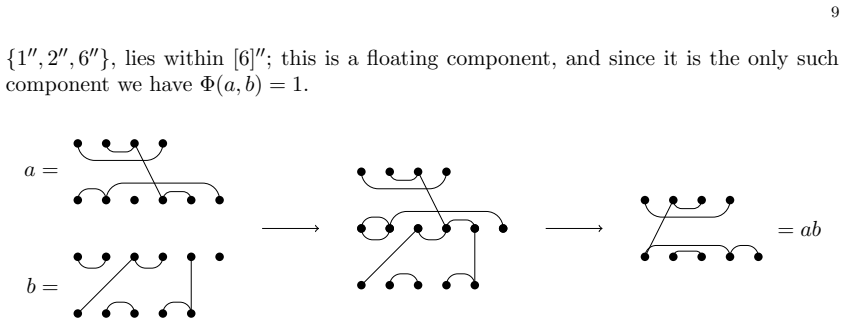
Dimensions are minimal powers of two over additively idempotent semirings and count floating components in compositions.

Figure from the paper full image
abstract click to expand
We study representations of diagram categories by binary relations and matrices over rings and semirings. Our main result is a faithful involutive tensor representation of the partition category $P$ (and consequently of each partition monoid $P_n$) by zero-one matrices over an arbitrary (additively) idempotent semiring. The dimensions of the matrices involved are powers of $2$, and we show that these are minimal with respect to faithful involutive tensor representations by matrices over any semiring. Intriguingly, these matrices encode the number of floating components formed when composing partitions, and can therefore be used to construct faithful representations of ($d$-)twisted partition categories $P^\Phi$ and $P^{\Phi,d}$ (and the respective twisted partition monoids $P_n^\Phi$ and $P_n^{\Phi, d}$) over rings of appropriate characteristic. We also give lower-dimensional involutive representations of the Brauer and Temperley--Lieb categories $B$ and $TL$. In the case of $TL$, the dimensions are given by Fibonacci numbers.
0
0
math.RA 2026-05-07

Complete non-perfect Lie algebras exist with only inner derivations

On Lie Algebras with Only Inner Derivations

The constructions also produce perfect examples with nontrivial centers down to dimension 31 and show nonvanishing second cohomology.

abstract click to expand
This paper is devoted to the study of non-semisimple Lie algebras of the form $\mathcal{L} = \mathcal{S} \ltimes \mathcal{N}$ whose derivations are all inner. By generalizing the methods of Sato and Angelopoulos, we introduce new families of Lie algebras and establish the vanishing of their first adjoint cohomology. As an application, we construct a family of complete non-perfect Lie algebras, thereby providing examples that yield a positive answer to Carles' question on the existence of such algebras. In addition, we reduce the dimension of known examples of perfect Lie algebras with non-trivial center and only inner derivations to $31$. Furthermore, we employ the Hochschild--Serre factorization theorem to analyze the second adjoint cohomology groups, providing insights non-vanishing of the second adjoint cohomology groups for the algebras obtained through the paper.
0
0
math.RA 2026-05-07

Polynomial images generate simple algebras

On the structural behavior of images of polynomials

Sums of products of noncentral polynomial values contain nonzero ideals, so the subring they form equals the whole algebra except minor low-

abstract click to expand
The study of images of noncommutative polynomials on algebras has attracted considerable attention. We investigate polynomial images and the additive structures they generate in associative algebras, focusing on sums and products of values. Motivated by results on additive commutators, we show that finite sums of such products on a nonzero ideal must contains a nonzero ideal, with only minor exceptions. Consequently, for a simple algebra, the subring generated by the image of a noncentral polynomial coincides with the whole algebra, up to a small exceptional case. We further study representations of elements as sums of products of polynomial values, and examine products of additive commutators for matrices over division rings. To simplify multilinear polynomials, we introduce decomposable polynomials and show that, in many cases, their images equal the whole algebra. Finally, we consider polynomial commutators and prove that every noncommutative infinite simple algebra is generated by such elements, together with results on multiplicative commutators, including a complete description for real quaternions.
0
0
math.RA 2026-05-06 3 theorems

Star-product yields central series for cocommutative Hopf braces

Central series of cocommutative Hopf braces

The resulting Hopf formulae express homology via relative commutators, including the Huq commutator for the commutative case.

abstract click to expand
By extending some classical results known for groups and skew braces, we define and investigate central series of cocommutative Hopf braces. Both left and right central series are defined using a $\star$-product that measures the difference between the two algebra operations, and naturally leads to introducing the notions of socle and of annihilator of a cocommutative Hopf brace. We characterize the central extensions relative to the subcategories of cocommutative Hopf algebras and of commutative and cocommutative Hopf algebras, respectively. Since the category of cocommutative Hopf braces is semi-abelian and it has enough projectives with respect to the class of cleft extensions, one can then establish suitable Hopf formulae for their homology. These are expressed in terms of the corresponding notions of relative commutators of cocommutative Hopf braces. In particular, the one relative to the subcategory of commutative and cocommutative Hopf algebras turns out to be the Huq commutator.
0
0
math.RA 2026-05-06 2 theorems

Generalized Jordan form classifies matrices over any field

A Generalised Jordan Normal Form and Its Computation Over Finite Fields

Decomposing the vector space into invariant subspaces yields computable canonical representatives for each similarity class, with algorithms

abstract click to expand
The question of matrix similarity is a classical one in linear algebra. For a field $\mathbb{F}$ and some positive integer $n \in \mathbb{N}$, one may consider the following problems: 1. Given two matrices $A, B \in \mathrm{GL}(n, \mathbb{F})$, determine whether they are similar or not. 2. If they are similar, compute a conjugating matrix $X \in \mathrm{GL}(n, \mathbb{F})$. 3. List a representative for each conjugacy class of $\mathrm{GL}(n, \mathbb{F})$. They can be readily solved by using normal forms. The most commonly studied forms are the rational canonical form (also known as the Frobenius normal form) and the Jordan normal form. The Jordan form, however, is traditionally defined only over algebraically closed fields such as $\mathbb{C}$. In this thesis, we aim to extend the notion of the Jordan normal form to arbitrary fields. Moreover, we provide practical algorithms for computing this generalized Jordan form, which we have implemented in GAP for finite fields. The construction of the Jordan normal form relies on analyzing the action of a matrix $A \in \mathbb{F}^{n\times n}$ on the vector space $V = \mathbb{F}^n$. By decomposing $V$ into $A$-invariant subspaces, one obtains, in a sense, a corresponding decomposition of $A$ itself. The proofs in this thesis are expressed in terms of matrices, rather than modules, to reflect the computational approach used in practice.
0
0
math.RA 2026-05-06

Bahturin-Regev conjecture holds under characteristic condition

On Regular Quantum Commutative Algebras

Positive solution for finite-dimensional algebras when char avoids dividing quantum length in minimal regular decomposition.

abstract click to expand
Let $K$ be an algebraically closed field of characteristic different from $2$. We provide a positive solution to the Bahturin--Regev conjecture in the general finite-dimensional (non-graded) setting, assuming that $\operatorname{char}(K)$ does not divide the quantum length of a minimal regular quantum commutative decomposition. Furthermore, we obtain a criterion, formulated in terms of regular quantum commutative decompositions, under which a set-grading on a semisimple associative algebra is realized as a group grading.
0
0
math.RA 2026-05-06 3 theorems

Greatest-solution method extends to symmetrized and supertropical semirings

Solving one-sided linear systems over symmetrized and supertropical semiring

One-sided linear systems Ax=b stay solvable in two steps with consequences for tropical cryptography.

abstract click to expand
One-sided linear systems of the form ``$Ax=b$'' are well-known and extensively studied over the tropical (max-plus) semiring and wide classes of related idempotent semirings. The usual approach is to first find the greatest solution to such system in polynomial time and then to solve a much harder problem of finding all minimal solutions. We develop an extension of this approach to the same systems over two well-known extensions of the tropical semiring: symmetrized and supertropical, and discuss the implications of our findings for the tropical cryptography.
0
0
math.RA 2026-05-05

Split extensions of Hom-Jacobi-Jordan algebras match their second cohomology

Non-abelian extensions of Hom-Jacobi-Jordan algebras

Equivalence classes of such extensions correspond one-to-one with H^2(J, V) via explicit 2-cocycle pairs, generalizing Lie and Leibniz cases

abstract click to expand
This paper develops a cohomology theory for Hom-Jacobi-Jordan algebras using and applies it to classify non-abelian extensions. The main result establishes that equivalence classes of split extensions of a Hom-Jacobi-Jordan algebra $J$ by $V$ are in bijection with the second cohomology group $H^2(J,V)$, generalizing classical results from Lie and Leibniz algebra theory. We characterize extensions explicitly through 2-cocycles $(\rho, \theta)$ satisfying compatibility conditions, and provide complete classifications of low-dimensional cases.
0
0
math.RA 2026-05-04

Poisson n-Lie algebras correspond to ordinary Poisson algebras

Poisson n-Lie algebras: constructions and the structure of solvable algebras

Explicit constructions both ways transfer solvability, nilpotency, and Engel-Lie analogues between the two classes.

abstract click to expand
In this paper, we develop a construction of Poisson $n$-Lie algebras arising from $n$-Lie algebras of Jacobians and establish conditions under which this construction yields a Poisson $n$-Lie algebra. We also formulate a general conjecture in the unital case. In addition, we show that tensor products of Poisson algebras admit natural Poisson $n$-Lie structures via suitable quotient constructions. Conversely, we construct a Poisson algebra from a given Poisson $n$-Lie algebra, thereby establishing a correspondence between these classes of algebras. Furthermore, we obtain analogues of Engel's and Lie's theorems and provide a characterization of solvable and nilpotent Poisson $n$-Lie algebras in terms of the underlying algebraic structures. We also introduce the notion of hypo-nilpotent ideals and prove results concerning maximal hypo-nilpotent ideals in finite-dimensional solvable Poisson $n$-Lie algebras. Finally, we show that generalized eigenspaces of multiplication operators form ideals.
0
0
math.RA 2026-05-04 2 theorems

Constructions link Poisson algebras to Poisson n-Lie algebras

Poisson n-Lie algebras: constructions and the structure of solvable algebras

Tensor products and Jacobian n-Lie algebras yield the higher-arity versions, with correspondence and solvable structure theorems.

abstract click to expand
In this paper, we develop a construction of Poisson $n$-Lie algebras arising from $n$-Lie algebras of Jacobians and establish conditions under which this construction yields a Poisson $n$-Lie algebra. We also formulate a general conjecture in the unital case. In addition, we show that tensor products of Poisson algebras admit natural Poisson $n$-Lie structures via suitable quotient constructions. Conversely, we construct a Poisson algebra from a given Poisson $n$-Lie algebra, thereby establishing a correspondence between these classes of algebras. Furthermore, we obtain analogues of Engel's and Lie's theorems and provide a characterization of solvable and nilpotent Poisson $n$-Lie algebras in terms of the underlying algebraic structures. We also introduce the notion of hypo-nilpotent ideals and prove results concerning maximal hypo-nilpotent ideals in finite-dimensional solvable Poisson $n$-Lie algebras. Finally, we show that generalized eigenspaces of multiplication operators form ideals.
0
0
math.RA 2026-05-04

Matrix subalgebras cannot be smaller than n by n up to size 13

Minimal Dimensions of Maximal Commutative Matrix Algebras and Sharp Courter-Type Bounds

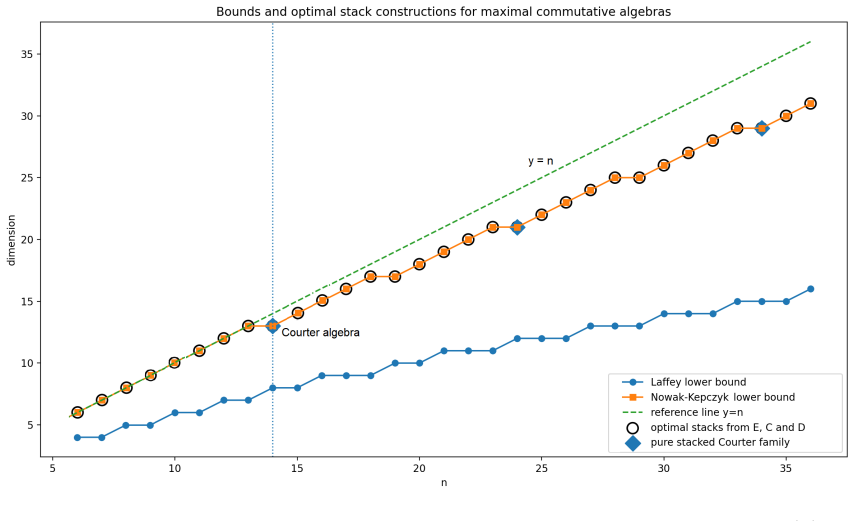
Courter's construction at n=14 meets the lower bound exactly, and new stacking yields families of the same size for every larger n.

Figure from the paper full image
abstract click to expand
Let $K$ be an algebraically closed field and let $M_n(K)$ denote the algebra of $n\times n$ matrices over $K$. A classical problem asks for the minimal possible dimension of a maximal commutative subalgebra $A \subseteq M_n(K)$. We determine sharp lower bounds for maximal commutative subalgebras of $M_n(K)$, refining the classical estimate of Laffey. In particular, we prove that $\dim A \ge n$ for all $n \le 13$, so no Courter-like algebras exist in this range. Moreover, we show that Courter's example in $M_{14}(K)$ is the first possible exceptional case and already attains the optimal bound. Finally, we introduce a stack construction and obtain explicit infinite families of maximal commutative subalgebras attaining the bound for all $n \ge 14$.
0
0
math.RA 2026-05-04

Criterion decides when As∘Var is nonsymmetric

Nonsymmetric versions of binary quadratic operads

A new algebraic test identifies which binary quadratic operads produce nonsymmetric versions under the white Manin product with As.

abstract click to expand
In this paper, we study the white Manin product of the associative operad $\As$ with a binary quadratic operad $\Var$. We introduce the notion of a nonsymmetric version of $\Var$ and provide a criterion for determining when the operad $\As\circ\Var$ has this property. We illustrate the construction with several examples and counterexamples. Finally, for some operads admitting nonsymmetric versions, we describe their combinatorial properties.
0
0
math.RA 2026-05-04

Noetherian Hopf algebras still lack a general finite injective dimension proof

Report on AS-Gorenstein Hopf algebras

Review collects positive results for many classes after thirty years, yet the main question stays open.

abstract click to expand
This is a review of progress on the question whether noetherian Hopf algebras always have finite injective dimension and related good homological properties. As well as discussing in detail the main results giving positive answers for particular classes of Hopf algebras, some consequences of such positive answers are also described. Full definitions and references are included, also sketches of some proofs. A considerable number of open questions are listed, additional to the original question, which itself remains open after 30 years.
0
0
math.RA 2026-05-04

Power set ring ideals define limit points for group topology

On local function, an algebraic approach

Combined with anti-ideals they produce a topology whose homomorphic images transfer the structure from one group to another.

abstract click to expand
The paper discuss the limit point concept of a subset in a group via ideal of the power set ring. This idea along with anti-ideal give the topological structure in a group. Homomorphic images of both ideal and anti-ideal are played the remarkable role to change the topological structure from one system to another system.
0
0
math.RA 2026-05-04

Morita relation orders π-systems in Kac-Moody algebras

On {π}-systems of symmetrizable Kac-Moody algebras

The ordering is proved for finite, untwisted affine and hyperbolic types and yields all maximal hyperbolic diagrams in ranks 3-10.

abstract click to expand
Given a symmetrizable Kac-Moody algebra $\mathfrack{g}$, we study its $\pi$-systems, which are subsets of real roots, the pairwise differences of whose elements are not roots. Such systems arise as simple systems of regular subalgebras of $\mathfrack{g}$, and were originally studied by Dynkin, Morita and Naito. We show that the binary relation introduced by Morita defines a partial order on the set of $\mathfrack{g}$ of finite, untwisted affine or hyperbolic type. We also formulate general principles for constructing $\pi$-systems as well as for finding forbidden diagrams that cannot occur as Dynkin diagrams of $\pi$-systems of a given $\mathfrack{g}$. Among other applications, we use this to determine the set of maximal hyperbolic Dynkin diagrams in ranks $3$-$10$ relative to the Morita partial order.
0
0
math.RA 2026-05-01

Finite words with f(n) ≤ n take explicit periodic forms

Combinatorics on finite words and the length of a finite-dimensional associative algebra

The characterization also links power avoidance to complexity and supplies relations among length and other invariants in finite-dimensional

abstract click to expand
Let $f_W(n)$ be the number of different factors of length $n$ appearing in $W$. A classical result of Morse and Hedlund, stated in 1938, asserts that an infinite word $W$ is ultimately periodic if and only if $f_W(n)\leq n$ for some $n\in \mathbb N$. In this paper, we describe the form of finite words that satisfy the condition $f_W(n)\leq n$. We study relations between power avoidance and subword complexity of a finite word. We apply our combinatorial results to study the interrelations between various numerical invariants of finite-dimensional associative algebras.
0
0
math.RA 2026-05-01

Identities imply vanishing products of derivatives in perm algebras

Identities in differential perm algebras

Any nontrivial differential identity not forced by the perm law reduces to a product of derivatives equaling zero, which yields explicit sub

abstract click to expand
Let $(P,\cdot,d)$ be a differential perm algebra over a field of characteristic $0$, i.e. an associative algebra satisfying $(ab)c=(ba)c$ equipped with a derivation $d$. We investigate polynomial identities in the algebras obtained from $d$ by the derived operations \[ a\prec b=ab',\quad a\succ b=a'b,\quad a\blacklozenge b=ab'+ba',\quad a\bullet b=a'b+ab',\quad a\Diamond b=ab'-ba',\quad a\circ b=a'b-ab', \] where $a'=d(a)$. Our first result shows that any nontrivial differential polynomial identity (not supported by the right annihilator forced by the perm law) implies a purely differential consequence of the form $a_1'a_2'\cdots a_m'=0$ for some positive integer $m$. We then study the subalgebras of the free differential perm algebra generated by $X$ under $\blacklozenge$ and under $\bullet$, giving explicit generating sets and computing the multilinear dimensions of their homogeneous components. Finally, we construct perm-Witt type Lie and Leibniz algebras arising naturally from differential perm algebras.
0
0
math.RA 2026-05-01

Fixed-point-free automorphisms force Lie algebras to be strongly unimodular

Fixed-point-free automorphisms of solvable Lie algebras

The property obeys an explicit criterion for complex almost abelian cases and holds exactly when filiform Lie algebras are not nilpotent in

abstract click to expand
In this paper, we investigate the existence of fixed-point-free automorphisms for finite-dimensional Lie algebras. By a result of Jacobson, a Lie algebra admitting a fixed-point-free automorphism is solvable. We prove that such a Lie algebra must be even strongly unimodular. We find a necessary and sufficient criterion such that a complex almost abelian Lie algebra admits a fixed-point-free automorphism. For complex filiform Lie algebras we show that the existence of a fixed-point-free automorphism is equivalent to not being characteristically nilpotent.
0
0
math.RA 2026-05-01

Nullity of A2 decides when A1 X^k + A2 Y^k covers all n x n matrices

Polynomial Maps with Constants on Matrix Algebra

For n=3 and 4, with A1 invertible, surjectivity holds precisely when the kernel dimension of A2 satisfies an explicit condition in n and k.

abstract click to expand
Let $\mathcal A$ be an $\mathbb F$-algebra and $\omega \in \mathcal A\langle x_1, \ldots, x_m \rangle$ which defines a map $\mathcal A^m \rightarrow \mathcal A$ by evaluation, called a polynomial map with constant. We consider $\mathcal {A} = M_n(\mathbb{F})$, the algebra of $n \times n$ matrices over an algebraically closed field $\mathbb{F}$ of characteristic $0$, and polynomial maps given by $\omega(x_1, x_2) = A_1x_1^k + A_2x_2^k$, where $A_1,A_2\in M_n(\mathbb F)$. For $n=2$, the images of such a map is competely determined in an earlier work (Panja, S.; Saini, P.; Singh, A., Images of polynomial maps with constants, Mathematika 71 (2025), no. 3, Paper No. e70031). In this article, by assuming one of the coefficients, say $A_1$, is invertible, we relate the surjectivity of $\omega$ to the nullity of $A_2$. When $n=3, 4$, we completely classify the surjectivity of $\omega(x_1, x_2)$ by obtaining the necessary and sufficient condition in terms of $n$, $k$, and the nullity of $A_2$.
0
0
math.RA 2026-05-01 Recognition

Rota-Baxter operators deform matrices for sliding-mode stability

Study of Rota-Baxter Operators in Matrix C^*-Algebras Motivated by Toeplitz Structures, and Applications to Sliding Mode Control

Norm-compatible operators on M_n(C) yield LMI conditions that guarantee asymptotic sliding-manifold stability and a concrete L2-gain bound.

Figure from the paper full image
abstract click to expand
This paper studies Rota-Baxter operators on the matrix $C^*$-algebra $M_n(\mathbb{C})$, motivated by the discrete Toeplitz algebra (whose role is purely heuristic; see Remark~\ref{rem:toeplitz_scope}). We provide a structural classification of such operators compatible with the $C^*$-norm, analyze their induced Lie brackets, and apply them to deform system matrices in discrete-time delayed systems under sliding mode control. Lyapunov-based Bilinear Matrix Inequality conditions, together with a tractable linear reformulation via $Q=X^{-1}$, guarantee asymptotic stability on the sliding manifold and $\mathcal{L}_2$-gain stability. The effective gain from uncertainty $\delta$ to state $x$ is $\gamma/\sqrt{\mu}$ with $\mu=\lambda_{\min}(-\mathcal{M})>0$ determined \emph{a posteriori}; minimizing $\gamma$ alone does not minimize this bound, which holds under zero extended initial conditions ($V_0=0$). We work under the standing assumption $m=n$ (square actuation); a supplementary non-degenerate example with $m=1$, $n=2$ illustrates LMI feasibility with $\Pi\neq0$. All algebraic results are proved directly in $M_n(\mathbb{C})$; no infinite-dimensional reduction is used.
0
0
math.RA 2026-04-30

Obstruction class decides when derivations lift through Lie algebra extensions

Non-abelian Extensions of Lie algebras with derivations

The non-abelian theory is equivalently described by second cohomology, Deligne groupoids, homotopy categories of strict Lie 2-algebras with

abstract click to expand
In this paper, we investigate non-abelian extensions of Lie algebras with derivations using several different approaches. We show that the theory of non-abelian extensions of a Lie algebra with a derivation can be characterized by means of the second non-abelian cohomology, the Deligne groupoid, the homotopy category of strict Lie $2$-algebras with strict derivations, and the notion of a $(\g, D)$-kernel, respectively. Moreover, within this unified framework, we address the following existence problem: given a non-abelian extension of Lie algebras \[\begin{CD} 0@>>>\h@>i>>\hat{\g}@>p>>\g @>>>0, \end{CD}\] let $(K,D)\in\Der(\h)\times\Der(\g)$ be a pair of derivations of $\h$ and $\g$ respectively. When does there exist a derivation $\hat{D}$ of $\hat{\g}$ such that $\hat{D}|_\h=K$ and $D\circ p=p\circ\hat{D}.$ We provide an obstruction class for the existence of such a lift.
0
0
math.RA 2026-04-29

The paper examines the exterior spinor model S = wedge V(W) for the standard hyperbolic…

Exterior-Model Spinors in Split Rank: Exact Levi Images and Square-Determinant Obstructions

For split rank at least three the image of Spin(H_W) inside the split Levi subgroup of SO(H_W) is exactly the square-determinant subgroup…

abstract click to expand
Let $K$ be a field with $2 \in K^\times$, and let $H_W$ denote the standard hyperbolic form on $W \oplus W^*$. We study the exterior spinor model $S = \bigwedge V(W)$ together with the spin-to-orthogonal map for this split form, keeping the chosen hyperbolic presentation explicit. The main results determine the field-sensitive part of the split Levi image. In positive split rank the kernel of $\mathrm{Spin}(V,Q) \to SO(V,Q)$ is $\{\pm 1\}$; therefore the exterior spinor action descends to the orthogonal image only projectively. For the split line the image of $\mathrm{Spin}(H_K) \to SO(H_K)$ is precisely the square-scaling subgroup. In arbitrary split rank we construct explicit Clifford representatives for hyperbolic transvections and chosen-line square scalings, prove the weight-2 torus conjugation law, and show that any split Levi lift acts on $\bigwedge V(W)$ as a scalar multiple of the natural exterior action. If $\det(g) \in u^2$, the transported Levi element $\hat{g} = (g, g^{-\top})$ admits an explicit even unitary Clifford lift acting as $u^{-1} \bigwedge(g)$ on $S$. In finite split rank at least three, if $H_W \in \mathrm{im}(\mathrm{Spin}(H_W) \to SO(H_W))$, then $g_{H_W} \in \det(g) \cdot K^{\times 2}$. Equivalently, the spin image meets the split Levi subgroup exactly in its square-determinant subgroup. This recovers, by direct Clifford calculation, the determinant-modulo-squares spinor-norm criterion on the split Levi.
0
0
math.RA 2026-04-29

Simple transposed Poisson algebras are all W_n(q) mutations

On simple transposed Poisson algebras

Over algebraically closed fields of char p>3 they have Zassenhaus Lie algebra W(1;n) and arise from mutating its commutative product.

abstract click to expand
We develop a structure theory for transposed Poisson algebras over fields of characteristic different from two. In particular, we prove that every finite-dimensional transposed Poisson algebra over an algebraically closed field decomposes as the direct sum of a unital ideal and a nilpotent ideal. As a consequence, we obtain restrictions on simple transposed Poisson algebras and use them to classify the simple finite-dimensional transposed Poisson algebras over an algebraically closed field of characteristic $p>3$. Precisely, we show that every such algebra has as underlying Lie algebra a Zassenhaus algebra $\mathcal{W}(1;n)$ and is isomorphic to one of the algebras of the family $\mathcal{W}_n(q)$ arising from a mutation of a natural associative commutative structure on $\mathcal{W}(1;n)$. We then study the corresponding isomorphism problem for the family $\mathcal{W}_n(q)$ and determine the irreducible finite-dimensional representations of these simple transposed Poisson algebras $\mathcal{W}_n(q)$ in the unital case. We conclude with some applications to Jordan superalgebras, weak-Leibniz algebras and quasi-Poisson algebras.
1 0
0
math.RA 2026-04-29 Recognition

Three DGA equivalence problems shown to be undecidable

Undecidability problems for semifree DG algebras

Stable tame isomorphism, quasi-isomorphism, and derived Morita equivalence for semifree noncommutative DGAs have no algorithmic solution.

abstract click to expand
We prove that the stable tame isomorphism, quasi-isomorphism, and derived Morita equivalence problems for semifree noncommutative differential graded algebras (DGAs) are all undecidable. This resolves half of Problem 5.16 from the K3 Problem List in Low-Dimensional Topology. We present two solutions, both obtained (essentially autonomously) by Gemini Deep Think / Aletheia.
0
0
math.RA 2026-04-29

Nilpotency of transposed Poisson algebras equals nilpotency of left multiplications

Nilpotency and Frattini theory for transposed Poisson algebras

An Engel-type theorem and Frattini results give concrete criteria for radicals, maximal subalgebras, and decompositions.

abstract click to expand
We develop the theory of nilpotency and the Frattini theory for transposed Poisson algebras. The lower central series is shown to admit a simplified form, and an analogue of Engel's theorem is established: a finite-dimensional transposed Poisson algebra is nilpotent precisely when the left multiplication operators in both the associative and the Lie structures are nilpotent. Constructions of nilpotent and solvable algebras via tensor products and derivations are given. For a finite-dimensional Lie-nilpotent transposed Poisson algebra, we prove that the derived Lie subalgebra is a nilpotent ideal, which implies that the nilpotent radical coincides with the associative radical. In the framework of Frattini theory, we show that the Frattini subalgebra is always contained in the derived algebra and the Frattini ideal is associative nilpotent. When the algebra is nilpotent, all maximal subalgebras are ideals and the Frattini subalgebra equals the derived algebra. Conversely, for a Lie-nilpotent transposed Poisson algebra, if all maximal subalgebras are ideals, the algebra either is nilpotent or decomposes as a direct sum of a one-dimensional algebra generated by an idempotent and the nilpotent radical; if the Frattini subalgebra equals the derived algebra, the algebra is necessarily nilpotent. We also prove that the zero socle coincides with the nilpotent radical, and when the Frattini ideal is zero, the algebra splits into a subalgebra and its zero socle; in the Lie-nilpotent case this subalgebra is abelian as a Lie algebra.
0
0
math.RA 2026-04-28

Graphs produce k-step nilpotent symplectic Lie algebras

k-step nilpotent symplectic Lie algebras associated with graphs

The method extends the 2-step case and establishes existence whenever the nilpotency type satisfies mild conditions.

abstract click to expand
We construct families of $k$-step nilpotent symplectic Lie algebras associated with graphs, extending the construction given in [Pouseele-Tirao, JPAA 213 (2009)] for the 2-step case. We also show that, under mild conditions on the nilpotency type, there exist symplectic Lie algebras of that type.
0
0
math.RA 2026-04-28 2 theorems

Every lim¹ group equals the cokernel of a module to its completion

The structure of lim¹-groups

A functorial filtration sequence realizes any derived limit as the obstruction to surjectivity onto the completion.

abstract click to expand
If $(A_n)_n$ is a decreasing filtration of a module $A$ and $\widehat{A} = \lim_n A/A_n$, then $\lim^1_n A_n$ is identified with the cokernel of the canonical map $A \longrightarrow \widehat{A}$. In this note, we show that any $\lim^1$-group is canonically of that form: For any inverse sequence of modules $(X_n)_n$ there exists an inverse sequence $(A_n)_n$ as above and a morphism $(A_n)_n \longrightarrow (X_n)_n$, depending functorially on $(X_n)_n$, that induces an isomorphism on $\lim^1$. The proof is based on Quillen's small object argument, as formulated by Eklof and Trlifaj in their investigation of the existence of enough injective objects in certain cotorsion pairs, and also uses a construction by Salce that provides enough projective objects therein.
0
0
math.RA 2026-04-27

Maximal commutative subalgebras in M_6 have dimension at least 6

On the minimal dimension of maximal commutative subalgebras of M₆(k)

This rules out any example smaller than n for 6 by 6 matrices over algebraically closed fields.

abstract click to expand
We study the minimal dimension of maximal commutative subalgebras of the matrix algebra $M_n(k)$ over an algebraically closed field. While examples with dimension strictly smaller than n are known for $n \geq 14$, no such examples are known in smaller dimensions. In this paper, we show that for n = 6 every maximal commutative subalgebra $A\subset M_6(k)$ satisfies $\dim A \geq 6$. The proof is based on a detailed analysis of local algebras and their module structure, combined with explicit estimates of the dimension of the centralizer.
1 0
0
math.RA 2026-04-27 2 theorems

Left and right ranks match for quaternion Hankel matrices

On the rank of quaternion Hankel matrices

The Hankel structure forces equality even though the two ranks can differ for unstructured quaternion matrices, enabling simpler recurrence-

Figure from the paper full image
abstract click to expand
This paper discusses the left and right ranks of quaternion matrices with Hankel structure. While they are in general different for arbitrary quaternion matrices, we show that the left and right ranks of quaternion Hankel matrices are equal. Moreover, we establish the relation between Hankel matrices and the existence of linear recurrence relations with quaternion coefficients and discuss some practical implications for computational methods relying on low-rank properties of quaternion Hankel matrices.
0
0
math.RA 2026-04-27

Left and right ranks match for quaternion Hankel matrices

On the rank of quaternion Hankel matrices

The anti-diagonal constancy forces the two ranks to coincide and ties the matrices to linear recurrences over quaternions.

Figure from the paper full image
abstract click to expand
This paper discusses the left and right ranks of quaternion matrices with Hankel structure. While they are in general different for arbitrary quaternion matrices, we show that the left and right ranks of quaternion Hankel matrices are equal. Moreover, we establish the relation between Hankel matrices and the existence of linear recurrence relations with quaternion coefficients and discuss some practical implications for computational methods relying on low-rank properties of quaternion Hankel matrices.
0
0
math.RA 2026-04-24

Helix endomorphism algebras on elliptic curves are quotients by normal elements

Three-periodic helices on elliptic curves and their associated regular algebras

The algebra is noetherian exactly when growth is polynomial, in which case bundle ranks form Markov triples.

abstract click to expand
Let $k$ denote an algebraically closed field of characteristic zero and let $X$ denote a smooth elliptic curve over $k$. Given a three-periodic elliptic helix $\underline{\mathcal{E}}$ of vector bundles over $X$ with endomorphism $\mathbb{Z}$-algebra $\operatorname{End} \underline{\mathcal{E}}$ and quadratic cover $\mathbb{S}^{nc}(\underline{\mathcal{E}})$, we prove that $\operatorname{End} \underline{\mathcal{E}}$ is the quotient of $\mathbb{S}^{nc}(\underline{\mathcal{E}})$ by a degree three family of normal elements, generalizing a result of the authors to the case in which $\operatorname{dim }(\operatorname{End} \underline{\mathcal{E}})_{i, i+1}$ isn't a constant function of $i$. We then show that $\operatorname{End} \underline{\mathcal{E}}$ is noetherian if and only if it has polynomial growth, and in this case, the ranks of any three consecutive bundles in the helix are a Markov triple. Furthermore, in this case $\mathbb{S}^{nc}(\underline{\mathcal{E}})$ is a noetherian GK-three $\mathbb{Z}$-algebra which is ${\sf Proj }$-equivalent to an elliptic algebra. We conclude the paper by constructing several new families of elliptic helices with exponential growth.
0
0
math.RA 2026-04-24

Lambda-construction globalizes partial actions on non-associative algebras

Globalization of Partial Group Actions on Not Necessarily Associative Algebras and Covariant Representations

It solves the globalization problem inside the variety V(I) and produces adjoint functors for representations in associative and Lie cases.

abstract click to expand
We extend the concept of a partial group action to non-associative algebras in a variety \(\mathcal{V}(I)\), solve the globalization problem within \(\mathcal{V}(I)\) and examine its universal property. It is achieved using what we call the ``$\Lambda$-construction'', which we also apply to deal with covariant representations in the associative and Lie algebra settings, considering related categories and constructing an adjoint pair of functors between them. We also show that the $\Lambda$-construction behaves well with semidirect products of Lie algebras.
0
0
math.RA 2026-04-23

Left modularity equals extremality in key infinite lattice families

Left modularity and extremality for (some) infinite lattices

The equivalence holds for torsion-class lattices exactly when the algebra is brick-directed, extending finite-lattice results.

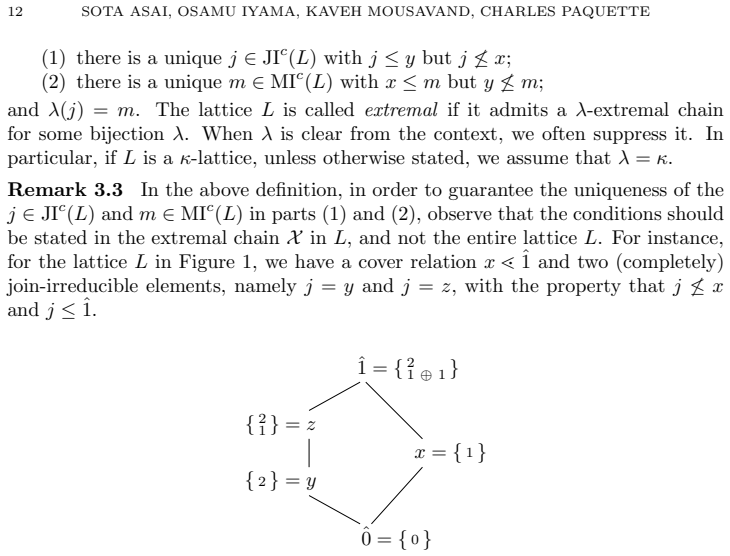
Figure from the paper full image
abstract click to expand
For some important families of complete infinite lattices, we study some generalizations of two fundamental notions which are mostly treated for finite lattices. Specifically, for well-separated $\kappa$-lattices, and also for weakly atomic completely semidistributive lattices, we generalize the notions of left modularity and extremality. These two families of lattices coincide if restricted to finite lattices, but are distinct when infinite lattices are also included. For both families, we prove that extremality and left modularity imply each other. Furthermore, for weakly atomic completely semidistributive lattices, we give several conceptual characterizations of left modular elements, and show that the set of left modular elements form a complete distributive sublattice. Our results, combined with some recent work on finite lattices, imply that the weakly atomic completely semidistributive lattices that are left modular (or extremal) generalize the semidistributive trim lattices; from finite to infinite lattices. We then apply our results to the lattice of torsion classes of finite dimensional algebras, which are known to fall in the intersection of the two families treated in our work. For an algebra $A$, we obtain that the lattice of torsion classes is left modular (equivalently, extremal) if and only if $A$ is brick-directed. This leads to an abundance of concrete examples and non-examples.
0
0
math.RA 2026-04-23

Trivial extensions of Koszul AS algebras match derived categories

Trivial extensions of Koszul Artin-Schelter regular algebras

The stable MCM category over S ⋉ S_σ(-1) is triangle equivalent to the bounded derived category over the Koszul dual of S^{σ^{-1}}.

abstract click to expand
Let $S$ be an $\mathbb N$-graded Koszul Artin-Schelter regular algebra and let $\sigma$ be a graded algebra automorphism of $S$. We study the stable category of graded maximal Cohen-Macaulay modules over the trivial extension algebra $S\ltimes S_\sigma(-1)$. We show that this category is triangle equivalent to the bounded derived category of finitely generated (ungraded) modules over the Koszul dual algebra of the Zhang twist $S^{\sigma^{-1}}$. In the connected graded case, we also obtain a criterion for when two such stable categories are triangle equivalent, and show that such an equivalence induces an equivalence between the categories of graded modules over the original algebras.
0
0
math.RA 2026-04-23 Recognition

Constants in Jacobson radicals of q-skew Ore extensions are nil

On a q-Skew Amitsur's Theorem

This partially answers a 2019 question and yields a q-skew Amitsur theorem in characteristic zero.

abstract click to expand
Let $R$ be an algebra over an uncountable field, $\sigma$ a locally torsion automorphism and $\delta$ a locally nilpotent left $\sigma$-derivation such that $q\sigma\delta = \delta\sigma$, where $q$ is a nonzero scalar. We show that the constant part of the Jacobson radical of the Ore extension $R[x;\sigma,\delta]$ is nil. This partially answers a question of Greenfeld, Smoktunowicz and Ziembowski posed in 2019. As a corollary, we employ Shin's 2024 result to prove a q-skew Amitsur's theorem whenever the field is additionally assumed to be of characteristic zero. That is, the Jacobson radical of $R[x;\sigma, \delta]$ is $N[x;\sigma,\delta]$ for some nil ideal $N$ of $R$.
0
0
math.RA 2026-04-22 2 theorems

Summand-lifting stabilizes C4*-modules under exact sequences

Exact-Sequence Stability and Ambient Realizations for C4^{ast}-Modules

Explicit conditions ensure preservation under kernels, cokernels and short exact sequences, with necessity shown by counterexamples.

abstract click to expand
The theory of C4*-modules is presently dominated by decomposition methods, but it lacks a systematic closure theory. In particular, it is not known in general whether the C4* property is preserved under extensions, kernels, cokernels, or short exact sequences. This is a structural difficulty, since C4*-type conditions are governed by summand behavior and comparison of submodules, and such data are not automatically respected by exact sequences. This paper develops an exact-sequence framework for C4*-modules and strongly C4*-modules. It identifies explicit hypotheses under which these classes are stable under split extensions, admissible kernels, admissible cokernels, and short exact extensions. The paper also separates positive and negative directions: closure results are established under summand-lifting and factor-control assumptions, while converse results show that these hypotheses cannot in general be removed. This produces concrete obstruction patterns for extension stability and for passage to submodules and factor modules. A further aim is categorical. Natural ambient settings are identified in which C4*-modules form an extension-closed subcategory, or at least a relative exact class appropriate to summand-sensitive module theory. Finally, concrete ambient verification theorems are proved: semisimple right modules over any ring provide a canonical exact environment, and over a semisimple artinian ring this extends to the full module category.
0
0
math.RA 2026-04-22

Hyper operators equate symplectic and Hessian structures on Lie algebras

Hyper relative differential operators on Lie algebras

Nijenhuis-based relative differential operators give matching algebraic descriptions for both hyper symplectic and hyper Hessian structures.

abstract click to expand
In this paper, we first introduce the notion of a hyper relative differential operator on a Lie algebra, in which Nijenhuis operators are used to characterize the relative differential operators and their inverse. We then introduce the notions of DN-structures, KN-structures, and KD-structures on Lie algebras and study the relationships between DN-structures, KD-structures, KN-structures, and hyper relative differential operators. Finally, we investigate hyper symplectic structures and hyper Hessian structures from the view point of hyper relative differential operators, and provide equivalent descriptions for both hyper symplectic structures and hyper Hessian structures.
0
0
math.RA 2026-04-21

Skew polynomial fractions yield nonaffine division algebras

`New' examples of skew fields not finitely generated as algebras

Over arbitrary fields, those from Weyl algebras and quantum spaces are finitely generated over centers only if finite-dimensional over them.

abstract click to expand
An associative division algebra D is said to be _affine_ over a central subfield k if D is finitely generated as a k-algebra. In 1956 Amitsur famously proved that, when k is uncountable, D cannot be k-affine unless D is algebraic over k. In this paper we consider affineness -- and nonaffineness -- for certain naturally occurring classes of division algebras over arbitrary fields. The primary applications are to division algebras of fractions of suitably conditioned iterated skew polynomial rings over k, including many examples naturally arising in Lie theoretic and quantum group settings. Many transcendental division algebras are thus verified to be nonaffine over k. Division algebras of fractions of Weyl algebras and quantum affine spaces are determined to be affine over their centers exactly when they are finite dimensional over their centers.
0
0
math.RA 2026-04-21

Witt algebra local half-derivations reduce to ordinary ones

Local and 2-local frac{1}2-derivations of infinite-dimensional Lie algebras

For the Witt algebra, its positive and one-sided variants, and the W(a,b) family, maps satisfying the condition locally or on pairs satisfy

abstract click to expand
In this work, we describe local and 2-local $\frac12$-derivations of infinite-dimensional Lie algebras. We prove that all local and 2-local $\frac12$-derivations of the Witt algebra as well as of the positive Witt algebra and the classical one-sided Witt algebra are $\frac12$-derivations. We also give an example of an infinite-dimensional Lie algebra with a local (2-local) $\frac12$-derivation which is not a $\frac12$-derivation. Further we prove that all local (2-local) $\frac12$-derivations on the $\mathcal{W}(a,b)$ algebra are $\frac12$-derivations.
0
0
math.RA 2026-04-21

Seaweeds are rigid exactly when indecomposable

Rigidity and Cohomology of Seaweed Lie Algebras

Adjoint cohomology vanishes for indecomposables; center supplies all nontrivial groups for decomposables via semidirect-product formula.

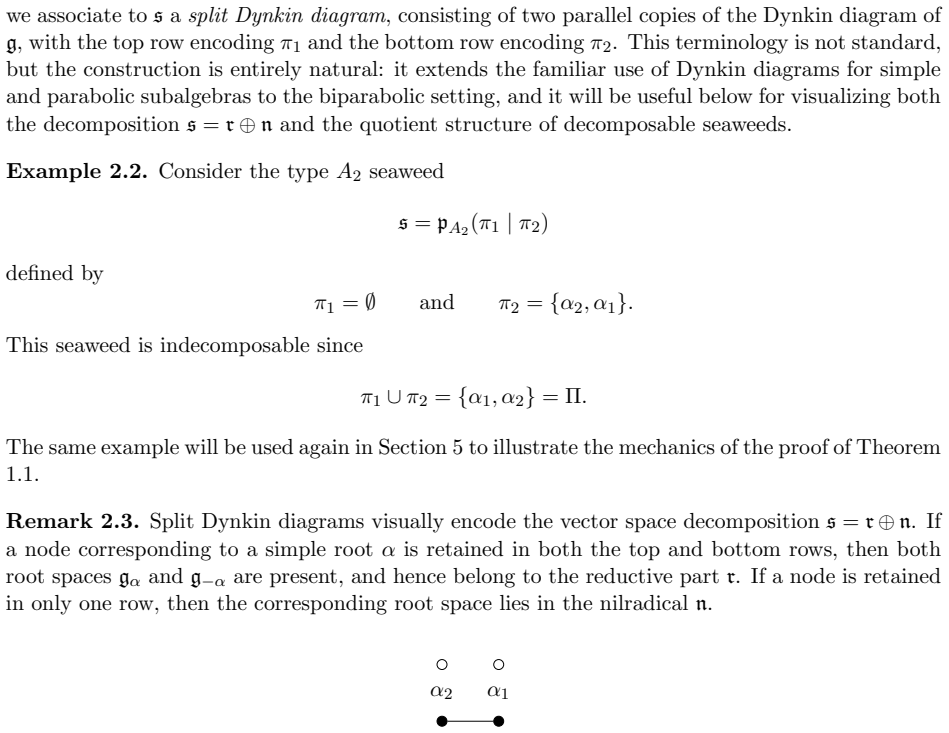
Figure from the paper full image
abstract click to expand
Seaweed (biparabolic) subalgebras form a large and structurally rich class of subalgebras of simple Lie algebras. We determine their adjoint cohomology. If $\mathfrak{s}$ is an indecomposable seaweed subalgebra of a complex simple Lie algebra, then \[ H^\ast(\mathfrak{s},\mathfrak{s})=0, \] and hence $\mathfrak{s}$ is absolutely rigid. If $\mathfrak{s}$ is decomposable, then the Coll--Gerstenhaber decomposition for Lie semidirect products gives, for each $n\ge 0$, a canonical description of $H^n(\mathfrak{s},\mathfrak{s})$ in terms of exterior powers of $\mathcal{Z}(\mathfrak{s})^\ast$ and the zero-weight cohomology of $\mathfrak{s}/\mathcal{Z}(\mathfrak{s})$. In particular, the center is the unique source of nontrivial adjoint cohomology. These results identify indecomposability as the precise condition for cohomological rigidity and give a uniform description of adjoint cohomology for seaweed Lie algebras.
0
0
math.RA 2026-04-20

Jordan multiplications generate every linear map on matrices

The Jordan multiplication semigroup of matrix algebras is the full endomorphism semigroup

Any K-linear endomorphism of M_n(K) is a finite composition of operators given by symmetrized matrix products.

abstract click to expand
Let $\mathbb{K}$ be a field of characteristic different from $2$, and let $M_n(\mathbb{K})$ be the algebra of all $n\times n$ matrices over $\mathbb{K}$. We consider the corresponding special Jordan algebra $\mathcal{A}:=M_n(\mathbb{K})^+$ with symmetrized product $A\circ B:=(AB+BA)/2$, and write $\mathcal{A}_{\mathrm v}:=M_n(\mathbb{K})$ for the underlying $\mathbb{K}$-vector space of $\mathcal{A}$. For $A\in\mathcal{A}$, let $\mathrm{L}_A(X):=A\circ X$ be the multiplication operator. We consider the Jordan multiplication semigroup generated by all multiplication operators, \[ \mathrm{JMS}(\mathcal{A}):=\langle \mathrm{L}_A:A\in\mathcal{A}\rangle\subseteq \mathrm{End}_{\mathbb{K}}(\mathcal{A}_{\mathrm v}). \] We prove that $\mathrm{JMS}(\mathcal{A})=\mathrm{End}_{\mathbb{K}}(\mathcal{A}_{\mathrm v})$. Equivalently, every $\mathbb{K}$-linear endomorphism of $\mathcal{A}_{\mathrm v}$ is a composition of multiplication operators. The proof is primarily linear-algebraic. The main step is to show that $\mathrm{SL}(\mathcal{A}_{\mathrm v})\subseteq \mathrm{JMS}(\mathcal{A})$ by constructing elementary transvections inside the semigroup. We then prove determinant surjectivity on the unit group of $\mathrm{JMS}(\mathcal{A})$ and combine it with the existence of a singular element of rank $n^2-1$ to obtain the full endomorphism semigroup. In the finite-field case, the determinant-surjectivity step is established via Jacobi-sum estimates.
0
0
math.RA 2026-04-20

Jordan map property extends to n-Jordan maps under ring conditions

A note on n-Jordan homomorphisms

For unital A and B of characteristic exceeding n, the homomorphism assumption on Jordan maps forces the n-version to hold as well.

abstract click to expand
By using a variation of a theorem on $n$-Jordan homomorphisms due to Herstein, we deduce the following G. An's result: Let $ A $ and $ B $ be two rings where $ A $ has a unit and $ char(B)> n. $ If every Jordan homomorphism from $ A $ into $ B $ is a homomorphism (anti-homomorphism), then every $n$-Jordan homomorphism from $ A $ into $ B $ is an $n$-homomorphism (anti-$n$-homomorphism).
0
0
math.RA 2026-04-20

Localization and w* fix isotropy of derivations on Ore extensions

On the isotropy of differential Ore extensions

When gcd(h, h') > 1 the isotropy of D = ad_w + EH + Delta_s(x) reduces to a localization problem centered on w* = w + psi^{-1}H.

abstract click to expand
Let Ah = k[x][t; d] be the differential Ore extension. We study the action of the automorphism group of Ah on the derivations of Ah and explicitly describe, using Nowicki's decomposition of the derivations of Ah, the isotropy groups of this action. More precisely, we first obtain an explicit description of the automorphism group of Ah for deg(h) >= 1. Then we determine the isotropy groups of derivations of the form D = ad_w + Delta_s(x), which exhaust all derivations in the square-free case, that is, when gcd(h,h') = 1. In the singular case, where gcd(h,h') is not equal to 1 and special derivations of type EH appear, we show that the isotropy problem is governed by a suitable localization and by the element w* = w + psi^(-1)H, where psi = gcd(h,h'). This yields a general criterion for the isotropy of a derivation of the form D = ad_w + EH + Delta_s(x). Finally, we provide explicit examples illustrating the new phenomena that arise in this setting.
0
0
math.RA 2026-04-20

Endomorphisms lift iff they preserve Poisson structure on center

Hochschild cohomology and lifts of endomorphisms

For constant-rank Azumaya algebras over formally smooth centers, a Hochschild class vanishes exactly under this preservation condition.

abstract click to expand
We study when algebra endomorphisms can be lifted to first-order flat lifts. To a first-order flat lift of an algebra and an endomorphism, we associate a canonical class in Hochschild cohomology with coefficients in a naturally twisted bimodule. The cohomology class vanishes exactly when the endomorphism admits a multiplicative lift. For an Azumaya algebra of constant rank over a formally smooth center, we prove that an endomorphism lifts if and only if the induced endomorphism of the center preserves the Poisson structure given by the lift of the algebra.
0
0
math.RA 2026-04-20

Hopf algebra has Chevalley property iff discriminant ideals are trivial

Chevalley property of module-finite Hopf algebras and discriminant ideals

For affine Cayley-Hamilton cases where the fiber algebra satisfies the property, the full algebra does so exactly when all discriminant sub-

abstract click to expand
In this paper, we study the Chevalley property of Cayley-Hamilton Hopf algebras in the sense of De Concini-Procesi-Reshetikhin-Rosso using discriminant ideals. For any affine Cayley-Hamilton Hopf algebra $(H,C,\text{tr})$ whose identity fiber algebra has the Chevalley property, we prove that an irreducible $H$-module $V$ has the property that $V\otimes W$ is a completely reducible $H$-module for every irreducible $H$-module $W$ if and only if $V$ is annihilated by the lowest discriminant ideal of $(H,C,\text{tr})$, which establishes a bridge between the tensor-nondegenerate behaviour of the irreducible representations of $H$ and the lowest discriminant ideal of $(H,C,\text{tr})$. Using discriminant ideals, we prove that an affine Cayley-Hamilton Hopf algebra $(H,C,\text{tr})$ has the Chevalley property if and only if its identity fiber algebra $H/\mathfrak{m}_{\overline{\varepsilon}}H$ has the Chevalley property and all the discriminant ideals of $(H,C,\text{tr})$ are trivial, thereby resolving a question posed by Huang-Mi-Qi-Wu. Moreover, it is shown that the lowest discriminant subvariety $\mathcal{V}_{\ell}$ of the algebraic group $\operatorname{maxSpec}C$ is a closed subgroup, which reflects the rigid nature of $\mathcal{V}_{\ell}$ and is effective in determining the lowest discriminant subvarieties in certain examples of low GK dimension. This rigidity property provides a method, via the lowest discriminant ideals, for constructing a large family of Hopf algebras with the Chevalley property and finite GK dimension. The results are illustrated through applications to the big quantized Borel subalgebras at roots of unity and to certain Artin-Schelter Gorenstein Hopf algebras of low GK dimension. In particular, the framework yields (non-finite) tensor categories with the Chevalley property arising from some big quantum groups at roots of unity.
0
0
math.RA 2026-04-20

G2-structures match octonion algebras over manifold functions

G₂-structures as Octonion Algebras

An isomorphism identifies G2-structures on 7-manifolds with a subcategory of octonion algebras, allowing algebraic tools to study the metric

abstract click to expand
We define the category of $G_2$-structures over a Riemannian 7-manifold $M$ and present an isomorphism between this category and a full subcategory of the category of octonion algebras over the ring of smooth real-valued functions $C^\infty(M)$ of the same manifold $M$. A classification of $G_2$-structures in the same metric class is shown to agree with a parametrisation of octonion algebras with isometric norm. A short study of the local structure of octonion algebras over $C^\infty(M)$ shows similarities to the theory of octonion algebras over $\mathbb{R}$. Thus, many of the results on real octonion algebras, and in general octonion algebras over rings, can be applied to $G_2$-structures viewed as octonion algebras, under the aforementioned isomorphism of categories.
0
0
math.RA 2026-04-17

The paper proves that every square matrix over a finite field of characteristic 2 with…

Matrices over Finite Fields of Characteristic 2 as Sums of Diagonalizable and Square-Zero Matrices

Every matrix over finite fields of char 2 with more than three elements is the sum of a diagonalizable matrix and a square-zero matrix.

abstract click to expand
We investigate the problem asking when any square matrix whose entries lie in a finite field of characteristic 2 is decomposable into the sum of a diagonalizable matrix and a nilpotent matrix with index of nilpotency at most 2 and, as a result, we completely resolve this question in the affirmative for any finite field of characteristic 2 having strictly more than three elements. Our main theorem of that type, combined with results from our recent publication in Linear Algebra & Appl. (2026) (see [7]), totally settle this problem for all finite fields different from $\mathbb{F}_2$ and $\mathbb{F}_3$. However, in this paper we also prove that each matrix over $\mathbb{F}_2$ is expressible as the sum of a potent matrix with index of potency not exceeding 4 and a nilpotent matrix with index of nilpotency not exceeding 2, thus substantiating recent examples due to \v{S}ter in Linear Algebra & Appl. (2018) and Shitov in Indag. Math. (2019) (see, respectively, [9] and [8]).
0
0
math.RA 2026-04-17

Projectors capture all additive group codes in semisimple algebras

Projector additive group codes

Images of FG-linear projectors on KG recover every additive left group code when semisimple and exactly the direct summands otherwise.

abstract click to expand
Let $F=\mathbb{F}_q$ and let $K=\mathbb{F}_{q^m}$ be a finite extension. An additive left group code is a left $FG$-submodule of the group algebra $KG$. In this paper, we introduce projector additive left group codes and restricted projector additive left group codes as additive counterparts of idempotent group codes in the classical theory of group codes. More precisely, they are defined, respectively, as images of $FG$-linear projectors on $KG$ and as images of left $FG$-submodules under such projectors. This perspective is motivated by the fact that idempotent elements of $KG$ do not yield a sufficiently general and natural algebraic framework for the study of additive left group codes. Projector additive left group codes are a particular class of projective left $FG$-submodules of $KG$. Consequently, in the semisimple case every additive left group code arises in this way, whereas in the non-semisimple case the projector construction captures precisely the direct summands of $KG$ as left $FG$-modules, and hence a natural subclass of projective left $FG$-submodules. We further relate trace-Euclidean and trace-Hermitian duality to adjoint projectors, establish criteria for the LCD and self-dual cases, study the Murray--von Neumann equivalence of projectors, and interpret quotients by orthogonal codes in terms of module duals.
0
0
math.RA 2026-04-16

All 5D nilpotent Jordan superalgebras classified up to isomorphism

Varieties of nilpotent Jordan superalgebras of dimension five

The varieties they span are decomposed into irreducible components and every degeneration is traced.

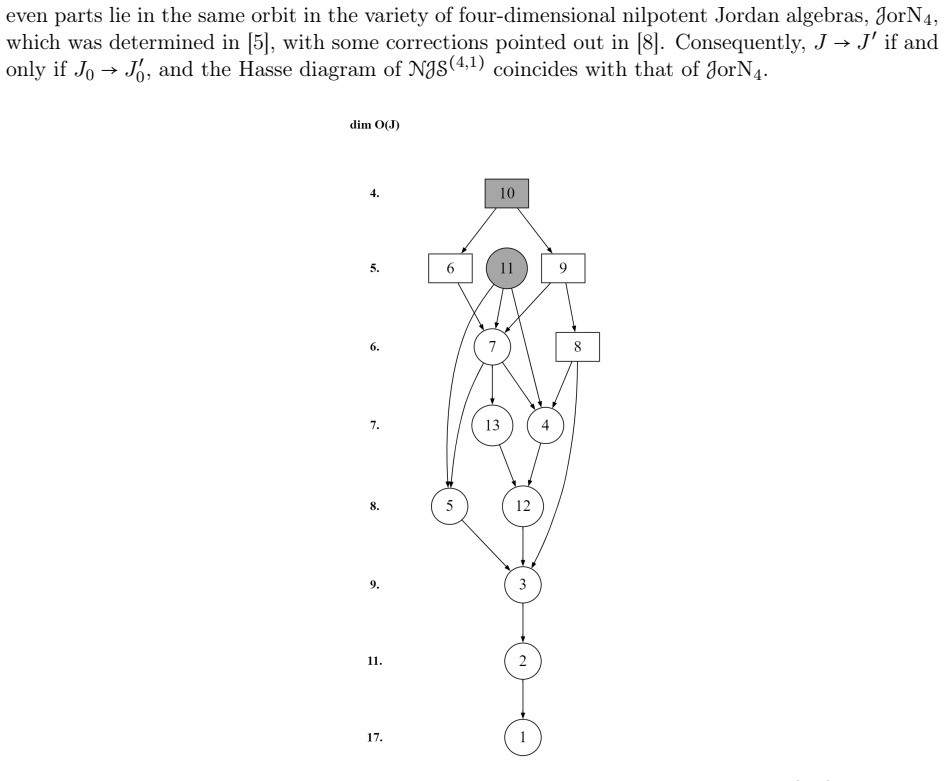
Figure from the paper full image
abstract click to expand
The paper is devoted to the description of the varieties of complex 5-dimensional nilpotent Jordan superalgebras. We find all representatives for the isomorphism classes, using the Jordan normal form, results of simultaneous matrix triangularization, the Jordan-Kronecker theorem for a pair of skew-symmetric bilinear forms and similar arguments developed for $\Delta$-modules by Burde and Grunewald. We also provide a complete geometric classification, determining the irreducible components of the corresponding varieties and describing all possible degenerations and non-degenerations between these superalgebras, in particular, applying some $\mathbb{Z}_2$-graded subspaces as invariants.
0
0
math.RA 2026-04-16 3 theorems

Lifting conditions let C4* module properties localize and globalize

Localization, Local--Global Transfer, and Hull Theory for C4^{ast}-Modules over Commutative Rings

Exact decomposition and morphism lifting enable forward transfer to localizations while descent and patching give the converse, with hulls,

abstract click to expand
Let \(R\) be a commutative ring and \(M\) an \(R\)-module. We develop a localization and local-global theory for \(C4\)-modules, \(C4^{\ast}\)-modules, strongly \(C4^{\ast}\)-modules, \(C4\)-hulls, and pseudo-continuous hulls over commutative rings. The problem is structural: these notions are defined through decompositions, summand conditions, and minimal extensions, while localization changes decomposition data, support, and hull minimality. We prove forward localization theorems for the \(C4\), \(C4^{\ast}\), and strongly \(C4^{\ast}\) conditions under exact lifting hypotheses formulated through decomposition lifting, morphism lifting, and submodule lifting. We also prove converse local-global theorems under descent and patching hypotheses, showing when primewise or maximal-local \(C4^{\ast}\) behavior implies global \(C4^{\ast}\) behavior. In addition, we establish obstruction results showing that no unrestricted local-global principle can hold. We compare the localization of a global \(C4\)-hull or pseudo-continuous hull with the hull formed after localization. We show that hull commutation requires both localization stability of the hull class and envelope-type axioms for hull minimality and uniqueness, and we prove conditional patching theorems for reconstructing global hulls from compatible local hulls. Our method is purely algebraic and support-theoretic, based on summand descent, patching of local witnesses, support control, and dimension-stratified transfer on \(\operatorname{Spec} R\). As applications, we show that for commutative artinian rings these properties are detected exactly on the local factors, and that for finitely generated torsion modules over a Dedekind domain they are detected exactly on the primary components, equivalently on the localizations at maximal ideals in the support.
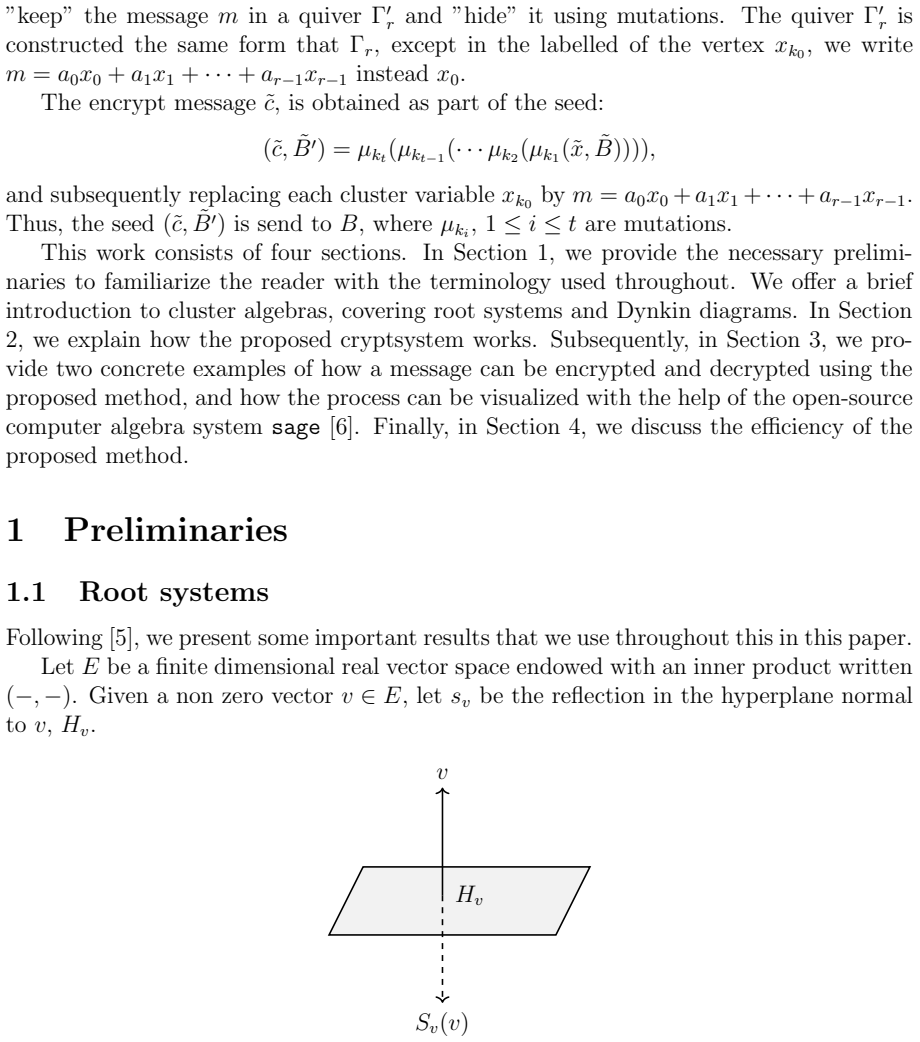
0
0
math.RA 2026-04-16

Centralizers commute for nonscalars in mixed algebra coproducts

Commutativity of centralizers in a coproduct of a free algebra and a polynomial algebra

The centralizer of any nonscalar element in the coproduct of a free algebra and a polynomial algebra is commutative.

abstract click to expand
We show that the centralizer of a nonscalar element in the coproduct $k\langle X\rangle *k[Y]$ of a free associative algebra and a polynomial algebra over a given field is commutative. For $k\langle X \rangle$ this is part of Bergman's centralizer theorem. Our proof relies on a reduction given in Bergman's proof and is of combinatorial nature, employing a strict order structure of the coproduct monoid.
0
0
math.RA 2026-04-16

GAP package derives commutator relations in F4-graded groups

Symbolic computation in cubic Jordan matrix algebras and in related structures

It implements symbolic operations on cubic Jordan matrix algebras to calculate relations in groups built from them.

Figure from the paper full image
abstract click to expand
We present CubicJordanMatrixAlg, a GAP package for symbolic computation in cubic Jordan matrix algebras and in related Lie-theoretic structures. As an application, we use it to compute certain (commutator) relations in $F_4$-graded groups that were constructed by De Medts and the author from cubic Jordan matrix algebras.
0
0
math.RA 2026-04-16

n- and m-homomorphisms add to (n+m) and compose to nm

Compositions of n-homomorphisms

Generalized maps between arbitrary rings obey simple arithmetic rules on their indices, proved by direct combinatorial expansion.

abstract click to expand
We study $n$-homomorphisms in the sense of Khudaverdian--Voronov, but generalized to maps from arbitrary rings to arbitrary commutative rings. We show that the sum of an $n$-homomorphism and an $m$-homomorphism is an $\left( n+m\right) $-homomorphism, and that the composition of an $n$-homomorphism and an $m$-homomorphism is an $nm$-homomorphism. The proofs are entirely combinatorial.
0
0
math.RA 2026-04-16

Growth entropy bounds categorical entropies for noncommutative algebras

Growth in noncommutative algebras and entropy in derived categories

For algebras of finite global dimension the bounds become equalities for regular algebras and smooth projective varieties, but strict formon

abstract click to expand
A noncommutative projective variety is defined, after Artin and Zhang, by a graded coherent algebra A, where the category of coherent sheaves is the quotient qgr(A) of the category of finitely presented graded modules by the subcategory of torsion modules. We consider the categorical and polynomial entropies of the Serre twist, that is, of the degree shift functor on the bounded derived category of qgr(A). These two types of entropy can be viewed as analogues of the dimension of the noncommutative variety. We relate these invariants with the growth of the algebra. For algebras of finite global dimension, the entropies are bounded above by the growth entropy and the Gelfand--Kirillov dimension of the algebra. Moreover, these equalities hold for regular algebras, as well as for coordinate rings of smooth projective varieties. However, the polynomial entropy is zero for monomial algebras of polynomial growth, so in this case the inequality is strict.
0
0
math.RA 2026-04-15 2 theorems

Additive surjections preserving strong orthogonality on C*-algebras classified

Additive preservers of mutual strong Birkhoff-James orthogonality on finite-dimensional C^ast-algebras

The result follows from first describing all additive singularity preservers on direct sums of matrix algebras.

abstract click to expand
We describe additive surjections on direct sum of matrix algebras that preserve singularity in one direction. As an application, we classify additive surjections on finite-dimensional $C^\ast$-algebras that preserve mutual strong Birkhoff-James orthogonality in one direction.
0
0
math.RA 2026-04-15

Graded equivalences match Morita contexts with surjective traces

Graded Equivalence for Graded Idempotent Rings

Extends the criterion to general idempotent graded rings and connects their graded submodule lattices.

abstract click to expand
In this paper, we extend the study of graded equivalences to the case of general idempotent graded rings. We prove that the existence of a graded equivalence between two categories of graded torsion-free unital modules may be characterized by the existence of a Morita context with surjective trace maps. As an application of our results we relate certain lattices of graded submodules and graded ideals of graded equivalent garded rings and give some properties invariant under graded equivalences.
0
0
math.RA 2026-04-14

Finitely generated symmetric operads have no GK dimension between 1 and 2

Symmetric operads of GK-dimension one

The result answers a 2020 question by proving a gap in attainable dimensions and classifying the prime cases that reach exactly 1.

abstract click to expand
We prove that there is no finitely generated symmetric operad of Gelfand-Kirillov dimension strictly between 1 and 2 that answers an open question posted in 2020. We also classify finitely generated prime symmetric operads of Gelfand-Kirillov dimension 1.
0
0
math.RA 2026-04-14 Recognition

Explicit resolutions compute extension dimensions for Leavitt modules

Extensions of simple modules over Leavitt path algebras

Projective resolutions for simple modules from cycles and irreducibles are built for any graph and field, then used to find the dimensions.

abstract click to expand
Let $K$ be any field, and let $E$ be any graph. We explicitly construct the projective resolution of simple left modules over the Leavitt path algebra $L_K(E)$ associated to cycles and irreducible polynomials. Then we study the dimension of the $K$-vector space of the extensions between two such simple modules.
0

browse all of math.RA → full archive · search · sub-categories