Recognition: unknown
A Wide-Regulation-Range Hybrid Switched-Capacitor Converter for 48V Automotive Power Systems
Pith reviewed 2026-05-10 11:23 UTC · model grok-4.3
The pith
A hybrid switched-capacitor converter uses a three-state sequence to achieve variable voltage ratios from 0.2 to 0.4 while keeping soft switching and efficiencies above 88 percent.
A machine-rendered reading of the paper's core claim, the machinery that carries it, and where it could break.
Core claim
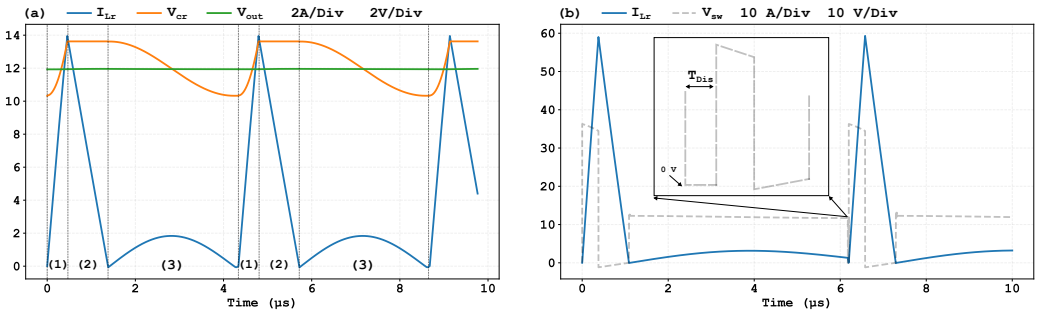
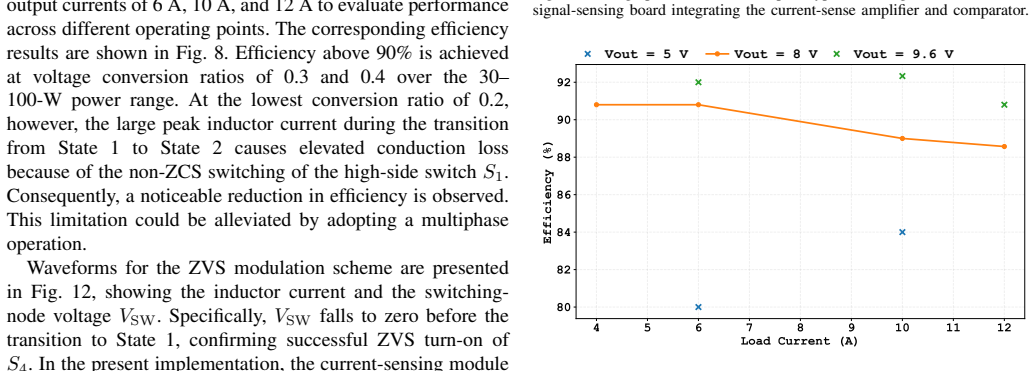
By extending conventional 2:1 resonant operation with a three-state sequence, the hybrid switched-capacitor converter realizes variable conversion ratios while preserving zero-current and zero-voltage switching in most transitions; a prototype demonstrates this capability over ratios 0.2-0.4 with peak efficiency exceeding 92 percent at 100 W and efficiency above 88 percent over a wide load range for 3:1 conversion.
What carries the argument
The multi-mode modulation (3M) scheme that inserts a three-state operating sequence into the resonant switched-capacitor cycle, enabling both ZCS and ZVS while supporting closed-loop PI control tuned by reinforcement learning.
If this is right
- Variable conversion ratios become practical in resonant switched-capacitor topologies without sacrificing soft switching.
- The same modulation approach supports both ZCS-dominant and ZVS-dominant operation in one hardware design.
- Reinforcement-learning tuning of the PI controller compensates for the nonlinear variable-frequency dynamics that arise from the three-state sequence.
- The resulting converter fits directly into 48 V automotive rails that require regulation between battery and downstream loads.
Where Pith is reading between the lines
- The three-state idea could be ported to other resonant switched-capacitor families to widen their usable range without new magnetics.
- The RL-assisted controller tuning offers a general method for handling variable-frequency converters whose small-signal models change with operating point.
- If scaled to higher power, the topology might reduce the number of separate DC-DC stages needed in electric-vehicle power distribution.
Load-bearing premise
The three-state sequence maintains soft-switching conditions across the entire claimed load and conversion range, as observed in the prototype tests.
What would settle it
A measurement showing hard switching or efficiency below 80 percent at any point inside the stated 0.2-0.4 ratio window at 100 W load would falsify the wide-regulation claim.
Figures





read the original abstract
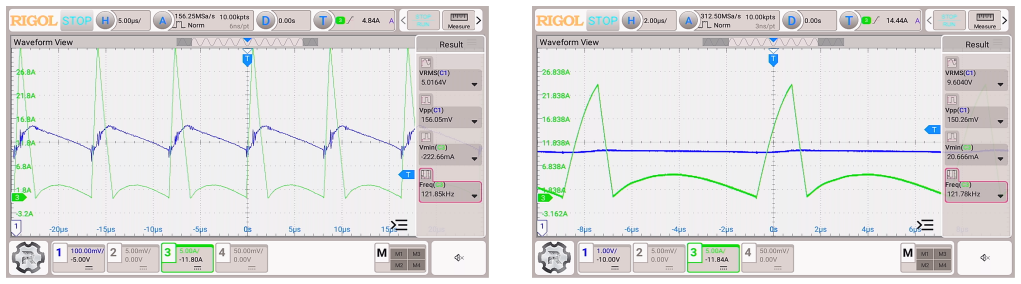
This paper presents a hybrid switched-capacitor converter (HSCC) with a novel multi-mode modulation (3M) scheme for wide-range voltage regulation in 48-V automotive power systems. By introducing a three-state operating sequence beyond the conventional 2:1 resonant operation, the proposed converter achieves variable step-down conversion ratios while preserving soft-switching operation in most transitions. The proposed modulation supports both zero-current switching (ZCS) and zero-voltage switching (ZVS) modes, enabling efficient operation over a broad range of load and conversion conditions. To enable voltage regulation, a closed-loop control configuration is proposed with a linear proportional-integral (PI) controller, with gain tuning assisted by reinforcement learning (RL) to address the converter's nonlinear and variable-frequency nature while maintaining good transient performance. A hardware prototype was built to validate the proposed modulation scheme. The measured results verify ZCS operation over voltage conversion ratios of 0.2--0.4, with a peak efficiency exceeding 92\% at 100~W, and efficiency above 88\% over a wide operating range for 3:1 conversion. The feasibility of both ZCS and ZVS operation is also experimentally demonstrated. These results show that the proposed HSCC significantly extends the practical regulation range of resonant switched-capacitor converters while maintaining high efficiency.
Editorial analysis
A structured set of objections, weighed in public.
Referee Report
Summary. The paper proposes a hybrid switched-capacitor converter (HSCC) employing a novel three-mode (3M) modulation scheme based on a three-state operating sequence. This extends beyond conventional 2:1 resonant operation to achieve variable step-down conversion ratios (0.2–0.4) while preserving soft-switching (ZCS and ZVS) in most transitions. A closed-loop control using a reinforcement-learning-tuned PI controller addresses the nonlinear variable-frequency dynamics. Hardware prototype measurements confirm ZCS operation across the claimed ratios, peak efficiency >92% at 100 W, and >88% efficiency over a wide range for 3:1 conversion, demonstrating an extended practical regulation range for resonant SC converters in 48 V automotive applications.
Significance. If the prototype results hold under the stated conditions, the work provides a concrete experimental demonstration that a three-state modulation can meaningfully widen the usable regulation range of resonant switched-capacitor converters without sacrificing high efficiency or soft-switching. The inclusion of efficiency maps, transient waveforms, and RL-assisted controller tuning supplies practical evidence relevant to 48 V automotive power delivery, where flexible voltage ratios are needed. The absence of fitted parameters in the core modulation and the direct hardware validation are positive features.
major comments (2)
- [§4.1] §4.1, three-state timing analysis: the manuscript states that the sequence preserves ZCS over 0.2–0.4 ratios, yet the explicit timing equations relating the three state durations to the instantaneous conversion ratio and resonant current zero-crossings are not derived; without them the claim that soft-switching holds for arbitrary ratios within the range rests entirely on the measured waveforms rather than on an a-priori guarantee.
- [Table 3, Fig. 8] Table 3 and Fig. 8: the efficiency data for the 3:1 conversion ratio report >88% across the load range, but no uncertainty intervals or repeated measurements on the same or additional prototypes are provided; this weakens the quantitative support for the “wide operating range” claim that is central to the abstract.
minor comments (3)
- [Abstract] The abstract introduces the “3M” acronym without expansion; the first use of the term in the main text should be spelled out.
- [Fig. 6] Fig. 6 (transient response) would benefit from an overlay of the reference step and measured output voltage on the same axes with consistent time scales to allow direct visual assessment of settling time.
- [§5.2] The RL tuning procedure is described at a high level; a brief pseudocode or hyper-parameter table would clarify reproducibility of the gain selection process.
Simulated Author's Rebuttal
We thank the referee for the positive assessment of our work and the recommendation for minor revision. We address each major comment below with point-by-point responses, indicating the revisions we will make to strengthen the manuscript.
read point-by-point responses
-
Referee: [§4.1] §4.1, three-state timing analysis: the manuscript states that the sequence preserves ZCS over 0.2–0.4 ratios, yet the explicit timing equations relating the three state durations to the instantaneous conversion ratio and resonant current zero-crossings are not derived; without them the claim that soft-switching holds for arbitrary ratios within the range rests entirely on the measured waveforms rather than on an a-priori guarantee.
Authors: We agree that explicit timing equations would provide a stronger a-priori analytical guarantee for ZCS operation across the full range. The manuscript describes the three-state sequence and its resonant behavior but does not derive the closed-form relations between state durations, conversion ratio, and zero-crossing instants. In the revised manuscript, we will add these timing equations to §4.1, showing how the durations are chosen to align resonant current zero-crossings with state transitions for conversion ratios in [0.2, 0.4], thereby complementing the experimental waveforms. revision: yes
-
Referee: [Table 3, Fig. 8] Table 3 and Fig. 8: the efficiency data for the 3:1 conversion ratio report >88% across the load range, but no uncertainty intervals or repeated measurements on the same or additional prototypes are provided; this weakens the quantitative support for the “wide operating range” claim that is central to the abstract.
Authors: We acknowledge that the absence of uncertainty intervals and repeated measurements limits the statistical robustness of the efficiency claims. The data were obtained from a single hardware prototype using standard laboratory instrumentation. In the revision, we will incorporate uncertainty intervals into Table 3 and Fig. 8, derived from the specified accuracy of the measurement equipment (e.g., power analyzer and probe tolerances). We will also add a brief discussion in the text clarifying that the results represent performance on the developed prototype under the tested conditions. While additional prototype builds and repeated trials were not performed owing to typical resource constraints in prototype development, the presented measurements are consistent across operating points and support the wide-range claim. revision: partial
Circularity Check
No significant circularity detected
full rationale
The paper is an experimental hardware design contribution centered on a prototype HSCC with three-state modulation and RL-tuned PI control. All central claims (extended regulation range 0.2-0.4, ZCS/ZVS operation, >88% efficiency) are validated directly by measured waveforms, efficiency maps, and transient data from the built prototype rather than any first-principles derivation chain. No equations, fitted parameters presented as predictions, self-citations used as load-bearing uniqueness theorems, or ansatzes smuggled via prior work appear in the abstract or described content. The RL tuning is an implementation aid for the nonlinear plant, not a reduction of the result to its own inputs. The derivation chain is therefore self-contained against external benchmarks.
Axiom & Free-Parameter Ledger
Reference graph
Works this paper leans on
-
[1]
Power Electronics Converters for Electric Vehicle Auxiliaries: State of the Art and Future Trends,
R. Kotb, S. Chakraborty, D. D. Tran, E. Abramushkina, M. El Baghdadi, and O. Hegazy, “Power Electronics Converters for Electric Vehicle Auxiliaries: State of the Art and Future Trends,”Energies, vol. 16, 2 2023
2023
-
[2]
A GaN-based DC/DC converter for e-vehicles applications,
E. F. De Oliveira, S. Sprunck, J. Pfeiffer, and P. Zacharias, “A GaN-based DC/DC converter for e-vehicles applications,”2020 22nd European Conference on Power Electronics and Applications, EPE 2020 ECCE Europe, 9 2020
2020
-
[3]
High-V oltage Bus Converter Power Modules for Electric Vehicle 48 V Power Delivery Networks,
M. Wood, “High-V oltage Bus Converter Power Modules for Electric Vehicle 48 V Power Delivery Networks,”IEEE Power Electronics Magazine, vol. 12, no. 2, pp. 39–45, 2025
2025
-
[4]
DC-DC converters for electric vehicle applications,
D. M. Bellur and M. K. Kazimierczuk, “DC-DC converters for electric vehicle applications,” in2007 Electrical Insulation Conference and Electrical Manufacturing Expo, pp. 286–293, 2007
2007
-
[5]
Perfor- mance Limits of Resonant Switched-Capacitor Converter With V oltage Regulation,
W. Xie, W. Xi, S. Li, K. M. Smedley, X. Zhu, and Y . Dai, “Perfor- mance Limits of Resonant Switched-Capacitor Converter With V oltage Regulation,”IEEE Transactions on Power Electronics, vol. 40, no. 1, pp. 1441–1456, 2025
2025
-
[6]
A high-efficiency resonant switched capacitor converter with continuous conversion ratio,
A. Cervera, M. Evzelman, M. M. Peretz, and S. S. Ben-Yaakov, “A high-efficiency resonant switched capacitor converter with continuous conversion ratio,”IEEE Transactions on Power Electronics, vol. 30, pp. 1373–1382, 3 2015
2015
-
[7]
Step-down switched- capacitor quasi-resonant PWM converter with continuous conversion ratio,
M. Turhan, M. A. Hendrix, and J. L. Duarte, “Step-down switched- capacitor quasi-resonant PWM converter with continuous conversion ratio,”2015 17th European Conference on Power Electronics and Applications, EPE-ECCE Europe 2015, 10 2015. Fig. 11. Measured inductor current (Ch3, green) and output-voltage (Ch1, blue) waveforms under ZCS operation atV in = 2...
2015
-
[8]
Resonant switched-capacitor converter with multi-resonant frequencies,
O. Jong, Q. Li, and F. C. Lee, “Resonant switched-capacitor converter with multi-resonant frequencies,”Conference Proceedings - IEEE Ap- plied Power Electronics Conference and Exposition - APEC, vol. 2019- March, pp. 2177–2184, 5 2019
2019
-
[9]
Two-Stage 48V-1V Hybrid Switched-Capacitor Point-of-Load Converter with 24V Intermediate Bus,
Y . Chen, D. M. Giuliano, and M. Chen, “Two-Stage 48V-1V Hybrid Switched-Capacitor Point-of-Load Converter with 24V Intermediate Bus,” in2020 IEEE 21st Workshop on Control and Modeling for Power Electronics (COMPEL), pp. 1–8, 2020
2020
-
[10]
A Merged ZCS/ZVS Control Technique for Resonant Switched-Capacitor Converters,
H. B. Sambo, Y . Zhu, and R. C. Pilawa-Podgurski, “A Merged ZCS/ZVS Control Technique for Resonant Switched-Capacitor Converters,”2024 IEEE Energy Conversion Congress and Exposition, ECCE 2024 - Proceedings, pp. 4416–4422, 2024
2024
-
[11]
ZVS of Power MOSFETs Revisited,
M. Kasper, R. Burkart, G. Deboy, J. W. Kolar, M. Kasper, R. M. Burkart, G. Deboy, and J. W. Kolar, “ZVS of Power MOSFETs Revisited,”IEEE Transactions on Power Electronics, vol. 31, no. 12, p. 8063, 2016
2016
-
[12]
A 48-to-12 v cascaded resonant switched-capacitor converter for data centers with 99% peak efficiency and 2500 w/in power density,
Z. Ye, Y . Lei, and R. C. Pilawa-Podgurski, “A 48-to-12 v cascaded resonant switched-capacitor converter for data centers with 99% peak efficiency and 2500 w/in power density,”Conference Proceedings - IEEE Applied Power Electronics Conference and Exposition - APEC, vol. 2019-March, pp. 13–18, 5 2019
2019
-
[13]
Fast-Response Variable-Frequency Series- Capacitor Buck VRM Through Integrated Control Approaches,
G. Qian, H. Yan, and X. Cui, “Fast-Response Variable-Frequency Series- Capacitor Buck VRM Through Integrated Control Approaches,” in2025 IEEE 26th Workshop on Control and Modeling for Power Electronics (COMPEL), (Knoxville, TN, USA), pp. 1–8, IEEE, June 2025
2025
-
[14]
Fast-Response Variable Frequency DC–DC Converters Using Switching Cycle Event-Driven Digital Control,
X. Cui and A.-T. Avestruz, “Fast-Response Variable Frequency DC–DC Converters Using Switching Cycle Event-Driven Digital Control,”IEEE Transactions on Power Electronics, vol. 38, pp. 8190–8207, July 2023
2023
-
[15]
Design of an Adaptive Robust PI Controller for DC/DC Boost Converter Using Reinforcement-Learning Technique and Snake Optimization Algorithm,
S. M. Ghamari, M. Hajihosseini, D. Habibi, and A. Aziz, “Design of an Adaptive Robust PI Controller for DC/DC Boost Converter Using Reinforcement-Learning Technique and Snake Optimization Algorithm,” IEEE Access, vol. 12, pp. 141814–141829, 2024
2024
-
[16]
DC/DC Power Converter Control-Based Deep Machine Learning Techniques: Real-Time Implementation,
M. Hajihosseini, M. Andalibi, M. Gheisarnejad, H. Farsizadeh, and M.- H. Khooban, “DC/DC Power Converter Control-Based Deep Machine Learning Techniques: Real-Time Implementation,”IEEE Transactions on Power Electronics, vol. 35, pp. 9971–9977, Oct. 2020
2020
-
[17]
A Novel DCR Current Sensing Scheme for Accurate Current Readback in Power uModule Applications,
S. Tian, W. Ballar, X. Chen, Y . Yan, Z. Liu, R. Ying, and E. Beville, “A Novel DCR Current Sensing Scheme for Accurate Current Readback in Power uModule Applications,”Conference Proceedings - IEEE Applied Power Electronics Conference and Exposition - APEC, vol. 2020-March, pp. 2763–2765, 3 2020
2020
-
[18]
Control-Oriented Modeling of Comparator Overdrive Delay for Stabilizing High-Frequency Current- Mode DC-DC Converters,
G. Qian, A.-T. Avestruz, and X. Cui, “Control-Oriented Modeling of Comparator Overdrive Delay for Stabilizing High-Frequency Current- Mode DC-DC Converters,”IEEE Transactions on Power Electronics, pp. 1–14, 2026
2026
-
[19]
Light Load Efficiency Boost Technique for Switched Tank Converters Based on Hybrid ZVS-ZCS Control,
J. Liang and H. Wang, “Light Load Efficiency Boost Technique for Switched Tank Converters Based on Hybrid ZVS-ZCS Control,”2022 International Power Electronics Conference, IPEC-Himeji 2022-ECCE Asia, pp. 2231–2235, 2022
2022
discussion (0)
Sign in with ORCID, Apple, or X to comment. Anyone can read and Pith papers without signing in.