Noncrossing Partitions From Hull Configurations
Pith reviewed 2026-05-10 12:22 UTC · model grok-4.3
The pith
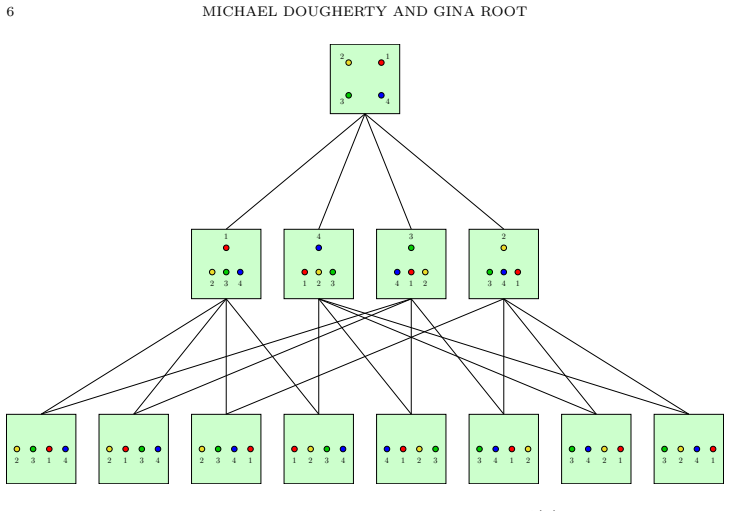
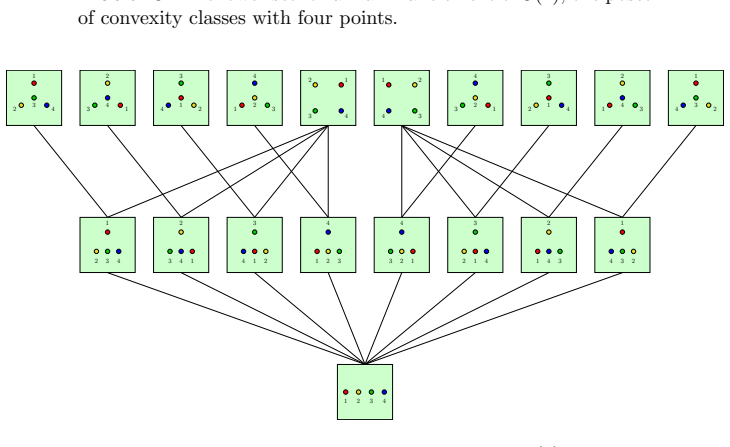
Hull configurations of points produce noncrossing partition lattices that are unions of maximal Boolean subposets.
A machine-rendered reading of the paper's core claim, the machinery that carries it, and where it could break.
Core claim
For hull configurations, defined as points either collinear or on the boundary of a convex polygon, the corresponding lattice of noncrossing partitions is a union of maximal Boolean subposets, and under certain circumstances has a symmetric chain decomposition.
What carries the argument
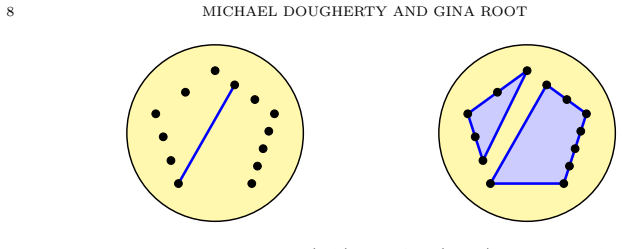
The noncrossing partition lattice induced by a finite point configuration in the plane, with the partial order based on refinement of partitions where crossings are forbidden.
If this is right
- The structure reduces to the Boolean lattice when all points are collinear.
- It generalizes the Kreweras noncrossing partition lattice for convex positions.
- The lattices have symmetric chain decompositions in specific cases.
- This provides a way to understand the poset structure through Boolean components.
Where Pith is reading between the lines
- Such decompositions might facilitate counting or generating functions for noncrossing partitions in geometric settings.
- The result could extend to other geometric constraints on point sets.
- Connections to symmetric chain decompositions in other combinatorial lattices may be explored.
Load-bearing premise
The relation defining noncrossing partitions on an arbitrary finite point set yields a lattice whose structure for hull configurations consists exactly of unions of maximal Boolean subposets.
What would settle it
A specific hull configuration of points where the noncrossing partitions do not form a union of maximal Boolean subposets would disprove the main claim.
Figures

read the original abstract
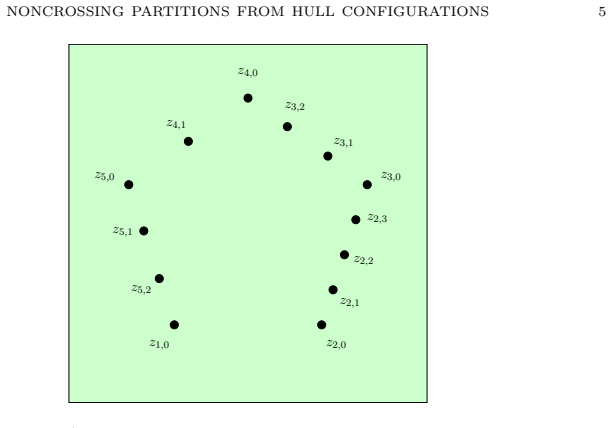
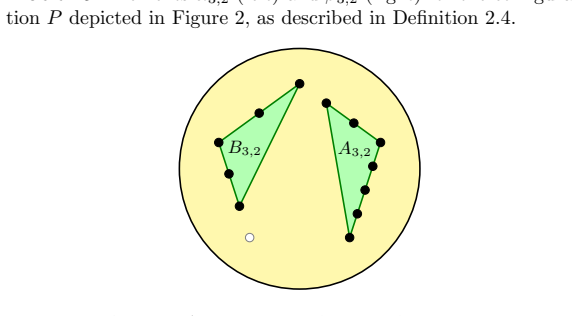
Each finite configuration of points in the plane determines a corresponding lattice of noncrossing partitions. When these points form the vertex set of a convex polygon, the associated lattice is the classical noncrossing partition lattice (introduced by Kreweras in 1972), which makes many appearances in combinatorics and geometric group theory. If, on the other hand, all points of the configuration lie on a common line segment, the result is a Boolean lattice. In this article, we examine the more general class of hull configurations, which we define to be those which lie either on a line segment or on the boundary of a convex polygon. We prove that the corresponding lattices of noncrossing partitions are unions of maximal Boolean subposets and, under certain circumstances, have symmetric chain decompositions.
Editorial analysis
A structured set of objections, weighed in public.
Referee Report
Summary. The manuscript defines lattices of noncrossing partitions associated to arbitrary finite point configurations in the plane. It specializes to hull configurations (points lying on a line segment or on the boundary of a convex polygon) and proves that the resulting posets are unions of maximal Boolean subposets; under additional conditions they admit symmetric chain decompositions. This extends the Boolean lattice realized by collinear points and the classical Kreweras noncrossing partition lattice realized by convex position.
Significance. If the stated proofs hold, the work supplies a geometric unification of two extremal cases in noncrossing partition theory via a direct combinatorial construction that introduces no free parameters or self-referential reductions. The explicit derivation of lattice properties from the hull-configuration axioms is a methodological strength that may facilitate further study of symmetric chain decompositions and Boolean subposet decompositions in geometrically defined posets.
minor comments (3)
- [Section 2] Definition 2.3 (hull configuration) and the subsequent noncrossing relation would benefit from an explicit small example (e.g., four points with three on the convex hull and one interior to an edge) together with the resulting poset diagram to illustrate the claimed union-of-Boolean-subposets structure.
- [Section 5] The proof of the symmetric-chain-decomposition claim in Theorem 5.2 is asserted to hold “under certain circumstances”; the precise hypotheses on the hull configuration (e.g., number of interior points on edges) should be stated as a numbered hypothesis before the theorem.
- [References] The bibliography entry for Kreweras (1972) is referenced in the introduction but the full citation is missing; add it in standard format.
Simulated Author's Rebuttal
We thank the referee for their positive summary of the manuscript and for recognizing the methodological strength of deriving lattice properties directly from hull-configuration axioms. The recommendation of minor revision is noted; we will incorporate any necessary minor changes in the revised version.
Circularity Check
No significant circularity; derivation self-contained from definitions
full rationale
The paper introduces hull configurations by explicit definition (points on a line segment or convex polygon boundary) and derives lattice properties (unions of maximal Boolean subposets, symmetric chain decompositions under conditions) directly from the combinatorial noncrossing partition relation. It extends the known Boolean lattice (collinear case) and Kreweras noncrossing partition lattice (convex case) via standard poset arguments without fitted parameters, self-definitional reductions, or load-bearing self-citations. No step reduces a claimed result to its own inputs by construction; the central claims remain independent of the definitions.
Axiom & Free-Parameter Ledger
axioms (2)
- standard math Noncrossing partitions of a finite point set in the plane form a lattice under the usual refinement order.
- domain assumption Hull configurations are exactly the point sets lying on a line segment or on the boundary of their convex hull.
Reference graph
Works this paper leans on
-
[1]
[BBG+19] B. Baumeister, K.-U. Bux, F. G¨ otze, D. Kielak, and H. Krause,Non-crossing parti- tions, Spectral structures and topological methods in mathematics, EMS Ser. Congr. Rep., EMS Publ. House, Z¨ urich, 2019, pp. 235–274. [BM10] Tom Brady and Jon McCammond,Braids, posets and orthoschemes, Algebr. Geom. Topol.10(2010), no. 4, 2277–2314. MR 2745672 [CD...
work page 2019
-
[2]
[HKS16] Thomas Haettel, Dawid Kielak, and Petra Schwer,The 6-strand braid group is CAT(0), Geometriae Dedicata182(2016), no. 1, 263–286. [HS18] Julia Heller and Petra Schwer,Generalized non-crossing partitions and buildings, Electron. J. Combin.25(2018), no. 1, Paper No. 1.24,
work page 2016
-
[3]
[Jeo23] Seong Gu Jeong,The seven-strand braid group isCAT(0), Manuscripta Math.171 (2023), no. 3-4, 563–581. MR 4597707 [Kre72] G. Kreweras,Sur les partitions non crois´ ees d’un cycle, Discrete Math.1(1972), no. 4, 333–350. [McC06] Jon McCammond,Noncrossing partitions in surprising locations, Amer. Math. Monthly113(2006), no. 7, 598–610. [McC17] ,Noncros...
work page 2023
-
[4]
[SU91] Rodica Simion and Daniel Ullman,On the structure of the lattice of noncrossing partitions, Discrete Math.98(1991), no. 3, 193–206
work page 1991
discussion (0)
Sign in with ORCID, Apple, or X to comment. Anyone can read and Pith papers without signing in.