The Two Orbital, Interacting Hatano-Nelson Model
Pith reviewed 2026-05-10 10:29 UTC · model grok-4.3
The pith
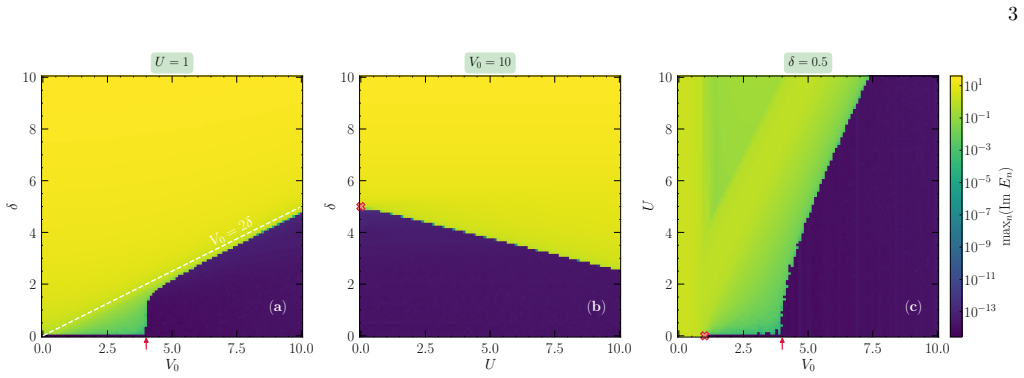
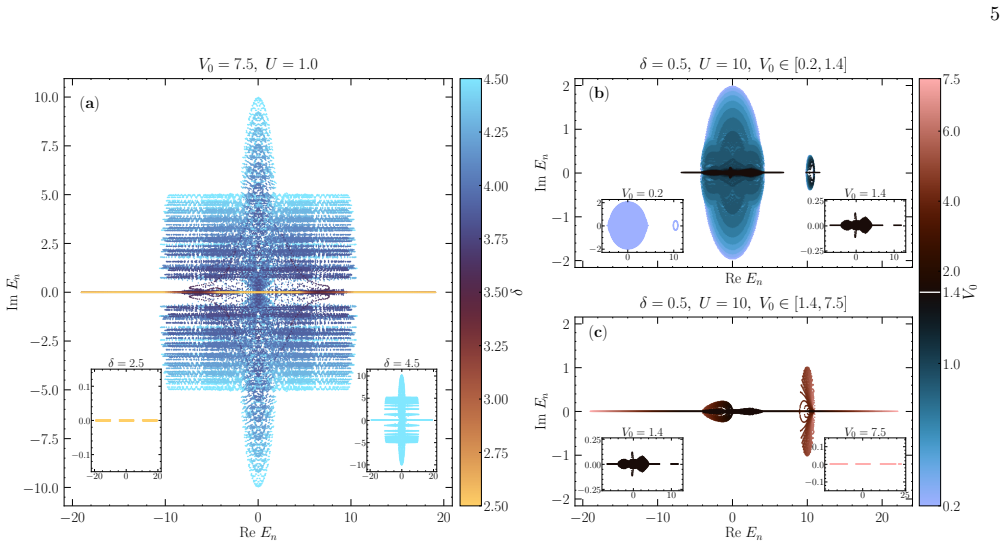
The interacting two-orbital Hatano-Nelson model admits regions of parameter space where the full spectrum is real, set by interaction strength, hopping asymmetry, and interchain coupling.
A machine-rendered reading of the paper's core claim, the machinery that carries it, and where it could break.
Core claim
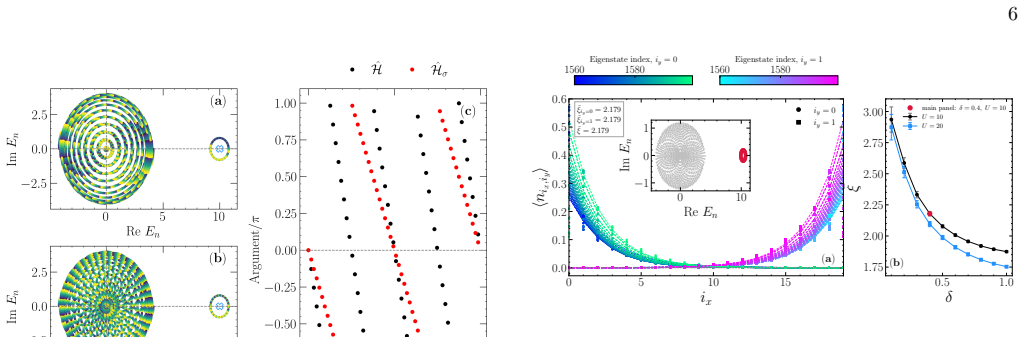
In the two-chain Hubbard-Hatano-Nelson model the spectrum is purely real inside certain regions of the three-dimensional parameter space spanned by interaction strength, non-Hermiticity, and interchain hopping. Winding-number analysis demonstrates that the spectral properties are sensitive to boundary conditions and that doublon states under periodic boundaries correspond to skin modes under open boundaries. At low filling the non-Hermitian Hamiltonian reproduces the essential features of the full Lindbladian time evolution.
What carries the argument
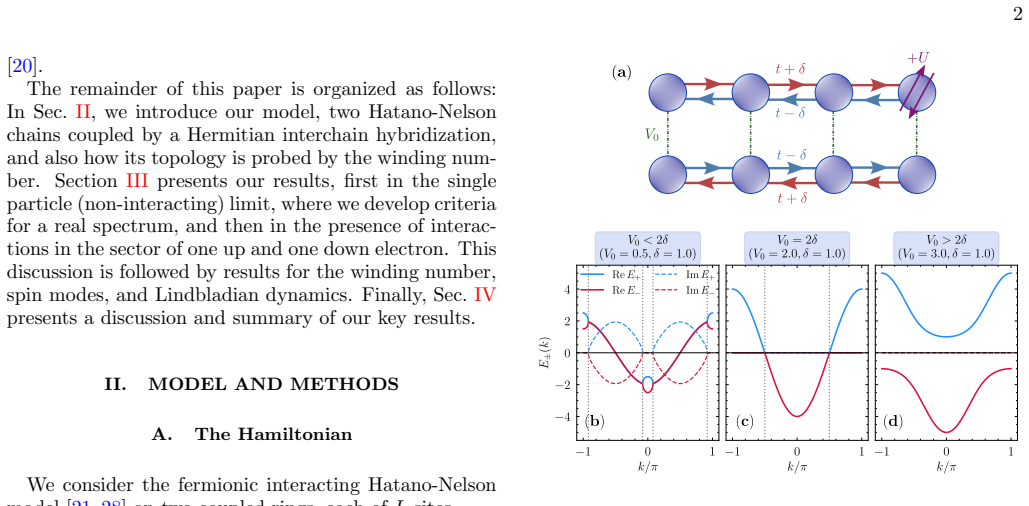
The two-orbital Hatano-Nelson Hamiltonian with asymmetric intra-chain hopping, symmetric inter-chain hopping, and Hubbard interaction, whose complex eigenvalues determine whether the spectrum collapses to the real axis.
If this is right
- Increasing Hubbard repulsion can drive the spectrum from complex to entirely real at fixed non-Hermiticity.
- Varying the interchain hopping strength moves the boundaries of the real-spectrum region in a systematic way.
- Winding numbers under periodic boundaries directly encode the skin-mode behavior seen under open boundaries.
- The non-Hermitian Hamiltonian supplies a qualitatively accurate shortcut for low-filling dissipative dynamics.
Where Pith is reading between the lines
- Interaction-tuned real spectra may appear generically in multi-orbital non-Hermitian lattices, offering a route to stabilize open many-body systems.
- The doublon-skin-mode correspondence suggests that bound pairs can be used as diagnostics for non-Hermitian topology in higher-dimensional or multi-band settings.
- If the low-filling agreement persists at moderate densities, effective non-Hermitian models could become practical simulators for a wider class of driven-dissipative Hubbard systems.
Load-bearing premise
Finite-lattice spectral features and the non-Hermitian effective description both survive the thermodynamic limit and remain faithful to the underlying Lindbladian dynamics at low filling.
What would settle it
A numerical diagonalization or Lindbladian simulation that finds persistent imaginary eigenvalues inside a parameter region the phase diagram labels as real-only, or that shows clear qualitative mismatch between non-Hermitian and Lindbladian dynamics even at very low particle density.
Figures
read the original abstract
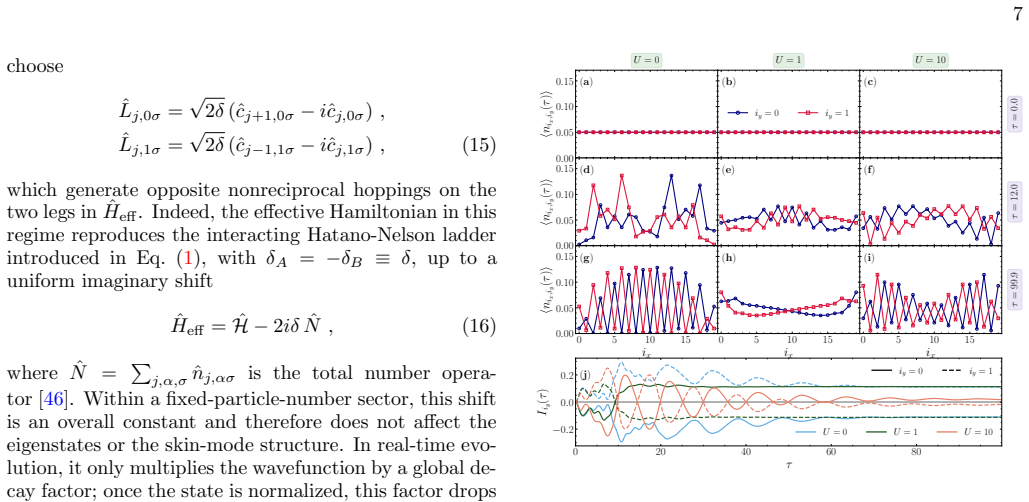
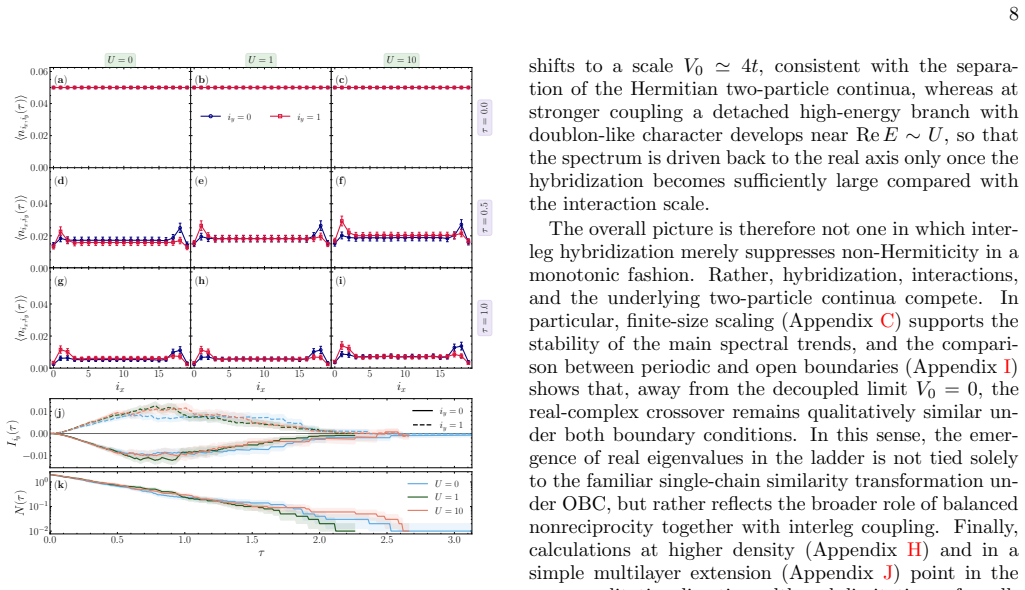
The single orbital, one-dimensional, Hatano-Nelson Hamiltonian provides deep insight into the physics of non-Hermiticity, resulting from asymmetric left/right hopping, and its connections to localization. In the absence of disorder, its single particle eigenvalues $E_{\alpha}$ lie on an ellipse in the complex plane whose extent in the imaginary direction is controlled by the degree of asymmetry. When randomness is introduced, two sets of real eigenvalues emerge at the extremes of the largest and smallest real part of $E_{\alpha}$. These real eigenvalues are associated with localized eigenvectors. For spinless fermions, increasing near-neighbor interactions first cause a transition to a charge density wave phase, and ultimately, on finite lattices, a collapse of all eigenvalues to the real axis. In this paper, we explore the presence of real eigenvalues in the interacting, two-particle sector for the spinful case (Hubbard model) in a two-chain (two-band) geometry with a Hermitian interchain hopping. Our key results are to obtain the ``phase" diagrams for the existence of a purely real spectrum, as a function of the interaction strength, degree of non-Hermiticity, and interchain hopping. We study the sensitivity to boundary conditions of the spectral properties of our two-chain model with winding number analysis and explore the relationship between PBC doublon states and OBC skin modes. To address the question of stability in such non-equilibrium systems, we solve the dynamics at low filling according to Lindbladian evolution and find that the non-Hermitian description is able to qualitatively describe such systems.
Editorial analysis
A structured set of objections, weighed in public.
Referee Report
Summary. The manuscript studies the two-orbital interacting Hatano-Nelson model (spinful Hubbard on two chains with asymmetric hopping and Hermitian interchain coupling). It reports phase diagrams in the two-particle sector for the region of fully real many-body spectra as functions of interaction strength U, non-Hermiticity asymmetry, and interchain hopping amplitude. Additional results include winding-number analysis of periodic- versus open-boundary spectral sensitivity, a proposed relation between PBC doublon states and OBC skin modes, and a qualitative comparison of non-Hermitian time evolution to Lindbladian dynamics at low filling.
Significance. If the reported real-spectrum regions survive extrapolation to the thermodynamic limit and the Lindbladian comparison can be made quantitative, the work would add to the understanding of interaction-tuned non-Hermitian skin effects and boundary-condition sensitivity in multi-orbital models. The direct diagonalization approach and winding-number diagnostics are standard tools, but the absence of scaling data limits the strength of the central claims.
major comments (3)
- [phase diagrams / results] The phase diagrams for purely real spectra (abstract and results section) are constructed on finite lattices with no reported system sizes L, no finite-size scaling, and no extrapolation of the critical surfaces in (U, asymmetry, interchain hopping). In non-Hermitian models the skin effect routinely produces strong L-dependence of eigenvalue trajectories; without scaling the claimed phase boundaries cannot be taken as thermodynamic-limit statements.
- [boundary-condition sensitivity] The winding-number analysis relating PBC doublons to OBC skin modes is presented without quantitative measures (e.g., winding number values, scaling of the imaginary-part gap with L, or explicit comparison of spectra for multiple L). This relation is load-bearing for the interpretation of the phase diagrams under open boundaries.
- [dynamics / Lindbladian evolution] The Lindbladian dynamics comparison is stated to be only qualitative (abstract and dynamics section) with no system sizes, no error estimates, no specific parameter values shown, and no quantitative metric (overlap, distance to real axis, etc.). The claim that the non-Hermitian effective Hamiltonian “qualitatively describes” the open-system evolution therefore rests on unverified numerical steps.
minor comments (2)
- [model definition] Notation for the two-orbital Hamiltonian (hopping terms, interaction U, asymmetry parameter) should be defined explicitly in the main text with a single equation reference rather than scattered definitions.
- [figures] Figure captions for the phase diagrams should include the lattice length(s) used and the number of disorder realizations or boundary-condition samples, if any.
Simulated Author's Rebuttal
We thank the referee for their careful reading of our manuscript and for the constructive comments, which help clarify the presentation of our results on the two-orbital interacting Hatano-Nelson model. We address each major comment point by point below, indicating the revisions planned for the next version.
read point-by-point responses
-
Referee: [phase diagrams / results] The phase diagrams for purely real spectra (abstract and results section) are constructed on finite lattices with no reported system sizes L, no finite-size scaling, and no extrapolation of the critical surfaces in (U, asymmetry, interchain hopping). In non-Hermitian models the skin effect routinely produces strong L-dependence of eigenvalue trajectories; without scaling the claimed phase boundaries cannot be taken as thermodynamic-limit statements.
Authors: We agree that the manuscript should explicitly report the lattice sizes and address finite-size effects, given the known sensitivity to the skin effect. The two-particle exact-diagonalization calculations were performed on finite chains with L ranging from 6 to 14 (depending on the parameter point to keep the Hilbert space manageable), but these values were not stated in the text or figure captions. In the revised manuscript we will add this information, include a new subsection discussing the L-dependence of the real-spectrum regions, and show representative data for at least three values of L. While a complete extrapolation of the critical surfaces to the thermodynamic limit (L→∞ at fixed particle number) would require substantial additional resources, the available data indicate that the boundaries separating real and complex spectra remain qualitatively stable for the largest accessible L; we will therefore qualify the phase diagrams as applying to finite but representative system sizes rather than claiming thermodynamic-limit validity. revision: partial
-
Referee: [boundary-condition sensitivity] The winding-number analysis relating PBC doublons to OBC skin modes is presented without quantitative measures (e.g., winding number values, scaling of the imaginary-part gap with L, or explicit comparison of spectra for multiple L). This relation is load-bearing for the interpretation of the phase diagrams under open boundaries.
Authors: We accept that the winding-number discussion would be strengthened by quantitative diagnostics. In the revised version we will report the explicit winding-number values obtained for the periodic-boundary doublon bands, plot the scaling of the imaginary-part gap versus L for several representative parameter sets, and include side-by-side spectral comparisons (PBC versus OBC) for at least two additional system sizes. These additions will make the link between PBC doublons and OBC skin modes more transparent and directly support the interpretation of the open-boundary phase diagrams. revision: yes
-
Referee: [dynamics / Lindbladian evolution] The Lindbladian dynamics comparison is stated to be only qualitative (abstract and dynamics section) with no system sizes, no error estimates, no specific parameter values shown, and no quantitative metric (overlap, distance to real axis, etc.). The claim that the non-Hermitian effective Hamiltonian “qualitatively describes” the open-system evolution therefore rests on unverified numerical steps.
Authors: The Lindbladian comparison was presented as a qualitative illustration of possible connections to open-system dynamics. We will revise the dynamics section to specify the system sizes and parameter values employed, report numerical error estimates from the time-integration routine, and introduce a simple quantitative metric (e.g., the time-averaged maximum imaginary part of the instantaneous eigenvalues or the L2 distance of the density matrix to the real-axis projection). These changes will allow readers to assess the degree of agreement more objectively while preserving the qualitative character of the original claim. revision: yes
Circularity Check
No circularity; results obtained via direct numerical diagonalization and time evolution on the defined Hamiltonian.
full rationale
The paper computes phase diagrams for real spectra in the two-particle sector by exact diagonalization of the interacting two-orbital Hatano-Nelson Hamiltonian on finite lattices, supplemented by winding-number analysis of boundary-condition sensitivity and Lindbladian dynamics at low filling. No parameters are fitted to data subsets and then repurposed as predictions of closely related quantities. No self-citations serve as load-bearing justifications for the central claims, and no ansatz or uniqueness theorem is smuggled in from prior author work. The reported spectra, phase boundaries, and qualitative dynamical agreement follow directly from the model definition and standard numerical methods without reduction to tautology or self-referential construction.
Axiom & Free-Parameter Ledger
free parameters (3)
- interaction strength
- non-Hermiticity asymmetry
- interchain hopping amplitude
axioms (2)
- domain assumption The non-Hermitian Hamiltonian provides a valid effective description of the open system
- domain assumption Finite-lattice exact diagonalization captures the relevant spectral features
discussion (0)
Sign in with ORCID, Apple, or X to comment. Anyone can read and Pith papers without signing in.