Recognition: unknown
Ultrahigh-energy cosmogenic neutrino emissions in the high-redshift universe
Pith reviewed 2026-05-10 11:00 UTC · model grok-4.3
The pith
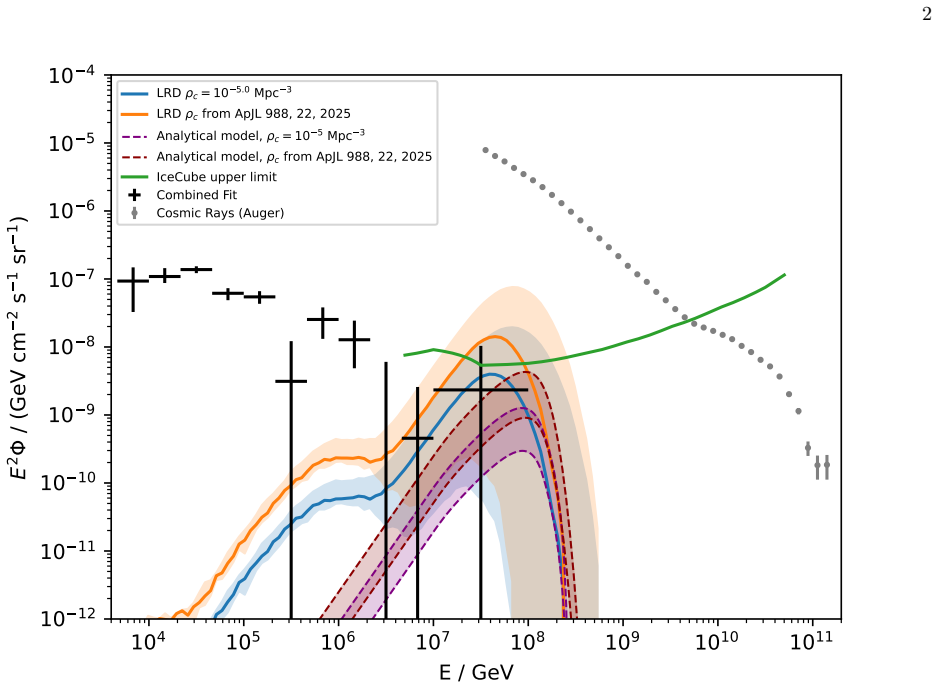
High-redshift AGN produce a cosmogenic neutrino flux bump at 50 PeV that matches IceCube estimates.
A machine-rendered reading of the paper's core claim, the machinery that carries it, and where it could break.
Core claim
If high-redshift AGN emit ultrahigh-energy protons with energies up to about 10 to the 19 electronvolts, the cosmogenic neutrino production in the high-redshift cosmic microwave background field produces a neutrino flux with a bump at around 50 PeV. This flux aligns with IceCube Neutrino Observatory estimates and arises naturally from the average AGN luminosity and number density observed by JWST.
What carries the argument
The production of cosmogenic neutrinos through interactions of ultrahigh-energy protons with the high-redshift cosmic microwave background, scaled by the luminosity and density of JWST-observed AGN.
If this is right
- Confirmation of the 50 PeV neutrino bump by future observations would indicate ultrahigh-energy cosmic ray emissions from the early universe.
- Measurements constraining small-scale anisotropy in the neutrino flux would further test the contribution from high-redshift AGN.
- The predicted intensity matches observations using standard AGN properties, suggesting no need for unusual acceleration mechanisms at high redshifts.
Where Pith is reading between the lines
- Neutrino telescopes could become a tool to study AGN activity at redshifts where optical observations are limited.
- This scenario implies that the sources of the highest energy cosmic rays may have been more common in the young universe.
- Future data on the neutrino spectrum could help distinguish between different models of cosmic ray origins.
Load-bearing premise
High-redshift active galactic nuclei emit ultrahigh-energy protons up to energies of approximately 10 to the 19 electronvolts.
What would settle it
Future neutrino detectors measuring a spectrum around 50 PeV that lacks the predicted bump or shows an intensity not matching the one calculated from JWST AGN data would disprove the claim.
Figures

read the original abstract
The James Webb Space Telescope (JWST) revealed a large population of active galactic nuclei (AGN) with redshifts greater than five. We show that if they emit ultrahigh-energy protons with energies up to $\lesssim 10^{19}$ eV, the cosmogenic neutrino production in the high-redshift CMB field yields a neutrino flux with a bump at around 50~PeV. This flux is consistent with the current estimate of neutrino intensity from the IceCube Neutrino Observatory. We argue that the predicted neutrino intensity naturally arises from the average AGN luminosity and number density observed by JWST, without the need for fine-tuning of relevant parameters. Future neutrino observations that confirm the 50-PeV bump and constrain the small-scale anisotropy will infer ultra-high energy cosmic-ray emissions in the early universe.
Editorial analysis
A structured set of objections, weighed in public.
Referee Report
Summary. The manuscript claims that AGN at z>5 observed by JWST, if accelerating protons to energies ≲10^19 eV, produce cosmogenic neutrinos through photopion interactions with the hotter high-redshift CMB, yielding a neutrino flux bump near 50 PeV whose normalization is consistent with IceCube's diffuse intensity estimate. The authors further assert that this intensity follows directly from the observed average AGN luminosity and comoving number density with no additional free parameters or fine-tuning required.
Significance. If the central calculation is shown to be robust, the result would connect JWST high-z AGN demographics to UHECR and neutrino astronomy by identifying an early-universe contribution to the IceCube flux. It would also motivate targeted searches for a 50 PeV spectral feature and small-scale anisotropy in future neutrino data, potentially constraining the hadronic output of the first AGN.
major comments (3)
- [Abstract and §4] The central claim that the neutrino intensity 'naturally arises' from JWST AGN luminosity and density without fine-tuning (abstract and concluding section) is load-bearing but unsupported by an explicit derivation of the required proton injection luminosity per AGN or the hadronic acceleration efficiency (UHECR power / bolometric luminosity). Without this step, it is impossible to verify that the normalization is parameter-free rather than implicitly adjusted to IceCube.
- [§2] The assumption that high-redshift AGN accelerate protons to E_max ≲ 10^19 eV (abstract, §2) is stated without reference to specific acceleration mechanisms, magnetic-field strengths, or efficiency estimates appropriate to z>5 environments; this directly controls both the neutrino bump position and amplitude and must be justified independently of the IceCube match.
- [§3] The cosmogenic neutrino yield calculation (presumably §3) is presented without error propagation, sensitivity to the assumed proton spectrum, or comparison against other possible high-z contributions (e.g., star-forming galaxies or GRBs), leaving the uniqueness and robustness of the 50 PeV bump unquantified.
minor comments (2)
- [Abstract] Notation for the maximum proton energy is given as ≲10^{19} eV in the abstract but should be stated consistently with an explicit value or range in the main text and figures.
- [Results] The manuscript would benefit from a table or figure showing the predicted neutrino spectrum overlaid on IceCube data points with uncertainty bands to allow direct visual assessment of the claimed consistency.
Simulated Author's Rebuttal
We thank the referee for their careful and constructive review. The comments highlight areas where the presentation of our central claims can be strengthened with additional derivations and quantitative assessments. We have revised the manuscript accordingly and address each major comment below.
read point-by-point responses
-
Referee: [Abstract and §4] The central claim that the neutrino intensity 'naturally arises' from JWST AGN luminosity and density without fine-tuning (abstract and concluding section) is load-bearing but unsupported by an explicit derivation of the required proton injection luminosity per AGN or the hadronic acceleration efficiency (UHECR power / bolometric luminosity). Without this step, it is impossible to verify that the normalization is parameter-free rather than implicitly adjusted to IceCube.
Authors: We agree that the manuscript would benefit from an explicit step-by-step derivation to make the parameter-free nature of the normalization fully transparent. In the revised version we have added a dedicated paragraph in §4 that starts from the JWST-measured comoving AGN density and average bolometric luminosity, computes the required average proton injection luminosity per source needed to produce the observed IceCube intensity via photopion production on the high-z CMB, and shows that the implied hadronic efficiency (proton power divided by bolometric luminosity) lies between 1 % and 5 %. This range is obtained directly from the observed quantities and standard photopion cross-sections without any additional tuning; the same efficiency also reproduces the 50 PeV bump position once E_max ≲ 10^19 eV is adopted. We have also inserted the explicit analytic expression for the neutrino intensity in terms of these observables so that readers can verify the normalization independently. revision: yes
-
Referee: [§2] The assumption that high-redshift AGN accelerate protons to E_max ≲ 10^19 eV (abstract, §2) is stated without reference to specific acceleration mechanisms, magnetic-field strengths, or efficiency estimates appropriate to z>5 environments; this directly controls both the neutrino bump position and amplitude and must be justified independently of the IceCube match.
Authors: The original text presented E_max ≲ 10^19 eV as a working hypothesis motivated by the need to reach the photopion threshold on the hotter high-z CMB. To address the referee’s request for independent justification, we have expanded §2 with a brief Hillas-criterion estimate using magnetic-field strengths and coherence lengths extrapolated from lower-redshift AGN jet observations (B ∼ 0.1–1 G, R ∼ 10^16–10^17 cm). These parameters yield E_max up to a few × 10^19 eV even at z > 5, and the higher CMB temperature at these redshifts actually relaxes the required maximum energy for producing the 50 PeV neutrino bump. References to relevant acceleration literature have been added. This discussion now stands on its own and is not tied to the IceCube normalization. revision: yes
-
Referee: [§3] The cosmogenic neutrino yield calculation (presumably §3) is presented without error propagation, sensitivity to the assumed proton spectrum, or comparison against other possible high-z contributions (e.g., star-forming galaxies or GRBs), leaving the uniqueness and robustness of the 50 PeV bump unquantified.
Authors: We accept that a quantitative uncertainty analysis and a short comparison with other candidate sources would improve the robustness section. The revised §3 now includes a sensitivity study in which the proton spectral index is varied between 2.0 and 2.5 and E_max between 10^18.5 eV and 10^19.5 eV; the resulting spread in the neutrino flux is shown as a shaded band around the fiducial 50 PeV bump. We have also added a concise paragraph noting that star-forming galaxies at high redshift are expected to produce neutrinos primarily through pp interactions at lower energies, while GRB contributions would peak at higher energies with a different spectral shape. A full multi-source population synthesis lies outside the scope of the present work, but the added material quantifies the distinctiveness of the AGN-driven feature within the stated assumptions. revision: partial
Circularity Check
No significant circularity; derivation uses external JWST data and conditional assumptions without self-referential fitting
full rationale
The paper's central claim is conditional on high-z AGN emitting UHE protons up to ~10^19 eV and computes the resulting cosmogenic neutrino flux via standard photopion production in the high-redshift CMB. It then states that this flux is consistent with IceCube when normalized to the observed average AGN luminosity and comoving number density from JWST, with no fine-tuning required. No equations or sections in the provided text demonstrate that a free parameter (such as hadronic efficiency) is fitted to the neutrino data and then relabeled as a prediction; the normalization is presented as directly following from the external luminosity/density inputs. The derivation chain remains self-contained against those benchmarks and does not reduce to self-definition, self-citation load-bearing, or renaming of known results.
Axiom & Free-Parameter Ledger
free parameters (1)
- maximum proton energy =
10^{19} eV
axioms (2)
- domain assumption High-redshift AGN emit ultrahigh-energy protons up to 10^{19} eV
- standard math Standard proton-CMB interaction physics applies at high redshift
Reference graph
Works this paper leans on
-
[1]
D. Seckel and T. Stanev, Neutrinos: The Key to UHE cosmic rays, Phys. Rev. Lett.95, 141101 (2005), arXiv:astro-ph/0502244
-
[2]
Aartsenet al.(IceCube), First observation of PeV- energy neutrinos with IceCube, Phys
M. Aartsenet al.(IceCube), First observation of PeV- energy neutrinos with IceCube, Phys. Rev. Lett.111, 021103 (2013), arXiv:1304.5356 [astro-ph.HE]
-
[3]
M. Aartsenet al.(IceCube), Constraints on Ultrahigh- Energy Cosmic-Ray Sources from a Search for Neutri- nos above 10 PeV with IceCube, Phys. Rev. Lett.117, 241101 (2016), [Erratum: Phys.Rev.Lett. 119, 259902 (2017)], arXiv:1607.05886 [astro-ph.HE]
-
[4]
M. Aartsenet al.(IceCube), Observation and Character- ization of a Cosmic Muon Neutrino Flux from the North- ern Hemisphere using six years of IceCube data, Astro- phys. J.833, 3 (2016), arXiv:1607.08006 [astro-ph.HE]
-
[5]
M. Aartsenet al.(IceCube), Differential limit on the extremely-high-energy cosmic neutrino flux in the presence of astrophysical background from nine years of IceCube data, Phys. Rev. D98, 062003 (2018), arXiv:1807.01820 [astro-ph.HE]
-
[6]
M. G. Aartsenet al.(IceCube), Detection of a particle shower at the Glashow resonance with IceCube, Nature 591, 220 (2021). 5
2021
-
[7]
Abbasiet al.(IceCube Collaboration), Improved mea- surements of the TeV-PeV extragalactic neutrino spec- trum from joint analyses of IceCube tracks and cascades, Phys
R. Abbasiet al.(IceCube Collaboration), Improved mea- surements of the TeV-PeV extragalactic neutrino spec- trum from joint analyses of IceCube tracks and cascades, Phys. Rev. D113, 062002 (2026)
2026
-
[8]
R. Abbasiet al.(IceCube Collaboration), Search for Extremely-High-Energy Neutrinos and First Constraints on the Ultrahigh-Energy Cosmic-Ray Proton Fraction with IceCube, Phys. Rev. Lett.135, 031001 (2025), arXiv:2502.01963 [astro-ph.HE]
- [9]
-
[10]
Abdul Halimet al.(Pierre Auger), Latest results from the searches for ultra-high-energy photons and neutrinos at the Pierre Auger Observatory, PoSICRC2023, 1488 (2023)
A. Abdul Halimet al.(Pierre Auger), Latest results from the searches for ultra-high-energy photons and neutrinos at the Pierre Auger Observatory, PoSICRC2023, 1488 (2023)
2023
- [11]
- [12]
-
[13]
Y. Harikane, Y. Zhang, K. Nakajima, M. Ouchi, Y. Isobe, Y. Ono, S. Hatano, Y. Xu, and H. Umeda, A JWST/NIRSpec First Census of Broad-line AGNs at z = 4-7: Detection of 10 Faint AGNs with M BH 106-108 M⊙ and Their Host Galaxy Properties, Astrophys. J.959, 39 (2023), arXiv:2303.11946 [astro-ph.GA]
-
[14]
de Graaffet al., A remarkable ruby: Absorption in dense gas, rather than evolved stars, drives the extreme Balmer break of a little red dot at z = 3.5, Astron
A. de Graaffet al., A remarkable ruby: Absorption in dense gas, rather than evolved stars, drives the extreme Balmer break of a little red dot at z = 3.5, Astron. As- trophys.701, A168 (2025)
2025
-
[15]
H. Umeda, K. Inayoshi, Y. Harikane, and K. Murase, A Black Hole Envelope Interpretation for Cosmological Demographics of Little Red Dots, Astrophys. J.999, 183 (2026), arXiv:2512.04208 [astro-ph.GA]
-
[16]
J. Mattheeet al., Little Red Dots: An Abundant Popu- lation of Faint Active Galactic Nuclei at z∼5 Revealed by the EIGER and FRESCO JWST Surveys, Astrophys. J.963, 129 (2024), arXiv:2306.05448 [astro-ph.GA]
-
[17]
J. E. Greeneet al., UNCOVER Spectroscopy Confirms the Surprising Ubiquity of Active Galactic Nuclei in Red Sources at z>5, Astrophys. J.964, 39 (2024)
2024
-
[18]
D. D. Kocevskiet al., The Rise of Faint, Red Active Galactic Nuclei at z>4: A Sample of Little Red Dots in the JWST Extragalactic Legacy Fields, Astrophys. J. 986, 126 (2025)
2025
-
[19]
I. Labbe, ,et al., UNCOVER: Candidate Red Active Galactic Nuclei at 3< z <7 with JWST and ALMA, Astrophys. J.978, 92 (2025), arXiv:2306.07320 [astro- ph.GA]
-
[20]
P. G. P´ erez-Gonz´ alezet al., What Is the Nature of Lit- tle Red Dots and what Is Not, MIRI SMILES Edition, Astrophys. J.968, 4 (2024)
2024
- [21]
- [22]
- [23]
- [24]
-
[25]
M. Kokubo and Y. Harikane, Challenging the Active Galactic Nucleus Scenario for JWST/NIRSpec Little Red Dot and Non–Little Red Dot Broad HαEmitters in Light of Nondetection of NIRCam Photometric Variability and X-Ray, Astrophys. J.995, 24 (2025), arXiv:2407.04777 [astro-ph.GA]
-
[26]
Little Red Dots
M. Yue, A.-C. Eilers, T. T. Ananna, C. Panagiotou, E. Kara, and T. Miyaji, Stacking X-Ray Observations of “Little Red Dots”: Implications for Their Active Galactic Nucleus Properties, Astrophys. J. Lett.974, L26 (2024)
2024
- [27]
-
[28]
R. Maiolinoet al., JWST meets Chandra: a large popu- lation of Compton thick, feedback-free, and intrinsically X-ray weak AGN, with a sprinkle of SNe, Mon. Not. Roy. Astron. Soc.538, 1921 (2025), arXiv:2405.00504 [astro- ph.GA]
-
[29]
M. Lemoine and E. Waxman, Anisotropy vs chemi- cal composition at ultra-high energies, JCAP11, 009, arXiv:0907.1354 [astro-ph.HE]
-
[30]
A black hole in a near-pristine galaxy 700 million years after the Big Bang
R. Maiolinoet al., A black hole in a near-pristine galaxy 700 million years after the Big Bang, arXiv e-prints 10.1093/mnras/staf2109 (2025), arXiv:2505.22567 [astro- ph.GA]
work page internal anchor Pith review Pith/arXiv arXiv doi:10.1093/mnras/staf2109 2025
-
[31]
Inayoshi, Little Red Dots as the Very First Activity of Black Hole Growth, Astrophys
K. Inayoshi, Little Red Dots as the Very First Activity of Black Hole Growth, Astrophys. J. Lett.988, L22 (2025)
2025
-
[32]
Fenu (Pierre Auger), The cosmic ray energy spec- trum measured using the Pierre Auger Observatory, PoS ICRC2017, 486 (2018)
F. Fenu (Pierre Auger), The cosmic ray energy spec- trum measured using the Pierre Auger Observatory, PoS ICRC2017, 486 (2018)
2018
-
[33]
Berezinsky and G
V. Berezinsky and G. Zatsepin, Cosmic rays at ultrahigh- energies (neutrino?), Phys. Lett. B28, 423 (1969)
1969
-
[34]
Yoshida and M
S. Yoshida and M. Teshima, Energy spectrum of ultrahigh-energy cosmic rays with extragalactic origin, Prog. Theor. Phys.89, 833 (1993)
1993
- [35]
- [36]
- [37]
-
[38]
G. Decerprit and D. Allard, Constraints on the origin of ultrahigh energy cosmic rays from cosmogenic neutri- nos and photons, Astron. Astrophys.535, A66 (2011), arXiv:1107.3722 [astro-ph.HE]
-
[39]
S. Yoshida and A. Ishihara, Constraints on the origin of the ultra-high energy cosmic-rays using cosmic diffuse neutrino flux limits: An analytical approach, Phys. Rev. 6 D85, 063002 (2012), arXiv:1202.3522 [astro-ph.HE]
-
[40]
R. Aloisio, D. Boncioli, A. di Matteo, A. F. Grillo, S. Petrera, and F. Salamida, Cosmogenic neutrinos and ultra-high energy cosmic ray models, JCAP10, 006, arXiv:1505.04020 [astro-ph.HE]
- [41]
-
[42]
Little Red Dots
H. B. Akinset al., COSMOS-Web: The Overabundance and Physical Nature of “Little Red Dots”—Implications for Early Galaxy and SMBH Assembly, Astrophys. J. 991, 37 (2025)
2025
-
[43]
Kokorevet al., A Census of Photometrically Selected Little Red Dots at 4<z<9 in JWST Blank Fields, Astrophys
V. Kokorevet al., A Census of Photometrically Selected Little Red Dots at 4<z<9 in JWST Blank Fields, Astrophys. J.968, 38 (2024)
2024
- [44]
-
[45]
V. Rusakovet al., Little red dots as young supermassive black holes in dense ionized cocoons, Nature649, 574 (2026), arXiv:2503.16595 [astro-ph.GA]
-
[46]
R. Kuze, K. Ioka, K. Murase, S. S. Kimura, and K. Inayoshi, Little Red Dots as Hidden Neu- trino Sources, arXiv e-prints 10.48550/arXiv.2601.11203 (2026), arXiv:2601.11203 [astro-ph.HE]
work page internal anchor Pith review Pith/arXiv arXiv doi:10.48550/arxiv.2601.11203 2026
-
[47]
C. M. Caseyet al., An Upper Limit of 106 M⊙in Dust from ALMA Observations in 60 Little Red Dots, Astro- phys. J. Lett.990, L61 (2025)
2025
-
[48]
M. Tanget al., SPURS: Evidence for Clumpy Neu- tral Envelopes and Ionized IGM Surrounding Little Red Dots in Abell 2744 from Ultra-Deep Rest-UV Spectroscopy, arXiv e-prints , arXiv:2604.03563 (2026), arXiv:2604.03563 [astro-ph.GA]
work page internal anchor Pith review Pith/arXiv arXiv 2026
-
[49]
X. Jiet al., Holes in the BH ⋆? AGN signatures in the FUV spectrum of a black-hole dominated Little Red Dot atz= 7.04, arXiv e-prints , arXiv:2604.03370 (2026), arXiv:2604.03370 [astro-ph.GA]
work page internal anchor Pith review Pith/arXiv arXiv 2026
- [50]
- [51]
- [52]
-
[53]
S. Yoshida and K. Murase, Constraining photohadronic scenarios for the unified origin of IceCube neutrinos and ultrahigh-energy cosmic rays, Phys. Rev. D102, 083023 (2020), arXiv:2007.09276 [astro-ph.HE]
-
[54]
K. Murase, Y. Inoue, and C. D. Dermer, Diffuse Neutrino Intensity from the Inner Jets of Active Galactic Nuclei: Impacts of External Photon Fields and the Blazar Se- quence, Phys. Rev. D90, 023007 (2014), arXiv:1403.4089 [astro-ph.HE]
work page Pith review arXiv 2014
-
[55]
P. Padovani, M. Petropoulou, P. Giommi, and E. Resconi, A simplified view of blazars: the neutrino background, Mon. Not. Roy. Astron. Soc.452, 1877 (2015), arXiv:1506.09135 [astro-ph.HE]
-
[56]
S. Yoshida, K. Murase, M. Tanaka, N. Shimizu, and A. Ishihara, Identifying High-energy Neutrino Transients by Neutrino Multiplet-triggered Follow-ups, Astrophys. J.937, 108 (2022), arXiv:2206.13719 [astro-ph.HE]
-
[57]
S. Yoshida and K. Murase, Testing unified models for the origin of ultrahigh-energy cosmic rays and neutri- nos: Multimessenger approaches with x-ray observations, Phys. Rev. D110, 043045 (2024), arXiv:2406.10944 [astro-ph.HE]
-
[58]
S. Yoshida and H. Takami, Bounds on the origin of extra- galactic ultrahigh energy cosmic rays from the IceCube neutrino observations, Phys. Rev. D90, 123012 (2014), arXiv:1409.2950 [astro-ph.HE]
-
[59]
A. Mucke, R. Engel, J. P. Rachen, R. J. Protheroe, and T. Stanev, SOPHIA: Monte Carlo simulations of photo- hadronic processes in astrophysics, Comput. Phys. Com- mun.124, 290 (2000), arXiv:astro-ph/9903478. End Matter The rapid energy cooling of protons due to the dense CMB field in a high-redshift universe enables the appli- cation of the modeling of ne...
discussion (0)
Sign in with ORCID, Apple, or X to comment. Anyone can read and Pith papers without signing in.