Recognition: unknown
Disk-like galaxies at 4 < z < 7.7 : JWST/NIRCam morphologies revealed by denoising VAE-GCNN classification
Pith reviewed 2026-05-10 10:47 UTC · model grok-4.3
The pith
A VAE-GCNN pipeline on JWST/NIRCam images measures a 0.34 disk-like fraction among 100 galaxies at redshifts 4 to 7.7.
A machine-rendered reading of the paper's core claim, the machinery that carries it, and where it could break.
Core claim
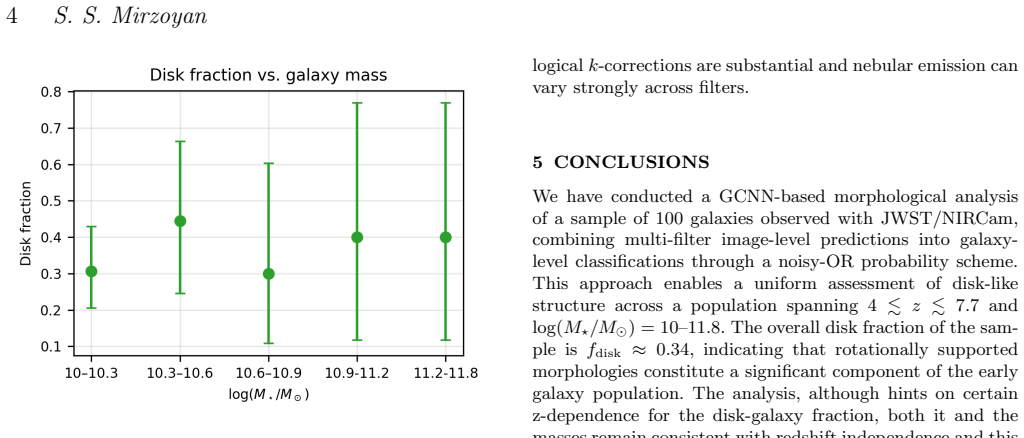
Applying the same denoising VAE-GCNN classification pipeline to multi-filter JWST/NIRCam cutouts, the authors determine the fraction of disk-like galaxies as 0.34 for a sample of 100 galaxies over the redshift range 4 < z < 7.7, also in dependence on the galaxy mass range.
What carries the argument
The denoising VAE-GCNN pipeline, in which a U-Net variational autoencoder removes astrophysical and instrumental contaminants while preserving intrinsic morphology and an equivariant graph convolutional neural network then classifies the cleaned cutouts as disk-like or non-disk.
If this is right
- Disk-like galaxies form a substantial fraction of the population already at redshifts greater than 4.
- Angular-momentum-supported structures must have assembled within the first billion years of cosmic time.
- The disk fraction shows dependence on galaxy mass within the sampled range.
- Homogeneous morphology-based studies at these epochs are required to test models of early disk formation.
Where Pith is reading between the lines
- If the fraction holds in larger samples, it would indicate that efficient mechanisms for acquiring angular momentum were already operating at these early epochs.
- Repeating the pipeline on deeper or wider JWST fields could reveal whether the disk fraction changes with redshift inside the 4 < z < 7.7 interval.
- Direct comparison of the classified sample against predictions from cosmological hydrodynamical simulations would test whether current models reproduce the observed 0.34 value.
Load-bearing premise
The variational autoencoder removes contaminants without altering or fabricating disk-like features in the galaxies, and the graph convolutional classifier trained on the cleaned images applies without bias to the high-redshift JWST observations.
What would settle it
Independent visual classification or an alternative morphological method applied to the identical 100 cutouts that returns a disk fraction differing by more than 0.1 from 0.34 would falsify the reported value.
Figures


read the original abstract
Understanding the prevalence of disk-like galaxies at very high redshifts is crucial for constraining the early formation of angular momentum-supported structures. The advent of JWST now permits rest-frame UV and optical morphological studies deep into cosmic epochs where disks have traditionally been considered uncommon. We apply an identical denoising VAE-GCNN classification pipeline to multi-filter JWST/NIRCam cutouts in order to obtain homogeneous, morphology-based disk fractions across the sample. Our approach comprises two steps: (i) a U-Net Variational Autoencoder (VAE) is trained to remove astrophysical and instrumental contaminants while preserving intrinsic morphology, and (ii) a rotation - and reflection - equivariant GCNN classifier is applied to the denoised cutouts to distinguish disk-like galaxies from non-disks. We determine the fraction of disk-like galaxies as 0.34 for a sample of JWST 100 galaxies over the redshift range 4 < z < 7.7, also in dependence on the galaxy mass range. Our GCNN-based morphological analysis indicates that disk-like systems constitute a significant fraction of the considered high-redshift population and underscore the importance of such studies for the models of disk formation in the first billion years.
Editorial analysis
A structured set of objections, weighed in public.
Referee Report
Summary. The manuscript describes a two-step machine-learning pipeline applied to JWST/NIRCam multi-filter cutouts of 100 galaxies at 4 < z < 7.7: (i) a U-Net variational autoencoder (VAE) trained to denoise images by removing astrophysical and instrumental contaminants while preserving intrinsic morphology, and (ii) a rotation- and reflection-equivariant graph convolutional neural network (GCNN) classifier that labels the denoised cutouts as disk-like or non-disk. The pipeline yields a disk-like fraction of 0.34 across the full sample, reported also as a function of galaxy stellar mass.
Significance. If the VAE-GCNN pipeline can be shown to introduce no net bias in disk-feature recovery at these redshifts, the reported 0.34 fraction would constitute a useful empirical constraint on the prevalence of angular-momentum-supported structures in the first billion years, directly informing models of early disk formation that have traditionally predicted lower disk fractions.
major comments (3)
- [Abstract] Abstract: the central numerical claim (disk-like fraction = 0.34) is presented without any accompanying classifier performance metrics (accuracy, precision, recall, F1, or confusion matrix), training-set composition details, or uncertainty estimates, rendering the result impossible to interpret as a physical measurement.
- [Abstract and Methods] Abstract and Methods: the claim that the U-Net VAE 'preserves intrinsic morphology' is stated but unsupported by any quantitative test (e.g., morphology-injection recovery curves on simulated high-z galaxies, comparison of denoised vs. raw classifications on overlapping HST data, or ablation of training-set redshift distribution).
- [Results] Results: the reported mass dependence of the disk fraction is given without binning details, sample sizes per bin, or error bars, so it is impossible to assess whether the trend is statistically significant or driven by small-number statistics.
minor comments (2)
- [Abstract] Abstract, sentence 3: 'JWST 100 galaxies' should read '100 JWST galaxies' for grammatical clarity.
- [Abstract] Abstract, final sentence: 'in dependence on the galaxy mass range' is awkward; 'and its dependence on galaxy stellar mass' would be clearer.
Simulated Author's Rebuttal
We are grateful to the referee for their thorough review and valuable suggestions, which have helped us improve the clarity and robustness of our work. Below, we provide point-by-point responses to the major comments and indicate the revisions made to the manuscript.
read point-by-point responses
-
Referee: [Abstract] Abstract: the central numerical claim (disk-like fraction = 0.34) is presented without any accompanying classifier performance metrics (accuracy, precision, recall, F1, or confusion matrix), training-set composition details, or uncertainty estimates, rendering the result impossible to interpret as a physical measurement.
Authors: We agree that the abstract should include key performance metrics to allow proper interpretation of the result. In the revised manuscript, we have added the classifier accuracy, precision, recall, and F1 scores obtained from cross-validation, a brief description of the training-set composition, and bootstrap-derived uncertainty estimates on the disk fraction. The full confusion matrix and additional training details remain in the Methods section. revision: yes
-
Referee: [Abstract and Methods] Abstract and Methods: the claim that the U-Net VAE 'preserves intrinsic morphology' is stated but unsupported by any quantitative test (e.g., morphology-injection recovery curves on simulated high-z galaxies, comparison of denoised vs. raw classifications on overlapping HST data, or ablation of training-set redshift distribution).
Authors: We acknowledge that quantitative validation strengthens the claim. We have added a dedicated subsection in the Methods describing morphology-injection recovery tests performed on simulated high-redshift galaxies, a direct comparison of denoised versus raw GCNN classifications for the subset of sources with overlapping HST coverage, and an ablation study varying the redshift distribution of the training set. These tests are now summarized in the abstract as well. revision: yes
-
Referee: [Results] Results: the reported mass dependence of the disk fraction is given without binning details, sample sizes per bin, or error bars, so it is impossible to assess whether the trend is statistically significant or driven by small-number statistics.
Authors: We have revised the Results section to specify the stellar-mass bin edges, the number of galaxies per bin, and binomial (or bootstrap) error bars on the disk fractions. The updated figure and text now allow readers to evaluate the statistical significance of the mass trend directly. revision: yes
Circularity Check
No circularity: disk fraction is direct empirical classifier output
full rationale
The paper's central result is the measured fraction 0.34 of disk-like galaxies obtained by applying a fixed VAE-GCNN pipeline to 100 JWST cutouts. No equations, fitted parameters, or derived quantities are presented that reduce to the input data or to the result itself by construction. The pipeline steps (denoising then classification) are described as applied identically but are not shown to be self-referential or justified solely via author self-citation chains. The reported fraction is therefore a straightforward count from the classifier labels and does not exhibit any of the enumerated circularity patterns.
Axiom & Free-Parameter Ledger
axioms (1)
- domain assumption The VAE reconstruction loss and GCNN training objective produce morphology-preserving outputs on high-redshift data
Reference graph
Works this paper leans on
-
[1]
L., Teyssier, R., & Dekel, A
Andalman, Z. L., Teyssier, R., & Dekel, A. 2025, MNRAS, 540, 3350
2025
-
[2]
2011, A&A, 532, A74
Baillard, A., Bertin, E., De Lapparent, V., et al. 2011, A&A, 532, A74
2011
-
[3]
et al, 2025, ApJ, 994, 126 Capozziello S., Di Valentino E., Gurzadyan V.G., 2025, Eur
Borbolato, L. et al, 2025, ApJ, 994, 126 Capozziello S., Di Valentino E., Gurzadyan V.G., 2025, Eur. Phys. J. Plus, 140, 1011 MNRAS000, 000–000 (2026) Disk galaxies at4≤z <7.7 5
2025
-
[4]
Carreira, C., Robertson, B. E., Danhaive, A. L., et al. 2026, arXiv:2601.15957
-
[5]
Group Equivariant Convolutional Networks
Cohen, T. S., & Welling, M., 2016,Group Equivariant Convolu- tional Networks, Proc. 33rd International Conference on Ma- chine Learning (ICML), arXiv:1602.07576
work page Pith review arXiv 2016
-
[6]
Conselice, C. J. 2014, ARA&A, 52, 291
2014
-
[7]
J., Basham, J
Conselice, C. J., Basham, J. T. F., Bettaney, D. O., et al. 2024, MNRAS, 531, 4857
2024
-
[8]
et al, 2025, JHEA, 48, 100405
Dainotti, M.G. et al, 2025, JHEA, 48, 100405
2025
-
[9]
et al, 2026, arXiv:2603.00497 Di Valentino E., Levi Said J., Saridakis E.N., arXiv:2509.25288
Dainotti, M.G. et al, 2026, arXiv:2603.00497 Di Valentino E., Levi Said J., Saridakis E.N., arXiv:2509.25288
-
[10]
2026, AJ, 171, 59
Fang, G., Zhu, S., Xu, J., et al. 2026, AJ, 171, 59
2026
-
[11]
Genin, A., Shuntov, M., Brammer, G., et al. 2025, arXiv:2505.21622 Gurzadyan V.G., Ozernoi L.M., 1981, A&A, 95, 39 Gurzadyan V.G., Stepanian A., 2021, A&A, 653, A145 Gurzadyan V.G., Fimin N.N., Chechetkin V.M., 2023, A&A, 677, A161 Gurzadyan V.G., Fimin N.N., Chechetkin V.M., 2025, A&A, 694, A252 Gurzadyan V.G., Fimin N.N., Chechetkin V.M., 2026, A&A, 705, A70
-
[12]
2024, MNRAS, 534, 918
Kocjan, Z., Cadiou, C., Agertz, O., & Pontzen, A. 2024, MNRAS, 534, 918
2024
-
[13]
Kuhn, V., Guo, Y., Martin, A., et al. 2023, arXiv:2312.12389
-
[14]
et al, 2025, ApJ, 978, 14L
Lee, L.L. et al, 2025, ApJ, 978, 14L
2025
-
[15]
A., Conselice, C
Mager, V. A., Conselice, C. J., Seibert, M., et al. 2018, ApJ, 864, 123
2018
-
[16]
Mirzoyan, S.S., Khachatryan H., Yegorian G., Gurzadyan V.G., 2019, MNRAS, 489, L32
2019
-
[17]
Mirzoyan, S. S. 2025, Res. Astron. Astrophys., 25, 095006
2025
-
[18]
Mirzoyan, S. S. 2026, Res. Astron. Astrophys., 26, 025010
2026
- [19]
-
[20]
2022, MNRAS, 509, 3966
Walmsley, M., Lintott, C., G´ eron, T., et al. 2022, MNRAS, 509, 3966
2022
-
[21]
W., Lintott, C
Willett, K. W., Lintott, C. J., Bamford, S. P., et al. 2013, MNRAS, 435, 2835
2013
-
[22]
2024, Res
Yao, Y., Zhang, J., Du, P., & Dong, S. 2024, Res. Astron. Astro- phys., 24, 035015
2024
-
[23]
Xu, Y., et al, 2024, ApJ, 976, 142 MNRAS000, 000–000 (2026)
2024
discussion (0)
Sign in with ORCID, Apple, or X to comment. Anyone can read and Pith papers without signing in.