Recognition: unknown
High-Speed Full-Color HDR Imaging via Unwrapping Modulo-Encoded Spike Streams
Pith reviewed 2026-05-10 12:22 UTC · model grok-4.3
The pith
An exposure-decoupled modulo formulation and iteration-free unwrapping enable 1000 FPS full-color HDR imaging from spike streams.
A machine-rendered reading of the paper's core claim, the machinery that carries it, and where it could break.
Core claim
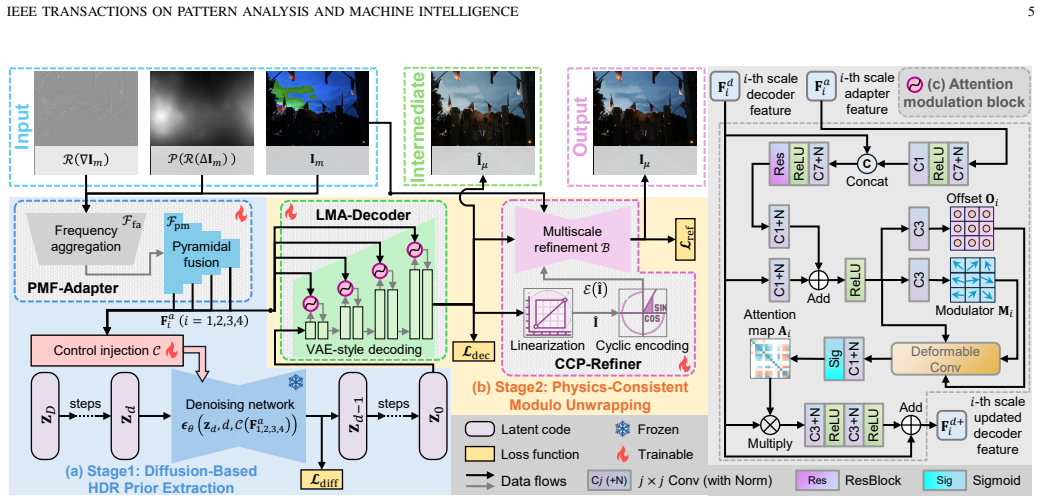
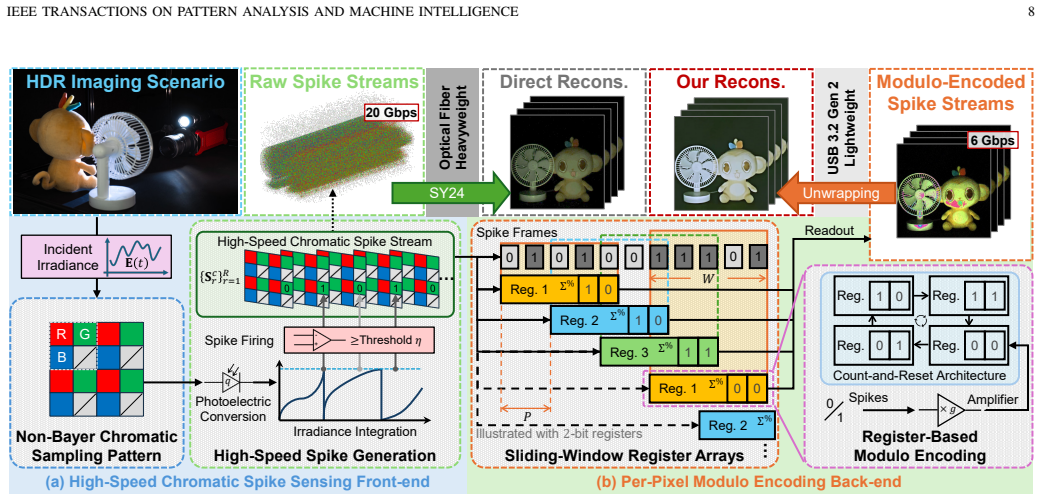
The central claim is that an exposure-decoupled formulation of modulo imaging permits temporal interleaving of multiple measurements under a clean observation model, and that an iteration-free unwrapping algorithm integrating diffusion-based generative priors with the least absolute remainder property produces physics-consistent HDR images from these measurements. The authors validate the approach through a proof-of-concept hardware system that records modulo-encoded spike streams, achieving 1000 FPS full-color HDR while lowering output bandwidth from roughly 20 Gbps to 6 Gbps.
What carries the argument
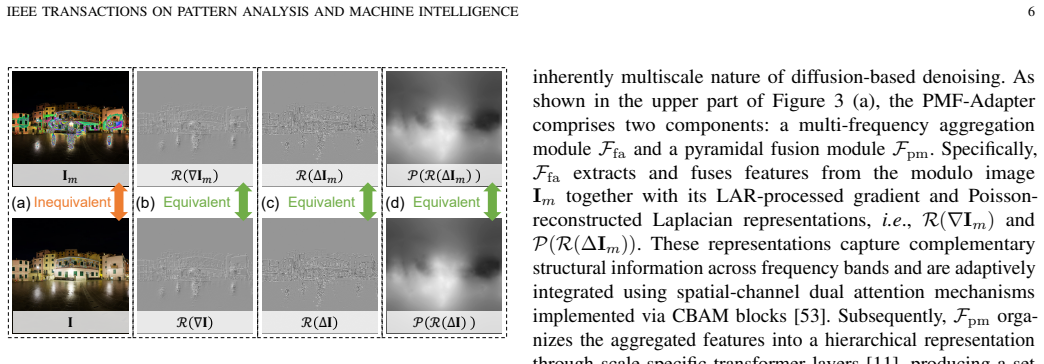
The exposure-decoupled modulo imaging formulation together with the iteration-free unwrapping algorithm that combines diffusion generative priors and the least absolute remainder property.
If this is right
- Full-color HDR capture at 1000 frames per second becomes practical for dynamic scenes.
- Data bandwidth falls from approximately 20 Gbps to 6 Gbps while preserving native spike-camera temporal resolution.
- Modulo imaging can move from low-speed grayscale demonstrations to real-time color use cases.
- The hardware proof-of-concept shows that spike-stream modulo encoding is deployable without previous speed or color limits.
Where Pith is reading between the lines
- The interleaving idea may transfer to other high-speed sensors that currently suffer from exposure trade-offs.
- Pairing generative priors with explicit physical constraints could simplify reconstruction in related computational imaging tasks such as phase unwrapping or event-based vision.
- Bandwidth savings at high frame rates suggest the pipeline could scale to higher spatial resolutions or multi-camera arrays without proportional storage growth.
Load-bearing premise
The iteration-free unwrapping algorithm that merges diffusion-based generative priors with the physical least absolute remainder property will produce artifact-free and physics-consistent HDR images from the interleaved modulo measurements.
What would settle it
Direct comparison of the reconstructed HDR frames against known ground-truth high-dynamic-range video in fast-moving high-contrast scenes; visible artifacts, temporal inconsistencies, or deviation from physical light levels would disprove the claim.
Figures




read the original abstract
Conventional RGB-based high dynamic range (HDR) imaging faces a fundamental trade-off between motion artifacts in multi-exposure captures and irreversible information loss in single-shot techniques. Modulo sensors offer a promising alternative by encoding theoretically unbounded dynamic range into wrapped measurements. However, existing modulo solutions remain bottlenecked by iterative unwrapping overhead and hardware constraints limiting them to low-speed, grayscale capture. In this work, we present a complete modulo-based HDR imaging system that enables high-speed, full-color HDR acquisition by synergistically advancing both the sensing formulation and the unwrapping algorithm. At the core of our approach is an exposure-decoupled formulation of modulo imaging that allows multiple measurements to be interleaved in time, preserving a clean, observation-wise measurement model. Building upon this, we introduce an iteration-free unwrapping algorithm that integrates diffusion-based generative priors with the physical least absolute remainder property of modulo images, supporting highly efficient, physics-consistent HDR reconstruction. Finally, to validate the practical viability of our system, we demonstrate a proof-of-concept hardware implementation based on modulo-encoded spike streams. This setup preserves the native high temporal resolution of spike cameras, achieving 1000 FPS full-color imaging while reducing output data bandwidth from approximately 20 Gbps to 6 Gbps. Extensive evaluations indicate that our coordinated approach successfully overcomes key systemic bottlenecks, demonstrating the feasibility of deploying modulo imaging in dynamic scenarios.
Editorial analysis
A structured set of objections, weighed in public.
Referee Report
Summary. The manuscript claims to present a complete modulo-based HDR imaging system enabling high-speed full-color acquisition. It introduces an exposure-decoupled formulation of modulo imaging to support interleaved multi-measurement capture while preserving per-observation models, an iteration-free unwrapping algorithm that fuses diffusion-based generative priors with the physical least-absolute-remainder property for artifact-free HDR reconstruction, and a proof-of-concept spike-camera hardware prototype that achieves 1000 FPS full-color imaging while reducing output bandwidth from ~20 Gbps to 6 Gbps.
Significance. If the reported performance and reconstruction quality hold under rigorous validation, the work would represent a meaningful advance in computational imaging by removing the motion-artifact versus dynamic-range trade-off that limits conventional RGB HDR methods and by demonstrating practical deployment of modulo sensors in dynamic, high-speed scenarios. The hardware prototype and explicit bandwidth-reduction numbers constitute concrete, falsifiable contributions that could influence sensor design and real-time vision pipelines.
major comments (2)
- [Abstract] The central feasibility claim (1000 FPS full-color HDR with 6 Gbps output) rests on the iteration-free unwrapping algorithm, yet the abstract supplies no derivation, pseudocode, or quantitative metrics (PSNR, SSIM, error bars, ablation on diffusion prior strength) for how the diffusion model is conditioned on the least-absolute-remainder property or how consistency with the physical measurement model is enforced. Without these details the physics-consistency guarantee cannot be assessed.
- [Abstract] The exposure-decoupled formulation is presented as enabling clean interleaving of measurements, but no explicit observation model, noise model, or proof that the modulo wrapping remains independent across interleaved exposures is supplied; this is load-bearing for the claim that the approach overcomes iterative unwrapping overhead.
minor comments (1)
- [Abstract] The abstract states 'extensive evaluations indicate success' without referencing any table, figure, or section containing the supporting data; this should be cross-referenced to the results section for reader convenience.
Simulated Author's Rebuttal
We thank the referee for the constructive feedback on our manuscript. We address each major comment below and have revised the abstract to improve clarity while preserving its concise nature.
read point-by-point responses
-
Referee: [Abstract] The central feasibility claim (1000 FPS full-color HDR with 6 Gbps output) rests on the iteration-free unwrapping algorithm, yet the abstract supplies no derivation, pseudocode, or quantitative metrics (PSNR, SSIM, error bars, ablation on diffusion prior strength) for how the diffusion model is conditioned on the least-absolute-remainder property or how consistency with the physical measurement model is enforced. Without these details the physics-consistency guarantee cannot be assessed.
Authors: The abstract is a high-level summary. The full derivation of the iteration-free unwrapping algorithm, its conditioning on the least-absolute-remainder property, enforcement of physical consistency via the diffusion prior, pseudocode, and quantitative metrics including PSNR, SSIM, error bars, and ablations are provided in the main manuscript. We have revised the abstract to briefly note these components and the resulting physics-consistent reconstruction. revision: yes
-
Referee: [Abstract] The exposure-decoupled formulation is presented as enabling clean interleaving of measurements, but no explicit observation model, noise model, or proof that the modulo wrapping remains independent across interleaved exposures is supplied; this is load-bearing for the claim that the approach overcomes iterative unwrapping overhead.
Authors: The abstract summarizes the contribution at a high level. The explicit observation model, noise model, and proof of independence of modulo wrapping across interleaved exposures are formally derived in the manuscript. This decoupled formulation directly enables the non-iterative unwrapping. We have revised the abstract to include a concise reference to the observation model. revision: yes
Circularity Check
No significant circularity detected in derivation chain
full rationale
The paper grounds its core contributions—an exposure-decoupled modulo formulation, an iteration-free unwrapping method that combines external diffusion-based generative priors with the independently stated least-absolute-remainder property, and a spike-camera hardware prototype—directly in physical measurement models and external priors rather than self-referential definitions, fitted parameters renamed as predictions, or load-bearing self-citations. No equations or claims in the provided abstract or described components reduce the reported 1000 FPS / 6 Gbps feasibility result to the inputs by construction; the approach remains self-contained against external benchmarks.
Axiom & Free-Parameter Ledger
Reference graph
Works this paper leans on
-
[1]
Single shot high dynamic range imaging using piecewise linear estimators
Cecilia Aguerrebere, Andr ´es Almansa, Yann Gousseau, Julie Delon, and Pablo Muse. Single shot high dynamic range imaging using piecewise linear estimators. InProc. of International Conference on Computational Photography, pages 1–10, 2014
2014
-
[2]
Reconfigurable snapshot HDR imaging using coded masks and inception network
Masheal M Alghamdi, Qiang Fu, Ali Kassem Thabet, and Wolfgang Heidrich. Reconfigurable snapshot HDR imaging using coded masks and inception network. InVision, Modeling and Visualization, 2019
2019
-
[3]
Deep plug-and-play algorithm for unsaturated imaging
Jorge Bacca, Brayan Monroy, and Henry Arguello. Deep plug-and-play algorithm for unsaturated imaging. InProc. of International Conference on Acoustics, Speech and Signal Processing, pages 2460–2464, 2024. IEEE TRANSACTIONS ON PATTERN ANALYSIS AND MACHINE INTELLIGENCE 14
2024
-
[4]
Inverse tone mapping
Francesco Banterle, Patrick Ledda, Kurt Debattista, and Alan Chalmers. Inverse tone mapping. InProc. of International Conference on Computer Graphics and Interactive Techniques in Australasia and Southeast Asia, 2006
2006
-
[5]
A 240 × 180 130 dB 3 µs latency global shutter spatiotemporal vision sensor.IEEE Journal of Solid-State Circuits, 49(10):2333–2341, 2014
Christian Brandli, Raphael Berner, Minhao Yang, Shih-Chii Liu, and Tobi Delbruck. A 240 × 180 130 dB 3 µs latency global shutter spatiotemporal vision sensor.IEEE Journal of Solid-State Circuits, 49(10):2333–2341, 2014
2014
-
[6]
1000 PFS HDR video with a spike-RGB hybrid camera
Yakun Chang, Chu Zhou, Yuchen Hong, Liwen Hu, Chao Xu, Tiejun Huang, and Boxin Shi. 1000 PFS HDR video with a spike-RGB hybrid camera. InProc. of Computer Vision and Pattern Recognition, pages 22180–22190, 2023
2023
-
[7]
Robust unfolding network for HDR imaging with modulo cameras
Zhile Chen and Hui Ji. Robust unfolding network for HDR imaging with modulo cameras. InProc. of International Conference on Computer Vision, pages 25218–25228, 2025
2025
-
[8]
UltraFusion: Ultra high dynamic imaging using exposure fusion
Zixuan Chen, Yujin Wang, Xin Cai, Zhiyuan You, Zheming Lu, Fan Zhang, Shi Guo, and Tianfan Xue. UltraFusion: Ultra high dynamic imaging using exposure fusion. InProc. of Computer Vision and Pattern Recognition, pages 16111–16121, 2025
2025
-
[9]
Recovering high dynamic range radiance maps from photographs
Paul E Debevec and Jitendra Malik. Recovering high dynamic range radiance maps from photographs. InProc. of ACM SIGGRAPH, pages 369–378, 1997
1997
-
[10]
Intrinsic single-image HDR reconstruction
Sebastian Dille, Chris Careaga, and Ya ˘gız Aksoy. Intrinsic single-image HDR reconstruction. InProc. of European Conference on Computer Vision, pages 161–177, 2024
2024
-
[11]
An Image is Worth 16x16 Words: Transformers for Image Recognition at Scale
Alexey Dosovitskiy, Lucas Beyer, Alexander Kolesnikov, Dirk Weis- senborn, Xiaohua Zhai, Thomas Unterthiner, Mostafa Dehghani, Matthias Minderer, Georg Heigold, Sylvain Gelly, et al. An image is worth 16 × 16 words: Transformers for image recognition at scale.arXiv preprint arXiv:2010.11929, 2020
work page internal anchor Pith review Pith/arXiv arXiv 2010
-
[12]
Mantiuk, and Jonas Unger
Gabriel Eilertsen, Joel Kronander, Gyorgy Denes, Rafał K. Mantiuk, and Jonas Unger. HDR image reconstruction from a single exposure using deep CNNs.ACM Transactions on Graphics (Proc. of ACM SIGGRAPH Asia), 36(6):178:1–178:15, 2017
2017
-
[13]
Deep reverse tone mapping.ACM Transactions on Graphics (Proc
Yuki Endo, Yoshihiro Kanamori, and Jun Mitani. Deep reverse tone mapping.ACM Transactions on Graphics (Proc. of ACM SIGGRAPH Asia), 36(6):177:1–177:10, 2017
2017
-
[14]
Hybrid high dynamic range imaging fusing neuromorphic and conventional images
Jin Han, Yixin Yang, Peiqi Duan, Chu Zhou, Lei Ma, Chao Xu, Tiejun Huang, Imari Sato, and Boxin Shi. Hybrid high dynamic range imaging fusing neuromorphic and conventional images. 2023
2023
-
[15]
Neuromorphic camera guided high dynamic range imaging
Jin Han, Chu Zhou, Peiqi Duan, Yehui Tang, Chang Xu, Chao Xu, Tiejun Huang, and Boxin Shi. Neuromorphic camera guided high dynamic range imaging. InProc. of Computer Vision and Pattern Recognition, pages 1730–1739, 2020
2020
-
[16]
Comparison of single image HDR reconstruction methods- the caveats of quality assessment
Param Hanji, Rafal Mantiuk, Gabriel Eilertsen, Saghi Hajisharif, and Jonas Unger. Comparison of single image HDR reconstruction methods- the caveats of quality assessment. InProc. of ACM SIGGRAPH, pages 1–8, 2022
2022
-
[17]
Burst photography for high dynamic range and low-light imaging on mobile cameras.ACM Transactions on Graphics (Proc
Samuel W Hasinoff, Dillon Sharlet, Ryan Geiss, Andrew Adams, Jonathan T Barron, Florian Kainz, Jiawen Chen, and Marc Levoy. Burst photography for high dynamic range and low-light imaging on mobile cameras.ACM Transactions on Graphics (Proc. of ACM SIGGRAPH), 35(6):1–12, 2016
2016
-
[18]
Deep residual learning for image recognition
Kaiming He, Xiangyu Zhang, Shaoqing Ren, and Jian Sun. Deep residual learning for image recognition. InProc. of Computer Vision and Pattern Recognition, pages 770–778, 2016
2016
-
[19]
Reducing the dimen- sionality of data with neural networks.Science, 313(5786):504–507, 2006
Geoffrey E Hinton and Ruslan R Salakhutdinov. Reducing the dimen- sionality of data with neural networks.Science, 313(5786):504–507, 2006
2006
-
[20]
Denoising diffusion probabilistic models
Jonathan Ho, Ajay Jain, and Pieter Abbeel. Denoising diffusion probabilistic models. InProc. of Advances in Neural Information Processing Systems, pages 6840–6851, 2020
2020
-
[21]
Generating content for HDR deghosting from frequency view
Tao Hu, Qingsen Yan, Yuankai Qi, and Yanning Zhang. Generating content for HDR deghosting from frequency view. InProc. of Computer Vision and Pattern Recognition, pages 25732–25741, 2024
2024
-
[22]
Analysis of the phase unwrapping algorithm.Applied Optics, 21(14):2470–2470, 1982
Kazuyoshi Itoh. Analysis of the phase unwrapping algorithm.Applied Optics, 21(14):2470–2470, 1982
1982
-
[23]
High dynamic range imaging using deep image priors
Gauri Jagatap and Chinmay Hegde. High dynamic range imaging using deep image priors. InProc. of International Conference on Acoustics, Speech and Signal Processing, pages 9289–9293, 2020
2020
-
[24]
Deep high dynamic range imaging of dynamic scenes.ACM Transactions on Graphics (Proc
Nima Khademi Kalantari and Ravi Ramamoorthi. Deep high dynamic range imaging of dynamic scenes.ACM Transactions on Graphics (Proc. of ACM SIGGRAPH), 36(4):144–1, 2017
2017
-
[25]
Deep HDR video from sequences with alternating exposures
Nima Khademi Kalantari and Ravi Ramamoorthi. Deep HDR video from sequences with alternating exposures. InComputer Graphics F orum, volume 38, pages 193–205, 2019
2019
-
[26]
Ghost removal in high dynamic range images
Erum Arif Khan, Ahmet Oguz Akyuz, and Erik Reinhard. Ghost removal in high dynamic range images. InProc. of International Conference on Image Processing, pages 2005–2008, 2006
2005
-
[27]
AFUNet: Cross-iterative alignment-fusion synergy for HDR reconstruction via deep unfolding paradigm
Xinyue Li, Zhangkai Ni, and Wenhan Yang. AFUNet: Cross-iterative alignment-fusion synergy for HDR reconstruction via deep unfolding paradigm. InProc. of International Conference on Computer Vision, pages 10666–10675, 2025
2025
-
[28]
Yanghao Li, Saining Xie, Xinlei Chen, Piotr Dollar, Kaiming He, and Ross Girshick. Benchmarking detection transfer learning with vision Transformers.arXiv preprint arXiv:2111.11429, 2021
-
[29]
Lightweight video denoising using aggregated shifted window attention
Lydia Lindner, Alexander Effland, Filip Ilic, Thomas Pock, and Erich Kobler. Lightweight video denoising using aggregated shifted window attention. InProc. of Winter Conference on Applications of Computer Vision, pages 351–360, 2023
2023
-
[30]
Joint HDR denoising and fusion: A real-world mobile HDR image dataset
Shuaizheng Liu, Xindong Zhang, Lingchen Sun, Zhetong Liang, Hui Zeng, and Lei Zhang. Joint HDR denoising and fusion: A real-world mobile HDR image dataset. InProc. of Computer Vision and Pattern Recognition, pages 13966–13975, 2023
2023
-
[31]
Single-image HDR reconstruction by learning to reverse the camera pipeline
Yu-Lun Liu, Wei-Sheng Lai, Yu-Sheng Chen, Yi-Lung Kao, Ming- Hsuan Yang, Yung-Yu Chuang, and Jia-Bin Huang. Single-image HDR reconstruction by learning to reverse the camera pipeline. InProc. of Computer Vision and Pattern Recognition, pages 1651–1660, 2020
2020
-
[32]
SGDR: Stochastic Gradient Descent with Warm Restarts
Ilya Loshchilov and Frank Hutter. SGDR: Stochastic gradient descent with warm restarts.arXiv preprint arXiv:1608.03983, 2016
work page Pith review arXiv 2016
-
[33]
Decoupled Weight Decay Regularization
Ilya Loshchilov and Frank Hutter. Decoupled weight decay regularization. arXiv preprint arXiv:1711.05101, 2017
work page internal anchor Pith review Pith/arXiv arXiv 2017
-
[34]
Rafal K Mantiuk, Dounia Hammou, and Param Hanji. HDR-VDP-3: A multi-metric for predicting image differences, quality and contrast distortions in high dynamic range and regular content.arXiv preprint arXiv:2304.13625, 2023
-
[35]
ExpandNet: A deep convolutional neural network for high dynamic range expansion from low dynamic range content
Demetris Marnerides, Thomas Bashford-Rogers, Jonathan Hatchett, and Kurt Debattista. ExpandNet: A deep convolutional neural network for high dynamic range expansion from low dynamic range content. Computer Graphics F orum, 37:37–49, 2018
2018
-
[36]
Fleming, Olga Sorkine, and Diego Gutierrez
Belen Masia, Sandra Agustin, Roland W. Fleming, Olga Sorkine, and Diego Gutierrez. Evaluation of reverse tone mapping through varying exposure conditions.ACM Transactions on Graphics (Proc. of ACM SIGGRAPH Asia), 28(5):160:1–160:8, 2009
2009
-
[37]
Deep optics for single-shot high-dynamic-range imaging
Christopher A Metzler, Hayato Ikoma, Yifan Peng, and Gordon Wetzstein. Deep optics for single-shot high-dynamic-range imaging. InProc. of Computer Vision and Pattern Recognition, pages 1375–1385, 2020
2020
-
[38]
High dynamic range imaging: Spatially varying pixel exposures
Shree K Nayar and Tomoo Mitsunaga. High dynamic range imaging: Spatially varying pixel exposures. InProc. of Computer Vision and Pattern Recognition, pages 472–479, 2000
2000
-
[39]
HDR-GAN: HDR image reconstruction from multi-exposed LDR images with large motions.IEEE Transactions on Image Processing, 30:3885–3896, 2021
Yuzhen Niu, Jianbin Wu, Wenxi Liu, Wenzhong Guo, and Rynson WH Lau. HDR-GAN: HDR image reconstruction from multi-exposed LDR images with large motions.IEEE Transactions on Image Processing, 30:3885–3896, 2021
2021
-
[40]
Robust high dynamic range imaging by rank minimization.IEEE Transactions on Pattern Analysis and Machine Intelligence, 37(6):1219–1232, 2014
Tae-Hyun Oh, Joon-Young Lee, Yu-Wing Tai, and In So Kweon. Robust high dynamic range imaging by rank minimization.IEEE Transactions on Pattern Analysis and Machine Intelligence, 37(6):1219–1232, 2014
2014
-
[41]
Towards practical and efficient high- resolution HDR deghosting with CNN
K Ram Prabhakar, Susmit Agrawal, Durgesh Kumar Singh, Balraj Ashwath, and R Venkatesh Babu. Towards practical and efficient high- resolution HDR deghosting with CNN. InProc. of European Conference on Computer Vision, pages 497–513, 2020
2020
-
[42]
High speed and high dynamic range video with an event camera.IEEE Transactions on Pattern Analysis and Machine Intelligence, 43(6):1964– 1980, 2019
Henri Rebecq, Ren ´e Ranftl, Vladlen Koltun, and Davide Scaramuzza. High speed and high dynamic range video with an event camera.IEEE Transactions on Pattern Analysis and Machine Intelligence, 43(6):1964– 1980, 2019
1964
-
[43]
Rempel, Matthew Trentacoste, Helge Seetzen, H
Allan G. Rempel, Matthew Trentacoste, Helge Seetzen, H. David Young, Wolfgang Heidrich, Lorne Whitehead, and Greg Ward. LDR2HDR: On-the-fly reverse tone mapping of legacy video and photographs.ACM Transactions on Graphics (Proc. of ACM SIGGRAPH), 26(3), 2007
2007
-
[44]
High-resolution image synthesis with latent diffusion models
Robin Rombach, Andreas Blattmann, Dominik Lorenz, Patrick Esser, and Bj ¨orn Ommer. High-resolution image synthesis with latent diffusion models. InProc. of Computer Vision and Pattern Recognition, pages 10684–10695, 2022
2022
-
[45]
Single image HDR reconstruction using a CNN with masked features and perceptual loss.ACM Transactions on Graphics (Proc
Marcel Santana Santos, Tsang Ing Ren, and Nima Khademi Kalantari. Single image HDR reconstruction using a CNN with masked features and perceptual loss.ACM Transactions on Graphics (Proc. of ACM SIGGRAPH), 39(4):80–1, 2020
2020
-
[46]
High dynamic range video by spatially non-regular optical filtering
Michael Sch ¨oberl, Alexander Belz, J ¨urgen Seiler, Siegfried Foessel, and Andr´e Kaup. High dynamic range video by spatially non-regular optical filtering. InProc. of International Conference on Image Processing, pages 2757–2760, 2012
2012
-
[47]
Goldman, and Eli Shechtman
Pradeep Sen, Nima Khademi Kalantari, Maziar Yaesoubi, Soheil Darabi, Dan B. Goldman, and Eli Shechtman. Robust patch-based HDR reconstruction of dynamic scenes.ACM Transactions on Graphics (Proc. of ACM SIGGRAPH), 31(6):203:1–203:11, 2012
2012
-
[48]
Convolutional sparse coding for high dynamic range imaging
Ana Serrano, Felix Heide, Diego Gutierrez, Gordon Wetzstein, and Belen Masia. Convolutional sparse coding for high dynamic range imaging. In Computer Graphics F orum, pages 153–163, 2016. IEEE TRANSACTIONS ON PATTERN ANALYSIS AND MACHINE INTELLIGENCE 15
2016
-
[49]
Denoising Diffusion Implicit Models
Jiaming Song, Chenlin Meng, and Stefano Ermon. Denoising diffusion implicit models.arXiv preprint arXiv:2010.02502, 2020
work page internal anchor Pith review Pith/arXiv arXiv 2010
-
[50]
Instance Normalization: The Missing Ingredient for Fast Stylization
Dmitry Ulyanov, Andrea Vedaldi, and Victor Lempitsky. Instance normalization: The missing ingredient for fast stylization.arXiv preprint arXiv:1607.08022, 2016
work page Pith review arXiv 2016
-
[51]
LEDiff: Latent exposure diffusion for HDR generation
Chao Wang, Zhihao Xia, Thomas Leimkuhler, Karol Myszkowski, and Xuaner Zhang. LEDiff: Latent exposure diffusion for HDR generation. InProc. of Computer Vision and Pattern Recognition, pages 453–464, 2025
2025
-
[52]
An asynchronous Kalman filter for hybrid event cameras
Ziwei Wang, Yonhon Ng, Cedric Scheerlinck, and Robert Mahony. An asynchronous Kalman filter for hybrid event cameras. InProc. of International Conference on Computer Vision, pages 448–457, 2021
2021
-
[53]
CBAM: Convolutional block attention module
Sanghyun Woo, Jongchan Park, Joon-Young Lee, and In So Kweon. CBAM: Convolutional block attention module. InProc. of European Conference on Computer Vision, pages 3–19, 2018
2018
-
[54]
HDRFlow: Real-time HDR video reconstruction with large motions
Gangwei Xu, Yujin Wang, Jinwei Gu, Tianfan Xue, and Xin Yang. HDRFlow: Real-time HDR video reconstruction with large motions. In Proc. of Computer Vision and Pattern Recognition, pages 24851–24860, 2024
2024
-
[55]
Dual-attention-guided network for ghost-free high dynamic range imaging.International Journal of Computer Vision, 130(1):76–94, 2022
Qingsen Yan, Dong Gong, Javen Qinfeng Shi, Anton Van Den Hengel, Chunhua Shen, Ian Reid, and Yanning Zhang. Dual-attention-guided network for ghost-free high dynamic range imaging.International Journal of Computer Vision, 130(1):76–94, 2022
2022
-
[56]
Real-data-driven 2000 FPS color video from mosaicked chromatic spikes
Siqi Yang, Zhaojun Huang, Yakun Chang, Bin Fan, Zhaofei Yu, and Boxin Shi. Real-data-driven 2000 FPS color video from mosaicked chromatic spikes. InProc. of European Conference on Computer Vision, pages 305–321, 2024
2000
-
[57]
Adding conditional control to text-to-image diffusion models
Lvmin Zhang, Anyi Rao, and Maneesh Agrawala. Adding conditional control to text-to-image diffusion models. InProc. of International Conference on Computer Vision, pages 3836–3847, 2023
2023
-
[58]
Unbounded high dynamic range photography using a modulo camera
Hang Zhao, Boxin Shi, Christy Fernandez-Cull, Sai-Kit Yeung, and Ramesh Raskar. Unbounded high dynamic range photography using a modulo camera. InProc. of International Conference on Computational Photography, pages 1–10, 2015
2015
-
[59]
Polarization guided HDR reconstruction via pixel-wise depolarization.IEEE Transactions on Image Processing, 32:1774–1787, 2023
Chu Zhou, Yufei Han, Minggui Teng, Jin Han, Si Li, Chao Xu, and Boxin Shi. Polarization guided HDR reconstruction via pixel-wise depolarization.IEEE Transactions on Image Processing, 32:1774–1787, 2023
2023
-
[60]
UnModNet: Learning to unwrap a modulo image for high dynamic range imaging
Chu Zhou, Hang Zhao, Jin Han, Chang Xu, Chao Xu, Tiejun Huang, and Boxin Shi. UnModNet: Learning to unwrap a modulo image for high dynamic range imaging. InProc. of Advances in Neural Information Processing Systems, 2020
2020
-
[61]
A retina- inspired sampling method for visual texture reconstruction
Lin Zhu, Siwei Dong, Tiejun Huang, and Yonghong Tian. A retina- inspired sampling method for visual texture reconstruction. InProc. of International Conference on Multimedia and Expo, pages 1432–1437, 2019
2019
-
[62]
Deformable ConvNets v2: More deformable, better results
Xizhou Zhu, Han Hu, Stephen Lin, and Jifeng Dai. Deformable ConvNets v2: More deformable, better results. InProc. of Computer Vision and Pattern Recognition, pages 9308–9316, 2019. Chu Zhoureceived the B.E. degree from Huazhong University of Science and Technology in 2019 and the Ph.D. degree from School of Intelligence Science and Technology, Peking Univ...
2019
discussion (0)
Sign in with ORCID, Apple, or X to comment. Anyone can read and Pith papers without signing in.