Recognition: unknown
Level statistics of the disordered Haldane-Shastry model with 1/r^α interaction
Pith reviewed 2026-05-10 10:40 UTC · model grok-4.3
The pith
Combined position disorder and random magnetic fields produce Poisson level statistics in the long-range Haldane-Shastry model, indicating many-body localization.
A machine-rendered reading of the paper's core claim, the machinery that carries it, and where it could break.
Core claim
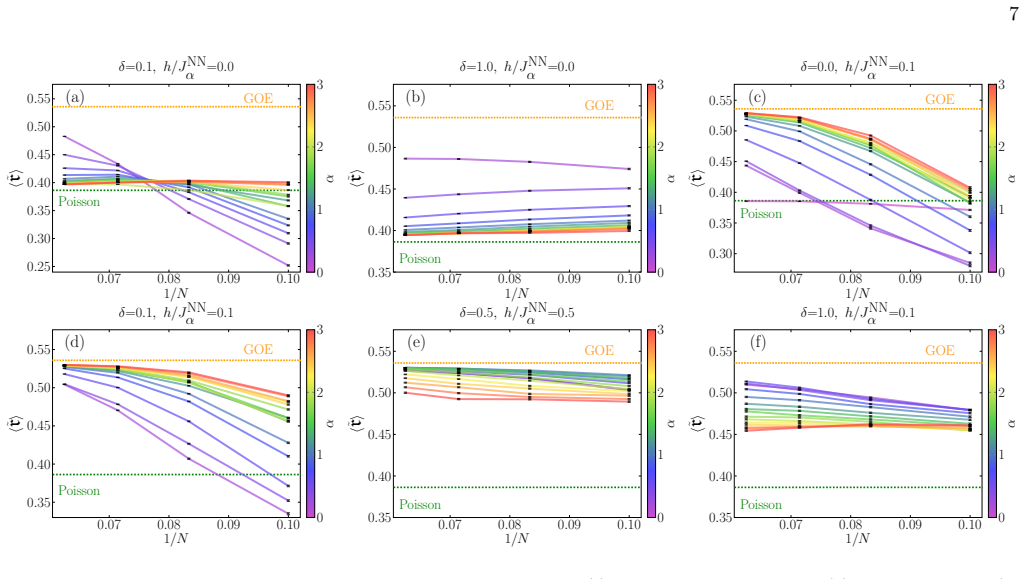
Neither position disorder nor random magnetic fields alone produces pristine Poisson statistics in this long-range interacting system; however, Poisson statistics emerge in their combined presence, suggesting the emergence of MBL when both types of disorder coexist. Once random magnetic fields break the SU(2) symmetry, the strength of the position disorder δ appears to play an important role, as evidenced by an approximate scaling collapse of the disorder-averaged gap ratios parametrized by αδ.
What carries the argument
The disorder-averaged gap ratio, whose distribution shifts from GOE-like to Poisson-like only under combined disorder, together with the scaling variable αδ that collapses the data when SU(2) symmetry is broken.
If this is right
- Many-body localization in this family of models requires the simultaneous action of positional and magnetic disorder.
- The effective disorder strength is set by the product αδ once SU(2) symmetry is lifted.
- Varying the interaction range α can be traded against the position-disorder amplitude δ to reach the same localization regime.
- Single-disorder perturbations are insufficient to localize the system at any finite α.
Where Pith is reading between the lines
- Similar combined-disorder requirements may apply to other long-range spin or boson models that preserve SU(2) symmetry.
- The αδ scaling suggests a possible universal description of the localization transition that is independent of the separate values of α and δ.
- Entanglement or transport observables could be checked to confirm whether the Poisson statistics truly correspond to an MBL phase.
- The result raises the question of whether position disorder becomes irrelevant in the presence of unbroken SU(2) symmetry for any α.
Load-bearing premise
The trend toward Poisson statistics seen in finite-size calculations with both disorders continues to the thermodynamic limit rather than representing a transient crossover.
What would settle it
Exact diagonalization or other numerics on system sizes substantially larger than those used here, checking whether the gap-ratio distribution remains Poisson or reverts toward GOE as size grows.
Figures






read the original abstract
Understanding how the interaction range and various types of disorder affect the level statistics of many-body quantum systems and lead to the emergence of many-body localization (MBL) is a challenging open frontier. We study the level statistics of a variant of the spin-$1/2$ Haldane-Shastry model with $1/r^{\alpha}$ interactions, where $\alpha{\geq}0$ parametrizes the range of the interactions, in the presence of position disorder and/or random magnetic fields. We find that neither position disorder nor random magnetic fields alone yields pristine Poisson statistics in this long-range interacting system; however, Poisson statistics emerge in their combined presence, suggesting the emergence of MBL when both types of disorder coexist. Interestingly, once random magnetic fields break the $SU(2)$ symmetry, the strength of the position disorder, $\delta$, appears to play an important role, as evidenced by an approximate scaling collapse of the disorder-averaged gap ratios that is parametrized in terms of a single parameter, $\alpha \delta$.
Editorial analysis
A structured set of objections, weighed in public.
Referee Report
Summary. The manuscript studies the level statistics of the disordered Haldane-Shastry spin-1/2 chain with tunable long-range interactions 1/r^α (α ≥ 0). It reports that neither position disorder (strength δ) nor random magnetic fields alone produce Poissonian gap-ratio statistics, but their simultaneous presence yields statistics approaching the Poisson value, interpreted as evidence for many-body localization (MBL). When random fields break SU(2) symmetry, the disorder-averaged gap ratio exhibits an approximate scaling collapse controlled by the single parameter αδ.
Significance. If the numerical findings are robust, the work would demonstrate that the combination of two disorder types can induce Poisson statistics (and potentially MBL) in a long-range interacting model where individual disorders fail to do so, and would identify αδ as a relevant scaling variable once symmetry is broken. This adds to the limited literature on MBL in long-range systems and uses the standard gap-ratio diagnostic, but the absence of thermodynamic-limit controls and complementary observables limits its immediate impact.
major comments (3)
- [Results on combined disorder and scaling collapse] The central claim that combined disorder produces Poisson statistics signaling MBL rests on finite-size exact diagonalization, yet the manuscript provides no explicit 1/N extrapolation of the gap ratio, no entanglement-entropy scaling, and no participation-ratio data. For 1/r^α interactions the localization length can remain comparable to system size, so the observed approach to ~0.386 could be a slow crossover rather than true localization (see skeptic note on finite-size effects).
- [Scaling analysis paragraph and associated figure] The approximate scaling collapse of the disorder-averaged gap ratio versus αδ is presented as evidence that δ plays an important role once SU(2) is broken, but no quantitative assessment of collapse quality (e.g., data overlap for different α or residual variance) is supplied, and it is unclear over what range of α and δ the collapse holds.
- [Methods / Numerical details section] The abstract and main text omit all technical details required to assess the numerics: system sizes N, number of disorder realizations, diagonalization method (full or Lanczos), and error estimation on the averaged gap ratios. These omissions make it impossible to judge whether the reported trends are statistically reliable or system-size limited.
minor comments (2)
- [Abstract and introduction] The phrase 'pristine Poisson statistics' is used without a precise definition; clarify whether it means exact agreement with the Poisson value within error bars or merely closer to Poisson than to GOE.
- [Throughout results section] Notation for the gap ratio r and its disorder average should be introduced once and used consistently; occasional switches between r and <r> reduce readability.
Simulated Author's Rebuttal
We thank the referee for the careful reading of our manuscript and the constructive comments. We address each major comment below and will revise the manuscript to improve clarity, add missing details, and discuss limitations where appropriate.
read point-by-point responses
-
Referee: The central claim that combined disorder produces Poisson statistics signaling MBL rests on finite-size exact diagonalization, yet the manuscript provides no explicit 1/N extrapolation of the gap ratio, no entanglement-entropy scaling, and no participation-ratio data. For 1/r^α interactions the localization length can remain comparable to system size, so the observed approach to ~0.386 could be a slow crossover rather than true localization (see skeptic note on finite-size effects).
Authors: We agree that our results are based on finite-size exact diagonalization and that the absence of 1/N extrapolation, entanglement-entropy scaling, or participation-ratio data leaves open the possibility of a slow crossover rather than true MBL. The long-range nature of the interactions limits accessible system sizes, and we observe the gap ratio approaching the Poisson value only for the combined disorder case as N increases within the studied range. In the revised manuscript we will add an explicit discussion of these finite-size limitations and the potential for crossover effects, while retaining the gap-ratio diagnostic as the primary observable. revision: partial
-
Referee: The approximate scaling collapse of the disorder-averaged gap ratio versus αδ is presented as evidence that δ plays an important role once SU(2) is broken, but no quantitative assessment of collapse quality (e.g., data overlap for different α or residual variance) is supplied, and it is unclear over what range of α and δ the collapse holds.
Authors: We acknowledge that the scaling collapse is presented as approximate and that no quantitative metrics of its quality were provided. In the revision we will specify the range of α and δ over which the collapse is observed and add a quantitative assessment, for example by reporting the residual variance or a measure of data overlap across different α values for fixed αδ. revision: yes
-
Referee: The abstract and main text omit all technical details required to assess the numerics: system sizes N, number of disorder realizations, diagonalization method (full or Lanczos), and error estimation on the averaged gap ratios. These omissions make it impossible to judge whether the reported trends are statistically reliable or system-size limited.
Authors: We apologize for these omissions. The revised manuscript will include a dedicated Numerical Methods section that reports the system sizes, number of disorder realizations, the diagonalization method used, and the procedure for estimating errors on the averaged gap ratios, thereby allowing readers to evaluate the statistical reliability of the trends. revision: yes
Circularity Check
No circularity: results from direct numerical diagonalization
full rationale
The paper computes level statistics (gap ratios) by exact diagonalization of finite-size Hamiltonians with position disorder and/or random fields, then reports disorder-averaged trends and an approximate data collapse. No analytical derivation chain exists that reduces a claimed prediction to fitted inputs, self-definitions, or self-citations. All central claims are observational outputs of the numerics rather than self-referential constructions.
Axiom & Free-Parameter Ledger
free parameters (2)
- α
- δ
axioms (1)
- domain assumption The distribution of adjacent energy gaps (gap ratios) reliably distinguishes ergodic from localized many-body phases.
Reference graph
Works this paper leans on
-
[1]
0 0. 5 1. 0 1. 5 2. 00. 0
-
[2]
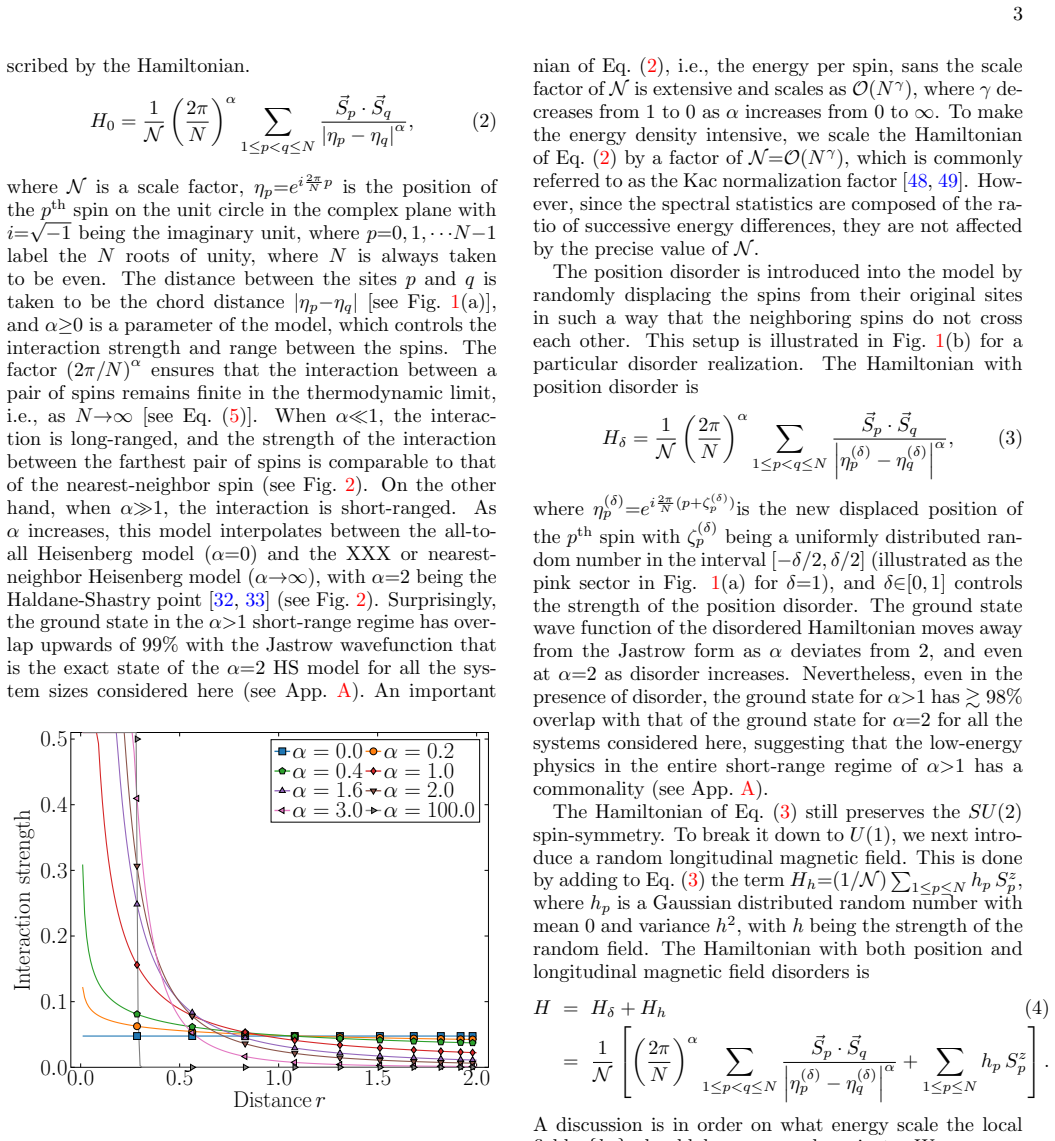
5 Distance r Interaction strength α = 0. 0 α = 0. 2 α = 0. 4 α = 1. 0 α = 1. 6 α = 2. 0 α = 3. 0 α = 100. 0 FIG. 2. Interaction profile of the Hamiltonian of Eq. (2) for N=22 sites, i.e., the interaction strength between a given site and its neighbors as a function of distance,r, for different values of the interaction parameterα. The markers indi- cate t...
-
[3]
6 GOE Poisson (a) α ⟨˜r⟩ h/J NN α =0. 0 δ=0. 0 δ=0. 1 δ=0. 3 δ=0. 5 δ=0. 8 δ=1. 0
-
[4]
05 0. 06 0. 07 0. 08
-
[5]
0) Exact result Upper bound FIG
6 GOE Poisson (b) 1/N ⟨˜r⟩ Clean limit 0 1 2 3 α 10 20 30 40 50 102 103 104 (c) N NE Haldane− Shastry model ( α=2. 0) Exact result Upper bound FIG. 3. (a) level statistics parameter⟨ ˜r⟩of the Hamiltonian of Eq. (2) as a function ofα, where 1/r α is the interaction between any two spins separated by a chord distance ofr, forN=22 spin-1/2 particles on a ri...
-
[6]
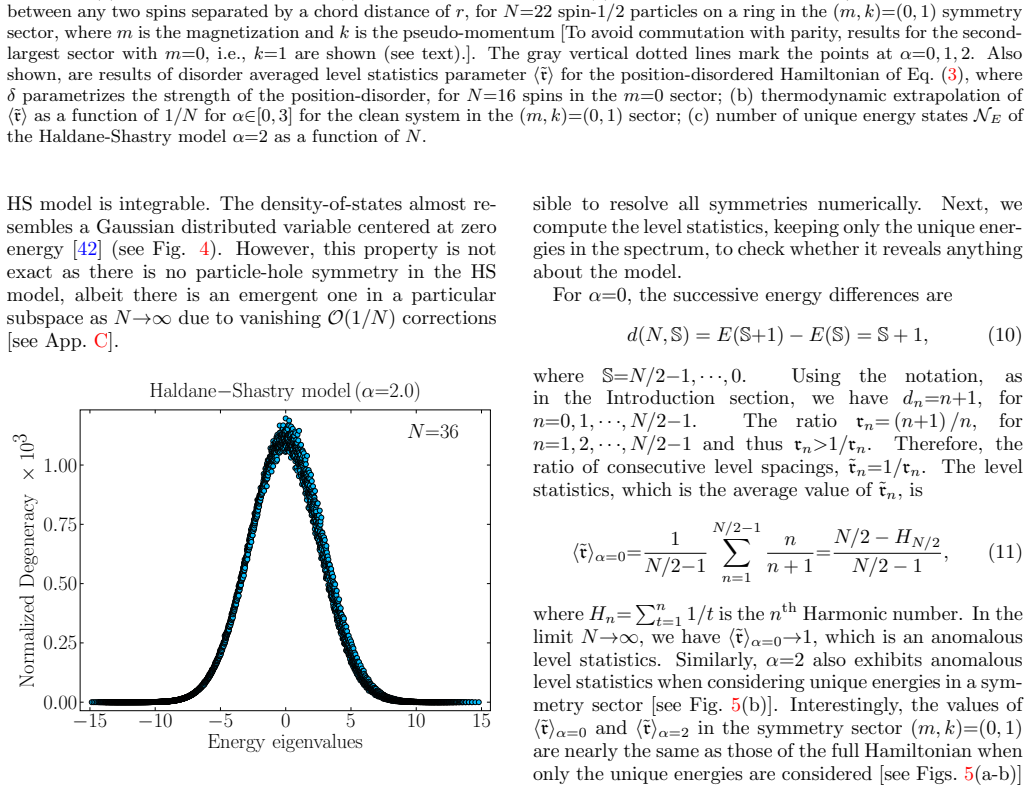
00 N =36 Energy eigenvalues Normalized Degeneracy × 103 Haldane−Shastry model ( α=2. 0) FIG. 4. Normalized degeneracy of the full spectrum forN=36 spins of theα=2 Haldane-Shastry model
-
[7]
Many of these degeneracies arise from unresolved symmetries, as it is not always pos- sible to resolve all symmetries numerically
level statistics with unique energies The reason for the anomalous behavior in the level statistics of the clean model atα=0,2 is due to the large degeneracies in its spectra. Many of these degeneracies arise from unresolved symmetries, as it is not always pos- sible to resolve all symmetries numerically. Next, we compute the level statistics, keeping onl...
-
[8]
8 GOE Poisson (a) α ⟨˜r⟩ Clean limit, N =20 Unique energies in (m, k )=(0, 1) sector Raw energies in (m, k )=(0, 1) sector Unique energies in full spectrum
-
[9]
02 0. 04 0. 06 0. 08 0. 100. 00
-
[10]
0) Unique energies in (m, k )=(0, 1) sector Raw energies in (m, k )=(0, 1) sector Unique energies in full spectrum
00 GOE Poisson GUE GSE (b) 1/N ⟨˜r⟩ Haldane− Shastry model (α=2. 0) Unique energies in (m, k )=(0, 1) sector Raw energies in (m, k )=(0, 1) sector Unique energies in full spectrum
-
[11]
05 0. 06 0. 07 0. 08 0. 09 0. 10
-
[12]
5 Unique energies in (m, k )=(0, 1) sector Raw energies in (m, k )=(0, 1) sector Unique energies in full spectrum FIG
6 GOE Poisson (c) 1/N ⟨˜r⟩ XXZ model, ∆=0 . 5 Unique energies in (m, k )=(0, 1) sector Raw energies in (m, k )=(0, 1) sector Unique energies in full spectrum FIG. 5. Analysis of the spectral-statistics before [raw energies] and after removing the degeneracies [unique energies]. (a) level statistics parameter⟨ ˜r⟩as a function ofαfor the clean system of Eq...
-
[14]
1, h/J NN α =0
55 GOE Poisson (a) 1/N ⟨˜r⟩ δ=0. 1, h/J NN α =0. 0 0 1 2 3 α
-
[16]
0, h/J NN α =0
55 GOE Poisson (b) 1/N ⟨˜r⟩ δ=1. 0, h/J NN α =0. 0 0 1 2 3 α
-
[18]
0, h/J NN α =0
55 GOE Poisson (c) 1/N ⟨˜r⟩ δ=0. 0, h/J NN α =0. 1 0 1 2 3 α
-
[19]
07 0. 08 0. 09 0. 10
-
[20]
1, h/J NN α =0
55 GOE Poisson (d) 1/N ⟨˜r⟩ δ=0. 1, h/J NN α =0. 1 0 1 2 3 α
-
[22]
5, h/J NN α =0
55 GOE Poisson (e) 1/N ⟨˜r⟩ δ=0. 5, h/J NN α =0. 5 0 1 2 3 α
-
[23]
07 0. 08 0. 09 0. 100. 35
-
[24]
0, h/J NN α =0
55 GOE Poisson (f) 1/N ⟨˜r⟩ δ=1. 0, h/J NN α =0. 1 0 1 2 3 α FIG. 7. Thermodynamic extrapolation of the level statistics parameter⟨ ˜r⟩of the Hamiltonian of Eq. (4) as a function of 1/N for interaction parameterα∈(0,3], disorder strengthδand magnetic field strengthh/J NN α in the zero magnetization sector. For each value ofα,δ, andh/J NN α , the results a...
-
[25]
55 GOE Poisson (a) α ⟨˜r⟩ h/J NN α =0. 1 δ=0. 0 δ=0. 1 δ=0. 3 δ=0. 5 δ=0. 8 δ=1. 0 0 1 2 3
-
[26]
55 GOE Poisson (b) α ⟨˜r⟩ h/J NN α =0. 3 δ=0. 0 δ=0. 1 δ=0. 3 δ=0. 5 δ=0. 8 δ=1. 0 0 1 2 3
-
[27]
55 GOE Poisson (c) α ⟨˜r⟩ h/J NN α =0. 5 δ=0. 0 δ=0. 1 δ=0. 3 δ=0. 5 δ=0. 8 δ=1. 0 0 1 2 3
-
[28]
55 GOE Poisson (d) α ⟨˜r⟩ h/J NN α =0. 8 δ=0. 0 δ=0. 1 δ=0. 3 δ=0. 5 δ=0. 8 δ=1. 0 0 1 2 3
-
[29]
55 GOE Poisson (e) α ⟨˜r⟩ h/J NN α =1. 0 δ=0. 0 δ=0. 1 δ=0. 3 δ=0. 5 δ=0. 8 δ=1. 0 0 1 2 3
-
[30]
55 GOE Poisson (f) α ⟨˜r⟩ h/J NN α =1. 3 δ=0. 0 δ=0. 1 δ=0. 3 δ=0. 5 δ=0. 8 δ=1. 0 0 1 2 3
-
[31]
55 GOE Poisson (g) α ⟨˜r⟩ h/J NN α =1. 5 δ=0. 0 δ=0. 1 δ=0. 3 δ=0. 5 δ=0. 8 δ=1. 0 0 1 2 3
-
[32]
55 GOE Poisson (h) α ⟨˜r⟩ h/J NN α =2. 0 δ=0. 0 δ=0. 1 δ=0. 3 δ=0. 5 δ=0. 8 δ=1. 0 0 1 2 3
-
[33]
55 GOE Poisson (i) α ⟨˜r⟩ h/J NN α =4. 0 δ=0. 0 δ=0. 1 δ=0. 3 δ=0. 5 δ=0. 8 δ=1. 0 FIG. 9. level statistics parameter⟨ ˜r⟩of the Hamiltonian of Eq. (4) as a function of the interaction parameterαfor different values of position disorder strengthsδand magnetic field disorder strengthsh/J NN α in the zero magnetization sector. For each value ofα,δ, andh/J N...
-
[34]
55 GOE Poisson (a) αδ ⟨˜r⟩ N =10, h/J α =0. 5 δ=0. 1 δ=0. 3 δ=0. 5 δ=0. 8 δ=1. 0 1 2 3 4 5 6 7 8 9 10 11 12 13 14 150. 35
-
[35]
55 GOE Poisson (b) αδ ⟨˜r⟩ N =12, h/J α =0. 5 δ=0. 1 δ=0. 3 δ=0. 5 δ=0. 8 δ=1. 0 1 2 3 4 5 6 7 8 9 10 11 12 13 14 150. 35
-
[36]
55 GOE Poisson (c) αδ ⟨˜r⟩ N =14, h/J α =0. 5 δ=0. 1 δ=0. 3 δ=0. 5 δ=0. 8 δ=1. 0 1 2 3 4 5 6 7 8 9 10 11 12 13 14 150. 35
-
[37]
55 GOE Poisson (d) αδ ⟨˜r⟩ N =16, h/J α =0. 5 δ=0. 1 δ=0. 3 δ=0. 5 δ=0. 8 δ=1. 0 FIG. 10. The average level statistics⟨ ˜r⟩of the Hamiltonian of Eq. (4) as a function of the effective rescaled parameterαδfor different values ofδandh/J NN α =0.5 in the zero magnetization sector for (a)N=10, (b)N=12, (c)N=14, and (d)N=16 spins. suggesting a crossover from a...
2023
-
[38]
14 XXX model 99% overlap α 1 − |⟨Ψ J|Ψ GS α ⟩|2 N =12 N =14 N =16 N =18 N =20 N =22 FIG. 11. Squared overlap deviation from unity, i.e., 1− |⟨ΨJ|ΨGS α ⟩|2, as a function ofαfor the clean system for vari- ous systems, where|Ψ GS α ⟩is the numerically evaluated ground state atαand|Ψ J⟩is the ground state atα=2 [defined in Eqs. (A1) and (A2)]. The non-intera...
-
[39]
Each tableau should be symmetrized over all boxes in a given row and antisym- metrized over all boxes in a given column
Using Young tableaux A standard Young tableaux is an arrangement ofN numbered boxes with numbers ranging from 1,2,· · ·, N such that the numbers assigned to the boxes within each row increase from left to right and within each column increase from top to bottom. Each tableau should be symmetrized over all boxes in a given row and antisym- metrized over al...
-
[40]
B 1, admit a representation in the momentum indexκspace, where the spinons occupy their correspondingκand the remaining emptyκslots are interpreted as occupied by spinon holes
Using distinct spinon states The extended Young tableaux, discussed in App. B 1, admit a representation in the momentum indexκspace, where the spinons occupy their correspondingκand the remaining emptyκslots are interpreted as occupied by spinon holes. In this picture, all the distinct configu- rations in theκspace are distinct spinon states of the HS mod...
-
[41]
1 N =6 N =8 N =10 N =12 N =14 N =16 0 1 2 30
00 (a) α 1 − |⟨Ψ J|Ψ GS α ⟩|2 δ=0. 1 N =6 N =8 N =10 N =12 N =14 N =16 0 1 2 30. 00
-
[42]
5 N =6 N =8 N =10 N =12 N =14 N =16 0 1 2 30
00 (b) α 1 − |⟨Ψ J|Ψ GS α ⟩|2 δ=0. 5 N =6 N =8 N =10 N =12 N =14 N =16 0 1 2 30. 00
-
[43]
0 N =6 N =8 N =10 N =12 N =14 N =16 FIG
00 (c) α 1 − |⟨Ψ J|Ψ GS α ⟩|2 δ=1. 0 N =6 N =8 N =10 N =12 N =14 N =16 FIG. 12. Mean and standard deviation of the overlap deviation, 1−|⟨Ψ J|ΨGS α ⟩|2, where|Ψ J⟩is the state defined in Eqs. (A1) and (A2) with{η}being the (disordered) positions on the unit circle, and|Ψ GS α ⟩is the numerically evaluated ground state for the position disordered system at...
-
[44]
1 N =6 N =8 N =10 N =12 N =14 N =16 0 1 2 30
25 (a) 98% overlap α 1 − |⟨Ψ GS α =2|Ψ GS α ⟩|2 δ=0. 1 N =6 N =8 N =10 N =12 N =14 N =16 0 1 2 30. 00
-
[45]
5 N =6 N =8 N =10 N =12 N =14 N =16 0 1 2 30
25 (b) 98% overlap α 1 − |⟨Ψ GS α =2|Ψ GS α ⟩|2 δ=0. 5 N =6 N =8 N =10 N =12 N =14 N =16 0 1 2 30. 00
-
[46]
0 N =6 N =8 N =10 N =12 N =14 N =16 FIG
25 (c) 98% overlap α 1 − |⟨Ψ GS α =2|Ψ GS α ⟩|2 δ=1. 0 N =6 N =8 N =10 N =12 N =14 N =16 FIG. 13. Mean and standard deviation of the overlap deviation, 1−|⟨Ψ GS α=2|ΨGS α ⟩|2, where|Ψ GS α ⟩is the numerically evaluated ground state for the position disordered system atα, over 1000 independent disorder realizations as a function ofαfor the position disorde...
-
[47]
J. M. Deutsch, Quantum statistical mechanics in a closed system, Phys. Rev. A43, 2046 (1991)
2046
-
[48]
Srednicki, Chaos and quantum thermalization, Phys
M. Srednicki, Chaos and quantum thermalization, Phys. Rev. E50, 888 (1994)
1994
-
[49]
Rigol, V
M. Rigol, V. Dunjko, and M. Olshanii, Thermalization and its mechanism for generic isolated quantum systems, Nature452, 854 (2008)
2008
-
[50]
Polkovnikov, K
A. Polkovnikov, K. Sengupta, A. Silva, and M. Vengalat- tore, Colloquium: Nonequilibrium dynamics of closed in- teracting quantum systems, Rev. Mod. Phys.83, 863 (2011)
2011
-
[51]
Rigol and M
M. Rigol and M. Srednicki, Alternatives to eigenstate thermalization, Phys. Rev. Lett.108, 110601 (2012)
2012
-
[52]
H. Kim, T. N. Ikeda, and D. A. Huse, Testing whether all eigenstates obey the eigenstate thermalization hypothe- sis, Phys. Rev. E90, 052105 (2014)
2014
-
[53]
L. D’Alessio, Y. Kafri, A. Polkovnikov, and M. Rigol, From quantum chaos and eigenstate thermalization to statistical mechanics and ther- modynamics, Advances in Physics65, 239 (2016), https://doi.org/10.1080/00018732.2016.1198134
-
[54]
J. M. Deutsch, Eigenstate thermalization hypothesis, Re- ports on Progress in Physics81, 082001 (2018)
2018
-
[55]
Ueda, Quantum equilibration, thermalization and prethermalization in ultracold atoms, Nature Reviews Physics2, 669 (2020)
M. Ueda, Quantum equilibration, thermalization and prethermalization in ultracold atoms, Nature Reviews Physics2, 669 (2020)
2020
-
[56]
P. W. Anderson, Absence of diffusion in certain random lattices, Phys. Rev.109, 1492 (1958)
1958
-
[57]
P. A. Lee and T. V. Ramakrishnan, Disordered electronic systems, Rev. Mod. Phys.57, 287 (1985)
1985
-
[58]
I. V. Gornyi, A. D. Mirlin, and D. G. Polyakov, Interact- ing electrons in disordered wires: Anderson localization and low-ttransport, Phys. Rev. Lett.95, 206603 (2005)
2005
-
[59]
Basko, I
D. Basko, I. Aleiner, and B. Altshuler, Metal–insulator transition in a weakly interacting many-electron system with localized single-particle states, Annals of Physics 321, 1126 (2006)
2006
-
[60]
Oganesyan and D
V. Oganesyan and D. A. Huse, Localization of interacting fermions at high temperature, Phys. Rev. B75, 155111 (2007)
2007
-
[61]
D. A. Huse, R. Nandkishore, V. Oganesyan, A. Pal, and S. L. Sondhi, Localization-protected quantum order, Phys. Rev. B88, 014206 (2013)
2013
-
[62]
Nandkishore and D
R. Nandkishore and D. A. Huse, Many-body localization and thermalization in quantum statistical mechanics, An- nual Review of Condensed Matter Physics6, 15 (2015)
2015
-
[63]
D. A. Abanin, E. Altman, I. Bloch, and M. Serbyn, Col- loquium: Many-body localization, thermalization, and entanglement, Rev. Mod. Phys.91, 021001 (2019)
2019
-
[64]
E. P. Wigner, On the statistical distribution of the widths and spacings of nuclear resonance levels, Mathematical Proceedings of the Cambridge Philosophical Society47, 790–798 (1951)
1951
-
[65]
F. J. Dyson, Statistical theory of the energy levels of complex systems. i, J. Math. Phys.3, 140 (1962). 15
1962
-
[66]
M. L. Mehta,Random Matrices(Academic Press, San Diego, 1990)
1990
-
[67]
Haake, S
F. Haake, S. Gnutzmann, and M. Ku´ s,Quantum Signa- tures of Chaos(Springer International Publishing, Cham, 2018)
2018
-
[68]
Bohigas, M
O. Bohigas, M. J. Giannoni, and C. Schmit, Character- ization of chaotic quantum spectra and universality of level fluctuation laws, Phys. Rev. Lett.52, 1 (1984)
1984
-
[69]
Pal and D
A. Pal and D. A. Huse, Many-body localization phase transition, Phys. Rev. B82, 174411 (2010)
2010
-
[70]
Serbyn, Z
M. Serbyn, Z. Papi´ c, and D. A. Abanin, Local conserva- tion laws and the structure of the many-body localized states, Phys. Rev. Lett.111, 127201 (2013)
2013
-
[71]
D. A. Huse, R. Nandkishore, and V. Oganesyan, Phe- nomenology of fully many-body-localized systems, Phys. Rev. B90, 174202 (2014)
2014
-
[72]
Y. Y. Atas, E. Bogomolny, O. Giraud, and G. Roux, Distribution of the ratio of consecutive level spacings in random matrix ensembles, Physical Review Letters110, 084101 (2013)
2013
-
[73]
Kudo and T
K. Kudo and T. Deguchi, Unexpected non-Wigner behav- ior in level-spacing distributions of next-nearest-neighbor coupled XXZ spin chains, Phys. Rev. B68, 052510 (2003)
2003
-
[74]
A. W. Sandvik, Computational studies of quantum spin systems, AIP Conference Proceedings1297, 135 (2010)
2010
-
[75]
Fabricius and B
K. Fabricius and B. M. McCoy, Bethe’s equation is in- complete for the XXZ model at roots of unity, Journal of Statistical Physics103, 647 (2001)
2001
-
[76]
O’Dea, Level statistics detect generalized symmetries (2024), arXiv:2406.03983 [cond-mat.stat-mech]
N. O’Dea, Level statistics detect generalized symmetries (2024), arXiv:2406.03983 [cond-mat.stat-mech]
-
[77]
T. C. Hsu and J. C. Angle‘s d’Auriac, Level repulsion in integrable and almost-integrable quantum spin models, Phys. Rev. B47, 14291 (1993)
1993
-
[78]
F. D. M. Haldane, Exact Jastrow-Gutzwiller resonating- valence-bond ground state of the spin- 1 2 antiferromag- netic Heisenberg chain with 1/r 2 exchange, Phys. Rev. Lett.60, 635 (1988)
1988
-
[79]
B. S. Shastry, Exact solution of an S=1/2 Heisenberg antiferromagnetic chain with long-ranged interactions, Phys. Rev. Lett.60, 639 (1988)
1988
-
[80]
Greiter,Mapping of Parent Hamiltonians, Springer Tracts in Modern Physics, Vol
M. Greiter,Mapping of Parent Hamiltonians, Springer Tracts in Modern Physics, Vol. 248 (Springer Berlin, Hei- delberg, 2011) pp. XIV, 194
2011
-
[81]
F. D. M. Haldane, Z. N. C. Ha, J. C. Talstra, D. Bernard, and V. Pasquier, Yangian symmetry of integrable quan- tum chains with long-range interactions and a new de- scription of states in conformal field theory, Phys. Rev. Lett.69, 2021 (1992)
2021
-
[82]
V. G. Drinfel’D, Hopf algebras and the quantum yang- baxter equation, inYang-Baxter Equation in Integrable Systems(World Scientific, 1990) pp. 264–268
1990
-
[83]
Chari and A
V. Chari and A. Pressley,A Guide to Quantum Groups (Cambridge University Press, 1995)
1995
-
[84]
J. C. Talstra, Integrability and applications of the exactly-solvable Haldane-Shastry one-dimensional quan- tum spin chain (1995)
1995
discussion (0)
Sign in with ORCID, Apple, or X to comment. Anyone can read and Pith papers without signing in.