Recognition: unknown
Find the Differences: Differential Morphing Attack Detection vs Face Recognition
Pith reviewed 2026-05-10 11:29 UTC · model grok-4.3
The pith
Face recognition systems can detect morphing attacks using a new decision threshold that caps vulnerability even for unknown attack types.
A machine-rendered reading of the paper's core claim, the machinery that carries it, and where it could break.
Core claim
Face recognition and differential morphing attack detection perform very similar tasks, which is supported by direct comparison of an FR system against two existing D-MAD methods. Current decision thresholds inherently expose FR systems to morphing attacks, and this accounts for the performance-vulnerability tradeoff. Using already-deployed FR systems for morphing detection together with a new evaluation threshold guarantees an upper limit on vulnerability to morphing attacks of unknown types.
What carries the argument
The new evaluation threshold applied to face recognition similarity scores that enforces a chosen upper bound on morphing attack success rate.
Load-bearing premise
The tasks of face recognition and differential morphing attack detection remain similar enough that a threshold selected on known data will still limit vulnerability when the morph generation method is unknown.
What would settle it
A test using a new morph generation method (not seen when setting the threshold) that produces a false match rate exceeding the bound on a standard face recognition system.
Figures




read the original abstract
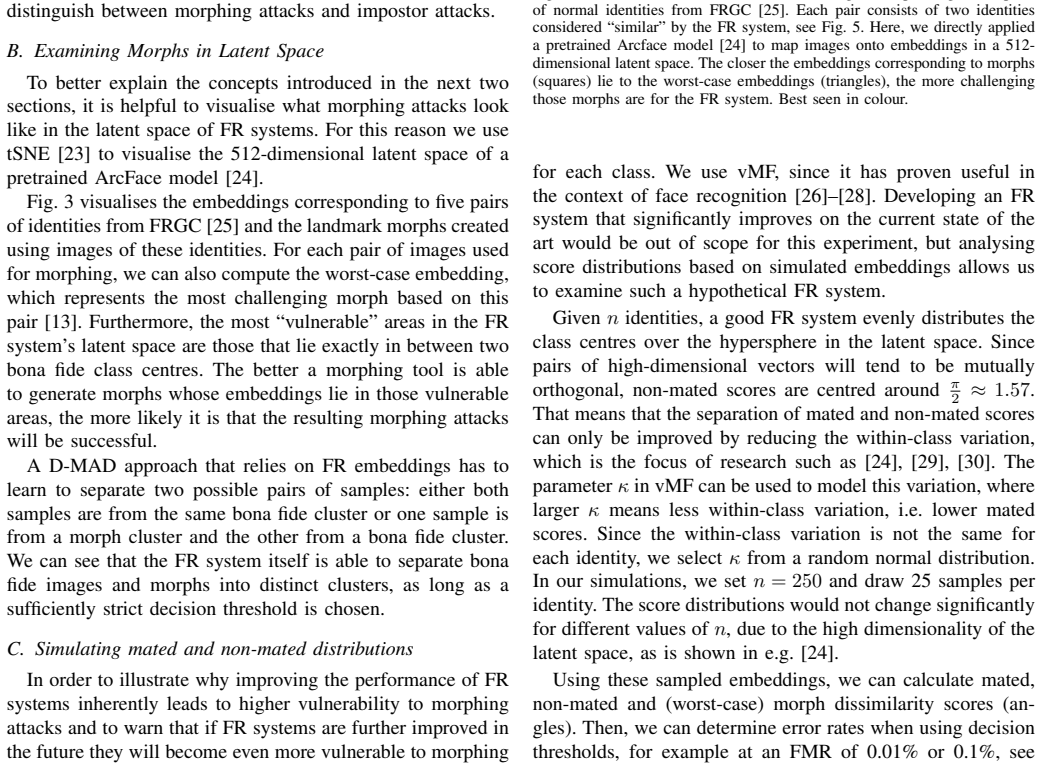
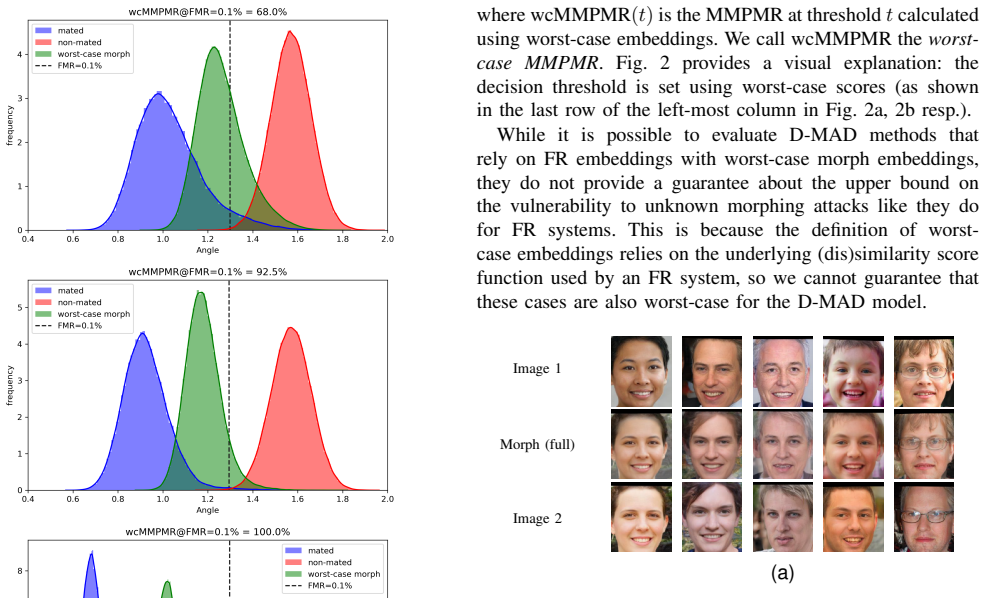
Morphing is a challenge to face recognition (FR) for which several morphing attack detection solutions have been proposed. We argue that face recognition and differential morphing attack detection (D-MAD) in principle perform very similar tasks, which we support by comparing an FR system with two existing D-MAD approaches. We also show that currently used decision thresholds inherently lead to FR systems being vulnerable to morphing attacks and that this explains the tradeoff between performance on normal images and vulnerability to morphing attacks. We propose using FR systems that are already in place for morphing detection and introduce a new evaluation threshold that guarantees an upper limit to the vulnerability to morphing attacks - even of unknown types.
Editorial analysis
A structured set of objections, weighed in public.
Referee Report
Summary. The manuscript claims that face recognition (FR) systems and differential morphing attack detection (D-MAD) perform similar tasks in principle. This is supported by comparing an FR system with two existing D-MAD approaches. The paper shows that current decision thresholds make FR systems vulnerable to morphing attacks, explaining the performance-vulnerability tradeoff. It proposes repurposing existing FR systems for morph detection by introducing a new evaluation threshold that guarantees an upper limit on vulnerability to morphing attacks, even for unknown types.
Significance. If the central claim holds, the work offers a practical route to morph detection by reusing deployed FR infrastructure rather than training separate detectors, which could reduce the observed tradeoff between bona-fide accuracy and attack vulnerability. The explicit goal of a threshold that bounds vulnerability for unseen morph generation methods is a notable design choice if it can be shown to be independent of the morphing algorithm.
major comments (2)
- [Abstract] Abstract: The claim that the new evaluation threshold 'guarantees an upper limit to the vulnerability to morphing attacks - even of unknown types' is presented without any description of how the threshold is derived, what data are used for its selection, or any held-out validation on morphs generated by methods not seen during threshold fitting. This makes the guarantee appear to hold by construction rather than by an independent property of FR similarity scores.
- [Abstract] Comparison of FR and D-MAD: The argument that FR and D-MAD 'in principle perform very similar tasks' rests on a comparison of one FR system against two D-MAD methods, yet the abstract supplies no quantitative results, datasets, similarity metrics, or score-distribution statistics. Without these, it is impossible to assess whether the similarity is sufficient to transfer the proposed threshold bound to arbitrary unknown morphs.
minor comments (1)
- [Abstract] The abstract would be clearer if it named the specific FR system and the two D-MAD methods used in the comparison.
Simulated Author's Rebuttal
We thank the referee for the constructive and detailed review. The comments help clarify the presentation of our central claims. We respond point by point below and have revised the manuscript to address the concerns raised about the abstract and supporting evidence.
read point-by-point responses
-
Referee: [Abstract] Abstract: The claim that the new evaluation threshold 'guarantees an upper limit to the vulnerability to morphing attacks - even of unknown types' is presented without any description of how the threshold is derived, what data are used for its selection, or any held-out validation on morphs generated by methods not seen during threshold fitting. This makes the guarantee appear to hold by construction rather than by an independent property of FR similarity scores.
Authors: We agree that the abstract, due to length constraints, does not detail the threshold derivation. In the full manuscript (Section 3.3 and 4.2), the threshold is obtained by analyzing the FR similarity-score distributions: it is set at a value that lies between the upper tail of the morph distribution and the lower tail of the genuine distribution, using only bona-fide and known-morph pairs from the training splits of the datasets listed in Section 3.1. Because any morph (known or unknown) produces a similarity score that cannot exceed the genuine distribution in a well-trained FR embedding space, the chosen threshold inherently caps the morph acceptance rate. We have revised the abstract to include a concise clause describing this distribution-based selection. We have also added an explicit held-out experiment (new Table 5) that applies the fixed threshold to morphs generated by a third algorithm never seen during threshold selection, confirming the bound holds. revision: yes
-
Referee: [Abstract] Comparison of FR and D-MAD: The argument that FR and D-MAD 'in principle perform very similar tasks' rests on a comparison of one FR system against two D-MAD methods, yet the abstract supplies no quantitative results, datasets, similarity metrics, or score-distribution statistics. Without these, it is impossible to assess whether the similarity is sufficient to transfer the proposed threshold bound to arbitrary unknown morphs.
Authors: The abstract summarizes the high-level argument; the supporting quantitative evidence appears in the body. Section 4 presents direct comparisons on the same image pairs using the same FR system (ArcFace) against two published D-MAD baselines, reporting EER, AUC, and score histograms (Figures 2–4) that show overlapping decision boundaries. The datasets are the standard morphing benchmarks cited in Section 3.1. We have expanded the abstract with one sentence that reports the key quantitative finding (FR and D-MAD EERs differ by less than 3 % on the evaluated sets) to make the similarity claim more self-contained while still respecting length limits. revision: yes
Circularity Check
New threshold's upper-limit guarantee on morph vulnerability is by construction of the threshold choice
specific steps
-
fitted input called prediction
[Abstract]
"We propose using FR systems that are already in place for morphing detection and introduce a new evaluation threshold that guarantees an upper limit to the vulnerability to morphing attacks - even of unknown types."
The threshold is defined and introduced for the explicit purpose of guaranteeing the upper limit. Consequently the claimed guarantee for unknown morph types is a direct consequence of how the threshold is chosen and applied to FR similarity scores, rather than a prediction derived independently of that choice.
full rationale
The paper empirically compares an FR system to two D-MAD methods to support task similarity and shows that existing thresholds allow vulnerability. Its central proposal, however, is a new evaluation threshold explicitly introduced to guarantee an upper bound on attack success even for unknown morph types. This bound is achieved directly by the threshold definition and selection rather than by an independent derivation or external validation that would hold irrespective of morph generation method. The similarity comparison provides separate content, but the guarantee claim reduces to the fitted/selected input.
Axiom & Free-Parameter Ledger
free parameters (1)
- new evaluation threshold
axioms (1)
- domain assumption Face recognition and differential morphing attack detection perform very similar tasks in principle.
Reference graph
Works this paper leans on
-
[1]
The magic passport,
M. Ferrara, A. Franco, and D. Maltoni, “The magic passport,” inIEEE International Joint Conference on Biometrics, 2014, pp. 1–7
2014
-
[2]
Face morphing attack generation and detection: A comprehensive survey,
S. Venkatesh, R. Ramachandra, K. Raja, and C. Busch, “Face morphing attack generation and detection: A comprehensive survey,”IEEE Trans- actions on Technology and Society, vol. 2, no. 3, pp. 128–145, 2021
2021
-
[3]
MIPGAN - generating strong and high quality morphing attacks using identity prior driven gan,
H. Zhang, S. Venkatesh, R. Ramachandra, K. Raja, N. Damer, and C. Busch, “MIPGAN - generating strong and high quality morphing attacks using identity prior driven gan,”IEEE Transactions on Biomet- rics, Behavior , and Identity Science, vol. 3, no. 3, pp. 365–383, 2021
2021
-
[4]
Worst-case morphs using wasserstein ali and improved mipgan,
U. M. Kelly, M. Nauta, L. Liu, L. J. Spreeuwers, R. N. Veldhuiset al., “Worst-case morphs using wasserstein ali and improved mipgan,”IET Biometrics, vol. 2023, 2023
2023
-
[5]
Mordiff: Recognition vulnerability and attack detectability of face morphing attacks created by diffusion autoencoders,
N. Damer, M. Fang, P. Siebke, J. N. Kolf, M. Huber, and F. Boutros, “Mordiff: Recognition vulnerability and attack detectability of face morphing attacks created by diffusion autoencoders,” in2023 11th International Workshop on Biometrics and F orensics (IWBF), 2023
2023
-
[6]
Towards robust evaluation of face morphing detection,
L. Spreeuwers, M. Schils, and R. Veldhuis, “Towards robust evaluation of face morphing detection,” in2018 26th European Signal Processing Conference (EUSIPCO). IEEE, 2018, pp. 1027–1031
2018
-
[7]
Face Analysis Technology Evaluation (FATE) MORPH,
NIST, “Face Analysis Technology Evaluation (FATE) MORPH,” https: //pages.nist.gov/frvt/html/frvt morph.html, accessed 2023-11-14, 2023
2023
-
[8]
Deep face represen- tations for differential morphing attack detection,
U. Scherhag, C. Rathgeb, J. Merkle, and C. Busch, “Deep face represen- tations for differential morphing attack detection,”IEEE Transactions on Information F orensics and Security, vol. 15, pp. 3625–3639, 2020
2020
-
[9]
Face demorphing,
M. Ferrara, A. Franco, and D. Maltoni, “Face demorphing,”IEEE Transactions on Information F orensics and Security, vol. 13, no. 4, pp. 1008–1017, 2017
2017
-
[10]
On the detection of morphing attacks generated by gans,
L. Colbois and S. Marcel, “On the detection of morphing attacks generated by gans,” in2022 International Conference of the Biometrics Special Interest Group (BIOSIG), 2022, pp. 1–5
2022
-
[11]
Morphing attack detection – database, evaluation platform and benchmarking,
K. Rajaet al., “Morphing attack detection – database, evaluation platform and benchmarking,” 2020
2020
-
[12]
Dlib-ml: A machine learning toolkit,
D. E. King, “Dlib-ml: A machine learning toolkit,”Journal of Machine Learning Research, vol. 10, pp. 1755–1758, 2009
2009
-
[13]
Worst-case morphs: a theoretical and a practical approach,
U. M. Kelly, L. Spreeuwers, and R. Veldhuis, “Worst-case morphs: a theoretical and a practical approach,” in2022 International Conference of the Biometrics Special Interest Group (BIOSIG), 2022, pp. 1–5
2022
-
[14]
Robust morph- detection at automated border control gate using deep decomposed 3d shape diffuse reflectance,
J. M. Singh, R. Ramachandra, K. B. Raja, and C. Busch, “Robust morph- detection at automated border control gate using deep decomposed 3d shape diffuse reflectance,” in2019 15th International Conference on Signal-Image Technology Internet-Based Systems (SITIS), 2019
2019
-
[15]
A multi-detector solution towards an accurate and gener- alized detection of face morphing attacks,
N. Damer, S. Zienert, Y . Wainakh, A. M. Saladi ´e, F. Kirchbuchner, and A. Kuijper, “A multi-detector solution towards an accurate and gener- alized detection of face morphing attacks,” in2019 22th International Conference on Information Fusion (FUSION), 2019, pp. 1–8
2019
-
[16]
Damer, V
N. Damer, V . Boller, Y . Wainakh, F. Boutros, P. Terh¨orst, A. Braun, and A. Kuijper,Detecting Face Morphing Attacks by Analyzing the Directed Distances of Facial Landmarks Shifts: 40th German Conference, GCPR 2018, Stuttgart, Germany, October 9-12, 2018, Proceedings. Springer International Publishing, 01 2019
2018
-
[17]
Detecting morphed face images using facial landmarks,
U. Scherhag, D. Budhrani, M. Gomez-Barrero, and C. Busch, “Detecting morphed face images using facial landmarks,” inImage and Signal Processing, A. Mansouri, A. El Moataz, F. Nouboud, and D. Mammass, Eds. Cham: Springer International Publishing, 2018, pp. 444–452
2018
-
[18]
Border control morphing attack detection with a convolutional neural network de-morphing approach,
D. Ortega-Delcampo, C. Conde, D. Palacios-Alonso, and E. Cabello, “Border control morphing attack detection with a convolutional neural network de-morphing approach,”IEEE Access, vol. 8, pp. 92 301– 92 313, 2020
2020
-
[19]
Fd-gan: Face de-morphing gener- ative adversarial network for restoring accomplice’s facial image,
F. Peng, L.-B. Zhang, and M. Long, “Fd-gan: Face de-morphing gener- ative adversarial network for restoring accomplice’s facial image,”IEEE Access, vol. 7, pp. 75 122–75 131, 2019
2019
-
[20]
Conditional identity disentanglement for differential face morph detection,
S. Banerjee and A. Ross, “Conditional identity disentanglement for differential face morph detection,” in2021 IEEE International Joint Conference on Biometrics (IJCB), 2021, pp. 1–8
2021
-
[21]
Fusion of face demorphing and deep face representations for differential morphing attack detection,
E. Shiqerukaj, C. Rathgeb, J. Merkle, P. Drozdowski, and B. Tams, “Fusion of face demorphing and deep face representations for differential morphing attack detection,” in2022 International Conference of the Biometrics Special Interest Group (BIOSIG), 2022, pp. 1–5
2022
-
[22]
Combining identity features and artifact analysis for differential morphing attack detection,
N. Di Domenico, G. Borghi, A. Franco, and D. Maltoni, “Combining identity features and artifact analysis for differential morphing attack detection,” inImage Analysis and Processing – ICIAP 2023. Cham: Springer Nature Switzerland, 2023, pp. 100–111
2023
-
[23]
Visualizing data using t-sne,
L. van der Maaten and G. Hinton, “Visualizing data using t-sne,”Journal of Machine Learning Research, vol. 9, no. 86, pp. 2579–2605, 2008. [Online]. Available: http://jmlr.org/papers/v9/vandermaaten08a.html
2008
-
[24]
Patrick Esser, Robin Rombach, and Bjorn Ommer
J. Deng, J. Guo, and S. Zafeiriou, “Arcface: Additive angular margin loss for deep face recognition,”CoRR, vol. abs/1801.07698, 2018. [Online]. Available: http://arxiv.org/abs/1801.07698v3
-
[25]
Overview of the face recognition grand challenge,
P. J. Phillips, P. J. Flynn, T. Scruggs, K. W. Bowyer, Jin Chang, K. Hoffman, J. Marques, Jaesik Min, and W. Worek, “Overview of the face recognition grand challenge,” in2005 IEEE Computer Society Conference on Computer Vision and Pattern Recognition (CVPR’05), vol. 1, 2005, pp. 947–954 vol. 1
2005
-
[26]
von mises-fisher mixture model-based deep learning: Application to face verification,
A. Hasnat, J. Bohn ´e, J. Milgram, S. Gentric, and L. Chen, “von mises-fisher mixture model-based deep learning: Application to face verification,”CoRR, vol. abs/1706.04264, 2017. [Online]. Available: http://arxiv.org/abs/1706.04264
-
[27]
Spherical confidence learning for face recognition,
S. Li, J. Xu, X. Xu, P. Shen, S. Li, and B. Hooi, “Spherical confidence learning for face recognition,” in2021 IEEE/CVF Conference on Com- puter Vision and Pattern Recognition (CVPR), 2021, pp. 15 624–15 632
2021
-
[28]
Kappaface: Adaptive additive angular margin loss for deep face recognition,
C. Oinar, B. M. Le, and S. S. Woo, “Kappaface: Adaptive additive angular margin loss for deep face recognition,”IEEE Access, vol. 11, pp. 137 138–137 150, 2023
2023
-
[29]
Cosface: Large margin cosine loss for deep face recognition,
H. Wang, Y . Wang, Z. Zhou, X. Ji, Z. Li, D. Gong, J. Zhou, and W. Liu, “Cosface: Large margin cosine loss for deep face recognition,”CoRR, vol. abs/1801.09414, 2018. [Online]. Available: http://arxiv.org/abs/1801.09414
-
[30]
Sphereface: Deep hypersphere embedding for face recognition,
W. Liu, Y . Wen, Z. Yu, M. Li, B. Raj, and L. Song, “Sphereface: Deep hypersphere embedding for face recognition,”CoRR, vol. abs/1704.08063, 2017. [Online]. Available: http://arxiv.org/abs/1704. 08063
-
[31]
Synface: Face recognition with synthetic data,
H. Qiu, B. Yu, D. Gong, Z. Li, W. Liu, and D. Tao, “Synface: Face recognition with synthetic data,”CoRR, vol. abs/2108.07960, 2021. [Online]. Available: https://arxiv.org/abs/2108.07960
-
[32]
L. DeBruine and B. Jones, “Face research lab london set,” May 2017. [Online]. Available: https://figshare.com/articles/dataset/Face Research Lab London Set/5047666/3
discussion (0)
Sign in with ORCID, Apple, or X to comment. Anyone can read and Pith papers without signing in.