Recognition: unknown
Nonmagnetic-magnetic Transitions in Rutile RuO2
Pith reviewed 2026-05-10 11:23 UTC · model grok-4.3
The pith
Volume-changing strains switch rutile RuO2 between nonmagnetic and altermagnetic ground states.
A machine-rendered reading of the paper's core claim, the machinery that carries it, and where it could break.
Core claim
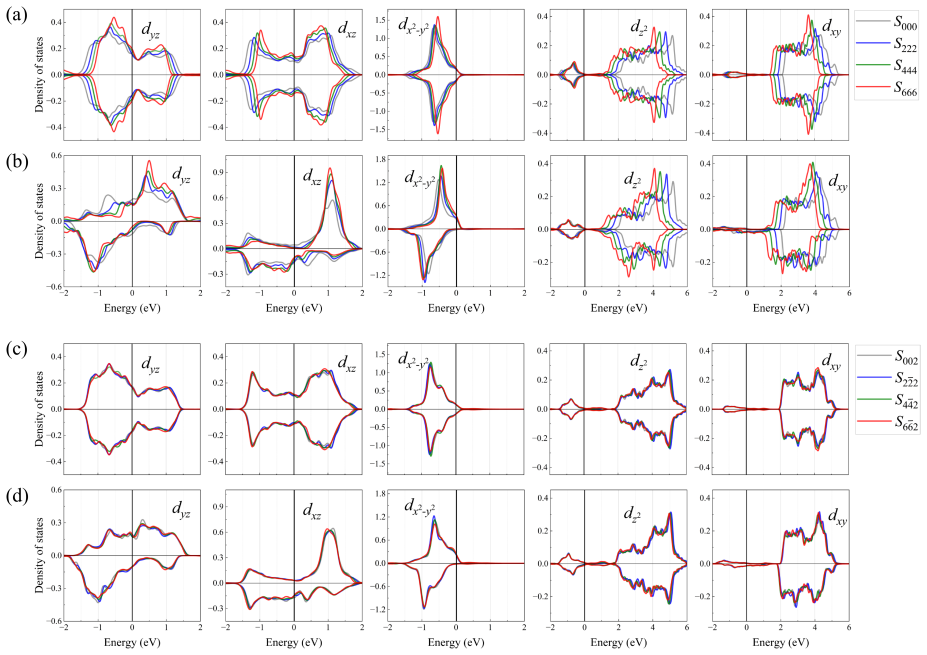
Density functional theory calculations identify multiple altermagnetic phases in RuO2 with different magnitudes of spin magnetic moment as the Hubbard U parameter is varied. When strains that significantly change the crystal cell volume are applied, the ground state undergoes transitions between the nonmagnetic state, which has no spin splitting, and the magnetic states, which exhibit spin splitting in the band structure.
What carries the argument
Strain that alters crystal cell volume, which modulates the correlation-driven transition between nonmagnetic and altermagnetic states in the DFT+U phase diagram.
If this is right
- Multiple altermagnetic phases with different spin moments are stable for different strengths of electron correlations.
- Volume-altering strains can turn spin splitting in the bands on or off.
- The ground-state magnetism depends sensitively on the crystal cell volume.
- Sample-to-sample strain variations can explain why some experiments see nonmagnetic behavior and others see altermagnetic order.
- Strain provides a practical route to tune RuO2 for spintronic use.
Where Pith is reading between the lines
- Epitaxial thin films on lattice-mismatched substrates could be used to lock in a chosen magnetic state.
- The transitions should produce measurable changes in spin-dependent transport quantities such as the anomalous Hall effect.
- Similar volume-tuned magnetic transitions may occur in other 4d transition-metal rutile oxides.
Load-bearing premise
The DFT+U method with scanned Hubbard U values accurately captures the true ground state and magnetic transitions in RuO2 without significant errors from the approximation or choice of functional.
What would settle it
Experimental observation of whether spin splitting in the band structure of RuO2 appears or disappears when its unit-cell volume is changed by several percent under controlled hydrostatic pressure or epitaxial strain.
Figures



read the original abstract
Rutile RuO$_2$ has attracted great interest recently, as its magnetic ground state remains controversial. Experimental studies have reported either nonmagnetic or altermagnetic (AM) ground states in different crystalline samples of RuO$_2$, highlighting the need for a reasonable explanation to resolve this contradiction. In this study, density functional theory calculations are performed to reveal the correlation-sensitive and strain-dependent magnetism of bulk RuO$_2$. On one hand, multiple AM phases with different magnitudes of the spin magnetic moment are identified in the Hubbard parameter space for RuO$_2$. On the other hand, when appropriate strains which significantly change the crystal cell volume are applied, the ground state of RuO$_2$ can undergo transitions between the nonmagnetic state with no spin splitting and the magnetic states with spin splitting in the band structure. These findings not only demonstrate intriguing physics in 4d-electron-correlated RuO$_2$, but also retain its potential for spintronic applications.
Editorial analysis
A structured set of objections, weighed in public.
Referee Report
Summary. The manuscript uses DFT+U calculations to study rutile RuO2, identifying multiple altermagnetic (AM) phases with varying spin moments as a function of the Hubbard U parameter on Ru. It further shows that volume-changing strains can drive transitions between a nonmagnetic (NM) ground state (no spin splitting) and magnetic AM states (with spin splitting), offering an explanation for conflicting experimental reports on the magnetic ground state of RuO2.
Significance. If the strain-induced NM-AM transitions prove robust beyond the specific DFT+U parametrization, the work would resolve the experimental controversy on RuO2 magnetism and underscore the interplay of moderate 4d correlations and lattice strain in determining spin-split band structures, with direct relevance to spintronic device design. The identification of multiple AM phases in U-space is a useful mapping, though the overall predictive strength is limited by the empirical nature of U.
major comments (3)
- [Computational Methods] Computational Methods section: The Hubbard U for Ru is scanned to stabilize different AM phases, but no first-principles evaluation (linear-response or constrained-DFT) is reported for each strained cell volume; the NM-AM energy crossing at fixed U is therefore vulnerable to small shifts in U or XC functional, as small volume changes routinely move the transition point by several percent.
- [Results] Results on strain dependence: Total-energy comparisons between NM and AM states under volume-changing strains are presented without accompanying convergence tests, error estimates, or sensitivity analysis to U; this leaves the reported ground-state transitions dependent on the chosen parametrization rather than method-independent.
- [Discussion] Discussion of experimental reconciliation: The claim that strain explains NM vs. AM observations in different samples assumes the DFT+U magnetic states are faithful to experiment, yet no direct comparison to measured lattice parameters, magnetic moments, or band splittings from specific samples is provided to anchor the U values.
minor comments (2)
- [Abstract] Abstract and introduction: Specific numerical values of U used for the strain calculations and the precise strain magnitudes that induce the transitions are not stated, reducing reproducibility.
- [Figures] Figure captions: Labels for the different AM phases (e.g., by moment magnitude) and the corresponding U ranges should be added for clarity when discussing the parameter-space mapping.
Simulated Author's Rebuttal
We thank the referee for the careful reading of our manuscript and the constructive comments. We have addressed each major point below, with revisions where appropriate to strengthen the presentation of our DFT+U results on strain-dependent magnetism in RuO2.
read point-by-point responses
-
Referee: [Computational Methods] Computational Methods section: The Hubbard U for Ru is scanned to stabilize different AM phases, but no first-principles evaluation (linear-response or constrained-DFT) is reported for each strained cell volume; the NM-AM energy crossing at fixed U is therefore vulnerable to small shifts in U or XC functional, as small volume changes routinely move the transition point by several percent.
Authors: We agree that a volume-dependent first-principles U would be preferable for rigor. However, linear-response calculations for every strained cell are computationally prohibitive within the scope of this study and introduce their own methodological uncertainties. Our approach instead maps the full U-dependence at fixed volumes and then varies volume at representative U values, showing that NM-AM crossings occur across the physically plausible U window (0-4 eV). In the revised manuscript we have added an explicit discussion of this limitation together with a sensitivity plot showing how the transition strain shifts with U and with the choice of XC functional (PBE vs. PBEsol). revision: partial
-
Referee: [Results] Results on strain dependence: Total-energy comparisons between NM and AM states under volume-changing strains are presented without accompanying convergence tests, error estimates, or sensitivity analysis to U; this leaves the reported ground-state transitions dependent on the chosen parametrization rather than method-independent.
Authors: We have added convergence tests with respect to k-point density and plane-wave cutoff to the Supplementary Information, confirming that the reported energy differences are converged to better than 1 meV per formula unit. We now also present the NM-AM energy difference versus strain for three fixed U values (U = 1, 2, 3 eV), demonstrating that while the precise transition strain varies, the qualitative NM-to-AM switch remains robust. Error estimates derived from the SCF convergence threshold are stated in the revised text. revision: yes
-
Referee: [Discussion] Discussion of experimental reconciliation: The claim that strain explains NM vs. AM observations in different samples assumes the DFT+U magnetic states are faithful to experiment, yet no direct comparison to measured lattice parameters, magnetic moments, or band splittings from specific samples is provided to anchor the U values.
Authors: We have expanded the discussion to include a table comparing our calculated lattice constants and local Ru moments (for both NM and AM solutions) against published experimental values from multiple RuO2 samples. The NM state reproduces the lattice parameters reported in several non-magnetic studies, while the AM states are closer to samples showing magnetic signatures. Direct experimental band-splitting data remain scarce; we therefore limit our claim to consistency with existing ARPES and theoretical literature rather than quantitative anchoring of U. We have rephrased the text to present strain as a plausible reconciling mechanism rather than a definitive resolution. revision: yes
- Performing linear-response or constrained-DFT evaluations of U for every strained volume would require a separate, computationally intensive methodological study that lies outside the present scope.
Circularity Check
No significant circularity; standard DFT+U parameter scan with independent strain calculations
full rationale
The paper explores the Hubbard U parameter space to locate multiple altermagnetic phases in RuO2 and then applies volume-changing strains at selected U values to track energy crossings between nonmagnetic and magnetic states. This constitutes a conventional computational survey of model parameters rather than any self-definitional loop, fitted input renamed as prediction, or load-bearing self-citation. No equation or claim reduces to its own input by construction; the reported transitions are explicit numerical outcomes of the chosen DFT+U setup and are presented as such. The derivation chain remains self-contained against external benchmarks such as total-energy comparisons.
Axiom & Free-Parameter Ledger
free parameters (1)
- Hubbard U for Ru
axioms (1)
- domain assumption DFT+U with appropriate U reproduces the correlation-sensitive magnetism of RuO2
Forward citations
Cited by 1 Pith paper
-
Correlation-driven tunability of altermagnetism in RuO$_2$
Dynamical correlations in RuO2 drive it close to the paramagnetic-altermagnetic boundary, rendering its magnetic state tunable by minimal strain and explaining experimental conflicts.
Reference graph
Works this paper leans on
-
[1]
W. D. Ryden and A. W. Lawson, Electrical transport properties of IrO 2 and RuO 2, Phys. Rev. B1, 1494 (1970)
1970
-
[2]
W. D. Ryden and A. W. Lawson, Magnetic susceptibility of IrO 2 and RuO2, J. Chem. Phys. 52, 6058 (1970)
1970
-
[3]
J. E. Graebner, E. S. Greiner, and W. D. Ryden, Magnetothermal oscillations in RnO 2, OsO2, and IrO2, Phys. Rev. B13, 2426 (1976)
1976
-
[4]
Berlijn, P
T. Berlijn, P. C. Snijders, O. Delaire, H.-D. Zhou, T. A. Maier, H.-B. Cao, S.-X. Chi, M. Mat- suda, Y. Wang, M. R. Koehler, P. R. C. Kent, and H. H. Weitering, Itinerant antiferromag- netism in RuO 2, Phys. Rev. Lett.118, 077201 (2017)
2017
-
[5]
Z. H. Zhu, J. Strempfer, R. R. Rao, C. A. Occhialini, J. Pelliciari, Y. Choi, T. Kawaguchi, H. You, J. F. Mitchell, Y. Shao-Horn, and R. Comin, Anomalous antiferromagnetism in metal- lic RuO2 determined by resonant X-ray scattering, Phys. Rev. Lett.122, 017202 (2019)
2019
-
[6]
S. W. Lovesey, D. D. Khalyavin, and G. van der Laan, Magnetic properties of RuO 2 and charge-magnetic interference in bragg diffraction of circularly polarized x-rays, Phys. Rev. B 105, 014403 (2022)
2022
- [7]
-
[8]
Fedchenko, J
O. Fedchenko, J. Min´ ar, A. Akashdeep, S. W. D’Souza, D. Vasilyev, O. Tkach, L. Odenbreit, Q. Nguyen, D. Kutnyakhov, N. Wind, L. Wenthaus, M. Scholz, K. Rossnagel, M. Hoesch, M. Aeschlimann, B. Stadtm¨ uller, M. Kl¨ aui, G. Sch¨ onhense, T. Jungwirth, A. B. Hellenes, G. Jakob, L. ˇSmejkal, J. Sinova, and H.-J. Elmers, Observation of time-reversal symmetr...
2024
-
[9]
Lytvynenko, A
Y. Lytvynenko, A. Akashdeep, T. P. Vo, O. Tkach, S. V. Chernov, A. Gloskovskii, C. Schlueter, C. Luo, V. Ukleev, F. Radu, F. Kronast, T. Hiroto, A. Winkelmann, J. Min´ ar, M. Kl¨ aui, G. Sch¨ onhense, G. Jakob, H. J. Elmers, and O. Fedchenko, Magnetic circular dichroism in core-level x-ray photoelectron spectroscopy of altermagnetic RuO 2 films, Phys. Rev...
2026
-
[10]
Zhang, H
Y.-C. Zhang, H. Bai, D.-H. Zhang, C. Chen, L. Han, S.-X. Liang, R.-Y. Chu, J.-K. Dai, M. Sawicki, F. Pan, and C. Song, Probing the N´ eel order in altermagnetic RuO 2 films via X-ray magnetic linear dichroism, Chin. Phys. Lett.42, 027301 (2025)
2025
-
[11]
C. He, Z. Wen, J. Okabayashi, Y. Miura, T. Ma, T. Ohkubo, T. Seki, H. Sukegawa, and S. Mitani, Evidence for single variant in altermagnetic RuO 2(101) thin films, Nat. Commun. 16, 8235 (2025)
2025
-
[12]
Y. Guo, J. Zhang, Z. Zhu, Y. Jiang, L. Jiang, C. Wu, J. Dong, X. Xu, W. He, B. He, Z. Huang, L. Gu, G. Zhang, K. Wu, X. Han, D. Shao, G. Yu, and H. Wu, Direct and inverse spin splitting effects in altermagnetic RuO 2, Advanced Science11, 2400967 (2024)
2024
-
[13]
S. G. Jeong, I. H. Choi, S. Nair, L. Buiarelli, B. Pourbahari, J. Y. Oh, N. Bassim, D. Hirai, A. Seo, W. S. Choi, R. M. Fernandes, T. Birol, L. Zhao, J. S. Lee, and B. Jalan, Altermagnetic polar metallic phase in ultra-thin epitaxially-strained RuO2 films, Proc. Natl. Acad. Sci. U.S.A. 123, e2526641123 (2026)
2026
-
[14]
Y. Zhang, S. G. Jeong, L. Buiarelli, S. Lee, Y. Guo, J. Wen, H. Li, S. Nair, I. H. Choi, Z. Ren, Z. Yue, A. Fedorov, S.-K. Mo, J. Kono, J. S. Lee, T. Low, T. Birol, R. M. Fernandes, M. Radovic, B. Jalan, and M. Yi, Observation of mirror-odd and mirror-even spin texture in ultra-thin epitaxially-strained RuO 2 films (2025), arXiv:2509.16361
-
[15]
J. Song, S. H. Lee, S. Kang,et al., Spin-orbit coupling driven magnetic response in altermag- netic RuO2, Small , 2407724 (2024)
2024
-
[16]
ˇSmejkal, J
L. ˇSmejkal, J. Sinova, and T. Jungwirth, Beyond conventional ferromagnetism and antiferro- magnetism: A phase with nonrelativistic spin and crystal rotation symmetry, Phys. Rev. X 12, 031042 (2022)
2022
-
[17]
ˇSmejkal, J
L. ˇSmejkal, J. Sinova, and T. Jungwirth, Emerging research landscape of altermagnetism, Phys. Rev. X12, 040501 (2022)
2022
-
[18]
J. Liu, J. Zhan, T. Li, J. Liu, S. Cheng, Y. Shi, L. Deng, M. Zhang, C. Li, J. Ding, Q. Jiang, M. Ye, Z. Liu, Z. Jiang, S. Wang, Q. Li, Y. Xie, Y. Wang, S. Qiao, J. Wen, Y. Sun, and D. Shen, Absence of altermagnetic spin splitting character in rutile oxide RuO 2, Phys. Rev. Lett.133, 176401 (2024)
2024
-
[19]
Osumi, K
T. Osumi, K. Yamauchi, S. Souma, P. Shubhankar, A. Honma, K. Nakayama, K. Ozawa, M. Kitamura, K. Horiba, H. Kumigashira, C. Bigi, F. Bertran, T. Oguchi, T. Takahashi, Y. Maeno, and T. Sato, Spin-degenerate bulk bands and topological surface states of RuO 2, 15 Phys. Rev. B113, 085116 (2026)
2026
-
[20]
Hiraishi, H
M. Hiraishi, H. Okabe, A. Koda, R. Kadono, T. Muroi, D. Hirai, and Z. Hiroi, Nonmagnetic ground state in RuO 2 revealed by muon spin rotation, Phys. Rev. Lett.132, 166702 (2024)
2024
-
[21]
Keßler, L
P. Keßler, L. Garcia-Gassull, A. Suter, T. Prokscha, Z. Salman, D. Khalyavin, P. Manuel, F. Orlandi, I. I. Mazin, R. Valent´ ı, and S. Moser, Absence of magnetic order in RuO2: insights fromµSR spectroscopy and neutron diffraction, npj Spintronics2, 50 (2024)
2024
-
[22]
Kiefer, F
L. Kiefer, F. Wirth, A. Bertin, P. Becker, L. Bohaty, K. Schmalzl, A. Stunault, J. A. Rodr´ ıguez- Velamaz´ an, O. Fabelo, and M. Braden, Crystal structure and absence of magnetic order in single-crystalline RuO2, J. Phys.: Condens. Matter37, 135801 (2025)
2025
-
[23]
Wenzel, E
M. Wenzel, E. Uykur, S. R¨ oßler, M. Schmidt, O. Janson, A. Tiwari, M. Dressel, and A. A. Tsirlin, Fermi-liquid behavior of nonaltermagnetic RuO 2, Phys. Rev. B111, L041115 (2025)
2025
-
[24]
J. Song, C. Mu, S. Zhu, X. Zhou, W. Wu, Y.-z. Long, J. Luo, and Z. Li, Absence of magnetic order and magnetic fluctuations in RuO 2, Phys. Rev. B112, 144444 (2025)
2025
-
[25]
Yumnam, P
G. Yumnam, P. R. Raghuvanshi, J. D. Budai, L. Bocklage, D. Abernathy, Y. Cheng, A. H. Said, I. I. Mazin, H. Zhou, B. A. Frandsen, D. S. Parker, L. R. Lindsay, V. R. Cooper, M. E. Manley, and R. P. Hermann, Constraints on magnetism and correlations in RuO2 from lattice dynamics and M¨ ossbauer spectroscopy, Cell Rep. Phys. Sci.6, 102852 (2025)
2025
-
[26]
S. Wang, C. Wang, Y. Yuan, J. Li, F. Pei, D. Liu, C. Qin, J. Cao, Y. Wang, T. Wang, J. Liu, J.-E. Lee, G. Zhang, C. Klewe, C. Yu, F. Zhang, D. Song, K. Chen, W. Zhao, D. Shen, Z. Qiu, M. Yang, B. Hong, and Q. Li, Absence of magnetic order in epitaxial RuO 2 revealed by x-ray linear dichroism, Phys. Rev. B113, 024439 (2026)
2026
-
[27]
Wang, Z.-Y
Y.-C. Wang, Z.-Y. Shen, C.-H. Lin, W.-C. Hsu, Y.-S. Chen, Y.-Y. Chin, A. K. Singh, W.-L. Lee, C.-T. Chen, S.-Y. Huang, and D. Qu, Absence of transport altermagnetic spin-splitting effect in RuO 2, Nano Letters26, 2548 (2026)
2026
- [28]
- [29]
-
[30]
Liang, A
Q. Liang, A. Bieberle-Hutter, and G. Brocks, Anti-ferromagnetic RuO 2: A stable and robust OER catalyst over a large range of surface terminations, J. Phys. Chem. C126, 1337 (2022). 16
2022
-
[31]
D. Q. Ho, D. Q. To, R. Hu, G. W. Bryant, and A. Janotti, Symmetry-breaking induced surface magnetization in nonmagnetic RuO 2, Phys. Rev. Mater.9, 094406 (2025)
2025
-
[32]
Brahimi, D
S. Brahimi, D. Prakash Rai, and S. Lounis, Stabilizing altermagnetism in RuO 2 thin films, J. Phys.: Condens. Matter37, 395801 (2024)
2024
-
[33]
Akashdeep, S
A. Akashdeep, S. Krishna, J.-H. Ha, S. An, M. Gaerner, T. Prokscha, A. Suter, G. Janka, G. Reiss, T. Kuschel, D.-S. Han, A. Di Bernardo, Z. Salman, G. Jakob, and M. Kl¨ aui, Surface- localized magnetic order in RuO 2 thin films revealed by low-energy muon probes, Appl. Phys. Lett.128, 022406 (2026)
2026
- [34]
-
[35]
X. Peng, Z. Liu, S. Zhang, Y. Zhou, Y. Sun, Y. Su, C. Wu, T. Zhou, L. Liu, Y. Li, H. Wang, J. Yang, B. Chen, Y. Li, C. Xi, J. Du, Z. Jiao, Q. Wu, and M. Fang, Universal scaling behavior of transport properties in non-magnetic RuO 2, Commun. Mater.6, 177 (2025)
2025
-
[36]
C. A. Occhialini, C. Nelson, A. Bombardi, S. Fan, R. Acevedo-Esteves, R. Comin, D. N. Basov, M. Musashi, M. Kawasaki, M. Uchida, and J. Pelliciari, Structural origin of resonant diffraction in RuO 2, Phys. Rev. B113, L060411 (2026)
2026
-
[37]
Pawula, A
F. Pawula, A. Fakih, R. Daou, S. H´ ebert, N. Mordvinova, O. Lebedev, D. Pelloquin, and A. Maignan, Multiband transport in RuO 2, Phys. Rev. B110, 064432 (2024)
2024
-
[38]
Mukuda, K
H. Mukuda, K. Ishida, Y. Kitaoka, K. Asayama, R. Kanno, and M. Takano, Spin fluctuations in the ruthenium oxides RuO 2, SrRuO 3, CaRuO 3, and Sr 2RuO4 probed by Ru NMR, Phys. Rev. B60, 12279 (1999)
1999
-
[39]
Hariki, Y
A. Hariki, Y. Takahashi, and J. Kuneˇ s, X-ray magnetic circular dichroism in RuO 2, Phys. Rev. B109, 094413 (2024)
2024
-
[40]
S. G. Jeong, S. Lee, B. Lin, and B. Jalan, Metallicity and anomalous hall effect in epitaxially strained, atomically thin RuO 2 films, Proc. Natl. Acad. Sci. U.S.A.122, e2500831122 (2025)
2025
-
[41]
Torun, C
E. Torun, C. M. Fang, G. A. de Wijs, and R. A. de Groot, Role of magnetism in catalysis: RuO2 (110) surface, J. Phys. Chem. C117, 6353 (2013)
2013
-
[42]
Jiang, L
H. Jiang, L. Wang, S. Hu, W. Xie, Y. Min, J. Yang, F. Liu, Y. Lu, L. Xie, and H. Huang, Strain-induced giant enhancement of magnetism in RuO 2 films, Adv. Funct. Mater. , e28172 (2026)
2026
-
[43]
Smolyanyuk, I
A. Smolyanyuk, I. I. Mazin, L. Garcia-Gassull, and R. Valent´ ı, Fragility of the magnetic order 17 in the prototypical altermagnet RuO 2, Phys. Rev. B109, 134424 (2024)
2024
-
[44]
B. Z. Gregory, J. Strempfer, D. Weinstock, J. P. Ruf, Y. Sun, H. Nair, N. J. Schreiber, D. G. Schlom, K. M. Shen, and A. Singer, Strain-induced orbital-energy shift in antiferromagnetic RuO2 revealed by resonant elastic x-ray scattering, Phys. Rev. B106, 195135 (2022)
2022
-
[45]
Z. Qian, Y. Yang, S. Liu, and C. Wu, Fragile unconventional magnetism in RuO2 by proximity to Landau-Pomeranchuk instability, Phys. Rev. B111, 174425 (2025)
2025
-
[46]
K.-H. Ahn, A. Hariki, K.-W. Lee, and J. Kuneˇ s, Antiferromagnetism in RuO 2 as d-wave Pomeranchuk instability, Phys. Rev. B99, 184432 (2019)
2019
-
[47]
Y. Hou, J. Lu, X. Chen, J. Lu, W. Zheng, G. Liu, and P. Zhang, Supplymentary Material of Nonmagnetic-magnetic transitions in rutile RuO 2 (2026), url
2026
-
[48]
C. A. Occhialini, V. Bisogni, H. You, A. Barbour, I. Jarrige, J. F. Mitchell, R. Comin, and J. Pelliciari, Local electronic structure of rutile RuO 2, Phys. Rev. Research3, 033214 (2021)
2021
-
[49]
J. B. Goodenough, Direct cation–cation interactions in several oxides, Phys. Rev.117, 1442 (1960)
1960
-
[50]
Y. Hou, Z. Shao, M. Pan, S. Wu, F. Zheng, Z. Fu, and P. Zhang, Nonmagnetic ground state of marcasite FeTe 2: The competition between crystal field splitting and on-site Coulomb repulsion, Phys. Rev. Mater.9, 124414 (2025)
2025
-
[51]
S. L. Dudarev, G. A. Botton, S. Y. Savrasov, C. J. Humphreys, and A. P. Sutton, Electron- energy-loss spectra and the structural stability of nickel oxide: An LSDA+U study,, Phys. Rev. B57, 1505 (1998)
1998
-
[52]
E. C. Stoner, Collective electron ferromagnetism, Proc. A165, 372 (1938)
1938
-
[53]
Reichlova, R
H. Reichlova, R. L. Seeger, R. Gonz´ alez-Hern´ andez,et al., Observation of a spontaneous anomalous hall response in the Mn 5Si3 d-wave altermagnet candidate, Nat. Comm.15, 4961 (2024)
2024
-
[54]
J. D. S. Forte, S. G. Jeong, A. Santhosh, S. Lee, B. Jalan, and T. Low, Strain engineering of altermagnetic symmetry in epitaxial RuO 2 films (2026), arXiv:2510.26581v2
work page internal anchor Pith review Pith/arXiv arXiv 2026
- [55]
discussion (0)
Sign in with ORCID, Apple, or X to comment. Anyone can read and Pith papers without signing in.