Recognition: 2 theorem links
· Lean TheoremCorrelation-driven tunability of altermagnetism in RuO₂
Pith reviewed 2026-05-14 18:16 UTC · model grok-4.3
The pith
Dynamical correlations in RuO2 drive it close to the paramagnetic-altermagnetic boundary, rendering its magnetic state tunable by minimal strain and explaining experimental conflicts.
A machine-rendered reading of the paper's core claim, the machinery that carries it, and where it could break.
Core claim
dynamical correlation effects are the key driving force behind the highly tunable magnetic ground state of RuO₂; even a minimal compressive strain of ∼0.5% is sufficient to drive the system into an altermagnetic phase.
Load-bearing premise
The specific values chosen for the local Hubbard interaction and Hund's coupling in the DMFT impurity solver accurately locate RuO2 near the paramagnetic-altermagnetic boundary without post-hoc adjustment that would move the system across the transition.
Figures




read the original abstract
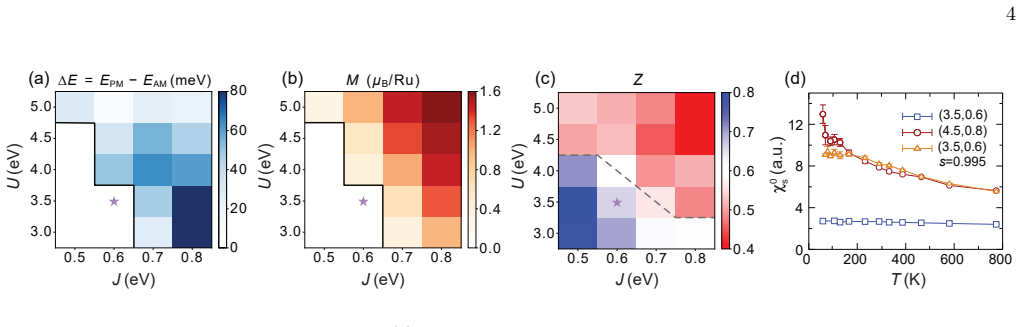
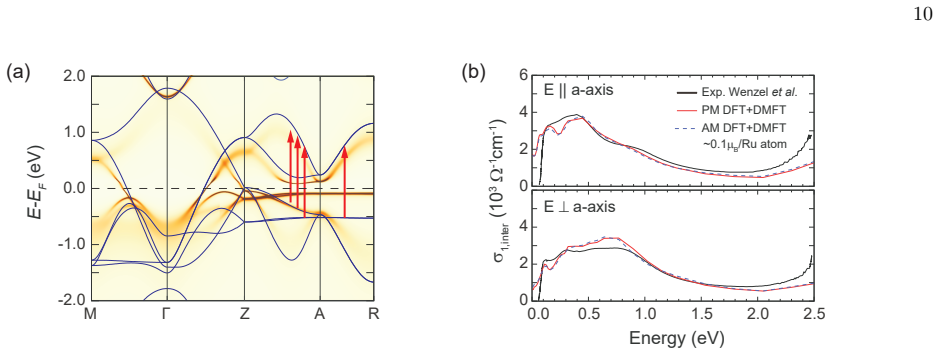
RuO$_2$ has been regarded as a prototypical candidate for metallic altermagnet, offering a potential platform for high-speed and high-efficiency spintronics. However, the magnetic ground state of RuO$_2$ remains a topic of active debate due to conflicting experimental reports. In this work, we investigate the effect of electron correlations in RuO$_2$ using density functional theory combined with dynamical mean-field theory (DFT+DMFT). In contrast to previous DFT-based studies, DFT+DMFT captures essential dynamical correlation effects, yielding spectral functions and optical conductivities in excellent quantitative agreement with experiments, and further reveals that RuO$_2$ resides in the close vicinity of both the paramagnetic-altermagnetic phase boundary and the itinerant-localized crossover, rendering the magnetic ground state highly susceptible to external perturbations. Indeed, even a minimal compressive strain of $\sim$0.5% is sufficient to drive the system into an altermagnetic phase. These findings elucidate the origin of the conflicting experimental observations and reveal that dynamical correlation effects are the key driving force behind the highly tunable magnetic ground state of RuO$_2$.
Editorial analysis
A structured set of objections, weighed in public.
Axiom & Free-Parameter Ledger
free parameters (1)
- Hubbard U and Hund J for Ru 4d orbitals
axioms (1)
- domain assumption DMFT local self-energy approximation
Lean theorems connected to this paper
-
IndisputableMonolith/Cost/FunctionalEquation.leanwashburn_uniqueness_aczel unclear?
unclearRelation between the paper passage and the cited Recognition theorem.
DFT+DMFT calculations were performed at T∼58 K with (U, J) = (3.5,0.6) eV... U−J phase diagram of the energy difference between PM and AM states... quasiparticle weight Z of Rud x2−y2 orbital
-
IndisputableMonolith/Foundation/AlphaCoordinateFixation.leanalpha_pin_under_high_calibration unclear?
unclearRelation between the paper passage and the cited Recognition theorem.
the AM solution is not stabilized unless U is sufficiently large... itinerant-to-localized crossover
What do these tags mean?
- matches
- The paper's claim is directly supported by a theorem in the formal canon.
- supports
- The theorem supports part of the paper's argument, but the paper may add assumptions or extra steps.
- extends
- The paper goes beyond the formal theorem; the theorem is a base layer rather than the whole result.
- uses
- The paper appears to rely on the theorem as machinery.
- contradicts
- The paper's claim conflicts with a theorem or certificate in the canon.
- unclear
- Pith found a possible connection, but the passage is too broad, indirect, or ambiguous to say the theorem truly supports the claim.
Reference graph
Works this paper leans on
-
[1]
ˇSmejkal, J
L. ˇSmejkal, J. Sinova, and T. Jungwirth, Physical Review X12, 031042 (2022)
2022
-
[2]
ˇSmejkal, J
L. ˇSmejkal, J. Sinova, and T. Jungwirth, Physical Review X12, 040501 (2022). 7
2022
-
[3]
Jungwirth, J
T. Jungwirth, J. Sinova, R. M. Fernandes, Q. Liu, H. Watanabe, S. Murakami, S. Nakatsuji, and L.ˇSmejkal, Nature649, 837 (2026)
2026
-
[4]
ˇSmejkal, A
L. ˇSmejkal, A. B. Hellenes, R. Gonz´ alez-Hern´ andez, J. Sinova, and T. Jungwirth, Physical Review X12, 011028 (2022)
2022
-
[5]
T. Jungwirth, J. Sinova, P. Wadley, D. Kriegner, H. Reichlova, F. Krizek, H. Ohno, and L. Smejkal, arXiv:2508.09748 (2025)
-
[6]
C. Song, H. Bai, Z. Zhou, L. Han, H. Reichlova, J. H. Dil, J. Liu, X. Chen, and F. Pan, Nature Reviews Materials 10, 473 (2025)
2025
-
[7]
ˇSmejkal, R
L. ˇSmejkal, R. Gonz´ alez-Hern´ andez, T. Jungwirth, and J. Sinova, Science Advances6, eaaz8809 (2020)
2020
-
[8]
Gonz´ alez-Hern´ andez, L.ˇSmejkal, K
R. Gonz´ alez-Hern´ andez, L.ˇSmejkal, K. V` yborn` y, Y. Ya- hagi, J. Sinova, T. Jungwirth, and J. ˇZelezn` y, Physical Review Letters126, 127701 (2021)
2021
-
[9]
A. Bose, N. J. Schreiber, R. Jain, D.-F. Shao, H. P. Nair, J. Sun, X. S. Zhang, D. A. Muller, E. Y. Tsymbal, D. G. Schlom, et al., Nature Electronics5, 267 (2022)
2022
-
[10]
H. Bai, L. Han, X. Feng, Y. Zhou, R. Su, Q. Wang, L. Liao, W. Zhu, X. Chen, F. Pan,et al., Physical Review Letters128, 197202 (2022)
2022
-
[11]
Karube, T
S. Karube, T. Tanaka, D. Sugawara, N. Kadoguchi, M. Kohda, and J. Nitta, Physical Review Letters129, 137201 (2022)
2022
-
[12]
Fedchenko, J
O. Fedchenko, J. Min´ ar, A. Akashdeep, S. W. D’Souza, D. Vasilyev, O. Tkach, L. Odenbreit, Q. Nguyen, D. Kut- nyakhov, N. Wind, et al., Science Advances10, eadj4883 (2024)
2024
-
[13]
Berlijn, P
T. Berlijn, P. C. Snijders, O. Delaire, H.-D. Zhou, T. A. Maier, H.-B. Cao, S.-X. Chi, M. Matsuda, Y. Wang, M. R. Koehler, et al., Physical Review Letters118, 077201 (2017)
2017
-
[14]
Z. Zhu, J. Strempfer, R. Rao, C. Occhialini, J. Pelliciari, Y. Choi, T. Kawaguchi, H. You, J. Mitchell, Y. Shao- Horn, et al., Physical Review Letters122, 017202 (2019)
2019
-
[15]
Z. Feng, X. Zhou, L. ˇSmejkal, L. Wu, Z. Zhu, H. Guo, R. Gonz´ alez-Hern´ andez, X. Wang, H. Yan, P. Qin,et al., Nature Electronics5, 735 (2022)
2022
-
[16]
T. Tschirner, P. Keßler, R. D. Gonzalez Betancourt, T. Kotte, D. Kriegner, B. B¨ uchner, J. Dufouleur, M. Kamp, V. Jovic, L. Smejkal, et al., APL Materials 11, doi.org/10.1063/5.0160335 (2023)
-
[17]
Hiraishi, H
M. Hiraishi, H. Okabe, A. Koda, R. Kadono, T. Muroi, D. Hirai, and Z. Hiroi, Physical Review Letters132, 166702 (2024)
2024
-
[18]
Keßler, L
P. Keßler, L. Garcia-Gassull, A. Suter, T. Prokscha, Z. Salman, D. Khalyavin, P. Manuel, F. Orlandi, I. I. Mazin, R. Valent´ ı,et al., npj Spintronics2, 50 (2024)
2024
-
[19]
J. Liu, J. Zhan, T. Li, J. Liu, S. Cheng, Y. Shi, L. Deng, M. Zhang, C. Li, J. Ding, et al., Physical Review Letters 133, 176401 (2024)
2024
-
[20]
Wenzel, E
M. Wenzel, E. Uykur, S. R¨ oßler, M. Schmidt, O. Janson, A. Tiwari, M. Dressel, and A. A. Tsirlin, Physical Review B111, L041115 (2025)
2025
-
[21]
Z. Wu, M. Long, H. Chen, S. Paul, H. Matsuki, O. Zhe- liuk, U. Zeitler, G. Li, R. Zhou, Z. Zhu, et al., Physical Review X15, 031044 (2025)
2025
-
[22]
Kiefer, F
L. Kiefer, F. Wirth, A. Bertin, P. Becker, L. Bohat` y, K. Schmalzl, A. Stunault, J. A. Rodr´ ıguez-Velamaz´ an, O. Fabelo, and M. Braden, Journal of Physics: Con- densed Matter37, 135801 (2025)
2025
-
[23]
X. Peng, Z. Liu, S. Zhang, Y. Zhou, Y. Sun, Y. Su, C. Wu, T. Zhou, L. Liu, Y. Li, et al., Communications Materials6, 177 (2025)
2025
-
[24]
Smolyanyuk, I
A. Smolyanyuk, I. I. Mazin, L. Garcia-Gassull, and R. Valent´ ı, Physical Review B109, 134424 (2024)
2024
-
[25]
J. D. Forte, S. G. Jeong, A. Santhosh, S. Lee, B. Jalan, and T. Low, arXiv:2510.26581 (2025)
work page internal anchor Pith review Pith/arXiv arXiv 2025
-
[26]
Y.-X. Li, Y. Chen, L. Pan, S. Li, S.-B. Zhang, and H.-Z. Lu, Science China Physics, Mechanics & Astronomy69, 257001 (2026)
2026
-
[27]
Y. Liu, H. Bai, Y. Song, Z. Ji, S. Lou, Z. Zhang, C. Song, and Q. Jin, Advanced Optical Materials11, 2300177 (2023)
2023
-
[28]
H. Jung, G. So, S. Noh, G.-H. Kim, J. Lee, J. Lee, S. Lee, U. Seo, D.-S. Han, Y. S. Oh, et al., Nano Letters25, 16985 (2025)
2025
-
[29]
G. M. Q. Sun, Z. Xie, Y. Yang, Y. Zhang, N. Lei, and D. Wei, arXiv:2512.24099 https://doi.org/10.48550/arXiv.2512.24099 (2025)
-
[30]
Z. Li, Z. Zhang, Y. Chen, S. Hu, Y. Ji, Y. Yan, J. Du, Y. Li, L. He, X. Wang, et al., Advanced Materials37, 2416712 (2025)
2025
-
[31]
Mravlje, M
J. Mravlje, M. Aichhorn, T. Miyake, K. Haule, G. Kotliar, and A. Georges, Physical Review Letters106, 096401 (2011)
2011
-
[32]
Georges, L
A. Georges, L. d. Medici, and J. Mravlje, Annu. Rev. Condens. Matter Phys.4, 137 (2013)
2013
-
[33]
Wadati, J
H. Wadati, J. Mravlje, K. Yoshimatsu, H. Kumigashira, M. Oshima, T. Sugiyama, E. Ikenaga, A. Fujimori, A. Georges, A. Radetinac, et al., Physical Review B90, 205131 (2014)
2014
-
[34]
Kim and B
M. Kim and B. Min, Physical Review B91, 205116 (2015)
2015
-
[35]
X. Deng, K. Haule, and G. Kotliar, Phys. Rev. Lett.116, 256401 (2016)
2016
-
[36]
Zhang, E
G. Zhang, E. Gorelov, E. Sarvestani, and E. Pavarini, Phys. Rev. Lett.116, 106402 (2016)
2016
-
[37]
M. Kim, J. Mravlje, M. Ferrero, O. Parcollet, and A. Georges, Phys. Rev. Lett.120, 126401 (2018)
2018
-
[38]
Tamai, M
A. Tamai, M. Zingl, E. Rozbicki, E. Cappelli, S. Ricc` o, A. de la Torre, S. McKeown Walker, F. Y. Bruno, P. D. C. King, W. Meevasana, M. Shi, M. Radovi´ c, N. C. Plumb, A. S. Gibbs, A. P. Mackenzie, C. Berthod, H. U. R. Strand, M. Kim, A. Georges, and F. Baumberger, Phys. Rev. X9, 021048 (2019)
2019
-
[39]
Kim, C.-J
M. Kim, C.-J. Kang, J.-H. Han, K. Kim, and B. Kim, Phys. Rev. B106, L201103 (2022)
2022
-
[40]
Y. Ling, F. Pawula, R. Daou, B. Fauqu´ e, and K. Behnia, Physical Review Materials10, 035002 (2026)
2026
-
[41]
A. Sihi, S. Mandal, and K. Haule, arXiv:2601.12678 https://doi.org/10.48550/arXiv.2601.12678 (2026)
-
[42]
Meinert, arXiv:2512.04995 https://doi.org/10.48550/arXiv.2512.04995 (2025)
M. Meinert, arXiv:2512.04995 https://doi.org/10.48550/arXiv.2512.04995 (2025)
-
[43]
Y.-F. Hou, J. Lu, X. Chen, G.-B. Liu, and P. Zhang, arXiv:2604.14764 https://doi.org/10.48550/arXiv.2604.14764 (2026)
work page internal anchor Pith review Pith/arXiv arXiv doi:10.48550/arxiv.2604.14764 2026
-
[44]
De’Medici, J
L. De’Medici, J. Mravlje, and A. Georges, Physical Re- view Letters107, 256401 (2011)
2011
-
[45]
Stadler, Z
K. Stadler, Z. Yin, J. Von Delft, G. Kotliar, and A. We- ichselbaum, Physical Review Letters115, 136401 (2015)
2015
-
[46]
Georges and G
A. Georges and G. Kotliar, Physics Today77, 46 (2024)
2024
-
[47]
Kresse and J
G. Kresse and J. Furthm¨ uller, Physical Review B54, 11169 (1996)
1996
-
[48]
Kresse and D
G. Kresse and D. Joubert, Physical Review B59, 1758 8 (1999)
1999
-
[49]
J. P. Perdew, K. Burke, and M. Ernzerhof, Phys. Rev. Lett.78, 1396 (1997)
1997
-
[50]
Blaha, K
P. Blaha, K. Schwarz, F. Tran, R. Laskowski, G. K. H. Madsen, and L. D. Marks, The Journal of Chemical Physics152, 074101 (2020)
2020
-
[51]
Haule, C.-H
K. Haule, C.-H. Yee, and K. Kim, Physical Review B—Condensed Matter and Materials Physics81, 195107 (2010)
2010
-
[52]
Haule and T
K. Haule and T. Birol, Physical Review Letters115, 256402 (2015)
2015
-
[53]
C. A. Occhialini, V. Bisogni, H. You, A. Barbour, I. Jar- rige, J. Mitchell, R. Comin, and J. Pelliciari, Physical Review Research3, 033214 (2021). 9 Appendix A: DFT+DMFT Spectral Functions and Optical conductivity Fig. 4(a) shows the PM DFT+DMFT spectral function and DFT band structure over an extended energy win- dow. The red arrows, each spanning∼1.3 e...
2021
discussion (0)
Sign in with ORCID, Apple, or X to comment. Anyone can read and Pith papers without signing in.