Recognition: unknown
Sequence Search: Automated Sequence Design using Neural Architecture Search
Pith reviewed 2026-05-10 10:41 UTC · model grok-4.3
The pith
A neural architecture search method can automatically generate MRI pulse sequences from tissue properties and design goals alone, recovering standard sequences and finding new variants.
A machine-rendered reading of the paper's core claim, the machinery that carries it, and where it could break.
Core claim
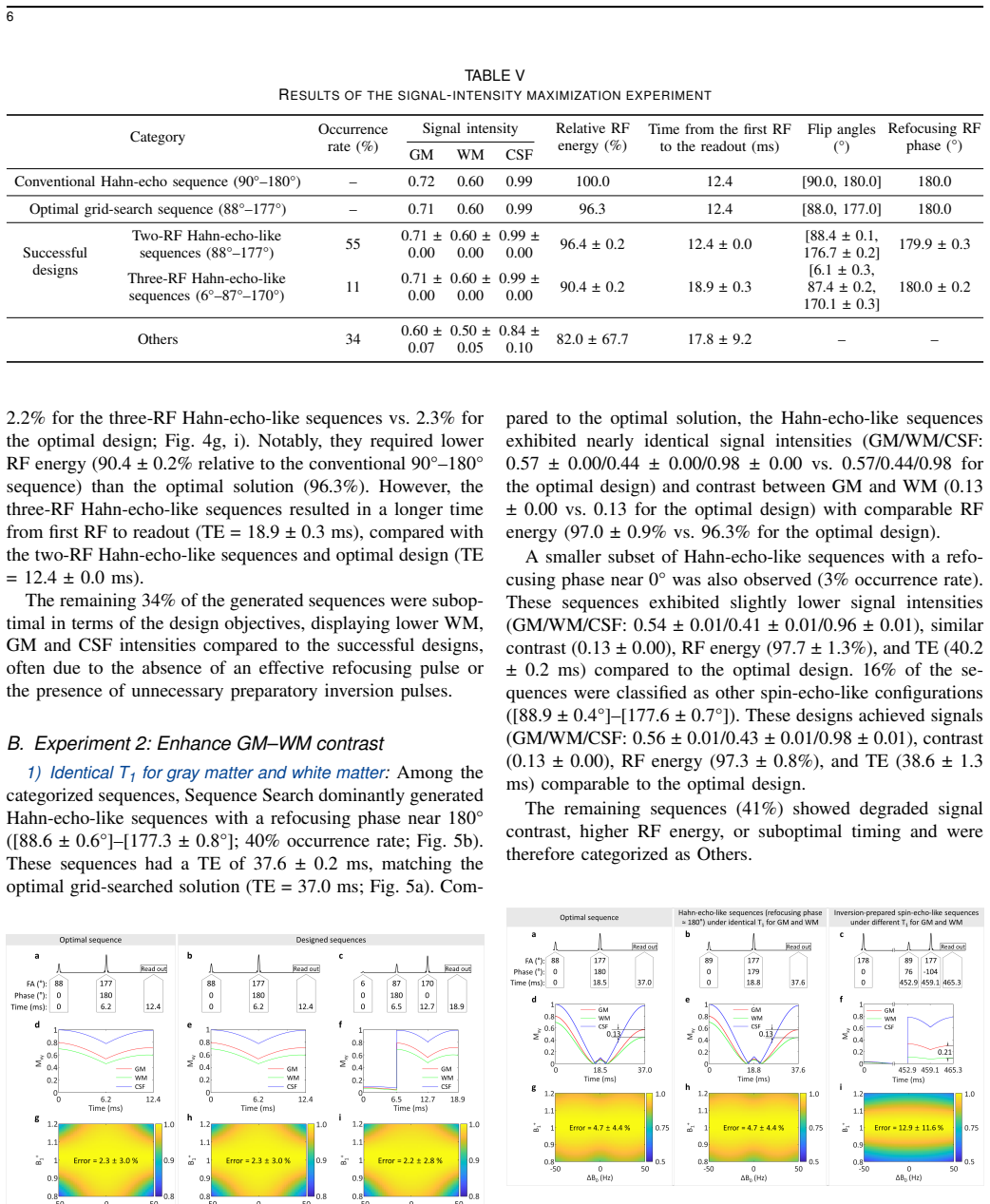
Sequence Search establishes that neural architecture search, paired with gradient-based optimization against a differentiable Bloch simulator, can produce valid MR pulse sequences that meet specified objectives without any initial sequence template or large training data, successfully replicating conventional spin-echo, T2-weighted spin-echo, and inversion recovery sequences while also identifying non-standard three-RF spin-echo-like sequences with reduced RF energy and altered refocusing phases.
What carries the argument
Neural architecture search that iteratively generates candidate pulse sequences and optimizes them via gradient descent on loss functions computed by a differentiable Bloch simulator.
If this is right
- Sequence design no longer requires an expert to supply a starting template or hand-tune parameters.
- New sequences can be generated for arbitrary combinations of tissue parameters and imaging goals.
- Sequences with lower RF energy deposition become discoverable without explicit prior constraints.
- The same search process can be applied to other objective functions such as specific contrast types or scan speed.
Where Pith is reading between the lines
- The framework could be extended to jointly optimize sequence and reconstruction parameters in a single loop.
- Validation on multiple scanner vendors would be needed before clinical deployment of any novel sequence.
- Similar search methods might apply to designing sequences for other modalities if accurate differentiable simulators exist.
Load-bearing premise
The Bloch simulator must model real MRI hardware and tissue behavior closely enough that sequences optimized in simulation remain effective and safe when run on actual scanners.
What would settle it
Running one of the discovered non-standard sequences on a physical MRI scanner and measuring whether the acquired images and signal intensities match the simulator predictions within acceptable error bounds.
Figures



read the original abstract
Developing an MR sequence is challenging and remains largely constrained by human intuition. Recently, AI-driven approaches have been proposed; however, most require an initial sequence for parameter optimization or extensive training datasets, limiting their general applicability. In this study, we propose "Sequence Search," an automated sequence design framework based on neural architecture search. The method takes tissue properties, imaging parameters, and design objectives as inputs and generates pulse sequences satisfying the design objectives, without requiring prior knowledge of conventional sequence structures. Sequence Search iteratively generates candidate sequences through neural architecture search and optimizes them via a differentiable Bloch simulator and objective-specific loss functions using gradient-based learning. The framework successfully replicated conventional spin-echo, T2-weighted spin-echo, and inversion recovery sequences. Less intuitive solutions were also discovered, such as three-RF spin-echo-like sequences with reduced RF energy and refocusing phases deviating from the conventional Hahn-echo. This work establishes a generalizable framework for automated MR sequence design, highlighting the potential to explore configurations beyond conventional designs based on human intuition.
Editorial analysis
A structured set of objections, weighed in public.
Referee Report
Summary. The manuscript proposes 'Sequence Search', a neural architecture search (NAS) framework for automated MRI pulse sequence design. It accepts tissue properties, imaging parameters, and design objectives as inputs, iteratively generates candidate sequences via NAS, and optimizes them using a differentiable Bloch simulator combined with gradient-based learning and objective-specific loss functions. The central claims are that the method replicates conventional sequences (spin-echo, T2-weighted spin-echo, inversion recovery) without prior structural knowledge and discovers less intuitive variants, such as three-RF spin-echo-like sequences with reduced RF energy and non-Hahn refocusing phases.
Significance. If the simulator-based results translate to hardware, the work would be significant for providing a generalizable, intuition-independent method to explore MRI sequence space beyond conventional designs. The combination of NAS with a differentiable Bloch simulator enables gradient-driven optimization without pre-defined targets or large training datasets, which is a methodological strength. However, the absence of quantitative metrics, error analysis, and experimental validation currently limits the assessed impact and generalizability.
major comments (2)
- [Abstract] Abstract: The replication of conventional sequences and discovery of novel variants are stated without any quantitative metrics (e.g., contrast values, signal fidelity, sequence duration, or comparison to reference implementations), error bars, or ablation studies. This directly under-supports the central claim that the framework 'successfully replicated' and 'discovered' sequences.
- [Abstract] Abstract (and implied Methods): The claim that less intuitive solutions (three-RF spin-echo-like sequences with reduced RF energy and non-Hahn phases) are valid rests on the differentiable Bloch simulator producing physically accurate gradients and signals. No details are given on simulator extensions for B1 inhomogeneity, gradient nonlinearity, RF pulse distortions, or SAR/hardware constraints, nor any cross-validation against real scanner data. This is load-bearing for the novelty claim, as standard Bloch models can be exploited by optimization.
minor comments (2)
- [Abstract] The abstract could more precisely define the NAS search space and sequence representation (e.g., how RF pulses and gradients are encoded as architectures).
- Consider adding a table or figure in the results that lists optimized sequence parameters, simulated signals, and objective losses for both conventional and novel designs to improve clarity and reproducibility.
Simulated Author's Rebuttal
We thank the referee for the constructive feedback. We address each major comment below and will revise the manuscript to strengthen the presentation of results and clarify methodological assumptions.
read point-by-point responses
-
Referee: [Abstract] Abstract: The replication of conventional sequences and discovery of novel variants are stated without any quantitative metrics (e.g., contrast values, signal fidelity, sequence duration, or comparison to reference implementations), error bars, or ablation studies. This directly under-supports the central claim that the framework 'successfully replicated' and 'discovered' sequences.
Authors: We agree that the abstract would benefit from explicit quantitative support. The full manuscript includes signal evolution plots and objective function values demonstrating replication of spin-echo, T2-weighted spin-echo, and inversion recovery sequences, along with comparisons of RF energy and echo times for the discovered variants. In revision we will add specific metrics (e.g., contrast ratios, normalized signal fidelity, sequence duration) with error bars from repeated NAS runs, plus a brief ablation on the architecture search components. These will be summarized in the abstract and expanded in Results. revision: yes
-
Referee: [Abstract] Abstract (and implied Methods): The claim that less intuitive solutions (three-RF spin-echo-like sequences with reduced RF energy and non-Hahn phases) are valid rests on the differentiable Bloch simulator producing physically accurate gradients and signals. No details are given on simulator extensions for B1 inhomogeneity, gradient nonlinearity, RF pulse distortions, or SAR/hardware constraints, nor any cross-validation against real scanner data. This is load-bearing for the novelty claim, as standard Bloch models can be exploited by optimization.
Authors: The simulator is a standard differentiable Bloch implementation that computes exact gradients under the rotating-frame approximation for ideal rectangular RF pulses and linear gradients. We will add an explicit Methods subsection detailing these assumptions and the absence of B1 inhomogeneity, gradient nonlinearity, or SAR modeling. The discovered three-RF sequences achieve the target objective (e.g., spin-echo contrast with lower total RF energy) strictly within the simulated physics; the non-Hahn refocusing phases emerge because the optimizer is free to adjust flip angles and phases without a Hahn-echo constraint. While we acknowledge that real-hardware effects could alter performance, the optimization is not exploiting numerical artifacts but satisfying the Bloch equations under the stated model. Full scanner validation lies outside the current simulation-focused scope. revision: partial
- Experimental validation on physical MRI hardware or in vivo subjects is absent; the work is limited to simulation results.
Circularity Check
No circularity: outputs derived via external simulator optimization
full rationale
The paper describes a NAS-based search that generates candidate sequences and optimizes them end-to-end using a differentiable Bloch simulator plus objective-specific losses. The resulting sequences (both conventional replications and novel variants) are produced by gradient descent on the simulator's forward model, not by re-expressing the inputs or by any self-referential definition. No equations or steps reduce the claimed discoveries to fitted parameters or prior self-citations; the simulator and NAS procedure are treated as independent computational engines. Replication of known sequences functions as external validation rather than a tautological outcome. This satisfies the default expectation of a non-circular derivation chain.
Axiom & Free-Parameter Ledger
free parameters (1)
- NAS hyperparameters and loss weights
axioms (1)
- domain assumption The Bloch equations provide a sufficiently accurate model of spin dynamics for sequence optimization.
Reference graph
Works this paper leans on
-
[1]
Self-play reinforcement learning guides protein engi- neering,
Y . Wanget al., “Self-play reinforcement learning guides protein engi- neering,”Nat. Mach. Intell., vol. 5, no. 8, pp. 845–860, Jul. 2023, doi: 10.1038/s42256-023-00691-9
-
[2]
Inverse molecular design using machine learning: Generative models for matter engineering,
B. Sanchez-Lengeling and A. Aspuru-Guzik, “Inverse molecular design using machine learning: Generative models for matter engineering,” Science, vol. 361, no. 6400, pp. 360–365, Jul. 2018, doi: 10.1126/sci- ence.aat2663
-
[3]
Deep reinforcement learning-designed radiofrequency waveform in MRI,
D. Shinet al., “Deep reinforcement learning-designed radiofrequency waveform in MRI,”Nat. Mach. Intell., vol. 3, no. 11, pp. 985–994, Nov. 2021, doi: 10.1038/s42256-021-00411-1
-
[4]
Deep reinforce- ment learning designed Shinnar-Le Roux RF pulse using root-flipping: DeepRFSLR,
D. Shin, S. Ji, D. Lee, J. Lee, S.-H. Oh, and J. Lee, “Deep reinforce- ment learning designed Shinnar-Le Roux RF pulse using root-flipping: DeepRFSLR,”IEEE Trans. Med. Imag., vol. 39, no. 12, pp. 4391–4400, Dec. 2020, doi: 10.1109/TMI.2020.3018508
-
[5]
M. S. Vinding, C. S. Aigner, S. Schmitter, and T. E. Lund, “DeepControl: 2DRF pulses facilitating B 1+ inhomogeneity and B 0 off-resonance compensation in vivo at 7 T,”Magn. Reson. Med., vol. 85, no. 6, pp. 3308–3317, Jun. 2021, doi: 10.1002/mrm.28667
-
[6]
T. Luo, D. C. Noll, J. A. Fessler, and J.-F. Nielsen, “Joint design of RF and gradient waveforms via auto-differentiation for 3D tailored excitation in MRI,”IEEE Trans. Med. Imag., vol. 40, no. 12, pp. 3305– 3314, Dec. 2021, doi: 10.1109/TMI.2021.3083104
-
[7]
Automated pulse sequence generation (AUTOSEQ) using Bayesian reinforcement learning in an MRI physics simulation environment,
B. Zhu, J. Liu, N. Koonjoo, B. R. Rosen, and M. S. Rosen, “Automated pulse sequence generation (AUTOSEQ) using Bayesian reinforcement learning in an MRI physics simulation environment,” inProc. Joint Annual Meeting ISMRM-ESMRMB, 2018, p. 0438
2018
-
[8]
Y . Zhanget al., “Multi-task convolutional neural network-based design of radio frequency pulse and the accompanying gradients for magnetic resonance imaging,”NMR Biomed., vol. 34, no. 2, p. e4443, Feb. 2021, doi: 10.1002/nbm.4443
-
[9]
Learning optimal k-space acquisition and reconstruction using physics-informed neural networks,
W. Peng, L. Feng, G. Zhao, and F. Liu, “Learning optimal k-space acquisition and reconstruction using physics-informed neural networks,” inProc. IEEE/CVF Conf. Comput. Vis. Pattern Recognit. (CVPR), 2022, pp. 20794–20803
2022
-
[10]
G. Wang, T. Luo, J.-F. Nielsen, D. C. Noll, and J. A. Fessler, “B-spline parameterized joint optimization of reconstruction and k-space trajecto- ries (BJORK) for accelerated 2D MRI,”IEEE Trans. Med. Imag., vol. 41, no. 9, pp. 2318–2330, Sep. 2022, doi: 10.1109/TMI.2022.3161875
-
[11]
Deep- learning-based optimization of the under-sampling pattern in MRI,
C. D. Bahadir, A. Q. Wang, A. V . Dalca, and M. R. Sabuncu, “Deep- learning-based optimization of the under-sampling pattern in MRI,” IEEE Trans. Comput. Imag., vol. 6, pp. 1139–1152, Jul. 2020, doi: 10.1109/TCI.2020.3006727
-
[12]
Active MR k-space sampling with reinforcement learning,
L. Pineda, S. Basu, A. Romero, R. Calandra, and M. Drozdzal, “Active MR k-space sampling with reinforcement learning,” inProc. Int. Conf. Med. Image Comput. Comput.-Assist. Intervent. (MICCAI), 2020, pp. 23–33
2020
-
[13]
Stochastic optimization of three-dimensional non-cartesian sampling trajectory,
G. Wang, J.-F. Nielsen, J. A. Fessler, and D. C. Noll, “Stochastic optimization of three-dimensional non-cartesian sampling trajectory,” Magn. Reson. Med., vol. 90, no. 2, pp. 417–431, Apr. 2023, doi: 10.1002/mrm.29645
-
[14]
S. P. Jordanet al., “Automated design of pulse sequences for magnetic resonance fingerprinting using physics-inspired optimization,”Proc. Natl. Acad. Sci. U.S.A., vol. 118, no. 40, p. e2020516118, Oct. 2021, doi: 10.1073/pnas.2020516118
-
[15]
MRzero – Automated discovery of MRI sequences using supervised learning,
A. Loktyushinet al., “MRzero – Automated discovery of MRI sequences using supervised learning,”Magn. Reson. Med., vol. 86, no. 2, pp. 709– 724, Jun. 2021, doi: 10.1002/mrm.28727
-
[16]
O. Perlman, B. Zhu, M. Zaiss, M. S. Rosen, and C. T. Farrar, “An end- to-end AI-based framework for automated discovery of rapid CEST/MT MRI acquisition protocols and molecular parameter quantification (Au- toCEST),”Magn. Reson. Med., vol. 87, no. 6, pp. 2792–2810, Jun. 2022, doi: 10.1002/mrm.29173
-
[17]
Using deep reinforcement learning to actively, adaptively and autonomously control a simulated MRI scanner,
S. Walker-Samuel, “Using deep reinforcement learning to actively, adaptively and autonomously control a simulated MRI scanner,” inProc. ISMRM 27th Annual Meeting & Exhibition, 2019, p. 0473
2019
-
[18]
X. He, K. Zhao, and X. Chu, “AutoML: A survey of the state- of-the-art,”Knowl.-Based Syst., vol. 212, p. 106622, Jan. 2021, doi: 10.1016/j.knosys.2020.106622
-
[19]
T. Elsken, J. H. Metzen, and F. Hutter, “Neural architecture search,” inAutomated Machine Learning: Methods, Systems, Challenges. Cham, Switzerland: Springer, 2019, pp. 63–77, doi: 10.1007/978-3-030-05318- 5 3
-
[20]
Neural architecture search: A survey,
T. Elsken, J. H. Metzen, and F. Hutter, “Neural architecture search: A survey,”J. Mach. Learn. Res., vol. 20, no. 1, pp. 1997–2017, 2019
1997
-
[21]
ProxylessNAS: Direct Neural Architecture Search on Target Task and Hardware
H. Cai, L. Zhu, and S. Han, “ProxylessNAS: Direct neural architecture search on target task and hardware,” inProc. Int. Conf. Learn. Represent. (ICLR), 2019, doi: 10.48550/arXiv.1812.00332
-
[22]
Adam: A Method for Stochastic Optimization
D. P. Kingma and J. Ba, “Adam: A method for stochastic optimization,” arXiv:1412.6980, 2014, doi: 10.48550/arXiv.1412.6980
work page internal anchor Pith review Pith/arXiv arXiv doi:10.48550/arxiv.1412.6980 2014
-
[23]
Theory of NMR signal behavior in magnetically inhomogeneous tissues: The static dephasing regime,
D. A. Yablonskiy and E. M. Haacke, “Theory of NMR signal behavior in magnetically inhomogeneous tissues: The static dephasing regime,” Magn. Reson. Med., vol. 32, no. 6, pp. 749–763, Dec. 1994, doi: 10.1002/mrm.1910320610
-
[24]
Postprocessing technique to correct for background gradients in image-based R 2* measurements,
M. A. Fernandez-Seara and F. W. Wehrli, “Postprocessing technique to correct for background gradients in image-based R 2* measurements,” Magn. Reson. Med., vol. 44, no. 3, pp. 358–366, Sep. 2000, doi: 10.1002/1522-2594(200009)44:3<358::aid-mrm3>3.0.co;2-i
-
[25]
NMR relaxation times in the human brain at 3.0 tesla,
J. P. Wansapura, S. K. Holland, R. S. Dunn, and W. S. Ball, Jr., “NMR relaxation times in the human brain at 3.0 tesla,”J. Magn. Reson. Imag., vol. 9, no. 4, pp. 531–538, Apr. 1999, doi: 10.1002/(sici)1522- 2586(199904)9:4<531::aid-jmri4>3.0.co;2-l
-
[26]
M. Sabati and A. A. Maudsley, “Fast and high-resolution quantitative mapping of tissue water content with full brain coverage for clinically- driven studies,”Magn. Reson. Imag., vol. 31, no. 10, pp. 1752–1759, Dec. 2013, doi: 10.1016/j.mri.2013.08.001
-
[27]
T 2* measurements in human brain at 1.5, 3 and 7 T,
A. M. Peterset al., “T 2* measurements in human brain at 1.5, 3 and 7 T,”Magn. Reson. Imag., vol. 25, no. 6, pp. 748–753, Jul. 2007, doi: 10.1016/j.mri.2007.02.014
-
[28]
Chapter 8 – Nuclear magnetism of tissue,
F. A. Duck, “Chapter 8 – Nuclear magnetism of tissue,” inPhysical Properties of Tissue. London, U.K.: Academic Press, 1990, pp. 279– 317
1990
-
[29]
PyTorch: An imperative style, high-performance deep learning library,
A. Paszkeet al., “PyTorch: An imperative style, high-performance deep learning library,” inProc. Adv. Neural Inf. Process. Syst. (NeurIPS), vol. 32, 2019, pp. 8024–8035
2019
-
[30]
MR-double-zero – Proof-of-concept for a framework to autonomously discover MRI contrasts,
F. Glang, S. Mueller, K. Herz, A. Loktyushin, K. Scheffler, and M. Zaiss, “MR-double-zero – Proof-of-concept for a framework to autonomously discover MRI contrasts,”J. Magn. Reson., vol. 341, p. 107237, Aug. 2022, doi: 10.1016/j.jmr.2022.107237
discussion (0)
Sign in with ORCID, Apple, or X to comment. Anyone can read and Pith papers without signing in.