Recognition: unknown
Understanding jump discontinuity in disordered system
Pith reviewed 2026-05-10 08:45 UTC · model grok-4.3
The pith
In the diluted Bethe-lattice random-field Ising model the magnetization jump is the sum of contributions from sites with coordination 4, 3, 2, 1 and 0, all occurring at the identical critical field value.
A machine-rendered reading of the paper's core claim, the machinery that carries it, and where it could break.
Core claim
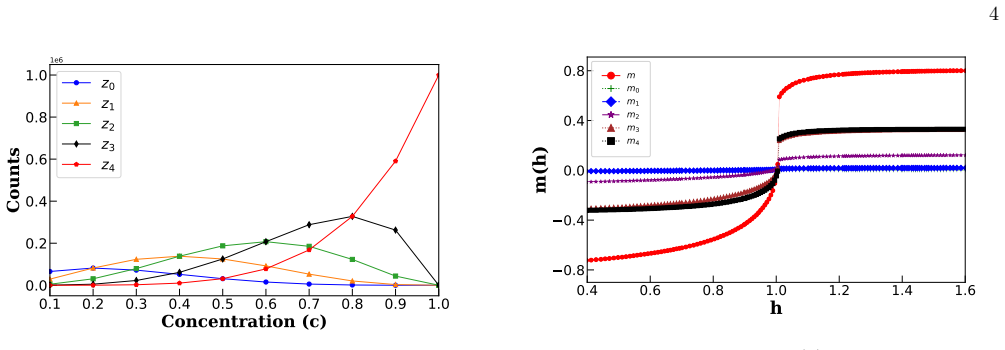
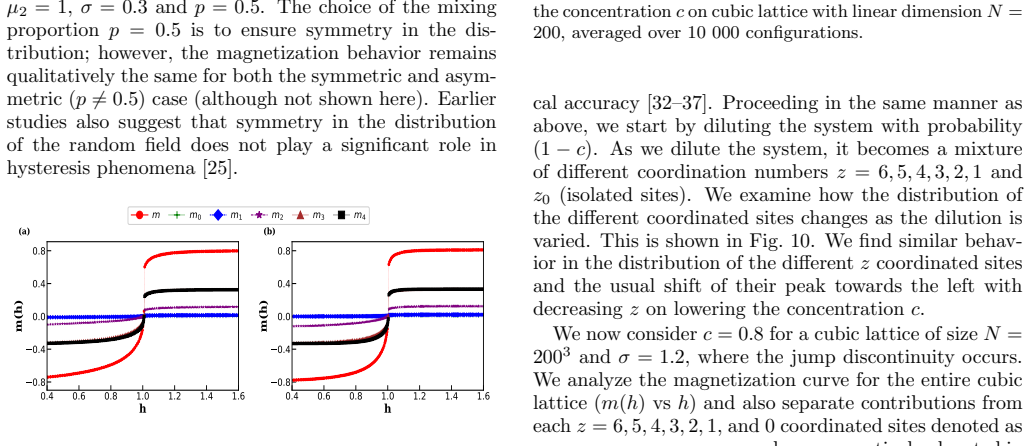
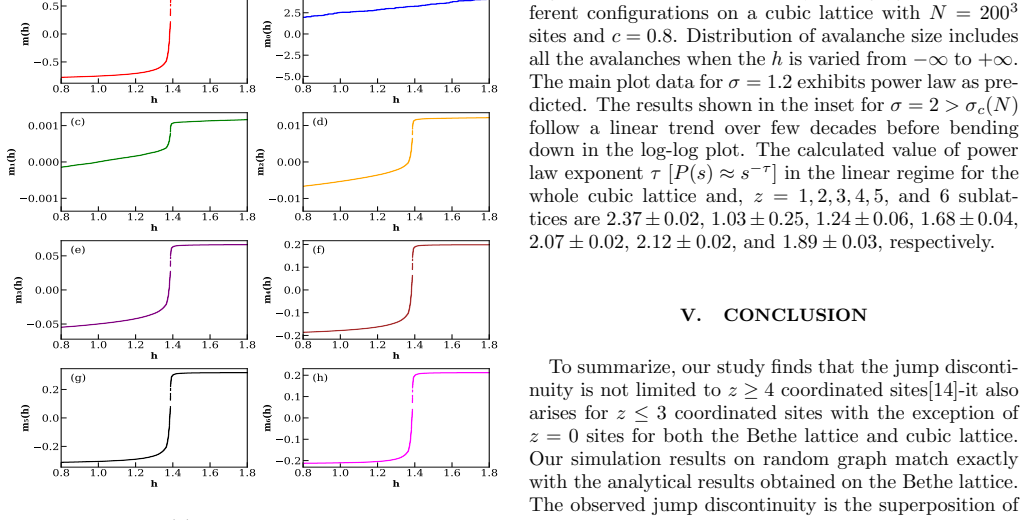
The discontinuity in total magnetization is the result of the superposition of the jumps of different z coordinated sites and observed at the same value of external field, h_crit. The dominant contribution to the jump comes from those sites with higher concentration and larger z. However, the triggering sites responsible for large jumps are mostly z≥3.
Load-bearing premise
That the exact Bethe-lattice recursion for the diluted system produces jumps from every coordination class at precisely the same external field value, with no shift arising from the random-field distribution or from the way dilution is implemented.
Figures




read the original abstract
The response of a complex system to a slow varying external force often displays a jump discontinuity in the order parameter near the critical point. However, this discontinuity is not usually a single jump but rather breaks into smaller jumps which makes it difficult to locate the critical point on approaching its vicinity based only on simulations, in the absence of exact results. Our work is a small effort in understanding these breaks in jump through the hysteretic response of a classical Ising spin system to an external field, $h$, in the context of a nonequilibrium zero-temperature random field Ising model on dilute systems. We consider a Bethe lattice with coordination number, $z = 4$, and dilute a fraction $(1-c)$ of the sites. Therefore the lattice now consists of sites with varying $z = 4, 3, 2, 1$ and possibly few isolated sites $(z=0)$, depending on the concentration $c$. We obtain the exact solution of the magnetization curve, $m(h)$ vs $h$, for the entire lattice as well as for each sublattice of different $z$ coordinated sites, $m_4(h), m_3(h), m_2(h), m_1(h), m_0(h)$. The discontinuity in total magnetization is the result of the superposition of the jumps of different $z$ coordinated sites and observed at the same value of external field, $h_{crit}$. The dominant contribution to the jump comes from those sites with higher concentration and larger $z$. However, the triggering sites responsible for large jumps are mostly $z\ge3$. We test this on cubic lattices as well, where exact results are not available. We hope our analysis will help in understanding fluctuations around a jump in numerical simulations as well as experiments.
Editorial analysis
A structured set of objections, weighed in public.
Referee Report
Summary. The manuscript derives an exact solution for the zero-temperature hysteretic response of the random-field Ising model on a diluted Bethe lattice with nominal coordination z=4. Sites are diluted with concentration c, producing a mixture of local coordinations z=0–4. Exact recursions are solved for the total magnetization m(h) and for the sublattice magnetizations m_z(h) grouped by local coordination. The central result is that the discontinuous jump in m(h) at a single critical field h_crit is exactly the superposition of jumps in each m_z(h), all occurring at the identical value of h_crit; the dominant contribution arises from the most probable, high-z sites, while the largest individual jumps are triggered by z≥3 sites. The same phenomenology is checked numerically on cubic lattices.
Significance. If the central claim is correct, the work supplies a mechanistic account of why jump discontinuities in disordered systems appear fragmented in simulations: the apparent sub-jumps are simply the additive responses of different coordination classes whose individual thresholds nevertheless coincide. The exact Bethe-lattice decomposition into sublattice magnetizations is a clear technical strength and could guide the interpretation of both numerical and experimental data near criticality in diluted or heterogeneous media.
major comments (2)
- [derivation of sublattice magnetizations m_z(h)] The claim that every coordination class jumps at precisely the same h_crit is load-bearing for the superposition interpretation, yet the recursion for the cavity-field distribution on the diluted Bethe lattice contains z-dependent binomial factors and neighbor-count terms. It is not shown explicitly that the local stability threshold (or the point at which the fixed-point distribution loses stability) remains independent of z; a shift with z would split the discontinuity and contradict the reported single h_crit. Please provide the explicit expression for the critical field of each m_z and demonstrate its z-independence.
- [cubic-lattice simulations] The numerical checks on the cubic lattice are invoked to support the Bethe-lattice picture, but the manuscript does not specify the precise random-field distribution, the dilution algorithm, or the criterion used to identify jump locations. Without these details it is impossible to rule out post-hoc alignment of the observed jumps.
minor comments (2)
- [abstract] The abstract states that isolated sites (z=0) are possible but their magnetization contribution is identically zero for all h; this trivial case could be omitted from the decomposition to improve clarity.
- [methods] Notation for the dilution probability and the cavity-field distribution should be introduced once and used consistently; several symbols appear to be redefined between the Bethe-lattice recursion and the cubic-lattice section.
Simulated Author's Rebuttal
We thank the referee for the careful reading of our manuscript and for the constructive comments. We address each major comment below and will revise the manuscript to incorporate the requested clarifications and explicit derivations.
read point-by-point responses
-
Referee: [derivation of sublattice magnetizations m_z(h)] The claim that every coordination class jumps at precisely the same h_crit is load-bearing for the superposition interpretation, yet the recursion for the cavity-field distribution on the diluted Bethe lattice contains z-dependent binomial factors and neighbor-count terms. It is not shown explicitly that the local stability threshold (or the point at which the fixed-point distribution loses stability) remains independent of z; a shift with z would split the discontinuity and contradict the reported single h_crit. Please provide the explicit expression for the critical field of each m_z and demonstrate its z-independence.
Authors: We thank the referee for this important observation. In the exact recursions for the cavity-field distributions on the diluted Bethe lattice, the location of the instability (i.e., the critical field h_crit at which the fixed-point distribution loses stability) is determined by the self-consistent solution of the global cavity-field equations and is independent of the local coordination z. The z-dependent binomial coefficients and neighbor-count terms appear only in the weighted averaging that defines the total magnetization and the individual m_z, but they do not shift the threshold itself; the random-field distribution is identical for all sites, so the point at which a site flips under the effective field is the same. We will add an explicit subsection deriving the critical-field expressions for each m_z from the stability analysis of the fixed-point recursions, confirming that all five classes share the identical h_crit value. revision: yes
-
Referee: [cubic-lattice simulations] The numerical checks on the cubic lattice are invoked to support the Bethe-lattice picture, but the manuscript does not specify the precise random-field distribution, the dilution algorithm, or the criterion used to identify jump locations. Without these details it is impossible to rule out post-hoc alignment of the observed jumps.
Authors: We apologize for the lack of these implementation details. The random fields are drawn from a uniform distribution on [-Δ, Δ] with Δ chosen to place the system near the jump regime; dilution is performed by independently removing each site with probability (1-c) while preserving the underlying cubic connectivity for the remaining sites; jumps are identified by scanning the field in small increments (Δh = 10^{-4}) and flagging any magnetization change larger than 0.005 within a single step. We will insert a new paragraph in the revised manuscript (and an accompanying appendix) that fully specifies the random-field distribution, the site-removal procedure, the field-sweep protocol, and the quantitative jump-detection criterion, together with the system sizes and number of disorder realizations used. revision: yes
Axiom & Free-Parameter Ledger
axioms (2)
- domain assumption Bethe-lattice recursion relations remain exact after random site dilution.
- ad hoc to paper Jumps from sites of every coordination number occur at exactly the same external field value.
Reference graph
Works this paper leans on
-
[1]
J. P. Sethna, K. Dahmen, S. Kartha, J. A. Krumhansl, B. W. Roberts, and J. D. Shore, Physical Review Letters 70, 3347 (1993)
1993
-
[2]
O. E. Wohlman and C. Domb, Journal of Physics A: Mathematical and General17, 2247 (1984)
1984
-
[3]
Nattermann, inSpin Glasses and Random Fields, edited by A
T. Nattermann, inSpin Glasses and Random Fields, edited by A. P. Young (World Scientific, Singapore, 1997) pp. 277–298
1997
-
[4]
Sabhapandit, P
S. Sabhapandit, P. Shukla, and D. Dhar, Journal of Sta- tistical Physics98, 103 (2000)
2000
-
[5]
J. P. Sethna, K. A. Dahmen, and C. R. Myers, Nature 410, 242 (2001)
2001
-
[6]
Vives and A
E. Vives and A. Planes, Journal of magnetism and mag- netic materials221, 164 (2000)
2000
-
[7]
Jani´ cevi´ c, S
S. Jani´ cevi´ c, S. Mijatovi´ c, and D. Spasojevi´ c, Physical Review E95, 042131 (2017)
2017
-
[8]
Spasojevi´ c, S
D. Spasojevi´ c, S. Mijatovi´ c, V. Navas-Portella, and E. Vives, Physical Review E97, 012109 (2018)
2018
-
[9]
Mijatovi´ c, D
S. Mijatovi´ c, D. Jovkovi´ c, and D. Spasojevi´ c, Physical Review E103, 032147 (2021)
2021
-
[10]
Bingham, S
N. Bingham, S. Rooke, J. Park, A. Simon, W. Zhu, X. Zhang, J. Batley, J. Watts, C. Leighton, K. Dahmen, et al., Physical review letters127, 207203 (2021)
2021
-
[11]
M. L. Rosinberg, G. Tarjus, and F. J. P´ erez-Reche, Jour- nal of Statistical Mechanics: Theory and Experiment 2009, P03003 (2009)
2009
-
[12]
Illa and E
X. Illa and E. Vives, Physical Review B—Condensed Matter and Materials Physics74, 104409 (2006)
2006
-
[13]
Aharony, A
A. Aharony, A. B. Harris, and Y. Meir, Physical Review B32, 3203 (1985)
1985
-
[14]
D. Dhar, P. Shukla, and J. P. Sethna, Journal of Physics A: Mathematical and General30, 5259 (1997)
1997
-
[15]
Shukla, Progress of Theoretical Physics96, 69 (1996)
P. Shukla, Progress of Theoretical Physics96, 69 (1996)
1996
-
[16]
Sabhapandit, Physical Review B—Condensed Matter and Materials Physics70, 224401 (2004)
S. Sabhapandit, Physical Review B—Condensed Matter and Materials Physics70, 224401 (2004)
2004
-
[17]
Bupathy, M
A. Bupathy, M. Kumar, V. Banerjee, and S. Puri, Journal of Physics: Conference Series905, 012025 (2017)
2017
-
[18]
R. S. Kharwanlang and P. Shukla, Physical Review E85 (2012)
2012
-
[19]
Liu and K
Y. Liu and K. A. Dahmen, Phys. Rev. E79, 061124 (2009)
2009
-
[20]
Imry and S.-k
Y. Imry and S.-k. Ma, Physical Review Letters35, 1399 (1975)
1975
-
[21]
Shukla, Phys
P. Shukla, Phys. Rev. E62, 4725 (2000)
2000
-
[22]
J. Z. Imbrie, Physical Review Letters53, 1747 (1984)
1984
-
[23]
Shukla and D
P. Shukla and D. Thongjaomayum, Journal of Physics A: Mathematical and Theoretical49, 235001 (2016). 9
2016
-
[24]
Shukla and D
P. Shukla and D. Thongjaomayum, Physical Review E 95, 042109 (2017)
2017
-
[25]
Sabhapandit, D
S. Sabhapandit, D. Dhar, and P. Shukla, Physical Review Letters88, 197202 (2002)
2002
-
[26]
Spasojevi´ c, S
D. Spasojevi´ c, S. Jani´ cevi´ c, and M. Kneˇ zevi´ c, Phys. Rev. Lett.106, 175701 (2011)
2011
-
[27]
Thongjaomayum and P
D. Thongjaomayum and P. Shukla, Physical Review E 88, 042138 (2013)
2013
-
[28]
Thongjaomayum and P
D. Thongjaomayum and P. Shukla, Physical Review E 99, 062136 (2019)
2019
-
[29]
Kurbah, D
L. Kurbah, D. Thongjaomayum, and P. Shukla, Physical Review E91, 012131 (2015)
2015
-
[30]
N. G. Fytas and V. Mart ´ ın-Mayor, Physical Review Let- ters110, 227201 (2013)
2013
-
[31]
R. J. Glauber, Journal of Mathematical Physics4, 294 (1963)
1963
-
[32]
Perkovi´ c, K
O. Perkovi´ c, K. A. Dahmen, and J. P. Sethna, Physical Review B59, 6106 (1999)
1999
-
[33]
J.-C. A. d’Auriac and N. Sourlas, Europhysics Letters 39, 473 (1997)
1997
-
[34]
Vives and F.-J
E. Vives and F.-J. P´ erez-Reche, Physica B: Condensed Matter343, 281 (2004)
2004
-
[35]
Wu and J
Y. Wu and J. Machta, Physical Review B—Condensed Matter and Materials Physics74, 064418 (2006)
2006
-
[36]
Picco and N
M. Picco and N. Sourlas, Europhysics Letters109, 37001 (2015)
2015
-
[37]
N. G. Fytas and V. Mart ´ ın-Mayor, Physical Review E 93, 063308 (2016)
2016
-
[38]
Fishman and A
S. Fishman and A. Aharony, Journal of Physics C: Solid State Physics12, L729 (1979)
1979
-
[39]
J. P. Hill, Q. Feng, R. Birgeneau, and T. Thurston, Zeitschrift f¨ ur Physik B Condensed Matter92, 285 (1993)
1993
-
[40]
Schechter, Physical Review B—Condensed Matter and Materials Physics77, 020401 (2008)
M. Schechter, Physical Review B—Condensed Matter and Materials Physics77, 020401 (2008)
2008
-
[41]
S. Miga, W. Kleemann, J. Dec, and T. Lukasiewicz, Phys- ical Review B—Condensed Matter and Materials Physics 80, 220103 (2009)
2009
-
[42]
Westphal, W
V. Westphal, W. Kleemann, and M. Glinchuk, Physical Review Letters68, 847 (1992)
1992
-
[43]
Millis, A
A. Millis, A. Kent, M. Sarachik, and Y. Yeshurun, Physi- cal Review B—Condensed Matter and Materials Physics 81, 024423 (2010)
2010
-
[44]
J. Xu, D. Silevitch, K. Dahmen, and T. Rosenbaum, Physical Review B92, 024424 (2015)
2015
-
[45]
Sreekala and G
S. Sreekala and G. Ananthakrishna, Physical review let- ters90, 135501 (2003)
2003
-
[46]
Sreekala, R
S. Sreekala, R. Ahluwalia, and G. Ananthakrishna, Phys- ical Review B—Condensed Matter and Materials Physics 70, 224105 (2004)
2004
-
[47]
Vives, J
E. Vives, J. Ort ´ ın, L. Ma˜ nosa, I. R` afols, R. P´ erez- Magran´ e, and A. Planes, Physical review letters72, 1694 (1994)
1994
-
[48]
Vives, I
E. Vives, I. R` afols, L. Ma˜ nosa, J. Ort ´ ın, and A. Planes, Physical Review B52, 12644 (1995)
1995
-
[49]
Dahmen, S
K. Dahmen, S. Kartha, J. A. Krumhansl, B. W. Roberts, J. P. Sethna, and J. D. Shore, Journal of Applied Physics 75, 5946 (1994)
1994
discussion (0)
Sign in with ORCID, Apple, or X to comment. Anyone can read and Pith papers without signing in.