Recognition: unknown
Hamiltonian Monodromy in a Tavis-Cummings System with an A₂ Singularity
Pith reviewed 2026-05-10 09:51 UTC · model grok-4.3
The pith
A reduced Tavis-Cummings system with three degrees of freedom has its most degenerate singular fiber homeomorphic to S²×S¹ with an A₂ singularity.
A machine-rendered reading of the paper's core claim, the machinery that carries it, and where it could break.
Core claim
The most degenerate singular fiber is homeomorphic to S²×S¹ with a singularity of A₂ type. The bifurcation diagram and the global topology of the fibration are described, and the Hamiltonian monodromy is computed.
What carries the argument
The momentum map of the reduced three-degree-of-freedom Tavis-Cummings Hamiltonian, whose level sets form the singular Lagrangian fibration that contains the A₂ singularity on the S²×S¹ fiber.
If this is right
- The critical values of the integrals are organized by the explicitly described bifurcation diagram.
- The global topology of the fibration is fixed once the S²×S¹ fiber with A₂ singularity is present.
- Hamiltonian monodromy matrices are determined for loops in the base space that encircle the singular values.
Where Pith is reading between the lines
- This fiber topology may appear after reduction in other multi-spin or multi-atom quantum-optical models.
- The computed monodromy could be used to predict semiclassical features of the corresponding quantum spectrum.
- Direct numerical checks of level-set topology in the original six-dimensional phase space would test whether the reduction step alters the singularity.
Load-bearing premise
The reduction from the full Tavis-Cummings model to the 3DOF integrable system preserves the singular structure without introducing or hiding additional degeneracies.
What would settle it
An explicit calculation of the topology of the most degenerate level set in the unreduced six-dimensional phase space showing it is not homeomorphic to S²×S¹ would falsify the identification.
Figures


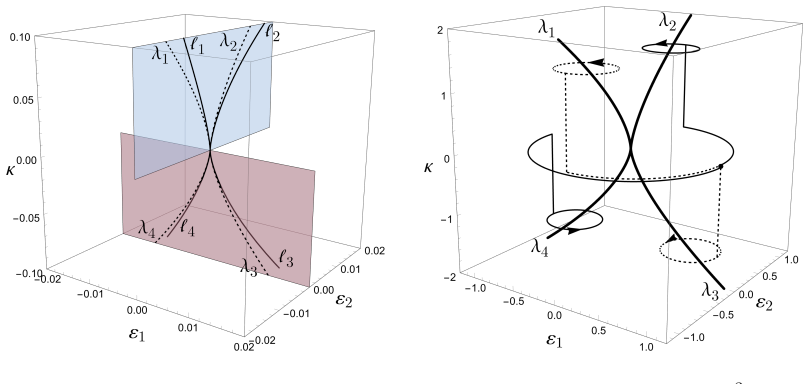

read the original abstract
Singular Lagrangian fibrations arising from three-degree-of-freedom integrable Hamiltonian systems remain largely unexplored. While several results describe the global structure of large classes of systems with two degrees of freedom, only a few examples are understood in higher dimensions. We present a three-degree-of-freedom system derived from the two-spin Tavis-Cummings model whose singular Lagrangian fibration exhibits a topology that has not been observed in other physical models. We show that the most degenerate singular fiber is homeomorphic to $\mathbf{S}^2\times\mathbf{S}^1$ with a singularity of $A_2$ type. We further describe the bifurcation diagram and the global topology of the fibration, and we compute its Hamiltonian monodromy.
Editorial analysis
A structured set of objections, weighed in public.
Referee Report
Summary. The manuscript analyzes a three-degree-of-freedom integrable Hamiltonian system obtained by symmetry reduction from the two-spin Tavis-Cummings model. It claims that the most degenerate singular fiber of the associated Lagrangian fibration is homeomorphic to S² × S¹ and carries an A₂-type singularity, while also providing the bifurcation diagram, the global topology of the fibration, and an explicit computation of the Hamiltonian monodromy.
Significance. If the central claims are verified, the work supplies a concrete new example of singular Lagrangian fibrations in 3DOF systems whose topology has not appeared in prior physical models. The explicit monodromy calculation and A₂ classification provide falsifiable data that can be compared against other integrable systems and used to test general theorems on Hamiltonian monodromy. The derivation of an effective Hamiltonian from a standard quantum-optics model is a strength that ties the topological results to an experimentally relevant setting.
major comments (2)
- [§2] §2 (reduction to effective 3DOF system): The symmetry reduction from the unreduced 6DOF phase space (two S² spin spheres plus bosonic C) to the 3DOF integrable system is performed, but no explicit comparison of critical points, Hessians, or local normal forms between the reduced and unreduced spaces is given. This verification is load-bearing for the A₂ singularity classification and the homeomorphism type of the most degenerate fiber, as any collapse or creation of degeneracies under the reduction map would alter the claimed singular structure.
- [§4] §4 (bifurcation diagram and fiber analysis): The identification of the most degenerate fiber as S² × S¹ with A₂ singularity relies on the momentum map and its critical values; however, the local normal form used to classify the singularity is not cross-checked against the unreduced Poisson structure, leaving open the possibility that the degeneracy type is an artifact of the reduced coordinates.
minor comments (3)
- [§3] The notation for the components of the momentum map (e.g., the functions F and G) is introduced in §3 without a consolidated table of definitions; a short summary table would improve readability.
- [Figure 4] In the bifurcation diagram (Figure 4), the curves meeting at the A₂ point are not labeled with their topological types; adding these labels would make the global topology description easier to follow.
- [Introduction] A few references to prior work on 2DOF monodromy (e.g., the standard examples of the spherical pendulum or the Euler top) are missing from the introduction; including them would better situate the novelty of the 3DOF case.
Simulated Author's Rebuttal
We thank the referee for the careful reading of our manuscript and for the constructive comments. We appreciate the positive evaluation of the work's significance and address each major comment below. Revisions have been made to strengthen the presentation of the reduction and singularity analysis.
read point-by-point responses
-
Referee: [§2] §2 (reduction to effective 3DOF system): The symmetry reduction from the unreduced 6DOF phase space (two S² spin spheres plus bosonic C) to the 3DOF integrable system is performed, but no explicit comparison of critical points, Hessians, or local normal forms between the reduced and unreduced spaces is given. This verification is load-bearing for the A₂ singularity classification and the homeomorphism type of the most degenerate fiber, as any collapse or creation of degeneracies under the reduction map would alter the claimed singular structure.
Authors: We agree that an explicit comparison between the unreduced and reduced systems strengthens the claims regarding the singularity type and fiber topology. In the revised manuscript we have added a new subsection in §2 that lists the critical points of the unreduced momentum map, computes their Hessians, and shows the corresponding quantities after Marsden-Weinstein reduction at the regular value of the symmetry momentum map. The local normal forms are shown to coincide because the reduction map is a submersion on the level set of interest and the Poisson structure descends without introducing or removing degeneracies. These calculations confirm that the A₂ singularity and the S² × S¹ homeomorphism type are intrinsic to the system and not artifacts of the reduction. revision: yes
-
Referee: [§4] §4 (bifurcation diagram and fiber analysis): The identification of the most degenerate fiber as S² × S¹ with A₂ singularity relies on the momentum map and its critical values; however, the local normal form used to classify the singularity is not cross-checked against the unreduced Poisson structure, leaving open the possibility that the degeneracy type is an artifact of the reduced coordinates.
Authors: The referee correctly identifies the need for an explicit cross-check with the original Poisson brackets. We have revised §4 to include a direct comparison: the local normal form of the reduced momentum map is recovered from the unreduced Tavis-Cummings Poisson structure by restricting to the symmetry-reduced level set and verifying that the quadratic and cubic terms responsible for the A₂ singularity are preserved. Because the reduction is performed at a regular value of the symmetry generators, the degeneracy type remains unchanged. This verification rules out coordinate artifacts and supports the claimed classification. revision: yes
Circularity Check
No significant circularity; derivation is self-contained
full rationale
The paper derives an effective 3DOF Hamiltonian from the Tavis-Cummings model via symmetry reduction, then computes the bifurcation diagram, singular fiber topology (S²×S¹ with A₂ singularity), and Hamiltonian monodromy directly from the reduced integrable system. No quoted steps reduce a claimed prediction or result to a fitted parameter, self-definition, or load-bearing self-citation chain. The reduction assumption is stated explicitly but does not create a definitional loop or force the fiber classification by construction. The analysis relies on standard techniques in integrable systems and is externally falsifiable via the explicit equations of the reduced model.
Axiom & Free-Parameter Ledger
axioms (2)
- domain assumption The two-spin Tavis-Cummings system is completely integrable after reduction by rotational symmetry.
- standard math Standard results on singular Lagrangian fibrations and A-type singularities apply to the reduced momentum map.
Reference graph
Works this paper leans on
-
[1]
Taylor series and twisting-index invariants of coupled spin–oscillators
J. Alonso, H. R. Dullin, and S. Hohloch. “Taylor series and twisting-index invariants of coupled spin–oscillators”. In:Journal of Geometry and Physics140 (2019), pp. 131–151. doi:10.1016/j.geomphys.2018.09.022
-
[2]
V. I. Arnol’d, S. M. Goussein-Zade, and A. N. Varchenko.Singularities of Differentiable Mappings. Birkhauser, Boston, 1988
1988
-
[3]
Hamiltonian monodromy via Picard-Lefschetz theory
M. Audin. “Hamiltonian monodromy via Picard-Lefschetz theory”. In:Communications in mathematical physics229.3 (2002), pp. 459–489
2002
-
[4]
Audin.Spinning Tops: A Course on Integrable Systems
M. Audin.Spinning Tops: A Course on Integrable Systems. Cambridge University Press, 1996
1996
-
[5]
Classical Bethe Ansatz and normal forms in an integrable version of the Dicke model
O. Babelon and B. Douçot. “Classical Bethe Ansatz and normal forms in an integrable version of the Dicke model”. In:Physica D241.23 (2012), pp. 2095–2108
2012
-
[6]
O.BabelonandB.Douçot.“Higherindexfocus–focussingularitiesintheJaynes-Cummings- Gaudin model: Symplectic invariants and monodromy”. In:Journal of Geometry and Physics87 (2015), pp. 3–29.doi:10.1016/j.geomphys.2014.07.011
-
[7]
Babelon, D
O. Babelon, D. Bernard, and M. Talon.Introduction to Classical Integrable Systems. Cam- bridge University Press, 2003
2003
-
[8]
Scattering monodromy and theA1 singularity
L. M. Bates and R. H. Cushman. “Scattering monodromy and theA1 singularity”. In: Central European Journal of Mathematics5.3 (2007), pp. 429–451
2007
-
[9]
R. C. Bernard and D. Matessi. “Lagrangian 3-torus fibrations”. In:Journal of Differential Geometry81.3 (2009), pp. 483–573.doi:10.4310/jdg/1236604343
-
[10]
A. V. Bolsinov and A. T. Fomenko.Integrable Hamiltonian systems: geometry, topology, classification. Chapman & Hall/CRC, 2004
2004
-
[11]
R.H.CushmanandL.M.Bates.Global Aspects of Classical Integrable Systems.Birkhaüser, Berlin, 1997
1997
-
[12]
The Harmonic Lagrange Top and the Confluent Heun Equation
S. R. Dawson, H. R. Dullin, and D. M. Nguyen. “The Harmonic Lagrange Top and the Confluent Heun Equation”. In:Regular and Chaotic Dynamics27 (2022), pp. 443–459
2022
-
[13]
Hamiltoniens périodiques et images convexes de l’application moment
T. Delzant. “Hamiltoniens périodiques et images convexes de l’application moment”. In: Bulletin de la S. M. F.116.3 (1988), pp. 315–339
1988
-
[14]
On global action-angle coordinates
J. J. Duistermaat. “On global action-angle coordinates”. In:Communications on Pure and Applied Mathematics33.6 (1980), pp. 687–706.doi:10.1002/cpa.3160330602
-
[15]
Monodromy in the resonant swing spring
H. Dullin, A. Giacobbe, and R. Cushman. “Monodromy in the resonant swing spring”. In: Physica D: Nonlinear Phenomena190.1 (2004), pp. 15–37.doi:https://doi.org/10. 1016/j.physd.2003.10.004
2004
-
[16]
Efstathiou.Metamorphoses of Hamiltonian Systems with Symmetries
K. Efstathiou.Metamorphoses of Hamiltonian Systems with Symmetries. Springer, Berlin Heidelberg New York, 2005. 33
2005
-
[17]
Bifurcations and Monodromy of the Axially Symmetric 1:1:-2 Resonance
K. Efstathiou, H. Hanßmann, and A. Marchesiello. “Bifurcations and Monodromy of the Axially Symmetric 1:1:-2 Resonance”. In:Journal of Geometry and Physics146 (2019), p. 103493.doi:10.1016/j.geomphys.2019.103493
-
[18]
Hamiltonian systems with Poisson commuting integrals
H. Eliasson. “Hamiltonian systems with Poisson commuting integrals”. PhD thesis. Stock- holm University, 1984
1984
-
[19]
Aaijet al.[LHCb Collaboration]
J.M.Fink,R.Bianchetti,M.Baur,M.Göppl,L.Steffen,S.Filipp,P.J.Leek,A.Blais,and A. Wallraff. “Dressed Collective Qubit States and the Tavis-Cummings Model in Circuit QED”. In:Phys. Rev. Lett.103 (8 Aug. 2009), p. 083601.doi:10.1103/PhysRevLett. 103.083601
-
[20]
A remark on integrable Hamiltonian systems
H. Flaschka. “A remark on integrable Hamiltonian systems”. In:Physics Letters A131.9 (1988), pp. 505–508.doi:10.1016/0375-9601(88)90678-0
-
[21]
Monodromy of the quantum 1:1:2 resonant swing spring
A. Giacobbe, R. H. Cushman, D. A. Sadovskií, and B. I. Zhilinskií. “Monodromy of the quantum 1:1:2 resonant swing spring”. In:Journal of Mathematical Physics45.12 (Dec. 2004), pp. 5076–5100.doi:10.1063/1.1811788
-
[22]
M. Gross. “Topological mirror symmetry”. In:Inventiones Mathematicae144.1 (2001), pp. 75–137.doi:10.1007/s002220000119
-
[23]
Hamiltonian monodromy via spectral Lax pairs
G. J. Gutierrez Guillen, D. Sugny, and P. Mardešić. “Hamiltonian monodromy via spectral Lax pairs”. In:Journal of Mathematical Physics65.3 (Mar. 2024), p. 032703
2024
-
[24]
S. Haroche and J.-M. Raimond.Exploring the Quantum: Atoms, Cavities, and Photons. Oxford University Press, Aug. 2006.doi:10.1093/acprof:oso/9780198509141.001. 0001
-
[25]
A.Hatcher.Algebraic topology.CambridgeUniversityPress,2002.doi:10.2277/0521795400
-
[26]
Singularities of integrable systems and algebraic curves
A. Izosimov. “Singularities of integrable systems and algebraic curves”. In:International Mathematics Research Notices2017.18 (2017), pp. 5475–5524
2017
-
[27]
E. Jaynes and F. Cummings. “Comparison of quantum and semiclassical radiation theories with application to the beam maser”. In:Proceedings of the IEEE51.1 (1963), pp. 89–109. doi:10.1109/PROC.1963.1664
-
[28]
Symplectic Classification for Universal Unfoldings ofAn Singularities in Integrable Systems
E. A. Kudryavtseva. “Symplectic Classification for Universal Unfoldings ofAn Singularities in Integrable Systems”. In:Regular and Chaotic Dynamics30.4 (2025), pp. 639–665.doi: 10.1134/S1560354725040124
-
[29]
Integrals of nonlinear equations of evolution and solitary waves
P. D. Lax. “Integrals of nonlinear equations of evolution and solitary waves”. In:Commu- nications on Pure and Applied Mathematics21.5 (1968), pp. 467–490
1968
-
[30]
Coupling superconducting qubits via a cavity bus
J. Majer et al. “Coupling superconducting qubits via a cavity bus”. In:Nature449 (2007), pp. 443–447
2007
-
[31]
van der Meer.The Hamiltonian Hopf bifurcation
J.-C. van der Meer.The Hamiltonian Hopf bifurcation. Vol. 1160. Lecture Notes in Math- ematics. Springer, 1985.doi:10.1007/BFb0080357
-
[32]
HamiltonianDynamicsandSpectralTheoryforSpin–Oscillators
Á.PelayoandS.V˜ uNgo.c.“HamiltonianDynamicsandSpectralTheoryforSpin–Oscillators”. In:Communications in Mathematical Physics309.1 (2012), pp. 123–154.doi:10.1007/ s00220-011-1360-4
2012
-
[33]
Semitoric integrable systems on symplectic 4-manifolds
Á. Pelayo and S. V˜ u Ngo.c. “Semitoric integrable systems on symplectic 4-manifolds”. In: Inventiones mathematicae177.3 (2009), pp. 571–597
2009
-
[34]
Smooth functions invariant under the action of a compact Lie group
G. W. Schwarz. “Smooth functions invariant under the action of a compact Lie group”. In: Topology14.1 (1975), pp. 63–68.doi:10.1016/0040-9383(75)90036-1
-
[35]
Lorentz Invariance and the Kinematic Structure of V ertex Functions
M. Tavis and F. W. Cummings. “Exact Solution for anN-Molecule—Radiation-Field Hamiltonian”. In:Physical Review170.2 (July 1968), pp. 379–384.doi:10.1103/PhysRev. 170.379
-
[36]
Thom.Structural stability and morphogenesis
R. Thom.Structural stability and morphogenesis. CRC press, 2018
2018
-
[37]
Quantum Monodromy in Integrable Systems
S. V˜ u Ngo.c. “Quantum Monodromy in Integrable Systems”. In:Communications in Math- ematical Physics203.2 (1999), pp. 465–479. 34
1999
-
[38]
Solution for the dynamics of the BCS and central spin problems
E. A. Yuzbashyan, B. L. Altshuler, V. B. Kuznetsov, and V. Z. Enolskii. “Solution for the dynamics of the BCS and central spin problems”. In:Journal of Physics A: Mathematical and General38.36 (2005), pp. 7831–7849.doi:10.1088/0305-4470/38/36/003
-
[39]
Żołądek.The monodromy group
H. Żołądek.The monodromy group. Springer, 2006
2006
-
[40]
A note on focus-focus singularities
N. T. Zung. “A note on focus-focus singularities”. In:Differential Geometry and its Appli- cations7.2 (1997), pp. 123–130. 35
1997
discussion (0)
Sign in with ORCID, Apple, or X to comment. Anyone can read and Pith papers without signing in.