Recognition: unknown
Enhanced activity in close dual-AGN systems in the local Universe
Pith reviewed 2026-05-10 10:45 UTC · model grok-4.3
The pith
Close dual-AGN systems exhibit enhanced obscuration and increased accretion rates as galaxy separation decreases.
A machine-rendered reading of the paper's core claim, the machinery that carries it, and where it could break.
Core claim
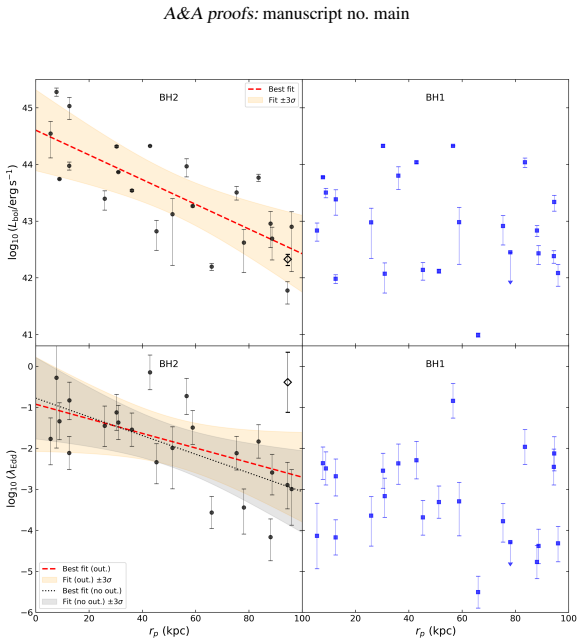
The central discovery is that in dual-AGN systems, the bolometric luminosity and Eddington ratio of the less massive black hole increase as the projected separation decreases, while the overall fraction of obscured AGN is higher in late-stage mergers compared to early-stage ones, supporting the role of mergers in triggering AGN accretion.
What carries the argument
Projected separation rp as the key parameter correlating with changes in AGN obscuration fraction, bolometric luminosity, and Eddington ratio.
Load-bearing premise
That the pairs identified by projected separation are mostly genuine physical mergers rather than random projections, and that the X-ray spectral analysis correctly determines the intrinsic absorption and luminosities without bias from the merger environment.
What would settle it
Measuring the actual three-dimensional separations or relative velocities of a subset of close pairs through spectroscopy or other means to confirm they are bound systems and checking if the activity trends persist.
Figures



read the original abstract
We present the study of an X-ray selected sample of active galactic nuclei (AGN) in pairs at projected spatial separations 1 <$ r_p$/kpc < 100 at z < 0.1, using XMM-Newton and Chandra data. The pair sample is derived from an initial pool of approximately 2,000 X-ray-selected AGN, and is composed of both AGN-AGN pairs (so called dual AGN) and AGN-galaxy pairs. From this selection, we find that approximately 10% of AGN reside in pairs, and about 4% are paired with another AGN. We performed a detailed X-ray and SDSS optical spectral analysis for AGN in duals and X-ray analysis for AGN in AGN-galaxy pairs, to characterise their absorption properties and investigate the possible triggering mechanisms. We then investigated how obscuration, luminosity, and Eddington ratio depend on projected separation $r_p$. Amongst all AGN in pairs, we found that ~55% are obscured (with hydrogen column density $N_H$ > $10^{22}$ cm$^{-2}$), amongst which ~6% are Compton-thick ($N_H$ > $10^{24}$ cm$^{-2}$). The fraction of absorbed AGN is significantly higher in late-stage mergers ($r_p$ < 30 kpc) compared to early-stage mergers ($r_p$ > 60 kpc). Amongst the AGN in pairs, we also observed an average excess of AGN pairs with respect to a control sample of inactive galaxies in pairs, and that such excess significantly increases with decreasing $r_p$ only for obscured AGN. Finally, in dual-AGN systems, both the bolometric luminosity and the Eddington ratio of the less massive black hole in the pair increase as the separation decreases. These findings suggest that mergers may have an important role in triggering AGN accretion and activity.
Editorial analysis
A structured set of objections, weighed in public.
Referee Report
Summary. The manuscript studies an X-ray-selected sample of ~2000 AGN at z<0.1 to identify pairs with projected separations 1 < rp/kpc < 100. It reports that ~10% of AGN reside in pairs (~4% dual-AGN), ~55% of paired AGN are obscured (NH>10^22 cm^-2, with ~6% Compton-thick), the obscured fraction is significantly higher at rp<30 kpc than at rp>60 kpc, an excess of AGN pairs relative to a control sample of inactive galaxies increases with decreasing rp (especially for obscured systems), and in dual-AGN the bolometric luminosity and Eddington ratio of the less-massive BH increase as rp decreases. The authors conclude that mergers play an important role in triggering AGN accretion and activity.
Significance. If the reported trends hold after addressing selection and measurement biases, the work would provide direct observational support for merger-driven AGN triggering and enhanced obscuration in the local universe, with quantitative fractions that can be compared to simulations of galaxy evolution and black-hole growth.
major comments (3)
- [Abstract and dual-AGN analysis section] The headline result that bolometric luminosity and Eddington ratio of the less-massive BH increase with decreasing rp in dual-AGN systems rests on SDSS optical spectral fitting for M_BH (via sigma_* or broad-line widths) and lambda. At rp < 30 kpc the 3-arcsec SDSS fiber captures light from both nuclei; this contamination can systematically alter measured line widths or sigma_*, introducing an rp-dependent bias that directly undermines the claimed trend. No test or correction for this effect is described.
- [Sample selection and results sections] The central statistical claims (higher obscured fraction at rp<30 kpc, excess of AGN pairs vs. control that increases with decreasing rp) lack reported details on sample completeness, control-sample matching criteria (e.g., mass, redshift, environment), error propagation, and handling of projection effects. Without these, the significance of the rp-dependent trends cannot be evaluated.
- [Discussion and conclusions] The interpretation that the observed excess and trends indicate physical merger triggering assumes the identified pairs are genuine bound systems rather than chance projections; no quantitative assessment of contamination by projected pairs or de-projection statistics is provided.
minor comments (2)
- [Abstract] The thresholds defining 'late-stage' (rp<30 kpc) and 'early-stage' (rp>60 kpc) mergers should be justified by reference to merger simulations or prior observational studies.
- [X-ray analysis section] Clarify whether the X-ray spectral fitting accounts for possible contamination or confusion from the companion in close pairs when deriving NH and intrinsic luminosities.
Simulated Author's Rebuttal
We thank the referee for their careful and constructive review of our manuscript. We have addressed each major comment by expanding the relevant sections with additional methodological details, bias assessments, and quantitative tests. Our point-by-point responses follow.
read point-by-point responses
-
Referee: [Abstract and dual-AGN analysis section] The headline result that bolometric luminosity and Eddington ratio of the less-massive BH increase with decreasing rp in dual-AGN systems rests on SDSS optical spectral fitting for M_BH (via sigma_* or broad-line widths) and lambda. At rp < 30 kpc the 3-arcsec SDSS fiber captures light from both nuclei; this contamination can systematically alter measured line widths or sigma_*, introducing an rp-dependent bias that directly undermines the claimed trend. No test or correction for this effect is described.
Authors: We agree this is a valid concern that was not explicitly treated in the original manuscript. Fiber contamination from the companion nucleus can indeed affect stellar velocity dispersion or broad-line width measurements used for black-hole mass estimates, potentially biasing Eddington ratios in a separation-dependent manner. In the revised manuscript we have added a dedicated paragraph in the dual-AGN analysis section that discusses this aperture effect and reports a robustness test: the reported trends in bolometric luminosity and Eddington ratio for the less-massive black hole remain statistically significant when the sample is restricted to pairs with rp > 10 kpc (where nuclear separation within the fiber is larger). We also note that the bolometric luminosities themselves are derived from X-ray data, which are unaffected by the optical fiber. These additions clarify the limitations while preserving the main result. revision: yes
-
Referee: [Sample selection and results sections] The central statistical claims (higher obscured fraction at rp<30 kpc, excess of AGN pairs vs. control that increases with decreasing rp) lack reported details on sample completeness, control-sample matching criteria (e.g., mass, redshift, environment), error propagation, and handling of projection effects. Without these, the significance of the rp-dependent trends cannot be evaluated.
Authors: We appreciate the request for greater transparency. While the original text contained brief descriptions, we have substantially expanded the sample selection and results sections in the revision. The new text now provides: (i) the X-ray flux limit and completeness fraction of the parent ~2000-AGN sample; (ii) explicit control-sample matching criteria (inactive galaxies matched in redshift, stellar mass from SDSS photometry, and local environment density); (iii) error estimation via binomial statistics supplemented by bootstrap resampling; and (iv) a direct statement that the excess over the control sample already incorporates the statistical effect of random projections. These additions allow readers to evaluate the significance of the reported rp-dependent trends. revision: yes
-
Referee: [Discussion and conclusions] The interpretation that the observed excess and trends indicate physical merger triggering assumes the identified pairs are genuine bound systems rather than chance projections; no quantitative assessment of contamination by projected pairs or de-projection statistics is provided.
Authors: We agree that a quantitative estimate of projection contamination is necessary to support the physical interpretation. Although the observed excess of AGN pairs relative to the matched control sample of inactive galaxies already demonstrates that a substantial fraction of pairs cannot be random projections, we have added a Monte Carlo assessment in the revised discussion. Using random catalogs that preserve the observed sky density, redshift distribution, and magnitude limits, we estimate that chance projections contribute 10–30 % of the detected pairs (higher at larger rp). After applying this statistical correction, the increase in pair excess with decreasing rp (especially for obscured systems) and the obscuration trend remain significant. This quantitative treatment has been incorporated into the discussion and conclusions. revision: yes
Circularity Check
Purely observational study with no derived predictions or self-referential steps
full rationale
The paper reports empirical measurements from an X-ray-selected sample of AGN pairs at z<0.1, including the fraction of obscured AGN (~55%), higher obscuration in late-stage mergers (rp<30 kpc), excess AGN pairs relative to controls, and increasing bolometric luminosity and Eddington ratio for the less-massive BH as rp decreases in dual-AGN systems. These are direct results of data selection, X-ray spectral fitting for NH and luminosities, and SDSS optical analysis for BH masses and Eddington ratios. No equations, models, or first-principles derivations are presented that reduce any reported trend to fitted inputs or self-citations by construction. No uniqueness theorems, ansatzes, or predictions are invoked. The work is self-contained as an observational catalog and trend analysis.
Axiom & Free-Parameter Ledger
free parameters (1)
- Projected separation thresholds
axioms (2)
- domain assumption Projected separation approximates three-dimensional physical separation at z < 0.1
- domain assumption X-ray spectral fitting yields unbiased NH and intrinsic luminosity
Reference graph
Works this paper leans on
-
[1]
, " * write output.state after.block = add.period write newline
ENTRY address archiveprefix author booktitle chapter edition editor howpublished institution eprint journal key month note number organization pages publisher school series title type volume year label extra.label sort.label short.list INTEGERS output.state before.all mid.sentence after.sentence after.block FUNCTION init.state.consts #0 'before.all := #1 ...
-
[2]
write newline
" write newline "" before.all 'output.state := FUNCTION n.dashify 't := "" t empty not t #1 #1 substring "-" = t #1 #2 substring "--" = not "--" * t #2 global.max substring 't := t #1 #1 substring "-" = "-" * t #2 global.max substring 't := while if t #1 #1 substring * t #2 global.max substring 't := if while FUNCTION word.in bbl.in " " * FUNCTION format....
-
[3]
M., et al
Agazie , G., Anumarlapudi , A., Archibald , A. M., et al. 2023, , 951, L8
2023
-
[4]
2024, , 530, 1512–1515
Aggarwal, Y. 2024, , 530, 1512–1515
2024
-
[5]
2020, , 249, 3
Ahumada , R., Allende Prieto , C., Almeida , A., et al. 2020, , 249, 3
2020
-
[6]
L., Moustakas, J., et al
Aird, J., Coil, A. L., Moustakas, J., et al. 2012, ApJ, 746, 90
2012
-
[7]
A., Arca Sedda , M., et al
Ajith , P., Seoane , P. A., Arca Sedda , M., et al. 2025, , 2025, 108
2025
-
[8]
& Georgantopoulos , I
Akylas , A. & Georgantopoulos , I. 2021, , 655, A60
2021
-
[9]
2023, Living Rev
Amaro-Seoane , P., Andrews , J., Arca Sedda , M., et al. 2023, Living Rev. Relativ., 26, 2
2023
-
[10]
M., Greenwell , C., et al
Andonie , C., Alexander , D. M., Greenwell , C., et al. 2025, , 539, 2202
2025
-
[11]
1993, , 31, 473
Antonucci , R. 1993, , 31, 473
1993
-
[12]
Arnaud , K. A. 1996, in Astronomical Society of the Pacific Conference Series, Vol. 101, Astronomical Data Analysis Software and Systems V, ed. G. H. Jacoby & J. Barnes , 17
1996
-
[13]
& McCammon , D
Balucinska-Church , M. & McCammon , D. 1992, , 400, 699
1992
-
[14]
H., White , R
Becker , R. H., White , R. L., & Helfand , D. J. 1995, , 450, 559
1995
-
[15]
C., Volonteri, M., & Rees, M
Begelman, M. C., Volonteri, M., & Rees, M. J. 2006, , 370, 289–298
2006
-
[16]
C., Denney , K
Bentz , M. C., Denney , K. D., Grier , C. J., et al. 2013, , 767, 149
2013
-
[17]
R., Aird, J., et al
Bernhard, E., Mullaney, J. R., Aird, J., et al. 2018, , 476, 436–450
2018
-
[18]
F., Guainazzi, M., Matt, G., & Ponti, G
Bianchi, S., Bonilla, N. F., Guainazzi, M., Matt, G., & Ponti, G. 2009, , 501, 915–924
2009
-
[19]
2019, , 485, 416–427
Bianchi, S., Guainazzi, M., Laor, A., Stern, J., & Behar, E. 2019, , 485, 416–427
2019
-
[20]
2008, , 389, L52
Bianchi , S., La Franca , F., Matt , G., et al. 2008, , 389, L52
2008
-
[21]
F., Satyapal , S., & Ellison , S
Blecha , L., Snyder , G. F., Satyapal , S., & Ellison , S. L. 2018, , 478, 3056
2018
-
[22]
G., Gandhi , P., Buchner , J., et al
Boorman , P. G., Gandhi , P., Buchner , J., et al. 2025, , 978, 118
2025
-
[23]
N., Hill, J
Burrows, D. N., Hill, J. E., Nousek, J. A., et al. 2005, , 120, 165–195
2005
-
[24]
Capelo , P. R. & Dotti , M. 2017, , 465, 2643
2017
-
[25]
R., Dotti , M., Volonteri , M., et al
Capelo , P. R., Dotti , M., Volonteri , M., et al. 2017, , 469, 4437
2017
-
[26]
R., Feruglio , C., Hickox , R
Capelo , P. R., Feruglio , C., Hickox , R. C., & Tombesi , F. 2023, in Handbook of X-ray and Gamma-ray Astrophysics (Springer Nature Singapore), 126
2023
-
[27]
R., Volonteri , M., Dotti , M., et al
Capelo , P. R., Volonteri , M., Dotti , M., et al. 2015, , 447, 2123
2015
-
[28]
2017, , 466, 798
Cappellari , M. 2017, , 466, 798
2017
-
[29]
A., Clayton , G
Cardelli , J. A., Clayton , G. C., & Mathis , J. S. 1989, , 345, 245
1989
-
[30]
1979, , 228, 939
Cash , W. 1979, , 228, 939
1979
-
[31]
2025, , 995, 197
Chen , S.-J., Wang , J.-X., Kang , J.-L., et al. 2025, , 995, 197
2025
-
[32]
Colpi , M., Danzmann , K., Hewitson , M., et al. 2024, arXiv e-prints, arXiv:2402.07571
work page internal anchor Pith review arXiv 2024
-
[33]
M., Gerke , B
Comerford , J. M., Gerke , B. F., Stern , D., et al. 2012, , 753, 42
2012
-
[34]
2011, , 530, A42
Corral , A., Della Ceca , R., Caccianiga , A., et al. 2011, , 530, A42
2011
-
[35]
S., Torres-Alb \`a , N., Marchesi , S., et al
Cox , I. S., Torres-Alb \`a , N., Marchesi , S., et al. 2023, , 958, 155
2023
-
[36]
2015, , 453, 214
De Rosa , A., Bianchi , S., Bogdanovi \'c , T., et al. 2015, , 453, 214
2015
-
[37]
2019, , 86, 101525
De Rosa, A., Vignali, C., Bogdanović, T., et al. 2019, , 86, 101525
2019
-
[38]
2023, , 519, 5149
De Rosa , A., Vignali , C., Severgnini , P., et al. 2023, , 519, 5149
2023
-
[39]
2018, , 480, 1639–1655
De Rosa, A., Vignali, C., Husemann, B., et al. 2018, , 480, 1639–1655
2018
-
[40]
2005, , 433, 604
Di Matteo , T., Springel , V., & Hernquist , L. 2005, , 433, 604
2005
-
[41]
2020, , 636, A73
Duras , F., Bongiorno , A., Ricci , F., et al. 2020, , 636, A73
2020
-
[42]
Eddington , A. S. 1916, , 77, 16
1916
-
[43]
2025, OJAp, 8, 12
Ellison , S., Ferreira , L., Bickley , R., et al. 2025, OJAp, 8, 12
2025
-
[44]
2023, , 678, A49
EPTA Collaboration , InPTA Collaboration , Antoniadis , J., et al. 2023, , 678, A49
2023
-
[45]
N., Primini , F
Evans , I. N., Primini , F. A., Glotfelty , K. J., et al. 2010, , 189, 37
2010
-
[46]
N., Primini , F
Evans , I. N., Primini , F. A., Miller , J. B., et al. 2020, in American Astronomical Society Meeting Abstracts, Vol. 235, American Astronomical Society Meeting Abstracts \#235, 154.05
2020
-
[47]
Flesch, E. W. 2024, OJAp, 7
2024
-
[48]
C., & Koss , M
Foord , A., G \"u ltekin , K., Runnoe , J. C., & Koss , M. J. 2021, , 907, 71
2021
-
[49]
C., Allen , G
Fruscione , A., McDowell , J. C., Allen , G. E., et al. 2006, in Society of Photo-Optical Instrumentation Engineers (SPIE) Conference Series, Vol. 6270, Observatory Operations: Strategies, Processes, and Systems, ed. D. R. Silva & R. E. Doxsey , 62701V
2006
-
[50]
D., Djorgovski , S
Fu , H., Myers , A. D., Djorgovski , S. G., et al. 2015, , 799, 72
2015
-
[51]
J., et al
Gao , F., Wang , L., Pearson , W. J., et al. 2020, , 637, A94
2020
-
[52]
2012, , 201, 31
Ge , J.-Q., Hu , C., Wang , J.-M., Bai , J.-M., & Zhang , S. 2012, , 201, 31
2012
-
[53]
2022, , 667, A153
Ge, L., Paltani, S., Eckert, D., & Salvato, M. 2022, , 667, A153
2022
-
[54]
George , I. M. & Fabian , A. C. 1991, , 249, 352
1991
-
[55]
E., Kim , D
Gianolli , V. E., Kim , D. E., Bianchi , S., et al. 2023, , 523, 4468
2023
-
[56]
& Done , C
Gierli \'n ski , M. & Done , C. 2004, , 349, L7
2004
-
[57]
2009, , 506, 1107
Gonz \'a lez-Mart \' n , O., Masegosa , J., M \'a rquez , I., Guainazzi , M., & Jim \'e nez-Bail \'o n , E. 2009, , 506, 1107
2009
-
[58]
Greene , J. E. & Ho , L. C. 2005, , 630, 122
2005
-
[59]
J., Gilfanov , M., & Sunyaev , R
Grimm , H. J., Gilfanov , M., & Sunyaev , R. 2002, , 391, 923
2002
-
[60]
2021, , 504, 393
Guainazzi , M., De Rosa , A., Bianchi , S., et al. 2021, , 504, 393
2021
-
[61]
& Maraschi , L
Haardt , F. & Maraschi , L. 1993, , 413, 507
1993
-
[62]
1994, , 432, L95
Haardt , F., Maraschi , L., & Ghisellini , G. 1994, , 432, L95
1994
-
[63]
A., Craig , W
Harrison , F. A., Craig , W. W., Christensen , F. E., et al. 2013, , 770, 103
2013
-
[64]
2023, , 949, 49
He, L., Hou, M., Li, Z., Feng, S., & Liu, X. 2023, , 949, 49
2023
-
[65]
M., Kauffmann, G., Brinchmann, J., et al
Heckman, T. M., Kauffmann, G., Brinchmann, J., et al. 2004, , 613, 109–118
2004
-
[66]
2016, , 594, A116
HI4PI Collaboration , Ben Bekhti , N., Fl \"o er , L., et al. 2016, , 594, A116
2016
-
[67]
F., Hernquist , L., Cox , T
Hopkins , P. F., Hernquist , L., Cox , T. J., et al. 2006, , 163, 1
2006
-
[68]
2020, , 900, 79
Hou , M., Li , Z., & Liu , X. 2020, , 900, 79
2020
-
[69]
Jaffe , W., Meisenheimer , K., R \"o ttgering , H. J. A., et al. 2004, , 429, 47
2004
-
[70]
M., Tremonti , C., et al
Kauffmann , G., Heckman , T. M., Tremonti , C., et al. 2003, , 346, 1055
2003
-
[71]
C., Yoon , I., Evans , A
Kim , D. C., Yoon , I., Evans , A. S., et al. 2020, , 904, 23
2020
-
[72]
D., Brightman , M., Nandra , K., et al
Kocevski , D. D., Brightman , M., Nandra , K., et al. 2015, , 814, 104
2015
-
[73]
Kocevski , D. D. e. a. 2012, , 744, 148
2012
-
[74]
2012, , 746, L22
Koss , M., Mushotzky , R., Treister , E., et al. 2012, , 746, L22
2012
-
[75]
2011, , 735, L42
Koss, M., Mushotzky, R., Veilleux, S., et al. 2011, , 735, L42
2011
-
[76]
A., Holland, S
Krimm, H. A., Holland, S. T., Corbet, R. H. D., et al. 2013, , 209, 14
2013
-
[77]
Lacy , M. e. a. 2020, , 132, 035001
2020
-
[78]
2015, PhD thesis, Rochester Institute of Technology, New York
Lena , D. 2015, PhD thesis, Rochester Institute of Technology, New York
2015
-
[79]
A., Osterheld , A
Liedahl , D. A., Osterheld , A. L., & Goldstein , W. H. 1995, , 438, L115
1995
-
[80]
A., & Hao , L
Liu , X., Shen , Y., Strauss , M. A., & Hao , L. 2011, , 737, 101
2011
discussion (0)
Sign in with ORCID, Apple, or X to comment. Anyone can read and Pith papers without signing in.